Friday, December 30, 2005

Fast Away The Old Year Passes

This is not my big year-in-review post. I am still doing the research for that one. However, I did want to get in one last post before the end of the year, just in case I get stuck doing something fun (and yet mysteriously not blog-related) tomorrow.

Even though my comics reading habits work out to about 80 percent DC, 20 percent Marvel, and a tiny percentage for a few other publishers (see? research), I do like to think I have a healthy awareness of this particular shortcoming. Another big shortcoming, of course, is my Grumpy Old Coot tendency to wish that everything was as good as it had been in any random year before this one.

I got on this kick thinking about the old Batman/Superman team-up books that were pretty much gone twenty years ago: World’s Finest Comics, The Brave and the Bold, and DC Comics Presents. Of the three, World’s Finest was my favorite, because it guaranteed Batman and Superman, the superheroic ideals. Next was The Brave and the Bold, which guaranteed Batman every issue, and that usually meant more suspenseful stories than the Superman team-ups of DCCP. The exception, and the one time I really paid attention to DC Comics Presents, was a three- or four-part saga in #s 26-29 (Oct. 1980-Jan. 1981), drawn by Jim Starlin, which introduced Mongul. The guest stars were Green Lantern, J’Onn J’Onzz, Supergirl, and the Spectre, and the highlight was Superman and Supergirl’s takedown of Warworld in #28. The kicker was, Supergirl was lost at the end of #28, and next up was the Spectre, so things didn’t look too good for her. Really fantastic cosmic stuff, which actually tested the heroes’ abilities, or so I seem to remember.

Anyway, the point is, Superman team-ups tended not to work because Superman was almost too powerful for his solo adventures. Today, since he’s less powerful, maybe a Superman team-up book would be fun, but most of the other heroes tend to revere Superman, and although I have not experienced it myself, constant adulation might get a little old, even if you are the one being adored.

Conversely, though, a new Batman team-up book might be fun precisely because all the other heroes would either be scared of him, or secretly thinking he’s a tool, or both. If visiting Superman is like going to see Santa at the mall, visiting Batman is like going to the dentist – and not the happy-happy dentist with the toy chest, but the one who works out of a trailer, thinks anaesthetic is for sissies, and would just as soon be left alone. A Batman team-up book would have to be done from the guest’s perspective, because issue after issue of Batman going from disapproval to grudging acceptance in 22 pages would definitely get old.

As for World’s Finest, it has come back, kind of, in the form of Superman/Batman, a title short on imagination but apparently beloved by focus groups. I’m not going to dwell on my least favorite part of S/B’s format (dueling first-person narration), so instead I will note that it has tended towards highlighting the differences between blasé, trusting Superman and practical, paranoid Batman. Every issue talks about how dissimilar they are and how they manage still to overcome it all to remain secretly close chums. Imagine the nightmare if "The Odd Couple" or the average buddy-cop movie had its protagonists talking constantly about their conflicted feelings toward the other. ("I admire Oscar, and would trust him with my life, but I do wish he would make his bed so I didn't have to do it every day. Still, having lost his parents to crime, it is so hard for him to trust in a person's basic goodness....")

What does this have to do with the end of the year? Just that fond memories don't mean that some old comics need revival, because their times may actually have passed. With regard to the Superman/Batman relationship, I also feel compelled to add the recurring caveat that It Could All Change After Infinite Crisis, which is another reason to be glad 2005 will soon be in the rear-view mirror.

If I don't get a chance to say it before 11:59 EST tomorrow, have a safe and happy New Year's!
Full Post

Tuesday, December 27, 2005

Golden Moments

What a Christmas we had! It was 9 1/2 hours driving to Chattanooga from Williamsburg on Thursday the 22nd, and 9 hours back yesterday. (The difference was not getting caught in Knoxville's rush-hour traffic.) In between my mother-in-law and the Best Wife Ever's sister-in-law both got sick with stomach flu. I had a cold on Thursday, but a big dose of Nyquil and about 13 hours of sleep took care of that.

We still had an enjoyable holiday with our families, and while others recuperated, I had the foresight to bring along A Christmas Story, "A Charlie Brown Christmas," Elf, and the MST3K editions of Santa Claus Conquers The Martians and the Mexican Santa Claus. (Thanks to Netflix, the first disc of "Aeon Flux" was in there too, but that's not so Christmas-y.)

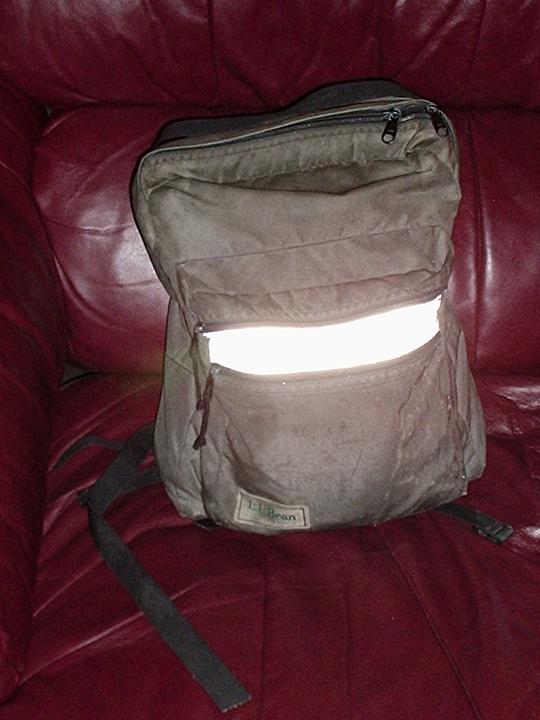
This year also marked the end of an era. A little over twenty years ago, I began my junior year of high school with a new backpack. It was sturdy and well-designed, with pockets upon pockets -- just the thing for schoolwork on weekdays and D & D on weekends. I used it through college and law school, and it went with me on excursions far and near. It has been from the Jersey Shore to the Pacific Coast Highway and from Florida to Niagara Falls. Lately I started calling it "Golden Boy," probably out of recognition that it was due to retire. When the Best Wife Ever asked what I wanted for Christmas this year, naturally I wanted Golden Boy to get a good sendoff.

So it was with a certain twinge of guilt that I opened the gold-wrapped present from the Best Wife Ever to find Golden Boy's successor. I don't know if it will put in the mileage that Golden Boy logged, and of course I'm tempted to say they don't make 'em like they used to. There may well be a display case and plaque in Golden Boy's future, but for now it will get a well-earned rest.

1985-2005

Full Post

Sunday, December 18, 2005

Infinite Christmas

Fans of a certain age -- let's not be coy, my age -- remember the event twenty years ago that was supposed to set everything straight. In Christmas on Infinite Earths, the Anti-Santa sought to stop Christmas from coming, but was thwarted by a vast assemblage of heroes from across time and space. Who could forget the opening scenes of issue #1, as onetime toy deliverer Jack Skellington was obliterated by the Anti-Santa's wave of all-consuming ennui?

We thrilled to revisit classic team-ups like Rudolph the Red-Nosed Reindeer and Frosty the Snowman (the "Season's Finest"), and witness new alliances like Clarence the Angel and Charlie Brown, Emmett Otter and the Little Drummer Boy, and Clement C. Moore (or was it Henry Livingston?) and David Sedaris. The sight of Santa wielding both Ralphie Parker's Red Ryder BB Gun and Linus van Pelt's security blanket came off surprisingly well; and even though they were villains, it was still disturbing to see Scrooge, the Grinch, the Bumble, and a group of Martians lose their time-traveling battle to stop the 31st Century Santa-Bot from freeing the Anti-Santa. Finally, lest we forget, it was the Herdmans' and Misfit Toys' emotional plea to the Angel Gabriel that convinced him to intervene, thereby giving Santa the fighting edge he needed over his evil opposite.

Seems like Christmas preparations start earlier every year, but this year March had Countdown to Infinite Christmas, a one-shot which killed Yukon Cornelius and introduced four summer-spanning miniseries. Aside from fueling speculation that Buddy the Elf would become the new Cornelius, it was all a big buildup to the current holiday apocalypse. Along the way, Santa's army of helpers got turned into killer cyborgs and put everyone on the "naughty" list; a weird spatial anomaly opened up over the North Pole; a duplicate Scrooge was revealed; and Clarence was seduced by Eclipso, who in turn was defeated by the Nutcracker. Yeah, I didn't understand that last one either.

So now Infinite Christmas is here, revealing the original Saint Nicholas' plan to restore the holiday to its religious roots and have folks "keep Christmas all year 'round." I have to say, Geoff Johns and Phil Jiminez certainly treat Nick reverently, even if objectively he is the villain of the piece. Although the chaos he kicked off was entertaining, the Anti-Santa wasn't much more than a scary plot device.

It's also tempting, in the face of rampant Christmas commercialism, to applaud such a back-to-basics approach. Nostalgia is essentially a rebellion against the perpetual march of time, and the fact that Christmas comes at the end of every year just makes nostalgia for its traditions more powerful. Who wouldn't want to have a few more child's-eye holidays, when two weeks of vacation could start with a leisurely walk home from school under slate-grey clouds fat with snow -- when the wind wasn't cold but bracing, and your only responsibilities were to keep your nose clean and your questions to yourself until the morning of December 25?

And yet the most powerful aspects of Christmas, anticipation and hope, are always with us. Early Christian public-relations gurus knew what they were doing when they scheduled Christ's birth celebrations around the winter solstice, because the darkest time of the year is perfect for ushering in the light.

A slightly twisted version of that approach is on display in Infinite Christmas. We know that Rudolph, Santa, and Frosty will become friends again. We know the reindeer will reunite (and in their absence, Earth-2 sleigh-pullers Dunder and Blixem can help pick up the slack). We know that as with every new year, change is inevitable, but perhaps only incremental; and nothing we can't handle.

When I was a kid I got excited over a few weeks of vacation from school. As I grew up I learned to keep hope alive all year. Even if I don't have a long vacation anymore, Christmas still gives me a bit of a break. Like the song says (watch out for the auto-play music past the link):

And ye, beneath life’s crushing load,
Whose forms are bending low,
Who toil along the climbing way
With painful steps and slow,
Look now! for glad and golden hours
Come swiftly on the wing.
O rest beside the weary road,
And hear the angels sing!

Happy Holidays, blogosphere!

(P.S. The GLX-Mas special was brilliant.)
Full Post

Tuesday, December 13, 2005

Smells Like Team Spirit

[Looks like I published a draft of this accidentally. Enjoy the finished product!]

The Justice Society of America was made up of the highest-profile superheroes under what became the DC umbrella. Later, so was the Justice League of America. The third of DC's three long-lived teams, the Teen Titans, tended to be more of a niche group, being composed largely of junior partners. Other teams have come and gone, and some (like the Doom Patrol and the Outsiders) have had multiple incarnations, but the JLA, JSA, and Titans have permanent spots in DC's lineup. Still, why does DC need them?

In dramatic terms, each was organized as a social club, with only the Justice League being structured enough to have regularly scheduled "monitor duty" and signal devices. As it happens, though, each team corresponds to an heroic generation. Nowadays, from oldest to youngest, we have the Justice Society, Justice League, Outsiders, and Teen Titans. (The generational divides were easier to see when the two youngest teams were the no-modifier Titans and Young Justice.) This reinforces the social-club idea, but by the same token, it's a little unsettling to think that groups of ultra-powerful costumed vigilantes would just "hang out." I'm sure there are psychological and sociological underpinnings, as with Watchmen's Minutemen, but outside of hijinks in Justice League International and the "Teen Titans" cartoon, I can't say DC has really made a point to explore them.

With the Infinite Crisis-related dissolution of the Justice League, the opportunity exists for the Justice Society to get back on top of the superhero world. The JSA could even take in former Leaguers, as it did with Black Canary II. Unfortunately, in the wake of InfC, the Leaguers aren't really in a position to get the band back together. Superman, Batman, and Green Arrow may not be speaking to each other; Wonder Woman, Flash, and Atom may be in limbo; and Aquaman and Green Lantern have enough to handle undersea and in space.

Granted, it would be clever of DC to let the JSA "take over" for the League on what might look like a permanent basis. One could argue that the JSA was the most powerful team fielded during Crisis on Infinite Earths, which was during the "JL Detroit" period. I've said it before, but at no point during COIE was the original Justice League -- the team whose multiple-Earth adventures inspired Crisis, remember -- reunited, even superficially, in the face of almost certain extinction. The opening pages of Crisis drive this point home by showing both the League's evil counterparts (no "Crime Syndicate Detroit?" Now there's a missed opportunity!) and the gutted JLA Satellite.

The "One Year Later" books therefore have the chance to emphasize and clarify the role of the Justice League in the larger scheme of things. The current situation, with a Justice League having to reinvent itself from the ground up, may be unique in that the world already has an established Justice Society. When the League first formed, the JSA had disbanded. The JSA was in Limbo (literally) from 1986-92, and when it returned, the League had long been established. When the JSA was revived in 1998 after disbanding again in 1994, the League was still there. Now, the current JSA is in a position to fill the League-sized void, and DC may well let it for a while.

Not forever, to be sure. I imagine various JSAers and Teen Titans working with Batman, Superman, and other expatriate Leaguers separately, but "matchmaking" with each of them in attempts to get the League back. At the risk of recycling another old thought, it would also be nice if the reorganized JLA had its roots in Mark Waid's new The Brave and the Bold.

It would be a little silly for me to spend a lot of time on a dream-team JLA, not least because we don't know who will be around to join. However, for the bulk of its history, the JLA has been DC's all-star team. '70s Tom might not have been a regular reader of the heroes' solo books, but he always liked seeing everyone in Justice League of America. '80s Tom appreciated the unique post-Crisis membership of the Giffen/DeMatteis League; and early '90s Tom respected Dan Jurgens and Gerard Jones' attempt to fuse together the JLI and classic League. Of course, late '90s Tom was positively giddy over the Morrison League, but I doubt we'll see anything like that again.

In restating the JLA's purpose, DC can also address the need for a Justice Society and Teen Titans. I haven't read JSA or TT in about a year, mostly because I was getting the sense that regardless of their stated purposes, they existed pretty much as legacies. The "reunions of names" took its cue from the Morrison JLA, and for a while both teams got by on the novelty of seeing Jack Knight or Tim Drake carrying on their respective traditions. The Titans also benefited from saying openly that they were a social group set up to handle the angst of being a teenaged superhero.

Still, a world with a Justice League may find it difficult to justify a Justice Society. I'm not saying that the JSA should be subsumed, ABA- or AFL-like, into the JLA; and I don't necessarily want the group disbanded. However, it may be time for the JSA to also embrace its "social" underpinnings. It is arguably just as exclusive a club as the JLA; and perhaps more so, due to the legacy element. James Robinson's Starman, which did a lot to birth the current JSA, really explored these aspects of generational superheroics. To me that is the JSA's strength, even if it doesn't lend itself to a steady diet of combat.

However the JLA is reorganized, DC should make sure its members will be sticking together for the duration. The Giffen/DeMatteis Leagues lasted five years, and the current title has made it through about nine. Unfortunately, the team's history also includes a few short-lived rosters, not all based out of Detroit. The potential for a 21st-century Justice League is limitless, and I'm eager to see what DC does with it.
Full Post

Saturday, December 10, 2005

New comics 12/7/05

Detective Comics #814 (written by David Lapham, pencilled by Ramon Bachs, inked by Nathan Massengill) is a somewhat confusing conclusion to "City of Crime," the twelve-part epic that was interrupted by a crossover and so took over twelve months to tell. It ends on the note of cheerful nihilism that marked the rest of the arc, but it asks the reader to remember characters and subplots from about a year ago, and so may be more appreciated in collected form. Overall I enjoyed "City of Crime," and if I get time may do an omnibus recap.

More to the point is Batman and the Monster Men #2 (by Matt Wagner), which also intends to use a large cast -- including Hugo Strange, Boss Maroni, Julie Madison, and her father -- but so far keeps better track of them. Wagner has always drawn a great-looking Batman, and here the minimalist "Year One" style isn't far from his own. My one quibble is a familiar one, namely first-person narration from various perspectives. It's not hard to tell who's speaking, but there's not a lot to differentiate the speakers when they switch.

Gotham Central #38 (written by Greg Rucka, pencilled by Kano, inked by Stefano Gaudiano) starts what will probably be the book's last arc. Despite the cover, and the rumors swirling around bad cop Jim Corrigan, there are no hints that he was the original Spectre or will be again. (Still, if a murdered do-gooder were to become the Spectre's new host, like good cop Jim Corrigan did back in the day, one could make an argument for a candidate in this issue.) Better characterization of Montoya and Allen this issue, and I continue to be amazed with how consistent the look of the book has been.

Superman #224 (written by Mark Verheiden, pencilled by Tom Derenick, inked by Wayne Faucher) presents a compare-and-contrast story of Superman vs. Blackrock and Luthor vs. an OMAC which actually comes off fairly well. While I don't want to say that there were no good "corporate Luthor" stories, in the old days he couldn't just steal a plane and kill a pilot; and not having to get through those plot mechanics makes things go faster. The issue includes another switch-to-Superman moment, which I am noticing more and more in recent months, and which I applaud for purely sentimental reasons.

Superman Secret Files 2005 includes two stories, a kids'-eye view, a Lois-meets-Superman tale, and an odd Bizarro two-pager. The first story, written by Devin Grayson with art by Ariel Olivetti, is sweet, if a little mawkish. The Lois story, written by Jami Bernard with art by Renato Guedes, is fine, but I can't decide if its slightly revisionist take on Lois' early relationship to Supes puts her in a good light. It has an uncanny Christopher Reeve evocation on the last page. The Bizarro "origin," written by Christine Boylan with art by Carlos Ferreira and Drew Geraci, starts out as a parody and ends up in pathos. None is absolutely essential, but then again, none are really the kinds of Superman stories the monthly books have been telling, so on balance it may be worth a look.

Seven Soldiers: Mister Miracle #2 (written by Grant Morrison, pencilled by Billy Patton and Freddie Williams II, inked by Michael Bair) reveals more of the "disguised" New Gods, and I start getting confused. Not because I'm trying to fit this into a convoluted DC-mainstream timeline, or trying to decide whether this is "real" or an alternate universe, but because I'm looking for familiar faces and everybody is drawn as hulking bald men. Still, by the end Darkseid and DeSaad are revealed, and that helps things get creepier. Maybe the larger plot will turn out to be "Shilo Norman escapes from the alternate universe," which would be OK but not very imaginative (considering I thought of it), so I hope Morrison ramps things up a little more and eases up on all the bald guys.

She-Hulk 2 #2 (written by Dan Slott, pencilled by Juan Bobillo, inked by Marcelo Sosa) features the big Return Of Hawkeye, sort of, and it may or may not be permanent. There are some funny bits, and a couple of heartfelt ones. However, the whole plot also revolves around a weird time paradox which exists for its own sake. Now, that's fine, and I can accept it, but I'm still trying to work out the mechanics.

Finally -- and I do mean "finally" -- Spider-Man/Black Cat #4 (written by Kevin Smith, drawn by Terry & Rachel Dodson) is an extended set of conversations between BC and Matt Murdock and Matt and Peter Parker; and it ends with a Spidey/Daredevil/mystery villain fight. "Oh, a dialogue-driven Kevin Smith book," you say,"how innovative." Yeah, it's like that, but it doesn't seem as witty as Smith's earlier Marvel work. (And when I say "earlier" ... oh, it's just too easy, isn't it?) Moreover, Smith makes a big deal of not revealing Matt Murdock, when it's patently obvious virtually from the cover. The other thing is, I'm not sure about the Daredevil timeline. I am not a real DD scholar, but I think it refers to events from the intervening years, and that seems like cheating to me.
Full Post

Another Saturday, another mea culpa

Most of the week I was in Lexington getting CLE (continuing legal education) credits and catching up with various folks. This had me avoiding supposedly scary winter weather on Tuesday and Thursday and trying not to get caught on the West Virginia Turnpike after dark. I kid the WVTP, but really, much of it is like a downhill slalom, and it's better negotiated without ice. Still, a friend of mine mentioned that until about 20 years ago, I-64 ended at Charleston, WV, and if that were still the case, my trips would be a lot longer and less pleasant.

So last night, after work, I picked up new comics and caught up on all the TV I missed. I hope to have a new-comics post up tomorrow afternoon. I am also working on a Christmasy essay which could potentially turn into something strange.

Back soon.
Full Post

Saturday, December 03, 2005

New comics 11/30/05

Adventures of Superman #646 (written by Greg Rucka, pencilled by Karl Kerschl, inked by Wayne Faucher) was a really good issue, and possibly Rucka's best single issue on the book. Although many writers, including Rucka, have played Mxyzptlk as a buffoon, here he really jerks at the ol' heartstrings, showing Mxy stripped of his powers and much of his faculties. The confrontation with Ruin also hearkens back nicely to the beginning of Marv Wolfman's run on Adventures, almost twenty years ago. What works about this issue is its uncomplicated nature. Superman, Mxy, and Ruin are all laid out in simple terms, and after months of everything tying into something else, it's a nice change. (There is a bit of crossover business with Lois and her shooter, which is good and doesn't distract.) Now clap your hands, kids, if you want the imp to get his powers back....

Rucka's other book this week, Wonder Woman #223 (pencilled by Rags Morales and Cliff Richards, inked mostly by Ray Snyder), was also in last-stand mode. It may be just a coincidence, but the pre-Crisis WW title ended with a siege of Paradise Island by shadow-demons. Substitute OMACs for the demons and here we are again. Rucka does a good job building suspense about who lives and who dies, and naturally Wonder Woman gets a chance to be hardcore. The art is a little too busy, though, such that it's hard to tell who's fragging who. As carnage-filled as the issue is supposed to be, I don't think that was the desired effect.

Since reading last week's Captain America, Batman #647 (written by Judd Winick, pencilled by Doug Mahnke, inked by Dustin Nguyen) can only suffer in comparison. The comparison itself may be a little unfair, since Batman and the Red Hood are ostensibly working together and Cap and the Winter Soldier aren't, but as you might expect, Batman betrays very little of the emotion here that Cap did last week. The story itself is a straight-up superhero fight involving C-list villains sent by the Secret Society to take out the Hood, and on those terms it's pretty entertaining. I will say, though, that Winick's use of first-person narration is another strike against it. He starts off with Alfred and switches to Batman, and back to Alfred again. While it's not like I expect to be spoon-fed, I think he could have accomplished the same thing by using a third-person narrator. He is still no Jeph Loeb, thank goodness.

JLA Classified #14 (written by Warren Ellis, art by Butch Guice) also trod familiar ground, this time the old "your fears will destroy you" dodge. The art is good, and the story holds some surprises, but not many.

Finally, the first year of Waid and Kitson's Legion of Superheroes (#12) ends with an all-action issue finding the Legion fighting on three fronts. It's pretty good, espeically if you don't mind a couple of the surprises to be reveals of familiar Legionnaires. Still, every time Waid mentions "Terror Firma," I think of "Terror Incognita," the better pun which he used in JLA. The issue also features a Lightning Lad/Saturn Girl backup, by Stuart Moore and Ken Lashley, which was clever but probably makes more sense in the context of the larger story.
Full Post

Monday, November 28, 2005

New comics 11/23/05

Apparently a shipping snafu delayed last week's comics two days, but we were having so much fun entertaining my parents over the holidays that I didn't get to the shop until today. Thus, here are very raw impressions of books which have probably already faded into distant memories.

I'm guessing Seven Soldiers: Zatanna #4 (written by Grant Morrison, pencilled by Ryan Sook, inked by Mick Gray) is best appreciated in the contexts of both its preceding issues and the larger 7S project as a whole, because on its own its conclusion left me scratching my head. The art was good as always, there were some interesting attempts to break the fourth wall, and the banter between Zatanna and her sidekick was entertaining too. It just felt like overhearing the end of somebody else's conversation.

On the other hand, Seven Soldiers: Frankenstein #1 (written by Morrison, drawn by Doug Mahnke) was quite good, in the vein of vintage Swamp Thing or Sandman stories. Like those, it didn't spend much time on the hero, but focused instead on a Carrie-style magic-powered geek whose goal is revenge on his tormentors -- and who instead brings the monster's wrath on his head. It'll take me a couple more readings to get a feel for the monster's background, but gosh this was a good issue.

Maybe I'm feeling a bit more charitable now that it's a lame duck, but Batman: Gotham Knights #71 (written by A.J. Lieberman, pencilled by Al Barrionuevo, inked by Bit) wasn't too bad. Although the cover is completely misleading, once you get inside it's a decent caper story about Batman having to break into Arkham Asylum to save Alfred's life. The action scenes are the best part, because the rest has to wrap up an impenetrable plot about Hush creating a Clayface to both frame and kill Alfred, and those parts are either glossed over or sound like bad Gotham Central impersonations. Anyway, at least Lieberman has Batman acting like a human being for a few pages.

Flash #228 (written by Joey Cavalieri, pencilled by Val Semeiks, inked by Livesay) was okay. It's better than last issue, because it turns away from being another dark-alternate-future story, but then it brings in Nightwing, Cyborg, a locked-room mystery, and Dexter Myles, longtime curator of the Flash Museum. The scenes with Dexter are kind of sweet, if only because this is probably his first appearance in at least 15 years, but again, it's just marking time until the end of Infinite Crisis.

The best book of the week was Captain America #12 (written by Ed Brubaker, pencilled by Steve Epting and Michael Lark), in which Cap comes to grips with the identity of the Winter Soldier. As much as anyone can feel sorry for a fictional character, this issue made me feel for Cap. Meanwhile, Lukin puts the Cosmic Cube on the open market, with unexpected, but appropriate, results. As if that weren't enough, Brubaker and Lark throw in some zombies! What more could anyone ask?
Full Post

Thursday, November 24, 2005

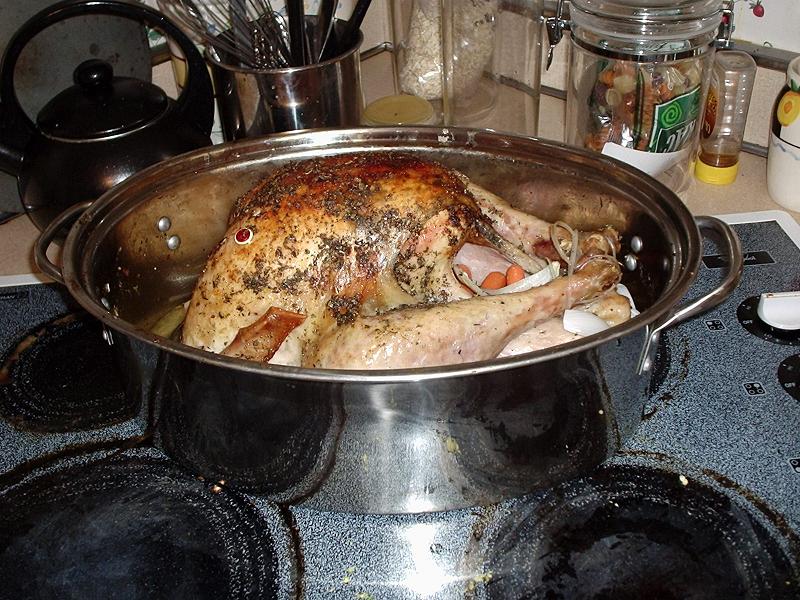
Made By Me


Happy Thanksgiving!
Full Post

Wednesday, November 23, 2005

Move over, Clapton

The new Superman Returns teaser trailer doesn't reveal a whole lot of plot, or even show a lot of characters (our hero, maybe Ma Kent, maybe Lois). Instead, it sets a tone which might best be described as "reverent." As the teaser shows a stunned crowd looking up in the sky, Marlon Brando intones "They can be a great people, Kal-El, if they wish to be." As Superman rises above the clouds, silhouetted by the sun, Brando continues, "They only lack the light to show them the way."

It's a very effective presentation, thanks in no small part to John Williams' epic "Planet Krypton." However, its effectiveness comes from its imagery of Superman being "above" humanity -- someone who, as a boy, learned to stop himself from falling, and indeed to leap high above the Kansas plains. Later, the trailer shows Superman taking off from a rooftop, and it concludes with Superman in space, looking down on the Earth like the Star Child at the end of 2001.

While I'm no film student, to me the trailer's emphasis on flight seeks to convey two aspects of Superman: freedom, as in Clark's childhood exultations; and also that "above"-ness. Combined, the message is "He can do whatever he wants" -- and the unspoken amendment of the message, alluded to in the last shot of Superman rocketing back to Earth, is that "he wants to help you."

The cover of All-Star Superman #1, showing a relaxed Superman sitting on a cloud high over Metropolis, conveys the same comfort. The rest of the issue brims with the kind of assurance that Grant Morrison had already summarized eight years before in JLA #1: "No sweat, kids, the crisis is over. The big guy's on the case." I wish I could remember the preamble of "Whatever Happened to the Man of Tomorrow," but from memory I believe it talks about "a man from the sky who did only good." Put them all together and Superman is more than the fatherly George Reeves, more than the big-brotherly Christopher Reeve, and certainly more than the superpowered pretty boys Dean Cain and Tom Welling. Right now, the trailer for the new movie paints Superman as God.

Clearly this is not a new idea. I'm not even sure it's a conscious idea, much of the time. However, it makes Superman unique among other superheroic icons. Batman represents the apex of human potential, and Wonder Woman an idealized female warrior. The major Marvel heroes represent different aspects of human behavior. Only Superman has developed into a paragon of moral virtue, whose strict adherence to such a code is as much a part of his portrayal as his powers are.

The flip side of this portrayal is the notion that Superman is so powerful, he's not interesting. One way to get around that is the current monthly books' route of challenge through emotional manipulation. The Superman Returns trailer exemplifies another way, and that is to define Superman through the perceptions of those around him. It's easier to do Superman-as-God the second way, because honestly, after a while the first way just ends up feeling forced.

Still, the second way results in a somewhat unknowable Superman, and that doesn't sit with the regular-guy picture of Clark. It fits better with the pre-Crisis model of a "Clark Kent" persona created and shaped by a being who knew at his core he was Kal-El. Under that way of thinking, Superman doesn't really make "human" mistakes, even as Clark -- he only makes mistakes resulting from approximations of human behavior.

That sounds a little extreme, doesn't it? Probably so, and I would argue that regardless of the era, Jonathan and Martha Kent deserve a lot of credit for shaping Clark into a more socialized being. Otherwise you get true "approximations of humanity" like Watchmen's Dr. Manhattan or Supreme Power's Hyperion.

That, I think, is the subconscious difference between Superman and various other omnipotent comic-book figures -- Superman relates to the public (and thus the reader), even as he hovers over them. If he is God, he's the God of miracle and wonder, not an Old Testament deity desiring sacrifice and dispensing retribution. In that light, Superman Returns' notion that the world has learned to live without him takes on an extra layer of significance.

Not that I expect the movie to be so deep, mind you; but based on the trailer, who knows?
Full Post

Sunday, November 20, 2005

New comics 11/16/05

The biggest compliment I can pay All-Star Superman #1 (written by Grant Morrison, drawn by Frank Quitely) is that it's the kind of Superman story people expect to read. Morrison and Quitely invest so much in making Superman likeable that the ending twist, which likely provides the spine of their 12-issue macro-arc, really carries an emotional kick. If you're reading this, odds are you at least have a passing interest in the book; so why haven't you gotten it yet?

Likewise, Batman and the Monster Men #1 (by Matt Wagner) begins what should be a fun retelling of the first Hugo Strange story from (I think) Detective Comics #37. It's dolled-up with the usual Year One additions of now-familiar Gotham gangsters, but its heart is with Batman fighting giants. As with All-Star Supes, Wagner has eleven more issues, and that's all to the good.

Two months late, Green Lantern #5 (written by Geoff Johns, pencilled by Ethan van Sciver, inked by Prentiss Rollins) concludes the Shark story from last issue, and begins a completely weird Black Hand arc. There's a lot of grue in this issue, and I'm not sure why. I think at some point we actually see one of Hal's armbones sticking out of his sleeve. Yes, I'm sure it would hurt to fight a giant mutated shark, but it never seemed to involve this much blood before, and it's not quite explained why it does this time. Van Sciver's art is a little too busy and intense for me, compared to the laid-back Carlos Pacheco; but at least Johns has some odd German-speaking gremlins wander through the proceedings, adding another layer of mystery.

Captain Atom: Armageddon #2 (written by Will Pfeifer, pencilled by Giuseppe Camuncoli, inked by Sandra Hope) finds Cap touring the WildStorm universe, trying to find a way back to DC-Earth. Along the way, he meets Majestic, who's already done that, but still can't help Cap. There's a lot of WildStorm history in this issue, which didn't really bother me, since the most I know about it comes from a 1997 JLA/WildCATS crossover. Along those lines, though, I get the feeling that this is a backdoor reintroduction of a few key WildStorm titles. Still, so far it doesn't feel too much like a marketing strategy, and I still like Cap enough to keep getting it.

Apparently, Hero Squared #3 (written by Keith Giffen and J.M. DeMatteis, drawn by Joe Abraham) is the conclusion of a 4-part miniseries introducing the characters and leading into an ongoing series. That would be fine with me, although this issue doesn't really feel like the end of a story. Instead, it's more an exploration of the awkwardness which results from the interaction between normal people and their super-counterparts. I like it fine, even if it does tend to trade on Giffen and DeMatteis' old JLI schtick. Also, Abraham's art is good enough, but the proportions of Lord Caliginous' battle armor could really use some work.

This may be an obscure reference, but remember that Secret Origins Annual which revealed that Barry Allen, circa Crisis on Infinite Earths #8, was the bolt of lightning that hit him in Showcase #4? Apply that to Reed Richards and you've got Fantastic Four #532 (written by J. Michael Straczynski, pencilled by Mike McKone, inked by Andy Lanning). It's a nice story, but as an ending to an allegedly big cosmic saga it's kind of meh.

Not so The Thing #1 (written by Dan Slott, pencilled by Andrea DiVito, inked by Laura Villari), which was a lot of fun. Slott seems to be testing the hearts of Marvel's lawyers, as he has Ben Grimm dating Eva Longoria, going to a Martha Stewart party, and running afoul of Paris Hilton. The Thing isn't wacky like She-Hulk or blackly comic like GLA -- instead, it's just plain superheroics, done well. My one complaint is with the opening fight sequence, which took me a few tries to get all the perspectives right. However, that is a very minor quibble.
Full Post

Monday, November 14, 2005

Take Your Time

If the Chronicles of Narnia all get adapted for film the way The Lion, The Witch & The Wardrobe has, at some point the producers will have to decide the order in which to film them. If memory serves, the fifth book in the series, The Magician's Nephew, is a prequel taking place a few decades before LW&W. My recent editions of the Narnia books have been re-ordered, apparently in line with C.S. Lewis' wishes, so that Nephew is #1 and LW&W is #2.

Naturally this brings me to Star Wars, and the opportunity which exists now to watch all six movies in succession. The end of Revenge of the Sith is objectively a downer, but not really, because longtime fans are happy that at last it's time for the originals. Thus, the reversed order of the movies' releases makes it impossible for us today to gauge fully the intended emotional impact of Episode IV.

Of course I watched Episode IV not long after finishing ROTS, but I tried to see it through those hypothetical new eyes, which would be making connections from the point of view of the prequels. In that respect it does play out a little differently. At first everything is familiar: there are the droids, still on Bail Organa's starship, and there's Anakin/Vader, still in the suit; but hey! that must be Leia, all grown up! Spotting Jawas a few scenes later, the hypothetical viewer might then realize we're back on Tatooine, and so not far from our first glimpse of Luke.

Thus, Star Wars (the original, that is) still holds some surprises, and some key scenes gain a little weight. Regardless, the tone of Episodes IV-VI is significantly different, and I wonder how much time one should let pass between the end of Episode III and the beginning of Episode IV. Fans of the original trilogy brought 16 years' worth of expectations to their first viewing of The Phantom Menace. What sort of expectations will those hypothetical viewers of tomorrow bring to Episode IV, having been exposed first to the prequels?

Whatever those expectations are, it's fairly certain that they won't have twenty-some years to form -- or even the three years us old-schoolers spent stewing over the end of The Empire Strikes Back. I do think a bit of down time -- maybe a day, maybe a week -- might be in order, just to get one's imagination flowing about the next installment. It's nice that the six movies can now be watched over the course of one (very long) day, but I know from personal experience that four in a row is pretty taxing.

Back in 1998 the Kentucky Theater showed each of the Special Editions as Saturday matinees over three weeks. That worked out well, and was eminently appropriate considering the films' serial ancestry. Revenge of the Sith presents an extensive set of cliffhanger endings, with heroes in exile and twin suns setting on a galaxy in turmoil, but as convenient as it is to salve the hurt by popping the originals immediately into the DVD player, arguably that's not how they were intended to be viewed.

Today the end of Sith plays on the audience's memories of the originals. Future fans should allow themselves the time to imagine their own second trilogy, just as we imagined our own prequels.
Full Post

Sunday, November 13, 2005

New comics 11/9/05

I liked quite a few things about Infinite Crisis #2 (written by Geoff Johns, pencilled by Phil Jiminez and George Perez, inked by Andy Lanning and Jerry Ordway), but I'd like to think the Perez cover (showing Power Girl from the rear) is a none-too-subtle dig at the fascination with PG's chest. Perez and Ordway's contribution to the interior consists of a few pages telling the history of the old Multiverse, and while some might say that's proof that the whole magilla is too complicated, I think it's a fine tip of the hat to the original Crisis on Infinite Earths artists and to COIE itself. As exposition goes, it's fairly economical too.

The spotlight is on Power Girl in issue #2, and speaking of exposition, I'm now glad I didn't spend the money on her JSA Classified origin issues. InfC #2 is the emotional payoff of the former arc's false starts, but it doesn't need those issues to work well. Power Girl might well have been better off consigned to Earth-2 oblivion, for all the mucking around with her backgrounds various writers have performed over the last twenty years, but Johns takes good advantage of her confusion.

The issue's other plots all work as well. I especially enjoyed the interlude with Clark and Lois at the Daily Planet, culminating in a neat little "job for Superman!" moment. As much as I love Perez's work, Jiminez has become a fine storyteller in his own right. I just wonder if there's not an Earth-2 homage to COIE #7 in Power Girl's future....

JLA #122 (written by Bob Harras, pencilled by Tom Derenick, inked by Dan Green) is another "[MAIN CHARACTERS] vs. OMACs" story, just like half of DC's books from the past few months. I hope the number of these decreases after the events of Infinite Crisis #2. There's not much more to it than that, except the kind-of creative notion that the Key is attacking anything with the initials "JLA." (The Best Wife Ever is in the Junior League, so word of warning to the Key: they are tough.) It's nice to see some old familiar faces back in the fold, but I wish they had something more exciting to do.

Gotham Central #37 (written by Greg Rucka, drawn by Steve Lieber) is the big Infinite Crisis crossover issue, and I hate to say it, but it's not as good as I've come to expect. Sure, I like Allen and Montoya; sure, they react believably to the mystic carnage going on around them; and sure, this was probably a decent introduction to the characters for the hypothetical first-time reader -- but it just didn't have the punch of, say, the Poison Ivy one-off issue of a few months ago. It wasn't bad, it just wasn't as good as it has been. Good ending, though; and I do hope the Crisis completists pick up multiple copies, because the book deserves all the support it can get.

Action Comics #833 (written by Gail Simone, pencilled by John Byrne, inked by Nelson and various others) begins what looks to be a fun little story pitting Supes against an old Justice League foe. It doesn't appear to have much to do with Infinite Crisis, so instead it's free to weave in scenes for Lois and Jimmy. I'm not saying who the villain is, because Simone takes her time in building up the revelation, and packs a lot into the first half of the issue. For that I was pleasantly surprised.

As the first part of "Blaze of Glory," Batman: Legends of the Dark Knight #197 (written by Will Pfeifer, drawn by Chris Weston) also unloads a lot of plot. The story concerns a supervillain wannabe who blames Batman for his problems, which isn't overly original, but Pfeifer makes his antagonist a fairly smart guy who just happens to have wound up on the C-list. The one strange thing about the issue is the art. Weston's heads seem just a little too large (or the bodies a little too small), kind of like Mike Grell. Still, like Grell, once you get past that it's pretty good.

Finally, Star Wars: Empire #37 (written by Welles Hartley, pencilled by Davide Fabbri, inked by Christian Dalla Vecchia) continues "The Wrong Side Of The War" in fine fashion. As the Rebels put their undercover plans in motion, Imperial Lt. Sunber becomes acclimated to his new assignment. While Sunber takes on the alpha male in his barracks, though, the Rebels discover they may have to rescue all the slaves from Jabiim. Hartley portrays the Imperials as evil bureaucrats -- not so much mustache-twirling, but you can see they're not particularly nice. The art is also good, with bright colors (thanks again to Fabbri) and big, expansive layouts. Nothing groundbreaking, but a good Star Wars story nonetheless.
Full Post

Saturday, November 12, 2005

Devin Grayson's Nightwing: Worth the Search?

That's my question. Reading this interview with Ms. Grayson has made me curious about her run on the title, especially now that it's winding up. I don't dislike her work, and I thought her stints on The Titans and Gotham Knights were fairly decent. Like her, I am also a fan of the Bruce/Dick relationship. However, I haven't read Nightwing regularly, and don't really have an opinion on what she's done with the character, because I haven't really seen it reflected in other books. I do know a lot of people don't like it.

So, any recommendations on whether to start seeking out her back issues? Do you think I would like 'em? If so, where should I start, and what are the high and low points? I know the broad outline of the Tarantula arc, but should probably avoid spoilers beyond that.

Thanks!

P.S. New comics roundup probably coming tomorrow.
Full Post

Sunday, November 06, 2005

New comics 11/2/05

Apparently I missed Wonder Woman #222 (written by Greg Rucka, pencilled by Cliff Richards, inked by Ray Snyder) last week. Not surprisingly, it's plugged into the rest of DC's crossover madness, but the bulk of the issue is a straightforward Wonder Woman/Cheetah fight. Despite being saddled with a bad case of the Eartha Kitts during her Legion of Doom tenure on "Super Friends," the Cheetah has historically been an interesting villain. George Perez revamped her as a maverick archaeologist who stumbled into an Edgar Rice Burroughs-esque pulp-fiction cat-god religion, and she went after Wonder Woman for (among other things) her magic lasso. Rucka revisits that, but also brings in a bit of the old "Wonder Woman is too perfect" jealousy which informed the character originally. In any event, it all meshes well with other current events surrounding Diana, and plays much better than the star-crossed Cheetah-Zoom team-up from the recent Flash crossover. The art is good enough, although some of the shading reminded me of woodcuts.

Superman #223 (written by Mark Verheiden, pencilled by Ed Benes and Marc Campos, inked by a platoon) is likewise a Superman/Supergirl/Blackrock fight, with Infinite Crisis implications. Basically Superman tries to teach Supergirl, who's been trained by Wonder Woman, not to cross the line into killing the way WW has. I like Supergirl as a concept well enough, but this Supergirl still hasn't emerged as a real person for me, and sadly this issue didn't do much to advance that.

Firestorm #19 (written by Stuart Moore, pencilled by Jamal Igle, inked by Rob Stull and Keith Champagne) is also an Infinite Crisis tie-in, but it inserts Firestorm into the proceedings with the happy-go-lucky style and charm this title has developed. Jason merges with a couple of fun "partners," and meets up again with Gehenna, the strange girl from a couple of issues back. Along the way Firehawk introduces him to the Outsiders and Donna "No New Hero Name, Evidently" Troy, who have recruited him for a big space mission evidently meant for Infinite Crisis #2. This book is DC's She-Hulk, showing just as much love of the superhero milieu without being so silly. (Not that silly is bad.)

Detective Comics #813 (written by David Lapham, pencilled by Ramon Bachs, inked by Nathan Massengill) presents the penultimate chapter of "City of Crime," and as a single installment it's pretty good. Lapham basically tells a straightforward story of Batman riding to the rescue, throwing in Robin, Gordon, the Batcopter, the Batmobile, and an omnipresent Bat-Signal. Batman also confronts the mind behind the conspiracy. In short, this issue brings everything to a boil for the big finish next month. Honestly, I realize this may be at best just an above-average Batman story in the whole scheme of things, but as I said it pushes a number of good buttons and helps remind me what I like about Batman. These days that's pretty good.

Opening Seven Soldiers: Bulleteer #1 (written by Grant Morrison, pencilled by Yanick Paquette, inked by Michael Bair), I noticed two things right away, and they kept popping up the rest of the issue. Man, Bulleteer has a nice set of ... hair. Seriously, for a comic that explores the quasi-pornographic aspects of superhumanity, what's the message here? My guess is, we're all voyeurs, because check out our heroine's huge ... tracts of land! I did like the issue -- for the writing, too, perverts.

And then I read Captain Atom: Armageddon #1 (written by Will Pfeiffer, pencilled by Giuseppe Camuncoli, inked by Sandra Hope), about a guy also trapped in silver skin, and it was okay. I've followed Cap from his post-Crisis series through pretty much all his DC appearances, but once he was outed as a government agent, he lost a lot of what made him compelling. Now that his "man out of time" aspects have also been downplayed, he's just another indestructible guy who flies, shoots, and leaves. (Okay, maybe not "leaves," but you saw where I was going.) Anyway, I'm hoping that this miniseries, which once again makes Cap a fish out of water, will help spark the character. So far not bad, although no cheesecake. At least it's a good introduction to Cap.
Full Post

Saturday, November 05, 2005

The Week That Was

I don't know about you guys, but for me, it feels like I haven't posted since World War I. Not that I've had the chance -- it's been pretty busy around here....

Monday: First thing in the morning, drove to Richmond for a big new-lawyer swearing-in ceremony; passed out candy Monday night.

Tuesday: Turned 36; celebrated with the Revenge of the Sith DVD.

Wednesday: Started a new job; celebrated it (and my birthday, because the Best Wife Ever had a meeting Tuesday night) at a nice restaurant.

Thursday-Saturday: Tried to catch my breath from the first part of the week.

Don't worry, I have thoughts on last week's crop of comics, but it's getting late. Maybe tomorrow.
Full Post

Monday, October 31, 2005

Carving-Man Begins

Yesterday I sat down with a pattern, a pumpkin, and my Swiss Army knife. This, my first attempt at a jack o'lantern, was the result:


Next year, maybe the Batman TV show logo.
Full Post

Saturday, October 29, 2005

A Personal History Of (Mostly) Failed Halloween Costumes

Halloween is my favorite non-religious holiday, mostly because it taps into these various geeky interests. Also, my birthday is November 1, so even if I had a crappy Halloween, the next day would almost inevitably be better.

When I was a little kid, my grandmother made our costumes. One of the first was a Brachiosaurus -- basically a yellow jumpsuit with a tail, and a mask for the head and neck. The eye-holes were at the bottom of the neck, so with the stuffed dino's neck and head towering a good two feet above my own, it effectively doubled my height. It was also tremendously hot, but I didn't mind.

Later, when I was about 9 or so, Granny made me a really rockin' Spider-Man costume, very faithful to the comics, and comfortable enough to just wear around the house (which I didn't do ... that often). Most of it was one piece, with boots, gloves, and a mask that I soon lost. A couple of years later, Granny and I collaborated on an X-Wing flight suit of which we were both deservedly proud.

Many years later, as a first-year law student in 1991, I went to the school's Halloween party in a Starfleet outfit and claimed to be "Commander Bondurant" of the Starfleet JAG. The puzzled, almost pitying stares this produced soon taught me that sometimes it's better to just wear the suit without putting too much thought into the backstory.

Case in point: my buddy Sam, also a 1-L, came as Peloquin from Nightbreed, with red skin, elaborate makeup, and snake-like hair. Unfortunately, the Nightbreed-illiterate crowd thought he was supposed to be Native American:

Random person: Wow, what a great Indian costume!
Sam: No, I'm Peloquin, from Nightbreed!
RP: ???
Sam: It's this horror movie, and Peloquin's this monster....
RP (backing away carefully): Oh, okay....


After a while, Sam just sighed and accepted the compliments on his "Indian costume."

Second year I went back to the law school Halloween party (Sam did not) as Luke Skywalker from Return of the Jedi. The costume was pretty good, although I could only find a red lightsaber. The only embarrassment was having another classmate put a cowboy hat on my head and call me "Garth Vader," and that wasn't so bad.

For a couple of years I rented some appropriate period clothes and went as Sherlock Holmes, but without the cape and deerstalker cap, people just thought I had come from a wedding.

In 1996, a few years out from law school, I was Clark Kent for Halloween. I bought a Superman costume, modified it to make it a little more sturdy, sprayed my hair black, and put on a suit and tie over the costume. I wore a white shirt, so you could see the "S" underneath, but it was pretty dark at the party and I ended up taking off the street clothes. It was a good idea (and I wore all of the costume, including cape and boots, under my clothes), but not very practical.

After going as Luke again in 1997, I was out of ideas for Halloween '98, and ended up going as the Malcolm McDowell Mr. Roarke. I had a black suit and yellow tie, and sprayed my hair white. Apparently this made me look more like either my grandfather or Bill Clinton, both of whom were undoubtedly more familiar than the '98 "Fantasy Island" remake.

At this point I vowed never to be without a decent Halloween costume, and in the summer of 1999 found a seamstress who was making Phantom Menace-era Jedi robes. However, because mine didn't arrive until December, I would have to wait to debut them until Halloween 2000.

And so it came to pass that, five years ago yesterday, I ventured out into the cold October night for what turned out to be an appointment with destiny -- for at that party, I met the Best Wife Ever. The outfit was a good icebreaker, and it probably also answered a lot of questions about just how big a Star Wars fan I was. (As my cousin later put it, "So ... she knows.")

Now, we just rack our brains trying to find her a costume every year....

Happy Halloween!
Full Post

Thursday, October 27, 2005

New comics 10/26/05

Pretty good crop this week, starting with Captain America #11 (written by Ed Brubaker, art by Steve Epting). However, before we get started in earnest, let me just say a few words about Marvel's new ad-saturation policy:

It stinks. (Stinks!)

The first ad in Cap #11 is on page 2, and it's a double-page Honda Civic spread. I know superhero comics would love to be taken as seriously as Newsweek, but having the same ad layout isn't exactly the right way to start. Remember the good old days when pages 2 and 3 could be used for a spectacular action scene, not a sensible sedan?

There are 48 pages between the covers of Cap #11, and 24 of them are ads. (Two pages are devoted to an ad for Dan Slott's new Thing series, Marvel's circulation statement, and the letters page.) Moreover, including the Civic ad, there are three double-page spreads. There are no two-page spreads of artwork anywhere in the issue. In fact, there's not a page of story in this issue that isn't right next to an ad. Is this Marvel's way of getting me to wait for the trade -- not just for the higher price point, but also so it doesn't have to fool with juggling pages to avoid those troublesome two-page spreads? It's a good thing the story works within these hideous restrictions.

And work it does, relating the history of the Winter Soldier between bookends showing General Lukin's and Cap's reactions to his file. I'm not going to say much more, except that Brubaker and Epting have convinced me they'll do right by this character, whatever his fate. It was worth slogging through all the commerce.

By contrast, Defenders #4 (written by Keith Giffen and J.M. DeMatteis, art by Kevin Maguire and Joe Rubenstein) opens with six straight pages of story before the first ad, and it has two double-page spreads. (Then again, it only has 10 pages of ads. Clearly Marvel hates America, or at least its musclebound avatar.) Reading the issue, with its twisted versions of Marvel heroes, you'd think I'd be reminded of the evil Super Buddies from G/DM/M's "I Can't Believe It's Not The Justice League," and you'd be right. Regardless, for the anti-team book, it's doing very well, and I'm anticipating the conclusion.

Speaking of anticipating the conclusion, Legion of Super-Heroes #11 (written by Mark Waid, pencilled by Barry Kitson, inked by Mick Gray) finds our heroes split up and trying to regroup after the devastation of last issue. It was good enough to hold my attention for another month, but beyond that I'll have to give the series more thought. This goes into the omnibus-review pile.

JLA Classified #13 (written by Warren Ellis, drawn by Butch Guice) sends the League to Hell, where they fight demons to a standstill, or some other ambiguous result. Meh.

Flash #227 (written by Joey Cavalieri, pencilled by Val Semeiks, inked by Livesay) starts up a new story arc involving a dark alternate future (oh boy) and the new church Wally's in-laws are attending. It's better than it sounds, although I don't know how well Livesay's inks go with Semeiks' pencils. Everything seems just a little ... off. Anyway, I"m sure the alt-future is tied to the church somehow, and it's not a bad beginning.

Adventures of Superman #645 (plotted by Greg Rucka, scripted by Nunzio DeFilippis & Christina Weir, pencilled by Karl Kerschl and Renato Guedes, inked by Wayne Faucher and Guedes) takes place just before Infinite Crisis #1, so there's OMACs a-plenty and lots of Wonder Woman neck-snapping footage. Parasite's with (a) Luthor, Lois is back in Umec looking for her shooter, and Superman learns more clues about Ruin. Good stuff, much like Rucka winding up his Wonder Woman storylines to get them out of InfC's way. The art is also uniformly good, although I wonder -- with so many creators working on this book, the burden seems to be on DC to say the editors didn't change at least half of it.

JLA #121 (written by Bob Harras, pencilled by Tom Derenick, inked by Dan Green) was decent. Turns out I don't really miss the "Magnificent Seven" JLA as long as the lineup contains stalwarts like Green Arrow, Black Canary, Green Lantern, and Aquaman. After an interlude with the Key, the not-the-JLA decides to visit Nightwing and enlist him in case Batman goes really nuts. The issue comes together in ways which are not surprising, but after the past few months' chaos that's not so bad. The art was better this issue too. In terms of angsty JLA breakups, I'd rate this as only slightly more painful than the post-"Rock Of Ages" reorganization.

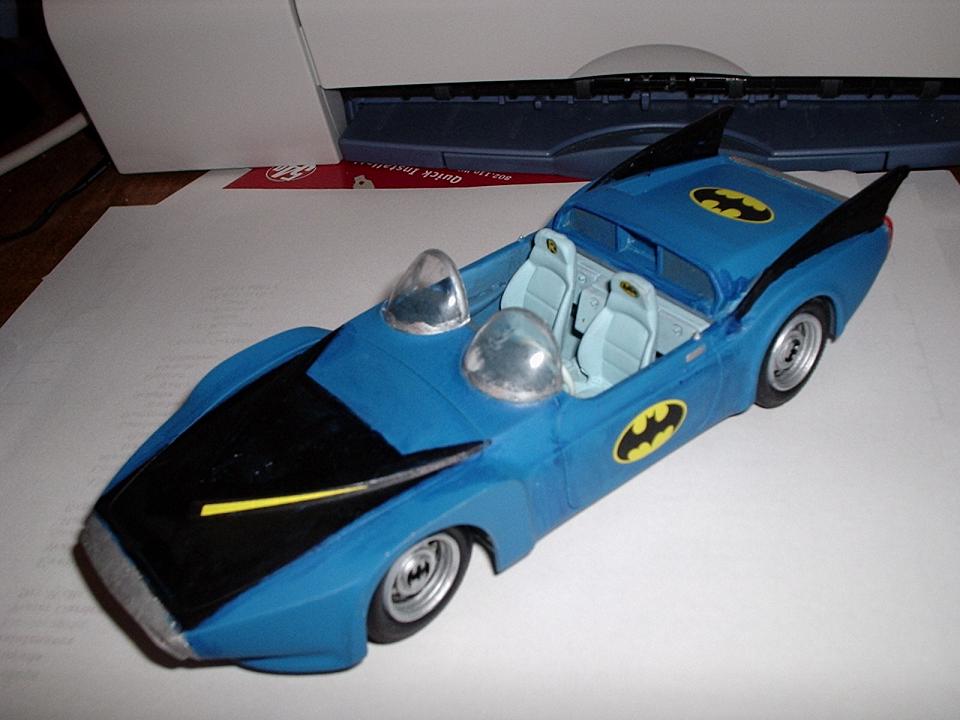
Finally, I had to laugh upon seeing the cover to the week's best book, Mike Allred's issue of Solo (#7). First DC nixed his Adam West cover, and the Mr. Miracle cover which replaced it (now on the inside front cover) has itself given way to Wonder Girl. The issue is a self-proclaimed "love letter" to DC books of the '60s and '70s, especially Teen Titans, Doom Patrol, and Batman. In fact, I had thought the original Batman cover was 86'ed by DC because they have issues (including legal issues) with the Adam West TV show, but the main story is, in effect, a deconstructed episode of that show, including the actors, sets, and Batmobile.

Cynics will laugh bitterly at the none-too-subtle message of that story, a devastating critique of ... well, everything DC's been doing with its main line of superhero books for the past 18 months. Some may well say that this is DC's sop to its aging fanbase (as opposed to the young whippersnappers who like the gritty), and the exception that proves the rule. However, as an eternal optimist when it comes to these kinds of things, I'd like to think "Batman A-Go-Go" shows that DC is comfortable with even the most diametrically opposed symbol of its current editorial tone. Not that it's perfect, but its heart is in the right place.

The other stories are more superficial, but again, I could tell Allred just wanted to cram as many classic DC characters into his Solo issue as he could. This becomes literal by the end of the last story, which itself is a bit of wish fulfillment. Still, Allred is a great cartoonist, and the focus is on him, not literary merit. Like I said with the Darwyn Cooke Solo a few months back, buy this book.
Full Post

Wednesday, October 26, 2005

New comics 10/19/05

We begin this week with Green Lantern Corps: Recharge #2 (written by Dave Gibbons and Geoff Johns, pencilled by Patrick Gleason, inked by Prentis Rollins and Christian Alamy). It features two plots: one group of GLs visits Mogo, the antisocial Lantern introduced by Alan Moore; and a pair of antagonistic trainees (one from Rann, one from Thanagar) gets assigned to protect a boring shipping route. Neither rises much above standard super-hero fare, but both tie into a larger story involving galactic politics. Besides, I've always liked the Corps for its tremendous potential -- not just to show how different characters would use a power ring, but for its political and legal implications. Still, I have two complaints about the issue: the art seems sloppier than it was in #1; and since when does Thanagar have a reptilian race?

Batman #646 (written by Judd Winick, pencilled by Shane Davis, inked by various people) felt very familiar, since once again it revolved around the Batman/Red Hood/Black Mask triangle. By the last few pages a new player has been added, and that itself makes the story more interesting, but we're going on a year since the Hood's been introduced and there's only so far Winick can draw out the tension between him and Batman. Apparently the next (sorely missed) Batman Annual will wrap things up, but how long until then? I did enjoy the issue, since much of it was a well-done set piece involving Batman, a couple of scared hoods, and a bomb needing defusing. Davis' art was fine, although I hope Doug Mahnke isn't gone for good.

Meanwhile, Batman: Gotham Knights #70 (written by A.J. Lieberman, pencilled by Al Barrionuevo, inked by Bit) was okay, I suppose. It advanced the Alfred/Hush/Clayface plot significantly, even with some exposition about the nature of Clayface. By the way, that itself reminded me of Lieberman's recent Poison Ivy storyline, because it too seemed to spend a lot of time in laboratories wondering how to replicate/cure a villain's condition. Like the Poison Ivy story, this has been better than Lieberman's usual meanderings, although that's not saying much. Not that strict adherence to continuity is a requirement for me, but I do wonder about a series which picks up threads from other Bat-titles and doesn't get much going the other way.

Superman #222 (written by Mark Verheiden, pencilled by Ed Benes and Joe Prado, inked by various folks) was better than I expected. Lois finds herself the target of an OMAC after having a fight with Clark. Both get to be journalists, which is nice, although it too contributes to the tension. Lois' beef is presented well enough that I actually wondered whether splitting them up might not be part of the Big DC Plan after all. In other words, some good character work peeks through all the fight scenes. The different pencils are virtually indistinguishable to my casual eye, and they seem preoccupied with the shapely forms of Lois and her new assistant, if that's an enticement to any of you.

Seven Soldiers: Klarion #4 (written by Grant Morrison, drawn by Frazer Irving) was also basically a big fight issue. Klarion and his friends and neighbors repel invaders from the world above. The art was fantastic, and the dialogue was good, but that's about it for the plot. Like the other 7S miniseries, it's To Be Continued....

Astro City: The Dark Age #4 (written by Kurt Busiek, drawn by Brent Anderson) concludes Book One (the Silver Agent story arc) by using familiar superhero elements in an unconventional way. An invasion from Monstro City interrupts the Silver Agent's death sentence, and in the melee the brothers we've been following resolve their personal issues. However, the plot isn't really the point of the issue. Busiek is more concerned with cathartic emotional release, whether it be that of the public, the brothers, or even the reader. The Silver Agent's fate is simply the catalyst for that release. Busiek and Anderson do a great job of building the tension, piling on more and more developments and using those familiar elements to good effect. There is a twist of sorts at the end which may come off hokey, but I thought was satisfying regardless. Bring on Book Two!

I had been thinking about dropping Star Wars: Empire (#36 written by Welles Hartley, pencilled by Davide Fabbri, inked by Christian Dalla Vecchia), but Part 1 of "The Wrong Side Of The War" was very good. Picking up from last issue, the Empire is pacifying the resistance on Jabiim, allowing us to focus on Imperial Lieutenant Sunber. Sunber cares about his men, even the cloned infantry. He is also torn between duty and his feelings for the Empire's prisoners. This probably telegraphs his character arc for the rest of the story. Still, telling it from Sunber's perspective was a nice touch, and the art effectively portrayed all the familiar Imperial hardware mowing down resistance. A final revelation concerning a very familiar Star Wars character was an especially pleasant surprise. I'm looking forward to the rest of the arc.

Finally, She-Hulk (vol. 2) #1 (written by Dan Slott, pencilled by Juan Bobillo, inked by Marcelo Sosa) was just as fun as I would have expected. A time-travel case inspires Shulkie towards a unique jury pool, but along the way there are a couple of fights, a few Avengers, and a jab or two at the comics industry.

She-Hulk is a funny book, and not just in the literal sense. Because it's about a superheroic attorney, much of its humor comes from its perspective on How Things Work in the Marvel Universe. (Shulkie's researchers use comics alongside their casebooks, for example.) Accordingly, it's a style of realism that, to a certain extent, repudiates the more serious, allegedly more "mature" style on display elsewhere. Naturally, I don't expect She-Hulk's style to set the company-wide editorial tone anytime soon.

Speaking of which, as you know I have not read any of the Avengers/House of M stuff, so I have no frame of reference for Shulkie's flashbacks in this issue, but I didn't think that was detrimental. To me that's part of the charm of any superhero book -- if the cliches, references, and motifs are used properly, the reader can accept them for their effects without having to know everything about them. (See also Astro City, above.) Slott's pretty good at doing that, which is why I feel comfortable reading one of his Marvel books without being drowned in continuity. One of these days he'll slip up, but I hope I'm not there to see it.
Full Post