Showing posts with label checkmate. Show all posts

Sunday, April 27, 2008

New comics 4/23/08

Well, Countdown ended on Wednesday, so I talked about it on Thursday. I thought it suffered from a lack of focus which, while understandable, was also avoidable.

Still, I did buy other comics, and here they are.

Star Trek: New Frontier #2 (written by Peter David, drawn by Stephen Thompson) brings in a couple more NF characters, just when I was starting to get used to the ones already in play. Essentially, everything's moving towards a confrontation with Jellico and the stolen timeship at New Thallon, but the waiting gives us time for some character interaction. Overall the issue was fine. Exposition was integrated pretty well into dialogue. (There are no narrative captions -- not even a Captain's Log -- in the entire issue, which is a little odd for a Trek comic.) A new Galaxy-class starship comes into the picture too, which is confusing for those of us expecting the only such ship to be the Excalibur. Anyway, the art is about the same as last issue -- rougher than I'm used to for a Trek comic, but true to the aesthetic. Three issues to go, and I have a feeling everything will happen in the last one.

It looks like Sergio Aragones and Mark Evanier put all their social commentary into the latest Groo miniseries and let themselves go wacky with The Spirit (#16 written by them and drawn by Paul Smith). Denny Colt is hardly as dense as Groo, but in this issue he errs -- in a well-meaning way, of course. The Spirit goes Hollywood to solve an on-set murder. While it looks play-fair at first, about halfway through it starts getting deliberately convoluted, so the reader is left to relax and let everything play out. Since that includes, among other things, a Carson Kressly parody and a stuntman gig (reminiscent of "bring in the double!" from that one Daffy Duck cartoon), the murder seems almost beside the point. With Paul Smith showing off his cartooning chops, the issue looks really good, but again, it's only Eisneresque on the surface.

Dwayne McDuffie devotes most of Justice League of America #20 (drawn by Ethan Van Sciver) to Wally West's struggle with rejoining the JLA. In its way, it's reminiscent of the "should I be a superhero?" angst which Wally went through 25 years ago, back in the New Teen Titans days -- only now, Wally has his own family, instead of worrying about his parents and girlfriend back home. Thus, Wally and Wonder Woman fight the Queen Bee while WW prods him to live up to his League responsibilities. I thought this issue was executed pretty well. McDuffie writes Wally and Diana well, and while Van Sciver's art is a little stiff, it's miles ahead of Ed Benes' sketchy, pose-heavy work. (The storytelling involving WW at the end is a little unclear, though.) I'd have liked more than two JLAers and a Black Lightning cameo in McDuffie's first crossover-free issue, but it sounds like he'll have time to do his own thing soon enough.

I don't know what happened to regular artists Tony Daniel and Jonathan Glapion, but fill-in penciller Ryan Benjamin and fill-in inker Saleem Crawford bring a bit too much '90s Image overthinking to Batman #675 (written, of course, by Grant Morrison). This issue is the bridge between the alternate-Batmen arc and next issue's "Batman R.I.P.," and it exists apparently to elevate Bruce's girlfriend Jezebel Jade to Silver St. Cloud status. It's the secret-identity dilemma of a familiar "Bruce is trapped in public" situation, only this time Bruce is somehow unable to find a good spot to change. Maybe it's the presence of a Ten-Eyed Assassin, the cult which was part of Bruce's epiphany during the Year of 52. Anyway, I don't have much of a problem with Morrison's script (which also includes scenes for Robin, Nightwing, and Talia), but the art is pretty distracting.

Sean McKeever's last issue of Birds Of Prey (#117, pencilled by Nicola Scott and inked by Doug Hazlewood) turns out to be his best. Misfit gets to show off without being annoying. The Platinum Flats supervillains are both believably low-rent and scary. Oracle makes good decisions. It's a good issue which tests our heroes but doesn't dwell on their troubles, and as always it's told well sequentially by Ms. Scott and Mr. Hazlewood. The bar has been set high for Tony Bedard.

Finally, I say goodbye to Checkmate, as writers Greg Rucka and Eric Trautmann turn in their last issue (#25, drawn by Joe Bennett and Jack Jadson). I can't say much about the plot without spoiling it, except that the Rooks take advantage of a truly scary and dangerous mind-link to do their thing as well as they do. Sasha gets a scene with Batman, Wonder Woman and Superman compliment Checkmate, and the final twist took me completely by surprise. Rucka and his co-writer(s) went out on top, and I think it's best to go out with 'em.
Full Post

Sunday, March 30, 2008

New comics 3/19/08

Thanks to Easter last weekend and the Siegel ruling this week, it's time to play catch-up. Here are last week's books.

Let's start with Captain America #36 (written by Ed Brubaker, pencilled by Butch Guice, inked by Mike Perkins), a mostly-action issue which eventually finds our hero failing to fill his mentor's inspirational role. It's a moment I'd been anticipating for a couple of issues -- except for the heckling, naturally -- and it speaks to the power of that costume. James B. Barnes looks like Captain America, fights like Captain America (if a little dirtier), and carries Cap's shield. As far as the "living symbol" stuff goes, though, the people aren't convinced. On the action side of the equation, the extended fight scene which takes up the first part of the issue is exciting enough. However, its capper -- Cap being thrown through a window, landing on a hovercar, and blowing away his attacker -- ends up a little static. Maybe some speed lines would have helped me, or maybe devoting just one panel to the fall drained some of the suspense. Overall, though, a consistently satisfying title.

It was a weird issue of Birds Of Prey (#116 written by Sean McKeever, pencilled by Nicola Scott, inked by Doug Hazlewood). I didn't think Black Alice was supposed to be that ... well, mean; and there was a very unsettling vibe running through the Lady Blackhawk/Killer Shark/Huntress scenes. I never expected to see Huntress in a damsel-in-distress situation in this title, that's for sure. Oh well, at least Scott & Hazlewood aren't going anywhere, right?

Like the cover blurb, I'm hesitant to call The Brave and the Bold #11 (written by Mark Waid, pencilled by Jerry Ordway, inked by Bob Wiacek) a "team-up." Instead, it trades mostly on a reversed Superman setup to amusing effect. Ordway fits Superman like a glove, not surprisingly. I think I even saw some of his old Daily Planet staffers (especially "Whit") in the background. I'm sure he'll do fine on the rest of the DC characters, but this issue was a perfect way to kick off his tenure.

Not so successful, unfortunately, was Superman/Batman Annual #2 (written by Joe Kelly, drawn by Scott Kolins), a reworking of a World's Finest two-parter from 1968. A mystical bad guy takes away Superman's powers and renders Batman helpless, and it's only through feeling good about themselves that they get their mojoes back. Really, I might have liked this issue more if not for the extraordinarily dark color work of Jorge Molina. Everything seems to occur against an indigo backdrop, and when you're talking about the black-robed villain, the deep blues, grays, and blacks of our heroes' costumes, and even the muted red and yellow of Robin's costume, it's like reading through sunglasses. Kelly's script doesn't help, since it neither sets up nor resolves the central problem (Superman's loss) with adequate explanation. I like these retro-style stories, obviously, but here things just didn't work out.

Serenity: Better Days #1 (written by Joss Whedon and Brett Matthews, drawn by Will Conrad) kicks off the second Dark Horse miniseries featuring the crew of everyone's favorite Firefly-class freighter, and the good news is, it reads like a pretty decent episode of the TV show. The bad news is, it took me a few passes to figure out how the big action sequence at the beginning was concluded. This was apparently not my week for action sequences. Art is fine; everyone looks about like you'd expect, with only a panel or two where Inara might be mistaken for River, or vice versa. Dialogue is typical for a Whedon-run production, although not too satisfied with itself. Better on subsequent readings, which helps justify me, y'know, buying it.

Unfortunately, I don't know that I can buy (see what I did there?) the central premise of The Flash #238 (drawn by Freddie Williams II), the first issue for new ongoing writer Tom Peyer. It's the old "Wally needs a job" plot, explored by Bill Messner-Loebs several years ago, but still. This time it's augmented by the "Wally openly admits he'd feel better getting paid" subplot; and again, I thoguht we'd settled this. When Wally's Flash identity was public knowledge, somebody (Messner-Loebs, I think) said he got trust-fund income from a charitable foundation set up in Barry Allen's name. When Geoff Johns restored his secret identity, he got a job as an auto mechanic. I guess that's gone away in the flurry of a) being thought dead and b) living on another planet for around a year. Anyway, the central question is, do Peyer and Williams sell this new development? Does the issue work? By those criteria, yeah; I guess so. The new money concerns are exacerbated by a new mind-controlling supervillain. I'm still not entirely sure Williams is a good fit for the Flash -- he's better on Wally's physique, but some of his expressions seem off. Peyer I like a lot, so I'll give him some time to convince me.

I probably should have figured out that Justice League of America #19 (written by Alan Burnett, pencilled by Ed Benes, inked by Sandra Hope, Mariah Benes, and Ruy Jose) wouldn't really cross over with the Salvation Run miniseries. Therefore, I should give it some credit for the misdirection, and some more for bringing back a classic JLA villain as the real menace. That's about it, though. For a one-and-out issue (which this is, essentially, despite its two issues' worth of lead-in), said villain gets defeated much too quickly, because there's too much time spent on Earth arguing over the civil rights issues of exiling supervillains. At least these crossover issues are coming to an end.

Ah, but speaking of which, here's Tangent: Superman's Reign #1 (written by Dan Jurgens, pencilled by Matthew Clark, inked by Jesse Delperdang), the story I almost wish was in JLA instead of its own miniseries. Basically, the Flash and Green Lantern travel to a parallel Earth quite different from their own, where they meet a Flash and Green Lantern who are the same in name only. The issue also introduces an all-new Mirror Master, well-suited for DC's multiverse, and has a nice "Deep Space Nine" reference. The plot isn't anything innovative -- Tangent's Superman is now the absolute ruler of his Earth, and I presume our heroes will spend the next 11 issues trying to overthrow him. However, it's nice to see a multiversal crossover where the only similarities are the names, and even the archetypes are different. Clark's figures are a little too splashy at times, but overall the issue flows well. I also can't fault Jurgens' dialogue, and believe me that's not something I say every day.

Clark used to draw Adventures of Superman from the scripts of one Greg Rucka, who continues the tour-de-force wrap-up of his run on Checkmate (#25 co-written by Eric Trautmann, pencilled by Joe Bennett and inked by Jack Jadson) with an extended guest appearance by the Man of Steel and certain other high-profile superheroes. It's been a change of pace for the title, but it gets no complaints from me. This arc not only answers the "why don't they get Superman to do it?" complaint, it draws some pretty clear lines between the world of bright spandex and the world of Checkmate. Bennett and Jadson are a little more suited for the superhero side of things, but that's a stylistic nitpick. They're good storytellers, and they keep a number of balls in the air. The only good thing about the end of this team's run is the fact that I won't feel bad about not following their replacements.

Finally, Countdown #6 (written by Paul Dini and Adam Beechen, story consultant Keith Giffen, pencilled by Mike Norton, inked by Jimmy Palmiotti) kicks off the End Of The World ... or, more precisely, the "Great Disaster" which will lay the foundation for Kamandi's Earth. It has the same doomsday appeal as the apocalyptic flashbacks in post-apocalyptic movies, only this time with people turning into animals and vice versa. Mike Norton's pencils are a little too clean, simple, and just plain pleasant for this sort of descent, although Beechen's script chooses wisely to have survivor Buddy Blank narrate it. For once, I approve of first-person narration! We know how this ends, though: the boat sinks. The question is whether Leo DiCaprio dies. For that, tune in next time....
Full Post

Sunday, February 24, 2008

New comics 2/20/08

The Brave and the Bold #10 (written by Mark Waid, pencilled by George Perez, inked by Scott Koblish) presents another time-hopping extravaganza for what has turned out to be Perez's last issue. After a prologue with the Challengers of the Unknown, Superman and the Silent Knight team up to fight a dragon and destroy a Megistus-related gizmo. In this story, Waid uses the Knight as a first-person narrator, but the narration isn't the usual hip-thought-balloon substitute. Instead, as a one-page montage of their travels demonstrates, the Knight is actually telling the story himself, thereby (at the risk of being redundant) narrating. So that was nice. The second half of the issue is a fun look at Aqualad through the eyes of the original Teen Titans, Aquaman, and Megistus himself. (The Big M alludes to the powers that the adult Garth will manifest as Tempest.) Set around Aquaman's wedding to Mera, it includes cameos by the Justice League and a neat set of jokes at the expense of Wonder Woman's earrings. Perez' work is, of course, great as always, and I'm sorry to see him go -- but as long as Waid and new penciller Jerry Ordway are on board, this will be one of DC's best titles.

I liked the big payoffs in Countdown #10 (written by Paul Dini and Justin Gray & Jimmy Palmiotti, story consultant Keith Giffen, drawn by Scott Kolins), and it's probably not worth complaining about the time it took to get to them. Harley, Holly, and Mary fight what I presume is a fresh-baked batch of Female Furies, Karate Kid fights the OMAC-ed Una, and it looks like everyone will have to fight all of Apokolips before too long. You'd think that with two powerhouses, a Green Lantern, an ex-Atom, and an ex-Robin, that wouldn't be too hard, but there are still nine issues to go. Kolins' art was good, although a little stiff and sketchy, kind of like Ron Lim. The dialogue was serviceable, because it really didn't have much to do beyond get the characters from one beat to the next. Finally, Scott Beatty and Bruce Timm contribute the very fun two-page Origin Of Harley Quinn.

The Salvation Run-fueled storyline continues in Justice League of America #18 (written by Alan Burnett, pencilled by Ed Benes, inked by Sandra Hope), and it doesn't improve that much. Burnett uses those first-person narrative-caption boxes Meltzer-style, which is to say that they're connected to the narrator/thinker only by their colors. The main story is fifteen pages long, but two of those are a rump-tastic double-page spread and most of it is a bunch of exposition and posturing between the League and the Suicide Squad. It's the kind of thing that turns me off of crossovers, and considering I've stuck with Countdown this long, that's not an easy thing to do. The backup story, by Dwayne McDuffie, Jon Boy Meyers, and Mark Irwin, is a Red Tornado spotlight that doesn't have much to do with anything. It describes the shiny new body Reddy is getting, and is probably intended to make him more sympathetic, but it just kind of sits there. I'm not terribly familiar with the artists, whose work is reminiscent of Todd Nauck's.

Birds Of Prey #115 (written by Sean McKeever, pencilled by Nicola Scott, inked by Doug Hazlewood) picks up with the Huntress and Lady Blackhawk tracking the old Blackhawk nemesis King Shark. Meanwhile, Oracle has to keep Misfit from killing Black Alice before BA can track down the magical menace who blew up a city block (and apparently killed Will & Grace) a couple issues back. This was a good issue, well-paced and fairly dialogue-driven. I expected the tension between Misfit and Black Alice to be a little wackier, given the cover, but Misfit comes across like a petulant kid ... which, of course, she is. I liked that McKeever was willing to take her there. Misfit is reminding me more of a non-psychopathic Tara Markov, and that's a good thing. Scott and Hazlewood turn in another fine issue, although I didn't quite get on the first pass the "lava burp" which downs the Blackhawk plane.

Yes, that's Superman in Checkmate #23 (written by Greg Rucka and Eric Trautmann, pencilled by Joe Bennett, inked by Jack Jadson), and he's only part of the well-done first installment of "Castling." The deep-cover agent who's infiltrated Kobra sends out a desparate message, alerting Checkmate to a big threat on the horizon from the cult. The situation is so dire that only Superman can evac the agent, which he does in typical fashion. The highlight, though, is the relationship between Checkmate and Superman, which is a real pleasure to see portrayed. I liked this issue a whole lot. Bennett and Jadson's clean lines contrast well with Santiago Arcas' earthy color palette (Superman excepted, of course). Superman alludes to his previous dealings with a less charitable Checkmate, but ultimately he respects the current leadership and they respect the heck out of him. I'll hate to give this book up when Rucka and Trautmann leave in a couple of issues, but I don't see how too many writers could produce something this enjoyable.

Superman also appears in The Flash #237 (written by Keith Champagne, pencilled by Koi Turnbull, inked by Art Thibert), as the Wests take a field trip to Metropolis. Wally procrastinates about job interviews by going on superhero missions, while Linda sends the kids on a scavenger hunt. I'm of two minds about the art: on one hand, it's certainly kinetic and expressive, which is appropriate for the book; but on the other, it's almost too busy. The story also seemed rather unfocused. The job-interview scenes were cute (apparently Wally still has a secret identity as far as the general public is concerned), and I liked Linda's interaction with Lois Lane, but I had a hard time keeping the Metropolis plot straight. Tom Peyer starts as writer next issue, so I'm looking forward to that.

Batman Confidential #13 (written by Tony Bedard, pencilled by Rags Morales, inked by Mark Farmer) begins a new arc featuring The Wrath, a one-off villain from a 1980s Batman Special. Wrath's parents were criminals killed by a policeman -- James Gordon, in fact -- so his life takes an oddly familiar, yet twisted path. Now he's back, and killing policemen attending a Gotham police convention. This story takes place in the Disco Nightwing days (which makes me think Jason Todd should be around somewhere), so there's some tension between Dick and Bruce, and Leslie Thompkins is still in the picture too. I liked it pretty well -- Morales is a good storyteller, and I like Farmer inking him. I liked the cliffhanger, too.

I also liked Superman Confidential #12 (written by B. Clay Moore, pencilled by Phil Hester, inked by Ande Parks), almost more for the art than for the story. It's a fun start to an arc involving the origin of Jimmy Olsen's signal watch and the Toyman's giant killer robots. I've always liked Hester and Parks' thick-lined, "cartoony" style, though; and they suit this kind of light-hearted adventure very well.

Finally, The Spirit #14 introduces the new creative team of writers Sergio Aragones and Mark Evanier, penciller Mike Ploog, and inker Mark Farmer, replacing writer/artist Darwyn Cooke. Their first issue is pretty entertaining -- a light murder mystery that didn't exactly play fair, but with a good sense of fun that carried it. Ploog and Farmer evoke Eisner's designs for the most part, although I thought their Spirit's jaw wasn't square enough and they didn't bring the same overall design schemes to the book that Cooke did.

So there you go. By the way, I still haven't gotten my scanner hooked up yet, but probably this week sometime.
Full Post

Friday, January 25, 2008

Friday Night Fights

You think this "M" stands for France?!?


... Well, uh, she kinda does....

Liberté, égalité, fraternité, Bahlactus!

[From "La Vie En Sang" in last week's Checkmate vol. 2 #22, March 2008. Written by Greg Rucka and Eric Trautmann, pencilled by Chris Samnee, lettered by Travis Lanham, colored by Santiago Arcas.]
Full Post

Friday, January 18, 2008

New comics 1/16/08

I'm not going to make the deadline for Friday Night Fights, but I do have time to run down this week's comics.

First up is The Flash #236, writer Mark Waid's last issue on the title and also the conclusion of his introductory storyline, "The Wild Wests." From a writing standpoint, my biggest problem with this issue was the fact that it hinges on a story element which, honestly, I don't think I'd noticed until it was pointed out. While that might have been lazy reading on my part, it made the rest of the arc feel a little unfocused, as far as the alien-fighting went. Still, part of the point of the story was to establish the new West Family status quo, and this I think it did pretty well. Freddie Williams II continues to draw a bulkier Flash than I'm used to, but his storytelling is alright and I could probably get used to him. I'm eager to see what new writer Tom Peyer brings.

In Groo: Hell On Earth #3 (written by Mark Evanier, drawn by Sergio Aragones), the allegory gets pretty thick, although again I just this issue noticed that the pro-war leader has a "B" initial and the pro-environment one is a "G." Also, the Bard's rhyming narration was somewhat tortured at times. Otherwise, I liked it pretty well.

Checkmate #22 (written by Greg Rucka and Eric Trautmann, drawn by Chris Samnee) was a good conclusion to the Mlle. Marie spotlight. However, either I'm misremembering things all over the place or last issue ended with Josephine being betrayed by her guides. Maybe I saw a Newsarama preview. Anyway, it was a good issue. Jo is competent enough, naturally, working her way across the Mideast and through various thugs, while flashbacks fill in her story and the story of Marie generally. I thought the "succession" scene was very effective -- you'd think it'd be seen more frequently, considering DC's army of legacy characters; but go figure. I like Samnee's work pretty well, too -- he's a good storyteller and choreographer. Checkmate is the spiritual heir to Rucka's, Ed Brubaker's, and Michael Lark's work on Gotham Central, and that's about the best compliment I can pay it.

I'm not sure how to approach the two stories in Justice League of America #17. I was glad that the main story (written by Alan Burnett, pencilled by Ed Benes, inked by Sandra Hope) picks up on the Brom Stikk subplot from last issue, and spins it into a larger Salvation Run-influenced plot. That at least gave last issue and this issue some collective meaning. Moreover, a big group of villains interacting with the Justice League is a natural plot for this book, and the twist applied to it was appropriate and intriguing. The second story (written by Dwayne McDuffie, pencilled by Jon Boy Meyers, inked by Serge LaPointe) focuses on the nature of Vixen's mimicry powers, and specifically how she's able to mimic specific abilities. I'm guessing it has a lot to do with Amazo, so let's hope that's either confirmed or discounted quickly. Overall, I'm frustrated with JLA for its current crossover-maintenance role -- a Tangent story last issue, the Salvation story here -- and while the latter plot shows some movement towards a more traditional League adventure, that movement has been incremental the past few months.

Speaking of crossovers, here's Booster Gold #6 (written by Geoff Johns & Jeff Katz, pencilled by Dan Jurgens, inked by Norm Rapmund), the big "Let's Save Ted Kord" issue. It's the kind of thing you read and enjoy on a superficial level, knowing full well that whatever changes, it won't stick and Booster will end up learning a Valuable Lesson. I hope I'm wrong, and that all involved are just using that expectation to build suspense and actually have a happy ending. I'd like that for Booster. As for the issue itself, it's good as usual. Rip Hunter gets a fun dramatic entrance. Jurgens' figures can be a bit stiff, but he puts a fair amount of expression and emotion into Booster's memories of Ted.

Birds Of Prey #114 (written by Sean McKeever, pencilled by Nicola Scott, inked by Doug Hazlewood) made more sense after I read on the Internets that Lady Blackhawk was once mind-controlled into being King Shark's moll. Also, while I enjoy spending time with the Birds, and continue to enjoy Scott & Hazlewood's work, this issue felt very transitory to me. Oracle is riding everyone hard after the events of last issue. Misfit is the main outlet of her aggression. Lady Blackhawk and Huntress turn to booze. (They're the relatively calm center of a brawl-prone bar, in a scene that maybe would have worked better had the fights in the background not been so obscured by the dark coloring.) These scenes are all fine on their own, and the last-page reveal is effective, but although groundwork is laid for future storylines, I didn't get the sense it was all building to something significant. Maybe I just needed an obvious "Part 1" in the story title, I dunno.

Finally, speaking of building to something, Countdown #15 (written by Paul Dini & Tony Bedard, story consultant Keith Giffen, pencilled by Pete Woods & Tom Derenick, inked by Wayne Faucher) went a long way towards pulling this often-haphazard series together. Concentrating on Ray Palmer and Earth-51 has focused the story's energies better than a lot of other plot devices, I think, and it may be deceptively easy to say in hindsight that this plot should've been explored in more depth earlier on. In keeping with the "preliminary" nature of this series, I get the feeling that Monarch & co. won't be defeated anytime soon, but instead everyone's gaining useful experience for Final Crisis. I liked the movement on the Paradise Island plot, and also the return of Brother Eye. I guess the Pied Piper story will have to wait another week, though (at least). The art was pretty good -- Faucher managed to blend Woods' and Derenick's disparate styles together. It wasn't seamless, but it wasn't a jarring transition either. Not bad, although I'm not ready to re-evaluate the entire experiment based on a few decent issues.

Full Post

Wednesday, December 19, 2007

Quick Thoughts On Today's New Comics (12/19/07)

Yeah, I know, it's been quite a while -- but sometimes you're inspired and you have the time, and sometimes one or both of those aren't present.

So...

Checkmate #21: really good start to a Mlle. Marie story. Very pleasantly surprised by the new White Queen. (She's no longer powered, is she?) Would have loved some hint that (a) Mlle. Marie had had a liaison with Alfred Pennyworth, like in the old days.

Birds Of Prey #113: Welcome aboard, Mr. McKeever! Glad to see you work so well with Ms. Scott and Mr. Hazlewood!

Detective Comics #839: This has been an uneven mess of a crossover, and the art in the first half of the book didn't help, but I did like the overall tone of this issue. Still, it's Christmas already?!? Man, the timeline questions surrounding today's DC superhero books....

Countdown Presents ... Ray Palmer: Superwoman/Batwoman: Well, that was rather pointless.

Countdown Arena #3 and Justice League of America #16: Arena is developing more of a plot than I originally expected, although Vampire!LibertyFiles!Batman! reminds me more and more of Primaul (TM). However, my main problem has to do with the Tangent Flash. Either she makes it out of Arena alive -- since she's on the cover of JLA #16 -- or there's a reset button built into the Arena setup, if not all of Countdown. It goes back to my "not the real Elseworlds" theory from a recent Grumpy Old Fan, but otherwise it just makes my head hurt.

Superman #671: Very good start to the "Insect Queen" story. Peter Vale's art is much better than I remembered.

She-Hulk #24: I dunno. There may be some parallels between the Jen-and-Jen setup and PAD's Supergirl, but I'm just not getting much out of the book right now.

I'll try to do a holiday-themed post before the weekend, but if not, regular service resumes around Dec. 27.
Full Post

Sunday, October 21, 2007

New comics 10/17/07

Since I'll probably never have the opportunity to do it again, let's lead off with Aquaman: Sword Of Atlantis #57 (written by Tad Williams and drawn by Shawn McManus), another comma of a last issue. It doesn't leave the reader hanging as badly as the final issues of Gotham Central or the latest Firestorm, but it's pretty noncommital.

With the globe-threatening problems taken care of as of last issue, #57 finds our cast embroiled in a hostage situation which turns into an opportunity to explore Arthur's true origins. Yes, Arthur is more connected with Orin than we might have thought; but anyone expecting the dramatic return of the "real" Aquaman may well be disappointed. In fact, I was kinda expecting that, considering that this was the book's last issue and all, but ignoring the character's upcoming role in Outsiders. That'll teach me to take my eyes off the bigger picture.

Speaking of pictures, the art is fairly effective, although McManus draws a less beefy Cyborg than I'm used to. I don't fault his storytelling, but I can't decide whether his figures are inconsistent, or just drawn to suit the emotion of the particular situation.

Otherwise, the issue itself is pretty transitory, answering some questions (yes, Narwhal looks to be who I thought he was) and raising others (whither Tempest?). Ultimately, it leaves Arthur (or "Joseph," by the end) in a more unsettled place than he was before, and that's not how I like my endings. If the current Aquaman doesn't parley his Outsider status (double-meaning probably intended) into a devoted fan following, I predict another "Aquaman: Rebirth" storyline before too long.

I didn't expect Checkmate #19 (written by Greg Rucka, pencilled by Joe Bennett, inked by Jack Jadson) to set up Salvation Run as much as it has, but in hindsight that shouldn't be a surprise. It's more political maneuvering, executed most skillfully by Amanda Waller and King Faraday in service of their SR-anticipating plans. Pointing up the connections between ex-Justice Leaguers and Waller's old Suicide Squad associates is a nice way to recall the roles of, and possible tensions between, those groups. Perhaps it also reminds readers that Justice League International (both the team and the comic) didn't take its mission too seriously, or at least not as seriously as Waller's Squadders. Anyway, as usual, Rucka does a great job laying out the motivations and keeping everything straight for the reader. Bennett and Jadson's work (assisted by Travis Lanham, I think, on colors) is suitably moody, but clean and direct enough that we can tell one "normal" person apart from another. A fine issue that has me eager for more.

The double-page spread from Justice League of America #14 (written by Dwayne McDuffie, pencilled by Ed Benes, inked by Sandra Hope), showing Wonder Woman, Black Canary, and Vixen strung up in some high-tech torture device, does look a bit excessive -- and that, aside from its unnecessary hypersexualization, is the point. Luthor wants to get Superman mad by showing the cruelties being inflicted on the other Leaguers, but Black Lightning successfully gets him to dial back his rage. That's pretty much it for the issue -- a lot of posturing and grimacing, which seems atypical for McDuffie and doesn't serve Benes' strengths well either. I can accept this issue as part of the larger storyline, but next issue's finale will have to do some heavy lifting to make up for it.

Not as much blatant cheesecake as you might have expected in The Brave and the Bold #7 (written by Mark Waid, pencilled by George Perez, inked by Bob Wiacek), a story which teams Wonder Woman and Power Girl. It's skillfully done, and it ties tangentially into the larger Book Of Destiny storyline, but its core is very familiar. While I liked it, there were a couple of things that bugged me. First, characters' faces seemed a little off in spots. I don't know if this is Perez experimenting or some trick of Wiacek's inking, but in places they looked more like a Perez/Bob McLeod combination. Second, Waid's "Look, up in the sky" joke walks a very thin line between working and not. Still, for the most part everyone does good work. I especially want to mention colorist Tom Smith, who gets to play with large-scale toys like the various environments, and small details like Power Girl's eyes (which, by the way, are up here...).

I've been buying Spider-Man Family (#5 written and drawn by various people) mostly for its offbeat, "generic Spidey" stories which have been pretty good. However, this issue's lead, written by Kevin Grevioux and drawn by Clayton Henry, didn't really do it for me. For one thing, guest-star Doctor Strange is deprived of his powers, and compensates with some ill-advised martial arts and telekinetically-animated blades. That made it seem more like the Doctor Strange animated movie, and thus not like the "real" Doc. Also, Doc gets the thankless thought-balloon speech where he notes that Spider-Man "is the definition of 'hero'" because he fights against the long odds, etc. The art is fine. The second original story, written by Dana Moreshead, pencilled by Eduardo Garcia, and inked by Roger Bonet, has Kraven leading Paris Hilton and Lindsay Lohan stand-ins on an urban safari. It's cute, but not that distinguished.

Captain America #31 (written by Ed Brubaker, drawn by Steve Epting) kicks off Act 2 of "Death of the Dream" with the Winter Soldier being tortured by Doctor Faustus and Sharon Carter struggling with the knowledge of her role in Cap's death. Most of the WS's torture involves tweaked "memories" of his time in The Big One with Cap, designed to turn him against his old mentor. Meanwhile, the Falcon, the Black Widow, and Tony Stark compare notes on Sharon and Cap's death. It was an effective issue that set up a decent cliffhanger. I especially like the way Epting captures the way the Red Skull gets giddily deranged on power.

Countdown #28 (written by Paul Dini and Tony Bedard, breakdowns by Keith Giffen, pencils by Al Barrionuevo, inks by Art Thibert) was decent. It covered a lot of ground, including (deep breath) Forager and Jimmy Olsen; Piper and Trickster escaping the Feds; Mary Marvel examined from afar by Shadowpact; weird visits with Brother Eye; and more fighting between the Challengers, the Crime Society, and the Extremists. I think it's found its level, which is to be a somewhat generic-looking comic whose periodical frequency and plot-point maintenance are its determining factors. If it leaves you one step closer to the end, one Wednesday at a time, it's done its job.

Finally, Bedard writes Birds Of Prey #111 (drawn by Jason Orfalas), the in-person showdown between online adversaries Oracle and the Calculator. It was good, with the suspense coming from the fact that if Oracle's face were known, her usefulness would be effectively ended. Calculator therefore has to look a little stupid and/or short-sighted not to put the pieces together, but who knows -- maybe he's just what they call "book-smart." Apart from that, Bedard's script is pretty clever. Orfalas' work fits with the style of regular artist Nicola Scott -- thin, clear lines, maybe closer to Ethan Van Sciver, but that's still good.
Full Post

Thursday, August 30, 2007

Thursday Night Thinking

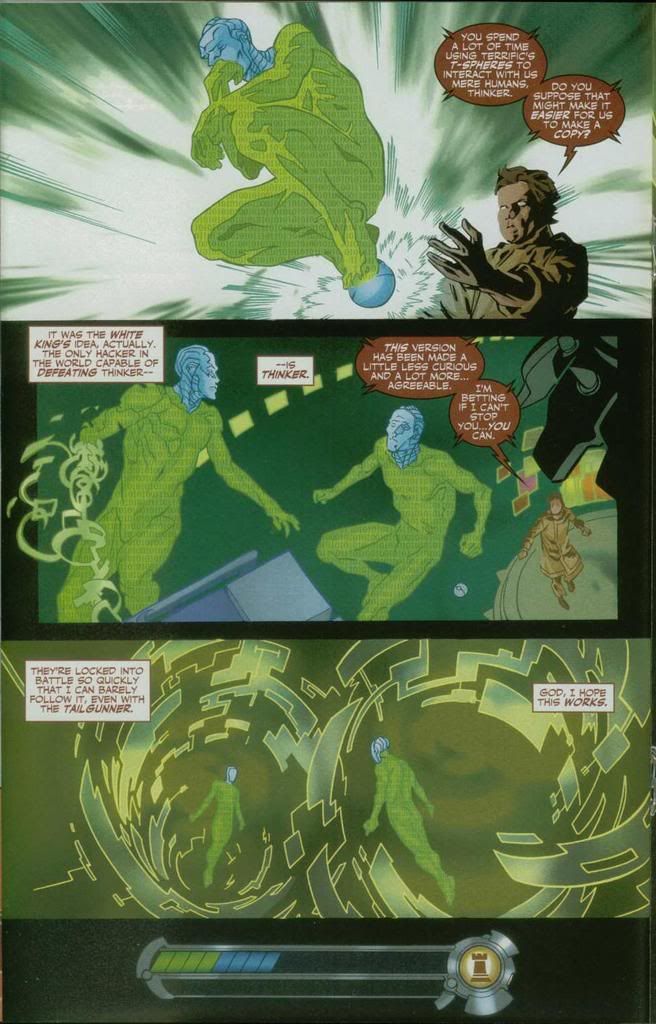
Carl "Deathtrap" Draper proves the old adage: send a Thinker to catch a Thinker!


(Psst -- the password is Diamondrock....)

[From "Firewall," Checkmate vol. 2 #17, October 2007. Written by Greg Rucka and Eric S. Trautmann, pencilled by Chris Samnee, inked by Steve Bird.]
Full Post

Saturday, August 18, 2007

New comics 8/15/07

Eleven issues this week, with a couple extra-sized. No time to waste!

We begin with The Brave and the Bold #6 (written by Mark Waid, pencilled by George Perez, inked by Scott Koblish), the cracking-good conclusion to the opening "Luck Lords" arc. It stars (deep breath) Batman, Green Lantern, Adam Strange, Supergirl, the Legion, and special surprise guests, but its cameos feature all manner of DC space heroes familiar to me mostly from the old Who's Who book. The big finish hinges on said special surprise guests, and I'm not entirely sure it's a valid plot twist, even within the plot's established logic, but it made me smile. Good work, all!

Next up is Countdown #37 (written by Paul Dini and Adam Beechen, breakdowns by Keith Giffen, pencils by David Lopez and Mike Norton, inks by Don Hillsman and Rodney Ramos). Considering that five people contributed to the art, it's all pretty agreeable. I'm sure that's the result of working from Giffen's breakdowns. Most of the issue deals with Mary Marvel's apprenticeship to Zatanna, with the B-plot apparently the cover-featured encounter between the Rogues and Poison Ivy. Otherwise, Karate Kid is still dying, Holly and Harley are still part of the Amazonian slumber party, and Jimmy's subplot leads into this week's Action Comics. Two-page villain origins start this week, with the first up being (appropriately enough) Poison Ivy, brought to you by Scott Beatty, Stephane Roux, and the Cheesecake Factory.

In the aforementioned Action Comics #854 (written by Kurt Busiek, pencilled by Brad Walker, inked by Livesay), Jimmy and Superman manage Jimmy's new powers and the new Titano, and it's actually all very sweet in the end, thanks to copious amounts of Krypto. More particularly, though, Busiek jumps back and forth between the "present" Countdown-influenced plot and the evidently-prior Kryptonite Man plot we've been following the past few issues. It might not sound like much of a compliment, but this has been a really good Countdown tie-in, and a very successful test of Busiek's shared-universe mojo.

Checkmate #17 (written by Greg Rucka and Eric S. Trautmann, pencilled by Chris Samnee, inked by Steve Bird) offers a one-off story spotlighting Checkmate's new security chief, the former Master Jailer. It's a fine introduction to the series, encapsulating all the paranoia and much of the politics on display every month. The climactic battle plays out kinda like a video game, but in a good way.

Volume 2 of The Flash picks up after over a year (i.e., after Volume 3) with issue #231, written by Mark Waid and drawn by Daniel Acuna. It's an introduction too, because as we all know, Wally's grooming his kids to be superheroes. Not to cast aspersions on the memory of Bart Allen, but what exactly was keeping this from being the Flash One Year Later storyline back in March '06? Anyway, the kids aren't unappealing, but I'd apparently forgotten that Linda Park had some med-school training on the way to becoming a journalist. I wasn't too high on Acuna's suitability for the title after All-Flash #1, but I was pleasantly surprised here. Because he's splitting his time between the Wests and the necessary exposition, Waid's script isn't as good as the All-Flash issue, but that doesn't mean it can't get better.

I haven't been as repulsed by Amazons Attack! (#5 written by Will Pfeifer, drawn by Pete Woods) as some, so when I say "it's almost over," that's more matter-of-fact than anything. Most of this issue deals with the Outsider Grace receiving overtures from the Bana-Mighdall Amazons, while Batman tries to lower the magic shield keeping the most powerful JLAers out of the decimated Washington. I still say it's not so bad, but if you've bailed on it by this point, I probably won't change your mind.

I really do need to re-read Tad Williams and Shawn McManus' run on Aquaman: Sword of Atlantis, because #55 was an enjoyable installment that could easily be described as "retro-superhero." There's a nice take on the monologuing bad guy (and there are actually a few of them), and Williams and McManus do a good job of building suspense. There are only two issues left in the title, and possibly the "new" Aquaman himself, but it's got me eager to see the wrap-up.

Brad Meltzer says goodbye to Justice League of America, at least for now, with #12 (pencilled by Ed Benes and Eric Wight, inked by Sandra Hope). Of course it's a character-driven ode to the greatness of the team, because that's been Meltzer's approach all along. It focuses on Meltzer's new members, Red Arrow, Hawkgirl, Red Tornado, Black Lightning, Vixen, and Geo-Force, and bonds are formed (in various degrees) between two couples. As with Countdown and Amazons Attack, you've probably made up your mind about this one already.

I didn't believe it when I saw it on his site, but there really is a screenshot of The Invincible Super-Blog on a SHIELD monitor screen in Captain America #29 (written by Ed Brubaker, drawn by Steve Epting and Mike Perkins). More good stuff from this crew, and the shout-out to a comics blogger is just the cherry on top.

I bought Spider-Man Family #4 for the Spidey/Agents of Atlas story (written by Jeff Parker, pencilled by Leonard Kirk, inked by Kris Justice), but I stayed for Chris Eliopolous' Puppet Master story and the entertaining reprints. The new stories were great, and it's 100 pages for $5.00, so what's not to like?

Finally, there's a lot to like about Booster Gold vol. 2 #1 (written by Geoff Johns and Jeff Katz, layouts by Dan Jurgens, finishes by Norm Rapmund). This is a dense book, with lots of story "compressed" into its 31 pages. I had compared this book earlier to the old Chronos series, but it's much more accessible, as you'd expect. It pokes fun at much of what Johns and his colleagues have done at DC the past few years, and as much as I got tired of Johns' continuity-referencing in his JSA work, it's actually more of the point of this series. Thus, it works a lot better here. Jurgens' work is the same as always, not bad but still kind of stiff, and it too plays into the plug-into-DC-history vibe the series clearly wants to evoke. Moreover, Booster's new setup comes with an appropriate, and poignant, emotional foundation. A very promising start to what could be the She-Hulk of DC.
Full Post

Tuesday, July 24, 2007

New comics 7/18/07

We begin this week with All Flash #1 (written by Mark Waid, drawn by various artists) ... and I can only speak for myself, but it felt really right to have Wally written by Waid again. Of all the writers who have handled Wally over the years -- among them John Broome, Cary Bates, Bob Rozakis, Marv Wolfman, Mike Baron, Bill Messner-Loebs, and Geoff Johns -- Wally and Waid seemed made for each other. I see a lot of commentators saying this effectively is a coda to Bart's Fastest Man Alive, and I don't disagree; and neither do I disagree that if the continuation of The Flash vol. 2 were drawn by Karl Kerschl, it would look fantastic. (It's got Daniel Acuna instead, and while I don't dislike Acuna, boy howdy does Kerschl's work sparkle here.) Much has been made as well of Wally's ironic punishment of Inertia, which is in many ways the point of this issue. I'd feel better if it were a prelude to the character's return, and even (as some suggested) to Bart's "return."

In the end, I liked the issue. Wally's departure was justified poorly, and his return was oddly reassuring, especially as voiced by Waid. Of course I'm looking forward to the regular Flash book, because that'll be the real test of Waid's speedster chops. I doubt we'll be saying goodbye to Wally again anytime soon.

Next up, another book Mark Waid used to write, Captain America #28 (written by Ed Brubaker, drawn by Steve Epting and Mike Perkins). It's the same format as last issue -- vignettes checking in with the book's current cast, mostly with Sin and the (new?) Serpent Squad as they prepare to break Crossbones out of jail. It hit me with this issue that there's still a lot I don't know about Cap's vast array of allies and enemies. Brubaker is evidently doing his best to work a lot of them into this story, and for the most part he's doing a good job of at least indicating who's good, who's evil, and who's got a long history I could probably find on Wikipedia. Ironically, though, the character I had the most trouble placing in this issue was Professor X. Seems like there's been another bald character in the book lately (or maybe I'm just hallucinating) and they all look like Lex Luthor. Anyway, still a good read.

Speaking of called-back characters, The Spirit #8 (by Darwyn Cooke and J. Bone) presents a twist on the cover-featured "cut the right wire" scenario. This time it's Agent Satin, who unfortunately reminded me of Erin Esurance early in the book when she's parachuting into the action. Anyway, that passed pretty quickly. The issue itself is pretty loaded, putting a lot of subplots into what boils down to cut-the-right-wire ... and, like I say, even that is a clever twist. However, it never feels coy or too clever, and the Spirit is only in it as a supporting character. It's even a sequel of sorts to a previous issue, but without so much as a footnote or express flashback to clutter the narrative. If I had to show someone what Cooke's Spirit was all about, I could do worse than give them this.

Reading the latest Action Comics (#852 written by Kurt Busiek, pencilled by Brad Walker, inked by John Livesay) made me wonder: why doesn't DC put Busiek into its Countdown rotation? If there's one thing at which Busiek excels, it's creating a sense of "movement away from the ball." Busiek is great at suggesting a larger world beyond the borders of a panel, a page, or an issue, and this story is no exception. Its focus on Jimmy connects his CD hijinx with the rest of the Superman plot. (This includes another reference to "Red Son" which pretty much spoils what has to be a big part of its ending, but in a perfect world that story would be long over anyway.) Unfortunately, I'm not clear about what's going on with the primates and the green goo (Kryptonite, I guess) because those scenes are hard to follow, and I'm still not on board with Brad Walker as a penciller. His stuff is a little too idiosyncratic to fit such a straight-laced book as Action. It worked for the quirky Secret Six, just not so much here.

The portion of the blogosphere which still reads Countdown seemed to recoil a lilttle less at this week's issue (#41 written by Paul Dini and Adam Beechen, drawn by Dennis Calero), and I'm in that camp too. Every scene seemed to be constructed just that much better: the Rogues on the run figure out how to survive a long fall; Harley and Holly get a vignette at the Athenian Women's Shelter; and even the one- and two-page check-ins with Mary Marvel and Donna & Jason feel more cohesive. It may be the result of accumulated backstory or the invisible hands of Keith Giffen, but whatever it is, it's working better. Dennis Calero is not an unfamiliar name, but I'm at a loss to remember something else he's drawn. His work's nice and simple, and it does what it needs to.

Two-thirds of the way through Amazons Attack (#4 written by Will Pfeifer, drawn by Pete Woods) and not only can I not tell where it ends and Wonder Woman begins, both series seem to be going over the same ground. Every installment features some unbelievable act of Amazonian carnage (here involving Air Force One), more tension between Wonder Woman and Hippolyta and Hippolyta and the other Amazons, more Circe scheming, etc. There’s barely a sense of plot movement despite having only two issues (well, plus the Wonder Woman issues, but still) to go. Thanks to Pete Woods, the book still looks very pretty.

Aquaman: Sword Of Atlantis #54 (written by Tad Williams, drawn by Shawn McManus) has too much going on. Aquaman and crew fight Black Manta in Sub Diego. There’s a new revelation involving the polar explorers. We check in with a couple of characters from the Peter David days. It’s charming enough, and I like what Williams and McManus have brought to the title, but it’s a strange combination of reliance on pre-OYL stories (maybe trying to win back that crowd?) and the new, oddball spin Williams has put on Kurt Busiek’s OYL "barbarian" concept. With three issues left in the title’s run, and so much plot, it all needs to start coming together.

The same applies to The Brave and the Bold #5 (written by Mark Waid, pencilled by George Perez, inked by Bob Wiacek), which takes a detour into the 31st Century so that Batman can outwit the current Legion of Super-Heroes. This gives Waid and Perez the opportunity to indulge themselves: Waid makes another Adam West reference, and Perez gets to work out with the Legion (a book which, he’s fond of saying, he’s never gotten to draw). There’s more with Supergirl, Green Lantern, and Adam Strange, and it’s all very fun and of course well-rendered; but again, it doesn’t feel like there’s just one issue to go in this arc.

If Brad Meltzer were staying on Justice League of America (#11 drawn by Gene Ha) longer than one more issue, I'd be more excited about this one-off tale of Red Arrow and Vixen trapped under the Watergate Hotel's wreckage. As it is, it's not a bad single-issue story. Meltzer clearly enjoys dialogue, and that's pretty much all this issue is, with only a few physical scenes to punctuate the tension. And in fact, there is a bit of tension, which is surprising considering the relative invulnerability of these characters. Good on Meltzer and Ha for that. A semi-significant aspect of Vixen's powers is revealed here too, in case a reader might feel that the story had no lasting impact. (It still might not, actually.) Ha's work is more diffuse here than his normal precise, fine lines, but it's still good, especially the way he plays with layouts towards the end. I kinda wish this had been more of a contrast from Meltzer's talky modus operandi, though.

Man, everything this week is ending or about to end, isn't it? Gail Simone's last Birds of Prey (#108 pencilled by Nicola Scott, inked by Doug Hazlewood) is an epilogue to the Spy Smasher story arc, as Barbara beats up on her rival something fierce. Afterwards Babs and Dinah reunite, sharing takeout with Huntress and Lady Blackhawk, and then Barbara picks up her newest official recruit. I haven't been back with this book for long, but I thought Simone had a touching farewell. I continue to be impressed with Nicola Scott and Doug Hazlewood -- their faces are especially expressive.

There's a bit of Checkmate #16 (written by Greg Rucka, pencilled by Joe Bennett, inked by Jack Jadson) which I halfway expected to see in BOP, and here it feels a touch out of place, but I suppose it fits better here than there. It's the Fire and Ice reunion, of course, and it's handled pretty deftly by all parties. It's actually very sweet, adding some more nuance to Fire's character (at least how she's been portrayed in this book). The rest of the book concerns itself with Sasha and Mr. Terrific, and sets up the downfall of Amanda Waller. Bennett and Jadson look really pretty good here -- their Fire/Ice scenes use a thicker line, subtly reminiscent of Adam Hughes and Joe Rubenstein's Justice League International work, but their Sasha/Michael scenes are thinner and more delicately rendered. All around, a fine issue.

Finally, here's the last issue (see? again!) of Jeff Smith's Shazam! The Monster Society Of Evil, and it's just as good as the other parts. Smith's Mr. Mind design is perfect -- menacing while still retaining the salient parts of the original. If this series isn't the tour de force of Cap villains that the original was, that's OK; as a revival/reimagining of the Captain Marvel mythology, it works very well. Now, of course, Smith has to do a sequel, so he can work Cap Jr. into the mix.
Full Post

Monday, June 25, 2007

New comics 6/20/07

We begin this week by picking up a spare from last week, Outsiders #48 (written by Judd Winick and Greg Rucka, pencilled by Ron Randall and Matthew Clark, inked by Art Thibert). It's Part 4 of the 6-part "Check/Out" crossover, and as such it features the Outsiders/Checkmate strike force's attempt to survive Oolong Island. Therefore, most of the issue is given over to shouting and fighting and movement and explosions and frantic dialogue. I was kind of surprised that I could follow the issue as well as I could, considering the fact that pencillers Randall and Clark seem to have divided up the issue pretty equally. Randall uses a thicker line, and I think his figures and composition are a bit more stable as a result, but really I couldn't tell much of a difference just reading the book. I ascribe that to inker Art Thibert, who's done his share of pencilling as well.

My main problem with the issue, and the crossover in general, was that it didn't make me any more sympathetic to the Outsiders themselves. I'm familiar with the well-established characters (Nightwing, Katana, Metamorpho), but I have to remind myself that "Owen"/"Boomer" is the new Captain Boomerang from Identity Crisis, and I know nothing about the two strong women (Grace and Thunder) beyond the broad strokes an action plot like this divulges. The book doesn't go out of its way to explain any of these people to this particular reader-just-along-for-the-crossover. (Each team having its own young red-haired guy doesn't help either.) This crossover also hasn't justified Outsiders' existence beyond being a random team of attitude-rich superheroes. Well, maybe it did a little, at the beginning, when there was some sense that Checkmate could take advantage of the group's cavalier approach to superheroics. Still, this title's got one more issue before Everything Changes with a new roster, and then it gets relaunched at some point in the future with Batman in charge. I guess what I'm saying is that this crossover could just as well have been a biweekly Checkmate arc for all it's made me care about the Outsiders. Still, this was a decent dumb-fun action issue.

Checkmate #15 (written by Rucka and Winick, pencilled by Joe Bennett, inked by Jack Jadson) presents Part 5 of "Check/Out," in which Nightwing, Boomer, and Sasha are tortured by Chang Tzu (can we call him "Egg Fu" anymore?) while the Checkmate high sheriffs negotiate with China for some assistance. In terms of craft, this was a better issue all around than Outsiders #48. Bennett and Jadson are a more solid team, and Rucka does a good job of laying out the various political issues and assigning their presentations to the appropriate characters. Checkmate has a much larger regular cast than Outsiders, but there they all are in roll-call format on the first page.

The one thing that I did not like about the issue, and it is not an insignificant complaint, is the attention paid to Boomer and Sasha's torture. The issue plays a darkly clever game with the reader by putting Nightwing -- who we know is "safe" from any permanent harm -- in a cell next to the torture chamber, thereby making him listen to his friends' anguished cries. In this way, and especially on the last page, "Check/Out" seems to set up pretty clearly the end of Nightwing's tenure as team leader. This is a particular blow to Nightwing's character, because for years, if not decades, it was the thing that most significantly separated him from Batman. As Titans leader, he was either rescuing his teammates (see "The Judas Contract" or "Titans Hunt") or sacrificing himself for him (i.e., in a few of the Brother Blood storylines). He's presented here as an ineffectual failure. Thus, while the issue does a good job of dramatizing just how deep these three are in their particular hole, the overall effect is not pleasant, and in fact kind of sickly voyeuristic.

I got a similar feeling reading The Flash: The Fastest Man Alive #13 (written by Marc Guggenheim, pencilled by Tony Daniel, inked by Daniel, Jonathan Glapion, and Marlo Alquiza). It was a gut-punch of an issue that apparently wanted to leave little doubt about Bart's fate. As I said on Thursday, I felt bad for Bart, but a lot of that had to do with the editorially-mandated aspects of his death. The fact that I didn't think he needed to die also contributed to my sadness that he did. Guggenheim and Daniel put together a decent issue, just in service of an unfortunate cause.

The other part of the Flash re-relaunch was, of course, Justice League of America #10 (written by Brad Meltzer, pencilled by Ed Benes, inked by Sandra Hope). While I am very, very happy at the return of Wally West -- I actually teared up a little; don't judge me -- this was an incredibly haphazard way to end "The Lightning Saga." First of all, it's not really over, because it obviously sets up more Old-Legion adventures in Countdown and other DC titles. Second, what in the name of little baby ducks does Wally West have to do with the Legion anyway? Third, I understand the Legion not wanting to tell the JLA and JSA that one of them will die when "whoever" is brought back, but that just means this is the old "Why didn't you ask us for help in the first place?" plot. Fourth, do I really have to list all of the ways in which Meltzer and Benes use innuendo and shorthand to create an illusion that things are happening? There were no real resolutions in this issue, at least not to the larger plot elements presented at the beginning of the crossover. Meltzer has some appealing ideas, but he treats them so reverently that before you know it, five issues are up and nothing's really gotten done.

I could probably say the same thing about Captain America #27 (written by Ed Brubaker, drawn by Steve Epting and Mike Perkins), but the difference is that the character scenes are hung on a plot that makes sense within the larger story arc. The Winter Soldier wants to reclaim Cap's shield, Sharon Carter struggles with her role in Cap's death, and she and the Falcon figure out where Bucky's headed with the shield. Oh, and Bucky reconnects with the Black Widow, his old Soviet-spy buddy. Epting and Perkins do a collectively fine job overall. I don't like their Tony Stark, but that's just me. Also, I wasn't sure it was "the" Black Widow, Natasha Romanov, because dialogue calls her "Natalia" and I don't know if that's an acceptable nickname. Other than those nitpicks, though, a really fine issue that advances the plot while still keeping the reader guessing about when any Captain America will headline his eponymous book again.

I continue to enjoy The Brave and the Bold (#4 written by Mark Waid, pencilled by George Perez, inked by Bob Wiacek), probably because it is unashamed of being a light, fun superhero title. This issue begins and ends with Batrok, and features a Lobo/Supergirl story which is fairly predictable but still enjoyable. It does appear that Supergirl has gotten more mature around Lobo than she was around Green Lantern a couple of issues ago -- Waid writes her as (let's say) early-20s, as opposed to late-teens -- but I like her better this way, so it works out.

In the same vein, Marvel gives us Spider-Man and the Fantastic Four #3 (written by Jeff Parker, pencilled by Mike Wieringo, inked by Wade von Grawbadger), which finds Spidey and 3/4 of the FF fighting aliens and dropping in on Dr. Doom and the High Evolutionary. There is nothing objectionable about this book.

You can guess the obvious segue into Countdown #45 (written by Paul Dini and I think Tony Bedard, although Palmiotti & Gray are credited; pencilled by J. Calafiore, inked by Mark McKenna). Actually, I kind of liked this issue, because it shows Donna Troy as a competent superhero for the first time in a while. An incongruous scene of her blasting away with an automatic rifle notwithstanding, she comes across believably as an Amazon warrior. However, the rest of the book is still in setup mode: Jimmy Olsen investigates Sleez's old tenement, Holly shows up when Jimmy leaves, and meanwhile the Legionnaires stuck in our time after JLofA #10 whine some more about being stuck on the JLA Satellite. Also, there has got to be a better way to distinguish between Monitors than their hairstyles. I'm begging you, DC: symbols, numbers, tattoos, whatever -- I just can't keep 'em straight anymore.

Finally, The Spirit #7 features three guest creative teams, and is largely successful. The first story, written by Walt Simonson and drawn by Chris Sprouse and Karl Story, concerns a no-good socialite (we know she's no good, because she's obviously reminiscent of Par-- I mean, She Who Must Not Be Named) and the Spirit's search for a missing diamond. It's pretty fun. The second story, written by Jimmy Palmiotti and drawn by Jordi Bernet, is more of an Eisner pastiche, because it features the indirect effects of a Spirit chase on the lives of tenement dwellers. Bernet's style is perhaps even more successful than Darwyn Cooke's at capturing the sort of organic cartoonishness of Eisner's work, so I think this is the most successful story in the issue. The last one, a sort of Spirit/Frank Miller mash-up parody by Kyle Baker, is rather an acquired taste. I thought excerpts of it were funny when I saw them online, but even for a short story the joke gets a little old. Still, like the man said, two out of three ain't bad.
Full Post

Monday, May 28, 2007

New comics 5/16/07 and 5/23/07

Would have gotten these up last night, but the traditional Memorial Day allergies started to kick in....

MAY 16, 2007

The Flash: The Fastest Man Alive #12 (written by Marc Guggenheim, pencilled by Tony Daniel, inked by Art Thibert) is a fairly decent issue which suffers somewhat by the behind-the-scenes murmurings about Bart Allen's fate. I give it a lot of credit for setting up an inescapable doom-trap, but at the same time I have to think that the doom-trap won't actually kill Bart. I mean, that would be a little too grim, even for someone like me who still can't get past the arbitrary nature of his promotion. My appreciation of said trap is therefore blunted somewhat. I'm also kind of ambivalent about whether I want Bart to escape. I don't want him to die, but at the same time I don't think he should be the Flash just yet.

How was the book itself, you ask? Decent, like I said. No one seems to be out of character, but Bart himself is still such a cipher that it's hard to say at this point what would be in character. Daniel's storytelling skills are fine, but Thibert's inks are inconsistent. The "weight" of characters on the page varies, and more often than not the Flash especially looks two-dimensional. Still, there is that doom-trap, and the Black Flash, so I don't feel bad about coming back.

Countdown #50 (written by Paul Dini, Jimmy Palmiotti, and Justin Gray, pencilled by J. Calafiore, inked by Mark McKenna) has already been dissected by many of you, so I will just add some brief observations. First, if the cover suggests that the Joker has targeted Jimmy Olsen, that implies a much more exciting story than Jimmy happening to end up at Arkham Asylum for a stereotypical Hannibal Lecter conference. I'd want to read Joker vs. Jimmy, and I'd be lukewarm about Joker Talks To Jimmy. Second, the scenes with the Rogues go on far too long: five pages to establish a) they hate the Flash, whoever he might be, and b) Piper and Trickster's bona fides are in question. I thought this scene added nothing to the current Flash arc. I think Countdown is improving, but boy, it's not improving quickly.

Justice League of America #9 (written by Brad Meltzer, drawn by Ed Benes) gets a lot of things right -- the Gorilla City scenes, for instance -- but again, nothing much seems to happen. Teams of JLAers and JSAers just show up and collect Legionnaires like they were checking out library books. At least the three bad guys were revealed.

Action Comics #849 (written by Fabian Nicieza, pencilled by Allan Goldman, inked by Ron Randall) finishes the "Redemption" two-parter about like I figured. There are some intriguing ideas, and Kurt Busiek's social worker from an earlier Superman is used well, but ironically, I think Superman himself comes across as imposing his will on the common folk more than the story's antagonist does. The final confrontation features Superman hovering over the congregation making pronouncements, and while Clark muses later that his moral compass has to be pretty accurate, I don't think the congregants understood that point.

Aquaman: Sword Of Atlantis #52 (written by Tad Williams, drawn by Shawn McManus) finds our hero and his companions hatching a plan to free Sub Diego from Black Manta. This was not a dull issue, and I don't have much of a problem with the art, but the Sub Diego stuff is just not involving me like it wants to. Besides, both Busiek and Williams want Arthur to be The Decider, but so far neither of them have really presented a compelling case for that. Arthur's just a guy who can live underwater unaided and maybe occasionally talk to marine life, and right now that's not enough to get me excited about him. There are exciting and chilling moments in the issue, including the Black Manta fights and Aquagirl's story about the fate of some Sub Diegans, but Arthur should be the compelling center and he's not.

Checkmate #14 (written by Greg Rucka and Judd Winick, pencilled by Joe Bennett, inked by Jack Jadson) is a solid caper story wherein a Checkmate team and the Outsiders infiltrate Oolong Island. As usual, Rucka uses the caper to advance the book's various political subplots effectively. As a crossover, though, I have to say this storyline isn't encouraging me to pick up Outsiders on a more regular basis. Beyond Nightwing, none of these characters seem particularly exciting, and most of them are defined by their sarcasm and air of bad-assery. If Rucka and Winick each wrote their respective team's dialogue, Rucka wins. Bennett and Jadson do well enough, but the big action scene at the beginning suffers from faulty perspective. Specifically, I couldn't tell at first whether the monster was supposed to be looming over the ship or sitting atop it.

Where do I begin with All-Star Batman & Robin, The Boy Wonder #5 (written by Frank Miller, pencilled by Jim Lee, inked by Scott Williams)? First, I don't think anyone should look to this title for the Platonic ideals of Batman, Robin, or any of the other iconic characters it features. This is not a story about How Batman Should Work. I don't know what this story is about, and it's been five issues. Actually, I take most of that back: this is a story about making Batman first among alpha males, by giving every other possible contender some fatal character flaw. Of the various costumed characters portrayed so far, Batman is the only one who seems to get the colossal joke underlying the very pursuit of superheroics. This makes a lot of sense in light of the basic "Batman" idea, and it could be a pretty entertaining series of issues, but remind me again ... what's the basic plot of this series? Where are the conflicts? Batman is wanted by the cops generally, never mind for kidnapping Dick Grayson, and by the way Dick's parents have been murdered. Five issues in and we're still just introducing all the players. This is starting to feel like the sub-glacial pace of Supreme Power all over again. It's bad enough the issues are so late, but then to have virtually no plot advancement feels like Miller and Lee are just in it to put one over on the suckers.

Fortunately, Grant Morrison, Andy Kubert, and Jesse Delperdang offer Batman #665, which gets a lot of ASB&R's ideas across in a mode that's much easier to digest. "The Black Casebook" ascribes a certain supernatural dread to those old Batman stories no one likes to talk about because they're "not realistic." In this issue, Batman and Robin take out the Bane-themed Batman, in part because Bruce convinces himself that he needs to be, yes, the top alpha male. However, Morrison's Batman is more sedate, and perhaps more self-aware, than Miller and Lee's cackling dervish. He's playing a role, not thinking with his id. The issue also has some fine action scenes, including Batman and Robin both slamming into the Bat-Bane with their respective vehicles.

Star Wars: Rebellion #6 (written by Brandon Badeaux & Rob Williams, drawn by Michel Lacombe) begins a new arc focusing on a character who should be familiar to me, but isn't. He's a Rebel agent who gets found out by the mob boss he's infiltrated, and sent on a mission by said mobster. I liked this issue well enough, even if some parts of it (the opening flashback to Episode III, and an assassination) weren't connected to the main plot. It all felt like part of the comfortable SW setting, and with a book like this, that's what you want.

Finally for this week, Hero Squared #6 (written by Keith Giffen and J.M. DeMatteis, drawn by Joe Abraham) offers the origins of Captain Valor and Caliginous, each told by them in what has to be somewhat self-serving fashion. Captain Valor's is more funny, being a pretty obvious parody of Captain Marvel's (including a Mr. Natural-like Shazam figure), but the emotional heft comes at the end of the issue, when one of the book's main players reacts to Caliginous' story. This is another book that doesn't do much in the way of macro-plot, but at least it offers a fairly complete story in every issue. If, as I have read, it's ending soon, it should probably get to its larger point, but issue by issue, it's still fun.

MAY 23, 2007

Countdown #49 (written by Paul Dini and Tony Bedard, pencilled by Carlos Magno, inked by Jay Leister) uses Jimmy's elastic past to get him out of the cliffhanger with Killer Croc, and the Pied Piper and Trickster get a good double-agent-y scene to establish their bona fides with the other Rogues. The rest of the issue is taken up with exposition-happy Monitors, Karate Kid and Red Arrow trading quips (leading me to wonder about the timing of this issue relative to the JLA/JSA crossover) and a dismemberment-happy Black Adam. The art this issue was pretty good for a team I've not seen before -- very dynamic, although there has to be a better way than facial hair to distinguish the Monitors.

I'm genuinely torn as to whether to continue with Supergirl and the Legion of Super-Heroes (#30 written by Mark Waid, pencilled by Barry Kitson, inked by Mick Gray and Jimmy Palmiotti), because this was a very solid issue, but I think it's Waid and Kitson's last. They go out raising more questions than they answer, with those questions being very intriguing. Will Cosmic Boy join this mysterious new team? What will happen to Mon-El? Most importantly, will the new creative team be any good? I keep saying I want to re-read this series, so maybe this will give me the impetus to do it.

I thought The Spirit #6 (by Darwyn Cooke) was too ambitious. It tries very hard to be a real Eisner-esque story about a new character, with the Spirit in the background, but it just felt so familiar, and not in a good way. It's probably redundant to say that tortured musicians suffer for the sake of their art, and will do anything to perfect it, but there didn't seem to be much new (beyond the sci-fi trappings) of this musician's story. This title will always be worth reading as long as Cooke is on it, because Cooke is such a great storyteller and designer, but this issue falls short.

Wonder Woman #9 (written by Jodi Picoult, drawn by Terry Dodson and Rachel Dodson) doesn't skimp on plot. Superman, Batman, and the Justice League appear briefly, Circe's plans are revealed further, and Diana and Circe square off. The art is gorgeous, as you might expect. Picoult is improving, but her dialogue is still too clever and she can't quite manage all the plot. It continues to mystify me why DC would try to build up this title's profile with a prose novelist, and then plop said novelist right in the middle of a big event.

For some reason Fantastic Four #546 (written by Dwayne McDuffie, pencilled by Paul Pelletier, inked by Rick Magyar) didn't make much of an impression on me the first time around. That's probably my fault, because upon further inspection it's a neat little issue which references everything from the '70s Jack Kirby Black Panther series to Waid and Wieringo's last big FF arc. Oh, and Beyond!, of course, written by McDuffie. I didn't expect to see Reed and Sue back in the book (and apparently on their way to a healthy relationship) so soon, but that was a pleasant surprise, as was the combination of Pelletier and Magyar. Magyar really gives the pencils a good heft and a lot of weight, for a nice Alan Davis look. If this is just a temporary team, the long-term folks had better be absolutely stellar.

Arnim Zola, another '70s Kirby creation, shows up in Captain America #26 (written by Ed Brubaker, pencilled by Steve Epting, inked by Mike Perkins). A series of brief episodes -- the typography of which reminds me of old Spirit stories, for some reason -- check in on Sharon, the Winter Soldier, the Falcon, and Zola and the other villains, all getting back to their lives after Cap's death. Apparently this issue comes after all of those Fallen Son specials Marvel's been pushing since Cap #25, but I haven't read 'em, so this isn't overkill (you'll pardon the expression) for me. Brief glimpses of the Avengers both connect this book to, and distance it from, the larger Marvel Universe. These are people who don't quite fit into the land of crossovers and tie-ins. In that respect they're misfits, not unlike the time-lost Captain America whose memory now links them. If you can't already tell, I like this book a lot.

Aaand speaking of crossovers I haven't read and am not reading, here's She-Hulk #18 (written by Dan Slott, pencilled by Rick Burchett, inked by Cliff Rathburn), featuring Jen's battle with Iron Man on the SHIELD Helicarrier. That's about it, really. This issue uses Jen as a bridge between Civil War and "World War Hulk," getting her from one side to the other. There are some cute moments, but most of those involve Shulkie's regular supporting cast. It's not bad, it's just not as good as the book has been.

Finally, here's a book that may be better than ever: Birds Of Prey #106 (written by Gail Simone, pencilled by Nicola Scott, inked by Doug Hazlewood). Not just the Barda/Knockout fight, this matches up all of the Secret Sixers against the Birds, with Ice slowly regaining consciousness throughout. (Just noticed: on the cover, Barda's mega-rod looks a lot like Luke's green lightsaber....) It's pretty fun, especially the Misfit/Harley Quinn pairing. Nicola Scott's choreography isn't as fluid as I'm used to, so some of the figures are posed a bit awkwardly. Then again, they are fighting, so maybe that's how they're supposed to look. This team has succeeded in making a book I look forward to every month, and it's another situation where the new writer will have big shoes to fill.
Full Post

Saturday, May 12, 2007

New comics 5/9/07

My browser crashed just before I could save the first attempt at this roundup, so these might be a little shorter and more to the point than usual....

We begin this week with Countdown #51 (written by Paul Dini, pencilled by Jesus Saiz, inked by Jimmy Palmiotti), a big hash of disconnected subplots which features exactly two of the characters appearing on the cover. It's the weakest Paul Dini script I've seen in a long time, with expositional dialogue and a very thin central storyline. It might look better in a few weeks, and the next issues might improve on this one, but for now, there's not a lot to latch onto. The art is pretty good, though, except for Darkseid's shell-casing head.

Much better is Spider-Man and the Fantastic Four #2 (written by Jeff Parker, pencilled by Mike Wieringo, inked by Wade von Grawbadger), in which the invading aliens turn everyone in New York against our heroes, and hilarity ensues. This doesn't aim to be a series of any consequence, unless you count well-done old-school superheroics consequential. Instead, it's a team-up that seems natural but doesn't happen often enough. My only complaint is with the Thing's proportions -- I don't remember him looking quite so candy-corn-shaped in Wieringo's FF issues.

Outsiders #47 (written by Greg Rucka and Judd Winick, pencilled by Matthew Clark, inked by Art Thibert) is Part 2 -- or, really, the second Part 1 -- of "Check/Out." It picks up with the team in Checkmate custody and Nightwing (of course) busting them out. It's not as good as the Checkmate issue, because the dialogue is a little too arch and the art is too heavy on gritted teeth and meaningful eye-closeups. It does a fine job of introducing everyone to each other, setting up the mission, and explaining the differences between the two groups. Most of it is a big romp involving an Outsider running around with her butt hanging out, and unfortunately that goes on a little too long.

Nightwing assembles yet another team in his own title, for Nightwing #132's conclusion of "Bride and Groom" (written by Marv Wolfman, drawn by Paco Diaz). While I appreciate the nod to Dick's team-leader capabilities, isn't this the book where he takes out bad guys on his own, without a random set of ex-supervillains I've never heard of? Basically they spend the whole issue wanting to kill B & G, and Dick says he's hip, but that's not how he rolls. I still don't understand Dick's emotional journey through this arc. Diaz' guest artistry gets the job done, but it's a different style from regular penciller (still, I hope) Jamal Igle, and it contributes to the feeling that the whole thing has gone slightly awry.

JLA Classified #38 (written by Peter Milligan, drawn by Carlos D'Anda) presents Part 2 of "Kid Amazo," and while it's a good installment of what looks to be a good superhero story, I have a few nitpicks. Although I did like being reminded that John Stewart is liberal and Wally West is conservative, I thought J'Onn J'Onzz and Amazo himself were somewhat out of character. J'Onn seemed too irreverent, and Amazo seemed too together. Still, the title character's main conflict was presented well, and I do like D'Anda's art -- bulky and expressive.

The Mogo-turns-everyone-evil subplot in Green Lantern Corps (#12 written by Dave Gibbons, pencilled by Patrick Gleason and Tom Nguyen, inked by Nguyen and Prentis Rollins) has been going on for an issue or two too long, but other than that this was another good floppy. I especially liked the Soranik Natu scenes. Nguyen's pencils also fit well with Gleason's style, and appropriately enough, they remind me of Dave Gibbons'.

Finally, guess which part of Tales of the Unexpected #8 I blogged about in Grumpy Old Fan this week? If you picked the Spectre (written by David Lapham, pencilled by Eric Battle, inked by Prentis Rollins), you lost!! The Spectre story did try to tie all of its carnage together into a unified look at one particularly evil tenement building, but it was just too nihilistic for me. Much more life-affirming was the conclusion of the Dr. 13 story "Architecture and Morality" (written by Brian Azzarello, drawn by Cliff Chiang), to which I wrote the aforementioned love letter. I know I'm not alone in saying a) I paid $3.99 a month for each 16-page chapter of this story, and b) I'll pay for the collection when it comes out as well. More of Dr. 13 by Azzarello and Chiang, please.
Full Post

New (at the time) comics 4/25/07 and 5/2/07

(sigh)

Yes, it's been another three weeks without a new-comics recap. I'm not going to dwell on that, though, so let's jump right in. Should have the 5/9 comics recapped by tonight or tomorrow.

4/25/07

52 #51 (written by Geoff Johns, Greg Rucka, Grant Morrison, and Mark Waid, breakdowns by Keith Giffen, pencilled by Joe Bennett, inked by Jack Jadson and Belardino Brabo) ... yeah, you know, it was fine. The space heroes got their reunions, there was a nice bookend to the first issue with the Superman/Superboy memorials, and it was a good way to wind down the bulk of the series. I can't help but see it as the first part of a 2-part conclusion to the series, given what happens in #52, but we'll get to that later.

Wonder Woman #8 (written by Jodi PIcoult, drawn by Terry Dodson and Rachel Dodson) and Amazons Attack #1 (written by Will Pfeifer, drawn by Pete Woods) are joined at the hip(Polyta -- oh, I hate myself), so I'll talk about 'em together. It occurs to me that AA does a better job of starting Wonder Woman's "rehabilitation" than the main title does. Not that I didn't like the Allan Heinberg issues, because they were on the whole pretty clever. It's just that you'd think the Big Novelist Arc would overshadow, or at least color, the Big Event Miniseries, and it's turned out the other way around -- and the ironic thing is, that's probably for the best. WW #8 is more of the same "save Nemesis from Circe" plot, now in its third issue; and still making with the contrivances for the sake of humor.

I may like AA better simply because it seems to give everything some direction. In fact, it hews more to a traditional superhero-story introduction: it establishes the threat, presents the stakes, and shows the heroes beginning to respond. Sure, the Amazons are bloodthirsty, perhaps excessively so; but I have a feeling the excess may be part of Circe's prompting. Both books look fabulous, so that helps a lot.

I was pleasantly surprised by how much I enjoyed Justice Society of America #5 (written by Geoff Johns, drawn by Fernando Pasarin), the wholly nondescript cover notwithstanding. (I almost didn't get it because -- unlike the Phil JIminez variant for sale for $10 behind the LCS' counter -- it didn't say anything about being Part 2 of the JLA crossover.) Anyway, it's part 2 of the JLA crossover, and oh boy stuff happens! Batman, Sandman, Starman, and Geo-Force fight "Batmen Through The Ages" and Doctor Destiny in Arkham Asylum! Superbo-- er, Superman gives the teen JSAers the Fortress tour, complete with Madame Toussaud's Legion of Super-Heroes! Wildfire vomits up Batman's utility belt, last seen on Rick Jones in Avengers Forever! Okay, that last part isn't quite true, but it kind of gives you the feel for where all of this is going. I liked this issue well enough, although Pasarin's art is just a little too much over-rendered. Also, unless those are animatronic Legion statues, I'm kind of disturbed by how expressive they are. Also also, as I clumsily indicated before, his Superman looked at first a little too Superboy-ish. Hope part 3, in JLA #9, is at least as good.

I now prefer to think of the final issue of Firestorm 2.0 (#35 written by Dwayne McDuffie, pencilled by Pop Mhan, inked by Mhan and Steve Bird) as Part 3 of the special bridge-the-gap Firestorm miniseries. Looks to me like the Dan Jolley/Stuart Moore-written plots and subplots all concluded satisfactorily in #32 -- because this issue ends on a terribly disappointing cliffhanger. It's good because it means Firestorm will be popping up later in other DC books, and might get enough new exposure for a revival, but it's bad in terms of narrative cohesion. It's the Gotham Central non-ending, pretty much. The plot is also kind of hard to understand, because it hinges on some use of Firestorm's powers that he takes great pains to set up ... but when he does it, the setup doesn't appear necessary. Basically it's a big fight scene, rendered and choreographed well, except for that one part.

Action Comics #848 (written by Fabian Nicieza, pencilled by Allan Goldman, inked by Ron Randall) continues the fill-ins with Part 1 of a 2-parter about a superhero who gets his powers from God. Well, faith, prayer, something like that. The new guy destroys a squad of soldiers in an African country because he's there to protect missionaries -- which he does -- but he can't control his powers otherwise. The religious angle causes Superman to question how much he should be interfering, because clearly he's got his own history of religious belief. It's a good start for a story, but as you might expect, it 's not too subtle. I'll be surprised if the folks behind Jarod (the new guy) aren't broadcasting their own powers through him, and not really acting on direct orders from the Lord. The story isn't helped by Goldman's pencils. They're serviceable, and his storytelling is fine, but his figures are awkward and his perspective falters occasionally. One scene, with Clark and Lois getting ready for bed, features an overmuscled Clark and a Lois whose back arches too far, apparently so she can display her hinder more prominently.

Supergirl and the Legion of Super-Heroes #29 (written by Tony Bedard, pencilled by Kevin Sharpe, inked by Mark McKenna & Jack Purcell) was a weird fill-in, if indeed it is such and not just the start of the Bedard/Sharpe Era. It basically spilled the beans on 52 a week early (in the comics themselves; Dan DiDio did it first, of course), explaining why the Dominators hate the Earth, and the Legion in particular. The issue is nothing special -- the Dominators' history is told against the backdrop of the Legion trashing their planet -- and the art is decent at best.

Batman Confidential #5 (written by Andy Diggle, pencilled by Whilce Portacio, inked by Richard Friend) is another issue-long fight scene, as first the Batplane and then the Batcycle are used to attack Luthor's secret robot warehouse. It took me about three minutes to read.

For the first time in a long time, I didn't get a whole lot out of Astro City (The Dark Age Book Two #3 written by Kurt Busiek, drawn by Brent Anderson). Maybe the Ron Burgundy cameo threw me off. I had the same reaction to Planetary Brigade: Origins #3 (written by Keith Giffen and J.M. DeMatteis, drawn by Julia Bax).

Thankfully, the same was not true for Fantastic Four #545 (written by Dwayne McDuffie, pencilled by Paul Pelletier, inked by Rick Magyar), which did a lot with the new FF, the Silver Surfer, and Gravity. I'll echo the blogosphere's concerns about some of the physics in the issue, but overall it continues to be very good.

5/2/07

I talked about 52 #52 in the 5/3 Grumpy Old Fan. Short version: yay multiverse! Slightly longer version: a big jumble of a story that felt more like a Big 52 Special than an organic ending to the series. Also, I'm not sure, but I think it broke out of the "this happened this week" mold in large part for the last issue. Still, a good end to the series.

Probably the worst thing about Green Lantern #19 (written by Geoff Johns, drawn and colored by Danlel Acuna) is the continued existence of the new Star Sapphire costume. Otherwise, it would be this issue's notions about the beginnings of a Star Sapphire Corps -- which, okay, makes some sense, but that doesn't mean you have to do it right on the heels of the Sinestro Corps. I did like seeing Carol in a Green Lapphire costume, and the Hal/Carol scenes are fine, but there's some really weak dialogue here -- mostly predictable "first dates are hell" stuff. Acuna's art is good, but it's so different from the Pacheco/Reis school of finely-rendered figures that it takes some getting used to. The "Sinestro Corps" backup continues to be good and scary, in every sense of the words.

Detective Comics #832 (written by Royal McGraw, drawn by Andy Clarke) showcases the return of the Terrible Trio, a '50s-era threefer of theme-gimmick villains now bent on killing each other off. I figured out the twist about halfway through. Not a bad issue, but not a standout either.

Checkmate #13 (written by Greg Rucka and Judd Winick, pencilled by Joe Bennett, inked by Jack Jadson) begins "Check/Out," the Outsiders crossover, with the Checkmaters taking out the Outsiders one by one. Not much plot beyond that, and it's a good way to introduce someone who's never read any Outsiders (i.e., me) to the team. It also makes Checkmate look capable without making the Outsiders look like chumps. Bennett and Jadson are the new art team starting this issue, and they do their usual fine job.

(The All-New) Atom #11 (written by Gail Simone, pencilled by Eddy Barrows, inked by Trevor Scott) concludes the Atom-vs.-zombies story, and not an issue too soon. As much as I want this series to show how it can handle different subgenres, this story just felt shoehorned into the book to get it out of the way before the big Ray Palmer arc. I am still rooting for Ryan Choi, but I'm eager for the more science-y stuff to return.

Welcome To Tranquility #6 (written by Gail Simone, drawn by Neil Googe and Billy Dallas Patton) also wraps up its arc. While I think WTT is a very ambitious book, and deserves a look because of it, it hasn't really hooked me. I'll probably re-read these six issues before deciding whether to continue.

Jeff Smith's Shazam! The Monster Society Of Evil #3 was good as usual, with some familiar Sivana-vs.-Batsons action at the center of the issue. The manner of Billy's escape is particularly fun. However, maybe it was just the way the story broke out, but this issue's cliffhanger isn't all that suspenseful. Oh well; it's not like I won't get #4.

Finally, Superman #662 (written by Kurt Busiek, pencilled by Carlos Pacheco, inked by Jesus Merino) offered a decent bridge into the second half of "Camelot Falls." Some have complained that nothing happens, but I thought Superman's examination of his role in Earth's history was done well. It's not really the "Must There Be A Superman?" question, because Superman's allegedly not making humanity weaker as much as he's making the bad guys stronger. I can see where someone who didn't read the previous Busiek issues might wonder what all the fuss is about, but since I did, and since that particular future was about as apocalyptic as one could get, I was invested in Superman's musings from the start.

Now for the 5/9 books, and maybe some more new content besides.
Full Post