Showing posts with label questions. Show all posts

Monday, September 28, 2009

Where are the Marvel nerd pages?

Writing annotations for Trinity was a whole lot easier thanks to the wealth of DC nerd-sites on the Internets. The Unauthorized Chronology of the DC Universe is an excellent, well-reasoned, and fairly comprehensive timeline of post-Crisis DC. The DCU Guide indexes most characters' appearances, both currently and in the Golden and Silver Ages. Mike's Amazing World Of DC Comics focuses on the company's publishing history.

However, for a company which made Eliot R. Brown a legend among nerds, I haven't been able to find comparable resources for the Marvel Universe. If I want to know how Dr. Strange's Defenders appearances dovetailed with his various solo series, where do I go? Last week I was curious to see whether the Essential Spider-Woman books covered all of the character's major appearances, but I'm unaware of a Marvel counterpart to the DCU Guide. I'd love to see month-by-month charts of Marvel's output over the past seventy years, but again, no luck.

So what about it, True Believers? And don't tell me it's because you actually have lives....
Full Post

Thursday, July 30, 2009

I thought this was easy, but my answers are probably wrong

Kurt Busiek asks:

How many Legionnaires can you name who had letters on their costume?

Naturally, the 'L' on the flight ring doesn't count.

I got five — or eight, depending on how technical you want to get.

Mark Waid got the same five, but agreed that those other three shouldn't count.

Paul Levitz got four, with the same caveat.

James Robinson got five.

Tom Galloway came up with a sixth, but then, as I understand it, he was at the Challenge last year, so he's had much more time to think about it. And I spurn his sixth name as a technicality anyway, while Mark grumbled that yeah, it's a technicality but he should have gotten it anyway.


I can think of five, plus the "three who shouldn't count" -- but again, I am not really a Legion scholar, so I'm probably missing something:

1. Superboy
2. Supergirl
3. Phantom Girl
4. Element Lad
5. Ferro Lad

... and the "honorable mentions" would be Cosmic Boy, Lightning Boy, and Saturn Girl, whose codenames were written out on their costumes in their very first appearance.

Now off to Busiek.com's forum to check my work!
Full Post

Friday, October 03, 2008

Now I want a John Stewart movie too

Inspired by Brainfreeze, just a quick question before a busy weekend (and no time for Friday Night Fights, darn it)....

Wouldn't the first Green Lantern movie be more interesting if it focused on John Stewart?

I mean, I love Hal, but his story arc is pretty much a straight line. The basic Green Lantern origin-story plot is "you are in over your head." Here is a magic ring; now go fight aliens and fix problems.

With Hal, there's no real story arc. Any complications (father issues! drunk driving!) seem artificial, because come on, he's a test pilot. He's got the right stuff already, so why are we wading through these subplots to see it?

Speaking broadly, Guy and Kyle exist primarily in relation to Hal. Guy is the star of the Green Lantern movie that Adam Sandler's production company would make (har har, I'll use the ring for hookers and blow!); and Kyle is the star of Disney's (I am sensitive and I believe in myself!). Those are gross oversimplifications, to be sure, but I'm thinking two-minute trailers here -- not a lot of room for nuance.

John, though ... now there's a movie-movie. Spend the first ten minutes on slice-of-life stuff for a socially-conscious architect. However, drop into the background a couple of news items: a polarizing politician's visit, and Green Lantern saving a busload of school kids in Baltimore. The plot begins in earnest when Hal shows up to make John his deputy (and I did say make, because Hal and probably a big holographic Guardian head make it clear that John has no choice).

So yeah, it's essentially an adaptation and expansion of John's origin from the Denny O'Neil/Neal Adams Green Lantern #87, but really, isn't that the kernel of a good movie all by itself? Here is Hal, representing (as he did originally) the establishment, having to train a new Lantern who he worries may not have the right attitude for the job; and here is John, wondering what in fact this new role means to his long-held beliefs. Sure, there are racial and political overtones, but it would have been a heck of an introduction to John, Hal, and the Green Lantern Corps.

Okay, gotta go. Back before too long.
Full Post

Saturday, April 19, 2008

Brief thoughts after re-reading Ronin

(By the way, I'm writing this while listening to "Night On Disco Mountain" from the Saturday Night Fever soundtrack. Wasn't intentional; just worked out that way. Seems eerily appropriate.)

Since DC's doing an Absolute Edition of Ronin, I thought it appropriate to re-read the thing for the first time in ... well, several years. Maybe even ten years. Heck, maybe closer to fifteen.

For those who don't know, Ronin was six issues, 48 pages each, of Frank Miller sci-fi samurai action. It came out in 1983, which I think was around the end of his first stint on Daredevil. (Not being a DD scholar I can't say for sure.) Anyway, it came out before The Dark Knight, and was collected in 1987 in order to capitalize on Dark Knight's success.

The plot concerns a few major characters. The title character (never named) is a warrior whose master was killed by a demon, Agat, in feudal Japan. Naturally, both the ronin and Agat show up in a dystopian future New York, which has at its center the bio-mechanical Aquarius complex. Aquarius is controlled by the supercomputer Virgo, but its human master is a man named Taggart, and its chief security officer is a woman named Casey McKenna. There's also Casey's husband, who created Virgo. Basically, the ronin takes over a limbless telekinetic boy, gets a set of artificial limbs, and tries once again to stop Agat (who's taken over Taggart).

There's more, of course, but I don't want to get too far into it. Wikipedia says Ronin is Miller's most manga-influenced work, but I'm tempted to describe it (glibly) as "Samurai Jack" meets Heavy Metal via Akira. It also seems to have been Miller's first "mature readers" book, although there's no such advisory on my paperback and none on the Absolute's solicitation. There are a lot of racial slurs and a decent amount of nudity to go along with all the hacking and slashing.

But I digress. If you've read it, you know how it ends, so my question is ...

(SPOILERS)

3

2

1

... what the heck does it mean?

I read Ronin the first few times mostly for the superficial elements: violence, robots, nudity, etc. If I'm going to even entertain the thought of an Absolute edition, I'll need something a little more thematically coherent. Miller spends a lot of the climax selling the reader on the idea that Billy is (re)creating the ronin and Agat in the context of Aquarius -- but the ending suggests both that the ronin is dead and that Billy has recreated himself as the ronin.

So, is that it? The book just stops cold at that point.

I guess I'm asking whether we like Ronin 25 years later; and/or whether we consider it an example of the style-over-substance, pants-seat-plotting Miller of, say, The Dark Knight Strikes Back.

Mostly I guess I'm asking whether we like the ending. I didn't a few days ago, but I'm starting to warm up to it the more I think about it.
Full Post

Monday, March 24, 2008

Questions And Comments After Reading Essential Cap Vol. 4

I bought the first Essential Captain America volume for the Jack Kirby and Jim Steranko art, not really expecting to continue with the series much farther than that. Wrong again, of course -- I finished Volume 4 over the weekend, and am on the lookout for the next one.

Actually, thanks to the paperbacks of the second Kirby run, I just need to read issues 187-92 to bridge the gap. So that's the first question: anything noteworthy happen in those six issues? Kirby seemed to start fresh, which tells me there was probably some editorially-dictated wrapping-up during that time.

The second thing I wanted to bring up is more of an observation. Much of Englehart's run seemed pretty familiar: the Red Skull brainwashing one of Cap's allies, the Skull working to subvert the American economy, and "new" Captain(s) America. I think Brubaker has done a great job on the title from his first issue, but I can't help but wonder how longtime readers compare his stuff to Englehart's.

Finally, one of the noteworthy parts of Englehart's Green Lantern tenure was his "secret history of Star Sapphire" issue. Englehart pulled together plot elements from various Sapphire stories to link her with a new villain, and reading Cap #186, it seemed like he had already done something very similar for the Falcon.

Now, I know that Englehart isn't credited with the script for #186 (although "John Warner" may be one of his pseudonyms, for all I know), but he is credited with the plot, so I'm willing to make the connection between CA #186 and GL #192.

Speaking of Green Lantern, I wonder to what extent the socially-aware bent of Captain America was influenced by the O'Neil/Adams issues of GL. GL was a lot more direct about its messages, but CA might not have been as particularly concerned with changing the world.

So, any thoughts, Cap fans?
Full Post

Thursday, December 06, 2007

Brief Words About Recent Books And Upcoming Content

As you may have noticed, I upgraded to the current version of Blogger a week or so ago. It's made the site a little more functional, I think, although my StatCounter stats are screwed up. Either that or there are 90% fewer people visiting, which is entirely possible.

It's been a weird few weeks around here. The Best Wife Ever and I have been pretty busy with our real lives. My parents visited for Thanksgiving. The leaves need raking. We went to Grand Illumination, the kickoff of Colonial Williamsburg's Christmas season. That doesn't leave a lot of time for blogging about new comics.

Actually, I've been reading a lot outside the Wednesday hauls, and that's taken time away from the weekly roundups too. Last week it was The League Of Extraordinary Gentlemen: The Black Dossier and I Shall Destroy All The Civilized Planets!. I got Showcase Presents The Brave And The Bold Batman Team-Ups for my birthday last month, and Wednesday I got Showcase Presents Sgt. Rock. So far, all of them have been pretty entertaining, although Black Dossier was fairly self-indulgent.

Of course, I've been keeping my regular Thursday deadlines for Grumpy Old Fan, and as I mentioned in a comment on today's post, odds are good that I'll finish the magnum-opus Grand Unified Theory of DC Comics -- my own Black Dossier, probably, with all that implies -- before too long. I'm a little frightened by the thought of that, and you should be too.

I'm also interested in the more nuts-and-bolts aspects of DC's output, but I admit freely that it'll take more research than I have time for right now. Moreover, I'm not sure the answers are readily available. Just off the top of my head:

-- Are there still formal "ship weeks," i.e., where Batman ships reliably on, say, the second week of every month?
-- How does one calculate when a month has a fifth week? (I think it used to be the number of Tuesdays, but that might just have been back when the books shipped on Fridays.)
-- How late have DC's books been, really? How does that compare to Marvel, Dark Horse, and/or Image?
-- What should fill the slots all these Countdown miniseries will leave behind?
-- Is a variant cover a slot-filler? What about a second printing?

You get the idea. I still think a lot about comics, even if those thoughts don't make it to this blog. I just wanted you to know I haven't turned this space into a series of scans (although I like doing the scans too). It might not be this weekend, or next week, but before too long, I hope to be filling this space with long-winded tirades about superhero esoterica, just like old times.

As they used to say, "be here -- it'll be good!"
Full Post

Saturday, September 15, 2007

Judging Library Additions

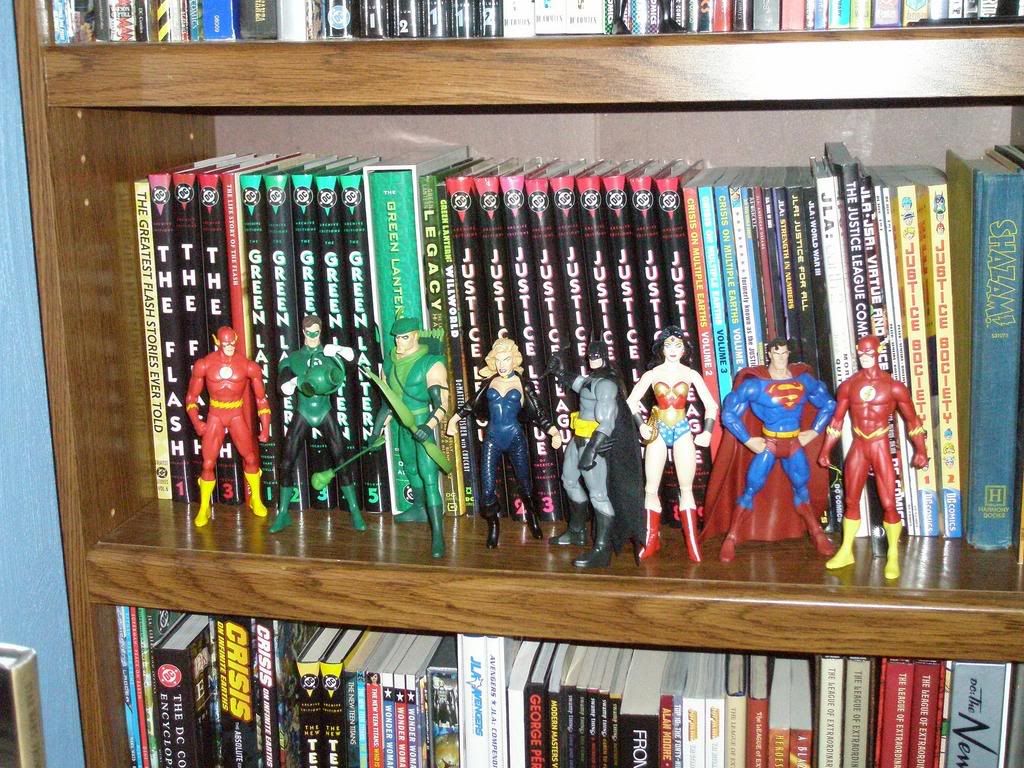
Help me decide who should go on the JLA bookshelf next:


I'm holding out for the upcoming Mattel Aquaman (classic orange outfit), and I'll probably get a Martian Manhunter at some point. I'd also like to replace Batman and Superman with figures who are more in scale with the rest.

Still, I probably won't add much more than that. There's just not that much more room on the shelf! I have an idea of who'll make the cut, but thought I'd throw it out to the select few who visit here.

So here goes: which single DC Direct/Mattel figure, from either the Satellite League or the Morrison League (reflecting the majority of books on the shelf), would you add? By my reckoning, your choices include

-- The Atom (Ray Palmer)
-- The Elongated Man
-- Firestorm (Ron Raymond/Martin Stein)
-- Green Lantern (John Stewart)
-- Hawkman & Hawkgirl (set)
-- Zatanna (fishnets, unfortunately)
-- Big Barda (in a set with Mr. Miracle & Oberon)
-- Green Lantern (Kyle Rayner)
-- Huntress (Helena Bertinelli; in a "Birds Of Prey" set with BC and Oracle)
-- Orion (upcoming)
-- Plastic Man
-- Steel (John Henry Irons)

I don't think I left anyone out. There is a Zauriel figure, but it's from the Hasbro "Total Justice" line and not in scale with these. The Zatanna figure in her period-appropriate blue-and-white superhero outfit is from the Identity Crisis line, so all her proportions are off. I'd have preferred that costume, because it reflects her time in the Satellite League, but I'll settle for the fishnets. I've seen John Stewart figures in classic and current costumes, and would use either one.

So, whaddaya think?
Full Post

Thursday, August 30, 2007

Genes, Environment, and Kryptonian Body Types

I was admiring the new Darwyn Cooke drawing of Power Girl for The Comics Journal (on display, among other places, at Written World), and it made me wonder: aren't she and Supergirl supposed to be essentially the same person? Shouldn't this mean they look the same -- or at least as similar as their cousins do?

I understand that PG (Kara Zor-L) was rocketed from Krypton-2 as an infant, at the same time as the infant Kal-L. Her spaceship just took a lot longer to arrive on Earth-2. By contrast, Supergirl (Kara Zor-El) left Argo City as a teenager and didn't age much during her trip. Therefore, I guess it's possible that their different environments (suspended animation in a spacecraft vs. artificial gravity on an asteroid) would have made Power Girl bustier and more muscular than the comparatively willowy Supergirl. PG would have also been exposed to a greater variety of stellar and cosmic radiation than her counterpart. The Earth-2 Supes is beefier than the "regular" one, as well.

So, has everyone already figured this out? Am I that slow on the uptake? Could this justify more naturalistic proportions on both characters, or is the appeal of artistic license too strong?
Full Post

Wednesday, August 08, 2007

A small question

This has been bugging me for a while: how long will The All-New Atom keep "All-New" in its title?

The cynic in me notes that the title isn't selling all that well (just under 17,000 in June), so the issue may be moot before too long.

Still, though ... issue 25? Issue 50?
Full Post

Wednesday, June 06, 2007

Cosmic Cataloguing

Let's see if I understand the development of DC’s cosmology.

* * *

A. THE UNIVERSE

1. In the Original Beginning, right after the Big Bang at the Dawn of Time, a Giant Cosmic Hand spins the first building blocks of the Universe into their starting places, as if casting bread crumbs on a lake. There’s also a single antimatter universe.

2. Millions of years later, the Oan scientist Krona attempts to observe this event, but ends up unleashing Evil on the universe. Krona’s interference also reaches back to the Dawn of Time and retroactively creates a Multiverse of infinite worlds.

* * *

B. THE MULTIVERSE

1. In the Multiversal Beginning, right after the Big Bang at the Dawn of Time, a Giant Cosmic Hand spins the first building blocks of the Multiiverse into their starting places, as if casting bread crumbs on a lake. Each parallel universe occupies the same space, but vibrates at its own unique frequency. There’s also a single antimatter universe. The planet Oa is unique to the universe of Earth-1.

2. Millions of years later, the Oan scientist Krona attempts to observe this event, but ends up unleashing Evil on the universe.

3. Millions of years after that, the Earth-Omega scientist who will become Pariah conducts his own disastrous experiment. It wakes up the Anti-Monitor and results in the first universal casualty of the antimatter wave. Pariah survives, immortal and alone.

4. Eventually, the antimatter wave gets to the last dozen or so worlds that people have actually heard of. This causes the Monitor to get off his duff and start recruiting heroes from these worlds to fight the Anti-Monitor. Of course, these events are depicted in Crisis On Infinite Earths.

5. Harbinger kills the Monitor just before the universes of Earth-1 and Earth-2 are wiped clean. Psyche! The Monitor’s death has turned his energies into a backup disk for these two universes. Soon afterwards, the universes of Earth-4, Earth-S, and Earth-X are cut and pasted onto the backup disk. Problem is, it’s only a temporary solution. The whole thing must be restarted.

6. Two teams -- one of heroes, one of villains -- travel back in time to set events aright. The villains can’t stop Krona from completing his experiment. However, the Spectre and the assembled heroes confront the Anti-Monitor at the Dawn of Time. A big white explosion takes us to...

* * *

C. THE POST-CRISIS UNIVERSE

1. In the Post-Crisis Beginning, right after the Big Bang at the Dawn of Time, a Giant Cosmic Hand spins the first building blocks of the Universe into their starting places, as if casting bread crumbs on a lake. There’s also a single antimatter universe.

2. Millions of years later, the Oan scientist Krona attempts to observe this event, but ends up unleashing Evil on the universe.

Here’s where it starts to get tricky. If Pariah was originally from another Earth, where’s he from now? If an antimatter wave wasn’t destroying parallel universes, what was it destroying? In other words, how was the post-Crisis Crisis different?

There are a couple of answers, but they’re not entirely compatible with the “one universe, no exceptions” rule which post-Crisis DC sought to enforce. First, Pariah and the other Multiversal survivors might actually be from other dimensions, like the Avengers-analogues who show up in (the post-Crisis) Justice League #3. Second, Hypertime offers a catch-all solution for many of these problems. Third, Crisis #11 indicates that there’s still *something* where Earth-2 was, it’s just a yawning void. Basically, in the years following COIE, DC had at least a few in-continuity parallel-Earth stories which contradicted the spirit, if not the letter, of COIE; and for the most part, pros and fans shrugged and moved on. Thus:

3. The post-Crisis Crisis happens. Lots of people die. Things Are Never The Same.

4. After the Crisis, “waves of time” cause random changes in order to facilitate the rebooting of several superhero titles.

5. The events of Zero Hour, too complicated to summarize here, bring all these time-anomalies to a head. A small group of heroes tries to prevent the unbalanced Hal Jordan from restarting the universe in his own image. They succeed, but guess what?

* * *

D. THE POST-ZERO HOUR* UNIVERSE

1. In the Post-Zero Hour Beginning, right after the Big Bang at the Dawn of Time, a Giant Cosmic Hand spins the first building blocks of the Universe into their starting places, as if casting bread crumbs on a lake. There’s also a single antimatter universe.

2. Millions of years later, the Oan scientist Krona attempts to observe this event, but ends up unleashing Evil on the universe.

3. The post-Zero Hour Crisis happens, probably not too differently from how the post-Crisis Crisis did. Lots of people die. Things Are Never The Same.

4. Things go on fine for a while, until a) in DC One Million, the Justice League takes a trip into the 853rd Century to meet up with Superman, who’s still alive and (it turns out) immortal, and b) in The Kingdom, a villain from the future shows up in our present to kill Superman, having already killed boatloads of Supermen on his way back in time. This leads to the discovery of Hypertime, which basically says all the old stories still exist, just like they originally happened, in their own cubbyholes of space, time, and dimension. The thing is, they’re just really really hard to access. There’s a suggestion that the Earth-2 Superman, relegated to “not dead, but still gone” limbo at the end of COIE, is still alive and punching on some Hypertime dimensional wall.

5. Nobody much likes Hypertime.

6. Instead, ZOMG!!1!! the four COIE survivors -- Superman (Kal-L) of Earth-2, his wife Lois Lane Kent, Alex Luthor of Earth-3, and Superboy (Kal-El) of Earth-Prime -- have been biding their time in the years since COIE, waiting to spring into action and fix all the bad stuff which has befallen their beloved Universe. Alex Luthor hopes that by recreating the Multiverse, the infinite monkeys on their infinite typewriters will come up with the perfect Earth that won’t need changing or revision, ever.

* * *

E. THE POST-INFINITE CRISIS MULTIVERSE

1. In the Post-Infinite Crisis Beginning, right after the Big Bang at the Dawn of Time, a Giant Cosmic Hand spins the first building blocks of the Universe into their starting places, as if casting bread crumbs on a lake. There’s also a single antimatter universe. Additionally, all the excess energy from the aftermath of Alex Luthor’s experiment creates 52 additional parallel universes, each occupying the same space as New Earth’s but inhabiting its own vibratory frequency. The histories of these 52 are altered radically by the intervention of Mr. Mind.

2. Millions of years later, the Oan scientist Krona attempts to observe the creation of (as far as he knows) the Universe, but ends up unleashing Evil.

3. The post-Infinite Crisis Crisis happens, probably not too different from the Post-Crisis Crisis. Lots of people die. Things Are Never The Same.

4. Hypertime is discovered, as before.

5. Nobody much likes Hypertime.

6. Apparently there are now 52 Monitors. They are dedicated to cleaning up all the anomalies.

* * *

And here we are. I know it doesn’t quite account for Animal Man. Still, does it all sound right?


[P.S. Yes, "Post-Zero-Hour" does sound like a '50s variety show sponsored by a cereal company.]
Full Post

Tuesday, April 17, 2007

Could, Would, Does, Part II: Evil Kids, Mismatched Moons, the Multiverse, and Green Lantern

This weekend the Star Trek Remastered episode was "And The Children Shall Lead," a ... well, just a wretched episode that I think trumps even "Spock's Brain" as the worst the Original Series offered.

It's got a creepy premise -- a research team commits suicide to keep a malevolent entity stranded on a distant planet, and their deaths leave their children vulnerable to being controlled by the entity itself -- but wow, everyone acts like idiots. I mean, no one thinks to tackle scrawny Tommy Starnes as he makes his onanistic gestures? What's worse, the kids can take over the Enterprise so easily because apparently they only need to control a half-dozen people. Never mind the other 420-odd, who are apparently fascinated by shiny objects and FreeCell. Oh, and shiny objects reminds me: daggers, Sulu? I wonder -- would that long-desired Excelsior-centered spinoff have ever featured a story where the Captain was paralyzed because he thought his ship would be Ginsu'ed open?

Sheesh. I don't even need to mention Melvin Belli's sparkly muumuu.

As you can tell, "ATCSL" really tests my defense of the wild and wacky as harmless examples of the "Does" approach. It cries out to be rehabilitated. In fact, I couldn't help but make connections between it and the plot of Star Trek V. Both feature eevil aliens manipulating the naive to bring them starships and spread their eevil throughout the galaxy, so it wouldn't be a stretch to suppose that Gorgan, the Friendly Angel, is (appropriately enough) affiliated with ST5's "God." There's probably a novel waiting to be written there, complete with flying daggers attacking Excelsior.

Of course, we could all just agree to forget "ATCSL," much as Gene Roddenberry disavowed Star Trek V, but that raises a troubling question: once those disavowals start, where do they stop? Indeed, aren't such disavowals the flip side of this whole Could, Would, Does structure? On one hand, the Does approach seems very fundamentalist, even dogmatic, in its suggestion that even the dopey stuff has value. On the other, though, a desire to justify every detail seems to lead inexorably to the Could and Would camps. I haven't quite figured out how to graph the degrees of Could, Would, and Does, but apparently one can pass through the Does realm and end up in the Could.

This kind of analysis always reminds me of "Twin Peaks." If you remember, the show made a big splash over its initial run of six or seven episodes in the spring of 1990. It then went on vacation for the summer and came back at the end of September -- the very day, in fact, that "The Best Of Both Worlds, Part 2" premiered on my local station. Oh mais oui, many donuts and slices of cherry pie were consumed that night!

Ahem. So I was watching all the "first-season" episodes, looking for clues, and noticed that at the end of the first-season finale, when Cooper is shot, the Moon was in a particular phase. However, at the beginning of the second-season opener, which picked up immediately thereafter, the Moon had changed phases. Now, at first, I thought this was a clue, because who knew what was and wasn't a clue at that point? The more I thought about it, though, the more I figured it was just a mistake -- or, in a more sinister vein, a deliberate attempt by David Lynch & Co. to screw with his viewers' heads. By the time I got to the troublesome logistics of X Files bees carrying virus-laden pollen, I was too tired of overthinking and just went with the flow.

I don't like admitting that kind of thing, because it seems antithetical to the Could approach, and the Could is a fairly rational, if somewhat obsessive, middle ground between the fundamentalisms of the Does and Would viewpoints. I'm trying to see how far the Does approach will go, but as we have seen, the Does approach ultimately sank both "Twin Peaks" and The X Files. This is -- not to put too fine a point on it -- because the Does approach could also be shorthand for "making it up as you go along," which both David Lynch and Chris Carter were doing after a while. Moreover, the cynical might well describe it as "the rubes will buy anything." I stoppped watching "Lost" when I thought its writers were headed down the same path.

Accordingly, there's a strong desire to temper the Does excesses with Could justifications. This becomes a problem when the Could-derived rules start limiting the Does-inspired possibilities. To bring this back to superheroes (thank goodness), I remember a few stories from the 1970s and early '80s which tried to establish that various parallel Earths were twenty years ahead of each other, such that the Batman of Earth-2 was 20 years older than his Earth-1 counterpart, and the Earth-1 Batman was twenty years older than some other Bruce Wayne, etc. This was the premise for the very fine story "To Kill A Legend" in Detective Comics #500, but expanded to an ongoing rule of an infinite Multiverse, it's too restrictive.

This may seem a little hypocritical, since I called the Multiverse a Could tool in the last post, but I think the difference is that the Multiverse expands storytelling possibilities, whereas rules defining it may tend to restrict those possibilities.

Take the Green Lantern mythology. A Green Lantern ring is a very Does-oriented device. The basic mechanics of the ring are also, I would argue, Does-oriented. The Guardians of the Universe use those big blue chess-club brains to generate green plasma for the Central Power Battery. The CPB then beams that energy all over the universe to thousands of individual power batteries, which in turn provide 24-hour recharges for individual rings. The setup may have been tweaked slightly since the Kyle Rayner era, but that's pretty much it. It works for the kinds of stories appropriate to Green Lantern adventures.

However, it cries out to be rationalized and justified. What kind of nanotechnology is in the rings? How much of a charge do the individual batteries hold? Is the Central Battery like a cosmic cell-tower, beaming energy invisibly throughout all creation? Mustn't that energy therefore travel faster than light? Couldn't it be intercepted? These, I feel, are the kinds of questions around which Geoff Johns could construct the last GL epic anyone would ever need or want, involving Sinestro's ultimate attempt to destroy his old masters by striking at the very supply lines of their power ...

... but once Johns does that story, laying bare all the details of How The Rings Work, then every GL writer who follows Johns, and every GL fan, will be charged with that knowledge, and if anyone wants to change The Rules, he or she might be looking at another 5-part miniseries to explain the changes.

Instead, of course, Johns decided to continue the Kyle Rayner model and abolish the yellow impurity -- ach! the only weakness that could crop up through a coloring error! -- and, I think, the 24-hour rule as well. Not that the rings became more magical, mind you. Now they're like super-tricorders, able to provide exposition at the slightest twitch of willpower. Additionally, now the Green Lanterns are more invested in procedure, thereby inviting fans to take notes for future nitpicking. There is a lot more jargon in Green Lantern and Green Lantern Corps these days, which is not all bad, just ... a little less swashbuckling.

I say that, and I've talked before about wanting the Green Lanterns to establish their jurisdictions more clearly, because in the Real World, they "Would" have to compete with local law enforcement....

Again, Could, Would, and Does all work together, and maybe with some more thought, I'll start to figure out how.

Until next time--!

Full Post

Tuesday, April 10, 2007

Could, Would, Does

Can't remember where I saw the article -- maybe in an old Best of TREK paperback, maybe in The Physics of Star Trek -- but it stated flat out that the transporter represented technology so advanced, it didn't even fit with what the 23rd Century otherwise showed was possible. In other words, going by the rest of the Federation, Klingons, etc., technological achievements, none of them should even be close to having a working matter-transportation system.

And yet there it is, like the proverbial bee that physics says can't fly.

This may end up being a half-formed post full of half-baked ideas, but I'm on a sugar high from Easter candy. Buckle up, folks:

Are there only three kinds of superhero stories?

Any superhero story involves at least one idea that separates it from what we consider the real world. Accordingly, any superhero story makes a case for how a given Concept X either a) could work, b) would work, or c) does work.

“Could” stories include most retcons, but they also include stories which rely on a lot of “realistic” jargon. “The Anatomy Lesson” is a classic Could story, as is Alan Moore’s explanation for including the ‘50s Marvelman stories in his revamp. However, those Chuck Dixon Batman stories that tell you the costumes are made of Nomex and Kevlar are also Could stories. Basically, a Could story says that Concept X is workable on its face, but flawed in its execution. The Could approach says that Swamp Thing can have Alec Holland’s memories, and Mickey Moran can have ‘50s adventures, but they need these retcons to do so. Likewise, Batman would be ventilated like a breezeway without that Nomex and Kevlar. Superhero comics today rely heavily upon the Could approach. Batman Begins is a very Could movie.

The pinnacle of all “Would” stories, at least for superheroes, is Watchmen. Would stories are declarative and definitive. Civil War is a Would story. Miracleman Book 3 (where he confronts Margaret Thatcher and ends up ruling the world) is a Would story. Ruins, where the spider bite gives Peter Parker cancer (right? didn’t read it) is a Would story. Supreme Power is a Would story. Would stories are generally depressing.

However, in a sense, the early Marvel superhero titles are also Would stories, because by and large, they allow a generous amount of real-world influence. Peter Parker takes his Spider-Man act to TV, much like the JMS-flavored Blur becomes a product pitchman. The Fantastic Four likewise become celebrities, and their public identities give them a new set of problems. The Hulk is pursued by the Army. Even Captain America is taken wholesale from the last days of World War II and plopped into the 1960s. Early Marvel was doing riffs not just on DC-style superheroes, but also on its own pre-superhero comics, using those disparate ancestors to say that its new superheroes “would” act differently, and specifically more “realistically.”

Once a superhero universe gets established, though, it starts to make its own rules, and therein lie the potential for divergences. “Flash Of Two Worlds” was a Could story. Dick Grayson leaving for college in “One Bullet Too Many!” was a Would story, but the eventual Robin/Nightwing succession was a Could story. It all comes down to the extent to which reality influences the fantastic. The most obvious real-world influence is the passage of time, and its acknowledgment is at the heart of both the Multiverse and the Dick-to-Jason transition. (It’s also at the core of DC’s problems with Captain Marvel, but that’s a topic for another day.)

That leaves the Does stories. All-Star Superman is a Does title, as is most of Morrison’s superhero work. By implication, then, the Mort Weisinger Superman of the Silver Age, and the Jack Schiff Batman of the ‘50s and early ‘60s, are Does stories. Instead of starting with the real world and incorporating the superheroes, they start with the superheroes and incorporate the real world. Hogwarts is a Does environment. Calvin and Hobbes was a Does strip. The Does stories are, at least theoretically, the most fun, but they put the burden most squarely on the creators.

See, the Could stories work from the outside in, relying on a knowledge base that is fairly public. It’s like fan fiction (to my fanfic-untrained eye): both extrapolate, or interpolate, based on identifiable bits of continuity. When we say Reed Richards is acting out of character, we are saying that our extrapolation/interpolation doesn’t match up with JMS’ or Millar’s. In that event, we need a Dwayne McDuffie to insert another knowledge bit -- another variable that “makes the math work” (allusion intended).

In that respect, the Could stories and fanfic are two sides of the same approach. Both look at the deficiencies in Concept X and try to fix them with real-world rules. By contrast, the Does stories attempt to identify the “rules” of a fantastic/superheroic world and construct their stories around those rules -- which may be, and probably should be, somewhat different.

Accordingly, the Does stories are the most vital, because they appear to be the only avenues for generating raw story material. Both the Could and the Would stories can put new spins on old material, but the Does stories provide the grist for the Could and Would mills. The Does stories are special for this reason, because almost by definition they are not predictable.

Now, this is not to say the Does stories are perfect. Plok reminded me in an e-mail that I already effectively labeled "Spock's Brain" a Does story. It was in a comment on Jim Roeg's blog back when Civil War ended:

...I imagine Data or Bashir or the Doctor cornering Admiral McCoy at some cocktail party and asking some winking question about "...so, you really got it reattached?" and rather than getting some remodulated Treknomedibabble answer, just having Bones shrug and smile. Oh well, these things happen. You don't have to explain everything, because once you do, you're limited by the explanation.
Obviously we're talking about the willing suspension of disbelief here, and the degrees to which we can accept those suspensions. "Spock's Brain" is pushing it, but the point is, it's something new. It's grist for the mill. You can't construct a retcon around it if it doesn't exist in the first place.

And that, I think, is the chance one takes by stepping out on that limb marked "Brain And Brain..." or postulating that a device can disassemble someone on a quantum level and reassemble him -- body, mind, and spirit, remember -- thousands of kilometers away. The transporter was born out of budgetary necessity (much like "SB's" invisible alien ship, come to think of it), because it made the series work regardless of whether it worked within the context of the series.

It's hard for me to pin down exactly how I feel about the Does stories, because ultimately, I just appreciate the creativity on display. Again, the Could and the Would stories are predictable to various degrees because they rely upon real-world rules. Readers are comfortable with them because they trust the rules of this world. The Does stories require the reader to put his trust in the creative team, and sometimes when you're talking about the fantastic that's not as comforting. It can be hard to embrace these kinds of stories, because to a certain extent that can involve choosing fantasy over reality, and that can be an awful choice....

... so instead we bring the real world into the fantastic, and we end up with the Coulds and the Woulds.

I dunno. I could go on for a little while longer about how "protomatter" represents the fudge factor of creativity, but I'm getting tired and you probably are as well. The point is, we readers (and writers, more often than not) keep trying to solve the mysteries of these universes, when their mysteries are their raisons d'etre.

What do you think?
Full Post

Wednesday, January 31, 2007

Prison breaks

In the old days, when editor's notes rolled across the prairie like an ocean of asterisks, the superhero books would show crooks being caught and, presumably, tried and incarcerated. Later, when it was time for them to cause trouble again, they'd be shown escaping from prison because, naturally, the escape would help demonstrate how dangerous they were. An editor's note might even pop up to remind us how long they'd been in the pen.

Does anybody show that part of the process anymore? Generally speaking, do DC and Marvel track their supervillains' movements that closely, or do they just treat them as free-range bad guys who are not so much captured as temporarily thwarted? If anyone has examples, please feel free to share. I can't think of any off the top of my head, but I'm not thinking too hard....
Full Post