Showing posts with label new teen titans. Show all posts

Tuesday, September 15, 2009

New comics 9/10/09

Another light week this week, in part because I got to the shop too late for new issues of Wednesday Comics and Warlord. It still leaves Blackest Night: Batman #2, Booster Gold #24, Doom Patrol #2, Green Lantern Corps #40, Secret Six #13, Superman: World Of New Krypton #7, Titans #17, and The Unwritten #5.

Tune in as I use the word "gratuitous" in a way that may seem, well, gratuitous; marvel as a "pal" gets the boot; admire the squickiness of Secret Six, and observe the unfortunate juxtaposition of a thong and hot dog. Olivia contributes comments in the background. Music, as always, is by R.E.M.

Download it here, listen to it via the player at right, or visit the podcast homepage here.

Happy listening!
Full Post

Friday, August 28, 2009

New comics 8/26/09

My throat's still a little sore, but the new comics just keep coming--!

Therefore, get ready for 32 minutes' worth of Batman And Robin #3, Blackest Night: Titans #1, Detective Comics #856, Fantastic Four #570, Flash: Rebirth #4, Gotham City Sirens #3, Green Lantern #45, Madame Xanadu #14, Superman #691, Superman's Pal Jimmy Olsen Special #2, Unknown Soldier #11, Wednesday Comics #8, and Wonder Woman #35. Can you handle it?

Music, of course, is by R.E.M.

Download it directly here, stream it directly from the player on this here site, or go to the podcast homepage here. Happy listening!
Full Post

Sunday, August 16, 2009

New comics 8/12/09

For this week's 40 minutes of heck, I try to balance a rant about Dr. Mid-Nite and some Blair Butler bewilderment with some memories of the classic New Teen Titans and nice words about Wednesday Comics' "Wonder Woman."

Specifically, it's Action Comics #880, Adventure Comics #1, Batman #689, Blackest Night #2, Blackest Night: Batman #1, Booster Gold #23, Green Arrow/Black Canary #23, Green Lantern Corps #39, JSA Vs. Kobra #3, Titans #16, The Unwritten #4, and Wednesday Comics #6. Plus, Olivia gets another cameo!

Download it directly here, visit the podcast homepage here, or cast your eyes to the player at right.

Music, as always, by R.E.M.
Full Post

Thursday, July 16, 2009

New comics 7/15/09

In this week's podcast: Action Comics #879, Agents Of Atlas #8, Batman: Streets Of Gotham #2, Blackest Night #1, Blackest Night: Tales of the Corps #1, Brave and the Bold #25, Captain America #601, JSA Vs. Kobra #2, Rasl #5, Titans #15, Wednesday Comics #2, and Prince Valiant Vol. 1: 1937-38.

I hope I have fixed some of the lingering technical issues (which I further hope no one minded in the last episode), and of course I am still working on my elocution. Early on, Olivia even offered her own comments in the background. (The music, once again, is by R.E.M.)

Download it here, or visit the podcast homepage here. Thanks for listening!
Full Post

Friday, March 13, 2009

Two new comics, 3/11/09

Longtime readers may remember that I used to post weekly new-comics roundups (I hesitated to call them "reviews") about a particular set of purchases. Between annotating Trinity and looking after a new baby, I got out of the habit of doing those.

However, this week I read two comics which, if not exactly polar opposites in terms of quality, were at least headed in different directions as far as merit was concerned. I was surprised at how much I liked one, and how much I disliked the other. Therefore, let's talk about Titans #12 and Batman: Battle For The Cowl #1.

* * *

First, though, just to be complete, I'll run down briefly the rest of Wednesday's haul. I covered Trinity #41 over at Robot 6. Batman Confidential #27 was Part 2 of the "hey, it's King Tut! In the comics!" story. It brings one of the '60s TV show's more ridiculous villains (and that's saying something) into the serious Batman comics after forty-odd years, but the story is neither goofy nor overly grim. Instead, Tut is creepy and mysterious, so much so that Batman is forced to turn to the Riddler for help. The result is an engaging mystery with snappy writing and great art.

I'll have to read back issues of Booster Gold and the Superman books to get a better idea for this week's developments (in Booster Gold #18 and Action Comics #875). I liked both fine, but each depended on the culmination of long-running plot threads. Same is true to a certain extent for Green Lantern Corps #34, although that issue was more setup than anything else.

Finally, I'm not sure how I feel about Green Arrow/Black Canary #18. It's three issues into the new writer's first arc, but he doesn't seem to have the best handle on the characters, and the "Green Arrow has a stalker" plot feels very familiar.

0n to the main event....

* * *

It's no exaggeration to say that the relaunched Titans has had its problems. In the first eleven issues and the Titans East special, the book has had a handful of different artists (and wildly divergent artistic styles). Although the writer, Judd Winick, has stayed the same, he's been criticized for failures of characterization and plotting. Next month begins "Deathtrap," a crossover with Teen Titans and Vigilante, two books I don't read. Accordingly, it would be easy for me to drop Titans, but something keeps me going.

Titans #12, guest-written by Sean McKeever, penciled by Howard Porter, inked by Wayne Faucher, and colored by Edgar Delgado, was a good example of what the title could be. Titans is essentially a revival of New Teen Titans, so it treads the dangerous ground of, say, a sequel called "fortysomething" (or, to my mind, a "Friends" reunion). At its core it must make the argument that this particular combination of characters -- Cyborg, Starfire, Raven, Beast Boy, Wonder Girl/Troia, Speedy/Red Arrow, and Kid Flash/Flash -- still works, and is still worth watching. So far Titans had been coasting on the assumption that its existence didn't need justifying.

However, this issue finds two members debating just that. Ex-member Jericho has turned evil, and since he can inhabit anyone's body and control anyone's actions, everyone else is on edge. As a result, when Donna and Roy meet for coffee, neither of them is particularly thrilled to go on like they have been. When Raven rebuffs Beast Boy's attempts at romance, he exclaims desperately that Jericho must be inside her, toying with him.

The other characters don't have quite as much to do with the Jericho plot, but they were more recognizable to me than they had been. Starfire, whose powers come from solar energy, gets a few pages to worship the sunrise in a way which is reverential, not prurient. Later in the issue, she and Donna meet at dusk for a photography lesson. Roy's conversation with Donna is sandwiched between leaving one lover (after busting up a mugging outside her window) and almost reluctantly picking up another. In a sign that he too might be leaving the team, Wally "Flash" West's only scenes are with his family, and by itself the scene doesn't really go anywhere. Finally, Cyborg's work in Titans Compound bookends the issue and sets up "Deathtrap."

I became increasingly dissatisfied with Sean McKeever's work on Teen Titans because I felt myself caring less about the characters, not more. Maybe I'm bringing too much of my own knowledge of these characters to this issue, but I found McKeever's writing here to be subtle and almost elegant in its efficiency. When Roy returns to his one-night-stand's apartment after fighting the muggers, she's eager for breakfast (and more), but the only thing he says to her is that he just came back to get his wallet. McKeever lets the art (and especially the coloring) speak for itself with regard to Starfire's sunrise-worship. Similarly, Starfire's conversation with Donna consists of the simple, direct sentences which old friends use as shorthand. Probably the clunkiest bits of dialogue are the ones with the most romantic tension, between ex-lovers Donna and Roy and would-be lovers Raven and Beast Boy.

On the whole I enjoyed the art of Howard Porter and Wayne Faucher, augmented by Edgar Delgado's colors. Porter can't quite settle on Roy's hairstyle, which makes him look like Wally; and his layouts of Raven's head over the "montage" of the last few pages doesn't quite work. Still, Porter and Faucher produce clean, readable work. It's stylized somewhat, but not to the point of distraction; and except for Wally and Roy it allows the characters to have distinct personalities.

Overall I was quite happy with Titans #12. It's the kind of issue which highlights this sort of book's soap-opera elements without swamping the reader in them. I thought all of the subplots touched on here were explained adequately, so as not to mystify a new reader. I'm curious about the next issue, and that's the kind of feeling a serialized comic book should produce.

* * *

Naturally, Batman: Battle for the Cowl #1, which was written and penciled by Tony Daniel, inked by Sandu Florea, and colored by Ian Hannin, is something else entirely. BFTC #1 drops the reader into the middle of a Gotham City gone insane. Because Batman is Teh Dedd, all the gangs and super-criminals are battling for turf. Trying to hold everything together is a motley crew of Bat-sociates, organized by Nightwing and Batgirl (but mostly by Nightwing, as Batgirl gets maybe one panel in this issue).

But soft! Whither goest yon red-eyed wraith with the Wayne-issue Batarangs? 'Tis a new Batman, taking out a trio of thugs wearing clown masks left over from The Dark Knight before Robin and the Squire (the British version of Robin) can get to them. This Batman knows enough about How Not To Be Seen to slip past experienced crimefighters, but they know he's Batman because, along with those Batarangs, he leaves helpful notes which say "I Am Batman."

And that, in a nutshell, is BFTC #1's main problem: its apocalyptic setting is based on there being No Batman, but in the first few pages it introduces I-Am-Batman. What's more, even though the streets are full of bad guys battling SWAT teams, Gotham is apparently safe enough for ordinary people to gather into mobs, just to drive home the point that society is breaking down. Granted, I've never been part of a city in turmoil, but it seems to me that if the streets aren't safe, is it really such a good idea to go out into the streets in large groups to highlight this lack of safety?

Still, as always, Gotham gets the local bureaucracy it deserves; because wouldn't you know it, everyone in Arkham Asylum -- the Joker, Poison Ivy, the Scarecrow, that guy with the shark-teeth -- is currently in low-security buses (buses!) while the Asylum is being fumigated. (Actually, narration explains that the Asylum is being decontaminated after the Black Glove's shenanigans.) This sets up the dramatic return of Black Mask, who hijacks the convoy and blows up Arkham Asylum.

That's about it for setup: new Batman, mayhem in the streets, super-crooks on the loose. In other hands it might be pretty exciting. However, under Tony Daniel, BFTC #1 is overwritten, uninspired, crowded, and generally just a lot of sound and fury. From the very first panel, when Daniel started with an establishing "Gotham City" caption and then had Robin narrate four sentences later that yes, they were in Gotham City, I knew it would be tough going. (I was willing to overlook Robin saying "Squire and I" when it should have been "and me.") I've mentioned some of the nonsensical plot elements already, but they're worth repeating. Instead of a city filled with protesters, gangs, cops, and supervillains, why not a ghost town of empty streets, distant fires, and a general air of hopelessness? Instead of Black Mask co-opting the Arkham residents by hijacking their bus convoy, why not show how these master criminals each attempting to escape? BFTC #1 is so concerned with getting all its ducks in a row that it never thinks about the ducks themselves.

Moreover, BFTC saves its worst element for last, in the form of Bruce Wayne's and Talia al Ghul's son Damian. Grant Morrison gave Damian -- who, if memory serves, grew up alongside the League of Assassins -- a bratty bad attitude and a mean sense of entitlement. Here, though, he's a posturing little kid whose facade crumbles, and literally screams for Mommy, when faced with Killer Croc and Poison Ivy. Morrison's Damian wouldn't just take this kid's lunch money, he'd make him eat it.

Daniel doesn't explain who Damian is, though, similarly failing to give a hypothetical new reader any information on the Knight, the Squire, or any of the several other superheroes -- some, like Black Canary, the Birds of Prey, and Wildcat, only tangentially related to Batman -- who flit through this issue's panels. I can live with assuming that everyone knows Nightwing's relation to Batman, but Robin's reference to "my father's costume" seemed to come out of left field, even knowing that Bruce adopted Tim three years ago.

All in all, Battle for the Cowl #1 is a story outline in comic-book form, filling a spot on DC's production schedule until everything settles down in June. I realize that the two main Batman books have had their own scheduling problems lately, and Robin, Nightwing, and Birds Of Prey were canceled to make room for the post-BFTC lineup, but considering the events of this issue makes me wish even more that the storyline had been serialized at least across Batman and Detective. Not only could it have built suspense (the Arkham inmates have to be moved! The police might strike!) over a few weeks, it could have pulled all of these elements into a more coherent narrative. Instead, BFTC looks like an exercise in Here's What Happened, a process-oriented miniseries in danger of being ignored.
Full Post

Wednesday, March 11, 2009

From bad to ... actually, not so bad?

This may be the week which gets me back into weekly-comics-roundup mode.

This week I bought both Battle For The Cowl #1 and Titans #12.

One of those was really pretty decent.

More later.
Full Post

Saturday, February 21, 2009

Thoughts on Donna Troy and "Dollhouse"; or, If You Wait Long Enough, It Gets Better

Last night I was taking care of a couple of nerd obligations -- watching "Dollhouse," because clearly someone has to; and trying to come up with my fifth list item for Tom Spurgeon's "Five For Friday" feature -- and found myself flipping through the Who Is Donna Troy? paperback collection.

WIDT? features the eponymous story from The New Teen Titans vol. 1 #38 (January 1984) in which Robin helps Wonder Girl reconnect with her past. It follows that one with Tales of the Teen Titans #50 (January 1985), the double-sized issue chronicling Donna's wedding. After a five-issue Titans storyline involving Donna's secret outer-space origin, it concludes with a short piece about Donna's memorial service (she was killed in a story not reprinted here).

It's no stretch to say that Donna -- or, perhaps more specifically, Wonder Girl -- has had a strange and complicated history. "Wonder Girl," like "Superboy," started out as the teenage version of an adult hero. Thus, Wonder Girl was the younger Wonder Woman. However, as the Wonder Woman comics got increasingly crazy in the 1950s and early '60s, the adult Wonder Woman found herself teaming up not only with Wonder Girl, but with the toddler Wonder Tot. The story goes that, when the time came to create a super-team for the teen sidekicks of adult heroes, the editor noticed only that there was a Wonder Girl, and put her on the roster without checking to see where she came from. Consequently, the "Wonder Girl" who first appeared with the Teen Titans in 1965 didn't get a separate origin, or even a real name, for four years. The first mention of the name "Donna Troy" came in Teen Titans vol. 1 #22 (July-August 1969), courtesy of writer Marv Wolfman.

Of course, Wolfman and artist George Perez would go on to produce most of the stories reprinted in the aforementioned paperback, and that's really where I want to start. Unlike her colleagues, Donna didn't have that much of a history from which character traits could be derived. Robin was struggling with independence from Batman, Kid Flash was already in semi-retirement, and Speedy had that unfortunate junkie phase. Therefore, it wasn't hard for Wolfman and Perez (and especially Wolfman) to flesh out Donna as everyone's friend, and sort of the wholesome girl-next-door. Since she had no real history, pros and fans alike could see whatever they wanted in her.

Naturally, that kind of approach can produce a creepy slippery slope, where Donna stays popular and loved because we said so. In 2003, Donna was killed (for all intents and purposes) in a fairly ignominious way at the climax of a miniseries designed to reshuffle DC's teen-hero and former-teen-hero team books. It was done mostly for shock value, since the reactions of various characters would cause said reshuffling. However, those were the characters: the book in which Donna appeared, Titans, never got as much attention as DC had hoped, and certainly not as much as the other team being broken up, Young Justice. Thus, on one level, Donna's death was an opportunity for the characters to voice what DC presumed would be the fans' reaction -- except that by 2003, Donna's popular days were at least about ten (and probably closer to 15) years behind her. Younger fans wouldn't have connected with Donna the way the older fans had; and we older fans had, I suspect, become jaded and bitter about superhero death anyway.

Still, Donna's death led to the last story in the Who Is Donna Troy? collection, writer/artist Phil Jiminez' account of Donna's wake. Jiminez is a huge fan of all things Wonder Woman and Teen Titans, and had drawn the JLA/Titans miniseries which led into the Titans ongoing which was cancelled as a part of Donna's death. This made Jiminez an especially appropriate choice to eulogize Donna. His story is rife with the kind of references and in-jokes which we enlightened superhero fans are supposed to condemn as "inaccessible."

Regardless, if like me you recognize the references (notwithstanding the fact that they refer to earlier stories in the WIDT? book), or if you know the significance of the "HELLO MY NAME IS DONNA" doll, odds are you'll find the story moving, as I did. The pivotal moments in Donna's life -- finding her real family, getting married, dying in battle -- resonate with those who "knew" her, because they are built on the readers' own hopes and dreams. I'm convinced that the fans who like Donna Troy actively want to like her in a way that other characters with more established histories don't facilitate.

What's this have to do with "Dollhouse?" Well, it's not that Donna is a blank slate on the order of Echo, or that people who like Eliza Dushku really like Eliza Dushku in some preternatural way. Instead, it's the notion that a series can be actively challenging to its viewers for a while, almost daring them to watch; and then turn a corner, change things up, and become all-of-a-sudden "good."

By now we all know the criticisms of the show's premise. Last week's episode reinforced those criticisms: why go through a shadowy criminal enterprise when you could hire a real person, etc. Last night's episode helped justify the Dollhouse's business plan, even if it raised still more questions (as pillock observes, what kind of infrastructure must it have?). However, it was a step in the right direction. Apparently the back half of this batch of episodes really reveals the point of the series, and these we're seeing now (including that debut episode, which I gather was reworked heavily) are just standalone warmups.

Question is, though, how much of the bad stuff must we wade through before that corner to Qualityville is turned? I have watched the first episodes of both "Farscape" and "Babylon 5" and wasn't sufficiently intrigued to continue with either; but I stuck with any number of shows which started out fair-to-middling and only hit their stride after a year or two. Whether I became more receptive to their individual charms, or they each simply got better, is something of a moot point; because in the end, the result is the same. You sit through a lot of fair-to-middling stuff so that the payoffs will matter more. "All Good Things..." was a reward for watching "Encounter At Farpoint." DS9's "What You Leave Behind" even included a montage. I know I'll be paying special attention to the Final Five's early scenes whenever I watch "Galactica 2.0" all the way through. "Lost" seems to be composed exclusively of buried details. Accordingly, if "Dollhouse" lasts long enough to build up its own macro-story, I'm sure I'll look back on these early episodes with a more practiced eye. That doesn't mean they were necessarily good ... just that they were, I don't know, tolerable. I'm not real comfortable spending my time just on the tolerable, but obviously I do believe in giving a show a chance to prove itself.

Going back to Donna, I do think that "Who Is Donna Troy?" and "We Are Gathered Here Today" (the wedding issue) were, by themselves, good comics. By that I mean that they were crafted well enough so that the emotional moments were built on elements from the stories themselves, and not merely on the reader's pre-existing awareness of the character. Sure, it helped if you knew Dick and Donna's relationship, and especially Donna and Terry's, but I read each of those for the first time when I had been away from comics for a couple of years. In this respect I think Perez's layouts and character direction help greatly, especially with the wedding. Talking about these stories in the context of the overall series, I thought they succeeded
almost despite the fact that there's not much more to Donna beyond being pretty and nice. However, the peculiar alchemy Wolfman and Perez were able to use on her has turned that around into a kind of unequivocal goodwill -- that because she's so nice, we don't want anything bad to happen to her, and we even actively wish her well.

To be clear, that kind of success is in addition to whatever enjoyment a reader new to the whole Donna thing gets out of those stories. Donna went through a lot of mediocre stories before Wolfman and Perez came along, and the duo didn't make her a star overnight either.

That's the appeal of serial superhero comics, though, isn't it? Even the bad stuff gets repurposed eventually ... except the really quite extraordinarily bad stuff (like the "Teen Tony" Iron Man or the Team Titans book), which is annihilated in the metaphorial incinerator. Still, if even the bad stuff has some potential value, aren't we just lowering standards with each bad element?

More than likely, I suppose ... but regardless, it sounds like I've been suckered into "Dollhouse" for a while....
Full Post

Tuesday, June 17, 2008

New comics 6/11/08

Booster Gold #10 (written by Geoff Johns and Jeff Katz, pencilled by Dan Jurgens, inked by Norm Rapmund) feels a little "off" to me, and I don't quite know why. It's probably because there's so much going on. Rip Hunter narrates for a couple of pages, with his Chalkboard Of Destiny (TM) distracting the reader in the background. Booster takes over as the scene switches to the scrum with Max's forces ... and here, I think, is where things get too overloaded. Essentially the rest of the book takes place in and around a big superhero fight involving -- get ready -- a reunited Justice League International (including Guy Gardner, the good Doctor Light, J'Onn J'Onzz, and Batman); Superman; Max Lord; the original version of Despero; the white-ape Ultra-Humanite; Per Degaton; Black Beetle; Ted "Blue Beetle" Kord; Maximillian (the evil Skeets); Booster and his dad; and the Mystery Villain. Oh, and I forgot the interlude with Rip and the time bubble.

Johns and Katz and Jurgens do their best to break out of the fight the important character-based scenes involving Booster and his dad, the Beetles, and the sidekick droids; but even so, there's still a lot going on in the background. In other words, the scenes aren't put in perspective like they should be, so the rest of the players feel like distractions and/or afterthoughts. What's more -- and I admit this may be just me -- I couldn't remember the non-sacrificial function of the vehicle for the eventual heroic sacrifice. (Said sacrifice plays out like Wrath of Khan, or the last Lone Gunmen appearance, by the way.) There's a sacrifice, but I don't know what else it accomplished. We'll find out next issue, I guess.

Anyway, it's not a bad issue, and it may well play out better in context. It's just a frustrating installment for this month.

Most of The Last Defenders #4 (written by Joe Casey, pencilled by Jim Muniz, inked by Cam Smith) finds Nighthawk on the wrong side of just about everybody, as the term "non-team" starts to take on its most literal meaning. I thought it was fine, but once again, there's a lot going on in the background which apparently only has two issues to resolve itself.

Star Wars: Rebellion #14 (written by Jeremy Barlow, drawn by Colin Wilson) wraps up the current story arc with a lot of action, and a little denouement. There's a suggestion that Luke and Deena Shan are a little sweet on each other, and since this is the interstitial period leading up to Empire, I'm all for anything which gets him away from those understandable-but-creepy-in-hindsight feelings he showed for Leia. I have to admit I'm not as up on my Expanded Universe characters as I should be, or else I'd probably be more sympathetic to them. Still, I can accept how the narration builds Deena up, and I always like seeing spaceship combat. Once again the art reminds me of Howard Chaykin's early SW work from thirty years ago, except the brief glimpse we get of Han seems a little too paunchy for the whip-thin Harrison Ford of 1977. Pretty good if you've been with this story the whole way; probably better the more you know.

This month in Batman Confidential (#18 written by Fabian Nicieza and drawn by Kevin Maguire), Batgirl and Catwoman inch that much closer to making X-rated Internet fanfic mainstream, as they spend the first 10 pages naked from the neck down, fighting in a nudist club. The fact that Maguire draws Babs with all these extremely uncomfortable expressions and retreating body language doesn't make it better. If last month was an excuse for cheesecake, this month drops the pretense ... uh, as it were. As much as I like him, Maguire's figures are just rendered too literally for this extended sequence to be farcical. Maybe someone with a softer style could have pulled it off (what?!? sorry!) better. Cliff Chiang's "Naked Ollie" chases from Green Arrow/Black Canary come to mind, so Chiang or his designated replacement Mike Norton might have done well with this. Anyway, everyone puts their clothes on for the rest of the issue, and I presume the rest of the story. (There's only so many opportunities to play the nude card.) It's pretty entertaining, especially since it focuses on puppies. I am not kidding. It's almost like DC felt like it needed to atone for the nearly-nude scenes with, yes, puppies. So, in summary, come for the cheap thrills, stay for the puppies!

(P.S. DC, if you use that as a blurb, I'd at least like a free copy of the paperback.)

The "Barbarian Queen" scenes in Wonder Woman #21 (written by Gail Simone, pencilled by Aaron Lopresti, inked by Matt Ryan) are fine, but I want to mention the Sarge Steel/Tom Tresser bit which opens the issue. On its own it's good: a typical "walk with me" scene which sets up a few familiar conflicts and advances the plot. However, these are two well-established spy characters who, by virtue of their respective careers, should interact on a higher level. Tom "Nemesis" Tresser had his own backup series in The Brave and the Bold, teamed up with Batman a couple of times, and was in the Suicide Squad; and Sarge Steel was Charlton Comics' answer to Nick Fury. So if this scene involved, say, Dirk Anger and Jimmy Olsen, it'd be easier to take.

As for Wonder Woman, her posse of '70s DC barbarians continues to grow, along with the savagery of her fights. "Losing her grip" is, I think, a fairly radical direction for the character, because it seems like most writers want to portray her as always in control, diplomatic, etc. However, it's still a valid direction; and I think Simone has presented it well. Diana's finding out what she's like without the fundamental sources of her strength. The art in the "barbarian" section is also tighter and darker, with more attention paid to the blacks and a more washed-out color palette (credit colorist Brad Anderson for that). Add a couple of callbacks to Simone's first arc and it makes for a good issue.

Green Lantern Corps #25 (written by Peter J. Tomasi, pencilled by Patrick Gleason, inked by Drew Geraci) presents the origin of the Black Mercy plant. It's a sensible, space-opera-y origin which maybe brings in Mongul a little too neatly, but it sends the story in a very Star Trek direction. New inker Geraci fits well with Gleason's pencils, giving them a little more definition in places and even putting a "cartoony" sheen on some of the figures. There's a misplaced word balloon on page 2, and there's more foreshadowing about different-color lanterns, but other than that it's pretty good.

About half of Green Arrow And Black Canary #9 (written by Judd Winick, pencilled by Mike Norton, inked by Wayne Faucher) features Plastic Man, with the other half showing Speedy and the British guy fighting super-powered bad guys. Thanks to Norton and Faucher, it's all portrayed with a light, breezy tone, which certainly makes some of Speedy's quips easier to take. Norton and Faucher draw a good Plastic Man too -- perhaps even nicer than what cover artist Cliff Chiang might have done. The issue builds to a couple of Dramatic Reveals: the bad guys' employer (which is pretty obvious) and the next guest-star (also not unexpected, but not unwelcome either). I continue to like this book.

Action Comics #866 (written by Geoff Johns, pencilled by Gary Frank, inked by Jon Sibal) is a heck of a start to the latest Brainiac storyline. The Daily Planet newsroom welcomes Steve Lombard, sports brute; and welcomes back noted innuendophile Cat Grant. Frank and Sibal really lay on the Christopher Reeve and Margot Kidder references for Clark and Lois, but it's all good. (Cat looks like she had a familiar model too, but I can't place her.) However, the showpiece of the issue is Brainiac's abduction of Kandor, shown in flashback (naturally) with references to General Zod and Brainiac's Kryptonian origins. To say that Brainiac now = Borg + Alien wouldn't do it justice. It's cold, scary stuff which sets up his threat level very well. Still, there is a bit of Borg plotting in place: Superman defeats a pawn, but the "king" is still out there....

Trinity #2 (written by Kurt Busiek, pencilled by Mark Bagley, inked by Art Thibert) finds the Trinitarians battling personalized threats: rogue solar systems, giant robots, and a mystical metropolis. It's nice to see each handle their own in the space of a few pages or so. Meanwhile, in the second story (written by Busiek and Fabian Nicieza, pencilled by Tom Derenick, inked by Wayne Faucher), Green Lantern John Stewart fights Konvikt and Graak in a sleepy Massachusetts town square. So far Trinity looks like superhero comfort food, and if it continues like this I suspect I won't have too many bad things to say about it.

Finally, here's Titans #3 (written by Judd Winick, pencilled by Joe Benitez, inked by various people), a frustrating installment of a series which has yet to define itself. Benitez' art has personality, but he doesn't have a handle on these characters. I hate to go all fanboy, but in an early pedeconference scene, all the characters are the same height. At the very least Starfire should be the tallest, but in a long shot she looks shorter than the Flash. Likewise, Beast Boy and Raven should probably be the shortest. These aren't just stylistic choices, they inform the characters' personalities.

The plot of the issue involves the Titans pairing off, with unfortunate results. While there's an in-story explanation, the sad thing is that the book has already established its willingness to "push the envelope" with regard to these characters, so we don't know how much of their behavior was provoked. I'm not saying the Titans should always be hugging, but Winick hasn't done much to lay a foundation for their normal behavior. I'd like to think this book will find its equilibrium sooner rather than later, but it might not happen for a few more months.
Full Post

Tuesday, May 20, 2008

New comics 5/14/08

I wasn't planning on buying any more of Secret Invasion than I had to, but I was intrigued by the last page of Secret Invasion: Fantastic Four #1 (written by Roberto Aguirre-Sacasa, pencilled by Barry Kitson, inked by Mick Gray). I won't spoil it for you, but it is a callback to an era I didn't think Marvel was in a mood to revisit. The rest of the issue is standard FF fare, following a Skrull infiltrator's sabotage of the Baxter Building. That's not the real story, though; and that's where the last page comes in. I've not read Aguirre-Sacasa's FF work before, but he does a good job here, getting through exposition about the sabotage and SI generally in an efficient manner. Barry Kitson's work is less cluttered than, say, his Legion pencils, and although Mick Gray has inked him before, the work doesn't seem as rigid. Overall, it's a nice-looking book that will probably work well as a standalone Skrull adventure.

Serenity: Better Days #3 (written by Joss Whedon and Brett Matthews, drawn by Will Conrad) finds the crew having to rescue Mal, which was kind of a surprise to me because I didn't remember the last issue leaving off with that. In fact, this whole miniseries has seemed disjointed, issue-to-issue. It also feels a bit short, like it could have used at least one more installment. Anyway, this one is fine for what it is -- Whedon and Matthews obviously have the characters' voices cold; and Conrad does fine with the likenesses and the storytelling. Maybe in a chunk it will read better, so maybe I should be waiting for the trades instead.

The same may be true for Last Defenders #3 (written by Joe Casey, pencilled by Jim Muniz, inked by Cam Smith), which is starting to veer too much into arcane-Marvel territory for me. I don't have a problem with the dialogue or the art, but I get the feeling that I'm supposed to be more emotionally affected by the plot.

Huntress: Year One #1 (written by Ivory Madison, pencilled by Cliff Richards, inked by Art Thibert) is in a weird position. The modern version of the character has been around for almost twenty years. For much of that time she was a B-list character in the Batman books. She resented Batman for not trusting her (join the club), she teamed up with Robin, and slept with Nightwing. She had two stints in the Justice League, first under Giffen/DeMatteis and then under Morrison. For the past few years, though, she's been a more well-adjusted member of the Birds Of Prey -- a little hardcore on occasion, sure, but more often than not kicking back with a beer after a mission is done.

Therefore, the Helena Bertinelli of H:Y1 is something of an artifact -- all hardcore, no quarter asked, none given. This issue retells the story of her family's murder and casts her in something approaching the Michael Corleone role: she wants to get out, but she's so good at playing the game. The issue itself is told non-sequentially, with different color palettes (wielded by Jason Wright) for different time periods; and that can get a little confusing. There are also quite a few new (or at least unfamiliar) characters, so while we know the outlines of Helena's story, it can be a chore to fit the others' timelines to hers. Madison's dialogue doesn't go over the top too often, and apart from the flashback problems, Richards is a decent storyteller. Overall, it's not particularly bad, but if this were ten years ago, it'd be less of a jolt.

I don't want to sound like an apologist -- or worse, a chauvinist -- but despite the "Catfight Begins Here" tagline on the cover of Batman Confidential #17 (written by Fabian Nicieza, drawn by Kevin Maguire), the issue didn't strike me as an excuse for 22 pages of cheesecake. As an extended chase sequence involving Batgirl and Catwoman, it is basically two attractive women in skintight costumes leaping and jumping and falling and fighting, so ... well, I guess that does sound like an excuse for cheesecake. Still, Maguire doesn't go out of his way not to draw sexy women, and the 22 pages are spent mostly on the mechanics of the chase itself. Nicieza uses dueling narrative captions, the device Jeph Loeb taught me to hate, but since he focuses mostly on the earnest Batgirl, they're used to good effect. Looks like a promising, if inconsequential, story.

Bat Lash concludes with #6 (written by Sergio Aragones and Peter Brandvold, drawn by John Severin with help from Javier Pina and Steve Lieber). I've said it before -- this miniseries was produced fairly well, but on the whole it seemed more like a generic Western than something which would have established Bat's "Maverick"-esque personality. Since this is the end, the bad guy gets his, starting with an entertaining sequence which finds pretty much everyone else in the book throwing things at him. Pina and Lieber draw the climactic pages in a style which is a little cleaner than Severin's, but not incompatible therewith. Actually, I wonder if this is the end for ol' Bat, since the very last panel seems like something of a cliffhanger for someone who might only be familiar with the character through this book. I will say that if Aragones et al. come back for a sequel, I'll probably get it; but I wish this miniseries had had a little more distinctiveness.

Green Lantern Corps #24 (written by Peter Tomasi, pencilled by Patrick Gleason, inked by Prentiss Rollins and Drew Geraci) follows our familiar GLs as they track Arisia and Sodam Yat, captives of the Black Mercy. Those of you expecting the familiar ideal-fantasy-fate seen in previous BM appearances may be disappointed here, as the plant has been made a little meaner by Mongul. That's not necessarily bad, though; because honestly, how resonant would Arisia or Yat's ideal fantasy be (as opposed to, say, Kyle or Guy's)? Add a creepy interlude with the Sinestro Corps prisoners on Oa and it's a full issue. However, as hard as it tries, this issue has a very matter-of-fact feel -- almost day-at-the-office -- right up to the last page. That last page redeems it, though.

I don't have much to say about Green Arrow And Black Canary #8 (written by Judd Winick, pencilled by Mike Norton, inked by Rodney Ramos) except that I liked it. It's a little light on scene transitions, but that could just be me not paying attention. I like Norton and Ramos as replacements for Cliff Chiang, I thought Winick's dialogue was a little cute at times but I can take it, and I liked the misdirection at the end.

Winick's other book this week, Titans #2 (pencilled by Joe Benitez, inked by Victor Llamas), was more of a puzzle. First off, let's make one thing perfectly clear: I've read the Wolfman/Perez Titans. Whenever I continue the Big Titans Project, I'll be getting into the post-Perez years. I've seen Wolfman/Perez pastiches before, most obviously from Devin Grayson and Phil Jiminez. Therefore, I'm not sure the Old New Teen Titans are best served by a return to Wolfman/Perez sensibilities.

However, I don't know that they need Judd Winick and Joe Benitez (or whoever the artist will be next month). This issue finds the Titans -- who refuse to acknowledge that they've gotten back together -- making sure that all the ex-Titans are safe from Trigon's minions. That makes sense. What doesn't make as much sense is Benitez drawing Trigon like Iggy Pop and Raven (in what is basically a dream sequence) like Aeon Flux. In fact, Benitez and Llamas' work looks like the offspring of Sam Kieth and Ed Benes. It's not bad in the sense that it tells the story in an understandable way; but it's not even as "realistic" as Ian Churchill's work was last issue. Still, it has personality. As for the plot, not much happens this issue beyond rescuing Argent in the opening pages and visiting Trigon midway through. I do think this book has potential, but first it has to decide what it wants to be.

Superman #676 (written by Vito Delsante, pencilled by Julian Lopez, inked by Bit) is an "untold tale" of Supes' first meeting with the Golden Age Green Lantern, as the two track down Solomon Grundy on Memorial Day. There's a lot of Greatest Generation-oriented narration, with which I can't argue; but it gets a little obvious after a few pages. The art is similar to the Carlos Pacheco/Jesus Merino style, which is nice, although it's made more 3-D by the color effects of Marta Martinez, and that can get a little overpowering. In the end, though, it tells the story well. This is an issue more for the longtime fan who wants to see the most powerful hero of (current) DC-Earth's Golden Age meet the most powerful hero of "today." That reader will appreciate the nods to DC history which pepper the story, and might forgive the fact that otherwise the story tries a little too hard.

Speaking of DC obscura, Gail Simone is making me hunt through the old Who's Whos for the scoop on the guy behind Wonder Woman #20 (written by Simone, pencilled by Aaron Lopresti, inked by Matt Ryan). He sends Diana on a quest to help a certain public-domain barbarian defeat his famous nemesis. This means new penciller Lopresti gets to draw Diana fighting wolves and barbarians without the benefit of most of her powers. A flashback scene with Etta Candy sets up the quest and lets Simone address the issue of Jodi Picoult's "Naive Diana," who was flummoxed by pumping gas. I liked this issue better than the Khund storyline, although Simone seems to be settling into a groove of "who will Diana fight this month?" She's found the right voice for Diana to do it, though, so I'm not complaining too much.

Booster Gold #9 (written by Geoff Johns and Jeff Katz, pencilled by Dan Jurgens, inked by Norm Rapmund) isn't exactly the perfect superhero-comic single issue, but it does demonstrate how much 22 pages can do. Basically the old Justice League International gang reunited to take down Max Lord and the mind-controlled Superman, it takes Booster and Beetle from a bombed-out Batcave to the final confrontation with the villains behind it all. (Continued next issue, of course.) Jurgens has done evil-alternate-timelines before, and in Justice League America to boot, so this is solid ground for him. Likewise, tweaking Infinite Crisis isn't too hard for Johns. This is an extra-fine storyline, and I'm eager to see how it ends.

Finally, Batman #676 (written by Grant Morrison, pencilled by Tony Daniel, inked by Sandu Florea) begins the long-awaited "Batman, R.I.P." arc with the Club of Villains, the Dynamic Duo taking out a would-be masked villain in about two minutes, a couple of scenes intended to beef up Jezebel Jet's character, and a visit with the Joker which took me a few tries to understand. Each is important not so much for their details, but for their tone. The issue as a whole hints that Batman's "happiness," both with Jezebel and in costume, will be his downfall despite the extent to which he's investigating the Black Glove's organization. If Morrison's basic take on the character is that "Batman always has a plan," this may be the storyline which tests his planning ability. Daniel and Florea convey this all in a satisfactory manner, from the ridiculous (the Green Vulture) to the sublime (the Joker). It's a good start to what is rumored to be a great story.
Full Post

Tuesday, May 06, 2008

New comics 4/30/08

For some reason DC Universe #0 (written by Grant Morrison and Geoff Johns, drawn by committee) felt more Johnsian than Morrisonian. It struck me as a collection of preview pages from a half-dozen upcoming arcs, tied together by vague narration from a Certain Familiar Someone. I responded most favorably to the George Perez pages and the Final Crisis tease.

The blow-up-the-base story currently running in Star Wars: Rebellion (#13 written by Jeremy Barlow, drawn by Colin Wilson) is starting to feel padded by about an issue, and this is that issue. Most of it follows a Rebel soldier as she tries to escape a sadistic Imperial officer and the requisite stormtrooper squads. There's some narration about her coming to grips with the meaning of being a Rebel, but that was lost on me somewhat because I've never gotten too invested in this character. A promising sequence at the end makes a good case for our heroine blowing up half the base with a single grenade (not unprecedented in Star Wars, I think you'll agree). Overall, some good stuff, and my opinion may change after next issue, but for now it still seems a bit long.

Teen Titans Year One #4 (written by Amy Wolfram, pencilled by Karl Kerschl, inked by Serge LaPointe) is, as the cover indicates, a Kid Flash spotlight, but it continues the Batman/Robin storyline which has run through the book so far. The issue doesn't quite put Flasher in the "I should be the leader" slot, but it does give him an ego to go with his considerable powers. Wolfram and Kerschl root for him regardless, so that he's never really unsympathetic. Also, Aqualad gets more of a personality, although he still doesn't do a whole lot. Wolfram and Kerschl's simple storytelling comes across as very matter-of-fact, and it leaves room for Kerschl's stylized, expressive designs to work. I'm looking forward to the rest of the series and wishing it could go on longer.

Back in the current Teen Titans (#58 written by Sean McKeever, pencilled by Carlos Rodriguez, and inked by various people), this month Miss Martian must fight not only the Terror Titans, but also her evil conscience. (I've been reading too many solicitations.) Not knowing much about the character, I thought this was a good way to highlight her inner turmoil. I was a little confused at first, thinking that her Evil Self was somehow connected to her Evil Future Self from a few issues back, but that was cleared up soon enough. The art was decent: not too far from the book's normal style, not too flashy, but adequate for the job at hand.

I get the feeling I should like "Secret Origin," part 2 of which appears in Green Lantern #30 (written by Geoff Johns, pencilled by Ivan Reis, inked by Oclair Albert), but it keeps falling flat for me. I shouldn't fault it for changing Hal's origin so that only he (and not the little training capsule) is yanked out of the hangar by Abin Sur's ring. Working classic GL characters into the background is also acceptable, as is tying it into "The Blackest Night" and the Ysmault prophecies. Maybe I just have a problem with Ivan Reis drawing Hal to look 17 years old; or with Johns having Hal cause a rival to crash. Otherwise, "Secret Origin" is appropriately reverent, which is nice. I don't dislike this storyline, but I like it less than Johns' and Reis' other GL work.

Johns does better with Action Comics #864 (pencilled by Joe Prado, inked by Jon Sibal), a bridge between Countdown and Legion of Three Worlds which plays like a standalone murder mystery. Basically, Batman and Lightning Lad (of the "Earth-1 Legion") clash over the corpses of Karate Kid and Una. Batman also makes the point that he's met three different versions of the Legion, so naturally he's not inclined to trust any of them. The mystery isn't solved -- it's a teaser for the aforementioned LO3W, after all -- but the issue is tied together by a Mysterious Narrator revealed on the last page. Suspenseful! (Also, this week, redundant!) The art is okay -- a little too chunky, but not to the point of Liefeldism. I can't get used to a Grunge-like Lightning Lad, though.
Full Post

Sunday, March 30, 2008

Sunday Soliloquy

This week's soliloquy is a preview of the next Titans recap -- but really, how could I have gone so long without featuring this guy...?


I get the feeling that Chris Claremont read this and muttered, "Eeesh, too much." In other words:


[From "The Origin Of Lilith!" in The New Teen Titans Vol. 2 #7. Written by Marv Wolfman, pencilled by Jose Luis Garcia-Lopez, inked by Romeo Tanghal, lettered by Phil Felix, colored by Adrienne Roy.]
Full Post

Sunday, March 09, 2008

Sunday Soliloquy

Vic just wants to unburden himself to his friends, so why does Dan Jurgens have him directing traffic?


ACTING!, I guess....

[From The New Teen Titans vol. 2 #6, March 1985. Plot by Marv Wolfman and George Perez, script by Wolfman, layouts by Jurgens, finishes by Romeo Tanghal, letters by John Costanza, colors by Adrienne Roy.]
Full Post

Saturday, March 08, 2008

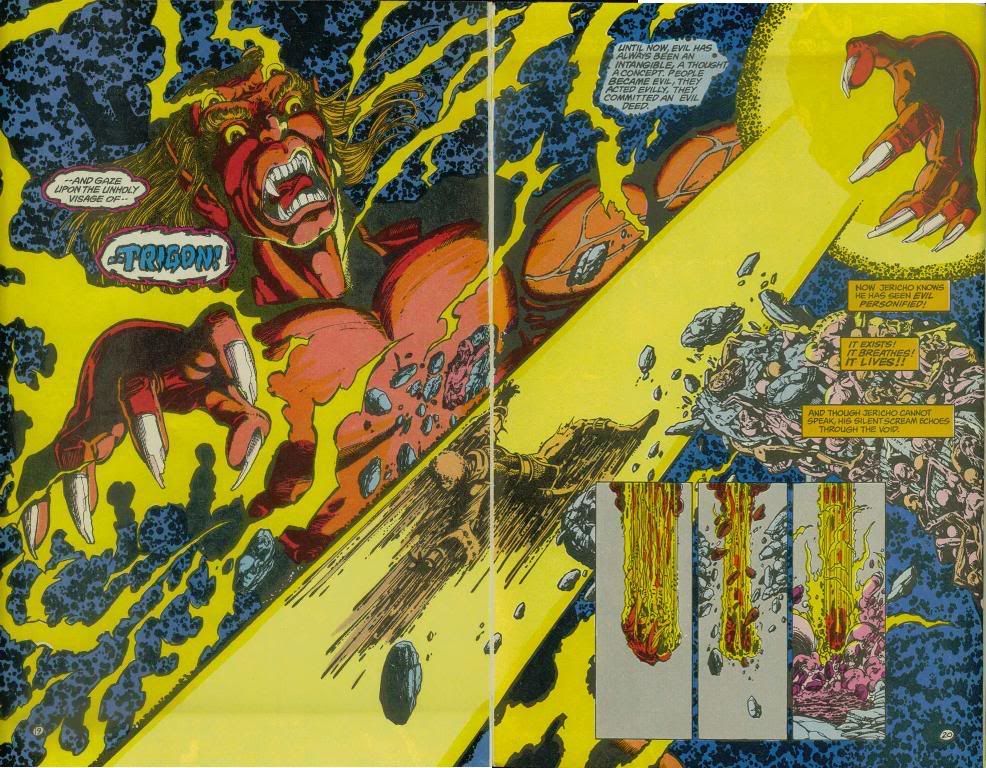
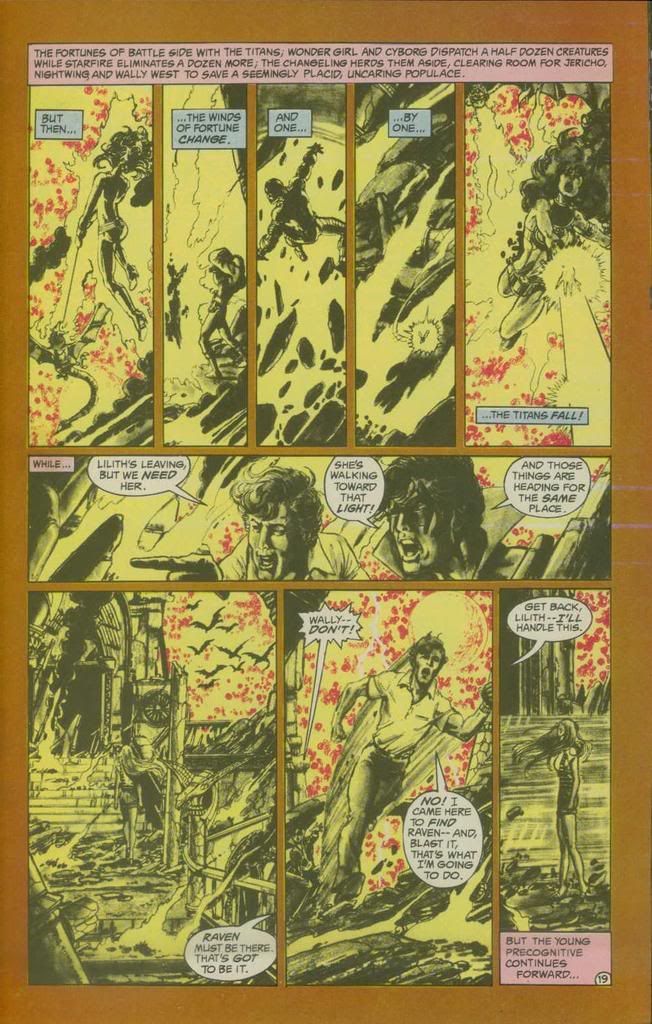
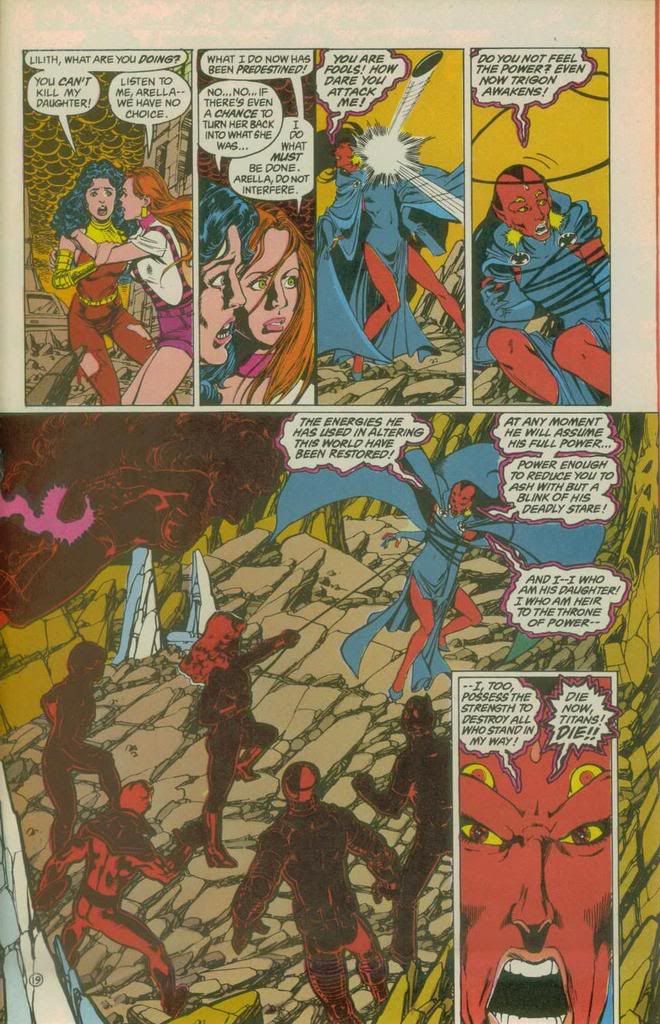
Who's Your Daddy? The New Teen Titans Vol. 2 #s 1-6

The first five issues of NTT2 are collected in a paperback called The Terror Of Trigon, but to me they work best as a showcase for George Perez. Appropriate to his last Titans work for four years, he goes out with a bang. He inks himself on issues 1 and 2, and portions of issue 2 are reproduced directly from his pencils. Although Romeo Tanghal returns to ink the last three issues, either his inks have gotten cleaner or the higher-quality paper allows them to be less muddy. Tanghal's inks compare pretty well to Bob McLeod's on the second Perez run ... but we've got a long way to go before that.

The story reminds me of "The Judas Contract," both in the sense that it caps a long-running subplot, its ending goes a bit beyond what you might have predicted, and it can't really be appreciated on its own. Just as the four installments of "TJC" are best seen in the light of almost two years' worth of Terra stories which preceded them, so "Trigon 2" is the culmination of the "Evil Raven" teases which date back to about the same period (if not farther).

Anyway, you want to know what happened, so let's cruise on....

Issue #1 (August 1984) opens with a training sequence in the Titans' Island woods (or, I guess, copse of trees). The object of the game is to capture Jericho, and everything's going well until Raven appears. She doesn't want anything to do with the game, but Joey doesn't know that, and tries to take her over. Raven "dodges" by teleporting away before he can merge into her body, leaving Joey -- who still managed to brush up against her consciousness -- seriously freaked out. The Titans want to help her, of course, so Joey volunteers to talk to Raven. In her pitch-black room, Raven tells Joey her destiny has finally arrived; and a few minutes later, she tells the Titans assembled in the meeting room that she's leaving.

(There's an interlude on Tamaran which shows the royal family sending a starship for Kory, but that's a couple of arcs away, so for now, it just lets Perez show off.)

While Cyborg and Changeling review old photos of Raven which show how Trigon's influence has changed her physically (and explain Perez's development with the character's features), Joey decides to sneak into Raven's room and take her over as she sleeps ... and here Perez really pulls out the stops. Joey/Raven trudges across bridges made of naked bodies and landscapes that would give Ditko's Doctor Strange nightmares. There he finds Arella, Raven's mother, naked herself; and as Arella cries that he's not her daughter, Trigon appears suddenly, blasting Raven's very form off of Joey.


Trigon treats Joey like a Nazi opening the Ark of the Covenant, but after a few moments Raven appears. Trigon shoos Joey back to Titans' Tower, where the Titans discover him, again, understandably Freaked Out. It's a dark, stormy middle of the night as Joey fills in the group, and as he finishes, the Titans hear Trigon's laughter....

Issue #2 (October 1984) opens with Perez on pencils only, following Arella (now fully clothed, so maybe her appearance in #1 was an illusion) and on the lookout for Raven. She's in Azar's dimension, but it's far from the calm star-studded place we've seen before. Now the skies crackle with energy and Trigon's bat-winged minions fly overhead. Arella catches up to Raven, terrified as Raven turns to face her, and Trigon cries out "She is mine!"

Meanwhile, the Titans have found Raven's rings, and wonder why Raven would have left them behind. Lucky for them Lilith shows up at that moment. The Titans apologize for the events of Tales #54 (specifically -- and foreshadowingly -- footnoted, since that issue was still about a year away), and Lilith says she was drawn to Titans' Tower because she could tell all the bad craziness was connected to Raven. As Lilith takes one of the rings, lightning strikes the tower (and Cyborg), a window blows out, and an unnatural wind whips the room into a frenzy. It's over just as quicly, though.

Lilith observes that "[t]hese rings are the nexus to [Raven's] soul. But we need to reach her heart as well." Thus, Dick and Donna take a T-Jet to Blue Valley to retrieve Wally West. The skies are stormy there too. Moreover, Frances Kane doesn't want Wally to leave her ... but he's gotta do what he's gotta do.

Back at the tower, Lilith summons a spectral, faceless Raven through a seance, but Raven doesn't stick around. However, the Azarites summon the Titans through Raven's rings, and the Titans are zapped to Azarath only to find it destroyed.

The Titans try to save as many Azarites from the bat-creatures as they can, but it's too late. Lilith, Arella, and the remaining Azarites gather at Azar's tomb to sacrifice themselves. The bat-creatures obliterate everything in their path ...

... and Raven, now completely transformed into a red-skinned, four-eyed replica of Trigon, appears with him over Titans' Tower.

Issue #3 (November 1984) begins with a full-page, full-face shot of the demonic Raven, inviting the people of New York (watching on TV) to please put their hands together for their new lord and master. Raven does in fact announce that "resistance is futile," about five years before the cool kids started saying it.

Meanwhile, the Titans and Arella wake up in what's left of Azarath, now basically an infinte white nothingness peppered by rocky outcroppings. Lilith informs the group that the Azarites have joined with Azar in the great beyond; that Raven has been taken over completely by Trigon; that Azar's rings protected the Titans from Trigon's destructive forces; and that Trigon is now on Earth. Azar's rings take the group back to New York, only to find it transformed into a literal concrete jungle similarly populated by souls writhing in torment. It's not long before the Titans run across Trigon (sleeping, lucky for them) and Raven (awake and upset). Raven downs everyone except Joey and Gar, and when Joey tries again to take her over, she repels him again -- this time with extreme prejudice.

As for the remaining six Titans, Raven sends them each into their own personal hells, where they must face black-and-white-and-red-eyed evil versions of themselves. Yes, like in the cartoon. However, the gore factor is significantly higher here, because each must also face his or her worst fear. Dick confronts a Jason Todd who couldn't save Batman from a grisly death. Vic's friends prefer his completely-human evil double. Gar's literally devours his loved ones; and Donna's kills Terry (but I'm sure is otherwise evil). Kory's invites her to submit again to slavery; and Wally's is a Trigon-eyed Kid Flash who taunts him for his wimpiness. These visions are all in the Titans' minds, naturally -- their bodies are trapped in a stone column, same as everyone else on Earth.

Issue #4 (January 1985) picks up there, and shows the Titans being run through familiar sets of angst. Each in turn gives in to his or her dark side, however, and as each kills an evil counterpart, his or her eyes turn glowy red. When the last Titan succumbs, their bodies are freed, but now they too have been transformed into black-and-red "negatives." Raven boasts that "Trigon has won," but Lilith says no -- thanks to the rings, she controls the Titans.

The transformed Titans attack Raven, chanting "Destroy her!" and absorbing her counterattacks. Trigon remains motionless atop Titans' Tower. Finally, the evil Starfire pumps a few lethal starbolts into Raven's "spiritless body," killing her.

This returns the Titans to normal, but of course they're horrified at what they've done. Lilith basically says don't sweat it -- "only in your evil forms would you have killed her," and "Trigon could not be defeated unless his daughter died." Speaking of Trigon, his voice now booms out over the landscape, vowing "vengeance" for Raven's death. He's awake, and he's about 300 feet tall.

Accordingly, issue #5 (February 1985) is the big Titans vs. Trigon blowout. Wally, despite his weak heart and the ongoing problems with his super-speed, is first out of the gate, but Trigon takes him out pretty quickly. The rest of the group (except Nightwing) then charges, only to have Trigon drop Titans' Tower on them. As Trigon strides through the wasteland that was New York, Nightwing lobs a grenade at him, but Trigon smites him with his staff. Trigon exposits about how Earth is the center of all his troubles -- the Azarites, who imprisoned him, came from here, as did Arella; and Earth has constantly resisted his power, "longer than any other." Thus, Earth must be destroyed.

However, Lilith still senses that the Titans are alive, and guess what -- Starfire has been protecting them with an energy shield. She shrugs off the rubble of Titans' Tower, the group plucks a still-breathing Nightwing out of his own pile of wreckage, and Lilith starts to outline their plan. Wally, unfortunately for his fans, is ready to give up in the face of Trigon's overwhelming power, but nobody else is.

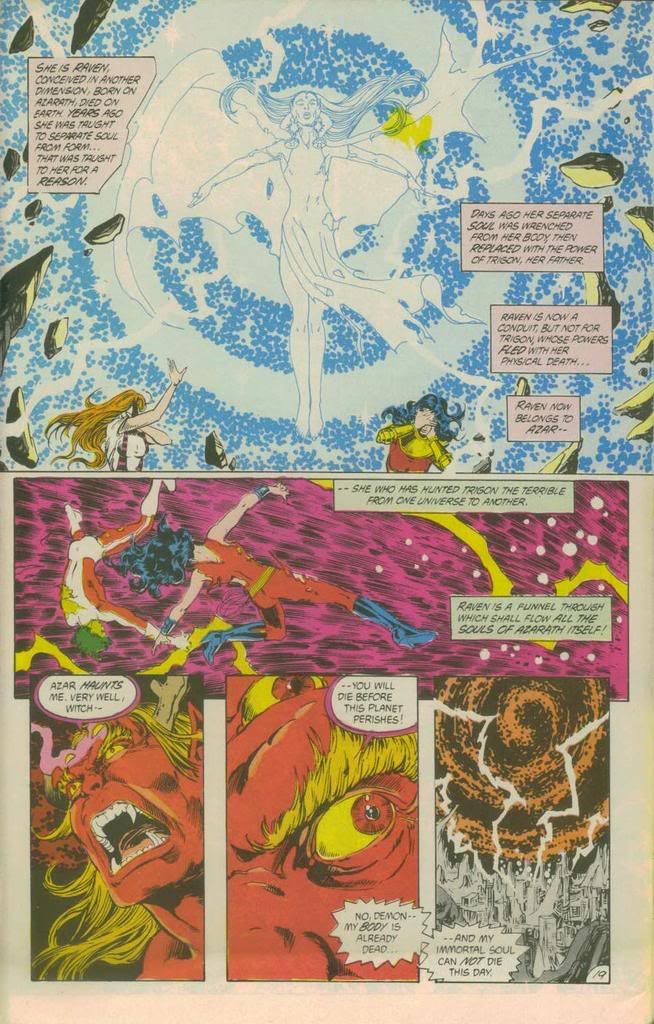
Trigon, standing atop the Twin Towers, opens a gateway into his home dimension so that he can project Earth's energy into it. Azar, speaking through Lilith, tells Arella to put Raven's rings back on Raven's hands -- turns out she's not dead, "[s]he has only been emptied ... for no soul-filled life could survive what comes next." Replacing the rings distracts Trigon, and gives the Titans an opening. They attack, but they know they're not doing much harm. The real action is back with Arella, Lilith, and Raven, who's starting to sparkle and glow. Here, then, is the big finish:


In a nutshell, Raven's soul-self -- which, you'll remember, had been corrupted by Trigon when she was still a girl in Azarath -- had been replaced completely with Trigon's energies. Now that she's been "emptied," Azar had space to insert Azarath's energies in its place. They now destroy Trigon, ghostly faces swarming over him like locusts, picking the flesh from his bones until nothing remains. Raven herself fades away, a beatific expression on her once-again-human face. With the explosion of light that marks her passing, the world returns to normal...

... except for Titans' Tower, which is just a stump of girders.

Issue #6 (March 1985) -- again, not included in the paperback -- is an epilogue pencilled by "Daniel" Jurgens wherein the Titans and New York recover from Trigon's takeover. A lot of it is devoted to characters giving speeches -- not like the past five issues didn't have their share of speechifying, but here the words get more attention than the pictures do. Besides, the speeches start out as news reports celebrating the Titans' victory before segueing into subplot maintenance. Wally and Frances Kane restate their commitments to not using their powers. Azrael (or Emo-Angel-Guy, since he still doesn't have a name) sees Lilith on the teevee and waxes poetic about her. (An old feller, seeing him and apparently not hearing his pronouncements, calls him the "Angel of Death." Oh, Marv.) Arella announces she's going to search for Raven.

Ultimately, Terry Long suggests that the group (minus Joey, who's recovering in the hospital) take another camping trip to the Grand Canyon and reconnect there. Each of the Titans recaps their Trigon-nightmares and explains how they continue to feel weighed down by them. (Well, Starfire is upbeat, but that's to be expected.) Terry then instructs them to turn those frowns upside down, because the fact that they're worried about these things means that they've got control of their fears.

I'm including issue #6 in the Trigon arc because it does provide some closure, but it would have worked better with Perez art. That's not the fairest comparison, and Jurgens tries hard, but his figures just lack the subtleties that Perez would have brought to this kind of issue. Let's put it this way: without Perez, I get the feeling that Wolfman wanted to write that much more dialogue to drive the various points home. Well, mission accomplished, Marv.

* * *

This arc has some very spooky moments, an horrific, gory second act, and a climax of almost Biblical proportions. However, it's also very "inside baseball" in parts, asking longtime readers to remember virtually back to the beginning of the series. The humor also seems somewhat forced, like Marv is trying to "write funny" It then connects those various storylines and subplots in a way that might actually be more friendly to new readers, but then the departure of George Perez leaves the book on a different footing than it started. Overall, though, it's very satisfying, especially if you believe that this puts the Titans' various Trigon-aggravated hangups to rest once and for all. (I don't know that it does; that's part of the reason I'm reading these again.)

The arc also works well as a commentary on the final "newsprint" storylines. Wally gets one last adventure with the Titans, after refusing to go after the HIVE undersea base. Lilith has both some tension with the group and a reason to be attuned to their needs. Vic's all-human evil twin probably helps him overcome any lingering doubts about his recent surgery. Gar has had a chance to work through his feelings about Terra, Joey, and Deathstroke. Having since married Terry, Donna has more of a need to affirm her commitment to him.

I also have to note that, once again, Wally West comes across as both craven and ineffectual. I presume that Marv and George considered this an outgrowth of his "retirement." It might also have been a way to provide an audience-identification character whose "game over, man!" pronouncements could have further heightened the tension. Wally does have some heroic moments in Azarath, and he's first to challenge Trigon, but his particular character arc doesn't end well. Maybe, even as close in time to Crisis On Infinite Earths as this arc comes, Wally was still meant to be retired permanently, so to have him struggle with his powers, and continue to pine for a superheroic life, might have been too much of a tease. Regardless, he'll get turned around before too long, so I can't complain too much.

Finally, this arc brings the stories of Raven and Trigon to a pretty definite end. Anytime you can say that about a superhero serial, it's a good thing. That ending might not have held up over the long haul, but that's (literally) a story for another day.

Next: The Children of the Sun!
Full Post

Saturday, March 01, 2008

Extreme Makeover: Tales of the Teen Titans #s 56-58

It's never felt quite right to me that this Cyborg/Fearsome Five arc should take up three whole issues. The Fearsome Five subplot feels rather perfunctory; and the Cyborg one has no real consequences. Still, for a story that purports to give Vic Stone the skin-deep "humanity" he has ostensibly craved ever since the series began, three issues isn't bad. Any fewer and the subject isn't taken seriously; too many more and it's just toying with the reader.

Of course, any drama would be sucked out of Vic's storyline if a reader remembered seeing ads for the direct-market-only NTT Vol. 2, or even Crisis On Infinite Earths, which showed him apparently unchanged. I suppose someone in the reverse situation -- a direct-market reader who still kept up with Tales -- might wonder a little more about Vic's flirtation with skin-colored parts.

While Vic is the Ben Grimm of the Titans, Ben actually did lose his orange hide every so often. By contrast, Vic has been stuck with his cybernetic parts constantly, and so has had time to get used to them. Moreover, his work with Sarah Simms' kids has helped him become a new kind of role model. In short, Vic should be above this kind of "I realize now that it's what's on the inside" story, but hey -- there's three issues to kill, and it makes an appropriate bookend to the monster-from-Vic's-origin which appeared in DC Comics Presents #26.

So, then, on to the issues themselves. Your penciller for this arc is Chuck Patton, inked by the familiar Mike DeCarlo in Tales #56 (August 1985). The issue begins at STAR Labs' hospital facility, where Raven breaks up an attempt by armored stormtroopers to hijack a mysterious iron-lunged patient being overseen by DC stalwart Dr. Jenet Klyburn. Raven's none too happy that the troopers are indirectly endangering the life of a little girl who's also a patient, so she metes out Trigon-flavored punishment on the troopers while using her own (much expanded) healing abilities to cure just about everyone in the ward. As it happens, though, the raid succeeds.

Meanwhile, Joey and his mom return from Europe. They're greeted by Gar, who apologizes profusely for his flagrantly emo storyline. (Also, I forgot to mention last time -- in #53, Cheshire reveals that one of the Titans is her baby daddy. Now, no fair spoiling it for the rest of us!)

After a brief interlude with Vic and Sarah Simms, which addresses some concerns about the propriety of his subplot, the Fearsome Five (minus Dr. Light) raid Tri-State Prison looking for their own mystery person. Nightwing, Wonder Girl, and Starfire try unsuccessfully to stop them.

In between all of that, Vic goes under Dr. Klyburn's knife. Seems that although he's happy with his super-heroic state, he sees the procedure as a chance to correct the original accident and live an ordinary life. It's an offer he can't really refuse.

The issue ends not on a Vic-related cliffhanger, however, but with Donna and Kory in a deathtrap situation. Regardless, Tales #57 (September 1985) picks up with Vic de-plated, having come through the surgery okay. In fact, Kory and Donna's escape from said deathtrap is never really explained, so there you go. Must not have been too bad.

This issue slows down in order to examine each of its parallel tracks: Vic meets his new physical therapist, the femulleted Dr. Sarah Charles; the Titans hit the training field to prepare better for their next fight; and the Fearsome Five (knowingly abbreviated "FF" by the Titans) get to know their new teammate, Jinx. Everything converges when the FF -- who were behind the raid on STAR that opened #56 -- can't figure out how to revive their other mystery member, and decide to kidnap Dr. Klyburn. They also take her "assistant" Vic, who they don't recognize without the parts. The Titans investigate, but don't get anywhere beyond learning about Vic's surgery.

Mystery Date turns out to be Neutron, a Wildfire-like Superman villain, and Vic helps Dr. K. sabotage Neutron's iron lung so it'll explode when opened. Unfortunately, while Vic and the Doc escape, the strain's too much for Vic's new parts. Accordingly, Tales #58 (October 1985) shows Vic getting his cyborg parts back while the other Titans duke it out with the Fearsome Six. I should point out that during this fight, Psimon is beamed up to the Monitor's satellite where he'll stay for three months (!) while Crisis On Infinite Earths pre-heats. Furthermore, Jericho is put to good use, body-jumping from one Fearsome Fiver to another and generally giving the Titans a decisive advantage. I've never really liked the Fearsome Five, even when Wolfman and Perez were making them deliberately over-the-top. Here they're just annoying, and the fight is rather bland.

A word about the art: Chuck Patton is a competent storyteller, but not really an innovative one. His characters are on-model, he can draw action and expressions equally well, and his figures have some flashes of personality. He's inked in #56 by Mike DeCarlo and in the other two issues by Romeo Tanghal, two strong inkers who tend to impose their own styles on pencils. Ultimately, though, if he were getting steady work from DC today, he'd be pencilling Countdown. His stuff gets the job done, and that's about it.

At the end of the issue, when everyone's gathered around Vic's bedside, he backpedals a bit ("I thought I got used to the way I looked, but I really didn't") and actually says "it's what's goin' on inside [that counts]." So ... yeah. In the other epilogue, the Titans present Jericho with his own life-size wall poster to hang alongside the others in Titans' Tower's wood-paneled meeting room.

And so we bid adieu to The New/Tales of the Teen Titans Vol. 1. In the end, this arc is probably best remembered for the introduction of Jinx, a character who'll go on to bigger and better things as part of the "Teen Titans" cartoon. It also closes out a period lasting over a year where, except for issue #50, the core group of Titans never appeared together. From the end of "The Judas Contract" through this issue, at least one Titan (mostly Gar and/or Vic, but sometimes Donna and/or Joey) was absent from the group. I'm not even counting Raven, whose storyline is about to heat up in a big way, and who'll thereafter be absent from the group for a good two years.

We'll pick up next time with the first arc from New Teen Titans Vol. 2. It's the last bit of George Perez's first run on the title, and it also works as a bookend to Vol. 1's first extended storyline.

Next: Wait 'til your father gets home...
Full Post

Wednesday, February 20, 2008

Pal Joey: Tales of the Teen Titans #s 51-55

It's been a little over a year, but as promised, the New Teen Titans recaps continue!

This post, and the next one, will go over the first real lean period in the group's history. Although his last story is still in our future, George Perez had pretty much left the building (except for this last run of Tales' covers) in favor of Crisis On Infinite Earths. In fact, this particular title -- the renamed New Teen Titans Vol. 1, remember -- was winding down its original content, with eight original issues to go. Therefore, 50 decent-to-great issues out of 58 isn't chicken feed, but these last eight are kind of ... uneven.

So, with that ringing endorsement, are you excited yet?

Let's go!

Tales of the Teen Titans #51 (March 1985) kicks off the post-Perez era with a pretty good issue. The new art team of Rich Buckler and Mike DeCarlo (starting with #52; Bob Smith inked #51) are experienced enough to handle this kind of super-team soap opera, and it's especially appropriate since Perez succeeded Buckler as Fantastic Four penciller some ten years earlier.

Since we're picking up right after the Troy-Long nuptials, Donna is still honeymooning, and Lilith has replaced Raven, who's apparently off in Azarath. The issue opens with the Titans breaking up a weapons shipment which, we learn, was meant for the Quraci government. Quraci President Marlo then hires Cheshire to kidnap Jericho's mother Adeline Wilson. Seems that a) Addie, as a mercenary, helped bring Marlo to power; but b) she was a double agent working for the rival nation of Kyran. Now that c) Marlo has been thinking about invading Kyran, it's been discovered that d) Addie has apparently removed all the information on Kyran from the Quraci government's files. Also, e) Addie has a photographic memory and (Marlo says) knows a good bit about Kyran. Press coverage of the Titans has led the Quraci government to Joey, and from there to his mom.

New subplots include Lilith moving in with Kory (Lilith mentions not knowing her background, to which Kory replies "Unknown parents seems [sic] to be a problem in the Titans") and a mysterious spaceship being discovered in Alaska.

Meanwhile, at the Pentagon, Dick learns that Interpol and the CIA both want to question Joey and his mom, because like Qurac, they want the Kyranian defense secrets too. Unfortunately, the only person Dick can get ahold of is Gar, who's really not in the mood for another potential Titan traitor. Thus, Gar goes off half-cocked to work out more Terra-related frustrations on Joey, but arrives after the big Cheshire/Addie/Jericho fight. Joey doesn't have time to waste with Gar, and after taking him out, contacts Amber, another of his mom's colleagues.

Later, at Titans' Tower, Gar continues to rant about the danger Joey poses, leading to this exchange:

KORY: And I can't believe Joe would do anything bad. He's so warm and caring.

GAR: So was Hitler ... to Eva Braun.

Hitler?!? Who said anything about Hitler?

The discussion about Joey resumes briefly at the start of Tales #52 (April 1985), but the Titans are soon distracted by news from STAR Labs about the Alaska discovery. Putting the Jericho situation on his mental back-burner, Nightwing muses that maybe the Terminator's upcoming trial will give Gar and the rest of the group some closure over Terra's death. As you might expect, things don't go perfectly at STAR Labs, with the whatever-it-is heating up to ludicrous levels and blowing up its containment chamber. Cyborg and Lilith are caught in the blast, and Lilith is pinned to the wall by some mysterious energy. I'm tempted to say it's the Pure Love radiating from the winged amnesiac Adonis that Who's Who will call "Azrael," but I honestly don't know.

In Qurac, Jericho and Amber decide the best way to Addie is to make themselves as obvious as possible. Their plan works a little too well, as Cheshire shows up (seemingly out of nowhere, in a weird storytelling failure) to capture both of them. Addie talks, in order to protect Joey, and the three of them are all put in the same cell. They use Joey's powers to run a variation on the old "Hey, Where'd He Go?" routine (works every time!) and before too long, Amber's shooting up Marlo's palace with an automatic weapon. When she and Cheshire get into a gunfight in Marlo's art gallery, though, Amber suddenly starts throwing herself in front of the paintings, yelling "Art is forever! You can't let it die!" Turns out that Joey has been inhabiting her, which gives him the edge over Cheshire. Joey turns solid, knocks out Cheshire, and then chooses to save the paintings over killing the man who tortured his mother. Well, that makes perfec-- huh?

The Azrael story takes up the bulk of Tales #53 (May 1985), which also features the return of Wonder Girl and the start of Slade Wilson's trial. Jericho, Addie, and Amber are off-stage, being questioned by the CIA. (That didn't carry quite the same connotations back then....)

Basically, after Donna and Terry assert their tennis dominance over Dick and Kory, the Azrael plot blossoms into a "He's Not A Threat, He's My Destiny" situation involving Lilith. Her exposure to Azrael last issue has apparently given her heat-style energy powers, so she busts Azrael (still officially unnamed, by the way) out of STAR Labs. Afterwards, the team gathers at Slade's trial, where Nightwing and the kidnap victim from issue #34 will be witnesses. The defense strategy, bolstered by a mysterious Terminator attack on Lilith earlier that morning, is to show that anyone could have been behind the Terminator's full-face mask at the times in question. It's not as good a tactic as Wolfman thinks, considering that there must be a whole body of superhero-specific case law to handle these kinds of masked crimes, but it works to rattle Mr. Victim, so the issue ends with Slade in pretty good shape.

Naturally, because this particular subplot has been fueling the Misunderstood Gar Acts Stupid subplot of the past several months, Tales #54 (June 1985) opens with Gar, well, acting stupid: he starts a fight with Slade in the middle of the courtroom.

Now, I have very little experience with criminal cases, but I'd think that such a super-fight would have serious consequences for the state's case against an accused super-villain. Furthermore, in typical superhero-comic fashion, Gar tells Judge Adrian Chase that Slade killed him (back in issue #10) and corrupted Tara Markov; which, I'd think, would only compound the state's problems. However, the issue creates its own continuity messes on top of all that.

Remember how "The Judas Contract" ended with a fight in The HIVE's base in the Rocky Mountains? Well, now Cyborg tells Chase that the Titans were held captive in the undersea base which was actually the setting of the follow-up storyline. This gives the defense attorney an opening to argue for dismissal based on jurisdictional issues, since that base was outside the U.S. It's all for nothing, though, because the trial (or whatever it is) will apparently go on after a brief adjournment.

So the Titans (minus Gar) look up Wintergreen, Slade's version of Alfred, to see if he might have been the Terminator who attacked Lilith last issue. While they're there, though, the Terminator attacks them, but meets a fiery end in a boat hit by one of Starfire's blasts. Since the boat belonged to Gar's foster father, and Gar thought "they bought it!" after he left the courtroom, it looks pretty obvious that Gar's been working to ensure Slade's freedom.

New subplot this issue: STAR Labs can give Cyborg plastic replacement parts which look human. His grandparents aren't too thrilled with the idea, but they're soon convinced it will be safe. More on that next time.

Back at the trial, the defense calls Lilith and Nightwing in order to have them repeat that no, we can't be sure who's behind these masks, good guys or bad guys. Chase then "renders his decision," which to me seems like a completely arbitrary plot device. I won't go into all the potential legal problems I see with this hearing -- whatever it's supposed to do -- but suffice it to say it's a traveshamockery. The simplest thing might well have been for Chase to declare a mistrial based on the Gar/Slade fight, but then we wouldn't have had those two pages' worth of redundant testimony from Lilith and Nightwing. The upshot of the issue is, as you've probably already guessed, Slade is acquitted of the big charges. This suits Gar fine, because he used Steve Dayton's Mento helmet to impersonate the Terminator himself. Now Gar gets to track Slade down and kill him, which is what he's wanted to do ... well, probably since issue #10, I'm guessing.

Also, in terms of the Lilith/Azrael plot, we learn that Lilith has had her heat-based powers for a while, but she's just never used them before now. They manifest themselves as nightmares whenever she's under stress, so that's why she left the group originally. This time, though, she's leaving because she's p.o.'ed over their treatment of Azrael. Don't worry, she won't be gone long.

Finally, Tales #55 (July 1985), drawn by Ron Randall, brings the Gar/Slade conflict to a head. Nothing's going right for the green-skinned 16-year-old -- the Titans won't help him, Steve Dayton's grounded him, Jillian is once again forbidden to see him, and his attitude isn't making matters any better. Slade's been sentenced to a year in a Club Fed on a weapons charge, so that gives Gar an opportunity to attack him in prison. It doesn't bear out, though, so Gar tells Slade to meet him out in the wilderness where they'll go mano y animales -- to the death. Gar visits Tara's grave, and Slade visits his son Grant's.

Trouble is, Slade then shows up at the fight scene without his costume or weapons, and Gar can't bring himself to kill plain ol' Slade Wilson. His frustrations having burned themselves out, Gar and Slade start to talk, and they don't stop until Gar's worked out his issues. Slade goes over ground that's fairly familiar to us: he only took the HIVE's contract on the Titans out of loyalty to his son; Tara Markov was a psychopath (who incidentally killed an old friend of Gar's from Africa); and once the HIVE contract was fulfilled by "The Judas Contract," Slade considered himself done with the Titans. The difference seems to be that this time Gar is in a mood to listen; I presume because his nerves are completely shot by this point. In the end, Slade sets Gar straight on a couple of things: Joey is completely trustworthy (also, Addie was working with the CIA); and Gar can prove himself to the Titans primarily by not acting like a doofus so much of the time. We'll be the judge of that, Mr. Wilson....

* * *

On their own, these issues aren't that bad. The plots and subplots start to break down the further they go along, though. By the time issue #51 rolls around, Joey's been with the group for at least five full issues, and has earned enough of their trust to invade the undersea HIVE base and participate pretty heavily in Donna's wedding. Granted, Joey didn't spend a lot of time with Gar during those stories, but still. Speaking of the undersea base, of course, that whole snafu illustrates the extent to which Marv was starting to confuse even himself. He was working on Crisis too, lest we forget.

Moreover, in the context of the larger series, these issues seem like a lot of subplot-churning. The Lilith/Azrael story doesn't really go anywhere. Much of the Gar/Terminator story feels pretty redundant, and undoes all the working-through-grief Gar did in issues 45-50. His sit-down with Slade in #55 is effective, but the book takes a long time to get there. The Jericho story isn't bad on its own, since it expands on his family history and establishes some intriguing elements in his backstory, but it doesn't feel like part of the regular book. (Today it'd probably be a separate miniseries.) Overall, these issues seem to be items on a checklist: Joey needs more of his own identity, despite having been in the book for several months; and Gar apparently needs more closure than was previously thought.

Of course, I suspect the real reason for these stories is to fill a certain amount of issues before the reprints of the Baxter series begin. In that respect these stories are the 52 of the franchise's "One Year Later" jump, but there's so little difference between the two Titans books that there can't have been too much going on in this one that's been left behind.

That illusion-of-change feeling gets worse with the next arc, the last for the book that started it all.

Next: One word -- plastics!
Full Post

Thursday, November 08, 2007

Next, Tonight's Lottery Numbers

In the September 13 Grumpy Old Fan, I said this:

[T]he Old New Teen Titans could do worse than to re-establish themselves as DC’s answer to the Defenders, an ad hoc non-team composed of old friends who just like working together. It could even be a twenty/thirtysomething version of the “adventurer’s club” I thought would be good for the Justice Society. George Perez once described the Titans as “sitting around a table waiting for a safe to fall on them,” but as long as the Titans’ Tower utilities are paid and someone sweeps the place out every couple of weeks, who needs a purpose?

Now Judd Winick, writer of the upcoming New Teen Titans revival, says

The way we’re going about it though is that they’re not actually a team. There’s not going to be anyone on monitor duty, there’s not going to be meetings and roll calls – they basically are coming together because they are together....

So, the thrust of the book will be that this is a group without being a group. They are a team without associating as a team, because they’re more than that. They have a lot more history. No one is getting in anyone else’s face about who’s the leader, or who will do this or that. The adventures that will occur, and the missions that they will go on will come from one of them needing some kind of help. Somebody will be working on something, and they could use some backup from their friends.

Even a blind squirrel finds a nut now and then, I guess.


P.S. Just to be clear, I am the squirrel.
Full Post

Sunday, November 04, 2007

Sunday Soliloquy

The New Teen Titans kicked off its second year with a three-issue "Search For The Doom Patrol's Killers" arc. (Yes, there was a time, not all that long ago, when the Doom Patrol was most famous for being dead.) Of course, all the Titans had parental issues, so this gave Gar the chance to explore his.


Gar spends most of the arc out for the blood of General Zahl and Madame Rouge, the DP's old enemies. He even gets what he wants, after a fashion; and so learns a valuable lesson. Take it away, Raven:


"Bloodthirsty Gar" would show up again, most notably right after the events of "The Judas Contract." For a while, though, he coped pretty well.

[Scans from, respectively, "Revolution!" in The New Teen Titans vol. 1 #14, December 1981, and "The Brotherhood Of Evil Lives Again!" in issue #15, January 1982. Written by Marv Wolfman, pencilled by George Perez, inked by Romeo Tanghal, colored by Adrienne Roy, and lettered by Ben Oda (#14) and John Costanza (#15).]
Full Post