Showing posts with label robin. Show all posts

Wednesday, June 10, 2009

Kids -- they'll age you!

[I should really preface this post with a disclaimer: anyone looking for an extremely well-thought-out DC timeline owes Chris Miller's site a look. The following won't necessarily match up with Chris's work, but that's probably because I'm making more assumptions than he is.]

It's been a while since I've tried to work out a rough Batman timeline. However, Grant Morrison says that Damian Wayne is ten years old, and that's got me thinking. A ten-year-old Damian tends to explode the notion that DC's current timeline is perpetually only 12-13 years old (that is, DC's "Year One" was somewhere around 1996-97). Batman/Bruce didn't even meet Talia until Dick was off at college -- well into Dick's Robin career, at least a year or two before he became Nightwing. Assuming that Bruce and Talia didn't make the sign of the double-humped camel until 1987's Son of the Demon graphic novel -- which appeared a few real-time years after Dick gave up the short pants in early 1984 -- that means Dick has been Nightwing for at least ten years. Accordingly, that gives Tim Drake a pretty substantial Robin career, and it probably has implications for Jason Todd's tenure as well.

Memorable milestones make the Batman timeline is relatively easy to figure. Bruce Wayne was 25 during "Batman: Year One," Dick Grayson became Robin somewhere in Year Three and turned 20 not long after becoming Nightwing, and Tim Drake was 13 when he became Robin. (By the way, has "Batman: Year Three" been lost in a continuity fog? For some reason I think it has, even though it pretty much sets up Tim's origin in "A Lonely Place Of Dying.") Furthermore, back in late 1986/early 1987, when "Year One" was originally serialized, Bat-editor Denny O'Neil theorized that the then-current Batman stories were taking place in Year Seven.

I don't agree with Denny's thinking there, primarily because it gives Dick Grayson too short a Robin career. If he turned 20 as Nightwing, but he spent a year in college as Robin (say, age 18), then the transition probably happened while he was 19. Even if that changeover occurred in Year Seven (and it probably didn't), then Dick was only Robin for around four years, and was in his mid-to-late teens when he started.

Besides, Damian's age lets us work backwards. If he's ten now, he was conceived some eleven years ago (1998) -- probably as chronicled in Son of the Demon.

(Brief digression: Batman #666 has a one-panel flashback to the night Damian was conceived, showing the original/"Year One"-style Bat-suit, as opposed to the "New Look"/yellow-oval model still in use in SotD. No doubt this gives DC some wiggle room to claim that Damian was conceived many years earlier than SotD, and thus that Talia and Bruce "knew" each other before they were properly introduced, if you know what I mean and I think you do. Well, I say phooey on that. It would mean that either Ra's al Ghul or Talia knew pretty early on that Batman needed to join the family; and as impressive as Batman's early career might have been, it surely wasn't that impressive.)

Therefore, with Son of the Demon as our eleven-years-ago milepost, we can start estimating other events. Dick (age 20-21) was Nightwing, and Jason was a teenaged Robin. Dick turned 20 pretty soon after Crisis On Infinite Earths ended, so by the time of SotD he was probably around 21. Thus, Crisis took place twelve years ago. Moreover, if Dick became Nightwing at age 19, that takes us back thirteen years; with Dick's year at Hudson University being fourteen years ago. In other words, Dick was 18 in 1995, making him 32 today.

However, there is some disagreement over Dick's age in Year Three. Marv Wolfman, who wrote "Year Three" (and, of course, all those New Teen Titans issues; and who was writing Batman when NTT launched), stated often in dialogue that Dick had been Robin since age eight. This would give Dick a pretty substantial Robin career of at least eleven years (ages 8-19) -- but how old would that make Bruce? If Dick was eight in Year Three, that would make 2009 Year Twenty-Seven, and Bruce would be 53 -- which, by the way, is Dark Knight "retired for ten years" territory.

We can try to figure Dick's age by using Tim's; and we can figure Tim's in relation to Jason Todd's career. Jason was killed (in real time) in 1988, about a year after Son of the Demon was published. 13-year-old Tim met Batman and Nightwing some months after that, which probably places the event in the DC-year following SotD. It would make Tim 13 when Damian was 1.

Here, though, we run into another problem: as far as I know, DC refuses to let Tim turn 20; and it surely won't cop to Tim being 22. This ceiling makes Tim at most 9 years older than Damian and 13 years younger than Dick. It also affects Bruce's age, since Tim was old enough to remember the Flying Graysons' routines on the night Dick's parents were killed. For some reason I want to say Tim was 2 years old when this happened in Year Three. That would make Bruce 25 years older than Tim, and 44 today -- which would make this Year 20.

In summary, then, Bruce is 44, Dick 32, and Tim 19. Dick's Robin career lasted from ages 15-19, Jason Todd's spanned (all or parts of) Years 7-14, and Tim's is in its seventh year (his brief "retirement" notwithstanding). The lingering problem with this timeline is that it may give Jason a longer Robin career than he had in real time (around 4 years, 1984-88), so I may have to revisit my assumptions to correct that.

Still, the point remains that Damian's age necessarily extends everyone else's timeline, and I hope DC acknowledges that.
Full Post

Monday, November 12, 2007

New comics 11/7/07

We begin this week with Supergirl #23 (written by Kelley Puckett, pencilled by Drew Johnson, inked by Ray Snyder), which I bought mostly out of past loyalty to these creators. By now these Supergirl relaunches have an air of "This time for sure!" about them, so I'll also admit to some morbid curiosity. In that respect I wonder if it's a bit of black humor that the cover has our heroine going up in flames....

Anyway, the issue itself is an enigmatic bit of decompression which starts and ends with a mysterious box delivered to Supergirl's apartment. After a brief, but funny, chat with Batman about the box, she's called away by Superman to help him and a squad of Green Lanterns stop an interstellar war. Things don't quite go as planned, but her reaction -- and the role of the box -- aren't quite explained, thereby theoretically encouraging us readers to come back next month.

Should we, though? I'm more intrigued by the storyline than I am by the title character, and I'm not sure that's a good thing. From what I can tell from this issue, Supergirl's kind of a spaz. She zones out when the GLs brief her. She's apparently responsible enough to have her own (spacious, nicely furnished) apartment, and that magazine subscription in her hand indicates she's put down some roots, but how old is she supposed to be -- late teens? Early twenties? What's her "secret identity" like? (Judging by this week's Superman, she doesn't have much of one ... but that's this week's Superman.) She's got all the powers of Superman, so how does she use them differently? In short, why should I care about her enough to pay $2.99 (plus tax, minus folder discount) every month?

Well, the art is quite good. Johnson and Snyder do meticulous work. I'm not entirely sure about their Supergirl anatomy, but that could just be an optical illusion from the costume. There's a long, wordless stretch in the second half of the book, and they handle that pretty well too. Like I said, I'm intrigued by the story, and this issue was good enough to make me want to see more. However, if I'm going to make a long-term commitment, I'd like to know more about Supergirl herself.

As for her cousin, Superman #670 (written by Kurt Busiek, pencilled by Rick Leonardi, inked by Dan Green) finishes up "The Third Kryptonian." It's a good conclusion to what was a somewhat predictable but still enjoyable arc. Busiek hit most of the "moody loner" character beats with Kristin Wells, including the "only out for herself" one. However, the issue is mostly action, which Leonardi and Green do nicely. I also like their Supergirl, who looks about five pounds heavier than Johnson and Snyder's; and their Power Girl, who looks about ten pounds lighter than, say, Michael Turner's. Anyway, the basic plot is that the Head Bad Guy has all kinds of weapons specifically designed to kill Kryptonians, so Superman and his allies (including Batman) have to figure out inventive ways to counter them. It's all fairly straightforward, although it apparently sets up a sequel and at least one other future story. That's not really a criticism, because I haven't been this consistently pleased with a Superman writer in a long time.

Countdown #25 (written by Paul Dini and Adam Beechen, pencilled by Ron Lim, inked by Jimmy Palmiotti & John Stanisci) finally checks in with the cliffhanger that closed out Firestorm, lo those many months ago. That's the bulk of the issue, and it's entertaining and somewhat satisfying. However, the other "check-in" scenes -- Jimmy and Mary Marvel on Apokolips, and Piper and Trickster escaping from Deadshot (?!?) -- are kind of lame. Art is good throughout, and I would expect no less from an old hand like Lim.

I was curious about The Search For Ray Palmer: Red Rain (written by Peter Johnson, pencilled mostly by Eric Battle and Angel Unzueta, inked by Derek Fridolfs, Vicente Cifuentes, and Jonathan Glapson, with a few pages drawn by Kelley Jones) because I enjoyed the "Bat-Vampire" trilogy by Jones and writer Doug Moench. However, this has all of the grue and none of the grim nihilism. It's not a very attractive book, mostly because it tries to ape Kelley Jones' style without much success. The colors (by Art Lyons) are muted and muddy, like a red filter has overlaid everything. The plot is moderately diverting, since it involves this Earth's Dick Grayson (and, in a small role, Barbara Gordon), but even that feels like something of a departure from the original material. The Batman/Dracula: Red Rain book was creepy precisely because it was set in a Bat-milieu that could easily have been the character's regular title. However, this special's Dick and Babs are just characters with the same names. What's more, our Challenger heroes really can't do anything to affect this Earth's status quo -- they can only introduce us to it and move on. Therefore, nothing of consequence happens. Unless you just like seeing alternate versions of familiar characters put through penny-dreadful situations, you don't need this issue.

In the regular Bat-books, "The Resurrection of Ra's al Ghul" begins officially in Robin #168 (written by Peter Milligan, drawn by Freddie E. Williams II). If you've seen one of those "Bad Seed" kinds of movies, where no one will believe the good kid who knows the evil kid's evil, that's about how Tim must deal with Damien. Also, Batman rescues Talia from what is apparently her bandage-enwrapped father. It's kinda unremarkable, except for the hints at the mysticism (Nanda Parbat, the Sensei, etc.) behind Ra's' return. Williams' work is fine; Robin is lean and muscular, and Batman is appropriately chunky.

The romance, or whatever it is, of Ryan and Doris "Giganta" Zuel is the best thing about (The All-New) Atom #17 (written by Gail Simone, pencilled by Mike Norton, inked by Trevor Scott). I found myself rooting for the two crazy kids despite the fact that she's a little unhinged. The weird androgynous villain (at least I think "he" and "she" are the same person) was hard to figure, but that's a good enough mystery for two issues. Norton and Scott turn in another fine issue. They work about as well with Simone as Nicola Scott did on Birds Of Prey, and considering how much I like Nicola Scott, that's high praise indeed.

I bought Welcome To Tranquility: Armageddon #1 (written by Christos Gage, drawn by Neil Googe and Horacio Domingues) out of loyalty to the regular title -- only one issue left, apparently -- and it was just okay. Basically, it focused on Tranquility's Captain Marvel-analogue, but let him stay "in costume" the whole issue, as opposed to his regular role of deus ex machina. Also, the time-travel involved in showing us the alternate future also made our hero's role that much more confusing. In short, he flies around while others tell him how bad things have gotten, and then he forgets about everything and the issue is over. It was kind of like the Ray Palmer: Red Rain issue, above, except without the muddy art.

Fantastic Four #551 (written by Dwayne McDuffie, pencilled by Paul Pelletier, inked by Rick Magyar) looks like it kicks off this creative team's last arc, involving a set of time-travelers bent on stopping Reed from saving the world. It ends on a heck of a cliffhanger, and it ties into Reed's "room of notes" from Civil War. That's not a lot in terms of plot, but it's executed well.

Howard the Duck #2 (written by Ty Templeton, pencilled by Juan Bobillo, inked by Marcelo Sosa) gets closer to its roots, as Howard and Bev must deal with Howard's sudden celebrity following his smackdown of the hunters last issue. Most of the issue finds Howard on a yelling-match talk show, and that goes about like you'd expect, or maybe a little worse. I might be easily amused, but I did like MODOT (Designed Only for Talking) a lot. This is not a bad miniseries by any means, even if it has a lot to live up to.

Finally, the satire is presented much more deftly in Groo: Hell On Earth #1 (by Mark Evanier and Sergio Aragones), in which Groo's bumbling leads to eco-unfriendly consequences. I'm not sure how this can be stretched out into four issues, but if the rest are as clever as this one, I definitely won't care. The latest Groo tale finds everyone at the top of their particular game, especially Aragones and colorist Tom Luth. Those two complement each other perfectly through Aragones' exquisite backgrounds and two-page spreads. This story aims for a broad scope and even an epic feel, and succeeds admirably.
Full Post

Thursday, October 25, 2007

Thursday Night Thinking

Halloween in Rutland, Vermont, means superheroes, murder ... and THINKING!


But what could startle this seasoned crimefighter...?


Yep, I imagine that'd do it.

Trick or treat, Diamondrock!

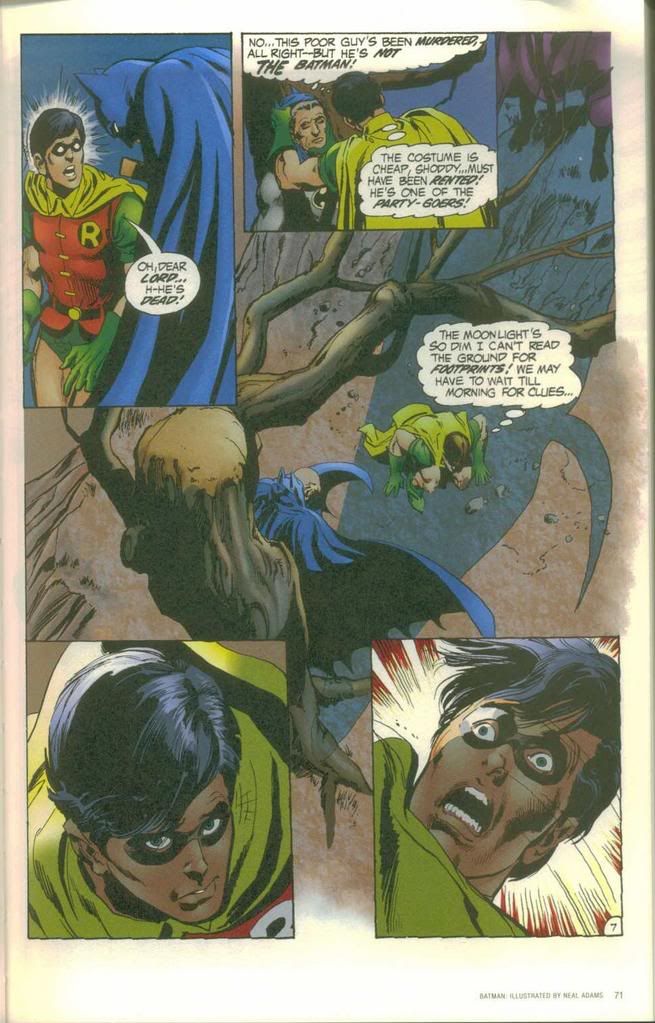
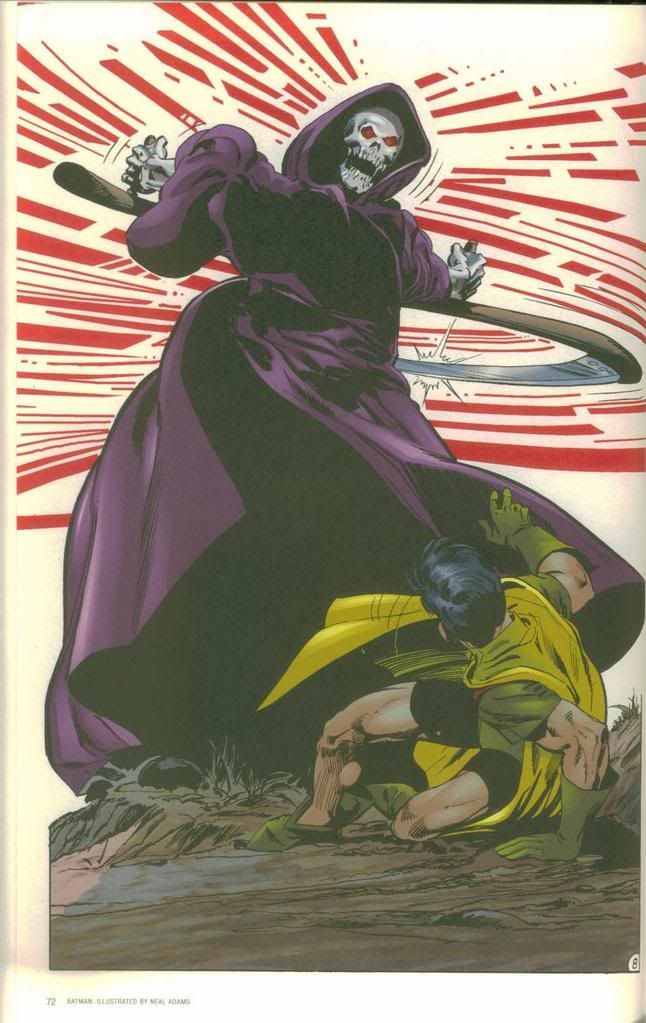
[From the classic "Night of the Reaper!" in Batman #237, December 1971. Written by Denny O'Neil (from an idea by Berni Wrightson with an assist by Harlan Ellison), pencilled by Neal Adams, inked by Dick Giordano, lettered by John Costanza; and touched-up for its reprinting in Batman Illustrated By Neal Adams Volume 3.]
Full Post

Sunday, October 14, 2007

Sunday Soliloquy

Nosferatu, new for the '90s:


This was actually a summer issue, not Halloween-themed nor timed to coincide with Bram Stoker's Dracula (which Mike Mignola helped design, if memory serves). Still, that's a pretty spooky vampire. Even Superman flying it into daylight can't kill it.

[From "Night Moves," Superman: The Man Of Steel #14, August 1992. Written by Louise Simonson, pencilled by Jon Bogdanove, inked by Dennis Janke, colored by Glenn Whitmore, lettered by Bill Oakley.]
Full Post

Friday, August 24, 2007

Friday Night Fights

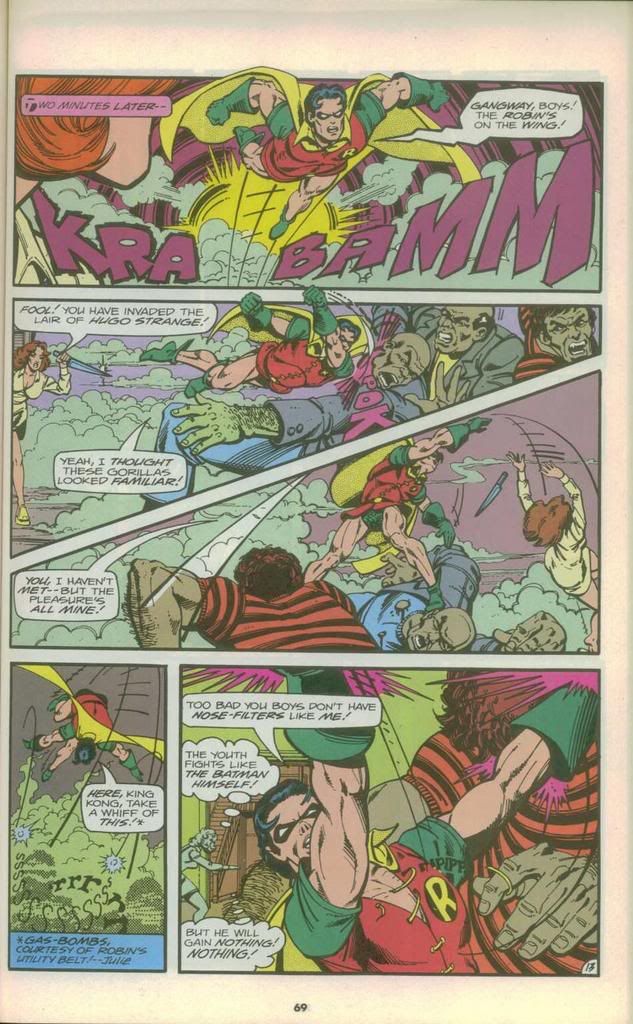
Batman's been captured and drugged to immobility by Hugo Strange. Lucky for him, it's not a long VW-van drive from Hudson University!


Bahlactus is our Dean Of Students!

[From "I Am The Batman!," Detective Comics #472, September 1977. Written by Steve Englehart, pencilled by Marshall Rogers, inked by Terry Austin.]
Full Post

Monday, August 13, 2007

Goodbye, Ringo

I didn't know Mike Wieringo personally, but I felt like I did. My buddy Sam had met him years ago in the course of doing some prototype Tellos figures. Today, when Sam called me, I knew why even before I answered the phone.

So I didn't know Mike Wieringo, but like Mike Parobeck, another comics artist who left this world too soon, I felt like I knew him through his work. Readers of this blog need look no further than last week's Sunday Soliloquy, and its quiet study of Reed Richards, for a great example of Wieringo's craftsmanship.


It's all there: the attention to detail, the way the characters move, and the expressiveness of both Reed and Valeria. Wieringo has what some might call a "cartoony" style, but it's hardly unrealistic. His objects have weight and his characters have life. There isn't much action on those two pages, but that just goes to show how good 'Ringo was at making them come alive.

Mike Wieringo worked on some of the Big Two's most treasured properties, including the Flash, Robin the Boy Wonder, Superman, Spider-Man, and the Fantastic Four. He "got" the appeal of superheroes, I think, and translated that appeal perfectly onto the page. The best superhero artists make us forget about the genre's constant struggle between "realism" and fantasy, and simply transport us into the worlds their pencils create. Mike Wieringo was a master at that. He never seemed to give less than his best, and in turn his best seemed effortless.

My thoughts and prayers go out to his loved ones. He brought a lot of joy to a lot of us.
Full Post

Saturday, June 24, 2006

New comics 6/14/06 and 6/21/06

We begin by picking up a spare from June 7. Fittingly enough, I got Nextwave #5 (written by Warren Ellis, drawn by Stuart Immonen) a week late, on my mom's birthday, June 14. I say "fittingly" because it featured teddy bears, which were the subject of a running joke between Mom and me. When I lived at home during law school, I watched TV with my parents, including "Star Trek: The Next Generation." Inevitably, Mom would see something or someone on the episode she didn't know anything about, and would ask me what was going to happen. Since these were first-run episodes, most times I didn't know what was going to happen, so all my answers ended up being about the planet of fuzzy teddy bears, and all the picnics and tea parties the crew would have. This satisfied my mother, who I might have mentioned has a master's in English and is really quite sharp. Anyway, when an episode put our heroes in a tight spot, Mom would look at me rather accusingly and wonder aloud when the teddy bears were coming. (This often happened around season-finale time.)

So last week I sent her some killer-teddy-bear scans from Nextwave #5. Happy birthday, Mom!

Captain Atom: Armageddon #9 (written by Will Pfeifer, pencilled by Giuseppi Camuncoli) wrapped up the miniseries that turned out to be a big tour through the WildStorm universe, just in time to blow it all up and start over. Whoopee. Now that it's over, maybe DC can use Cap's rather twisted history with the U.S. military to some good effect. It's a rich backstory which makes the character a little more than just a generic superhero, but you'd never know it from how he's been treated pretty much since his series ended.

American Virgin #4 (written by Steven T. Seagle, drawn by Becky Cloonan) concluded the book's first arc, but it really didn't leave much of an impression on me, and I'm leaning towards dropping the book.

The same goes for Green Lantern Corps #1 (written by Dave Gibbons, pencilled by Patrick Gleason). I like Guy Gardner and I have always liked the Corps, but this book just isn't doing a lot for me. I may give it a couple more issues.

It wasn't earth-shatteringly good, but I didn't dislike JLA Classified #22 (written by Steve Englehart, pencilled by Tom Derenick, inked by Mark Farmer), which began a new arc featuring JL Detroit. Much of it recapped Steel's origin, and a few other pages recapped the origin of the Royal Flush Gang. The rest, natcherly, was the fight between the two groups, and it wasn't David Mamet, but it wasn't bad either. Also, it reached a stopping point at the end of the issue, which was nice. Derenick's pencils were better than in his last JLA arc, although again nothing groundbreaking.

Firestorm #26 (written by Stuart Moore, pencilled by Jamal Igle, inked by Keith Champagne) was also a fairly intriguing issue centered around a super-hero fight, as Firestorm and Firehawk take on a new villain who's torturing Martin Stein. It all has to do with the nature of Firestorm, apparently, and the strange bond Jason and Lorraine have forged since "One Year Later." Fun stuff.

You know by now that 52 #6 (written by Earth, Air, Fire, and Water, pencilled by Joe Bennett, inked by Ruy Jose) introduced the Great Ten and Rip Hunter's "Lost" Blackboard, and you've probably already formed your opinions on both, so I'll just say it was fascinating to see how the book could pay so much attention to its four mainstays' plots while still herding them all towards some inexorable common destiny. Also, it managed to put the Green Lanterns, who are so far the highest-profile heroes who could appear in the book (with the Big Three, Aquaman, and the Flash off the table), on the same level as those supposed C-list mainstays. The GLs don't feel like guest-stars, but neither do they take over the book. Entirely appropriate for a book that purports to be a window on the world.

Superman #653 (written by Kurt Busiek and Geoff Johns, drawn by Pete Woods) was the big throw-down between Superman and Luthor (in the hijacked Kryptonian battle-mech), and it didn't disappoint. Of course, given the nature of this storyline, the cliffhanger ending the issue wasn't very suspenseful, just funny. Jimmy Olsen gets a good scene, Supes and Luthor both have some good "But I am also left-handed!" moments, and from the previews I read on Newsarama earlier this week, the conclusion should be just as good.

Of course, Jimmy -- or, I should say, his Cojo-influenced All-Star interpretation -- is the focus of this week's All-Star Superman #4 (written by Grant Morrison, drawn by Frank Quitely), which combines the goofy sitcommery of bumbling through being Superman's Pal with a couple of shots at "big event" comics past and present. As Mark Fossen points out, Jimmy gets to be All-Star Vicki Vale, and later on turns into Doomsday. This never fails to be an entertaining series.

I think I'm done with Robin after #151 (written by Adam Beechen, drawn by Freddie E. Williams II), not because it's poorly executed, or because the latest developments have repulsed me, but it just hasn't drawn me in.

At the other end of the spectrum is The Flash: The Fastest Man Alive #1 (written by Danny Bilson and Paul DeMeo, drawn by Ken Lashley), which did a lot to turn me off. First is its apparent baton-passing to Bart Allen, which I think is unnecessary. Second, it both devotes a lot of space to bringing everyone up to speed on Flash history, but then plops Bart into an entirely new situation, kind of like dropping Captain Atom into the WildStorm dimension. The exposition slows the book, and the new stuff seems barely sketched in. Bart now has a repellent "duuude!" roommate and works at the Keystone auto factory, because he's aged completely out of his teenage years. Never mind that, as originally conceived, he was a developing brain in an outsize body. Combined with the maturity Geoff Johns thrust upon him (this makes twice), he's just your average 20-year-old now, which makes him a lot less interesting. I'm waiting to see who ends up with the Infantino suit, but if it's still Bart in this form, I'll wait until the next creative team.

Lashley also pencils 52 #7 (written by Reed, Sue, Ben, and Johnny, inked by Draxhall), featuring Ralph Dibny played by Josh Holloway and sporting some ill-advised facial hair. His pencils look a lot better here than they do in the Flash book, which may have something to do with Keith Giffen's layouts. Anyway, Booster gets his from Manthrax and Ralph, and Montoya meets DC's most famous lesbian. The Booster/Ralph stuff is pretty good, and the Montoya/Kate Kane scenes aren't bad, except for one panel which seems like it could be either wishful thinking or a flashback, but is presented as reality. It's all better than the History of the DCU backup, though, which does nothing to make Zero Hour comprehensible, and in its few pages even makes it less so. I think its facts are wrong too, although that could just be more retconning.

I probably read Checkmate #3 (written by Greg Rucka, pencilled by Cliff Richards, inked by Bob Wiacek) too quickly. Either that or it's hard to summarize all the politics and maneuvering in a few sentences. It's still a good read, and I should get more out of it the second time around.

Superman/Batman #27 (written by Mark Verheiden, drawn by Kevin Maguire) was decent enough until the end, which tries to shoehorn it into modern DC continuity. It's really about the Earth-2 Power Girl and Huntress trying to save their "dads" from old foes, and on that level it's enjoyable enough. In fact, Maguire gives Huntress more cleavage exposure than Power Girl, which may be a first. However, the big dramatic reveal turns on a bit of Earth-2 continuity I had forgotten, and which isn't quite set up as well as it could have been. It doesn't amount to anything very substantial, I guess, but it's competently done.

Sgt. Rock: The Prophecy #6 (by Joe Kubert) concluded the miniseries rather quietly, if such a thing is possible after an issue full of urban Nazi-fighting. I'll have to read this all in one sitting, although it may play better as a series of episodes than as one story. If it has tested the waters for a Rock ongoing, I'd be on board for that.

Star Wars: Rebellion #3 (written by Rob Williams, drawn by Michael Lacombe) continues the dual double-agent plotlines carried over from the old Empire series. At least I think it does; the plots are kind of confusing after a while, and anybody who doesn't look like Mark Hamill or Katee Sackhoff is hard to pick out of a crowd. The art on this series is a little uglier than it was on SW:E, and that doesn't do the book any favors. I'm getting this because it offers classic Skywalker action, so that should buy it a few more issues at least.

Much of Captain America #19 (written by Ed Brubaker, drawn by Steve Epting) continued the waterfront fight from last issue, doing so in fine fashion. The rest was spy-type intrigue, with Sharon Carter showing up in London to take over operations. Art was a little confusing this issue, with Sharon looking like Spitfire and Cap looking like Master Man, but it wasn't too hard to figure out in context. Overall it was a good second act, and this London storyline has a lot of potential.

Finally, I got the Giant-Size Hulk special, although it was for the two Peter David-written stories and not for the "Planet Hulk" tie-in. Accordingly, I was happy -- David's excellent Hulk: The End extra-long special (art by Dale Keown) was reprinted here, and he also contributed a light and fluffy Champions vs. Hulk tale (pencilled by Juan Santacruz, inked by Raul Fernandez). The latter was clearly to prime Marvelites for a new Champions series, but I don't particularly care about that -- I was just glad to see a staple of '70s Marvel revisited and given the respect it probably deserves. The middle story (written by Greg Pak, drawn by Aaron Lopresti and Danny Miki) was a good complement to The End, although I suspect it meant more to those who've been following the Hulk more recently; and it probably didn't advance "Planet Hulk" much. Still, this is over 70 pages of story for $4.99 US, and thus a bargain.
Full Post

Saturday, May 20, 2006

New comics 5/17/06

After compiling data from dozens of 50 DC Characters entries I've received over the past few days, it's nice to sit down with a stack of new funnybooks.

Robin #150 (written by Adam Beechen, drawn by Freddie Williams III) was decent, but I'm ambivalent about picking it up again on a regular basis. This is not because I'm shocked and appalled at the treatment of another Bat-character within its pages, but maybe instead because I haven't really followed the character central to the storyline. These three issues have been a good showcase for Tim's one-year-better abilities, and this issue in particular hints at a further complication for his civilian life, but I still don't have a sense of Tim as a person. The art bears some responsibility for this, as Tim varies from somewhere around college-age to early high school. (He's still high-school-age, apparently.) Also, I don't like that the new costume doesn't have a red vest.

Sgt. Rock: The Prophecy #5 (by Joe Kubert) was a good, cathartic issue. Not only does it feature lots of Nazis getting killed, Easy Company kills them protecting a very sympathetic family. There's also a good, cathartic fistfight at the end. I can't say much more without spoiling the surprises. The issue also features a very innovative first-page recap which actually makes sense in the context of the story.

Aquaman: Sword Of Atlantis #42 (written by Kurt Busiek, drawn by Butch Guice) pulls back the curtain on a fair amount of the One Year Later backstory, so it has kept me interested for at least another month. I was starting to forget the details of this storyline, since the first couple of issues had blended together in my memories, but this issue grounds it more in the surface-dwelling DC universe. Also, last night I was looking through the DC Encyclopedia (that survey again!) and was reminded that King Shark was an early-90s Superboy villain, so that helped too.

52 #2 (written by GJ, GM, MW, GR, pencilled by Joe Bennett, inked by Jack Jadson) was much better than #1. Who's kidnapping mad scientists? What's the cryptic message on Sue Dibny's tombstone? Why do Renee Montoya and her fling sleep in their bras? This book feels like the window-on-the-world 52 promises. It takes the details and tone of a shared superhero universe (where a newspaper subhead can read "Mystery of the Wandering Witness") and presents them as the realities of everyday life -- without trying to conform them to our world's reality. Hope it's this good in, say, October.

On to Superman/Batman #25 (written by Jeph Loeb, pencilled by Ed McGuinness, inked by Dexter Vines) .... You know, there's a right way and a wrong way to do universe-spanning storylines with multiple versions/analogues of the main characters. There's even a right and wrong way to have omnipotent beings dictate the whole thing. This issue just doesn't feel right. It basically boils the "With A Vengeance!" storyline down to a satire poking fun not only at Marvel, but probably also at the book itself. (How else to explain Batzarro's narrative captions?) That's not a bad idea in and of itself, but as I probably said several months ago, the satire just lands with a thud. I can't hate this book, because it was obviously made with love. However, I can say that it is often painfully obvious, and often finds no new ways of approaching very old topics.

Speaking of which, here's All-Star Batman & Robin, The Boy Wonder #4 (written by Frank Miller, drawn by Jim Lee and Scott Williams), which I almost didn't buy because I thought #4 must have been published already. What happens this issue? "Dick Grayson visits the Batcave." That's pretty much it, except for brief appearances by Superman and Vicki Vale. Still, Miller does manage to frame explicitly Batman's rough treatment of his future sidekick in a way which might alter fans' hostility to the series. Unfortunately, a shot of the still-pneumatic Vicki on the operating table might pick at another scab....

In Fantastic Four: First Family #3 (written by Joe Casey, pencilled by Chris Weston, inked by Gary Erskine), the proto-FF fights the monster from the cover of FF #1 (1961). While the cover's not specifically re-enacted in the issue, it still shows the team creeping closer to the events of the series, and it's pretty well done otherwise. Maybe next issue will be the rematch.

Captain America #18 (written by Ed Brubaker, drawn by Steve Epting) was a great start to "Twenty-First Century Blitz," the story which takes Cap to London for a reunion with the Winter Soldier. It's more superheroic, perhaps, than even the Iron Man and Falcon issues from a few months ago, but it still has the understated spy-novel sensibility you'd expect from Brubaker and Epting. Plus, more Nazis!

I guess I went into Marvel Legacy: The 1970s Handbook expecting more spotlights on the major figures of '70s Marvel -- Spider-Woman, She-Hulk, Howard the Duck, Killraven, etc. Those must have been covered in the regular OHOTMU, because apart from a couple of entries for the Avengers and X-Men, the entries here approach the bottom of the barrel. That doesn't mean they're not fun, though. I had been ambivalent about getting the '60s volume (and the surely-forthcoming '80s volume), but now I'm interested in seeing what was in it.

Finally, I opened Star Wars: Rebellion #2 (written by Rob Williams, art by Brandon Badeaux) and started reading about ... Starbuck? Yep, Deena's a short-haired blonde with a fondness for tight tanktops and booze, so it's hard not to draw the comparison. The main plot still revolves around Luke and his old buddy (now Imperial lieutenant) Tank, and the ending is spoiled somewhat by the cover. The art is a bit stiff as well, with Leia in particular not looking quite right. I may give this one 'til the end of its story arc before deciding whether to continue.

Now back to the spreadsheet....
Full Post

Thursday, October 21, 2004

New comics 10/20/04

There were a couple of accidental themes this week -- vampires (because I got Essential Tomb Of Dracula Vol. 3 and Jimmy Olsen Adventures Vol. 2, featuring the "Transilvane" stories) and the future of Tim Drake. To be ornery, I'm saving Tim for last and starting with Star Wars.

Star Wars Empire #25: Written by Ron Marz, art by Joe Corroney. Continued from last issue, Han is in the clutches of a criminal who wants to torture him for information about the Rebels and then turn him over to Darth Vader. No, not that one -- this is before Empire. Seems that an old friend, who happens to be both cynical about the Rebels and female, sold him out. The whole thing is rather by-the-numbers and a little too neat -- why would they let Chewie just sit around the Falcon waiting for something to happen, instead of detaining him too? -- but a couple of things caught my eye. First, the femme fatale's ship is called Emerald Twilight, and second, nothing bad happens to our heroine. It's a little surprising, given Marz's reputation. I suppose my own cynical side would say he can't stuff someone in a space-refrigerator every month. Corroney does a good job with the likenesses, really pulling off an accurate Harrison Ford. Marz has been a decent writer these past few months, and I'm interested in the period covered, but I don't know whether this is worth $2.99 a pop.

Fantastic Four #519: Written by Mark Waid, pencilled by Mike Wieringo, inked by Karl Kesel. Also continued from last issue, Reed finds a way out of Zius' (Dr. Zius! Dr. Zius!) ... I hesitate to call it "trap" for Sue. Let's say "dilemma involving Sue." Anyway, Reed's solution is, shall we say, unique. It also has the virtue of rehabilitating the FF's reputation live on TV. Waid handles the whole thing with an almost farcical air, and the last-page cliffhanger had me laughing out loud.

Adventures of Superman #633: Written by Greg Rucka, pencilled by Matthew Clark, inked by Andy Lanning. It's two months since Lois was shot, and she's being mothered to death by Ma Kent and Ma Lane. Meanwhile, Ruin's lackeys/proteges are kept in check by a spartan diet of hoboes. Superman questions Xlim and figures out that Ruin's been able to block his powers -- using lead to stop X-ray vision, etc. Supes finds Ruin's hideout, we think, but is he too late...? I liked Clark fine, but I don't know if Lanning is a good inker for him -- maybe a little too fine of a line. Rucka's dialogue between Lois and Clark is very natural, so much so that I noticed that I wasn't noticing anything, if you know what I mean. Like his Wonder Woman, this book is starting to pick up steam.

Firestorm #6: Written by Dan Jolley, pencilled by Chris Batista, inked by Dan Green. It's the final fate of Ronnie Raymond as Jason uses Firestorm to joyride across town and up to the Moon. There Batman and J'Onn J'Onzz tell him Raymond is gone, and warn him they'll be watching if he abuses what he's been given. Jason behaves like you'd expect a teenager to, which in a way made Ronnie lucky he had an adult riding shotgun or he'd have gotten in bigger trouble. I haven't enjoyed a teen-hero book this much since those early Statics.

Robin #131: "War Games" Act 3 Part 4, written by Bill Willingham, pencilled by Thomas Derenick, inked by Robert Campanella. This wasn't a bad issue, because it had its own plot which just happened to fit the larger "WG" story. It contrasts Tim's return to duty with Spoiler's rematch with Black Mask. I would have liked it more if Willingham didn't lay everything out so clumsily. His Black Mask sounds like that guy from "The X Files" who wanted to give Scully a manicure, and his Tim makes a big deal out of being bright and cheery while using baroque phrases like "truly dire." The art is up to the task, but it's nothing special.

Batman: Gotham Knights #58: "War Games" Act 3 Part 5, written by A.J. Lieberman, pencilled by Al Barrionuevo, inked by Francis Portella. Spotlight on Tarantula as the GCPD decides to make her the poster-child for captured vigilantes. Batman gets Spoiler to Leslie's hospital and Black Mask orders every crook in town to converge on "the north end." Honestly, I don't quite know why Batman's so concerned with Tarantula and her charges. It's not like she's done anything to earn his trust. (Huntress got a lot more flack than Tarantula has.) Lieberman didn't do much to offend me this issue -- not like the last few months, at least -- and the scenes with Batman and Spoiler are kind of touching. She was Robin, after all.

Batgirl #57: "War Games" Act 3 Part 6, written by Dylan Horrocks, pencilled by Mike Huddleston, inked by Jesse Delperdang. Batgirl saves Onyx from rampaging hoodlums as Black Mask continues his trek across the city. That's basically it. The last page is the best one. It's a lot of big panels and clean, soft lines. I don't know that the Batgirl/Onyx/thug bits deserved their own issue, but at least it's in Batgirl's own book -- not like having Tim come back in Detective, or anything....

Teen Titans #17: Written by Geoff Johns, pencilled by Mike McKone, inked by Marlo Alquiza. Yes, it's another "the future has gone into the toilet and our once-pure heroes are now fascists" story, but I've gotta say it's one of the better ones. Future-Tim grows up to be Batman, and much is made of how the Adult Titans (not calling themselves "Justice League?") give him the same deference their former mentors gave Bruce Wayne. Actually, they defer to him more, because they trust him more than the Leaguers trust Batman. Future-Tim is also more ... punitive than Batman, crossing in the first few pages a couple of his mentor's lines-in-the-sand. The art is suitably moody, even with McKone's tendency to put a sheen on everything; and Johns' script doesn't let the plot lag. It's all setup for the next issue or two (or however long this will take), but it's good setup, not hindered by continuity or emotional manipulation like the last JSA.

Identity Crisis #5: Written by Brad Meltzer, pencilled by Rags Morales, inked by Michael Bair. The series is full of momentum (like a runaway freight train, perhaps), and this issue boasts a few big sequences. There is another Justice League/villain fight, some bonding between Captain Boomerang and his son (although why use the sharp boomerangs?), a scene between Ray Palmer and Jean Loring that falls flat thanks to redundant narration, and a genuinely suspenseful climax that finds a hero racing to save a loved one. I didn't like this issue as much as I did #4, but on balance IC hasn't been disappointing.

Beware of SPOILERS from here on out.

3

2

1

Now, about Tim: I don't know who's in charge of these kinds of things at the DC offices, but this week gave us three looks at the youngster. Let's see if they add up to a cohesive whole.

Obviously, Robin finds Tim back in the saddle and feeling good about himself. He gets to share a scene with his dad, who's calmed down after shoving a gun into Bruce Wayne's face this past spring. I haven't read Robin regularly in a long time (since #50, maybe), but it always seemed to me that Jack Drake was an important part of Tim's independence from Batman. Tim couldn't move into Wayne Manor like his predecessors, so his superhero career was theoretically something he could keep at arm's length. This also meant that Tim was stuck being Robin, for all practical purposes, as long as Jack didn't know about Tim's double life. Obviously Tim couldn't hide being Batman from his dad.

I've argued before about the nature of the Robin identity. It started as a focus for Dick Grayson's vengeance and grief. It served a similar function for Jason Todd (both versions). However, Tim saw it as a way to keep Batman sane. I don't know if he was alluding to Tim's origin, but Bill Willingham in Robin #131 had Tim acknowledge that Stephanie Brown also helped "lighten up" Batman. I've also mentioned that while Tim initially saw Robin solely in relation to Batman, almost from the beginning of his career he's been the most independent. Jack is a big part of that.

I can't remember who said it, but the argument has been made (and reinforced by Teen Titans #17) that Tim doesn't want to be Batman. (I'm not forgetting about the vision of Tim as Batman in the early Grant Morrison JLA story -- but I will point out that it was Bruce's vision, not Tim's.) Tim wants to be an adventurer until he's ready for a normal life, and then he wants normality. If Jack doesn't survive Identity Crisis, one of Tim's major ties to that normality will be gone, and Tim will have to make a choice between the Batcave and the real world. With Tim moving to Bludhaven by January, the waters are a little muddier -- is he moving in with Dick Grayson, is his dad getting away from Gotham, or something else? -- but that still suggests he's no closer to Wayne Manor than he was before.

The alternate future of "Titans Tomorrow" plays into these various theories. Tim asks "What would make me want to be Batman?" Obviously the death of Bruce Wayne might, but Tim would probably then expect Dick Grayson to take over before he would. Again, Jack Drake's death would remove another "normal" element of his life.

Furthermore, it may seem self-evident, but if Tim becomes Batman, he wouldn't have a Robin to keep him mellow -- and if he saw Batman killed, he might not want to make another impressionable kid his sidekick, in order to spare them such an horrific possibility. We'll find out in the next couple of months, but it could very well be that a career as Batman would be the worst thing that ever happened to Tim.
Full Post

Wednesday, August 25, 2004

Pre-review thoughts on "War Games"

Oh, how I want to like "War Games." Today's comics (the new Catwoman and Batman) each featured stunning revelations -- one about who called the "mob summit," and the other about the Batman's long-debated public image -- and while I want to believe they will give the Batman books a creative spark, I just don't know.

Here is the SPOILER warning, so proceed with caution.

5

4

3

2

1

So, Item One: Stephanie Brown lit the match by appropriating a Bat-plan which relied upon the intervention of Matches Malone. Not only did she not tell Batman (because she'd been fired by that point), she had no reason to, because she didn't know Matches is one of Batman's undercover aliases.

The first phrase into my head was naturally "Tower of Babel." That JLA story brought up a number of issues which will undoubtedly be explored by "War Games" -- among them, Batman's paranoia, obsession, and need to be in control. However, "ToB" had Talia al Ghul break into the Batcave and steal the "JLA protocols." How did Stephanie, who was Robin for around 6 weeks, a) find and b) steal these plans? Did she know Tim so well that she could guess code words unique to him? (That's my theory of the moment.)

Doesn't Batman recognize his own plan in action? I'll have to go back through the books to see.

I fully expect Batman to be hit with the kinds of accusations and recriminations from the Bat-family that he received from the Justice League. If someone doesn't at least mention the JLA protocols, however, I'll be very disappointed, because it will signal to me that the Bat-creators continue to hang their dramatic hats on Batman being an unapproachable paranoid obsessive. Both "Tower of Babel" and the "Bruce Wayne: Murderer/Fugitive" storylines were based on the notion that Batman Keeps Things From Those Closest To Him. ("Murderer" hinted that Bruce/Batman might actually have killed Vesper Fairchild because she had crossed some final line for which he was not prepared.) "M/F" was supposed to signal a new openness and make Batman realize how much he needed his colleagues, if only to keep him from becoming completely engulfed in darkness.

Now, if Batman puts it all together and realizes this is Plan #9 in action, tells his associates about it, and at least one of them says something like "Holy crap! Plan #9 without Matches would be disastrous!" then I will know that somebody in the Bat-office has been paying attention. I am not holding my breath for this to happen. (Still, what about the Mystery Villain talking to Hush in last week's Gotham Knights?)

Item #2 is the incredible -- but not implausible, unfortunately -- leap of logic which accompanies the end of "War Games" Act 1. Batman, Batgirl, Nightwing, and Tim Drake have successfully defused the standoff at Tim's high school. This has apparently resulted in the largest "Batman sighting" on record, and given the Gotham TV press a shot of Batman in the daylight -- thus proving that he is not an urban legend. (This is something which should have been settled oh, about 10 years ago, when Tim Drake saw Batman and Robin on the local TV news and was inspired to learn all about them, but as my grandmother used to say, nobody asked me.)

Because Batman emerges from the school carrying a dying girl, and helps load her onto a stretcher, the reporters state pretty unequivocally that his intervention caused her death. Never mind that nobody "official" -- police, firefighters, etc. -- seem to want to question Batman, Batgirl, or Nightwing, and pretty much let them leave without any trouble. The second act of "War Games" will now get to focus on Batman being Hated And Feared By Those He Swears To Protect.

The "Batman as outlaw" bit has been done before, of course. It was actually the status quo for the first 2 1/2 years of Batman's career, until he and Robin were made special deputies in "The People Vs. Batman" (1941). In his seminal Detective run in the mid-'70s, Steve Englehart had the Gotham City Council re-outlaw Batman and Robin, but they were under the influence of Rupert Thorne. Thorne did it again in the Bat-books of the early '80s; and the Batman: Outlaws miniseries from a few years back had our heroes hunted by federal authorities. And, of course, it was a big part of both Dark Knight miniseries.

I don't expect it to last very long here. For one thing, Batman is pretty well known to a lot of police and firefighters, and they'll give him the benefit of the doubt. Moreover, when does Batman have any meaningful interactions with the ordinary citizens of Gotham? The Batman who inhabits these books now doesn't care what people think of him, only that he saves those who need it. A "ban on Batman" will have little effect on his crimefighting. Finally, those who were rescued -- including Tim Drake, who was there when Darla got shot and can testify that Batman wasn't the proximate cause -- might have a more positive view of Batman and his associates.

Again, this was explored in slightly different terms in the "Murderer/Fugitive" issues -- only that time it was Bruce Wayne's public image under attack, not Batman's.

Ultimately, these plot twists do a lot to enliven what was looking like a pretty punishing event. It takes some guts to make Stephanie Robin at the beginning of the summer and have her cause a gang war at the end. (It would have taken more guts to make it Tim, Nightwing, or Batgirl....) I just hope the creators find new ways to explore their ramifications.
Full Post

Thursday, August 19, 2004

Recent Releases Reviews Roundup, 8/18/04 Edition

More good stuff than not. This week the good stuff gets mentioned first.

I really liked DC Comics Presents The Atom. Its two standout stories share a title, “Ride A Deadly Grenade!” The first recycles the familiar-if-not-cliched “put Julie Schwartz in the story” gimmick, but it’s still madcap fun, especially in the way Julie’s friends accept and even trust his crazy ideas. The second seems to channel the spirit of Schwartz’s heyday, using his off-the-wall ideas as springboards for actual crimes. It has much the same wacky spirit as the first story, making for a great read.

Fantastic Four #517 ties into the big Avengers “Disassembled” event mostly by showing us that with the Avengers gone, the FF will have to be trustworthy enough to satisfy the people of New York. While the thrust of the issue is to rehabilitate the FF’s public image (destroyed after Reed invaded Latveria), as a practical matter it doesn’t make sense. Someone’s stealing Manhattan Island, so naturally they’ll try to stop it without waiting for the Mayor to light the “4" flare. (I didn't even know he had a flare. When did he go to Commissioner Gordon school?) It doesn't make much difference anyway. There’s still plenty of fun and adventure, and even some Halloween shenanigans. I hesitate to call this Waid and 'Ringo's triumphant return, since Waid didn't go anywhere and the past few issues weren't that bad, but together they really work some magic here.

Speaking of crossovers, “War Games” rolls on this week in the Batman books. In Gotham Knights, a Russian mob boss allies herself with an African-American mob boss against the gang led by Bat-villain Scarface. However, before I have time to worry about what this means, there’s a double-cross and Scarface ends up joining one side. Hush meets with the Mystery Villain, which is ironic, because he used to be an M.V. himself. Prometheus is back as Hush’s bodyguard. Penguin has also amassed a handful of C- and D-list supervillains to offer as bodyguards to the other imperiled mob bosses, but they’re not buying. On one semi-ridiculous page, the mobsters take turns saying one sentence. What, no Mad Libs? Meanwhile, Batgirl conveys Batman’s message to Tarantula that her hoods should join up with Orpheus’.

The sheer number of characters – not counting the unnamed cannon-fodder crooks – is already becoming unwieldy. Even Crisis on Infinite Earths had its limits. So far there’s Batman, Oracle, Batgirl, Spoiler, Catwoman, Nightwing, Tarantula, Orpheus, Onyx, and Tim Drake for the good guys. Bad guys include Penguin, Hush, Deadshot, Scarface, and Prometheus. Penguin’s stable of super-goons – none of whom get lines in this issue, and I’m omitting some because I don’t know who they are – include Electrocutioner, Firefly, Trickster, and that eyepatched girl from the Ghost Dragons. Add in the mobsters, who you’ve seen I can only distinguish by ethnicity, and with all the fights and team-ups I am really starting to miss the omniscient narrator.
You know, Teen Titans opens every issue with little head shots of the main characters and a couple of sentences about who they are, and for the most part we already know. These crossovers are designed to get us to read books we wouldn’t otherwise read? How about filling us in on what’s been going on so we feel more comfortable reading the frickin’ thing?

Ahem.

Story continues in Robin #129, which is actually a pretty tight tale about the non-costumed Tim protecting a mobster’s daughter. Secret identity concerns take a back seat, probably because Tim doesn’t think he has a Robin identity anymore. The cynical part of me says that this will be a big part of Tim resuming the role once “War Games” is over. He can tell his worrywart dad that there is violence everywhere, and he can be more effective as yadda yadda yadda. Tim is hyper-capable here, but his actions weren’t really far-fetched when I considered this was the same kid who’s had adventures all over the place with Young Justice and the Titans. This issue’s art team also told a better story than Damion Scott has. (It helps that the action all takes place in daylight.) They gave Tim dark circles around his eyes which in some shots looked like the Robin mask. Other than that there’s not a costume in the entire issue.

Batgirl #55 shows her journey across town to meet up with Batman at the school. Along the way she runs into Spoiler and urges her to go home, but probably nothing doing. I have a feeling that this issue is meant to be contemporaneous with the Robin one, so other than everyone being in place, the plot isn’t really advanced.

This week in “War Games” has inspired a couple of ghoulish thoughts. First, I get the feeling that the whole thing is an editorial plan to pare down the number of Gotham mobs and make the books that much simpler. I’m all for that. Second, it was advertised that serious harm (if not death) would come to one of the Bat-heroes. The cynic in me observes that

-- Orpheus, Onyx, and Tarantula don’t have their own comics,
-- DC won’t kill another Robin, even a former Robin, and
-- Tarantula has sinned by corrupting Nightwing.

Doesn’t look good for the femme fatale from Bludhaven.

Over in Birds of Prey, Huntress and Vixen try to escape the cult compound, Oracle learns that her computer’s been invaded by an unexpected cyber-adversary who looks to have seen Demon Seed one too many times, and Black Canary tries to stop suicidal teens in super-costumes. This title is no stranger to wild adventure, and its heroines have faced Apokoliptian hordes and prehistoric beasts, but this issue seems to have taken that left turn into “Whaaa...?” territory. When I say the cyber-foe is "unexpected," I mean in the sense of "Where the hell did we get this?" There are two installments left in the current story, and it still makes a certain kind of sense, but it doesn’t look as good anymore.

Adventures of Superman follows two tracks – Lois in “Iraq” (called Umec so DC’s lawyers can breathe more easily) and Superman finishing up his fight against Ruin and Ruin's lackey. Different pencillers handle the two threads, although I’m not quite sure why. Lois’ story is objectively harrowing, but familiar to anyone who’s seen enough war movies. Given her particular situation, it was almost a Freudian slip for the Superman panel at San Diego to point out “we all know Lois isn’t going to die.” This is the second straight issue in which Rucka has underwhelmed me, and it’s starting to get disappointing. There is a hint that Ruin’s plan ties into events over in Superman, so that’s something positive; and Clark’s art is good as ever.

This week‘s Astro City special features “Supersonic.” I’ve followed most of Astro City but can’t remember if I’ve seen this guy before. Certainly he hasn’t been spotlighted like he was in this issue. He seems like a cross between the Silver Age Flash and Green Lantern. The special offers a a bittersweet contrast between his glory days, now decades ago, and the present, when he has to stop a giant robot from killing an entire suburb. Just about anything Astro City-related is worthwhile, and this is no exception.

In a perfect world, Supreme Power #12 would actually wrap up a year’s worth of storylines and subplots – but why should this issue be any different from the others? Hyperion is still pissed off at the government for manipulating him, just like he was 5 months ago. Nighthawk and Blur are on an actual case which is nowhere close to being solved, since it was just introduced last issue. Zarda goes on a lethal shopping spree which will probably catch Nighthawk’s attention about 3 issues from now. Dr. Spectrum makes a connection with the scientist supervising him, and Amphibian makes a fairly meaningless cameo. The Dr. Spectrum miniseries also premiered this week, but I’m not getting snookered by it on a monthly basis. If this book is going to be produced for the paperback, then on the slim chance I decide to read any more of it, that’s how I’ll do it. (And even that is suspect. It’s one thing to end arcs on quasi-cliffhangers filled with ominous portent; but it’s another to do it every six months without actually resolving anything.) These characters aren’t nearly compelling enough for me to follow their sordid exploits at such a paint-drying pace.

Credits:

DC Comics Presents The Atom. Story #1 written by Dave Gibbons, pencilled by Pat Oliffe, and inked by Livesay. Story #2 written by Mark Waid, pencilled by Dan Jurgens, and inked by Jon Bogdanove. Edited by Eddie Berganza.

Fantastic Four #517. Written by Mark Waid, pencilled by Mike Wieringo, inked by Karl Kesel, edited by Tom Brevoort.

Batman: Gotham Knights #56. Written by A.J. Lieberman, pencilled by Al Barrionuevo, inked by Francis Portella, edited by Matt Idelson.

Robin #129. Written by Bill Willingham, pencilled by Giuseppe Camuncoli, inked by Lorenzo Ruggiero, edited by Michael Wright.

Batgirl # 55. Written by Dylan Horrocks, drawn by Sean Phillips, edited by Michael Wright.

Birds of Prey #72. Written by Gail Simone, pencilled by Ron Adrian, inked by Rob Lea, edited by Joan Hilty.

Adventures of Superman #631. Written by Greg Rucka, pencilled by Matthew Clark and Renado Guedes, inked by Andy Lanning, edited by Eddie Berganza.

Astro City Special: Supersonic #1. Written by Kurt Busiek, drawn by Brent Anderson, edited by Ben Abernathy.

Supreme Power #12. Written by J. Michael Straczynski, pencilled by Gary Frank, inked by Jon Sibal, edited by Nick Lowe.
Full Post

Friday, July 30, 2004

Last week's comics: more "What the--?" than not

The batch of reviews for last week got lost in the shuffle of packing for San Diego. Still, I can sum up about half of last week's books under the "What was THAT about?" heading. Thumbs up for Captain Marvel #25, Flash #212, Birds of Prey #70, and the second half of DC Comics Presents Green Lantern #1. Thumbs down on Batman: Gotham Knights #55, Adventures of Superman #630, Justice League Elite #1, Robin #128, and the first half of DCCP Green Lantern. Seaguy #3 could fall into either category, but "Huh?" is probably the reaction I was supposed to have from it.

Here are the details, from (roughly) worst to first.

Batman: Gotham Knights #55: Story by A.J. Lieberman, art by Al Barrionuevo and Francis Portela. It's the conclusion of a story following up on last year's mega-event "Hush" over in Batman. Hush (the new villain) is after the Riddler and hires Prometheus (another fairly new villain) to take out the Riddler and Batman. The Riddler contacts the Joker for protection, offering to tell the Joker which cop is responsible for a tragedy in Joker's past. My first problem is that this storyline portrays the Joker with long stretches of lucidity, and even rationality. This means there is nothing funny or scary about him; he might as well be Ronald McDonald with a different color scheme. Hush gives Joker a beating, but since Joker's effectively been neutered already, we don't much care. (Actually, we care because Hush is a lame villain compared to the Joker, and we are a little sick at the way Hush is elevated over Joker -- but that wasn't the point.) Speaking of neutered villains, Prometheus (originally created specifically to be a better fighter than Batman) shoots and misses targets twice at point-blank range. Everybody gets away from everyone else, and nothing is really resolved. Whoopee.

Adventures of Superman #630: Written by Greg Rucka; art by Matthew Clark. I usually like Rucka, but here he takes a detour into wackyland. In the middle of a hostage crisis, Superman is whisked away by Mr. Mxyzptlk. Mxy wants to warn Supes about bad times ahead, but he's prohibited from so doing. Rucka's in-jokes fell flat for me, and Clark's portrayal of Mxy suggests somehow a thinner Archie Bunker with a limited range of expression. I'm sure this will make more sense in the grander scheme of things, but for this week it was a head-scratcher.

Justice League Elite #1 (of 12): Written by Joe Kelly; art by Doug Mahnke. "Superhero black ops" is probably the best way to describe this series. It takes the conceit that one could have "undercover" work in a subculture of costumed villains and mercenaries, and mixes in a few Justice Leaguers. Issue #1 is the basic "infiltrate the bad guys by showing how bad you are" plot, with a Mission: Impossible-style twist at the end. The plot involves Deathstroke, an assassin who also figures prominently in Identity Crisis, so it was hard here to tell which side he was on. At the end I didn't really care that much.

Robin #128: Written by Bill Willingham; art by DaMion Scott. On the trail of Scarab, the killer of potential Boys Wonder, Robin earns first praise and then condemnation from Batman. The art is still off-putting, as Scott seems eager to play with the relative sizes of Batman and Robin. On page 3, for example, they look about the same height, and Batman seems slender but athletic. (Robin's body is bottom-heavy, like a half-full water balloon, but I'll chalk that up to perspective.) Other scenes, especially in the Batcave, make Batman a massive individual, bulked-up and towering over Robin. There is a cliffhanger of sorts to end the issue, but I am skeptical about its effectiveness. We'll see who's Robin after the big "War Games" event concludes in October.

DC Comics Presents Green Lantern: The first half of this issue, a story by Brian Azzarello with art by Norm Breyfogle, is apparently a "throwback" tale designed to capture the carefree spirit of 1960s DC. However, it's spoiled by a truly bizarre denouement -- casting the rest of the Justice League as insensitive jerks -- which wastes the goodwill the tale had managed to engender with me. The second story, written by Martin Pasko with art by Scott McDaniel, is more rooted in reality (so to speak), working in longtime GL co-star Green Arrow, some social commentary, and a glimpse into GL's rocky childhood. Both stories riff on the unlimited possibilities a power ring offers, and both comment on how an individual personality will hold that power in check, consciously or not. I'll probably have more to say about Green Lantern in the weeks ahead, so I'll reserve judgment on this for now.

Captain Marvel #25: The last issue of writer Peter David's 5-year run on this character (across two series) is a mordantly funny demolition of the fourth wall (or, in a 2-d medium, the third wall?). Since it's also the series' last issue, our hero is henceforth relegated to comic-book limbo. For me, having read the entire run, there were some confusing stories (especially in this series), but the end is still poignant.

Flash #212: Written by Geoff Johns; art by Steven Cummings and Wayne Faucher. Here's the life story of the Mirror Master, and a grim one it is. The story is told proficiently, and since it's about a villain, it's not supposed to be pleasant; but at the end of the day I'm not sure whether to feel sorry for the guy or hate him. I tend to think this story serves a larger purpose in an upcoming arc, so we'll see how it pans out.

Birds of Prey #70: Written by Gail Simone; art by Ed Benes. Huntress investigates further into the superhero-centered cult. Meanwhile, after giving a former adversary a chance to do some good, Oracle is attacked through her computer. There's a good blend of fights, character bits, and plot advancement here, plus a couple of cliffhangers. I still don't like Huntress' current costume, but that's not the current team's fault.

Last is Seaguy #3, written by Grant Morrison with art by Cameron Stewart. This is the conclusion of a 3-issue miniseries, but I hope there's more. Not because I'm completely on Morrison's wavelength or anything; far from it. If I had to guess I'd say this miniseries was about the inherent innocence of superheroes and their manipulation by corporate masters, but that's as far as my analysis goes for now. No, I want more because Morrison and Stewart did create a couple of likeable, innocent characters in Seaguy and his sidekick -- and then put them through some horrific paces. It's almost like Pilgrim's Progress. These guys deserve a happy ending, so I hope they get one soon enough.
Full Post

Thursday, July 15, 2004

New Comics for July 14, Part 1

Big week this week, including several good issues. Since I’m turning out to be long-winded, I’m breaking these up into two posts.

Identity Crisis #2: Written by Brad Meltzer, drawn by Rags Morales and Michael Bair. Two basic storylines this issue –- a flashback to the “Satellite Era” of the Justice League (judging from Zatanna’s costume and the dialogue about Iris Allen’s death, around 1979-80) and checking in with the B-list villains in the old Injustice Gang satellite. The murder mystery is still intriguing, although there are some rather unsavory images surrounding the hideous events of the flashback. (In this respect IC is closer in spirit to the old Squadron Supreme maxiseries than the current Supreme Power is.) I have to say that the hype is fairly accurate –- this was a shocking episode for the old League, and their reaction will probably color my perception of them and Dr. Light for a while to come. Anyway, while the Leaguers square off against Light in the present, Dr. Mid-Nite’s autopsy reveals a surprise about the murder. It’s nothing earth-shattering, and like I said the story is still pretty involving. One word about the art, not that it’s not good: Morales and Bair make Light look suitably creepy, and Hawkman (thanks mostly to the mask) looks menacing, driven, and in charge. Since they represent opposite sides in this story, their depictions are good shorthand for the villain’s mania and the heroes’ determination.

The Legion #35: Gail Simone, Dan Jurgens, and Andy Smith come aboard to wrap up this Legion series. (Mark Waid and Barry Kitson take over in the fall.) Obviously the first thing one notices is the fetishistic cover, with Dreamer and her prominent breasts held prisoner by our new villain. (It looks like Adam Hughes art, but I can’t find a credit.) Actually, while the exact image isn’t in the story itself, Dreamer’s captivity is an important part of the plot, so I can’t entirely fault DC. They sure are– I mean, the cover sure is eye-catching....

Ahem. The story itself is quite good, featuring an attack by mysterious villains reminiscent of familiar modern-day DC heroes. They plan to assassinate the United Planets’ President, but that’s only the beginning. I am of two minds about making allusions to modern DC characters -- on one hand, it might indicate the series couldn’t stand on its own; but on the other, it takes advantage of “DC history.” Coming off a storyline which brought evil versions of those heroes into the future to fight the Legion, it seems redundant, but then again, these aren’t quite the same characters.

Simone gives the Legion a more accessible sense of humor (i.e., not as many in-jokes) and places them in a 31st Century Metropolis which feels more “real” than previous incarnations. (The opening pages show readers a floating prison which gives new meaning to the phrase “Not In My Backyard.”) Jurgens’ pencils are less stiff here than usual, perhaps because he’s only credited with breakdowns. Andy Smith’s finishes soften Jurgens’ lines and Sno-Cone’s colors give the figures depth and dimension. The color palette is particularly rich here, spread among the cool hues of the city, the harsh tones of the villain’s hideout, the darkness of the prison, and the vibrancy of the Legion uniforms. Legion is biweekly too for the duration of the story, so get this issue now and come back in two weeks!

Teen Titans #13: This is Part 1 of a story featuring Beast Boy’s powers “infecting” schoolchildren. Writer Geoff Johns also takes the opportunity to catch up with the Titans in general through a window-shopping interlude and a visit to the doctor. Penciller Tom Grummett has handled most of these characters before in his career –- the older Titans in the classic New Titans series, and Robin and Superboy in their respective solo series -- so it's nice to see him back. One panel of the Titans strolling downtown shows their relative heights (Cyborg and Starfire are tallest, Beast Boy is about a head shorter, and Raven, Kid Flash, and Wonder Girl are shorter still) and helps illustrate the characters’ age differences and the fact that the younger members are truly adolescent.

As the cover promises, Superboy confronts the new Robin, Stephanie Brown, and is none too happy to hear about Tim Drake’s absence. Again, Grummett drew both of these characters for many years in the Robin and Superboy books, so here he makes them both move with ease and fluidity. His take on Stephanie is a nice compromise between the stylization of Damion Scott and the more “realistic” approach of Pete Woods, and I hope Stephanie shows up in these pages again.

JSA #63: Apparently this is Old Home Week for artists. Penciller Jerry Ordway returns to the characters which helped make him famous in the 1980s (in All-Star Squadron and Infinity, Inc.). His clean, dynamic work, here inked by Wayne Faucher, is always welcome. Geoff Johns writes this book too, and unlike Titans, it is fairly continuity-heavy and seeks to pull together a few subplots imbedded throughout the book’s history. Let’s put it this way –- the Justice Society is “visited” by Sand, its former chairman, who was somehow lost in the bowels of the earth. At the same time, Hector Hall, the current Dr. Fate, seeks to rein in Nabu, the Lord of Order who lives in his magic amulet. It starts to get tangled when you realize that Hector was also a hero called Sandman, who had nothing to do with geology but lived in a dream realm. Thus, the JSA launches a two-pronged search for Sand, one underground and the other into the dream state. I have a feeling it also involves plot threads from DC's revered horror/fantasy series Sandman, which only briefly touched on superheroics. Johns isn’t as slick in dealing with continuity here as he is in Teen Titans, but these are potentially confusing issues and he juggles them pretty well.

One thing about Ethan von Sciver’s cover -– apparently the Flash has a mouth that Jessica Simpson would envy....

JLA #101: Yet another Part 1, and a biweekly story too, as writer Chuck Austen and penciller Ron Garney begin a 6-issue arc called “The Pain of the Gods.” This installment features Superman second-guessing himself when he encounters a newly-minted superhero (whose name we never learn, by the way). In one way the story is one big plot hole, because one could argue that Superman should have been fast enough to handle all of the problems involved; but since Superman knows he could have done better, arguably that fixes the hole. It boils down to Superman being deliberately thick, so I guess your reaction to the story will depend on how thick you think Supes should be. Garney’s art is rough but expressive, and he does a good job both with the action of the story’s first part and the conversations of the second.

Challengers of the Unknown #2: Howard Chaykin’s all-new take on the venerable “living on borrowed time” team picks up after the disaster which brings the group together. No one should have survived the explosion in Long Beach harbor, but five people did, and for some reason they’re all wearing identical jumpsuits and rings and sporting identical head wounds. There’s a lot of indirect exposition from everyone, a brief fight, and a decent amount of scantily clad women -- so if I wanted to be cute, I'd say it was a typical Chaykin outing. Chaykin approaches his villains with relish, drowning them in satirical dialogue that would make even their models at Fox News blush, but the purple prose of his narrative captions doesn’t work as well. On the whole, it’s not his best work (wait for the reprinting of his seminal American Flagg! for that) but so far it’s not his worst. It’s about on par with Midnight Men, a 4-issue series from about 10 years ago that seemed like a pale imitation of his Shadow reinterpretation. We’ll see.

Next up: Action, Batman, and the Schwartz is with us....
Full Post

Wednesday, July 14, 2004

Robin Problems, Part Two

Having taken care of Dick, Batman's caretakers wouldn't let the Robin identity retire. They had already created the young Jason Todd to take over as Robin. At first Jason was a fairly upbeat character, even written as a self-referential, pun-spouting echo of TV's "Holy Underwear!" Robin. A few years later, though, he had become a sullen teen, with one story implying pretty heavily he'd disobeyed Batman and let a criminal fall to his death. In 1988, when DC let readers call a 1-900 number to determine Robin's survival, a slim margin doomed Jason. (The fact that he was already dead in the bleak alternate future of the popular Dark Knight miniseries probably didn't help.)

Following a few months of Batman venting his rage on the underworld, readers met the third Robin, Tim Drake. Tim was at Haly's Circus when the Flying Graysons were killed, and from that experience deduced Batman and Robin's secret identities. When he saw Batman becoming more violent without Robin, he wanted to help. Unlike his predecessors, Tim's parents both survived for several months after he began his training (although eventually his mother was killed and his father crippled), and he soon had his own series. Tim was also not as integrated into Batman's world as Dick or Jason had been. Although he spent months training in the Batcave before earning his costume, he and his dad lived in the mansion next door to Wayne Manor. This didn't mean he told his dad about it -- in fact, he spent the next 14 years fighting crime solo, with Batman, and with his own group of teens called Young Justice, without his dad being any the wiser.

Tim was not the first Robin to have solo adventures, but I believe he was the first one created to separate the Robin identity from Batman. Tim received his unique Robin costume in November 1990, and almost immediately had his own 5-issue series spotlighting his martial-arts training in Europe. Tim had two more Batman-free miniseries under his belt by the time his ongoing series began in 1993. To reinforce expressly Robin's independence, in that issue the new Batman (filling in for an injured Bruce Wayne) locked Tim out of the Batcave. All of these developments are especially ironic considering Tim's initial pitch to Batman that he "needed" a Robin to keep him balanced. Instead, Tim became arguably the most independent Robin in 50 years.

Herein lies the second problem -- that Tim's Robin career took on a life of its own. Honestly, I don't want to advocate any kind of involuntary servitude, even for a fictional character, but for me Robin is a character who should always be connected to Batman. Having Dick literally mature into Nightwing was at the time a stroke of genius, but since then readers have seen Robin, and other heroes, replaced as marketing stunts. It would be possible in dramatic terms for Tim to craft his own Nightwing-type adult identity, or even take over as Batman, but it might be better dramatically for Tim to declare that his days of youthful crimefighting were over.

(This assumes that being Robin has an age limit. In the current comics, Batman first appeared at an indeterminate "10-12 years ago." On the alternate world of Earth-2, when Dick's adventures began in 1940, his Robin career lasted the rest of his life, some 45 years. I don't rule out such a fate for Tim, but it would have to acknowledge at leats that Tim was entering his 20s.)

In fact, when his dad learned this spring that Tim was Robin, it compelled Tim to quit. However, for some mysterious reason, Batman already had a contingency plan in place. Some years before, Tim had met Stephanie Brown, the daughter of an old Batman villain (a Riddler knockoff called Cluemaster). Stephanie wanted to atone for her dad's criminal ways and became a masked vigilante called Spoiler. She was never very good at it, and was invariably told by most masked adventurers she encountered to go home before she hurt herself. Nevertheless, she persisted, and received more advanced training from Batman and his cohorts. Accordingly, upon Tim's resignation earlier this year, Stephanie was tapped as his replacement.

Readers could be forgiven for any cynicism at this development. After all, this was the third Robin in twenty years. Besides, DC would never let Robin stay a girl -- they'd have to crank out a whole new set of action figures, for one thing. (Female Robins had shown up in The Dark Knight and other alternate-history stories, but never before in the "real" books.) For 64 years, in the comics, on TV, and in the movies, Robin has been a dark-haired boy, not a blonde. Changing the costume, as DC did with Tim in 1990, was one thing, but changing gender was something entirely different. Furthermore, DC is cranking up for a major storyline involving Gotham City gang wars, and promising carnage -- and Stephanie would be a bigger casualty as Robin than as Spoiler. The whole thing smelled of marketing.

On the other hand, if handled properly, Stephanie could strengthen Robin's ties to Batman. While her training continues, she's not likely to stray far from his side. Batman is not encouraging her to strike out on her own. She already wants to prove herself to him, and so seems very eager to learn.

Unfortunately, the role of Robin may have evolved past simply being Batman's assistant. Dick and Jason were both motivated by family tragedies. Tim wanted to help Batman cope with Jason's death. Now Stephanie considers herself "promoted" to Robin, like a Triple-A outfielder putting on a major-league uniform.

From here Robin's fate has three basic tracks: staying with Stephanie, returning to Tim, or becoming a sort of "rotating office" for Batman to train aspiring crimefighters. Personally, the last option is the least appealing, because it devalues the character. I don't hate Stephanie, but I can't see her staying Robin for very long; so it looks like the wait is on for Tim's comeback.
Full Post

Robin Problems

[Published in two parts because my pokey connection kept timing out.]

Whenever I start discussing current comics with non-comics fans, odds are good I'll get around to the "Robin history." It could be as simple as explaining the difference between Robin and Nightwing, but it always has the potential to snowball into a yooge, eyeball-glazing, dissertation. Now there is a new Robin who happens to be female, and while I suspect it's just a marketing stunt, it could end up returning the "office" of Robin to its roots.

I've always liked the idea of Batman and Robin. He was created so that young readers would have someone with whom they could identify. (This backfired somewhat -- Jules Feiffer in The Great Comic Book Heroes observed famously that he hated Robin for being so perfect.) Later, as Batman developed into a grim, obsessed figure, the then-Teen Wonder also matured into one of the few people who could break through the Dark Knight's great stone face. To me there was, and is, tremendous power in the Bruce Wayne/Dick Grayson relationship, for just that reason. Both were shaped by tragedy, but Bruce helped guide Dick through his, and Dick won't let Bruce forget it. Moreover, all indications are that Bruce did a great job raising Dick, who to my knowledge has always been shown as incredibly well-adjusted.

The first problem was that Dick Grayson had to grow up.

Robin debuted in Detective Comics #38, cover-dated April, 1940 -- eleven months after his mentor. A grade-school-aged circus acrobat, his parents (the "Flying Graysons") were killed by mobsters. Batman, recognizing the tragedy as a mirror image of his own, took in the orphaned Dick and allowed him to participate in the case which brought his parents' killers to justice. Mr. Feiffer aside, Robin was at least no detriment to sales, and soon adolescent adventurers were everywhere. Captain America had Bucky, the Human Torch had Toro, the Green Arrow had Speedy, and (in a twist) the Star-Spangled Kid had an adult aide, Stripesy. Superman's teenaged adventures were even chronicled in a very popular series of "Superboy" stories.

Batman and Robin were inseparable for almost three decades. For most of that time, Robin remained the same stocky, cowlicked, apple-cheeked youngster he was in 1940. However, along the way, comics became more self-aware, and gradually Dick started to grow up. December 1969's "One Bullet Too Many!" (Batman #217) opened with Dick packing up his things and leaving Wayne Manor to start college at Hudson University. Batman and Robin still joined forces whenever Dick wasn't at school, but Dick had his own adventures too, both alone and with a group of sidekicks called the Teen Titans. By 1980, Dick was more focused on heroics than school, and like many young adults trying to establish his own place in the world. Ultimately, in 1984, Dick created the new Nightwing identity to honor his relationship to Batman without being subordinate to it.

Nightwing started out as a Titans-centered character, putting his destiny for the next 10 years or so in the hands of Titans writer Marv Wolfman, but since getting his own series in 1996 has been squarely back in the Batman camp. Throughout it all, Dick/Nightwing has set the standard for his peers in the realm of former kid sidekicks and become emblematic of his generation. He continues to have a healthier relationship with Bruce/Batman than just about any other Bat-character except Alfred.

[Next up, the ‘80s and beyond....]
Full Post

Last week's comics

Kind of a light week last week. I'm writing these from memory too, so you might see some editing after a while.

Birds of Prey #69: Written by Gail Simone and drawn by Ed Benes. Murders, a cult, and the costumes of dead superheroes combine for the first part of a storyline spotlighting Huntress. Since she has to go undercover at said cult, there is a certain "Charlie's Angels" feel to some of the scenes, especially when she gets hassled by the local sheriff's department. The book has just come off a multi-part odyssey through Black Canary's martial-arts past, which was entertaining but hard to remember from month to month. This looks like a good change of pace. The cliffhanger ending is effective, if not unexpected.

DC Comics Presents Batman: The first of DC's Julius Schwartz tribute books takes its cue from Batman slacking off to watch TV. The book has two stories with TV themes. The first, written by Geoff Johns with art by Carmine Infantino (the artist who redesigned Batman for Schwartz in the '60s), involves a murder on the set of a "Batman" TV show, with the real Dynamic Duo getting involved. The twist ending is clever enough, but I know I have seen something similar on the recent Batman animated series. The second, written by Len Wein, is a little more satirical, and more fun. Someone's been taping Batman and Robin and editing the bits together into a reality TV show. This story ends on a fairly trite note, but it gets points with me for satirizing both the "reality" genre and the editorial notion that Batman is a Bigfoot-like "urban legend." Both stories are unusual for today in that they feature Batman and Robin working together, so that was a nice plus too.

Detective Comics #796: Speaking of Batman and Robin, here's the newest Robin, Stephanie Brown, making a special appearance outside her own comic. Anderson Gabrych wrote and Pete Woods drew this story about the Dynamic Duo tracking an incredibly dangerous serial killer, Mr. Zsasz, who carves a notch in his own body for each life he takes. The story is rendered in two styles, with a "watercolor" effect used for Zsasz's point of view. There is nothing groundbreaking about the story -- Batman doesn't want Robin around when he tracks down Zsasz, because she's never encountered him before and might get killed. You can probably guess what happens. Predictability aside, I liked the interaction between Batman and Robin better here than in the Robin book. However, Pete Woods' take on Stephanie makes her look quite different than Damion Scott's art in Robin, and despite Scott's heavily stylized take, I'm not sure which I prefer. (Woods did draw Robin for a while, so it's not like he's new to Stephanie.)

Firestorm #3: Written by Dan Jolley, pencilled by ChrisCross. For those who might not remember, as originally conceived Firestorm was the union of a teenager and a nuclear physicist. The teenager's body controlled Firestorm, and the physicist provided unseen "backseat driver" commentary. The new Firestorm series has so far shown readers the new Firestorm's sudden discovery of his powers, and the "fusion" he achieves with a second person. In this issue the "backseat driver" is our hero's antagonist, who's not so much a part of Firestorm as he is trapped inside Firestorm's head. The drama comes from needing to find a way to separate the two people before the "backseat driver" is killed. I didn't expect the outcome, but I did want more closure, since this is the end of the first arc. The most I got was the notion that Stormy's new secret identity will use his powers to escape his unquestionably bad life. (Peter Parker has it 10 times better than this kid!) Next issue, Firestorm gets visited by the Justice League, who remember the old guy and don't know who the new one is.

Captain America and the Falcon -- Madbomb: Jack Kirby co-created much of the early Marvel comics (the Fantastic Four, the Hulk, the X-Men, the Avengers, etc.) in the early '60s, but ended up leaving Marvel very publicly in 1970 to go to rival DC. There he created the groundbreaking "Fourth World" series and gave DC one of its most enduring villains, Darkseid the Destroyer. Kirby returned to Marvel in the mid-'70s, where he worked on various esoteric projects like Devil Dinosaur and a comics adaptation of 2001: A Space Odyssey. He also wrote and drew Captain America, a character he co-created with Joe Simon in 1941. Cap had fought in World War II but then was frozen in an iceberg at the end of the war, and thawed out by the Avengers some 20 years later.

I was excited to read Madbomb for a couple of reasons: because its first cover was all over Marvel's Trapper Keepers when I was in elementary school; and because I was expecting mind-blowing Kirby action taking up where the Fourth World had left off. Well, compared to his epics, Madbomb is a pretty ordinary story. Basically, a group that wants to roll back democracy has developed a mind-control device which causes riots, and they'll set off their "Big Daddy" bomb on July 4, 1976. It's mostly action without a lot of the social commentary Kirby had put into his earlier work. Considering that DC had just gotten a lot of attention in Green Lantern with a couple of superheroes traveling across America and righting social injustices, this is doubly surprising. The African-American Falcon makes a few ironic remarks about being descended from slaves, and the villains dress like George III, but other than that, and Cap's romantic interlude with a terminally ill woman, not a lot of thinking getting in the way of the action. Still, it is Kirby, which means the action is very well done. I know Kirby did more Cap in the '70s, and from what I remember it was a little freakier than this.

Fantastic Four #515: This is the second part of what looks like a three-part storyline featuring the new Frightful Four. As with Madbomb, there's a lot less going on here than in other storylines, but it's still reasonably well-done. Basically, a villain called the Wizard occasionally assembles a group of three other super-villains to take out the Fantastic Four. Here he's enlisted his daughter to infiltrate the Fantastic Four by seducing Johnny Storm, the Human Torch. I continue to be confused by the daughter's role, and the Wizard's insistence on having exactly four members in his group, but it does provide a plot point about midway through the issue. FF alum Karl Kesel helps out regular writer Mark Waid here, and regular penciller Mike Wieringo is on vacation, so these feel like fill-in issues -- but, as I say, reasonably good fill-ins.

Supreme Power #11: This installment of Marvel's "mature" take on familiar characters centers on Zarda, a beautiful naked woman, explaining to Superman-analogue Hyperion their shared history. The short answer: they're supposed to take over the world. Doctor Spectrum (think Green Lantern), still working for the U.S. military, continues to look for Hyperion, aided by the power prism which has a mysterious connection to Hype. Meanwhile, Nighthawk (i.e., Batman) enlists the Blur (the Flash) to help him track down a serial killer.

Since we're at issue #11, and the book goes on hiatus after #12, it's more than a little frustrating to feel like writer J. Michael Strazcynski is still setting things up. A lot could happen in #12, but given the pace of the book so far, I doubt it. Zarda, originally conceived as the Wonder Woman-analogue, is defined here by three qualities: naked, beautiful, and evil. Not the best combination for someone whose model is a feminist icon.

Back in a few hours with this week's books, fresh from the shop!
Full Post