Showing posts with label star wars. Show all posts

Tuesday, May 12, 2009

A dubious anniversary

Unfortunately the day is almost over, but I couldn't let it pass without mentioning this.

Ten years ago today, on Wednesday, May 12, 1999, I got up earlier than sane people should (actually, around 4 a.m.) to (gasp) stand in line for tickets to Star Wars, Episode I: The Phantom Menace. This was at Lexington, Kentucky's Woodhill Movies 10 (represent!), then the nicest cinema in town, but which I understand has been supplanted by newer movie palaces further out in the 'burbs. It probably goes without saying that I had taken off from work to do this. (The day of the movie was pretty calm until the afternoon, when I got seriously worried that I'd have to work late, and by all that is holy I was not doing that.)

Anyway, I got there at 4:30 a.m. and was 147th in line, which by that point snaked around to the back of the building. It was a festive atmosphere, like tailgating for nerds. One band of ticket-seekers had brought a video projector (VHS, I presume, but it could have been laser) and was showing the Holy Trilogy on the side of the building. I got there for the last 15 minutes or so of Return of the Jedi.

As for me, I traveled light, with just a paperback. Seems like it was The Electric Kool-Aid Acid Test, but it could have been another Tom Wolfe or maybe a Hunter Thompson. Eventually I made some small talk with the guys around me in line, but none of us really bonded for life. After a while, though, this was not a particularly thrilling event, no matter what the "nerd tailgating" nickname suggests. The local new-rock radio station did a live broadcast from near the head of the line, and people were pretty cool about saving each other's places. I was almost interviewed by one of the TV stations, but then I remembered I hadn't exactly told the office why I was taking off that day. I even got a break to get lunch and new comics (it was Wednesday, remember). It was sunny too, so that was a plus. I got a good tan -- fight the pasty stereotype! -- without getting burned.

It seems strange now to think that standing in line for movie tickets was a big deal just ten years ago. I remember The Onion did a story about it and there were editorial cartoons contrasting the lines with the exodus of refugees from the Balkans. However, I didn't know when the box office would open (it opened early, at 3:30 p.m., so I was in line for some 11 hours), and it only took cash (I was getting 10 tickets at $6.25 apiece).

I did the same thing for Episode II three years later, except I got to the theater at about 7 a.m., it rained a little, and I was only there until the b.o. opened at a little after 11:00 a.m. Also, I was about 20th in line.

So yeah, while it was a bit dull and not exactly the kind of thing I'd want (or need) to do again, it was still kind of fun to see all those years of fan expectations personified in this pre-dawn exercise. Naturally the atmosphere for the actual movie (a week later, on May 19) was pretty charged, although I'm sure one's feelings about the movie itself probably overwhelmed whatever goodwill that nerd camaraderie generated. Good times, good times.
Full Post

Friday, August 22, 2008

Friday Night Fights

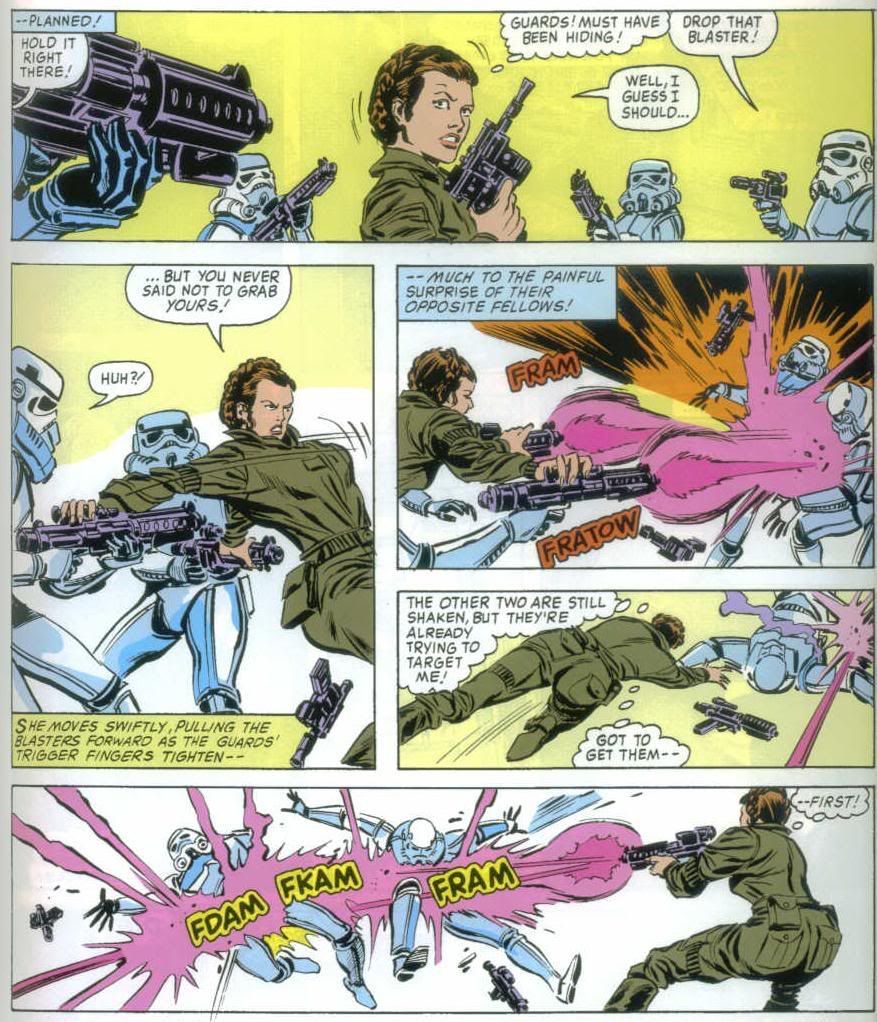
For someone who described her home planet as "peaceful" and "hav[ing] no weapons," Leia Organa sure is good in a scrap.


Of course, she also famously declared that "someone has to save our skins!"

Bahlactus decrees Ladies' Night, even in a galaxy far, far away!

[From "To Take The Tarkin!" in Star Wars #52, October 1981. Written by David Michelinie, pencilled by Walter Simonson, inked by Tom Palmer, lettered by John Morelli, colored by David Warfield. Scan from the reprint in Star Wars: A Long Time Ago ... Volume 3.]
Full Post

Tuesday, June 17, 2008

New comics 6/11/08

Booster Gold #10 (written by Geoff Johns and Jeff Katz, pencilled by Dan Jurgens, inked by Norm Rapmund) feels a little "off" to me, and I don't quite know why. It's probably because there's so much going on. Rip Hunter narrates for a couple of pages, with his Chalkboard Of Destiny (TM) distracting the reader in the background. Booster takes over as the scene switches to the scrum with Max's forces ... and here, I think, is where things get too overloaded. Essentially the rest of the book takes place in and around a big superhero fight involving -- get ready -- a reunited Justice League International (including Guy Gardner, the good Doctor Light, J'Onn J'Onzz, and Batman); Superman; Max Lord; the original version of Despero; the white-ape Ultra-Humanite; Per Degaton; Black Beetle; Ted "Blue Beetle" Kord; Maximillian (the evil Skeets); Booster and his dad; and the Mystery Villain. Oh, and I forgot the interlude with Rip and the time bubble.

Johns and Katz and Jurgens do their best to break out of the fight the important character-based scenes involving Booster and his dad, the Beetles, and the sidekick droids; but even so, there's still a lot going on in the background. In other words, the scenes aren't put in perspective like they should be, so the rest of the players feel like distractions and/or afterthoughts. What's more -- and I admit this may be just me -- I couldn't remember the non-sacrificial function of the vehicle for the eventual heroic sacrifice. (Said sacrifice plays out like Wrath of Khan, or the last Lone Gunmen appearance, by the way.) There's a sacrifice, but I don't know what else it accomplished. We'll find out next issue, I guess.

Anyway, it's not a bad issue, and it may well play out better in context. It's just a frustrating installment for this month.

Most of The Last Defenders #4 (written by Joe Casey, pencilled by Jim Muniz, inked by Cam Smith) finds Nighthawk on the wrong side of just about everybody, as the term "non-team" starts to take on its most literal meaning. I thought it was fine, but once again, there's a lot going on in the background which apparently only has two issues to resolve itself.

Star Wars: Rebellion #14 (written by Jeremy Barlow, drawn by Colin Wilson) wraps up the current story arc with a lot of action, and a little denouement. There's a suggestion that Luke and Deena Shan are a little sweet on each other, and since this is the interstitial period leading up to Empire, I'm all for anything which gets him away from those understandable-but-creepy-in-hindsight feelings he showed for Leia. I have to admit I'm not as up on my Expanded Universe characters as I should be, or else I'd probably be more sympathetic to them. Still, I can accept how the narration builds Deena up, and I always like seeing spaceship combat. Once again the art reminds me of Howard Chaykin's early SW work from thirty years ago, except the brief glimpse we get of Han seems a little too paunchy for the whip-thin Harrison Ford of 1977. Pretty good if you've been with this story the whole way; probably better the more you know.

This month in Batman Confidential (#18 written by Fabian Nicieza and drawn by Kevin Maguire), Batgirl and Catwoman inch that much closer to making X-rated Internet fanfic mainstream, as they spend the first 10 pages naked from the neck down, fighting in a nudist club. The fact that Maguire draws Babs with all these extremely uncomfortable expressions and retreating body language doesn't make it better. If last month was an excuse for cheesecake, this month drops the pretense ... uh, as it were. As much as I like him, Maguire's figures are just rendered too literally for this extended sequence to be farcical. Maybe someone with a softer style could have pulled it off (what?!? sorry!) better. Cliff Chiang's "Naked Ollie" chases from Green Arrow/Black Canary come to mind, so Chiang or his designated replacement Mike Norton might have done well with this. Anyway, everyone puts their clothes on for the rest of the issue, and I presume the rest of the story. (There's only so many opportunities to play the nude card.) It's pretty entertaining, especially since it focuses on puppies. I am not kidding. It's almost like DC felt like it needed to atone for the nearly-nude scenes with, yes, puppies. So, in summary, come for the cheap thrills, stay for the puppies!

(P.S. DC, if you use that as a blurb, I'd at least like a free copy of the paperback.)

The "Barbarian Queen" scenes in Wonder Woman #21 (written by Gail Simone, pencilled by Aaron Lopresti, inked by Matt Ryan) are fine, but I want to mention the Sarge Steel/Tom Tresser bit which opens the issue. On its own it's good: a typical "walk with me" scene which sets up a few familiar conflicts and advances the plot. However, these are two well-established spy characters who, by virtue of their respective careers, should interact on a higher level. Tom "Nemesis" Tresser had his own backup series in The Brave and the Bold, teamed up with Batman a couple of times, and was in the Suicide Squad; and Sarge Steel was Charlton Comics' answer to Nick Fury. So if this scene involved, say, Dirk Anger and Jimmy Olsen, it'd be easier to take.

As for Wonder Woman, her posse of '70s DC barbarians continues to grow, along with the savagery of her fights. "Losing her grip" is, I think, a fairly radical direction for the character, because it seems like most writers want to portray her as always in control, diplomatic, etc. However, it's still a valid direction; and I think Simone has presented it well. Diana's finding out what she's like without the fundamental sources of her strength. The art in the "barbarian" section is also tighter and darker, with more attention paid to the blacks and a more washed-out color palette (credit colorist Brad Anderson for that). Add a couple of callbacks to Simone's first arc and it makes for a good issue.

Green Lantern Corps #25 (written by Peter J. Tomasi, pencilled by Patrick Gleason, inked by Drew Geraci) presents the origin of the Black Mercy plant. It's a sensible, space-opera-y origin which maybe brings in Mongul a little too neatly, but it sends the story in a very Star Trek direction. New inker Geraci fits well with Gleason's pencils, giving them a little more definition in places and even putting a "cartoony" sheen on some of the figures. There's a misplaced word balloon on page 2, and there's more foreshadowing about different-color lanterns, but other than that it's pretty good.

About half of Green Arrow And Black Canary #9 (written by Judd Winick, pencilled by Mike Norton, inked by Wayne Faucher) features Plastic Man, with the other half showing Speedy and the British guy fighting super-powered bad guys. Thanks to Norton and Faucher, it's all portrayed with a light, breezy tone, which certainly makes some of Speedy's quips easier to take. Norton and Faucher draw a good Plastic Man too -- perhaps even nicer than what cover artist Cliff Chiang might have done. The issue builds to a couple of Dramatic Reveals: the bad guys' employer (which is pretty obvious) and the next guest-star (also not unexpected, but not unwelcome either). I continue to like this book.

Action Comics #866 (written by Geoff Johns, pencilled by Gary Frank, inked by Jon Sibal) is a heck of a start to the latest Brainiac storyline. The Daily Planet newsroom welcomes Steve Lombard, sports brute; and welcomes back noted innuendophile Cat Grant. Frank and Sibal really lay on the Christopher Reeve and Margot Kidder references for Clark and Lois, but it's all good. (Cat looks like she had a familiar model too, but I can't place her.) However, the showpiece of the issue is Brainiac's abduction of Kandor, shown in flashback (naturally) with references to General Zod and Brainiac's Kryptonian origins. To say that Brainiac now = Borg + Alien wouldn't do it justice. It's cold, scary stuff which sets up his threat level very well. Still, there is a bit of Borg plotting in place: Superman defeats a pawn, but the "king" is still out there....

Trinity #2 (written by Kurt Busiek, pencilled by Mark Bagley, inked by Art Thibert) finds the Trinitarians battling personalized threats: rogue solar systems, giant robots, and a mystical metropolis. It's nice to see each handle their own in the space of a few pages or so. Meanwhile, in the second story (written by Busiek and Fabian Nicieza, pencilled by Tom Derenick, inked by Wayne Faucher), Green Lantern John Stewart fights Konvikt and Graak in a sleepy Massachusetts town square. So far Trinity looks like superhero comfort food, and if it continues like this I suspect I won't have too many bad things to say about it.

Finally, here's Titans #3 (written by Judd Winick, pencilled by Joe Benitez, inked by various people), a frustrating installment of a series which has yet to define itself. Benitez' art has personality, but he doesn't have a handle on these characters. I hate to go all fanboy, but in an early pedeconference scene, all the characters are the same height. At the very least Starfire should be the tallest, but in a long shot she looks shorter than the Flash. Likewise, Beast Boy and Raven should probably be the shortest. These aren't just stylistic choices, they inform the characters' personalities.

The plot of the issue involves the Titans pairing off, with unfortunate results. While there's an in-story explanation, the sad thing is that the book has already established its willingness to "push the envelope" with regard to these characters, so we don't know how much of their behavior was provoked. I'm not saying the Titans should always be hugging, but Winick hasn't done much to lay a foundation for their normal behavior. I'd like to think this book will find its equilibrium sooner rather than later, but it might not happen for a few more months.
Full Post

Tuesday, May 06, 2008

New comics 4/30/08

For some reason DC Universe #0 (written by Grant Morrison and Geoff Johns, drawn by committee) felt more Johnsian than Morrisonian. It struck me as a collection of preview pages from a half-dozen upcoming arcs, tied together by vague narration from a Certain Familiar Someone. I responded most favorably to the George Perez pages and the Final Crisis tease.

The blow-up-the-base story currently running in Star Wars: Rebellion (#13 written by Jeremy Barlow, drawn by Colin Wilson) is starting to feel padded by about an issue, and this is that issue. Most of it follows a Rebel soldier as she tries to escape a sadistic Imperial officer and the requisite stormtrooper squads. There's some narration about her coming to grips with the meaning of being a Rebel, but that was lost on me somewhat because I've never gotten too invested in this character. A promising sequence at the end makes a good case for our heroine blowing up half the base with a single grenade (not unprecedented in Star Wars, I think you'll agree). Overall, some good stuff, and my opinion may change after next issue, but for now it still seems a bit long.

Teen Titans Year One #4 (written by Amy Wolfram, pencilled by Karl Kerschl, inked by Serge LaPointe) is, as the cover indicates, a Kid Flash spotlight, but it continues the Batman/Robin storyline which has run through the book so far. The issue doesn't quite put Flasher in the "I should be the leader" slot, but it does give him an ego to go with his considerable powers. Wolfram and Kerschl root for him regardless, so that he's never really unsympathetic. Also, Aqualad gets more of a personality, although he still doesn't do a whole lot. Wolfram and Kerschl's simple storytelling comes across as very matter-of-fact, and it leaves room for Kerschl's stylized, expressive designs to work. I'm looking forward to the rest of the series and wishing it could go on longer.

Back in the current Teen Titans (#58 written by Sean McKeever, pencilled by Carlos Rodriguez, and inked by various people), this month Miss Martian must fight not only the Terror Titans, but also her evil conscience. (I've been reading too many solicitations.) Not knowing much about the character, I thought this was a good way to highlight her inner turmoil. I was a little confused at first, thinking that her Evil Self was somehow connected to her Evil Future Self from a few issues back, but that was cleared up soon enough. The art was decent: not too far from the book's normal style, not too flashy, but adequate for the job at hand.

I get the feeling I should like "Secret Origin," part 2 of which appears in Green Lantern #30 (written by Geoff Johns, pencilled by Ivan Reis, inked by Oclair Albert), but it keeps falling flat for me. I shouldn't fault it for changing Hal's origin so that only he (and not the little training capsule) is yanked out of the hangar by Abin Sur's ring. Working classic GL characters into the background is also acceptable, as is tying it into "The Blackest Night" and the Ysmault prophecies. Maybe I just have a problem with Ivan Reis drawing Hal to look 17 years old; or with Johns having Hal cause a rival to crash. Otherwise, "Secret Origin" is appropriately reverent, which is nice. I don't dislike this storyline, but I like it less than Johns' and Reis' other GL work.

Johns does better with Action Comics #864 (pencilled by Joe Prado, inked by Jon Sibal), a bridge between Countdown and Legion of Three Worlds which plays like a standalone murder mystery. Basically, Batman and Lightning Lad (of the "Earth-1 Legion") clash over the corpses of Karate Kid and Una. Batman also makes the point that he's met three different versions of the Legion, so naturally he's not inclined to trust any of them. The mystery isn't solved -- it's a teaser for the aforementioned LO3W, after all -- but the issue is tied together by a Mysterious Narrator revealed on the last page. Suspenseful! (Also, this week, redundant!) The art is okay -- a little too chunky, but not to the point of Liefeldism. I can't get used to a Grunge-like Lightning Lad, though.
Full Post

Monday, March 17, 2008

New comics 3/5/08 and 3/12/08

I've got a lot of these to go through, so I'll try to keep it short.

3/5/08

Justice League: The New Frontier Special #1: Very nice all around. I probably didn't need to see how another Batman/Superman fight would play out, but it's justified as a "lost chapter" of NF. The Robin/Kid Flash and Wonder Woman/Black Canary stories are cute, the period ephemera is well-done, and the behind-the-scenes look at the DVD adaptation is pure eye candy.

Teen Titans Year One #3: Was a little surprised at the pacing of the overall miniseries, as depicted in this issue; but better earlier than later, I guess. Besides, the story's new direction looks intriguing. It's been good so far, so I'm in for the rest.

Supergirl #27: It's an understatement to say that this book hasn't been what I expected. If you remember the Steven T. Seagle/Scott McDaniel run on Superman a few years back, it's kinda like that, except on downers. I'm pretty much buying this book to see if it all makes sense. Plus, I like Drew Johnson and this issue's guest (fill-in?) artist, Rick Leonardi. S'girl isn't frustratingly bad like, say, early Hawkgirl or late Gotham Knights. It's just frustrating.

Countdown To Adventure #7: I read this book for the Adam Strange/Animal Man/Starfire story. I have no idea what's going on with the Forerunner story.

Nightwing #143: I like the fact that writer Peter Tomasi isn't afraid to plug Nightwing firmly into the center of DC's superhero culture. It can get a little precious, and sometimes -- not so much in this issue, but certainly in the last one -- it distracts from the main plot. This issue was fine, but I bet if it were your first DC comic in a while, you'd be mystified.

Detective Comics #842: Batman must deal with an EVIL! suit of armor that he ended up wearing in the Ra's Al Ghul storyline from a couple months back. You know Spider-Man's black costume? Like that, except Batman doesn't destroy it, it doesn't make him dance like a poser, and (so far) it hasn't come to life. I'm not sure why the world needed this story.

Green Lantern #28: The "Lost Lantern's" trial results in the creation of a Red Lantern. Hal has a Clarice Starling moment with Sinestro. We check in with the demons on Ysmault. The Guardians issue a radical new law. I can see how it all fits together, but I know the dots won't be connected for about another year.

Countdown #8: Yay, Ray Palmer's back as the Atom! Yay, Firestorm is back (although whither Martin Stein?)! Yay, Habitat, the Hairies, and the rest of Jack Kirby's Jimmy Olsen creations! Boo, all the bickering and running around pointlessly.

3/12/08

JLA Classified #54: Will probably read better in the trade. Since this is the last installment of the Titus storyline, the "past" narrative takes up the top half of each page, and the "present" gets the bottom half. Sometimes that trick works, sometimes not. Here, it might've been better to split the pages vertically. As for the story, Titus beats the tar out of the League for as long as is dramatically appropriate. The ends on an ecumenical note, which is always nice, but a bit treacly for the Justice League. Overall, though, pretty good.

Batman Confidential #14: Part 2 of a new look at a one-off villain from the '80s, The Wrath. As a modern-style story with an out-of-date setting, it's not exactly a nostalgia-fest. However, I give it points for picking a time period other than "Year One." Otherwise, I'm not sure what the general appeal would be.

The Last Defenders #1: The Defenders are famous as Marvel's "non-team." This book goes a step further, taking pains to point out how its characters are nowhere near as cool as the original Defenders. It's a weird little exercise in obstinance wrapped in a story about white supremacists and big snake-monsters. I'll probably stick with it.

Fantastic Four #555: Boring. Bryan Hitch and Paul Neary are fine craftsmen, but there's still no life in an issue which features an illicit tryst, a duplicate Earth, and a giant killer robot. It's all hat and no cattle.

Superman Confidential #13: Part two of the Toyman/Jimmy Olsen story is okay, and I like Phil Hester and Ande Parks' art, but it feels a bit padded and lethargic. Probably could have used some pruning.

Star Wars: Rebellion #12: Part two of yet another "infiltrate an Imperial base" story that just kinda sits there. Colin Wilson's art reminds me of early Howard Chaykin, and his Luke doesn't look much like Mark Hamill either.

Bat Lash #4: The big apocalyptic issue which sets up the climax. This miniseries has been decent, but it's hard to reconcile all the blood and death with the happy-go-lucky tone which got me interested in the character. (Lots of cattle, but I thought the hat would be different, in other words.) Maybe Sergio Aragones can do it. We'll see.

Countdown To Mystery #4: I continue to like the Doctor Fate story as it plays with the (pretty much inevitable) conclusion that has Kent Nelson become the latest Doctor F. This installment includes the most traditional superhero action we've seen since early on, but the pieces still haven't fallen into place. Most origin stories seem to place the origin alongside another threat, in order to give the new hero something to do in the third act. This one is all about the origin process itself, with Inza's comic-book ventures serving as metacommentary. Makes me miss Steve Gerber that much more. P.S. This book also contains an Eclipso story which is once again threatening to meander.

Booster Gold #7: It's The OMAC Project, Take Two, as we see how Max Lord took over the world once Booster saved Beetle from an (untimely?) death. (By the way, I've just started the second season of "Star Trek Voyager," and Tom and Harry are reminding me a lot of Beetle and Booster.) More subplots converge alongside more trips into DC's nostalgia mine, so for me, pretty good.

Superman #674: New artist Renato Guedes brings a nice "bigness" to the proceedings. Outgoing writer Kurt Busiek brings back an old JLA villain (from just before the Detroit days) to threaten Superman. Meanwhile, Supes has problems with Mon-El and the Kents have a new apartment. It's a full issue which doesn't feel overstuffed.

Wonder Woman #18: Guest artist Bernard Chang helps Gail Simone send WW into space, in what looks like an oblique sequel to the "Space Pirate" storyline from the early '90s. Basically, she's challenged by the Khunds (who act like Klingons) to stop an unstoppable race which threatens Khundia. Also, she gets pre-engaged to Tom Tresser, and Etta Candy shows up too. Chang makes WW look like someone familiar, but I can't think of who. His art is a lot less porntastic than I feared it would be.

Countdown #7: Yet another parallel world, 90% close to the familiar DC-Earth. Another Tom Derenick-pencilled issue too. I swear, this series would be twice as good if it were half as long.

Green Arrow and Black Canary #6: This issue seemed so indebted to "Alias" (the TV show, not the comic book) that I'm starting to think Connor Hawke is the Michael Vaughn designated-victim figure. Remember when Vaughn drowned at the end of Season One, or when he got shot like Bonnie & Clyde at the beginning of Season Five? My money is therefore on Connor to pull through.

Green Lantern Corps #22: Part two of the Boodikka/Alpha Lantern storyline seems pretty forgettable, although it'll probably look a lot more important in 2009. Today, though, I'm tempted to think that all the procedural GLC stuff would fit better in this book than in Green Lantern, with the Boodikka story as a backup.
Full Post

Saturday, August 11, 2007

New comics 8/8/07

We begin with Countdown #38 (written by Paul Dini, Justin Gray, & Jimmy Palmiotti, pencilled by Jesus Saiz, inked by Palmiotti), which has a lot of action, several big names, and a couple of decent character scenes, and yet it's undone by the little things.

The backbone of the issue is a cyber-fight between Oracle and the Calculator which has repercussions out in the real world. The JLA, JSA, and Freedom Fighters have to stop the various crashing planes and launching missiles, so there's your action. In an unrelated story (or is it?!?), Mary Marvel and Zatanna fight off Slig, one of the Apokoliptian Deep Six, who nevertheless becomes the latest Fourth Worlder to get zapped away. Jimmy Olsen tries to join the Teen Titans, and Trickster and Piper convince the Question they're not guilty of murdering Bart Allen. Oh, and Karate Kid is dying.

The problem is, Zatanna doesn't use the full range of her powers, but Mary Marvel has some new ones. The runaway Rogues are apparently too dumb to be lying about the Flash's death, but they still get away from the Question and Batwoman (who, admittedly, aren't all that experienced as superheroes). Finally, the Jimmy scene doesn't resolve anything: he doesn't join the Titans, but he's not dissuaded from superheroics; and the limit of his powers is something we readers probably figured out a few weeks ago. Art is good, though -- Saiz is a fine storyteller.

Star Wars: Rebellion #9 (written by Brandon Badeaux & Rob Williams, drawn by Michel Lacombe) was an entertaining chapter of the latest arc, with lots of action and plot movement. Using characters who aren't "untouchable" members of the main cast only reinforces the anything-goes feel. Art is quite good -- expressive, but faithful to the SW details that the license commands. Some of the character moments are a bit familiar, but again, it's Star Wars.

Speaking of character development, it turns out (in JLA Classified #41, written by Peter Milligan, drawn by Carlos D'Anda) that Kid Amazo's incorporated more of the Justice League than just their powers. Again, I think there are a few interesting nature-vs.-nurture and free-will questions floating around this story, and the end of the story is rather disquieting for the JLA's own solidarity. However, it's somewhere in between a philosophy treatise acted out by the Justice League, and a Justice League story rooted in philosophical principles. It's probably closer to the latter. Not bad, but not as great as I originally hoped.

Green Lantern #22 (written by Geoff Johns, pencilled by Ivan Reis, inked by Oclair Albert) is a big fight on Qward between Hal and Kyle and their attendant GL and SC colleagues. An interlude involving the Cyborg Superman and the Anti-Monitor is very Vader-and-Palpatine, which can't be a coincidence. Reis and Albert do a great job at organizing the chaos, creating a comic which invites the reader to slow down and look at the detail while simultaneously pushing the action forward. Everything looks bleak, but in a good way.

Finally, as you might have expected, I enjoyed Batman #667 (written by Grant Morrison, drawn by J.H. Williams III) the most this week. I can't say enough about Williams' design: panels are shaped like black gloves, the first page dissolves into bats, and a hero falls under a painting of past glory. The "Batmen Of Many Nations" is perfect for Morrison's multiple-choice examinations of superheroics, and he doesn't disappoint here. It's perhaps the best part of his Batman tenure so far, which is saying a lot.

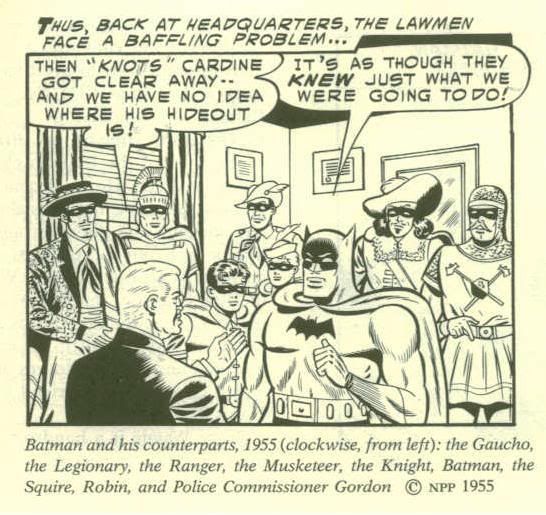
So just as an appendix, here's a picture of the original Club, cribbed from my trusty Michael Fleisher Batman Encyclopedia, along with its rundown of the original members.


England has the Knight and the Squire, secretly the Earl of Wordenshire and his young son Cyril, who, clad in knightly raiment, roar into action astride their motorized "war horses" whenever the tolling of the bell in a nearby rectory warns them that their services are urgently needed (BM No. 62/2, Dec/Jan '50-'51: "The Batman Of England!"),

Batman counterparts in other countries include the Legionary of Italy, the Musketeer of France, the Ranger of Australia, and the Gaucho of South America (Det. No. 215, Jan '55: "The Batmen Of All Nations!"). And in the Western United States, in the region inhabited by the Sioux, Chief Man-Of-The-Bats and his young son Little Raven battle crime and injustice among the Sioux much as Batman and Robin battle crime in Gotham City (BM No. 86/3, Sep '54: "Batman -- Indian Chief!").

Although Batman has given advice and encouragement to all these crime-fighters, some he has actually trained himself from scratch, such as Northern Europe's Wingman (BM No. 65/1, Jun/Jul '51: "A Partner for Batman!") and Latin America's Bat-Hombre (BM No. 56/1, Dec/Jan '49-'50: "Ride, Bat-Hombre, Ride!"). Bat-Hombre cauased Batman grave disappointment, however, when he turned out to be a member of an outlaw band....


(Fleisher, pp. 75-76.)

So there you go. There's a Batman in the 31st Century (but not the Legion's 31st) and on the distant planet Zur-En-Arrh; and Batman-related figures throughout history: a caveman (Tiger Man), an ancient Babylonian (Zorn -- I am not making that one up), the 17th Century American colonist Jeremy Coe, and the 18th Century's Abel "Captain Lightfoot" Adams. I don't expect Morrison to use all of these, but at this point, who knows?
Full Post

Tuesday, July 17, 2007

New comics 6/27/07, 7/5/07, and 7/11/07

Twenty-one titles over the past three weeks, and I'm looking at twelve more tomorrow....

6/27/07

Amazons Attack #3 and Wonder Woman #10 have bled into each other by now. I’d have to go through each side-by-side and page-by-page to determine what takes place in which order, let alone how this event relates to Countdown. Also, Batman’s “Bees. My God.” line from AA #3 demands to be said in a Cartman voice. Still, both books look pretty; AA’s Pete Woods always delivers, but Paco Diaz does a fine Dodson/Drew Johnson impression for Wonder Woman.

My only complaint with Fantastic Four #547 is that Reed can apparently survive in space unaided, and the more I think about it the more it makes a weird comic-science sense. Otherwise it’s another solid issue from Dwayne McDuffie, Paul Pelletier, and Rick Magyar.

I wasn’t going to get Supergirl & The Legion #31, because I thought a break was needed after the Waid/Kitson era, but it wasn’t too bad. It feels like a pastiche of Waid/Kitson, which isn't entirely fair considering that Tony Bedard and Kevin Sharpe had each done some fill-in work previously, but I'm still not sure I don't need a break.

She-Hulk #19 presented a fascinating legal strategy, one which might not be too innovative in the history of superhero comics, but which was argued well nonetheless. I continue to like the Dan Slott/Rick Burchett/Cliff Rathburn team, but some combination of the inks and the colors (by Andy Troy) actually make the figures look two-dimensional – and by that I mean that I had to look twice to see if a Two-Gun Kid cardboard cutout was supposed to be sitting at the table.

I talked about Sinestro Corps already.

7/4/07

The 3-D effects were the best thing about Action Comics #851, and that’s actually saying something this time. This story has been a mixed bag, but this issue doesn’t have too much to do beyond getting Superman out of the Phantom Zone and showing Zod’s conquest of the Earth. I bet in four or five months, when the conclusion finally appears, I’ll have had time to form an opinion on the story so far.

Atom #13 takes Ryan and Chronos back to the land of tiny barbarians Ray Palmer visited in the Sword of the Atom books, and by and large it’s pretty fun. Gail Simone uses the same kinds of funny-talkin’ aliens that endeared us to this book’s first crop of diminutive villains, but it works here too.

Nightwing #134 flashes back to a Bat-spat, and in the present finds our hero fighting the new Vigilante. However, one of the things I liked best was Jamal Igle’s two-page, top-tier spread of a swanky restaurant. It might seem like an indulgence, but it sets the proper tone for the scene. The story’s pretty good so far, too.

Detective Comics #834 -- 700 issues ahead of Nightwing, I see – finishes up the Batman/Zatanna team-up pretty well. Zatanna gets her revenge on the villain of the piece, and she and Batman finally make up after Identity Crisis. It’s still a Batman story, but he doesn’t overshadow her, which was nice.

Aquaman: Sword Of Atlantis #53 is officially a dead title walking, as of today’s DC solicitations. It’s a shame, but I can’t say I’ll miss the book too terribly much. This issue was decent; more of the Black Manta-takes-over-Sub Diego story, with well-done superhero action.

Welcome To Tranquility #8 presents a medley of spotlights on the people of Tranquility, and I have to say, these little doses have done more to make me like this title than the big six-issue opening arc did. They kept the book on my radar for sure.

All-Star Superman #8 wasn’t as immediately gratifying as its predecessors, but it was still good. I’m sure I will appreciate its depth and complexities the more I revisit it ... whenever that might be. The same thing applies to JLA Classified #40 -- I can tell there’s a nature/nurture/free-will theme running through the issue, but I want to look at it in a better context before passing a more definite judgment.

I talked about some ramifications of Outsiders #49 last week. Probably not going to pick up the revamped title.

7/11/07

Star Wars: Rebellion #8 was fairly entertaining. The pieces of the story are starting to come together, and it's done a good job of creating Star Wars-esque characters who aren't overly familiar. I didn’t buy Vader’s high-jump-flip, though -- too prequel-y.

Green Lantern #21 was a very good follow-up to the Sinestro Corps Special, and it gives me high hopes that "SC" will be the good kind of epic “Event,” not the bloated Countdown kind.

Superman #664 did a lot to advance the “Camelot Falls” arc, even explaining the arc’s title. Tying in the Prankster fill-in from a few months ago was good too. Man, Carlos Pacheco draws a great superhero book; and Jesus Merino’s inks are meticulous -- everything pops off the page. Too bad about the book’s scheduling problems.

Superman Confidential #5 likewise does a lot to start wrapping up the “Origin Of Kryptonite,” with the most important probably being the explanation for the meteor chunk’s thought balloons. A good, plot-driven, payoff-facilitating issue.

Lastly, the Deadpool/GLI Summer Fun Spectacular was a highly enjoyable romp through the silliness which is post-Civil War Marvel. The sight of Penance’s cat was priceless.

SPECIAL DOES-COUNTDOWN-MAKE-SENSE? SECTION

Okay, so I read Countdown #s 44-42 all together to see if there’s any narrative cohesion, and the answer is ...

... maybe, a little. Countdown has dedicated itself pretty firmly to following its basic cast of characters. When those characters’ stories are interrupted, as #43's Flash funeral does, the series’ rhythms are thrown off.

However, Countdown’s problem lies in its over-reliance on its core characters to explain everything going on in the rest of DC. It seems like each scene is an interaction between characters – and if that sounds basic, I mean that each scene essentially involves conversation. The exception in these three issues is the funeral, which begins with a few narrated panels establishing Keystone City. Still, even that narration comes from Jimmy Olsen. Jimmy might well be Countdown’s central figure, but the series spends so much time on each of its characters that Jimmy contends for space with Mary Marvel, Donna Troy, et al.

Indeed, Countdown doesn’t do a whole lot to lay out its story’s scope, explain what’s at stake, or otherwise build a structure upon which to hang those scenes. Countdown has focused pretty faithfully on its characters, so much so that it seems like the plot is being left to other titles. After ten issues of a fifty-two-issue miniseries, those structural devices should start becoming apparent, and I get no sense of them. Now, it may well be that this isn’t just a fifty-two-issue miniseries -- but how much shapelessness are we readers expected to endure in an eighty- or hundred-issue Mega-Comics Event?
Full Post

Sunday, June 17, 2007

New comics 6/13/07

We begin this week with Star Wars: Rebellion #7 (written by Brandon Badeaux & Rob Williams, drawn by Michel Lacombe), a decent second chapter for "The Ahakista Gambit." Our rag-tag group of lowlifes recruits its last member, a onetime Jedi Knight squirreled away in seclusion, and everyone then makes their way to Ahakista. So far there's just a lot of tension being built and mood being set. I'd rate this higher, but it uses caption boxes inappropriately. See, not only do the thoughts of the main character, Wyl, appear in caption boxes (with red letters), he's got a little speaker in his head that pipes in the taunts of the guy who sent him on this suicide mission. Those caption boxes have green letters. At the risk of being a Luddite who hates cool innovations like caption boxes, I think it would have been clearer to use differently-shaped thought balloons for these "tracks" of narration.

Other than that, the book does a good job of using Star Wars elements and design aesthetics. A particularly effective sequence has AT-ATs destroy a neighborhood like a kid stomping out sand castles. I also like the looks of our heroes' starship -- kind of a Y-Wing crossed with the Millennium Falcon. Overall, an appealing book, but it's a shame about those caption boxes.

Next is JLA Classified #39 (written by Peter Milligan, drawn by Carlos D'Anda), Part 3 of "Kid Amazo." The eponymous character isn't unsympathetic, but he does seem to tread the familiar ground of "must I follow my evil programming?" In this respect, making him a philosophy student was cute. I like D'Anda's art, and Milligan's dialogue is good too. There seem to be only a few ways this story can go, though, and I think we've seen them all already.

Batman Confidential #6 (written by Andy Diggle, pencilled by Whilce Portacio, inked by Richard Friend) finishes a bad story that never even touched on its goofy potential. At one point, Batman apparently reveals his secret identity to Lex Luthor (a reference to "my," i.e., WayneTech's, robots). I would much rather have read the story of how a novice Batman, whose most advanced bits of equipment were the hang-glider and sonic bat-call he had in "Year One," cobbled together the first Batmobiles, Batplanes, etc., and used those to fight Luthor's giant robots. Alas, this devolved pretty quickly into something better expressed with action figures. Portiaco's and Friend's art was not especially suited to the parts of the story not dealing with robot-combat. Characters just in this issue look manic when they're supposed to be inspirational, and sleazy when they're supposed to be noble. I expected more, especially from Diggle.

Countdown #46 (written by Paul Dini, Justin Gray, & Jimmy Palmiotti, pencilled by Jesus Saiz, inked by Palmiotti) was a weird mixed bag. Mary Marvel fights a demon made out of babies, which is all kinds of bizarre and should be Exhibit A to the "line between Vertigo and DCU is B.S." complaint. Jimmy Olsen visits Sleez, an Apokoliptian pornographer, who's killed before he can give Jimmy information on the late Lightray. There's another Tarantinoesque scene with the Rogues' Gallery, and the week's cliffhanger centers around Jason Todd, Donna Troy, and new villainess Forerunner. The art is good, although Jimmy looks a lot older than he probably should. However, it never quite comes together as a cohesive single issue. We hear a lot about Countdown's master plan, "bible," etc., but again, my fear is that it's a 900-1000 page story told in 52 unequal installments, and not a 52-week journey. In other words, even if this discombobulated opening actually starts to pay off in 6-8 weeks, the series hasn't earned a lot of goodwill on the way there.

Finally, Green Lantern Corps #13 (written by Dave Gibbons, pencilled by Patrick Gleason, inked by Prentiss Rollins & Tom Nguyen) finds Guy, Soranik Natu, and a few other Lanterns on Mogo, curing it of the disease that's been mind-controlling their colleagues for the past few issues. Everyone gets used well, especially Guy, Natu, and Mogo's insectoid partner. The cause of the disease is pretty clearly the Sinestro Corps, but the issue works well too on its own terms. Everyone involved with this book is doing fine work -- it's a well-executed space opera.
Full Post

Monday, May 28, 2007

New comics 5/16/07 and 5/23/07

Would have gotten these up last night, but the traditional Memorial Day allergies started to kick in....

MAY 16, 2007

The Flash: The Fastest Man Alive #12 (written by Marc Guggenheim, pencilled by Tony Daniel, inked by Art Thibert) is a fairly decent issue which suffers somewhat by the behind-the-scenes murmurings about Bart Allen's fate. I give it a lot of credit for setting up an inescapable doom-trap, but at the same time I have to think that the doom-trap won't actually kill Bart. I mean, that would be a little too grim, even for someone like me who still can't get past the arbitrary nature of his promotion. My appreciation of said trap is therefore blunted somewhat. I'm also kind of ambivalent about whether I want Bart to escape. I don't want him to die, but at the same time I don't think he should be the Flash just yet.

How was the book itself, you ask? Decent, like I said. No one seems to be out of character, but Bart himself is still such a cipher that it's hard to say at this point what would be in character. Daniel's storytelling skills are fine, but Thibert's inks are inconsistent. The "weight" of characters on the page varies, and more often than not the Flash especially looks two-dimensional. Still, there is that doom-trap, and the Black Flash, so I don't feel bad about coming back.

Countdown #50 (written by Paul Dini, Jimmy Palmiotti, and Justin Gray, pencilled by J. Calafiore, inked by Mark McKenna) has already been dissected by many of you, so I will just add some brief observations. First, if the cover suggests that the Joker has targeted Jimmy Olsen, that implies a much more exciting story than Jimmy happening to end up at Arkham Asylum for a stereotypical Hannibal Lecter conference. I'd want to read Joker vs. Jimmy, and I'd be lukewarm about Joker Talks To Jimmy. Second, the scenes with the Rogues go on far too long: five pages to establish a) they hate the Flash, whoever he might be, and b) Piper and Trickster's bona fides are in question. I thought this scene added nothing to the current Flash arc. I think Countdown is improving, but boy, it's not improving quickly.

Justice League of America #9 (written by Brad Meltzer, drawn by Ed Benes) gets a lot of things right -- the Gorilla City scenes, for instance -- but again, nothing much seems to happen. Teams of JLAers and JSAers just show up and collect Legionnaires like they were checking out library books. At least the three bad guys were revealed.

Action Comics #849 (written by Fabian Nicieza, pencilled by Allan Goldman, inked by Ron Randall) finishes the "Redemption" two-parter about like I figured. There are some intriguing ideas, and Kurt Busiek's social worker from an earlier Superman is used well, but ironically, I think Superman himself comes across as imposing his will on the common folk more than the story's antagonist does. The final confrontation features Superman hovering over the congregation making pronouncements, and while Clark muses later that his moral compass has to be pretty accurate, I don't think the congregants understood that point.

Aquaman: Sword Of Atlantis #52 (written by Tad Williams, drawn by Shawn McManus) finds our hero and his companions hatching a plan to free Sub Diego from Black Manta. This was not a dull issue, and I don't have much of a problem with the art, but the Sub Diego stuff is just not involving me like it wants to. Besides, both Busiek and Williams want Arthur to be The Decider, but so far neither of them have really presented a compelling case for that. Arthur's just a guy who can live underwater unaided and maybe occasionally talk to marine life, and right now that's not enough to get me excited about him. There are exciting and chilling moments in the issue, including the Black Manta fights and Aquagirl's story about the fate of some Sub Diegans, but Arthur should be the compelling center and he's not.

Checkmate #14 (written by Greg Rucka and Judd Winick, pencilled by Joe Bennett, inked by Jack Jadson) is a solid caper story wherein a Checkmate team and the Outsiders infiltrate Oolong Island. As usual, Rucka uses the caper to advance the book's various political subplots effectively. As a crossover, though, I have to say this storyline isn't encouraging me to pick up Outsiders on a more regular basis. Beyond Nightwing, none of these characters seem particularly exciting, and most of them are defined by their sarcasm and air of bad-assery. If Rucka and Winick each wrote their respective team's dialogue, Rucka wins. Bennett and Jadson do well enough, but the big action scene at the beginning suffers from faulty perspective. Specifically, I couldn't tell at first whether the monster was supposed to be looming over the ship or sitting atop it.

Where do I begin with All-Star Batman & Robin, The Boy Wonder #5 (written by Frank Miller, pencilled by Jim Lee, inked by Scott Williams)? First, I don't think anyone should look to this title for the Platonic ideals of Batman, Robin, or any of the other iconic characters it features. This is not a story about How Batman Should Work. I don't know what this story is about, and it's been five issues. Actually, I take most of that back: this is a story about making Batman first among alpha males, by giving every other possible contender some fatal character flaw. Of the various costumed characters portrayed so far, Batman is the only one who seems to get the colossal joke underlying the very pursuit of superheroics. This makes a lot of sense in light of the basic "Batman" idea, and it could be a pretty entertaining series of issues, but remind me again ... what's the basic plot of this series? Where are the conflicts? Batman is wanted by the cops generally, never mind for kidnapping Dick Grayson, and by the way Dick's parents have been murdered. Five issues in and we're still just introducing all the players. This is starting to feel like the sub-glacial pace of Supreme Power all over again. It's bad enough the issues are so late, but then to have virtually no plot advancement feels like Miller and Lee are just in it to put one over on the suckers.

Fortunately, Grant Morrison, Andy Kubert, and Jesse Delperdang offer Batman #665, which gets a lot of ASB&R's ideas across in a mode that's much easier to digest. "The Black Casebook" ascribes a certain supernatural dread to those old Batman stories no one likes to talk about because they're "not realistic." In this issue, Batman and Robin take out the Bane-themed Batman, in part because Bruce convinces himself that he needs to be, yes, the top alpha male. However, Morrison's Batman is more sedate, and perhaps more self-aware, than Miller and Lee's cackling dervish. He's playing a role, not thinking with his id. The issue also has some fine action scenes, including Batman and Robin both slamming into the Bat-Bane with their respective vehicles.

Star Wars: Rebellion #6 (written by Brandon Badeaux & Rob Williams, drawn by Michel Lacombe) begins a new arc focusing on a character who should be familiar to me, but isn't. He's a Rebel agent who gets found out by the mob boss he's infiltrated, and sent on a mission by said mobster. I liked this issue well enough, even if some parts of it (the opening flashback to Episode III, and an assassination) weren't connected to the main plot. It all felt like part of the comfortable SW setting, and with a book like this, that's what you want.

Finally for this week, Hero Squared #6 (written by Keith Giffen and J.M. DeMatteis, drawn by Joe Abraham) offers the origins of Captain Valor and Caliginous, each told by them in what has to be somewhat self-serving fashion. Captain Valor's is more funny, being a pretty obvious parody of Captain Marvel's (including a Mr. Natural-like Shazam figure), but the emotional heft comes at the end of the issue, when one of the book's main players reacts to Caliginous' story. This is another book that doesn't do much in the way of macro-plot, but at least it offers a fairly complete story in every issue. If, as I have read, it's ending soon, it should probably get to its larger point, but issue by issue, it's still fun.

MAY 23, 2007

Countdown #49 (written by Paul Dini and Tony Bedard, pencilled by Carlos Magno, inked by Jay Leister) uses Jimmy's elastic past to get him out of the cliffhanger with Killer Croc, and the Pied Piper and Trickster get a good double-agent-y scene to establish their bona fides with the other Rogues. The rest of the issue is taken up with exposition-happy Monitors, Karate Kid and Red Arrow trading quips (leading me to wonder about the timing of this issue relative to the JLA/JSA crossover) and a dismemberment-happy Black Adam. The art this issue was pretty good for a team I've not seen before -- very dynamic, although there has to be a better way than facial hair to distinguish the Monitors.

I'm genuinely torn as to whether to continue with Supergirl and the Legion of Super-Heroes (#30 written by Mark Waid, pencilled by Barry Kitson, inked by Mick Gray and Jimmy Palmiotti), because this was a very solid issue, but I think it's Waid and Kitson's last. They go out raising more questions than they answer, with those questions being very intriguing. Will Cosmic Boy join this mysterious new team? What will happen to Mon-El? Most importantly, will the new creative team be any good? I keep saying I want to re-read this series, so maybe this will give me the impetus to do it.

I thought The Spirit #6 (by Darwyn Cooke) was too ambitious. It tries very hard to be a real Eisner-esque story about a new character, with the Spirit in the background, but it just felt so familiar, and not in a good way. It's probably redundant to say that tortured musicians suffer for the sake of their art, and will do anything to perfect it, but there didn't seem to be much new (beyond the sci-fi trappings) of this musician's story. This title will always be worth reading as long as Cooke is on it, because Cooke is such a great storyteller and designer, but this issue falls short.

Wonder Woman #9 (written by Jodi Picoult, drawn by Terry Dodson and Rachel Dodson) doesn't skimp on plot. Superman, Batman, and the Justice League appear briefly, Circe's plans are revealed further, and Diana and Circe square off. The art is gorgeous, as you might expect. Picoult is improving, but her dialogue is still too clever and she can't quite manage all the plot. It continues to mystify me why DC would try to build up this title's profile with a prose novelist, and then plop said novelist right in the middle of a big event.

For some reason Fantastic Four #546 (written by Dwayne McDuffie, pencilled by Paul Pelletier, inked by Rick Magyar) didn't make much of an impression on me the first time around. That's probably my fault, because upon further inspection it's a neat little issue which references everything from the '70s Jack Kirby Black Panther series to Waid and Wieringo's last big FF arc. Oh, and Beyond!, of course, written by McDuffie. I didn't expect to see Reed and Sue back in the book (and apparently on their way to a healthy relationship) so soon, but that was a pleasant surprise, as was the combination of Pelletier and Magyar. Magyar really gives the pencils a good heft and a lot of weight, for a nice Alan Davis look. If this is just a temporary team, the long-term folks had better be absolutely stellar.

Arnim Zola, another '70s Kirby creation, shows up in Captain America #26 (written by Ed Brubaker, pencilled by Steve Epting, inked by Mike Perkins). A series of brief episodes -- the typography of which reminds me of old Spirit stories, for some reason -- check in on Sharon, the Winter Soldier, the Falcon, and Zola and the other villains, all getting back to their lives after Cap's death. Apparently this issue comes after all of those Fallen Son specials Marvel's been pushing since Cap #25, but I haven't read 'em, so this isn't overkill (you'll pardon the expression) for me. Brief glimpses of the Avengers both connect this book to, and distance it from, the larger Marvel Universe. These are people who don't quite fit into the land of crossovers and tie-ins. In that respect they're misfits, not unlike the time-lost Captain America whose memory now links them. If you can't already tell, I like this book a lot.

Aaand speaking of crossovers I haven't read and am not reading, here's She-Hulk #18 (written by Dan Slott, pencilled by Rick Burchett, inked by Cliff Rathburn), featuring Jen's battle with Iron Man on the SHIELD Helicarrier. That's about it, really. This issue uses Jen as a bridge between Civil War and "World War Hulk," getting her from one side to the other. There are some cute moments, but most of those involve Shulkie's regular supporting cast. It's not bad, it's just not as good as the book has been.

Finally, here's a book that may be better than ever: Birds Of Prey #106 (written by Gail Simone, pencilled by Nicola Scott, inked by Doug Hazlewood). Not just the Barda/Knockout fight, this matches up all of the Secret Sixers against the Birds, with Ice slowly regaining consciousness throughout. (Just noticed: on the cover, Barda's mega-rod looks a lot like Luke's green lightsaber....) It's pretty fun, especially the Misfit/Harley Quinn pairing. Nicola Scott's choreography isn't as fluid as I'm used to, so some of the figures are posed a bit awkwardly. Then again, they are fighting, so maybe that's how they're supposed to look. This team has succeeded in making a book I look forward to every month, and it's another situation where the new writer will have big shoes to fill.
Full Post

Thursday, May 24, 2007

Into The Woods: Star Wars, Episode VI: Return of the Jedi

I'm always a bit surprised by how much I like Return of the Jedi. There are parts of it I don't like (the Special Edition's musical number chief among them) and choices I think were ill-advised, but I give it credit for its central focus. As much as George Lucas claims the entire cycle is about Anakin/Vader, Jedi is about Luke.

Spooky Luke is in full effect from his first appearance in the film, hooded and cloaked as an obvious combination of Obi-Wan and Vader. Mark Hamill's Jedi-mind-trick voice sounds like it's been hollowed out with a battered wooden spoon, and his eyes are cold and penetrating: "You will bring Captain Solo and the Wookiee to me." Later, when he tells the Emperor "soon I'll be dead, and you with me," he's pretty convincing. He's come a long way from those power converters at Tosche Station. It's no accident that the final Jedi/Sith confrontation takes place high above the rest of the action. It would not have carried as much weight had the Emperor's throne room been a hellish environment, as originally conceived.

The rescue of Han particularly shows Luke in charge, and also ensures that Han will be in a secondary role throughout the film. Han spends most of the sail-barge fight flailing around trying to rescue Lando. He gets to bark orders and fight later on, but he's nowhere near the presence he was in Empire. He's also been separated from the Millennium Falcon, so the dynamic space-pirate mojo he was working in the other films is curtailed here. His presence on Endor, and that of Leia, does make the audience care about the ground battles, and gives Lando a chance to shine in his old ride, but those assignments seem more logistical than character-driven. The principals spent most of Empire apart, so Jedi naturally wants to have them together as much as it can.

There's still something missing from the Luke/Han/Leia relationship, beyond even the hint of a love triangle from the first film. Indeed, with Han and Leia free to be romantic, the Unresolved Sexual Tension which sparked their interactions in the previous films has been dimmed. One can see how they will grow into an old married couple in this film, but one still misses the "I am not a committee!" style of banter which made them appealing in the first place.

I tend to think that Leia gets the short end of the Jedi stick in this movie. I understand why, mind you; I just think Luke could have done a bit more planning, and maybe passed along a few simple Jedi exercises, before he strode off to face certain death at the hands of the Sith Lords. She does get to strangle Jabba with her chain, but her dealings with the Ewoks make her more of a nurturer. Obviously this is in keeping with the implication that she and Han are to breed the next generation of Jedi.

Like Han, Vader takes a more subordinate role in this movie. In this respect the prequels do Jedi a favor, showing us how fearsome Palpatine was (and may still be), but except for the beginning and the end, Vader is back to the same level on the organizational chart he had in Episode IV. Only in his climactic duel with Luke, when he ponders evilly the prospect of turning Leia to the Dark Side, does the Vader of Empire peek through.

For his part, the Emperor hasn't lost much from his last big appearance in Episode III. He's not as seductive or as scary, but he is more of a presence than Vader in the scenes they share. He's just as manipulative, too -- by making the Rebels aware of his Death Star visit, he sets the same kind of trap for Luke that he did for Anakin at the beginning of Episode III. When push comes to shove and he realizes he'll have to kill Luke himself, it connects him most clearly with the end of Episode III.

We'll come back to that in a moment, but I do want to talk about some technical aspects. Jedi has a very organic look, not surprising for a movie that spends most of its time in the redwood forest. It goes along with the general breakdown of structures that the two Star Wars trilogies chronicle. The Death Star is only half-finished, the Rebel fleet is an ad hoc collection of starships and fighters, and in fact the only major man-made structures in the movie belong to bad guys: Jabba's palace, the shield generator bunker, and the Death Star. (If memory serves, Yoda's house and the Ewok villages are the only other buildings.)

(The sight of the half-finished Death Star is nice and eerie. When I saw the first preview images back in 1983, at first I thought it was the wreckage of the old one. As it is, it's like a great metal skull made of scaffolding.)

However, the location scenes, especially on Endor, don't feel right somehow. The less built-up they are, the more they remind me of live-action role-playing. Aside from the original movie, and the prequels' Tatooine scenes, Star Wars tends not to do well with location shooting. I got the feeling the camera couldn't follow the Endor battles as well due to real-world restrictions, so they aren't quite as involving as the Hoth battle or especially the prequels' large-scale combat. Obviously, Jedi's space battle scenes could be choreographed more flexibly, and are more satisfying as a result.

The Ewoks can get annoying, but I still enjoy their schtick in moderation. Besides, the film doesn't take them all that seriously. Considering they're cuddly teddy bears who were more than ready to cook and eat Han, Luke, and Chewie, they're a lot like the killer dolls in Barbarella -- cute and fanged. Sure, given the choice, I would have liked a planet of Wookiees rising up against the Empire, but a) that would have been a much shorter battle and b) the Ewoks in large part buy time for the Rebel strike force to blow up the shield generator. In fact, I would put an Ewok village up against a village full of out-of-shape, overfed Hobbits any day. Last I heard, the Hobbits hadn't perfected hang-gliding.

Indeed, watching the Ewok flip switches knowingly in order to steal that speeder bike, I wondered whether the Ewoks weren't really just the last remnant of a more advanced civilization the Empire had subjugated a decade or ago to build this second (bigger, more powerful) Death Star. That would explain the Ewoks' "Gilligan's Island"-level of technology. It would also fit perfectly with the broken-systems motif I've been flogging throughout these disjointed little essays. The Ewoks are rebels too, of course, trying to throw the occupying Imperial forces out of their backyard, so they can go back to living in harmony with nature, or whaterver it was they were doing before.

Star Wars isn't an ode to anarchy, because it does believe in some systems -- remember Obi-Wan trying to convince the Gungans that they lived in symbiosis with the Naboo humans? It just doesn't like the artificial systems which can preoccupy the ruling classes of hominids. Its heroes are unconventional Jedi, whiny farmboys, politicians-turned-freedom-fighters, outlaws, and robots with minds of their own. Luke triumphs through the Power of Love, which isn't exactly the most original solution in all of fiction ... except that he does so while channeling a Force that's not supposed to favor such "attachments." Apparently, the Force needed Anakin to destroy the Jedi Order so that Luke could rebuild it. As the last of the Jedi, and the first in a long time with no exposure to the Order's practices, Luke is free to remold his students as the Force guides them.

Moreover, Jedi sees absolutely nothing wrong with Leia being a Jedi, a spouse, and presumably a mother, all at once. I've said before that through the Skywalkers, the Force sought to make itself more egalitarian, and I still see nothing to contradict that.

Accordingly, Jedi wraps up the cycle pretty well. It gets a bit draggy and repetitive for a good twenty minutes, when it bops back and forth among the Death Star, Endor, and space-battle threads, but watching it this time the end snuck up on me, and that gave the big climaxes an extra kick. Being a sentimental old softie, I still enjoy the brief surveys of Bespin, Tatooine, Naboo, and Coruscant, and the hugs-all-around montage. I even like the insertion of Hayden Christensen. He looks a little embarrassed -- as he should -- but it connects Anakin's experiences more to Luke's, and makes Anakin's journey more poignant as a result. The circle is now complete, indeed.

Fireworks, anyone...?
Full Post

Wednesday, May 23, 2007

Who's Your Daddy? Star Wars, Episode V: The Empire Strikes Back

There's an odd moment early in The Empire Strikes Back that encapsulates the halting pace of its opening scenes. It's the last shot of Leia in the "scruffy-looking nerf-herder" exchange, right after Han gets the last word. She really looks angry, like Han's just kicked her dog. It gives the scene a tension that probably wasn't intended, because the exchange moves just slower than it should and Leia's Look of Death is the capper. She seems madder there than she will later on when she lets Chewie strangle Lando.

The opening scenes play out mostly against blurry white backgrounds, giving them a kind of abstract unreality and not really grounding them. The exception is the sequence with Luke in the cave, which is dreamlike on purpose.

Everything kicks into high gear at the 20-minute mark, when Vader is introduced in a great little "big, bigger, biggest" progression. Vader was the henchman of evil bureaucrats in the previous movie, but Empire rightly capitalized on his popularity. His costume has been tweaked slightly and shined-up, so he appears even bigger and more imposing, and he is totally superbad. He wasn't exactly middle-management last time, but here he's the senior VP.

Han is Empire's other star. I don't know whether director Irvin Kershner made a big difference, Ford was just more accustomed to the role, or some combination thereof; but Han owns every scene he's in. He gets to do a lot, too: slapstick, seduction, swashbuckling, and points in between.

Not to say that the scenes with Luke and Yoda are somehow inferior; although prequel viewers might well think Yoda's gone off his nut when he first appears. Yoda questioning Luke's dedication also rings a bit hollow, considering that the Jedi are clearly best served training him. The Dagobah scenes build on the Wampa escape and transform Luke into the serene, somewhat scary character of Return of the Jedi. Whiny Luke was fun, but Spooky Luke seems more appropriate.

The raise-the-X-wing scene particularly illustrates why the Jedi recruited their padawans so young: kids don't know that things can't work. There are religious overtones in that too, of course, and also in the "I don't believe it"/"That is why you fail" bit that closes the scene. However, Luke's -- I hesitate to call it "insecurity," but there doesn't seem to be a better word -- gives him a strength of character that Anakin lacked. Anakin knew he was operating from a position of strength, and Luke's similar chosen-one status is similar, but Luke has the advantage of not knowing how powerful he can become, and not being cocky as a result. In fact, Vader gets progressively more angry as the climactic lightsaber battle goes on. At the beginning he's parrying Luke's swings one-handed, but by the end he's almost in berserker mode. Luke might be on the edge of panic, but he never gives in, and ultimately he sacrifices himself rather than join Vader.

As for Leia, aside from the aforementioned Look of Death, she has a pleasant Gillian Anderson-like quality in this movie that makes her appealing to this nerd even without the gold bikini. I keep thinking she doesn't have any chemistry with Han, but it's there; he's not the only one trying to make the relationship convincing.

The movie itself does the most with its raw footage. It's beautifully lit (by director of photography Peter Suskitzchy), with rich, warm, vibrant colors. The armor of Vader and the stormtroopers is sleek and glossy. The overall effect isn't as immersive as the previous film, although with the small spaces of the Falcon, Yoda's hut, and the carbon-freeze chamber, it's almost claustrophobic at times. Its characters and vehicles really move more too, and while that might sound hard to reconcile with the "non-immersive" and "claustrophobic" comments, that's how I see it.

For me it all comes together when Luke realizes Obi-Wan truly can't help him, and reaches out to Leia. It's the payoff for the end of Episode III, uniting both twins through the Force. It's a shame the Special Edition breaks up the flow of the sequence with its shuttle landing. The Falcon moves like a ballet dancer, rolling and juking away from TIE fighters and Star Destroyers, and you just don't interrupt that kind of thing.

But I digress. Luke spent a lot of the previous movie, and the first part of this one, being saved by other people. Although he has to call Leia to pick him off the bottom of Cloud City, he's still being proactive. He doesn't know (and apparently neither did Lucas, at this point) that Leia's potentially as strong in the Force as he is, so he has no idea whether he's broadcasting enough for her to hear. In other words, just like at the end of the last movie, he's taking a risk and trusting the Force.

I forgot to mention in my discussion of Attack of the Clones that Anakin is perfectly willing to stay on Tatooine and not try to rescue Obi-Wan. He might not be happy about it, but he's bound to follow orders. Instead, it's Padme who finds the "loophole" by "forcing" Anakin to "follow" her to Geonosis. Similarly, in Revenge of the Sith, Obi-Wan begs Yoda not to send him to kill Anakin, but Yoda rebuffs him: Sidious is too powerful for Obi-Wan. Empire offers a combination that appears to have inspired both prequel scenes: Luke chooses for himself, despite Yoda's protests about Vader's power level. For me, this raises the issue of "attachments," which I think is at the heart of the entire cycle, and about which I have already written at length. Luke's battle with Vader doesn't end well, but he's still not punished for his attachments as much as Anakin was for his. Arguably, Luke's attachments aren't as strong as Anakin's, but that may be splitting hairs.

Really, what can you say about Empire that hasn't already been said? It opened up Star Wars in new and different ways, it showed that the characters and situations could flourish outside of George Lucas' direct control, and it gave everything a new polish. Episode VI would have a lot to live up to....

Next: the big finish!
Full Post

Tuesday, May 22, 2007

Here To Rescue You: Star Wars (Episode IV: A New Hope)

The original Star Wars doesn't offer a lot of explanations. (Quick quiz: when's the first time in this movie someone says the name "Skywalker?") It gets by pretty well nevertheless, mostly by focusing on on one thing at a time. First there are spaceships, then droids, then laser battles, then a desert planet populated by wondering gnomes. We who have just watched the prequels are oriented as to time and place (i.e., about 20 years later, above Tatooine), but those just being introduced to the Galaxy Far, Far Away aren't lost either.

The movie really commanded my attention a lot more than I thought it would. Coming out of seven hours or so of CGI, I figured the low-tech approach would make it even easier to divide my attention between screen and keyboard, but oh no -- that steady focus demands to be watched, and invites careful scrutiny. It's almost diametrically opposed to the full-to-bursting CGI backgrounds of the prequels, but it's more captivating. The physical props themselves turn out to be a kind of silent commentary on the bygone world of the prequels. The sandcrawler's hold especially calls to mind all those CGI robots flitting around, now humbled by substance (ooh, arty!) and tossed in a junk pile. This is a different galaxy than the one the Empire came to rule, and we're looking at it from the bottom up.

Just noticed -- the big double-sunset scene comes at about the 25-minute mark, and the movie already feels like it's accomplished more in terms of plot advancement than at the same point in Revenge of the Sith. I lauded the latter's opening battles yesterday, and I stand by that, but jeez, I'd forgotten how fast the original moves.

(I love the double-sunset scene. It's one of a few that take me right back thirty years. I can feel the heat radiating up from the sand, and no matter where or when I see it, it's always a stuffy, clear, sweet-smelling summer night.)

Things really get going once Obi-Wan shows up. Ewan McGregor was ingratiating in the role, but Alec Guinness was just such a phenomenal actor. His few lines, and the look in his eyes, after Luke mentions "Obi-Wan Kenobi," pretty much made the prequels possible. There's so much emotion, and such a suggestion of rich backstory, even though Guinness disavowed Star Wars later on and probably thought he was slumming at the time.

Obi-Wan lays a massive guilt trip on Luke too, even before Aunt Beru and Uncle Owen get flash-fried. Qui-Gon Jinn had his own agenda, but he didn't put quite the persuaasive inflection into lines like "you must do what you feel is right, of course," and "only Imperial Stormtroopers are so precise." Despite his "it's too dangerous!" protestations, Obi-Wan also doesn't do a lot to stop Luke from racing back to the Lars homestead. I bet even an older Obi-Wan -- who's actually just in his late 50s, according to the prequels -- could have Force-pulled Luke out of the speeder cockpit if he'd wanted.

For those of you wondering how much time to allow for bathroom breaks, Han Solo shows up at the 47-minute mark. His presence, especially in the early Death Star scenes, really remind me of The Hidden Fortress. The movie slows down a little at that point, but considering that's just after the one-hour mark, that ain't bad. Once Han, Luke, and Chewie shoot up Cell Block 1138, and Leia enters the mix full-time, there's no looking back. Her "who's the professional terrorist here, anyway?" attitude is a great complement to Luke's idealism and Han's practicality.

It's that combination of viewpoints which makes the original trilogy run. None of these new characters are the hypercompetents of the prequels -- not yet, at least. (In fact, Artoo seems to be the only hypercompetent character to make it to Episode IV relatively unscathed.) In a sense, both trilogies are about the subversion of implacable systems. In the prequels, Palpatine and his apprentii turn the Republic into the Empire; and here, Leia and company try to turn it back.

Of course, what they're trying to to involves constant reference to the Force. I suppose by this time it's a rallying cry, intended to remind the Rebels of the fallen Jedi, and the Republic they represented, kind of like "Remember the Alamo." Interestingly enough, Vader's main allegiance in Episode IV also seems to be to the Force, as shown by his "technological terror" speech. If Anakin was all about fixing things, and playing by the rules, maybe the Force is the only thing he really believes in anymore? That sounds like a religion to me, and indeed, I think this movie is the first to call belief in the Force a "religion." Both times the word is used, it's derisive -- the Imperial officer to Vader, and Han to Luke. Still, the Force looms unseen, waiting to be tapped, whether by Vader, Obi-Wan, or Luke. Obviously, the end of the movie gives the most play to Luke's newfound Force skills.

To me that goes back to Qui-Gon's "always a bigger fish" line. There has to be a bigger fish; otherwise, there's no conflict, and therefore, no story. Battle droids sliced up by lightsabers can be fun for a while, but you can't build a movie on it. (I say that, and the next thing I know, it's 2010 and the big-screen version of "Gauntlet" is the big summer blockbuster to beat.) I liked the prequels well enough, most times despite their flaws, but they can't help but have a different style. Their artifice and baroque qualities have finally been broken down by the time of this movie, and as we'll see, this trilogy implies strongly that it won't return. Instead, the Force seeks to reassert itself, first through Anakin/Vader, and now through Luke.

And here I thought this was going to be a simpler film. To be sure, this movie had it easier than the prequels. It only had to play off the audience's expectations of westerns, B-movie sci-fi, serials, etc. The prequels had to a) convince viewers they were back in the GFFA, b) establish how the Republic was different from the Empire, and c) start dismantling the Republic, all while d) meeting heightened audience expectations. The prequels also didn't have Harrison Ford.

Still, it's fun to note how the prequels change expectations and backstories with regard to the secondary (and at least one of the primary) characters. Obi-Wan and Artoo must remember each other, and it's hardly a coincidence that Yoda's old pal Chewbacca is in Mos Eisley when Obi-Wan needs him. I've long thought that Leia was Plan A for dealing with the Rebels' "most desperate hour" -- when the time came, Bail would send her to Tatooine to pick up Obi-Wan and Luke, they'd all take out the Death Star, and then head to Dagobah for Jedi training. The way it turned out, though, Obi-Wan had to improvise, leaning hard on Plan B to blow off his aunt and uncle and come to Alderaan. It's another broken system, isn't it?

(Answer to the "Skywalker" question: around the 1:16 mark. "I'm Luke Skywalker -- I'm here to rescue you!")

I have to mention that it's no exaggeration to say that Star Wars led directly to my blogging. I started writing out what came to be called "the manifesto" -- prequel predictions, mainly -- somewhere around 1996. That led to a brief stint with a StarWars.com fan site where the manifesto took on HTML form, which led to the TrekBBS, which led here. Star Wars was the first work which inspired fannish feelings in me, and it's never really relinquished its hold.

Next: The Empire Strikes Back!
Full Post

Monday, May 21, 2007

Scenes from the Nativity: Star Wars, Episode III: Revenge of the Sith

The first 23 minutes of Revenge of the Sith are made up of very-well-managed action sequences which flow naturally into each other, leading the viewer from the great orbital Battle of Coruscant into the rescue of Palpatine and the crash of Grievous' battleship. Anakin and Obi-Wan's friendship is portrayed much more effectively here than in Attack of the Clones, mainly because they have moved past being master and student. They are more appealing as equals and colleagues, which of course makes the rupture of their relationship more painful.

ROTS follows its bravura opening with an unfortunate scene on Padme's balcony which appears to confirm that bad romantic dialogue isn't Anakin's exclusive province. The movie slows down for several minutes of exposition after that, and the tension between Anakin and Obi-Wan rolls them back to AOTC mode.

Before going too further, I have to make up for the deficiencies in my coverage of Ewan McGregor. He's a constant highlight of both this movie and AOTC, having taken over the viewer-guide role from Qui-Gon. The other actors all appear to have at least brief moments of fun with their roles, but McGregor seems to be the most consistently playful. Sir Alec Guinness' Obi-Wan did so much heavy lifting, especially in the original Star Wars, that it's easy to forget the twinkle in his eye -- again, especially in the original.

Even throughout the exposition, Revenge of the Sith never exactly explains its title. Obviously it's a reference to Darth Maul's line from Phantom Menace, and dialogue from that movie and AOTC indicates that the Republic's formation is tied to the Jedi's obliteration of the Sith, but piecing that together requires some attention. Palpatine's opera-night speech to Anakin also suggests that he killed his Sith master Darth Plagueis. I take this to mean that the Sith never truly went away, just underground for a thousand years' worth of masters and apprentii.

Speaking of which, Anakin's eventual descent into darkness is a pretty chilling scene that presents no easy answers. Indeed, Anakin's intervention in the Mace Windu-Palpatine battle is perfectly in keeping with his reluctance to kill Dooku at the beginning of the movie. In fact, Mace may have been close enough to his own dark-side triggers that one way or another, a Sith would have ended up ruling the Republic. That gives the scene an extra oomph which makes the movie's apocalyptic last hour virtually inevitable.

Up to that point the movie has been a sprawling action-adventure with maybe a hint of doom, but then it takes that last turn into tragedy. The purge montage is heartbreaking, because whatever one's feelings about the prequels as movies, the Jedi are still the good guys, and it hurts to see them cut down mercilessly. I said earlier that neither trilogy does a whole lot to convince us of the Empire's evil, but I stand somewhat corrected: the purge, including Anakin's butchery of the younglings, goes a long way towards fulfilling that requirement. Sith reverses Clones' wonderful/terrible juxtapositions very effectively.

I went into this movie thinking that it functioned better as the last movie in the series, not the end of the first half, but I think a lot of that is based on ROTS's final Tatooine-sunset scene. Viewing the scene in context, I think it works fairly well as the lead-in to intermission. It's an homage, sure, but it also indicates a glimmer of hope, and that's the point, isn't it?

The question then becomes whether Revenge of the Sith works as well if you don't know there will be an Episode IV. It clearly indicates a sequel's basic outlines, with Anakin's twins poised to fight him and Padme's dying words that there is still good in him. Sith's heroes aren't complete failures, either: by crippling Anakin, they reduced Vader's potential power level.

A couple of final notes: Anakin turns to the Dark Side to learn powers ostensibly exclusive to it, but the end of the movie reveals that Qui-Gon has learned a similar power. This might just be covering a nitpick from Phantom Menace, but it provides a neat counterpoint. Also, I have to note that the end of the "Frankenstein's Lab" scene is truly a moment of melodrama worthy of the great Calculon himself.

Revenge of the Sith is clearly the best of the prequels, and not just because it comes closest in spirit to the best of the originals. It builds on its predecessors, introduces the requisite number of new characters and gewgaws, and keeps everything moving. Lucas is more active with the camera than in any of the films he directed -- at least, I noticed the camerawork more -- but unlike, say, Attack of the Clones or even A New Hope, the camera moves actually do their job, enhancing the viewer's involvement in the scene. This is the one prequel that tells me George Lucas actually learned something in the twenty-eight years since he directed the original Star Wars, so it's a peculiar notion that the next movie will be the one that made it all possible.

Next: A long time ago...
Full Post

Sunday, May 20, 2007

Instant Army's Gonna Get You: Star Wars, Episode II: Attack of the Clones

Attack of the Clones starts somewhat tentatively, but it finishes well.

Actually, it's a little strange to describe AOTC's opening as "tentative," since it features the destruction of a big chrome Naboo cruiser. After that sequence, though, the movie takes what I would call a turn towards "aggressive exposition" -- as you might guess, exposition with a lightsaber. Because Teen Anakin is the only character unfamiliar from Phantom Menace, the movie has to present him as both a convincing Jedi and a convincing suitor for Padme. Obviously, the Jedi side has the easier job.

It is not quite an act of faith to accept Anakin and Padme's love, but the movie doesn't make the best case. Anakin's fumblings and emo tendencies can be rationalized in large part by his bizarre upbringing: child slave thrust into a seedy adult world and just as suddenly taken out of it for an adolescence filled with adventure and monastic discipline. AOTC offers viewers the first look at Jedi younglings, clearly younger than Anakin was at the start of his training, and no doubt possessed of much greater control of their emotions. With ten or so years having passed since Phantom Menace, Anakin has gone through the bulk of puberty consumed by the visions of his fantasy woman, probably waiting and hoping for the chance to see her again -- but bereft of anyone else in his life who'd encourage those feelings or at least get him to work on his social skills. I daresay Anakin didn't run the "sand" speech by Obi-Wan before putting it to the test.

Padme's side of the relationship is harder to figure. Perhaps there's some idealization of Anakin on her part too. He did risk his life -- twice -- to help her. Anakin and Obi-Wan may even represent Padme's ideal of the Jedi role in the Republic: great power used wisely, and under the direction of the Supreme Chancellor. Padme is clearly older than Anakin, though, making it very unlikely that she would have any romantic feelings for him back then. Her physical attraction to him, together with the knowledge that as a Jedi he's almost certainly not involved with anyone else, might have combined for the final push over the cliff.

(That's either one of the more insightful things I have ever written, or one of the more embarrassingly clueless -- U-Decide!)

In any event, they do have some chemistry, especially by the time they team up to rescue Obi-Wan. It wasn't hard for me to believe they would be together after that point. Their secret wedding is both the movie's logical "happy ending" and a nice cliffhanger, considering what we know about Anakin's future. Similarly, the climactic reviewing-the-troops scene is also presented as a triumphal moment, assuming that the troops' ultimate development is unknown to the viewer. Attack of the Clones succeeds in making its heroes' achievements wonderful and terrible at the same time.

It also has the advantage of playing with the viewer's reaction to Phantom Menace. The destruction of the Naboo starship is just the first step in "dirtying" TPM. Jar Jar is pushed to the background and manipulated by Palpatine, Shmi is brutalized, and Nute Gunray and Watto are tragic figures, trying to make up for their TPM failures.

The locations AOTC explores are also more rugged than Naboo: the isolated Lars farm, the lower-rent areas of Coruscant, the perpetually stormy Kamino, and the rocky wastelands of Geonosis. AOTC feels more like a Star Wars movie because Star Wars isn't supposed to be pristine.

Most of this movie is made of action sequences, and these are all pretty entertaining. The CGI flows freely, sometimes betraying the actors' best attempts to keep up, but on the whole the illusion is effective. In fact, the CGI camerawork occasionally seems more authentic than its human-guided counterpart. There are some impressive "handheld" CGI shots, but for the humans, the standard camera move seems to be just a slow push in on an actor's face. This especially occurs at the beginning of the movie, and I guess it indicates "intensity." Overall, though, the movie is put together better than Phantom Menace, and it held my interest more.

I still can't quite accept the clonetroopers' equipment. I can buy that an army of clones was grown over a period of ten years based on an order from an obscure Jedi whose identity was stolen, but to then have them outfitted with heretofore-unknown starships, aircraft, and ground-support vehicles, seems a bit much. I didn't see any shipyards on Kamino, but maybe they were on the other side of the planet. Or, maybe Palpatine threw some black-budget money at one of his defense-contractor buddies ten years ago, and was just waiting for all the clones to come of age.

Doesn't look like I'll get to "Clone Wars," so next up, Revenge of the Sith!
Full Post

Saturday, May 19, 2007

Fish Story: Star Wars, Episode I: The Phantom Menace

With the 30th anniversary of the premiere of Star Wars coming up on Friday, May 25, it's incumbent on me as an old stooge to blog about the films this week. No promises about "Clone Wars"; we'll just have to see how the week shakes out.

Today was The Phantom Menace, which as it happens premiered on this date eight years ago, and which I don't think is entirely terrible. It labors under the necessities of a) laying out the Republic's major players, b) setting up the falls of both the Republic and Anakin Skywalker, and c) being big, bombastic, and entertaining. Some sacrifices had to be made, and these are largely in the areas of dialogue, acting, and directing. Otherwise, it's a handsome, nice-sounding movie, and it sets a decent stage.

A disclaimer before we get too much farther: I was interrupted in the early moments of TPM by a persistent telemarketer -- and yes, watching the film was the better alternative -- and I "rested my eyes" a couple of times during the big quadrophenic finish, but other than those things I watched it straight through with few distractions.

Phantom Menace's unofficial motto comes from Qui-Gon's line "There's always a bigger fish." For eight years I have wondered what the sea-monster chase scenes had to do with the rest of the movie, beyond showing the Jedi calm under pressure. Watching the sequences today, and considering the bigger picture, the fish-on-fish violence seems to warn about life's inherent unpredictability. (See also the Tusken Raiders taking potshots at the pod racers, and Empire's space slug.) The film suggests that the Republic runs on predictability, structure, and systems, chief among them the Senate and the Jedi Order. I've long thought that TPM's fascination with parliamentary procedure, midichlorians, and other minutiae was really criticism of such systems and the complacency they breed. Maybe that comes from watching too much Star Trek, but it seems to be a viable reading.

Thus, into these set systems come the film's two movers and shakers, Qui-Gon Jinn and Senator Palpatine. Both know how to work their respective groups, and both are otherwise willing to use their power to steer outcomes their way. Unfortunately, I can't quite figure out why Palpatine wants Naboo under Federation control so badly. Back when this was the only prequel, I thought Naboo had, or was, some unique resource that would allow the Sith to rule the galaxy. Watching the film today, the best explanation I could think of was that Palpatine simply wanted an excuse to force the Senate into a vote of no-confidence in Chancellor Valorum, and the obviously unfair balance of power between Naboo and the Federation would by itself provide that excuse. The more suffering the Naboo endured, the better, because the more sympathy it would engender in the Senate.

(Which, of course, reminds me of the Imperial commander's line about Leia's capture generating "sympathy for the Rebellion in the Senate," but we'll get to that....)

I suppose it's therefore appropriate that Naboo is treated like a chessboard (somebody even says "we've captured the Queen!") and we never actually see any of its people mistreated. There's room in TPM for fart jokes and other shenanigans, but not for the horrors of an occupation force. Still, this isn't The Battle of Algiers; and in keeping with the backhanded defenses, there's not a lot of evidence of the Empire's oppression later on either. As the "kids' movie" of the bunch, Phantom Menace especially isn't supposed to be bloody, saving the most graphic violence for the ends of Qui-Gon and Darth Maul.

Speaking of Qui-Gon, Liam Neeson might give a detached performance, but he ties the whole movie together. He's perhaps the most plugged-in character next to Palpatine, but he also functions well as the viewer's guide. It's probably because his character is the most free to behave like a member of the audience, occasionally stepping outside of his assigned role to take matters into his own hands. He tries to ditch Jar Jar (understandable) until the latter leads him to Gunga City (also understandable); he tries to convince the Jedi Council that he's found their messiah; and he does all the negotiating that drives the plot. (Palpatine and Amidala have their own roles in the plot too, but they're not as prominent.) This is not to say that Qui-Gon acts entirely out of self-interest. Rather, his perception of the common good seems to be slightly different than what his peer group might indicate, so he influences events accordingly.

This is most obvious with regard to his discovery of Anakin. Another plot point which I thought cried out for future reference is the use of the Force with regard to the die-roll which determines Anakin's fate. Qui-Gon could have freed your mother too, I imagined Palpatine murmuring. He did not, because he wanted you to join the Jedi -- and the Jedi frown on children basking in their parents' love.... Again, the Jedi Code is unapologetically spartan, but the movies only dwell on it with regard to romance. Interestingly enough, there' s a hint of affection -- but just a hint, per Lucas' direction -- between Qui-Gon and Shmi Skywalker, subtly reinforcing the notion that Qui-Gon doesn't quite follow all of the Jedi dictates. Accordingly, Qui-Gon turns out to be Mr. Foreshadowing: his manipulative tendencies appear again in the older Obi-Wan, and of course his rebelliousness prefigures the attitudes of both Anakin and Luke.

Phantom Menace is loaded with foreshadowing and parallel references, the most obvious of which concern the Trade Federation. Their designs anticipate those of the Empire so much so that I imagined Palpatine engineering a "hostile takeover" of the TF to build his clone military. (As we'll see, almost the opposite happened.) The treatment of droids sets up the later heroics of Artoo and Threepio. Whole sequences of this movie are intended to remind viewers of similar awards ceremonies, asteroid chases, and multi-front battles in the originals. I'll never be able to speak to the experience of this being my first-ever Star Wars mvoie, but in terms of watching them all in "intended order," the foreshadowing and the references can get pretty heavy-handed, which is a nice way of saying they occasionally don't make much sense unless the movies are watched in release order.

Overall, this time The Phantom Menace reminded me of the first Harry Potter movie. It wants so much to remind viewers of its bona fides that it makes sure to point out when they should cheer, boo, and laugh. It proceeds in fits and starts, with the podrace as the centerpiece. At times it has so many plates spinning that there's no room to connect with any one subplot. Still, just about every main character gets a good moment that resonates. I'm trying to think of Jar Jar's ... probably the "When yousa thinka wesa in trouble?" line, so yeah, he peaks early. It's an overstuffed movie which invites fanwankery and continuity maintenance. I'm sure there are books, novels, and comics which explain all of the inconsistencies, and on some level I wonder if that wasn't the point. Just as Qui-Gon falls victim to a "bigger fish," Phantom Menace sets the stage for bigger and bigger developments in the still-complacent Galaxy Far, Far Away.


Next: Attack of the Clones!
Full Post