Showing posts with label crisis. Show all posts

Monday, August 24, 2009

New comics 8/19/09

As promised, here's the podcast for last week's comics. Specifically, they're Batman: Streets Of Gotham #3, Blackest Night: Superman #1, The Brave and the Bold #26, Final Crisis Aftermath: Dance #4, Justice League of America #36, Supergirl #44, Superman Annual #14, and Wednesday Comics #7. The embarrassing reference this time out is to Ally McBeal. Music, of course, is by R.E.M.

Download it directly here, stream it directly from the player on this here site, or go to the podcast homepage here.
Full Post

Sunday, December 14, 2008

Attempting a "cold dissection" of Final Crisis' woes

Tom Spurgeon observes that discussions about Final Crisis' failure to perform have descended into
angry jeremiads about the utter stupidity and ineptness of the current DC brain trust vs. self-styled realists lecturing in acidic tones to why none of this matters in the long run unless you're a big nerd that cares about stupid things. What's missing is a cold dissection as to the why and how of this happening.

Someday, possibly decades in the future, someone is going to ask Dan DiDio, Geoff Johns, Grant Morrison, and the rest of the DC brain-trust about what was really going on in the years 2004-2009. Until then, I will have to make do with my own perspective.

To me, Final Crisis’ problems began with the success of 52 and the failure of “One Year Later.” Together, they were presented as a victory lap for Infinite Crisis, which advertised them via that trusty old device of the two-page characters-rushing-towards-the-reader spread. However, after 52's relatively good reception, I think DC’s high sheriffs figured that the marketplace was still more friendly to an event than to the regular books’ attempts to reconnect.

Furthermore, DC probably knew at the time that it had two big Grant Morrison projects in the pipeline, namely Final Crisis and “Batman R.I.P.” The seeds of each had already been planted in “Seven Soldiers,” Batman, and 52. However, I don’t think that DC had any blockbuster events planned between the end of 52 in May 2007 and the beginning of Final Crisis in May '08; and in light of 52's success, I think DC wanted to gin up something to keep the momentum going. FC and “R.I.P.” might still have been big sellers on their own, but why take that chance? Give the public more 52 ... or, more accurately, give it a “better” 52: a weekly series that helped out the regular titles and built momentum for FC.

Thus, DC created Countdown, apparently without a lot of help from Morrison. (Remember all the plans for the last issue of Countdown? Morrison was going to write it, and then it was Morrison and Geoff Johns, and then it wasn’t the last issue of Countdown but a standalone issue which led into FC.) Whether Morrison’s involvement would have helped is probably moot by now, though. Countdown sold in decent numbers, despite receiving regular critical and fan drubbings.

And I think that dichotomy helps explain Final Crisis’ big problem: it is an esoteric, creator-driven project which must fit into the every-Wednesday model of big-event series. I have nothing to back up either of the following assertions, but I suspect that for a good bit of the people who followed Countdown, FC doesn’t mesh with orthodox continuity strongly enough; or otherwise doesn’t feel enough like a big-event crossover. (Conversely, for many non-regular DC readers, FC may feel too heavily connected to Dan DiDio’s “culture of continuity.”) FC’s shipping schedule, and lack of connection to the regular titles, has also made it easy for every-Wednesday readers like me to forget it’s there. At this point FC might even feel perfunctory.

Final Crisis might also have arrived “too late” in another way. In the wake of Countdown and “Sinestro Corps,” DC has settled on an array of mini-events emulating the latter, each focused on a different high-profile character. Indeed, six of the seven DC franchises I consider “foundational” -- the Big Three, plus the Flash, Green Lantern, and the Legion -- are either in the middle of an event or preparing for one; and Geoff Johns is involved in four of the six. (Justice League has just started relaunching the Milestone characters, but I don’t think that’s the same thing.) More importantly, though, none of these events ties directly into Final Crisis. That may be good in terms of continuity tangles, but it doesn’t help remind readers that FC is still out there, waiting to be resolved.

I say all of this not sure myself of my feelings about Final Crisis’ merits. Each issue so far has left me with a feeling of creeping dread, which is probably the minimal, baseline reaction for which Morrison et al. were hoping. However, using a collection of moments to illustrate the end of the world, instead of a more traditional approach, takes some getting used to. I loved Morrison’s JLA, and I still think his DC One Million (which admittedly, at its core, was an extension of JLA) is a model for line-wide crossovers. FC’s storytelling style is a couple of steps removed from both of those, and again that might explain a reader’s ambivalence towards it. I don't dislike FC, but neither is it as thrilling as certain other Morrison works.

(It is sorely tempting to speculate that Final Crisis might be doing better if Geoff Johns were at the helm. Johns is involved more directly with the regular titles, and is in a better position to do “subliminal advertising” in the pages of Green Lantern or Action. We’ll see, I suppose, next summer with Blackest Night, which will have been hawked for some two years with little promoting it except the two Green Lantern titles and endless, almost self-parodic mentions on convention panels.)

To sum up, then, I don’t think DC had much choice but to hype FC. It was the next big event after 52, but its ostensible lead-in may well have created an environment (at least among DC fans) more suited to smaller-scale “nothing will be the same” storylines.
Full Post

Monday, August 25, 2008

New comics 7/28/08 and 8/6/08

Here are some quick impressions of recent books, as I try to get rid of the accumulated baby-related backlog....

7/28/08

Batman: Death Mask #4: I stand by my original appraisal of this series, which is that it's more of a read-right-to-left exercise than a demonstration of manga's storytelling potential. It was a decent Batman story, but (as opposed to those Star Wars manga from ten years ago) nothing which really encouraged me to read more manga. If this were Batman/Punisher or some other outside-the-norm crossover, each "side" would get a chance to "win." Here, though, Batman is still Batman, just read differently; so he wins decisively.

Green Lantern #33: This was the penultimate chapter of "Secret Origin," wasn't it? Good. I get the feeling that "SO" could have been more interesting, and more to the point (leading up to "Blackest Night"), if it had been a couple of oversized issues told from the point of view of someone other than Hal. Also, I really think Johns et al. are pushing it to give Black Hand's mortuary the Black Lantern symbol.

Justice Society of America Annual #1: I talked about this one in a Grumpy Old Fan.

Teen Titans #61: Not a bad issue, although I am still not convinced that Kid/Red Devil is the breakout character everyone says he is -- and I say that as someone who looked forward to his appearances in the old Blue Devil series.

8/6/08

Detective Comics #847: Part 2 of "Heart of Hush" would have been better if it didn't have so much Hush.

Final Crisis #3: This is a scary, scary miniseries, and I admire its unwavering fatalism. I think I also like the way it paints its terrifying picture through individual snapshots, and not a "widescreen" overview.

House Of Mystery #4: Last month I think I said it's taking a while for Fig to realize what the readers already know (because it's the premise of the book). This month does nothing to change that. HOM isn't badly made, it's just slow; and I may have to give it another storyline to evaluate it properly.

Manhunter #33: I continue to like this series, and I want to learn more about it, but honestly I couldn't tell you why I liked this particular issue.

Nightwing #147: Part 1 of a 3-part Two-Face storyline is fairly entertaining, although for various external reasons I'm not sure how much longer I'll be with the book.

Supergirl #32: However, it looks like I'll be with this book for a while to come, as long as it ties into the Superman titles.

Tor #s 3 and 4: Tor starts a family in these issues. I'll probably finish out this miniseries, if only because I enjoy Joe Kubert's storytelling.

Of course, I also bought Trinity #s 9 and 10, and enjoyed them beyond my self-imposed obligation to annotate.

Back before too long to catch up on the next two weeks!
Full Post

Sunday, July 13, 2008

New comics 6/25/08

You would not believe the week I have had. Actually, it's been more like two weeks.

Actually, you probably would believe it; but since a lot of it involves finishing up the 3-part Grumpy Old Fan look at DCU miniseries, 2001-08, it's kind of dull.

Regardless, it's been pretty busy for me in the Real World, so I'm on the road to recovery as far as this here blog is concerned. What say we get cracking on that backlog?

Obviously this week's big release was Final Crisis #2, which quite honestly scared me. When you have one of DC's major characters locked into an Apokoliptian torture machine and screaming "CALL THE JUSTICE LEAGUE!" to an apparently random person who wouldn't have any way of knowing how to do so, that's a pretty dire circumstance. Grant Morrison and J.G. Jones have thrown our heroes into the deep end of the pool and are now pouring even more water on top of them. It's not exactly a new thought to say this is the JLA arc "Rock Of Ages" from a slightly different perspective, but what makes it more immediate, and more scary, is the notion that it's happening right now, without the comfort of a reset button that the original had.

Superman #677 was the start of James Robinson's run as writer, and he chose to begin with heavy doses of Krypto and the Science Police troopers. I'm not looking for him to make this particular SP squad into a higher-tech O'Dare family, because clearly this isn't Starman and Robinson's not that repetitive anyway. Still, there are Starman-esque touches in the omniscient narration's bullet points and the characters' self-awareness; and they're certainly not unwelcome. The "new guy wants to replace Superman" story is pretty well-worn, though, so I'll be expecting some new twist from Robinson. On the art side, I have no complaints with Renato Guedes except that he (like Gary Frank) is using Christopher Reeve pretty clearly as Supes' model. While I love Reeve's Superman, actually seeing him in print pulls me out of the story.

What If This Was [sic] The Fantastic Four? (written by Jeff Parker, illustrated by various people) is a perfectly charming tribute to the late Mike Wieringo, postulating (for the second time) that the Spider-Man/Hulk/Ghost Rider/Wolverine team had stayed together. I encourage you to pick it up.

Back in the regular book, though, Mark Millar and Bryan Hitch ... well, I think you know how I stand on their tenure so far. Fantastic Four #558 brings in the "New Defenders," a team with some similarities to the FF, who've captured Doctor Doom and apparently are less than charitable in dealing with them. There's also a new nanny whose subplot was pretty obvious to me from the moment of her introduction. Therefore, I have a pretty good idea as to how this arc will play out, but I am in fact curious to see what Millar will do with the issue's Big Revelation about one of the Richards clan. Otherwise, I wonder if the story would read any better with Alex Ross on art. That's how static Hitch and inker Andrew Currie's work seems to me now.

The newest Captain America meets the public in Captain America #39 (written by Ed Brubaker, drawn by Rob De La Torre). The issue presents a familiar story about manipulating the public through imagery and superficialities, and it winds up similar to Superman #677. De La Torre is new to me, although he (augmented by regular colorist Frank D'Armata) preserves the book's quasi-realistic style. However, his Bucky is a bit more buff than, say, Steve Epting's, which was a little distracting.

Was I saying that Batman: Gotham After Midnight didn't know how seriously to take itself? With issue #2 (written by Steve Niles, drawn by Kelley Jones), it seems to be saying "not very." That's hardly a bad thing, mind you. This particular approach to Batman casts him as the scariest dude in the room, except for the scarier dude who's working behind the scenes. I'm still not completely on board with it, but I do give it credit for being true to a gonzo sensibility. Let's put it this way: if you like scenes where Batman is lit apparently by a noir-ish light source independent of everything else, you'll love this book.

About Green Lantern #32: "Secret Origin" continues, and I think we're up to the point where Hal gets hired officially by Carol Ferris. Honestly, though, we've been down this road so many times I'm just picking out the "Blackest Night" clues and letting the rest go by. It's not a bad story, but it's like hearing another cover of "Yesterday."

The same goes for Teen Titans #60, which concludes the Terror Titans arc. Our heroes triumph, but one of 'em leaves the team. While I didn't dislike it, I found Clock King and his minions to be rather boring, and I'm not eager to see 'em again.

I also bought Trinity #4 and liked it fine.

Back before you know it with the first new comics of July!

Full Post

Monday, June 09, 2008

New comics 5/29/08

May 29, 2008 was Grant Morrison Day for DC superhero fans, heralding the arrivals of Final Crisis #1, All Star Superman #11, and Batman #677. Those three issues made up half of my haul, so let's start with the other half.

Honestly, the most pleasant surprise was Action Comics #865, a Toyman spotlight written by Geoff Johns, with art by Jesus Merino. I never did like Johns' all-villain issues of The Flash, but those largely aimed to "grittify" old, goofy Rogues. Here, Johns aims to clean up some continuity issues surrounding the Toyman, and along the way to re-establish him as slightly less dark. The result is quite good, and shows what can be done in the space of 22 pages. Perhaps better known as an inker, Merino is also a fine storyteller with (if this issue is any indication) a good sense of design. His regular style isn't too far from DC's baseline, but he and the Hi-Fi colorist drop into a watercolor-y "Tim Sale" mode for the flashbacks. The best part of the issue, though, is its misdirection regarding the means of Jimmy Olsen's rescue. I wasn't expecting it, and I'm glad a comic book can still catch me off-guard.

Countdown To Mystery #8 will be remembered for its salute to Steve Gerber, and that's probably as it should be. Writers Adam Beechen, Gail Simone, Mark Evanier, and Mark Waid each offer short takes on how they would have ended "More Pain Comics," Gerber-style. Beechen invokes Howard The Duck. Waid uses a Gerber-esque text box. Evanier gives Kent Nelson a there'll-always-be-a-Fate speech that's equal parts cynicism and hope. Simone grounds her conclusion in psychology, this Fate's civilian calling. It's not fair not to list the artists, because they each do fine work, but the art is of the same piece as the regular team of Justiniano and Walden Wong: a sort of softer, fuller Walt Simonson. This Doctor Fate series was supposed to be a new and exciting take on a character DC loves to use, and I'm sure that had Gerber lived, there would have been at least a stab at a regular series and probably some form of lasting legacy in the pages of Justice Society. Wisely, though, DC chose to honor Gerber's work not by farming the conclusion out to another writer and continuing with those plans, but simply by assuring the readers that it all turned out well, and by the way be on the lookout....

The conclusion of the Spectre story (written by Matthew Sturges, pencilled by Chad Hardin, inked by Robert Campanella) was decent enough: for various reasons, the Spectre can't really fight Battle-Armor Eclipso one-on-one, so he encourages Bruce Gordon to re-absorb the dark god. It's nothing new, but it was presented well, and I'm sure we'll be seeing more of Eclipso in the months to come. I don't feel any better for having read the whole thing, though.

I bought Batman: Gotham After Midnight #1 (written by Steve Niles) mostly for the Kelley Jones artwork, and I'm sticking by that. It's not just his unique style, but his page layouts and his bits of marginal business, which really make the book enjoyable. Unfortunately, Niles can't quite decide how seriously to take things; so the combination of Jones' over-the-top storytelling and Niles' ultra-straight Batman tend to steer the issue towards self-parody. I'll be back next issue for the art, and I'll hope the script works with it a little more.

Batman #677 (written by Grant Morrison, pencilled by Tony Daniel, inked by Sandu Florea) gets into the meat of "Batman, R.I.P." by laying out the ultra-paranoid notions at the heart of the plot. I give Morrison a lot of credit for the audacity of these ideas. If true (which I doubt, and which the issue itself seems to question), they would be almost impeccable retcons which wouldn't invalidate a whit of Batman stories but which would redefine "Batman's" very existence. This issue thus accelerates the plot faster than just about every Bat-epic of the past twenty years, doing so largely through a conversation in the Batcave. There is, of course, the feeling that Jezebel Jet is behind the whole thing, but I think Morrison is better than that; and based on this issue, I have high hopes for "R.I.P."

The penultimate issue of All Star Superman (#11 written by Morrison and drawn by Frank Quitely) is pretty much wall-to-wall awesome, featuring a super-powered Lex Luthor, a dying Superman's battle with Solaris the Tyrant Sun, the introduction of Luthor's cheeky niece, and no sense that this will end with anything but the Man of Steel's heroic sacrifice. Never has the impending death of Superman seemed so obvious and yet so right. Can't wait for issue #12.

Finally (ha ha), here at last is Final Crisis #1 (written by Morrison, drawn by J.G. Jones), the start of DC's big run-out-the-year crossover. (By the way, last time I got Sparx and Live Wire confused -- that was Live Wire in Birds Of Prey, and it's Sparx here.) On the whole I liked it. It didn't try to be too loud or flashy, opting instead to start slow. Considering that Morrison's talked broadly about what's to come, I imagine things will get loud before too long. I liked the police-procedural approach, contrasting the Green Lanterns with the Justice League and the police themselves. I liked the use of "Terrible" Turpin as the point-of-view character. I don't think that you-know-who is really dead, but neither do I think that Libra is really you-know-who-else. I liked Jones' work, especially the "reveal" of Darkseid (it's the eyes) in the Dark Side Club, but my concern is that he can't do big-and-loud like, say, Howard Porter on Morrison's JLA. The best description may simply be "ominous," and that's just fine with me.
Full Post

Saturday, May 31, 2008

New comics 5/21/08

Yes, these are comics from ten days ago. Memorial Day Weekend was just too jam-packed, and I came out of it apparently itching to write a 2200-word dissertation on Crisis On Infinite Earths, the original JLA/JSA team-ups, and the problems with line-wide events.

Therefore, might as well begin with the lead-in to the latest LWE, Justice League of America #21 (written by Dwayne McDuffie, pencilled by Carlos Pacheco, inked by Jesus Merino). I really, really hope that this is the last crossover-affected issue of JLA for a while. It begins with a 9-page sequence of the "Trinity" sitting around a table talking about how they're not really running the League from behind the scenes. I thought the dialogue was good ("I had a run-in with Mr. Polka-Dot." "Is that a euphemism?"). However, although Pacheco kept the talking heads from getting too boring, he could have used a few flashback images. Overall, it assumes a little too much knowledge, even on the part of the longtime reader. I presume this will have repercussions in JLA itself, but I wouldn't be at all surprised if it showed up later in Trinity.

The bulk of the issue concerns the Human Flame, his fight with Red Arrow and Hawkgirl, and his recruitment by Libra. HF is a schmoe, that's for sure; but he's not the stereotypical lovable-loser supervillain schlub. McDuffie gives him a mean streak that undercuts whatever sympathy we might be starting to feel. Likewise, Pacheco doesn't play up any endearing parts of his dumpy appearance. Overall, this was a well-told story, but I still think it should have been in a Secret Files.

For those of you who know the dirty secret of cruise ships -- namely, that they give the surviving passengers hush money to cover up all the deaths -- the nautical nastiness depicted in The Spirit #17 (written by Mark Evanier and Sergio Aragones, pencilled by Aluir Amancio, inked by Terry Austin) will come as no surprise. This was yet another light-hearted, compact caper using Will Eisner's characters and designs; but one of the subplots seemed pretty obvious and the other only slightly less so. Also, from what little I've read of the original Spirit stories, I don't remember Ellen Dolan being such a self-absorbed Barbie doll. Amancio and Austin's work is more cartoony than Paul Smith or Mike Ploog, but it gets the job done.

According to the first page of Fantastic Four #557 (written by Mark Millar, pencilled by Bryan Hitch, inked by Paul Neary), I should have read Mighty Avengers #11 first. However, I don't know why; and I'm not eager to track down a 3-month-old issue to find out. Anyway, I did like how Reed and Sue celebrate their anniversary, but the rest of it is a bunch of exposition wrapped around a one-joke fight scene. I can kind-of accept "the Anti-Galactus," but things like Johnny's nympho supervillain girlfriend and the faux-drama about Reed being tempted just seem artificial. The snow effects look better this time, though.

Captain America #38 (written by Ed Brubaker, pencilled by Steve Epting, inked by Epting and Mike Perkins) (re)introduces what I presume is the last player in this particular arc, and sets him up against Bucky/Cap. It's hard to explain without giving everything away, but I'll try. Using a raid on an AIM base as its main sequence, the issue examines the relationships of mentors and proteges, and inspirations and successors; and observes that, for the three principals involved, those roles have shifted, if not outright reversed. It's a neat little chapter which probably sums up at least one of Brubaker's overriding themes, and while it might appear to be a simple action issue, there's a lot more going on.

For the second straight month, Tangent: Superman's Reign (#3 written by Dan Jurgens, pencilled by Jamal Igle, inked by Robin Riggs) focuses on the squad of Tangenteers trying to free the Tangent Atom. While that subplot achieves some closure, and the two worlds' characters actually come into conflict (as opposed to comparing notes), it still feels a little redundant. I like Igle's work fine, although Riggs' inks are looser than what Igle usually gets. It feels more like a Justice League story than what's been in JLA lately; and next issue I bet things will pick up.

The "Dark Side Club" banner started appearing on particular DC titles last week, and it looks like the kind of underground fight-club we've seen before. Specifically, Birds Of Prey #118 (written by Tony Bedard, pencilled by Nicola Scott, inked by Doug Hazlewood) opens with a fight involving Sparx, a D-list character whose abduction we see in the first issue of Final Crisis. So, you know, there's that crossover element we like so much. The rest of the issue involves Black Alice and Misfit fighting, again. This issue introduces a new aspect of their relationship which leads to a result I wasn't expecting. However, I wasn't expecting it because their relationship feels artificially manipulated to begin with, and the latest twist just seems like another manipulation. Scott and Hazlewood are good as always, with (I hate to say it) a grisly, shadowy death being a particular highlight.

The new issue of The Flash (#240, written by Tom Peyer, drawn by Freddie Williams II) also sports a "Dark Side Club" banner, but it's incidental to the main story of Wally and Jay vs. Grodd and Spin. I can't complain any more about Williams' chunky Flash, because he seems to have gotten through that phase. I also got a kick out of this issue's mind-control victims talking in Local-Newscast-ese -- it's funny 'cause it's true. The cliffhanger makes me wonder about the length of the current setup, though....

Finally, here's Jay Garrick again, teaming up with Batman in The Brave and the Bold #13 (written by Mark Waid, pencilled by Jerry Ordway, inked by Scott Koblish and Bob McLeod). They make a good team, because the easygoing Jay not only provides a good counterpoint to Batman's intensity, Batman respects him and so dials it back a few notches. The plot, involving an old Bat-villain, a mad scientist, killer robots, and Jay's chemist colleagues, may be more complicated than it needs to be, but it's probably necessary to get these two characters together. I daresay Ordway's more understated style is better-suited to this story's amiable nature than George Perez's would have been; and Waid provides good conversation amongst all the robot-smashing.

Look for the comics from Thursday (Happy Grant Morrison Day!) in the next couple of days.
Full Post

Tuesday, May 06, 2008

New comics 4/30/08

For some reason DC Universe #0 (written by Grant Morrison and Geoff Johns, drawn by committee) felt more Johnsian than Morrisonian. It struck me as a collection of preview pages from a half-dozen upcoming arcs, tied together by vague narration from a Certain Familiar Someone. I responded most favorably to the George Perez pages and the Final Crisis tease.

The blow-up-the-base story currently running in Star Wars: Rebellion (#13 written by Jeremy Barlow, drawn by Colin Wilson) is starting to feel padded by about an issue, and this is that issue. Most of it follows a Rebel soldier as she tries to escape a sadistic Imperial officer and the requisite stormtrooper squads. There's some narration about her coming to grips with the meaning of being a Rebel, but that was lost on me somewhat because I've never gotten too invested in this character. A promising sequence at the end makes a good case for our heroine blowing up half the base with a single grenade (not unprecedented in Star Wars, I think you'll agree). Overall, some good stuff, and my opinion may change after next issue, but for now it still seems a bit long.

Teen Titans Year One #4 (written by Amy Wolfram, pencilled by Karl Kerschl, inked by Serge LaPointe) is, as the cover indicates, a Kid Flash spotlight, but it continues the Batman/Robin storyline which has run through the book so far. The issue doesn't quite put Flasher in the "I should be the leader" slot, but it does give him an ego to go with his considerable powers. Wolfram and Kerschl root for him regardless, so that he's never really unsympathetic. Also, Aqualad gets more of a personality, although he still doesn't do a whole lot. Wolfram and Kerschl's simple storytelling comes across as very matter-of-fact, and it leaves room for Kerschl's stylized, expressive designs to work. I'm looking forward to the rest of the series and wishing it could go on longer.

Back in the current Teen Titans (#58 written by Sean McKeever, pencilled by Carlos Rodriguez, and inked by various people), this month Miss Martian must fight not only the Terror Titans, but also her evil conscience. (I've been reading too many solicitations.) Not knowing much about the character, I thought this was a good way to highlight her inner turmoil. I was a little confused at first, thinking that her Evil Self was somehow connected to her Evil Future Self from a few issues back, but that was cleared up soon enough. The art was decent: not too far from the book's normal style, not too flashy, but adequate for the job at hand.

I get the feeling I should like "Secret Origin," part 2 of which appears in Green Lantern #30 (written by Geoff Johns, pencilled by Ivan Reis, inked by Oclair Albert), but it keeps falling flat for me. I shouldn't fault it for changing Hal's origin so that only he (and not the little training capsule) is yanked out of the hangar by Abin Sur's ring. Working classic GL characters into the background is also acceptable, as is tying it into "The Blackest Night" and the Ysmault prophecies. Maybe I just have a problem with Ivan Reis drawing Hal to look 17 years old; or with Johns having Hal cause a rival to crash. Otherwise, "Secret Origin" is appropriately reverent, which is nice. I don't dislike this storyline, but I like it less than Johns' and Reis' other GL work.

Johns does better with Action Comics #864 (pencilled by Joe Prado, inked by Jon Sibal), a bridge between Countdown and Legion of Three Worlds which plays like a standalone murder mystery. Basically, Batman and Lightning Lad (of the "Earth-1 Legion") clash over the corpses of Karate Kid and Una. Batman also makes the point that he's met three different versions of the Legion, so naturally he's not inclined to trust any of them. The mystery isn't solved -- it's a teaser for the aforementioned LO3W, after all -- but the issue is tied together by a Mysterious Narrator revealed on the last page. Suspenseful! (Also, this week, redundant!) The art is okay -- a little too chunky, but not to the point of Liefeldism. I can't get used to a Grunge-like Lightning Lad, though.
Full Post

Sunday, September 16, 2007

Sunday Soliloquy

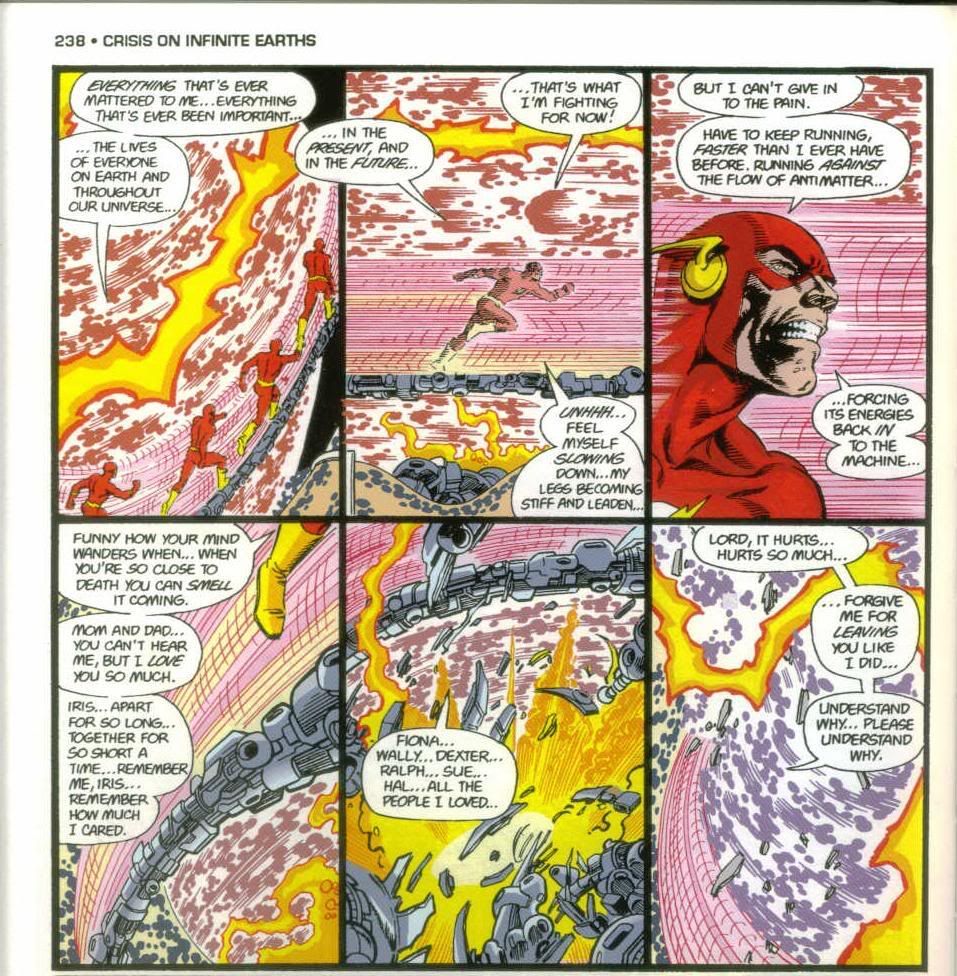
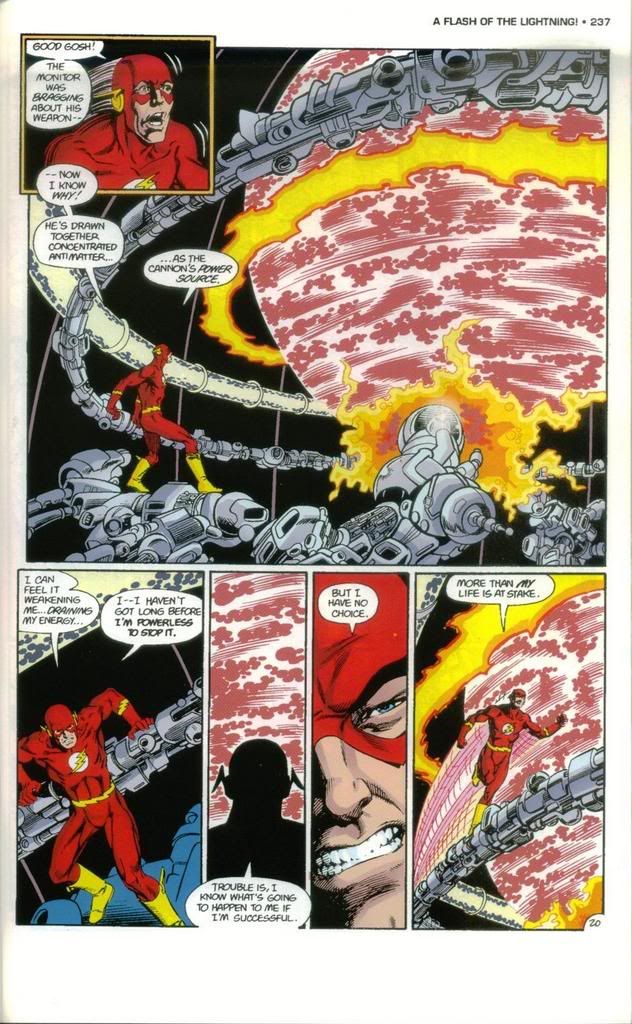
Single-handedly and anonymously, the Flash saves the Multiverse's five remaining Earths.


After this point Barry starts jumping around in time, interacting with Kid Flash, the Joker, and Batman, so it's not really a soliloquy anymore. Also, I wasn't in a mood to dwell on Barry's death. It's enough to say that I think this scene holds up as a fine sendoff to the character who introduced DC to its Multiverse. Barry's monologue is one of the few instances in superhero comics where, "realistically," a character would talk to himself as he literally ran out his life.

[From "A Flash Of The Lightning!" in Crisis On Infinite Earths #8, November 1985. Written by Marv Wolfman, pencilled by George Perez, inked by Jerry Ordway.]

...

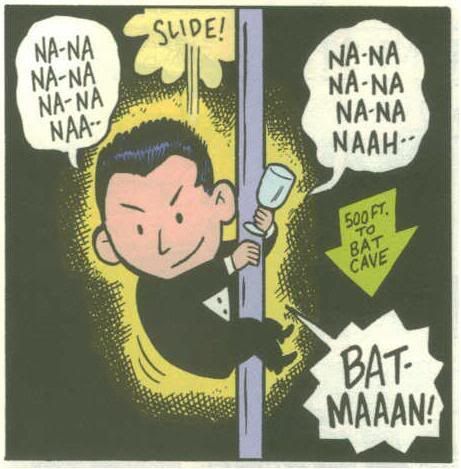
Man, now I'm depressed. Let's see if this helps:


That's better!

[From "That's Really Super, Superman!" in Bizarro Comics, 2001. Written by Ivan Brunetti, drawn by Evan Dorkin.]
Full Post

Wednesday, June 06, 2007

Cosmic Cataloguing

Let's see if I understand the development of DC’s cosmology.

* * *

A. THE UNIVERSE

1. In the Original Beginning, right after the Big Bang at the Dawn of Time, a Giant Cosmic Hand spins the first building blocks of the Universe into their starting places, as if casting bread crumbs on a lake. There’s also a single antimatter universe.

2. Millions of years later, the Oan scientist Krona attempts to observe this event, but ends up unleashing Evil on the universe. Krona’s interference also reaches back to the Dawn of Time and retroactively creates a Multiverse of infinite worlds.

* * *

B. THE MULTIVERSE

1. In the Multiversal Beginning, right after the Big Bang at the Dawn of Time, a Giant Cosmic Hand spins the first building blocks of the Multiiverse into their starting places, as if casting bread crumbs on a lake. Each parallel universe occupies the same space, but vibrates at its own unique frequency. There’s also a single antimatter universe. The planet Oa is unique to the universe of Earth-1.

2. Millions of years later, the Oan scientist Krona attempts to observe this event, but ends up unleashing Evil on the universe.

3. Millions of years after that, the Earth-Omega scientist who will become Pariah conducts his own disastrous experiment. It wakes up the Anti-Monitor and results in the first universal casualty of the antimatter wave. Pariah survives, immortal and alone.

4. Eventually, the antimatter wave gets to the last dozen or so worlds that people have actually heard of. This causes the Monitor to get off his duff and start recruiting heroes from these worlds to fight the Anti-Monitor. Of course, these events are depicted in Crisis On Infinite Earths.

5. Harbinger kills the Monitor just before the universes of Earth-1 and Earth-2 are wiped clean. Psyche! The Monitor’s death has turned his energies into a backup disk for these two universes. Soon afterwards, the universes of Earth-4, Earth-S, and Earth-X are cut and pasted onto the backup disk. Problem is, it’s only a temporary solution. The whole thing must be restarted.

6. Two teams -- one of heroes, one of villains -- travel back in time to set events aright. The villains can’t stop Krona from completing his experiment. However, the Spectre and the assembled heroes confront the Anti-Monitor at the Dawn of Time. A big white explosion takes us to...

* * *

C. THE POST-CRISIS UNIVERSE

1. In the Post-Crisis Beginning, right after the Big Bang at the Dawn of Time, a Giant Cosmic Hand spins the first building blocks of the Universe into their starting places, as if casting bread crumbs on a lake. There’s also a single antimatter universe.

2. Millions of years later, the Oan scientist Krona attempts to observe this event, but ends up unleashing Evil on the universe.

Here’s where it starts to get tricky. If Pariah was originally from another Earth, where’s he from now? If an antimatter wave wasn’t destroying parallel universes, what was it destroying? In other words, how was the post-Crisis Crisis different?

There are a couple of answers, but they’re not entirely compatible with the “one universe, no exceptions” rule which post-Crisis DC sought to enforce. First, Pariah and the other Multiversal survivors might actually be from other dimensions, like the Avengers-analogues who show up in (the post-Crisis) Justice League #3. Second, Hypertime offers a catch-all solution for many of these problems. Third, Crisis #11 indicates that there’s still *something* where Earth-2 was, it’s just a yawning void. Basically, in the years following COIE, DC had at least a few in-continuity parallel-Earth stories which contradicted the spirit, if not the letter, of COIE; and for the most part, pros and fans shrugged and moved on. Thus:

3. The post-Crisis Crisis happens. Lots of people die. Things Are Never The Same.

4. After the Crisis, “waves of time” cause random changes in order to facilitate the rebooting of several superhero titles.

5. The events of Zero Hour, too complicated to summarize here, bring all these time-anomalies to a head. A small group of heroes tries to prevent the unbalanced Hal Jordan from restarting the universe in his own image. They succeed, but guess what?

* * *

D. THE POST-ZERO HOUR* UNIVERSE

1. In the Post-Zero Hour Beginning, right after the Big Bang at the Dawn of Time, a Giant Cosmic Hand spins the first building blocks of the Universe into their starting places, as if casting bread crumbs on a lake. There’s also a single antimatter universe.

2. Millions of years later, the Oan scientist Krona attempts to observe this event, but ends up unleashing Evil on the universe.

3. The post-Zero Hour Crisis happens, probably not too differently from how the post-Crisis Crisis did. Lots of people die. Things Are Never The Same.

4. Things go on fine for a while, until a) in DC One Million, the Justice League takes a trip into the 853rd Century to meet up with Superman, who’s still alive and (it turns out) immortal, and b) in The Kingdom, a villain from the future shows up in our present to kill Superman, having already killed boatloads of Supermen on his way back in time. This leads to the discovery of Hypertime, which basically says all the old stories still exist, just like they originally happened, in their own cubbyholes of space, time, and dimension. The thing is, they’re just really really hard to access. There’s a suggestion that the Earth-2 Superman, relegated to “not dead, but still gone” limbo at the end of COIE, is still alive and punching on some Hypertime dimensional wall.

5. Nobody much likes Hypertime.

6. Instead, ZOMG!!1!! the four COIE survivors -- Superman (Kal-L) of Earth-2, his wife Lois Lane Kent, Alex Luthor of Earth-3, and Superboy (Kal-El) of Earth-Prime -- have been biding their time in the years since COIE, waiting to spring into action and fix all the bad stuff which has befallen their beloved Universe. Alex Luthor hopes that by recreating the Multiverse, the infinite monkeys on their infinite typewriters will come up with the perfect Earth that won’t need changing or revision, ever.

* * *

E. THE POST-INFINITE CRISIS MULTIVERSE

1. In the Post-Infinite Crisis Beginning, right after the Big Bang at the Dawn of Time, a Giant Cosmic Hand spins the first building blocks of the Universe into their starting places, as if casting bread crumbs on a lake. There’s also a single antimatter universe. Additionally, all the excess energy from the aftermath of Alex Luthor’s experiment creates 52 additional parallel universes, each occupying the same space as New Earth’s but inhabiting its own vibratory frequency. The histories of these 52 are altered radically by the intervention of Mr. Mind.

2. Millions of years later, the Oan scientist Krona attempts to observe the creation of (as far as he knows) the Universe, but ends up unleashing Evil.

3. The post-Infinite Crisis Crisis happens, probably not too different from the Post-Crisis Crisis. Lots of people die. Things Are Never The Same.

4. Hypertime is discovered, as before.

5. Nobody much likes Hypertime.

6. Apparently there are now 52 Monitors. They are dedicated to cleaning up all the anomalies.

* * *

And here we are. I know it doesn’t quite account for Animal Man. Still, does it all sound right?


[P.S. Yes, "Post-Zero-Hour" does sound like a '50s variety show sponsored by a cereal company.]
Full Post

Wednesday, May 30, 2007

(It's an old MST3K line.)


(Original via Newsarama.) Full Post

Thursday, February 02, 2006

New comics 2/1/06

This week was unusual for a couple of reasons. First, it featured new issues of Green Lantern and Legion of Super-Heroes after only two weeks, since both series are trying to get back to a regular monthly schedule. Second, I expected both Gotham Central and the Rann-Thanagar War Special to have endings, but instead both seemed beholden to larger corporate storytelling concerns. In the case of GC, take that as a spoiler.

Other than that, not a bad week. Batman and the Monster Men #4 (by Matt Wagner) and Detective Comics #816 (written by Shane McCarthy, art by Cliff Chiang) both featured good, straightforward, entertaining Batman stories. BMM relates Batman's narrow escape from the lair of Hugo Strange's monsters; and 'Tec finishes up the Mr. Zsasz two-parter with the cops chasing both hero and villain. Both explore the balance between mundane crime and super-crime, and both feature healthy doses of Bat-mystique.

Green Lantern #8 (written by Geoff Johns, drawn by Carlos Pacheco) finishes its latest two-parter with Mongul (and Mongal, his unfortunately-named sister), and since half of it is Pacheco-illustrated dream sequences, I had much the same reaction as I did with Pacheco's Superman/Batman arc: very pretty, and it gives him room to draw all kinds of outlandish situations, but ultimately it doesn't add up to much. I'm still trying to work out how Hal's fantasy would be so seductive to him. Either Johns doesn't quite get the Black Mercy, or he's just throwing in wild scenarios and teasing the explanations. Anyway, once GL and Green Arrow get back to reality, it's all fun and games until somebody's head comes off, and I'm wondering -- between this and Infinite Crisis, can I bring the "Four Beheadings And A Funeral" joke out of storage?

Legion #14 (written by Mark Waid, pencilled by Ken Lashley and Adam DeKraker) continues with the political and personal fallout from the Legion's victory over Terror Firma. Again, it's probably a cop-out, but I need to read this book from the beginning. There was a point when it all seemed familiar but radically new, and now it seems to have assumed that the reader is familiar with the radically-new aspects. It's not poorly done by any means, and I don't dislike the characters, but I get the feeling I've spent too little time with them.

Seven Soldiers: Bulleteer #3 (written by Grant Morrison, pencilled by Yanick Paquette) was a fun issue mostly for the inclusion of Mind-Grabber Kid, a one-off Denny O'Neil character from the late �60s post-Gardner Fox era of Justice League of America. Now MGK is an adult trying to trade on his moment of fame at a superhero convention. Yes, it's easy to mock comic conventions, but it's also fun, and Morrison does it with a knowing wink. There was a lot of cheesecake in this book at first, but now I can see where Morrison has been going with it.

Fantastic Four #534 (written by J. Michael Straczynski, drawn by Mike McKone) continues Ben and Johnny's fight with the Hulk, but throws into the mix the notion that the Hulk is acting out all of his most painful memories in a gamma-fueled haze. It feels a bit more like a Hulk story than an FF story, and it probably requires at least a passing knowledge of Hulk history to understand completely, but it works. Ben and Johnny are handled well too. A fun "Franklin Richards" story rounds out the issue.

Captain America #14 (written by Ed Brubaker, drawn by Steve Epting) concludes "The Winter Soldier" and, in fact, wraps up a dangling plotline from as far back as issue #1. Although it's a Cap/WS fight, it builds both on Cap's emotions for Bucky and WS's confusion about his own origins, so there's more dramatic heft to it.

It also provides an ending, which brings me to Gotham Central #40 (written by Greg Rucka, drawn by Kano and Stefano Gaudiano) and Rann-Thanagar War Special #1 (written by Dave Gibbons, drawn by Ivan Reis and Joe Prado). With RTWS I kind of understand, and arguably I have tacitly bought into the whole concept of this sort of "half-issue" (as in, this should have been Infinite Crisis #4.5) on the front end.

RTWS does three things: it allows everyone in space to point and gawk at the big hands coming out of the space-warp; it resolves the Rann-Thanagar war; and it sets up the new Ion series. Now, maybe when I see this in the larger Infinite Crisis context, I will understand the editorial meeting at which it was decided that these three things should happen in a special outside the main miniseries. Right now, though, this particular issue just feels very padded. It contains one extremely unfortunate (and I hope accidental) reference to the big "footprints" revelation in Identity Crisis, and the Ion setup also comes out of left field (and will probably be revisited even further in Ion #1). I was sorry to see the one person die, though, and that was handled decently.

In hindsight, though, this last arc of Gotham Central has been nothing but setup for future series -- specifically, Detective Allen as the new Spectre, and Detective Montoya working out unresolved issues about Allen�s murder. As setup it's okay, but I was expecting some closure and I don't feel like this last issue of the series was a fitting end for the arc, let alone the series itself. I had thought Gotham Central was insulated somewhat by larger editorial dictates, and it's disappointing to see so patently that in the end, it wasn't.
Full Post

Thursday, January 19, 2006

Quick Thoughts On Infinite Crisis #4

Call me an old softie, but Infinite Crisis #4 was one of the more emotionally affecting comics I have read in recent months. At the very least, Geoff Johns, Phil Jiminez, and George Pérez know which middle-aged fanboy buttons to push.

SPOILERS FOLLOW

6

5

4

3

2

1

First off, dropping Chemo on Blüdhaven? Genius.

Next, the Nightwing/Batman scenes really captured both how I view the characters and how their fictional peers view them. Given what he’s been through during the Devin Grayson run, is it ironic that they still trust Nightwing?

The big fight with Superboy-Prime was chilling, with a bit of gratuitous violence (oh sure, rip apart the Titans nobody likes), but his reaction to it was almost heartbreaking. Remember, this was the kid from “our” Earth, where the only superheroes were fictional – but by the same token, this kid grew up with the perfect fictional ideal of Superman. Not just the Superman of Julius Schwartz, but of “Super Friends,” George Reeves, and Christopher Reeve (and before Superman IV, too!). Imagine a young “Clark Kent,” who grows up looking like his namesake, and upon discovering he can fly, almost literally runs into the real thing (or at least one of them). Talk about a reader-identification character!

Naturally, by the time of Infinite Crisis, he’s been isolated for who-knows-how-long and fed a constant diet of good ol’ days reminiscing mixed with growing frustration. Sure he’s come unhinged; but Johns, Jiminez, and Pérez made me feel for him. Never mind whether he represents some segment of the DC audience whose mind has been warped by the unrealistic expectations of the older fans – from the beginning he’s been in over his head, and in hindsight it’s a wonder he lasted this long. What’s more, he’s not done yet, if his new DC Direct action figure is any indication.

Still, the sequence that haunted me in this morning’s wee hours was the Pérez-drawn “deaths” of the Flash and Kid Flash, with special appearances by DC’s honored dead speedsters. Obviously I don’t believe there’s anything permanent about the fates of Wally or Bart, and I would be very surprised if there were. Nevertheless, when Jay Garrick said the Speed Force was gone, it told me that DC was serious about putting its speedsters out of action at least until the summer.

Oh, and Detective Allen becoming the Spectre? Who had this issue in the pool?

Time will tell whether Infinite Crisis #4 was the start of an epic struggle that truly rivaled its predecessor, or just a collection of emotionally manipulative scenes. If it’s the latter, for me the manipulation was skillfully done.
Full Post

Sunday, December 18, 2005

Infinite Christmas

Fans of a certain age -- let's not be coy, my age -- remember the event twenty years ago that was supposed to set everything straight. In Christmas on Infinite Earths, the Anti-Santa sought to stop Christmas from coming, but was thwarted by a vast assemblage of heroes from across time and space. Who could forget the opening scenes of issue #1, as onetime toy deliverer Jack Skellington was obliterated by the Anti-Santa's wave of all-consuming ennui?

We thrilled to revisit classic team-ups like Rudolph the Red-Nosed Reindeer and Frosty the Snowman (the "Season's Finest"), and witness new alliances like Clarence the Angel and Charlie Brown, Emmett Otter and the Little Drummer Boy, and Clement C. Moore (or was it Henry Livingston?) and David Sedaris. The sight of Santa wielding both Ralphie Parker's Red Ryder BB Gun and Linus van Pelt's security blanket came off surprisingly well; and even though they were villains, it was still disturbing to see Scrooge, the Grinch, the Bumble, and a group of Martians lose their time-traveling battle to stop the 31st Century Santa-Bot from freeing the Anti-Santa. Finally, lest we forget, it was the Herdmans' and Misfit Toys' emotional plea to the Angel Gabriel that convinced him to intervene, thereby giving Santa the fighting edge he needed over his evil opposite.

Seems like Christmas preparations start earlier every year, but this year March had Countdown to Infinite Christmas, a one-shot which killed Yukon Cornelius and introduced four summer-spanning miniseries. Aside from fueling speculation that Buddy the Elf would become the new Cornelius, it was all a big buildup to the current holiday apocalypse. Along the way, Santa's army of helpers got turned into killer cyborgs and put everyone on the "naughty" list; a weird spatial anomaly opened up over the North Pole; a duplicate Scrooge was revealed; and Clarence was seduced by Eclipso, who in turn was defeated by the Nutcracker. Yeah, I didn't understand that last one either.

So now Infinite Christmas is here, revealing the original Saint Nicholas' plan to restore the holiday to its religious roots and have folks "keep Christmas all year 'round." I have to say, Geoff Johns and Phil Jiminez certainly treat Nick reverently, even if objectively he is the villain of the piece. Although the chaos he kicked off was entertaining, the Anti-Santa wasn't much more than a scary plot device.

It's also tempting, in the face of rampant Christmas commercialism, to applaud such a back-to-basics approach. Nostalgia is essentially a rebellion against the perpetual march of time, and the fact that Christmas comes at the end of every year just makes nostalgia for its traditions more powerful. Who wouldn't want to have a few more child's-eye holidays, when two weeks of vacation could start with a leisurely walk home from school under slate-grey clouds fat with snow -- when the wind wasn't cold but bracing, and your only responsibilities were to keep your nose clean and your questions to yourself until the morning of December 25?

And yet the most powerful aspects of Christmas, anticipation and hope, are always with us. Early Christian public-relations gurus knew what they were doing when they scheduled Christ's birth celebrations around the winter solstice, because the darkest time of the year is perfect for ushering in the light.

A slightly twisted version of that approach is on display in Infinite Christmas. We know that Rudolph, Santa, and Frosty will become friends again. We know the reindeer will reunite (and in their absence, Earth-2 sleigh-pullers Dunder and Blixem can help pick up the slack). We know that as with every new year, change is inevitable, but perhaps only incremental; and nothing we can't handle.

When I was a kid I got excited over a few weeks of vacation from school. As I grew up I learned to keep hope alive all year. Even if I don't have a long vacation anymore, Christmas still gives me a bit of a break. Like the song says (watch out for the auto-play music past the link):

And ye, beneath life’s crushing load,
Whose forms are bending low,
Who toil along the climbing way
With painful steps and slow,
Look now! for glad and golden hours
Come swiftly on the wing.
O rest beside the weary road,
And hear the angels sing!

Happy Holidays, blogosphere!

(P.S. The GLX-Mas special was brilliant.)
Full Post

Sunday, November 13, 2005

New comics 11/9/05

I liked quite a few things about Infinite Crisis #2 (written by Geoff Johns, pencilled by Phil Jiminez and George Perez, inked by Andy Lanning and Jerry Ordway), but I'd like to think the Perez cover (showing Power Girl from the rear) is a none-too-subtle dig at the fascination with PG's chest. Perez and Ordway's contribution to the interior consists of a few pages telling the history of the old Multiverse, and while some might say that's proof that the whole magilla is too complicated, I think it's a fine tip of the hat to the original Crisis on Infinite Earths artists and to COIE itself. As exposition goes, it's fairly economical too.

The spotlight is on Power Girl in issue #2, and speaking of exposition, I'm now glad I didn't spend the money on her JSA Classified origin issues. InfC #2 is the emotional payoff of the former arc's false starts, but it doesn't need those issues to work well. Power Girl might well have been better off consigned to Earth-2 oblivion, for all the mucking around with her backgrounds various writers have performed over the last twenty years, but Johns takes good advantage of her confusion.

The issue's other plots all work as well. I especially enjoyed the interlude with Clark and Lois at the Daily Planet, culminating in a neat little "job for Superman!" moment. As much as I love Perez's work, Jiminez has become a fine storyteller in his own right. I just wonder if there's not an Earth-2 homage to COIE #7 in Power Girl's future....

JLA #122 (written by Bob Harras, pencilled by Tom Derenick, inked by Dan Green) is another "[MAIN CHARACTERS] vs. OMACs" story, just like half of DC's books from the past few months. I hope the number of these decreases after the events of Infinite Crisis #2. There's not much more to it than that, except the kind-of creative notion that the Key is attacking anything with the initials "JLA." (The Best Wife Ever is in the Junior League, so word of warning to the Key: they are tough.) It's nice to see some old familiar faces back in the fold, but I wish they had something more exciting to do.

Gotham Central #37 (written by Greg Rucka, drawn by Steve Lieber) is the big Infinite Crisis crossover issue, and I hate to say it, but it's not as good as I've come to expect. Sure, I like Allen and Montoya; sure, they react believably to the mystic carnage going on around them; and sure, this was probably a decent introduction to the characters for the hypothetical first-time reader -- but it just didn't have the punch of, say, the Poison Ivy one-off issue of a few months ago. It wasn't bad, it just wasn't as good as it has been. Good ending, though; and I do hope the Crisis completists pick up multiple copies, because the book deserves all the support it can get.

Action Comics #833 (written by Gail Simone, pencilled by John Byrne, inked by Nelson and various others) begins what looks to be a fun little story pitting Supes against an old Justice League foe. It doesn't appear to have much to do with Infinite Crisis, so instead it's free to weave in scenes for Lois and Jimmy. I'm not saying who the villain is, because Simone takes her time in building up the revelation, and packs a lot into the first half of the issue. For that I was pleasantly surprised.

As the first part of "Blaze of Glory," Batman: Legends of the Dark Knight #197 (written by Will Pfeifer, drawn by Chris Weston) also unloads a lot of plot. The story concerns a supervillain wannabe who blames Batman for his problems, which isn't overly original, but Pfeifer makes his antagonist a fairly smart guy who just happens to have wound up on the C-list. The one strange thing about the issue is the art. Weston's heads seem just a little too large (or the bodies a little too small), kind of like Mike Grell. Still, like Grell, once you get past that it's pretty good.

Finally, Star Wars: Empire #37 (written by Welles Hartley, pencilled by Davide Fabbri, inked by Christian Dalla Vecchia) continues "The Wrong Side Of The War" in fine fashion. As the Rebels put their undercover plans in motion, Imperial Lt. Sunber becomes acclimated to his new assignment. While Sunber takes on the alpha male in his barracks, though, the Rebels discover they may have to rescue all the slaves from Jabiim. Hartley portrays the Imperials as evil bureaucrats -- not so much mustache-twirling, but you can see they're not particularly nice. The art is also good, with bright colors (thanks again to Fabbri) and big, expansive layouts. Nothing groundbreaking, but a good Star Wars story nonetheless.
Full Post

Thursday, October 13, 2005

New comics 10/12/05

Beware of SPOILERS, although I'm trying to avoid discussing them.

3

2

1

Batman: Legends of the Dark Knight #196 was the last part of the "Snow" arc, so I'm adding it to my omnibus-review inbox.

Action Comics #852 (written by Dan Abnett & Andy Lanning, pencilled by John Byrne, inked by Nelson) was a strange little Halloween-themed Spectre story wherein Superman must decide whether to protect Lord Satanus from the Spectre. It doesn't amount to much at the end, besides allowing Lois a last visit with the ghost of her father, so I thought the most interesting aspect of it was its relative normalcy. Except for the Spectre's current predicament, it could have come out of Satanus' last heyday in the Jurgens/Ordway/Stern '90s. I take that as a good sign for the Superman books, at least for the moment -- a brief respite in the midst of all the other strife.

Speaking of which...

Villains United #6 (written by Gail Simone, art by Dale Eaglesham and Wade von Grawbadger) provided the most satisfying conclusion of the four lead-ins, probably because this miniseries ties into Infinite Crisis the least. The revelation about Mockingbird's identity got a nice twist, and while there were some unexpected deaths (in the "I thought _____ was more valuable to DC" sense), overall they made sense within the context of the story. VU was a story about unsavory people, regardless of Catman's attempts at nobility, so the laws of crime fiction had to be followed.

Firestorm #18 (written by Stuart Moore, pencilled by Pat Olliffe and Jamal Igle, inked by Simon Coleby and Rob Stull) bills itself as an OMAC tie-in, but it really follows up on 'Stormy's escape from last issue's Villains United-related predicament. Anyway, he defeats an OMAC in such a way that one wonders whether it will be applied to the other 199,999. More important, though, is the fallout in Jason's personal life, which will be familiar to anyone who's read a few Lee/Ditko Amazing Spider-Mans. We'll see how long the new status quo holds, since the next-issue blurb promises big changes. I am still confident that the book is in good hands.

For an issue which apparently starts a new Justice League era, JLA #120 (written by Bob Harras, pencilled by Tom Derenick, inked by Dan Green) was decent enough. The threat of an escaped Arkham Asylum inmate bookends Aquaman's memorial service at the old Secret Sanctuary cave. Of the Big Three, only Batman shows up -- in daylight, even -- and soon fingers are pointed at him as the mastermind behind destroying the Watchtower. This is nothing new, given the events of the past year, but I hope it's among the last of these types of scenes. Derenick's art is fine, although his figures start breaking down towards the end. I don't know if that's meant to convey the members' tempers, but it ultimately came off sloppy. Anyway, it could be the start of a good story, now that all the preliminaries have been addressed.

And since all its preliminaries are out of the way, Infinite Crisis #1 (written by Geoff Johns, pencilled by Phil Jiminez, inked by Andy Lanning) was pretty good. Pulling together all of the lead-in elements, Johns and Jiminez establish the theme as "everything is in the toilet and the Big Three have split up." That may be enough for a new reader who's picked InfC as her first DC comic in 20 years, but clearly this is meant for someone who's done his homework. Besides its lead-ins and the original Crisis on Infinite Earths, InfC contains references to Kingdom Come, The Kingdom, and even the classic Alan Moore/Dave Gibbons story "For The Man Who Has Everything". That last carries with it a bit of irony, since it was (in a small way) a celebration of the Superman/Batman/Wonder Woman relationship, and quite the opposite is happening here. As for the technical aspects, Johns' dialogue is sometimes off, and Jiminez' figures are sometimes a little distorted, but overall not a bad beginning. It may well have been worth the wait.
Full Post

Wednesday, October 05, 2005

Idenfinite Crisis at about the 2/3 mark

Here's a new-comics-day essay which doesn't talk so much about the new comics. I did read the final issues of Rann-Thanagar War, OMAC Project, and Donna Troy, not to mention the new Wonder Woman (which follows the conclusion of OMAC, although nothing warns you to read OMAC first), so it looks like Infinite Crisis is just about ready.

This whole strange digression into grim 'n' gritty started last June with Identity Crisis. Now the start of the payoff is right around the corner -- but Infinite Crisis won't be over until April 2006, and then the magic will continue until April 2007 with the 52 sequel/spinoff/tie-in. By next April or May, the new status quo will be revealed, and if Mark Waid is to be believed it will look less gloomy -- so whatever of the grim 'n' gritty remains for the 52 flashbacks to tell, it should be tempered by the current books' lighter mood. Still, all that time...!

On one hand I have to admire DC's ambition. Tearing down and rebuilding its core characters ought not to be a simple affair, and DC may well feel like the process was botched when they did it the last time. On the other hand, though, reading all these books over all these months has been exhausting. Today I was glad for Gotham Central, a really great end to the "Dead Robin" storyline. It featured a classic Batman scene to boot. In a perfect world, GC would set the tone for the Bat-books, instead of being an exception or aberration. Of course, GC can afford to use Batman to maximum effect, because it doesn't have to deal with him every issue.

Really, it's the "every issue" part that gets to me. Since last June, the whole Identity/Infinite Crisis paradigm has been harder and harder to escape. Parts of it have been fun, and parts have been unpleasant (either in content or execution, or both). Moreover, DC must feel that what it has planned is so radical as to justify all the buildup -- kind of like the continuity gymnastics Geoff Johns performed in Green Lantern: Rebirth.

One suggestion has been the return of the DC Multiverse. In light of DC's strict no-takebacks policy in the late '80s and early '90s, having one of its characters even acknowledge the multiverse has been something of a radical act. Zero Hour couched its alternate timelines carefully, to avoid setting up circumstances where they could easily be accessed. Likewise, Hypertime was introduced as the continuity equivalent of the good china -- you needed special permission to use it, and only for special occasions. If the multiverse is coming back, even without altering the main post-Crisis DC timeline, that would be yooge.

I like the multiverse, and not just because I'm a crusty old dope who apparently belongs to DC's core demographic. The concept allows DC to exploit fully its 60-year publishing history -- even more so than Elseworlds, because it doesn't close off the alternate timelines or make them prohibitively difficult to access. However, DC also put a lot of effort into streamlining its stories 20 years ago, and I doubt it will reverse all of that with Infinite Crisis.

Whatever happens, at the end of the day, I just want the Earth(s) featured in DC's books to be an attractive escape from our dreary old Earth-Prime. I hope it's not a long wait until next April.

Full Post

Friday, September 23, 2005

All Together Now: Rann-Thanagar War #s 1-5

At long last, I'm down to Rann-Thanagar War (written by Dave Gibbons, pencilled by Ivan Reis and others, inked by Marc Campos and others). The slog through these miniseries was more difficult than I expected, and I can only hope it pays off in Infinite Crisis, if not in the various issues #6. Thankfully, RTW seems to be the most straightforward of the lead-ins, overlaying interplanetary war with the resurrection of an evil Thanagarian cult leader whose followers instigated the fighting.

As with the other miniseries, the events of RTW were themselves set up elsewhere; namely, in the excellent Adam Strange miniseries by Andy Diggle and Pasqual Ferry. However, RTW stands on its own, thanks to Adam Strange's opening scenes of exposition with Hawkman and Hawkgirl. Basically, the planet Thanagar has fallen into a lower orbit around its sun, putting all its life-forms in danger of being burned up. Strange and his armies from Rann evacuated many of Thanagar's people to Rann, but the two planets were never chummy to begin with and fighting began almost immediately. The presence of the Onimar Synn death-cult didn't help any either. Thus, Strange teleports to Earth to fetch Hawkman and Hawkgirl, hoping they can help calm everyone down.

Unfortunately, though, the situation has only gotten worse, and Thanagarian hordes have spread to other planets. Soon, planetary leaders like Prince Gavyn (assisted by Tigorr of the Omega Men) and Queen Komand'r join up with the Rannians, and it becomes clear that the Synnites still want Zeta-beam devices so they can spread their evil across the galaxy. Meanwhile, as if all that weren't enough, Green Lanterns Kyle Rayner and Kilowog run afoul of Synn's followers while on an apparently unrelated mission. They meet up with Captain Comet, who eventually finds his way to Strange and the Hawks, but the GLs still haven't interacted with anyone else.

Those are a lot of characters fighting on a lot of fronts, and for the most part Gibbons manages to keep everything orderly. It helps that the plot isn't too complicated -- just Rann and its allies fighting Thanagar and, eventually, the resurrected Onimar Synn himself. The problem is, Reis and Campos' art is very busy. It tries hard to convey an epic scope, with thousands of soldiers exchanging laser fire in various sci-fi cityscapes, but it ends up being cluttered. The colors don't help much either. The battlefields are lit by fire and explosions, and so take on an orange hue that overwhelms characters and backgrounds alike. Even the characters themselves blend into the armies at times, especially Adam Strange, whose outfit has only minor differences from every other Rannian soldier. At least the Hawks from Earth are distinct.

Still, on the whole I like RTW. I only know interstellar DC politics second-hand, but Gibbons has been good at using dialogue to convey backstory without it sounding like exposition. Characterization suffers a little, although there's not much room for character moments when everyone is flying around, yelling, and shooting most of the time. Gibbons does have Kyle and Kilowog terraform the post-apocalyptic surface of Thanagar; and he also gives Hawkman and Hawkwoman a tender farewell. Even the hoary old "fake prisoner infiltration" scene gets a bit of a twist.

The resolution of this miniseries apparently depends on subduing the giant monster Onimar Synn has become, but I doubt the story will end there. For one thing, even without Synn, his followers must still be defeated. There is also the possibility that this miniseries will end on a cliffhanger, and Synn will be around to cause trouble in Infinite Crisis. I threw a hissyfit the other day over Day of Vengeance's ending, but this miniseries' conclusion probably won't provoke me as much. RTW never felt bloated or decompressed -- if anything, it felt like it was trying to move too fast and cover too much ground.

One last thing which occurred to me this morning: what exactly is Hawkman's pre-InfC timeline? He's in JLA arguing for more mindwiping, he's in RTW, and isn't he supposed to be dead in his own book? Surely someone out there in Internet-land has the answer.
Full Post

Wednesday, September 21, 2005

New comics 9/14/05 and 9/21/05

At the risk of sounding like the stereotypical frothing-at-the-mouth angry superhero fan, I have to get this off my chest:

Day of Vengeance #6 (written by Bill Willingham, pencilled by Justiniano, inked by Walden Wong) is the worst comic I have read in a while, even including Willingham's Leslie Thompkins kiss-off in Batman. As the last issue of a miniseries, it doesn't conclude the story it started. Instead, it goes for what I can only assume is a series of shocks -- cliffhangers, really, since the people and places affected are too important to "die" -- designed to get the reader to buy Infinite Crisis. News flash, DC: we were going to do that already, and it would have been nice if DoV had been able to streamline InfC's storytelling. The last few pages could easily have been, and probably will be, incorporated into Infinite Crisis itself, arguably making the entire miniseries pointless. As for the Shadowpact, it defeats one of its foes early on, spends the rest of the issue patting itself on the back, and stands around like disinterested spectators for the aforementioned cliffhangers. The last panel of the issue has the Shadowpacters rallying themselves unironically, and the "next issue" blurb encourages us to watch out for their further adventures. Not if Bill Willingham is anywhere near, I won't. (By the way, DC -- how does the destruction of you-know-what over here affect the status of you-know-who in Villains United?)

Speaking of writers whose work frustrates me, Batman: Gotham Knights #69 (written by A.J. Lieberman, pencilled by Al Barrionuevo, inked by Bit) might actually start Lieberman back on the road to redemption, at least in my eyes. He seems to be retconning away one of the biggest mistakes of the Jeph Loeb/Jim Lee crowd-pleaser "Hush," namely the identity of the eponymous villain. The flashbacks and flash-forwards are better this issue, the dialogue isn't as arch, and the art has been consistently good. I wonder if I have reached some kind of critical mass with Lieberman, where his stuff finally starts to make sense....

Captain America #10 (written by Ed Brubaker, pencilled by Lee Weeks) interrupts "The Winter Soldier" for a House of M crossover. So far this is the first and only House of M issue I've read, and only because Brubaker's writing it. As alternate histories go, things start off pretty well for Cap, but he soon finds himself unwelcome at both ends of the political spectrum. Brubaker presents a series of compelling vignettes -- the problem is, they never approach any real climax, and the book just runs out of pages after a while. It's well-executed otherwise.

Green Lantern Corps: Recharge #1 (written by Geoff Johns and Dave Gibbons, pencilled by Patrick Gleason, inked by Christian Alamy and Prentiss Rollins) is a fine introduction to the new GL Corps, focusing on Guy Gardner and a would-be Lantern from Sinestro's old space sector. Johns and Gibbons combine for some subtler dialogue than I usually associate with Johns. The Korugarian physician, clearly the main guest star, is fleshed out well, even if her story seems a bit predictable this early on. The art is decent too. Except for Guy's head looking like a helium balloon in some panels, everybody looks heroic and the aliens look appropriately alien.

Finally (for this week, at least), Seven Soldiers: Mister Miracle #1 (written by Grant Morrison, drawn by Pasqual Ferry) almost read like a Mister Miracle Elseworlds. It doesn't seem to have much to do with the other 7S projects, but that's not necessarily bad. Giving the New Gods the alternate-reality treatment is a good way to invest the longtime fan emotionally, and for a newcomer they are effective just as elements of another reality to which Mr. Miracle isn't quite sure he belongs. The art was different than I remember seeing from previous Ferry projects -- more painted and three-dimensional -- but still very good. Too bad he's not coming back next issue.

Now to last week, except I'm saving Rann-Thanagar War #5, Star Wars: Empire #34, and Batman: Legends Of The Dark Knight #195 for omnibus recaps.

Chris Eliopolous' Franklin Richards: Son Of A Genius was a fun special, kind of a cross between Calvin & Hobbes and "Dexter's Laboratory," but good on its own terms, and no previous knowledge of the Fantastic Four was required.

Action Comics #831 (written by Gail Simone, pencilled by John Byrne, inked by Nelson) featured both a Superman/Black Adam/Dr. Psycho fight and a Bizarro/Zoom race. Bizarro comes off a lot more fun here than he does in Superman/Batman (for example), and Simone uses him to good comic effect against the more businesslike villains of the Secret Society. The Superman/Black Adam stuff is entertaining too, but not as much. Jimmy Olsen is here too, drawn with a Beatle/Chekov mophead when he had more of a shaggy '70s 'do in the last Superman -- but I quibble. At least the Super-books are paying attention to Jimmy again. Simone also writes a funny Perry White. I mention these things because it's been easy for the Superman writers to get caught up in the whole "let's make everything big, cosmic, and gut-wrenching" paradigm, and miss the interaction with Supes' normal friends that was a hallmark for so long. Simone is the most evocative of those old tropes at the moment, and the books are better for it.

Black Adam (get 'im while you can, folks!) is also in Firestorm #17 (written by Stuart Moore, pencilled by Jamal Igle, inked by Prentiss Rollins and Rob Stull), trying to recapture 'Stormy after the Secret Six broke him out of Secret Society captivity over in Villains United. However, the real guest-star is Gehenna, a young woman also being used as a power source by the Society. Their escape from the Society's base is both exciting and romantic, and the issue does a good job of conveying Jason's thrills at both defeating super-baddies and flirting with a teenaged hottie.

Another immensely enjoyable issue last week was JLA #118 (written by Geoff Johns and Allan Heinberg, pencilled by Chris Batista, inked by Mark Farmer), in which J'Onn J'Onzz and Aquaman square off against Despero, Zatanna seeks sanctuary on Themyscira, and the rest of the JLA votes on further mindwiping. This would be a good story even without the Identity Crisis theatrics, and it left me anticipating the next issue.

Finally (for sure), All-Star Batman & Robin #2 (written by Frank Miller, pencilled by Jim Lee, inked by Scott Williams) felt a little better than last issue. It seems looser and more freewheeling now that it doesn't have to establish a certain mood or live up to first-issue expectations. The subtext of the issue deals with Batman's emotional manipulation of Dick Grayson, and Dick's realization he's being manipulated. I have a theory that Robin exists to show readers it would be fun to live Batman's life without actually being Bruce Wayne, so I wonder if Miller is headed someplace similar. Still, the true test will come once Dick gets into the short pants and elf shoes.
Full Post

Tuesday, September 20, 2005

All Together Now: Villains United #s 1-5

Villains United (written by Gail Simone, pencilled by Dale Eaglesham and Val Semeiks) uses the same slobs-vs.-snobs premise as Day of Vengeance and does right by it. Not just a story about glib super-powered outcasts, it takes full advantage of its circumstances and weaves an anything-goes tale filled with manipulation, treachery, and degrees of evil.

Proceeding directly from Identity Crisis' revelations while not relying on the reader's knowledge of same, VU picks up with Lex Luthor organizing a mammoth new, hundreds-strong, Secret Society of Super-Villains. Luthor's pitch is that the villains must, well, unite in order to avoid the Justice League mindwiping them like they did Dr. Light those many years ago. Opposed to Luthor, for reasons as yet unclear, is the mysterious Mockingbird, whose new Secret Six includes himself, undercover as one of the Sixers. At first the Six are Cheshire, Deadshot, a new Rag Doll, a random Parademon, Scandal (apparently new for this miniseries), and the Fiddler. However, when Fiddler botches his part of a mission, he's executed by Deadshot and replaced with Cat-Man.

Cat-Man is therefore the reader's guide to the DC underworld. Introduced in January 1963's Detective Comics #311, he was a criminal amalgam of Batman and Catwoman, with a Batman-like costume and cat-themed crimes. His main gimmick was a magical orange cloth, incorporated into his costume, which gave him nine lives. VU hasn't said anything about this so far, being content to make him as much like the strong, silent Bat-type as possible. In other words, his mad skilz belie his loser's reputation. When armies of Secret Socialites attack the Sixers, Cat-Man takes out several single-handedly; and when the Sixers are eventually imprisoned and tortured, Cat-Man (somehow) breaks them out. If VU has a flaw, it's in making Cat-Man a little too capable. I read the breakout scene a few times last night and still couldn't figure out how he did it, short of simply being tough. It might go back to the magic cloth; I don't know.

Cat-Man's main relationships in VU are with Deadshot, his alpha-male antagonist, and Cheshire, who wants him to bear her child. As for the other Sixers, Rag Doll and Parademon have an odd, half-HoYay, half-Of Mice and Men bond, and nobody really trusts Scandal. Moreover, there's a traitor in the group, so between looking for the traitor and looking for Mockingbird, there are a lot of shifty-eyed glances traded.

Simone pays a bit less attention to the Secret Society's brain trust, which starts with Luthor and his former corporate colleague Talia al Ghul, and descends through Calculator, Deathstroke, Black Adam, and Dr. Psycho. Each of these folks gets a couple of thumbnail traits too -- nobody trusts Luthor, Dr. Psycho is all id, Black Adam has some Klingon-like honor, and Talia still lusts after Batman. Basically, though, the Society wants to make an example of the Six, and so doesn't go after them right away. Naturally, this ends up giving the Six the opening they need to defy the Society, and eventually they destroy the Society's big weapon. As the penultimate issue ends, though, the traitor within the Six has been revealed, and has brought the Society down on the Sixers' heads.

Maybe the best scene in the miniseries comes at the beginning of issue #4, when a small-time supervillain wannabe explains, in chilling detail, how the Society's formation will mean the end of every prison on Earth. It's a great couple of pages, executed flawlessly by Simone and Eaglesham, and it does more to heighten the stakes than any doomsday-device scenario Luthor could describe.

VU's potential lies in its paranoia. Most of the time the reader can tell which characters are "safe," because those are the characters the companies need to sell toothpaste or underwear. With VU, though, those "name" characters are the bad guys -- or, I should say, the really bad guys. DC's not going to kill the Secret Society's leaders, but it has no such need for Cat-Man.

This leaves a few basic outcomes. First, the Society could crush the Six in a kind of Grand Guignol, blaze-of-glory tragic ending. Second, the Six could survive, and continue to be a thorn in the Society's side, probably coming to the heroes' aid at some point in Infinite Crisis. Third -- and perhaps most intriguing -- would be the revelation that Mockingbird was somehow working with the Society to consolidate Luthor's bid for power. Any one of these endings would be fine with me, because Simone has garnered a lot of goodwill along the way.
Full Post

Wednesday, September 14, 2005

All Together Now: Day Of Vengeance #s 1-5

Day of Vengeance #s 1-5 is, in a couple of significant respects, the opposite of The OMAC Project. Like Countdown to Infinite Crisis, it is the story of B-listers trying to stop an A-list threat, but there the comparison stops. No A-listers overshadow the main characters (Captain Marvel is merely a plot device), and where OMAC's narrative ranged far and wide, DoV's is almost maddeningly simple. Its focus is on the characters, but to such a degree that it forgets to ground them for the reader.

It begins with Eclipso seducing the host-less Spectre (as opposed, of course, to host-less Twinkies) into destroying all of Earth's magic. He does this by killing or otherwise incapacitating Earth's magic-users. The survivors begin gathering at a bar outside space and time, run by John "Nightmaster" Rook and having Dan "Blue Devil" Cassidy as its bouncer. Bobo, the Detective Chimp, decides he's not going to sit around and wait for the end of the world, and recruits Nightmaster, Blue Devil, Ragman, Enchantress, and Nightshade to help him try and stop the Spectre.

There's not much more to the plot than that. The group (eventually named the Shadowpact) takes two stabs at the Spectre -- first, by increasing the flow of magic to Captain Marvel and making him Spectre's equal in power; and second, by recruiting a heretofore unknown teenager who can steal others' magic briefly, and using her to steal Spectre's power. Issue #5 ends with a cliffhanger in the middle of that fight. Here's the issue-by-issue breakdown:

#1. 6 pages of Jean Loring becoming Eclipso; 4 pages of Ragman introduction; 6 pages of Ragman and Enchantress establishing the plot; 5 pages in the Oblivion Bar; and one page of Shazam and Captain Marvel.

#2. 6 pages of Spectre and Eclipso; 4 pages of the team assembling and expositing; 4 pages of Spectre and Eclipso taking out magical heavyweights; 3 pages with the team before Detective Chimp and Nightshade split off; 2 pages with Enchantress and Ragman; 1 page with the remaining members getting ready for Eclipso and the Spectre; 1 page of Spectre/Captain Marvel fight; and 1 page of the Shadowpacters preparing to face Eclipso.

#3. 6 pages of Spectre/Eclipso/Shadowpact fight; 4 pages of Detective Chimp/Nightshade conversation; 6 pages of Eclipso/Shadowpact fight; 4 pages of Enchantress powering up Captain Marvel; 2 pages of Detective Chimp and Nightshade finding Lori Zechlin.

#4. 3 pages of Detective Chimp origin; 2 pages of Chimp/Nightshade/Mr. Zechlin conversation; 4 pages of Spectre/Captain Marvel fight; 3 pages of Enchantress going nuts; 2 pages of Lori introduction; 5 pages of Enchantress/Shadowpact/Spectre/Captain Marvel fight; 2 pages of team-reassembling.

#5. 1 page of Spectre/Eclipso; 5 pages of Shadowpact/Captain Marvel in the Oblivion Bar; 2 pages of Shazam/Captain Marvel conversation; 1 page of Nightmaster/Detective Chimp/Phantom Stranger Mouse; 1 page of Spectre/Eclipso; 3 pages of Shadowpact planning; 3 pages of Nightshade/Lori conversation; 6 pages of Shadowpact/Spectre/Eclipso fight.

Based on that, I'd say the book is split 60-40 in favor of characterization, and there are some decent character moments. Ragman has unrequited feelings for Enchantress. Nightshade hates Enchantress, apparently from their time in the Suicide Squad together. Blue Devil hates Detective Chimp because the chimp's a mean drunk. Nightmaster's armor itches. These are sometimes effective, but they aren't enough to fill out a thin plot, and the characters themselves are obscure enough that even their little bits of business emphasize the lack of backstory. I know who Nightshade is generally, but here she's in a fairly new costume, and her name is not uttered until issue #3. Again, it can be hard to get into the bits when you're trying to figure out who the characters are.

Still, this loosey-goosey attitude makes the book somewhat unique. When I first heard about these Infinite Crisis lead-in miniseries, I imagined that they would establish backgrounds and foundations for the components of IC's plot. Let's say that during Infinite Crisis, the Spectre can't do X because Y happened to him -- well, DoV would have streamlined the IC plot by telling how Y happened. From that perspective, Day of Vengeance already feels half-empty. I admit I could be approaching this the wrong way, and DoV is actually designed to introduce the Shadowpacters to the larger DC audience. In that respect it's more successful, but obviously it could have done more than just throwing the reader into the middle of their conversations.

I can't close this essay without mentioning Day of Judgment, the 1999 miniseries by Geoff Johns and Mike Mignola-wannabe Matt Smith, because there are some weird comparisons. Day of Judgment also featured an unhinged, host-less Spectre controlled by an evil presence. Ragman, Enchantress, and Blue Devil had minor roles too. However, Day of Judgment was more of a JLA-centered adventure, with scenes in Heaven, Hell, and purgatory; and it focused on making Hal Jordan the new Spectre. As such, it had a lot more action and a lot less characterization. Moreover, the art was so Mignola-esque it was distracting.

It's unfortunate that none of the Day of Vengeance participants seems to remember Day of Judgment. Even something along the lines of "We beat the Spectre before -- but we were second-chair to the JLA then" might have reinforced the oh-no-it's-up-to-us? theme. I suppose that could be chalked up to more selective backstory, but it's a curious omission.

Day of Vengeance tries hard to be witty and irreverent in the face of certain annihilation. The art, by Justiniano and Walden Wong with help from Ron Wagner on one issue, establishes a good, creepy, apocalyptic mood. Most of the time, though, the miniseries is too detached and ironic for its own good. On principle I want to like it, but in practice it's hard to work up any excitement. Obviously this could change depending on how #6 ends, because that will determine whether DoV was about beating the Spectre or forming the Shadowpact.
Full Post