Showing posts with label fantastic four. Show all posts

Monday, September 28, 2009

New comics 9/23/09

Good grief, it's another huge week for the podcast, although this one comes in at just under 40 minutes. The lineup includes Beasts Of Burden #1, Blackest Night: Superman #2, Detective Comics #857, Fantastic Four #571, Final Crisis Aftermath: Dance #5, Galactica 1980 #1, Justice League of America #37, Madame Xanadu #15, The Simpsons Treehouse Of Horror #15, Supergirl #45, Superman: Secret Origin #1, and Wednesday Comics #12. Music, as always, is by R.E.M.

Download it here, stream it via the player on this page, or visit the podcast homepage here. Happy listening!
Full Post

Friday, August 28, 2009

New comics 8/26/09

My throat's still a little sore, but the new comics just keep coming--!

Therefore, get ready for 32 minutes' worth of Batman And Robin #3, Blackest Night: Titans #1, Detective Comics #856, Fantastic Four #570, Flash: Rebirth #4, Gotham City Sirens #3, Green Lantern #45, Madame Xanadu #14, Superman #691, Superman's Pal Jimmy Olsen Special #2, Unknown Soldier #11, Wednesday Comics #8, and Wonder Woman #35. Can you handle it?

Music, of course, is by R.E.M.

Download it directly here, stream it directly from the player on this here site, or go to the podcast homepage here. Happy listening!
Full Post

Saturday, August 01, 2009

New comics 7/29/09

This week I go off on a little rant about Mark Millar's Fantastic Four, and there are references to Fargo and Stripes, as well as a thoroughly-unsurprising Monty Python reference. Otherwise, it's Batman: The Brave and the Bold #7, Blackest Night: Tales of the Corps #3, Detective Comics #855, Fantastic Four #569, Justice League of America #35, Madame Xanadu #13, Superman #690, Wednesday Comics #4, and Wonder Woman #34. Music, as always, is by R.E.M.

[EDIT: Sorry, folks, the Unknown Soldier stuff somehow got lost in the editing process. I'll try to work it in next week!]

Download it here, or go directly to the podcast homepage here.
Full Post

Tuesday, February 17, 2009

Numbers are fun!

I notice that May's issue of Fantastic Four will be number 567.

Get it? "4 5 6 7?" Huh? Huh?

Okay, it's not a big deal, but as long as people mention things like 8/8/08, I figure somebody finds it at least a little intriguing.

Too bad the Calculator is a DC villain....
Full Post

Monday, September 08, 2008

New comics 8/13/08

Olivia turned four weeks old yesterday, and will be a month old on Tuesday ... not unlike my current-comics backlog, as it turns out.

I've also been reading a lot of non-superhero comics. I finally got around to The Professor's Daughter, The Plain Janes, and Black Hole, with Bottomless Belly Button on deck.

But yes, the superheroes still dominate, so let's get to 'em.

In Booster Gold #11, guest-writer Chuck Dixon joins regular artists Dan Jurgens and Norm Rapmund for a light look back at Batman's less-grim days. Batman, you say? Yes; Booster must pose first as Killer Moth and then as the Darknight Detective himself in order to fix the problems one of Dixon's one-shot Detective Comics villains has caused. It's part 1 of 2, and it seems content to gawk giddily at the trappings of '60s Batman and one of his goofier villains. (Killer Moth considered himself the anti-Batman, down to his own set of themed gadgets.) There's the usual drama about A World Without Batman, but we know by now how that sort of thing turns out -- especially in a two-part guest-written arc. It's still fun, though.

Someday soon -- maybe after Bottomless Belly Button and finishing another run through Watchmen -- I'll break out all of the Grant Morrison Batman issues to date. Maybe then I'll have a more informed angle on "Batman R.I.P." In the meantime, though, every issue seems like a mad dash through the storyline, with Morrison throwing out ideas and plot points left and right. Batman #679 finds the "emergency persona" in full effect, busting heads and behaving like a cross between Rorschach (i.e., vigilantism on the cheap) and the Frank Miller parody, with a little "Moon Roach" from Cerebus thrown in. I liked it pretty well, and I think my problem is that I read it too quickly.

Wonder Woman #23 finished the "Ends of the Earth" storyline with a big, brutal fight between Diana and the Devil, with her soul (among other things) at stake. I liked it on its own terms, but I still couldn't follow the changing loyalties and subtle reveals from previous chapters. Fortunately, the issue brought Donna Troy into the romantic subplot involving Nemesis, and let Donna have a good scene involving Amazon ritual.

Assuming we hadn't seen it previously, Action Comics #868 adds The Matrix to the other sci-fi influences writer Geoff Johns and penciller Gary Frank have brought to their ultimate version of Brainiac. While Superman contends with the villain, the more lively parts of the issue involve Supergirl and her soon-to-be-Jonah-Jameson-like rival, Cat Grant. It's all good, though.

Fantastic Four #559 tracks the Human Torch's fight with the New Defenders across Manhattan, while Sue has dinner with Reed's ex-flame and Ben takes his new love to see Johnny perform on "The Late Show." If you think this is mostly an opportunity for Bryan Hitch once again to demonstrate his photorealistic tendencies, you're not far off (although there is no David Letterman cameo, unfortunately). One money shot shows the Fantasticar flying low over Times Square. The issue has a couple of big revelations, one involving Magrathe-- I mean, the "new Earth" -- which is mildly surprising, and the other involving a classic FF foe which recalls both the Walt Simonson issues and JLA/Avengers. If you'd never read a Fantastic Four comic book before, you'd probably think this was pretty cool stuff, but for us lifers, it feels pretty hollow.

Green Lantern Corps #27 holds a hodgepodge of day-in-the-life-of-Oa subplots including the opening of "Guy Gardner's American Cafe" (it's not called that), a visit to the Green Lantern graveyard, and hints of affection between Kyle and Dr. Natu. However, the cover image refers (somewhat inaccurately) to the tragedy which I presume kicks off the next storyline, and it's a gruesome one. Guest penciller Luke Ross (with guest inker Fabio Laguna) has a less distinctive style than regular penciller Patrick Gleason, but considering that this issue is concerned with introductions (Guy's bar, the crypt), I suppose that's okay. I have to say, though, that the aforementioned tragedy seems to fall squarely within the "worthwhile = realistic = gruesome" thinking which DC can't seem to shake. This will sound like an empty threat, but I think I'll be dropping this book if things don't improve after "Black Lanterns."

Batman Confidential #20, Part 4 of the current 5-part Batgirl/Catwoman storyline, was pretty much like the other three chapters, except with Batman replacing the shredded costumes and outright nudity. By that I mean Batgirl isn't necessarily struggling to impress/one-up Catwoman here, but Batman himself. Still pretty entertaining, although Batgirl's dialogue tends to be a little too earnest.

Green Arrow And Black Canary #11 lays out the details of the Plot To Kill Green Arrow, along the way revealing the mysterious mastermind behind it all. Not bad for an expository issue, although I'm not sure it dovetails entirely with the "Countdown was responsible" tone of the first few issues.

I'll be honest: I was ready to declare Final Crisis: Revelations #1 (written by Greg Rucka, pencilled by Philip Tan, inked by Jonathan Glapion et al.) one of the worst comic books I have ever read. The art seemed deliberately ugly and incomprehensible, and the writing depended upon a good working knowledge of recent DC crossovers.

Well, re-reading it, it's not quite that bad. The writing still involves a particular learning curve, but I suppose if you're buying a Final Crisis [Colon Subtitle] book, you're halfway there already. The art isn't a model of clarity, but perhaps it fits the particularly grim mood of the book. This is an issue where Doctor Light dresses up helpless teens as rape-ready superheroines, and where the Spectre subsequently gives him and assorted other supervillains their ironic punishments for the even-more-sordid acts they committed in the course of recent DC crossovers. Furthermore, the story invokes one of the classic responses to an omnipotent character: making him powerless (or not so powerful) against a particular foe. I wouldn't mind it so much here if it hadn't just been used in Countdown To Mystery, although it does make more sense here than there.

Ultimately, though, I'll stick with this miniseries largely out of a need for closure. I hate to say it so bluntly, but at least we won't have Doctor Light to kick around for a while. Maybe by the end of this miniseries we'll have a functional Spectre and/or Question.

Finally, The Last Defenders #6 was a letdown on a couple of levels. First, the big revelation is something of a betrayal of the "non-team" concept. Second, I kinda get Nighthawk's role, but I've been reading those Essential Defenders (halfway through #4!) and does he really need to be validated this much? I guess I was expecting something more subversive. Also, the opening fight choreography was hard to follow.

Three weeks (or so) worth of comics left....
Full Post

Sunday, July 13, 2008

New comics 6/25/08

You would not believe the week I have had. Actually, it's been more like two weeks.

Actually, you probably would believe it; but since a lot of it involves finishing up the 3-part Grumpy Old Fan look at DCU miniseries, 2001-08, it's kind of dull.

Regardless, it's been pretty busy for me in the Real World, so I'm on the road to recovery as far as this here blog is concerned. What say we get cracking on that backlog?

Obviously this week's big release was Final Crisis #2, which quite honestly scared me. When you have one of DC's major characters locked into an Apokoliptian torture machine and screaming "CALL THE JUSTICE LEAGUE!" to an apparently random person who wouldn't have any way of knowing how to do so, that's a pretty dire circumstance. Grant Morrison and J.G. Jones have thrown our heroes into the deep end of the pool and are now pouring even more water on top of them. It's not exactly a new thought to say this is the JLA arc "Rock Of Ages" from a slightly different perspective, but what makes it more immediate, and more scary, is the notion that it's happening right now, without the comfort of a reset button that the original had.

Superman #677 was the start of James Robinson's run as writer, and he chose to begin with heavy doses of Krypto and the Science Police troopers. I'm not looking for him to make this particular SP squad into a higher-tech O'Dare family, because clearly this isn't Starman and Robinson's not that repetitive anyway. Still, there are Starman-esque touches in the omniscient narration's bullet points and the characters' self-awareness; and they're certainly not unwelcome. The "new guy wants to replace Superman" story is pretty well-worn, though, so I'll be expecting some new twist from Robinson. On the art side, I have no complaints with Renato Guedes except that he (like Gary Frank) is using Christopher Reeve pretty clearly as Supes' model. While I love Reeve's Superman, actually seeing him in print pulls me out of the story.

What If This Was [sic] The Fantastic Four? (written by Jeff Parker, illustrated by various people) is a perfectly charming tribute to the late Mike Wieringo, postulating (for the second time) that the Spider-Man/Hulk/Ghost Rider/Wolverine team had stayed together. I encourage you to pick it up.

Back in the regular book, though, Mark Millar and Bryan Hitch ... well, I think you know how I stand on their tenure so far. Fantastic Four #558 brings in the "New Defenders," a team with some similarities to the FF, who've captured Doctor Doom and apparently are less than charitable in dealing with them. There's also a new nanny whose subplot was pretty obvious to me from the moment of her introduction. Therefore, I have a pretty good idea as to how this arc will play out, but I am in fact curious to see what Millar will do with the issue's Big Revelation about one of the Richards clan. Otherwise, I wonder if the story would read any better with Alex Ross on art. That's how static Hitch and inker Andrew Currie's work seems to me now.

The newest Captain America meets the public in Captain America #39 (written by Ed Brubaker, drawn by Rob De La Torre). The issue presents a familiar story about manipulating the public through imagery and superficialities, and it winds up similar to Superman #677. De La Torre is new to me, although he (augmented by regular colorist Frank D'Armata) preserves the book's quasi-realistic style. However, his Bucky is a bit more buff than, say, Steve Epting's, which was a little distracting.

Was I saying that Batman: Gotham After Midnight didn't know how seriously to take itself? With issue #2 (written by Steve Niles, drawn by Kelley Jones), it seems to be saying "not very." That's hardly a bad thing, mind you. This particular approach to Batman casts him as the scariest dude in the room, except for the scarier dude who's working behind the scenes. I'm still not completely on board with it, but I do give it credit for being true to a gonzo sensibility. Let's put it this way: if you like scenes where Batman is lit apparently by a noir-ish light source independent of everything else, you'll love this book.

About Green Lantern #32: "Secret Origin" continues, and I think we're up to the point where Hal gets hired officially by Carol Ferris. Honestly, though, we've been down this road so many times I'm just picking out the "Blackest Night" clues and letting the rest go by. It's not a bad story, but it's like hearing another cover of "Yesterday."

The same goes for Teen Titans #60, which concludes the Terror Titans arc. Our heroes triumph, but one of 'em leaves the team. While I didn't dislike it, I found Clock King and his minions to be rather boring, and I'm not eager to see 'em again.

I also bought Trinity #4 and liked it fine.

Back before you know it with the first new comics of July!

Full Post

Saturday, June 28, 2008

New comics 6/18/08

Catching up, yet again....

I'm a little torn about the format of Secret Invasion: Fantastic Four (#2 written by Roberto Aguirre-Sacasa, pencilled by Barry Kitson, inked by Mick Gray). On one hand I don't like crossovers disrupting a regular creative team's groove, especially if that team does Culturally Significant work. On the other, it's always nice to see how the regular creative team handles the shared-universe responsibilities. Besides, at some point I just want a singular creative voice.

Still, I know it's naive to wish that SI: FF were three issues of the regular book; and it's somewhat petty to say that it's better than Mark Millar and Bryan Hitch's work. For someone not reading Secret Invasion, and therefore not looking to reconcile the FF miniseries with the bigger picture, it's simply a story about Johnny fighting his Skrull ex-wife while Ben protects Franklin and Valeria from the horrors of the Negative Zone. Everyone involved has good handles on the characters. There's nothing wrong with it, but it's not Culturally Significant either. At times It can be pretty cute, though ("Yay, prison!").

Tangent: Superman's Reign #4 (written by Dan Jurgens, pencilled by Jamal Igle, inked by Robin Riggs) also falls in the "why isn't this in the main book?" category. It's basically a Justice League story, superficially very close to the JLA/JSA multiversal team-ups of yore. However, it's also something of a sequel to the "Tangent Comics" specials from ten years ago, so I guess that's why it gets its own maxiseries. It's been consistently entertaining, and this issue provides a little more insight into what Tangent-Superman sees as his benevolent dictatorship. Otherwise, more Justice Leaguers (Batman, GL/Hal Jordan, Black Canary, Black Lightning) join Flash and GL/John Stewart on Earth-Tangent, there's a stunning reversal, and we have our cliffhanger. The art is good -- I like Jamal Igle, and while Robin Riggs' inks are a little more loose than I'm used to seeing on Igle's work, he keeps the book from getting bogged down. Every time I read an issue I feel like I'm farther into the story than I actually am. On balance I suppose that's a compliment.

Via Annie, the Long-Suffering Girlfriend, RASL #2 (by Jeff Smith) offers a little more background on our hero and his dimension-hopping, and sets up the next bit of plot. The rest is tone and attitude -- Rasl likes the ladies, Annie has an holistic approach to parallel universes. The issue feels like it's about 8 pages long, not 32, but that's part of Smith's sparse approach. Still, there's enough in the issue (both implicit and explicit) that I didn't feel shortchanged, and I'll be waiting for #3.

Paul Smith returns as penciller of The Spirit (#18 written by Sergio Aragones and Mark Evanier and inked by Walden Wong), tackling a story which sends our hero to Egypt to deal with -- what else? -- mummies. This is getting to be the Adam West version of The Spirit, but that's not necessarily bad. Anyway, the ending is a bit predictable, so not quite as enjoyable as the other Aragones/Evanier done-in-one stories; and the art is good as always.

Wonder Girl and Speedy go on a date -- with danger!! -- in Teen Titans Year One #5 (written by Amy Wolfram, pencilled by Karl Kerschl, inked by Serge LaPointe), a thoroughly charming story which incorporates an old Titans villain, the Batmobile knock-off called the Arrow-Car, and a Green Arrow who's about as good a foster parent as you'd think. Of course the date goes wrong; of course Wonder Girl saves the day (the date's told mostly from her perspective, after all); but that's not the end of the story, and that ending sets the story apart. What's more, the art is a very nice blend of linework and painting which I'm guessing was run through some PhotoShop filter ... but technical details aside, it sets a dreamlike tone perfect for a first date. Really great work from Kerschl, LaPointe, and colorist John Rauch. I'll be very sorry to see this miniseries end.

Speaking of Green Arrow, here he is in The Brave and the Bold #14 (written by Mark Waid, drawn by Scott Kolins), essentially providing a body for Deadman to inhabit. Accordingly, this isn't so much a team-up as it is a takeover, but it's still a suspenseful Deadman story. See, Deadman needs to get back to his spiritual home of Nanda Parbat to free it from some evil presence, but along the way said presence keeps throwing mind-controlled pawns in his way. Waid and Kolins effectively evoke the spirit (so to speak) of paranoid thrillers like Invasion of the Body Snatchers; and while I didn't quite buy what the cliffhanger ending was selling, I can't complain about the execution.

The Flash #241 came out almost concurrent with the news that writer Tom Peyer and artist Freddie Williams II may well be leaving. That's too bad, because the current issue manages to use Gorilla Grodd, multiple Flashes, the Fourth-World-flavored bad guys behind the Dark Side Club, and Wally's ironic punishment (torture?) of Flash-killer Inertia, in a fairly cohesive story. It's a little too much to explain, but it all works. Both Peyer and Williams have found their grooves on the title, and Williams especially does good work with Wally's kids.

Birds Of Prey #119 (written by Tony Bedard, pencilled by Nicola Scott, inked by Doug Hazlewood) is, at first glance, a "moving-in" story about the Birds (don't call them that!) relocating to the Silicon Valley-esque town of Platinum Flats. However, in conjunction with Justice League of America #22 (written by Dwayne McDuffie, pencilled by Ed Benes, inked by Sandra Hope), it could be a lesson on How To Draw Super-Women.

On BOP, Nicola Scott draws a virtually all-female cast: the wheelchair-bound Oracle, the teenager Misfit, and the well-built Huntress, Lady Blackhawk, Manhunter, and Black Canary. Black Canary also appears in Justice League, along with Hawkgirl, Vixen, and Wonder Woman, and Zatanna. In the current issue of BOP, the women mostly do mundane things: talk, unpack, lift and tote boxes, etc. There are a couple of fight scenes, but more character interaction. Over in JLA, the women have some character scenes too -- especially Vixen and Black Canary. However, this reader was distracted by penciller Ed Benes' fascination with Vixen's dinners (her costume's zipper can't take the strain!) and Black Canary's rear. BC gets a Dramatic Reveal as a prelude to a fight in BOP, but Scott makes it heroic and not particularly sexualized. In JLA, though, when the same character delivers a bit of straight talk about the future of the Justice League, Benes gives her the beginnings of a wedgie and thrusts out her butt. What's weird is that Benes used to draw both BOP and Supergirl, and wasn't this blatant on either.

JLA has story problems too -- it focuses yet again on Red Tornado's Search For Humanity, a topic former writer Brad Meltzer pursued at his peril. I will say that if the Vision is currently out of commission, the comics world may be in desperate need of emotive androids, but it feels like this title has had maybe four different plots in almost two years. There's also some business about Red Arrow's relationship with Hawkgirl, and the aforementioned Vixen subplot, and I wonder whether those wouldn't also have come off better had they not been portrayed by Mr. Benes. His work is just too sketchy, scratchy, busy -- you get the idea -- and at this point it's become a distraction. McDuffie I still have faith in; but Benes needs to go.

Finally, I continue to like Trinity #3 (main story written by Kurt Busiek, pencilled by Mark Bagley, inked by Art Thibert). This issue brings in the Justice League and also (in the Fabian Nicieza/Mike Norton & Jerry Ordway second story) introduces Tarot, and it's a pretty decent, old-fashioned superhero story.
Full Post

Saturday, May 31, 2008

New comics 5/21/08

Yes, these are comics from ten days ago. Memorial Day Weekend was just too jam-packed, and I came out of it apparently itching to write a 2200-word dissertation on Crisis On Infinite Earths, the original JLA/JSA team-ups, and the problems with line-wide events.

Therefore, might as well begin with the lead-in to the latest LWE, Justice League of America #21 (written by Dwayne McDuffie, pencilled by Carlos Pacheco, inked by Jesus Merino). I really, really hope that this is the last crossover-affected issue of JLA for a while. It begins with a 9-page sequence of the "Trinity" sitting around a table talking about how they're not really running the League from behind the scenes. I thought the dialogue was good ("I had a run-in with Mr. Polka-Dot." "Is that a euphemism?"). However, although Pacheco kept the talking heads from getting too boring, he could have used a few flashback images. Overall, it assumes a little too much knowledge, even on the part of the longtime reader. I presume this will have repercussions in JLA itself, but I wouldn't be at all surprised if it showed up later in Trinity.

The bulk of the issue concerns the Human Flame, his fight with Red Arrow and Hawkgirl, and his recruitment by Libra. HF is a schmoe, that's for sure; but he's not the stereotypical lovable-loser supervillain schlub. McDuffie gives him a mean streak that undercuts whatever sympathy we might be starting to feel. Likewise, Pacheco doesn't play up any endearing parts of his dumpy appearance. Overall, this was a well-told story, but I still think it should have been in a Secret Files.

For those of you who know the dirty secret of cruise ships -- namely, that they give the surviving passengers hush money to cover up all the deaths -- the nautical nastiness depicted in The Spirit #17 (written by Mark Evanier and Sergio Aragones, pencilled by Aluir Amancio, inked by Terry Austin) will come as no surprise. This was yet another light-hearted, compact caper using Will Eisner's characters and designs; but one of the subplots seemed pretty obvious and the other only slightly less so. Also, from what little I've read of the original Spirit stories, I don't remember Ellen Dolan being such a self-absorbed Barbie doll. Amancio and Austin's work is more cartoony than Paul Smith or Mike Ploog, but it gets the job done.

According to the first page of Fantastic Four #557 (written by Mark Millar, pencilled by Bryan Hitch, inked by Paul Neary), I should have read Mighty Avengers #11 first. However, I don't know why; and I'm not eager to track down a 3-month-old issue to find out. Anyway, I did like how Reed and Sue celebrate their anniversary, but the rest of it is a bunch of exposition wrapped around a one-joke fight scene. I can kind-of accept "the Anti-Galactus," but things like Johnny's nympho supervillain girlfriend and the faux-drama about Reed being tempted just seem artificial. The snow effects look better this time, though.

Captain America #38 (written by Ed Brubaker, pencilled by Steve Epting, inked by Epting and Mike Perkins) (re)introduces what I presume is the last player in this particular arc, and sets him up against Bucky/Cap. It's hard to explain without giving everything away, but I'll try. Using a raid on an AIM base as its main sequence, the issue examines the relationships of mentors and proteges, and inspirations and successors; and observes that, for the three principals involved, those roles have shifted, if not outright reversed. It's a neat little chapter which probably sums up at least one of Brubaker's overriding themes, and while it might appear to be a simple action issue, there's a lot more going on.

For the second straight month, Tangent: Superman's Reign (#3 written by Dan Jurgens, pencilled by Jamal Igle, inked by Robin Riggs) focuses on the squad of Tangenteers trying to free the Tangent Atom. While that subplot achieves some closure, and the two worlds' characters actually come into conflict (as opposed to comparing notes), it still feels a little redundant. I like Igle's work fine, although Riggs' inks are looser than what Igle usually gets. It feels more like a Justice League story than what's been in JLA lately; and next issue I bet things will pick up.

The "Dark Side Club" banner started appearing on particular DC titles last week, and it looks like the kind of underground fight-club we've seen before. Specifically, Birds Of Prey #118 (written by Tony Bedard, pencilled by Nicola Scott, inked by Doug Hazlewood) opens with a fight involving Sparx, a D-list character whose abduction we see in the first issue of Final Crisis. So, you know, there's that crossover element we like so much. The rest of the issue involves Black Alice and Misfit fighting, again. This issue introduces a new aspect of their relationship which leads to a result I wasn't expecting. However, I wasn't expecting it because their relationship feels artificially manipulated to begin with, and the latest twist just seems like another manipulation. Scott and Hazlewood are good as always, with (I hate to say it) a grisly, shadowy death being a particular highlight.

The new issue of The Flash (#240, written by Tom Peyer, drawn by Freddie Williams II) also sports a "Dark Side Club" banner, but it's incidental to the main story of Wally and Jay vs. Grodd and Spin. I can't complain any more about Williams' chunky Flash, because he seems to have gotten through that phase. I also got a kick out of this issue's mind-control victims talking in Local-Newscast-ese -- it's funny 'cause it's true. The cliffhanger makes me wonder about the length of the current setup, though....

Finally, here's Jay Garrick again, teaming up with Batman in The Brave and the Bold #13 (written by Mark Waid, pencilled by Jerry Ordway, inked by Scott Koblish and Bob McLeod). They make a good team, because the easygoing Jay not only provides a good counterpoint to Batman's intensity, Batman respects him and so dials it back a few notches. The plot, involving an old Bat-villain, a mad scientist, killer robots, and Jay's chemist colleagues, may be more complicated than it needs to be, but it's probably necessary to get these two characters together. I daresay Ordway's more understated style is better-suited to this story's amiable nature than George Perez's would have been; and Waid provides good conversation amongst all the robot-smashing.

Look for the comics from Thursday (Happy Grant Morrison Day!) in the next couple of days.
Full Post

Tuesday, May 20, 2008

New comics 5/14/08

I wasn't planning on buying any more of Secret Invasion than I had to, but I was intrigued by the last page of Secret Invasion: Fantastic Four #1 (written by Roberto Aguirre-Sacasa, pencilled by Barry Kitson, inked by Mick Gray). I won't spoil it for you, but it is a callback to an era I didn't think Marvel was in a mood to revisit. The rest of the issue is standard FF fare, following a Skrull infiltrator's sabotage of the Baxter Building. That's not the real story, though; and that's where the last page comes in. I've not read Aguirre-Sacasa's FF work before, but he does a good job here, getting through exposition about the sabotage and SI generally in an efficient manner. Barry Kitson's work is less cluttered than, say, his Legion pencils, and although Mick Gray has inked him before, the work doesn't seem as rigid. Overall, it's a nice-looking book that will probably work well as a standalone Skrull adventure.

Serenity: Better Days #3 (written by Joss Whedon and Brett Matthews, drawn by Will Conrad) finds the crew having to rescue Mal, which was kind of a surprise to me because I didn't remember the last issue leaving off with that. In fact, this whole miniseries has seemed disjointed, issue-to-issue. It also feels a bit short, like it could have used at least one more installment. Anyway, this one is fine for what it is -- Whedon and Matthews obviously have the characters' voices cold; and Conrad does fine with the likenesses and the storytelling. Maybe in a chunk it will read better, so maybe I should be waiting for the trades instead.

The same may be true for Last Defenders #3 (written by Joe Casey, pencilled by Jim Muniz, inked by Cam Smith), which is starting to veer too much into arcane-Marvel territory for me. I don't have a problem with the dialogue or the art, but I get the feeling that I'm supposed to be more emotionally affected by the plot.

Huntress: Year One #1 (written by Ivory Madison, pencilled by Cliff Richards, inked by Art Thibert) is in a weird position. The modern version of the character has been around for almost twenty years. For much of that time she was a B-list character in the Batman books. She resented Batman for not trusting her (join the club), she teamed up with Robin, and slept with Nightwing. She had two stints in the Justice League, first under Giffen/DeMatteis and then under Morrison. For the past few years, though, she's been a more well-adjusted member of the Birds Of Prey -- a little hardcore on occasion, sure, but more often than not kicking back with a beer after a mission is done.

Therefore, the Helena Bertinelli of H:Y1 is something of an artifact -- all hardcore, no quarter asked, none given. This issue retells the story of her family's murder and casts her in something approaching the Michael Corleone role: she wants to get out, but she's so good at playing the game. The issue itself is told non-sequentially, with different color palettes (wielded by Jason Wright) for different time periods; and that can get a little confusing. There are also quite a few new (or at least unfamiliar) characters, so while we know the outlines of Helena's story, it can be a chore to fit the others' timelines to hers. Madison's dialogue doesn't go over the top too often, and apart from the flashback problems, Richards is a decent storyteller. Overall, it's not particularly bad, but if this were ten years ago, it'd be less of a jolt.

I don't want to sound like an apologist -- or worse, a chauvinist -- but despite the "Catfight Begins Here" tagline on the cover of Batman Confidential #17 (written by Fabian Nicieza, drawn by Kevin Maguire), the issue didn't strike me as an excuse for 22 pages of cheesecake. As an extended chase sequence involving Batgirl and Catwoman, it is basically two attractive women in skintight costumes leaping and jumping and falling and fighting, so ... well, I guess that does sound like an excuse for cheesecake. Still, Maguire doesn't go out of his way not to draw sexy women, and the 22 pages are spent mostly on the mechanics of the chase itself. Nicieza uses dueling narrative captions, the device Jeph Loeb taught me to hate, but since he focuses mostly on the earnest Batgirl, they're used to good effect. Looks like a promising, if inconsequential, story.

Bat Lash concludes with #6 (written by Sergio Aragones and Peter Brandvold, drawn by John Severin with help from Javier Pina and Steve Lieber). I've said it before -- this miniseries was produced fairly well, but on the whole it seemed more like a generic Western than something which would have established Bat's "Maverick"-esque personality. Since this is the end, the bad guy gets his, starting with an entertaining sequence which finds pretty much everyone else in the book throwing things at him. Pina and Lieber draw the climactic pages in a style which is a little cleaner than Severin's, but not incompatible therewith. Actually, I wonder if this is the end for ol' Bat, since the very last panel seems like something of a cliffhanger for someone who might only be familiar with the character through this book. I will say that if Aragones et al. come back for a sequel, I'll probably get it; but I wish this miniseries had had a little more distinctiveness.

Green Lantern Corps #24 (written by Peter Tomasi, pencilled by Patrick Gleason, inked by Prentiss Rollins and Drew Geraci) follows our familiar GLs as they track Arisia and Sodam Yat, captives of the Black Mercy. Those of you expecting the familiar ideal-fantasy-fate seen in previous BM appearances may be disappointed here, as the plant has been made a little meaner by Mongul. That's not necessarily bad, though; because honestly, how resonant would Arisia or Yat's ideal fantasy be (as opposed to, say, Kyle or Guy's)? Add a creepy interlude with the Sinestro Corps prisoners on Oa and it's a full issue. However, as hard as it tries, this issue has a very matter-of-fact feel -- almost day-at-the-office -- right up to the last page. That last page redeems it, though.

I don't have much to say about Green Arrow And Black Canary #8 (written by Judd Winick, pencilled by Mike Norton, inked by Rodney Ramos) except that I liked it. It's a little light on scene transitions, but that could just be me not paying attention. I like Norton and Ramos as replacements for Cliff Chiang, I thought Winick's dialogue was a little cute at times but I can take it, and I liked the misdirection at the end.

Winick's other book this week, Titans #2 (pencilled by Joe Benitez, inked by Victor Llamas), was more of a puzzle. First off, let's make one thing perfectly clear: I've read the Wolfman/Perez Titans. Whenever I continue the Big Titans Project, I'll be getting into the post-Perez years. I've seen Wolfman/Perez pastiches before, most obviously from Devin Grayson and Phil Jiminez. Therefore, I'm not sure the Old New Teen Titans are best served by a return to Wolfman/Perez sensibilities.

However, I don't know that they need Judd Winick and Joe Benitez (or whoever the artist will be next month). This issue finds the Titans -- who refuse to acknowledge that they've gotten back together -- making sure that all the ex-Titans are safe from Trigon's minions. That makes sense. What doesn't make as much sense is Benitez drawing Trigon like Iggy Pop and Raven (in what is basically a dream sequence) like Aeon Flux. In fact, Benitez and Llamas' work looks like the offspring of Sam Kieth and Ed Benes. It's not bad in the sense that it tells the story in an understandable way; but it's not even as "realistic" as Ian Churchill's work was last issue. Still, it has personality. As for the plot, not much happens this issue beyond rescuing Argent in the opening pages and visiting Trigon midway through. I do think this book has potential, but first it has to decide what it wants to be.

Superman #676 (written by Vito Delsante, pencilled by Julian Lopez, inked by Bit) is an "untold tale" of Supes' first meeting with the Golden Age Green Lantern, as the two track down Solomon Grundy on Memorial Day. There's a lot of Greatest Generation-oriented narration, with which I can't argue; but it gets a little obvious after a few pages. The art is similar to the Carlos Pacheco/Jesus Merino style, which is nice, although it's made more 3-D by the color effects of Marta Martinez, and that can get a little overpowering. In the end, though, it tells the story well. This is an issue more for the longtime fan who wants to see the most powerful hero of (current) DC-Earth's Golden Age meet the most powerful hero of "today." That reader will appreciate the nods to DC history which pepper the story, and might forgive the fact that otherwise the story tries a little too hard.

Speaking of DC obscura, Gail Simone is making me hunt through the old Who's Whos for the scoop on the guy behind Wonder Woman #20 (written by Simone, pencilled by Aaron Lopresti, inked by Matt Ryan). He sends Diana on a quest to help a certain public-domain barbarian defeat his famous nemesis. This means new penciller Lopresti gets to draw Diana fighting wolves and barbarians without the benefit of most of her powers. A flashback scene with Etta Candy sets up the quest and lets Simone address the issue of Jodi Picoult's "Naive Diana," who was flummoxed by pumping gas. I liked this issue better than the Khund storyline, although Simone seems to be settling into a groove of "who will Diana fight this month?" She's found the right voice for Diana to do it, though, so I'm not complaining too much.

Booster Gold #9 (written by Geoff Johns and Jeff Katz, pencilled by Dan Jurgens, inked by Norm Rapmund) isn't exactly the perfect superhero-comic single issue, but it does demonstrate how much 22 pages can do. Basically the old Justice League International gang reunited to take down Max Lord and the mind-controlled Superman, it takes Booster and Beetle from a bombed-out Batcave to the final confrontation with the villains behind it all. (Continued next issue, of course.) Jurgens has done evil-alternate-timelines before, and in Justice League America to boot, so this is solid ground for him. Likewise, tweaking Infinite Crisis isn't too hard for Johns. This is an extra-fine storyline, and I'm eager to see how it ends.

Finally, Batman #676 (written by Grant Morrison, pencilled by Tony Daniel, inked by Sandu Florea) begins the long-awaited "Batman, R.I.P." arc with the Club of Villains, the Dynamic Duo taking out a would-be masked villain in about two minutes, a couple of scenes intended to beef up Jezebel Jet's character, and a visit with the Joker which took me a few tries to understand. Each is important not so much for their details, but for their tone. The issue as a whole hints that Batman's "happiness," both with Jezebel and in costume, will be his downfall despite the extent to which he's investigating the Black Glove's organization. If Morrison's basic take on the character is that "Batman always has a plan," this may be the storyline which tests his planning ability. Daniel and Florea convey this all in a satisfactory manner, from the ridiculous (the Green Vulture) to the sublime (the Joker). It's a good start to what is rumored to be a great story.
Full Post

Sunday, May 18, 2008

Sunday Soliloquy

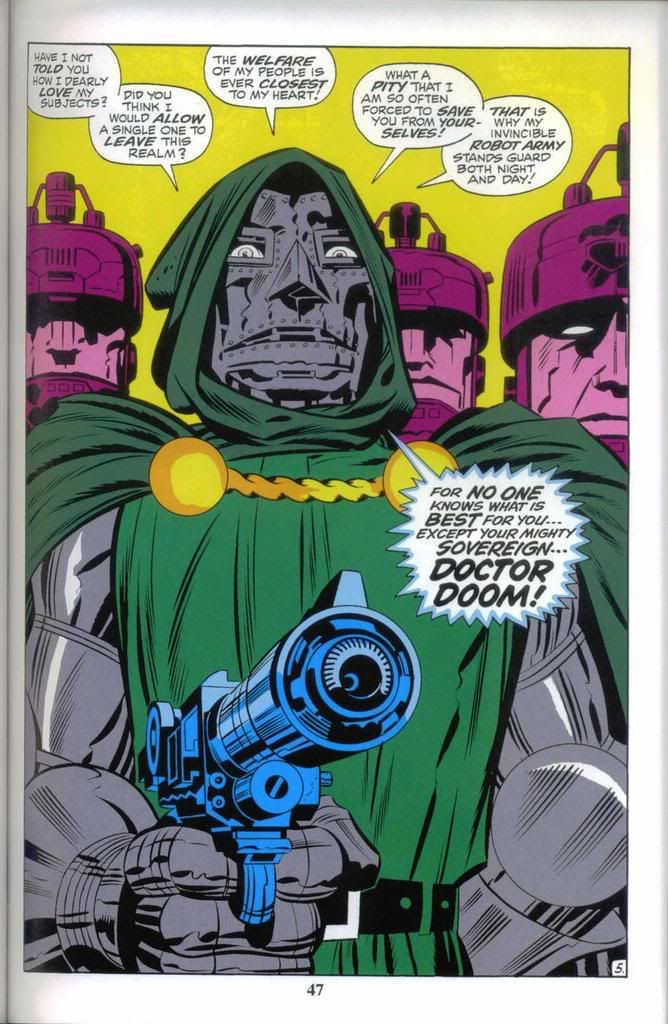
Doom had a few good speeches in the classic "Trapped In Latveria" storyline, but this one stuck out. Not only does it have this great splash panel ...


... it hints at another of his dark secrets --


-- namely, that he had Earth-Marvel's Stan Lee roughed up by Doombots for misspelling "soliloquy."

[From "The Name Is Doom!" in Fantastic Four vol. 1 #84, March 1969. Written by Stan Lee and Jack Kirby, pencilled by Kirby, inked by Joe Sinnott, lettered by Sam Rosen. Color reconstruction by Tom Smith. Reprinted in Marvel Masterworks: Fantastic Four #9 (2005).]
Full Post

Monday, April 14, 2008

New comics 4/9/08

You might already have seen my lengthy (shocking!) post about Titans #1 and Batman Confidential #16 over at Blog@Newsarama. Regardless, there's still a truckload of new books to go through here.

First I want to mention Green Arrow And Black Canary #7 (written by Judd Winick, pencilled by Mike Norton, inked by Wayne Faucher). When I saw that Cliff Chiang would be leaving this title, I announced loudly that he was one of the big reasons I was buying the book. If he went, I might just follow him; and how would you like them apples, DC?

Well, as it happens, new artists Mike Norton and Wayne Faucher do their darndest to replicate Chiang's endearing thick-lined style, which is nice. It also doesn't hurt that there's a touch of Mike Parobeck in their work. So, well done all. As long as Norton and Faucher are on the book, I'll be getting it.

As for the story, it may not please readers who think that longtime Justice Leaguers shouldn't comport themselves like they've OD'ed on "Alias" reruns; but hey, I liked it. After Ollie, Dinah, and Mia interrogate the guys they captured last issue, it's off to England for more hijinx in a pub. The story seems to have gotten padded out by at least an issue, but that may be so that Winick can introduce the guy our heroes meet this issue. Anyway, the trail leads back to one of Dinah's old flames, which should be interesting....

I liked a lot of things about The Last Defenders #2 (script by Joe Casey, breakdowns by Keith Giffen, pencils by Jim Muniz, inks by Cam Smith), but it's hard to describe why. The book isn't so much about this weird little group of "Defenders" as it is about the idea of the Defenders, and I suppose the sense that you can't impose too much organization upon it or it all falls apart. This issue is divided essentially in two: the opening fight scene which picks up from last issue, and the "infiltration" scene which sets up the cliffhanger. Running through the book is a jaunty, smart-aleck attitude where Joe Casey (by his own admission) essentially becomes Giffen's Justice League scripter, following in the keystrokes of J.M. DeMatteis, Bill Messner-Loebs, and Gerard Jones. It's that kind of attitude, and it actually ends up propelling the overall plot. Accordingly, the somewhat chunky, Ed McGuinness-y figures Jim Muniz pencils sometimes seem out of place -- too macho where they should be more comical -- but once we get past an Iron Man whose head seems to be shrinking as we watch, the effect becomes negligible. Revealing the book's villains as a couple of obscure Jack Kirby creations from the '70s doesn't hurt either.

Who wants to bet that Marvel does a "Special Rough Cut!" of Fantastic Four #556 (written by Mark Millar, pencilled by Bryan Hitch, inked by Hitch and Andrew Currie) where the stupid "blizzard" effects are removed? If you've seen the issue you know the problem. If not ... well, let's just say there are probably a half-dozen better ways to depict a snowstorm via sequential art, but obviously none of them looked as "realistic" as just putting random white splotches all over the panels. Especially when said panels depict dozens of tiny superheroes attacking a big red-white-and-blue robot. Thanks, Marvel, for making Hitch's work unreadable. The rest of the book is about like you'd expect; namely, very pleased with itself. I didn't think FF could test my patience any more than the JMS run did, but maybe I was wrong.

Superman Confidential comes to an end with #14 (written by B. Clay Moore, pencilled by Phil Hester, inked by Ande Parks), the conclusion of the Jimmy Olsen/Toyman story. I liked it well enough. I like Hester and Parks' work generally, and this issue hit all the right Toyman, Jimmy, and Superman beats. The story itself wasn't anything special, but it wasn't egregiously bad either.

It was good to see the regular team of Peter Tomasi (writer) Patrick Gleason (penciller) and Prentis Rollins (inker) back in Green Lantern Corps #23. The Boodikka story was only two issues, but it felt like an eternity. However, we're now looking at a few months with Mongul, the Sinestro rings, and a garden full of Black Mercy. This issue introduces that arc, with most of it devoted to summoning Guy, Kyle, Dr. Natu, et al. to Oa for their mission to round up the aforesaid yellow rings. I liked it pretty well. Tomasi has a better handle on the dialogue here than he does in Nightwing, by which I mean that he doesn't seem to be trying as hard to make the characters sound cool. Gleason and Rollins have long since settled into a comfortable groove on this title. The Black Mercy might be getting overexposed of late, but I still have high hopes for this story.

Another Green Lantern shows up in Wonder Woman #19 (written by Gail Simone, pencilled by Bernard Chang, inked by Jon Holdridge), but since he's unfamiliar to us, Diana spends most of the issue fighting him. It's a good illustration of the "fighting shows the value of not fighting" philosophy that informs the modern take on Wonder Woman, and it has the added advantage of letting Diana go one-on-one with a Green Lantern. Meanwhile, Etta Candy and a couple of Khunds have their own roles to play in deciding the fate of the planet. The art is good, but I still can't put my finger on who Chang's WW looks like. I was also pleasantly surprised at the ending, which I hope has repercussions down the line.

Speaking of repercussions, Booster Gold #8 (written by Geoff Johns and Jeff Katz, pencilled by Dan Jurgens, inked by Norm Rapmund) finds the death-cheating Blue Beetle and Booster Gold teaming up with a motley crew of superheroes to invade Max Lord's headquarters and maybe try to free Superman from Max's mental control. Yeah, good luck with that. Johns and Katz's script is good as usual, and I notice this issue how much more fluid Dan Jurgens' figures have gotten over the course of this series. It's another solid issue of a title which might just make DC's labyrinthine history accessible to (and, more importantly, fun for) the casual reader.

On the other hand, there's Countdown #3 (written by Paul Dini and Sean McKeever, story consultant Keith Giffen, drawn by Freddie Williams II), a Superman/Darkseid fight involving Dark Mary Marvel, a Kryptonite-powered Jimmy Olsen, and the Atom. There's 40-odd pages left in this monster storyline, and they'll pick up on Wednesday with Jimmy Vs. Darkseid. I can't make that sound any better. Freddie Williams, bless his heart, isn't quite the right artist for this throwdown either -- his characters look just a little too goofy for what's obviously meant to be serious business. Well, except for the last page, but I think that on some level that's meant to be serious too ... and if so, that's just sad.

The serious/funny thing is handled much better, of course, in the concluding issue of Groo: Hell On Earth (#4 produced by Sergio Aragones, with help from Mark Evanier, Tom Luth, and Stan Sakai), in which the Sage manages to get everyone lined up so that war is averted and environmental catastrophe is at least mitigated. It's been a fun little story -- somewhat obvious as an allegory, but it's not like Groo has ever been subtle.

Serenity: Better Days #2 (written by Joss Whedon & Brett Matthews, drawn by Will Conrad) finds the crew imagining what they'll do when they're rich, which turns out to be quite entertaining whether presented in single-panel gags or more extended sequences. The art is fine, and Conrad captures the look of the show and its cast well. As was the case last issue, the mechanics of one scene still don't make sense to me after multiple readings, but again, maybe I am slow. Also, the cliffhanger seems a little confusing. I was entertained, but maybe the book isn't technically as good as I thought.

Finally, I did buy Batman: Death Mask #1 (by Yoshinori Natsume), the "look! Bat-Manga!" miniseries, because I try to keep an open mind. I don't read manga, and I don't watch much anime, mostly because I am too busy with other things to give those media any significant attention. However, I will say that this Batman manga doesn't seem very innovative either for Batman or for manga. It certainly doesn't have the energy that a rookie like me might have expected. Instead, it's a black-and-white Batman story told from right to left. Maybe the speed lines and hyperactivity have been toned down for us entry-level readers? That would be understandable, but unfortunately the story isn't much to recommend either. The titular death mask kills people, there's a mysterious woman from Bruce Wayne's past, and Bruce is having strange dreams. But for the format, it'd be an average arc from Legends Of The Dark Knight. I'll keep getting the miniseries to see how it turns out, and to support this kind of cross-pollenization, but so far it looks like a missed opportunity.
Full Post

Monday, March 17, 2008

New comics 3/5/08 and 3/12/08

I've got a lot of these to go through, so I'll try to keep it short.

3/5/08

Justice League: The New Frontier Special #1: Very nice all around. I probably didn't need to see how another Batman/Superman fight would play out, but it's justified as a "lost chapter" of NF. The Robin/Kid Flash and Wonder Woman/Black Canary stories are cute, the period ephemera is well-done, and the behind-the-scenes look at the DVD adaptation is pure eye candy.

Teen Titans Year One #3: Was a little surprised at the pacing of the overall miniseries, as depicted in this issue; but better earlier than later, I guess. Besides, the story's new direction looks intriguing. It's been good so far, so I'm in for the rest.

Supergirl #27: It's an understatement to say that this book hasn't been what I expected. If you remember the Steven T. Seagle/Scott McDaniel run on Superman a few years back, it's kinda like that, except on downers. I'm pretty much buying this book to see if it all makes sense. Plus, I like Drew Johnson and this issue's guest (fill-in?) artist, Rick Leonardi. S'girl isn't frustratingly bad like, say, early Hawkgirl or late Gotham Knights. It's just frustrating.

Countdown To Adventure #7: I read this book for the Adam Strange/Animal Man/Starfire story. I have no idea what's going on with the Forerunner story.

Nightwing #143: I like the fact that writer Peter Tomasi isn't afraid to plug Nightwing firmly into the center of DC's superhero culture. It can get a little precious, and sometimes -- not so much in this issue, but certainly in the last one -- it distracts from the main plot. This issue was fine, but I bet if it were your first DC comic in a while, you'd be mystified.

Detective Comics #842: Batman must deal with an EVIL! suit of armor that he ended up wearing in the Ra's Al Ghul storyline from a couple months back. You know Spider-Man's black costume? Like that, except Batman doesn't destroy it, it doesn't make him dance like a poser, and (so far) it hasn't come to life. I'm not sure why the world needed this story.

Green Lantern #28: The "Lost Lantern's" trial results in the creation of a Red Lantern. Hal has a Clarice Starling moment with Sinestro. We check in with the demons on Ysmault. The Guardians issue a radical new law. I can see how it all fits together, but I know the dots won't be connected for about another year.

Countdown #8: Yay, Ray Palmer's back as the Atom! Yay, Firestorm is back (although whither Martin Stein?)! Yay, Habitat, the Hairies, and the rest of Jack Kirby's Jimmy Olsen creations! Boo, all the bickering and running around pointlessly.

3/12/08

JLA Classified #54: Will probably read better in the trade. Since this is the last installment of the Titus storyline, the "past" narrative takes up the top half of each page, and the "present" gets the bottom half. Sometimes that trick works, sometimes not. Here, it might've been better to split the pages vertically. As for the story, Titus beats the tar out of the League for as long as is dramatically appropriate. The ends on an ecumenical note, which is always nice, but a bit treacly for the Justice League. Overall, though, pretty good.

Batman Confidential #14: Part 2 of a new look at a one-off villain from the '80s, The Wrath. As a modern-style story with an out-of-date setting, it's not exactly a nostalgia-fest. However, I give it points for picking a time period other than "Year One." Otherwise, I'm not sure what the general appeal would be.

The Last Defenders #1: The Defenders are famous as Marvel's "non-team." This book goes a step further, taking pains to point out how its characters are nowhere near as cool as the original Defenders. It's a weird little exercise in obstinance wrapped in a story about white supremacists and big snake-monsters. I'll probably stick with it.

Fantastic Four #555: Boring. Bryan Hitch and Paul Neary are fine craftsmen, but there's still no life in an issue which features an illicit tryst, a duplicate Earth, and a giant killer robot. It's all hat and no cattle.

Superman Confidential #13: Part two of the Toyman/Jimmy Olsen story is okay, and I like Phil Hester and Ande Parks' art, but it feels a bit padded and lethargic. Probably could have used some pruning.

Star Wars: Rebellion #12: Part two of yet another "infiltrate an Imperial base" story that just kinda sits there. Colin Wilson's art reminds me of early Howard Chaykin, and his Luke doesn't look much like Mark Hamill either.

Bat Lash #4: The big apocalyptic issue which sets up the climax. This miniseries has been decent, but it's hard to reconcile all the blood and death with the happy-go-lucky tone which got me interested in the character. (Lots of cattle, but I thought the hat would be different, in other words.) Maybe Sergio Aragones can do it. We'll see.

Countdown To Mystery #4: I continue to like the Doctor Fate story as it plays with the (pretty much inevitable) conclusion that has Kent Nelson become the latest Doctor F. This installment includes the most traditional superhero action we've seen since early on, but the pieces still haven't fallen into place. Most origin stories seem to place the origin alongside another threat, in order to give the new hero something to do in the third act. This one is all about the origin process itself, with Inza's comic-book ventures serving as metacommentary. Makes me miss Steve Gerber that much more. P.S. This book also contains an Eclipso story which is once again threatening to meander.

Booster Gold #7: It's The OMAC Project, Take Two, as we see how Max Lord took over the world once Booster saved Beetle from an (untimely?) death. (By the way, I've just started the second season of "Star Trek Voyager," and Tom and Harry are reminding me a lot of Beetle and Booster.) More subplots converge alongside more trips into DC's nostalgia mine, so for me, pretty good.

Superman #674: New artist Renato Guedes brings a nice "bigness" to the proceedings. Outgoing writer Kurt Busiek brings back an old JLA villain (from just before the Detroit days) to threaten Superman. Meanwhile, Supes has problems with Mon-El and the Kents have a new apartment. It's a full issue which doesn't feel overstuffed.

Wonder Woman #18: Guest artist Bernard Chang helps Gail Simone send WW into space, in what looks like an oblique sequel to the "Space Pirate" storyline from the early '90s. Basically, she's challenged by the Khunds (who act like Klingons) to stop an unstoppable race which threatens Khundia. Also, she gets pre-engaged to Tom Tresser, and Etta Candy shows up too. Chang makes WW look like someone familiar, but I can't think of who. His art is a lot less porntastic than I feared it would be.

Countdown #7: Yet another parallel world, 90% close to the familiar DC-Earth. Another Tom Derenick-pencilled issue too. I swear, this series would be twice as good if it were half as long.

Green Arrow and Black Canary #6: This issue seemed so indebted to "Alias" (the TV show, not the comic book) that I'm starting to think Connor Hawke is the Michael Vaughn designated-victim figure. Remember when Vaughn drowned at the end of Season One, or when he got shot like Bonnie & Clyde at the beginning of Season Five? My money is therefore on Connor to pull through.

Green Lantern Corps #22: Part two of the Boodikka/Alpha Lantern storyline seems pretty forgettable, although it'll probably look a lot more important in 2009. Today, though, I'm tempted to think that all the procedural GLC stuff would fit better in this book than in Green Lantern, with the Boodikka story as a backup.
Full Post

Friday, February 15, 2008

New comics 2/13/08

Well, we're getting settled in here in the Memphis metro area (we're in the 'burbs, actually), and what looks like the main LCS is fairly close to the house, so good news all around. Thanks for all the good wishes, too. I'm looking forward to getting to know the area!

Still, you're not here for the travel tips, and I haven't hooked up the scanner yet, so...

Fantastic Four #554 (written by Mark Millar, drawn by Bryan Hitch) has some good ideas. Sue's Junior League-ish "super-team" is one of them, as is the idea that Alyssa Moy (glad I read the Claremont issues!) is just as good as Reed without being held back by family obligations. Hitch is reliably good, as usual. However, I can't decide whether Millar is ripping off Magrathea, the Quantum Mechanics from Hitch (and Mark Waid)'s JLA: Heaven's Ladder, or both. It's certainly a big enough idea for the FF (as it was for the Justice League), but Millar and Hitch have such matter-of-fact styles that it loses something, somehow, in "translation." I definitely get the idea that the A-games are being brought, but (at the risk of mixing metaphors horribly) their reaches may exceed their grasps.

Spider-Man Family #7 includes a funny, sweet story about the Looter's love for his piece of meteor rock. It's Mark Waid, Todd Dezago, and Karl Kesel's tribute to their late colleague Mike Wieringo, and I really enjoyed it. The rest of the issue reprints the first issue of a Venom miniseries obviously from the '90s, the first issue of a Gwen Stacy flashback miniseries, and a Japanese Spidey story. I'm still working my way through those, and also the bonus materials in Fantastic Four: The Lost Adventure. The latter reconstructs the Lee/Kirby story that appeared (in altered form) in FF #108, and of course I can't say anything bad about Lee/Kirby FF.

Bat Lash #3 (written by Sergio Aragones & Peter Brandvold, drawn by John Severin) takes the overall story in a pretty grim direction, and for a story which has featured attempted rape as a major plot device, that's saying something. I do think the villains are made to be suitably evil, but I'm not getting much in the way of characterization from Bat himself.

Was a little surprised to see an Alpha Lantern story in Green Lantern Corps #21 (written by Sterling Gates, drawn by Nelson), since I thought the Alphas' "origin" was still unfolding in the main GL book. Anyway, the spotlight here is on Boodikka, who I believe was introduced in the Gerry Jones era of the very early '90s. Even so, this may be our first look at her homeworld and early life. It's an OK issue -- the main conflicts have to be restated for folks who don't know them already from the other title, and the story-specific conflicts are pretty familiar. Boodikka isn't the first Lantern to suffer the rejection of her old social group. The art isn't bad, but it's not particularly energitic either. However, the plot brings everything together at the end in a fairly new way, and if this is your first Alpha Lantern story it's probably not too shabby.

JLA Classified #52 (written by Roger Stern, pencilled by John Byrne, inked by Mark Farmer) features the present-day League's fight with Titus. It was good, in terms of book-length fight scenes. Every Leaguer got a spotlight, there was a bit of backstory involving an Amazonian prophecy, and it ended on a cliffhanger. Can't ask for much more than that.

I didn't quite know what to expect from Beautie: An Astro City Character Special (written by Kurt Busiek, drawn by Brent Anderson), but I ended up pleasantly surprised by its "Twilight Zone" feel. At first I wondered whether Anderson was just giving Beautie Barbie-like characteristics and mannerisms, so it was a little confusing before I realized that's the way she's supposed to look. Once I got past that, I realized how unnerving she would be even among the other AC characters, and that discomfort helps to define her. Overall, I thought it was a good standalone story, and it doesn't quite matter that it might not have much to do with the overall AC mega-plot.

Superman #673 (written by Kurt Busiek, drawn by Jesus Merino) wraps up the Insect Queen storyline with a bit of super-power use that made me, and no doubt other readers, think "it doesn't work that way!" I didn't dislike this storyline, because it built the IQ up as a credible threat, gave Lana something productive to do, and had some good scenes with Chris Kent ... but really, heat vision doesn't work that way, does it? As for the art, Merino has some of the same issues with choreography and poses that Peter Vale does, but overall he did a good job.

I liked Wonder Woman #17 (written by Gail Simone, drawn by Terry & Rachel Dodson and Ron Randall) pretty well, but I couldn't figure out why one Amazon appears to suffer a couple of mortal wounds on one page and then turns up somewhat less than dead shortly thereafter. Misdirection, I guess; which is how we get suspense. Anyway, this is more of Wonder Woman being the toughest person in the room (or in the jungle, or on the beach), as she intimidates the Nazis off Themyscira and then takes out the four Amazons who've wanted her dead since her birth. I was also surprised by the revelations about Etta Candy, who I guess got Superboy-punched somewhere along the way. Thought Ron Randall meshed pretty well with the Dodsons, too.

Green Arrow/Black Canary #5 (written by Judd Winick, drawn by Andre Coelho) was okay. Essentially a flashback about Connor Hawke's childhood, it also includes Ollie and Dinah's real wedding and sets up what looks like the next main storyline (which may well involve Connor's being healed). The flashbacks are rooted in the core of Ollie's character, which is (I think) the conflict between his extreme self-centeredness and his perpetual desire to make up for same. In other words, Ollie's a jerk who realizes his shortcomings about ten seconds too late. If you can get past that, he becomes more sympathetic, and these flashbacks probably become easier to take. Otherwise, there's probably no way you keep reading this book. Art was pretty decent -- kind of like Cliff Chiang, but with thinner, harsher lines.

Most of the action's on Apokolips in Countdown #11 (written by Paul Dini and Justin Gray & Jimmy Palmiotti, story consultant Keith Giffen, pencilled by Mike Norton, inked by Mark McKenna), but nothing much happens. Oh sure, Brother Eye and OMAC mow down para-demons, and Holly, Harley, and Mary fight a new (and probably less-powerful) batch of Female Furies, and Karate Kid gets some action as well, but I don't get the same sense of plot advancement from this issue that I did from the Earth-51 story which ran through the January installments. Art is good, because I think Norton and McKenna are capable storytellers with a clean, appealing design sense. Other than that the book has the same problems it's always had: it assumes you're in this for the long haul and it doesn't need to explain anything.

Finally, I wasn't surprised by the cliffhanger at the end of Booster Gold #0 (written by Geoff Johns and Jeff Katz, pencilled by Dan Jurgens, inked by Norm Rapmund), because I'd seen the solicitations for future issues. Besides, no good can come of Booster's time-mucking. I did like the Zero Hour elements, though, especially the notion that this was the "Zero Month" issue which re-told Booster's origin. Unfortunately, I'm not getting the sense of camaraderie and joie de vivre that I should be from the return of the Blue and Gold team. Ted's just too serious -- understandably, I think, since he's just faced his own death. Maybe next month, when they're dodging OMACs, they'll be funnier.

Full Post

Saturday, December 29, 2007

New comics 12/28/07

... So I bought sixteen comic books and then entered a Nyquil fog? Isn't it supposed to happen the other way around?

Jeez, sixteen comics. I'll point out quickly, though, that three carry the Countdown banner, two the 52 Aftermath one, and a couple of others are one-shots (Green Lantern Secret Files, Fantastic Four Isla de la Muerte), and one I'm just giving a tryout to (LSH). So that's half, which makes me feel a little better.

Also, I read 'em last night during the Nyquil haze, so I might still be a little fuzzy talking about 'em today.

Onward!

The three Countdown books -- Arena #4, C. To Adventure #5, and issue #18 of the main book -- were all pretty competently done. The big attraction in the main book was the reunion with Ray Palmer, but it felt more like the capper to those wheel-spinning Search For specials from the past few months. Good to check in with Ray, but not much else happened this week, and of course another cliffhanger ending. The Adventure book advanced the plot in San Diego, but seeing that we're past the halfway point and our three stalwarts haven't hooked up again, the story starts to look a little more padded. Finally, Arena wrapped up with a weird fight involving the Supermen, made even more incomprehensible by Christopher Kent (the bald one)'s odd powers. If you had "Superman defeats Monarch," you lost!

The Forerunner backup in C. To Adventure was okay, about her taking over a pirate ship and generally being hardcore, but the overall storyline has not engaged me.

Moving on. Green Lantern Sinestro Corps Secret Files & Origins #1 was surprisingly comprehensive as these things go, delivering on the cover's promise of "bios on over 200 Lanterns!" and generally acting as the Bill James Baseball Abstract 2008 for all us GL fans. Worth the $4.99, and I don't say that lightly about these Secret Files books.

Mark Waid strikes twice this week, first with Flash #235 and then with Brave and the Bold #9. The Flash story was fine; more intriguing for its Jai-Wally scenes than for any advancement in the plot. I'm not convinced that Freddie Williams is a good fit for this book. I might have mentioned already that his figures are a little on the bulky side, and for a speedster I don't think that's optimal. Still, it's not a total mismatch. The backup fares better, being a Wally-and-Bart flashback and helping to explain the origin of the main story's bad guy.

The Brave and the Bold #9 is likewise a patchwork of three fairly simple team-ups (Metal Men and Dial H For Hero, Blackhawk and Boy Commandos, present-day Atom and Hawkman) in which each set of heroes fights some messenger of Megistus. It's all tied together by a Challengers of the Unknown framing sequence, and the suggestion that the Book of Destiny has come to life somehow. (There must have been some magic in that old silk hat they found....) It will probably mean more to the story once the bigger picture is seen, and it's not the best issue so far, but it's still pretty fun.

This week also sees a double dose of the Legion of Super-Heroes, first in their own book and then in Action Comics. Legion #37 kicks off the return of Scripter-Boy Jim Shooter, back after thirty-plus years; and I've gotta say, I wasn't really encouraged. The thrust of the story is that new Legion leader Lightning Lad is, to put it lightly, overwhelmed by his responsibilities, with the team suffering as a result. The issue provides an overview of quite a few Legionnaires, which is appropriate, and it's not really decompressed, which I appreciated; but it almost tries to do too much. Blocky, angular art from penciller Francis Manapul and inker Livesay doesn't help the scenes flow into one another. There's also not much sense that this Legion is appreciably different from the old Shooter/Levitz days, and I kinda think there should be. Maybe I'm just picky that way.

Over in Action Comics #860, what is allegedly the old Shooter/Levitz Legion gets its own workout, but again, the book just feels crowded with characters. Having them all introduced with their own bullet-point caption is a nice idea in theory, but in practice -- take the first page, for example -- the things can clutter up the page. The Legionnaires also crowd out Superman themselves, but if the point is to get all the players straight before the big scrum, that'd make it easier to take. Oddly enough, I think penciller Gary Frank makes the Legionnaires look a little older than Superman, which strikes me as an intriguing detail if it's intentional. Look at the cheekbones on Lightning Lass and Night Girl. Those faces seem almost middle-aged to me. Anyway, we're about where I'd expect for the halfway point of the story, so it's still good thus far.

Green Lantern #26 bills itself as Part 1 of "The Alpha Lanterns," but it's more transitory than that. Pieces are picked up after the Sinestro Corps War, Hal and John go back to Earth, and a group of "Lost Lanterns" runs afoul of Amon Sur. Mike McKone comes on as penciller and does a good job. His layouts aren't as crowded as Ivan Reis's, but of course he's not drawing thousands of GLs and Sinestros either. Because the issue is so episodic, it's hard to get a sense of what it wants to accomplish, and it dispenses with the "Alpha Lantern" thing pretty quickly. We'll see how Part 2 deals with the Alphas, I guess.

Another somewhat transitory issue was Captain America #33, wherein the Winter Soldier's arm beats up some SHIELD techs and the fully-armed (ha ha) W.S. almost takes out Iron Man. Pieces are put together by the good guys re: the involvement of the Red Skull, and next issue advertises the New Cap. Another fine installment.

Fantastic Four: Isla De La Muerte was a cute one-shot spotlighting the Thing's annual secret vacation to Puerto Rico. With as much time spent on team dynamics as on the mystery du jour, it's a good little FF story. I don't quite see the resemblance between Ben and El Morro, though. The art, by Juan Doe, is fairly cartoony, but I just say that to describe, not criticize.

JLA Classified #49 was a strange, rather insubstantial story about the Leaguers' various helpmates reacting to their being off-planet on a dangerous mission. Most of it concerns Lois Lane and Alfred Pennyworth meeting for the first time, which you'd think would place this fairly early in DC history; but Wally is the Flash and Linda is his sweetie, so it can't be that old. Also, Lois either doesn't know Superman's secret, or doesn't know that she can share it with Alfred. Paulo Siqueira and Amilton Santos are the penciller and inker, respectively, and they combine to produce somewhat Adam Hughes-like figures. However, the layouts are a little too self-conscious, with figures jumping out of panels when they maybe really shouldn't. The overall effect is to make the story seem more important than it is. I hate to be a continuity stickler, but it might've worked better with a more open relationship among the principals; and that might've been better portrayed with a group which included the Silver Age significant others. Those people did hang out together in a way that, say, Alfred and Lois don't.

Teen Titans #54 finished up the "Titans Of Tomorrow Today" storyline, but I'm not sure how. Did the revelations about Future-Kon and Future-Bart really affect the current Titans' viewpoints enough that history will be changed for the better? And what about that epilogue? The issue has some nice moments, many of them involving Wonder Girl or Blue Beetle, but I don't know that they add up to a coherent conclusion.

Batman #672 sees Grant Morrison and Tony Daniel return to the familar "Three Evil Batmen" storyline Morrison had been working before the Club of Heroes and Ra's al Ghul arcs intervened. I liked this issue pretty well, although I thought the ending was confusing. Since it involved Zur-En-Arrh, a Batman getting shot, and what looks like Bat-Mite, I'm sure it'll be explained eventually. Daniel and his various inkers still remind me of Andy Kubert, but that may well be the influence of Guy Major's colors.

Finally, the two 52 spinoffs, Four Horsemen and Crime Bible, were both pretty entertaining. I especially liked Crime Bible's look at the Gotham PD and, therefore, Greg Rucka's "return" to Gotham Central territory. Batwoman also seemed a lot more plausible as a crimefighter, although you'd think we'd have seen her in more places even taking her recovery into account. Anyway, Crime Bible was more a spotlight on the Question's relationship to Batwoman, and for that it was pretty good.

Four Horsemen continues to be a good adventure story, weaving various ancillary characters like Mr. Terrific, Veronica Cale, and Snapper Carr into its story about DC's "Big Three" taking on Apokoliptian terror-gods. This issue adds the Doom Patrol. It's all very well-organized, with enough set pieces (like Superman's and Batman's respective duels with Horsemen) to hold my interest. Of course, there's not much doubt about the outcome, so the fun is in seeing how we'll get there.

Whew! How's that for a whirlwind look at an end-of-year blowout week?

* * *

CREDITS

Action Comics #860. Written by Geoff Johns, pencilled by Gary Frank, inked by Jon Sibal, colored by Dave McCaig.

Batman #672. Written by Grant Morrison, pencilled by Tony Daniel, inked by Daniel, Jonathan Glapion, and others, colored by Guy Major.

The Brave and the Bold #9. Written by Mark Waid, pencilled by George Pérez, inked by Bob Wiacek and Scott Koblish, colored by Tom Smith.

Captain America #33. Written by Ed Brubaker, pencilled by Steve Epting, inked by Butch Guice, colored by Frank D’Armata.

Countdown Arena #4. Written by Keith Champagne, pencilled by Scott McDaniel, inked by Andy Owens, and colored by Guy Major.

Countdown To Adventure #5. “Space Heroes” written by Adam Beechen, pencilled by Allan Goldman, inked by Julio Ferreira, and colored by The Hories. “Forerunner” written by Justin Gray, pencilled by Fabrizio Fiorentino, inked by Adam DeKraker, and colored by The Hories.

Countdown (To Final Crisis) #18. Written by Paul Dini and Sean McKeever, story consultant Keith Giffen, drawn by Scott Kolins, colored by Tom Chu.

Fantastic Four: Isla de la Muerte! #1. Written by Tom Beland, drawn and colored by Juan Doe.

52 Aftermath: Crime Bible -- Five Lessons Of Blood #3. Written by Greg Rucka, drawn by Matthew Clark, colored by Javier Mena.

52 Aftermath: The Four Horsemen #5. Written by Keith Giffen, pencilled by Pat Olliffe, inked by John Stanisci, colored by Hi-Fi.

The Flash #235. Main story written by Mark Waid, drawn by Freddie Williams II, and colored by Tanya & Richard Horie. Backup written by Waid and John Rogers, drawn by Doug Braithwaite, and colored by Alex Sinclair.

Green Lantern #26. Written by Geoff Johns, pencilled by Mike McKone, inked by Andy Lanning, Marlo Alquiza, & Cam Smith, and colored by JD Smith.

Green Lantern Sinestro Corps Secret Files & Origins #1. Written, drawn, and colored by too many people to mention.

JLA Classified #49. Written by Andrew Kreisberg, pencilled by Paulo Siquiera, inked by Amilton Santos, and colored by Allen Passalaqua.

Legion of Super-Heroes #37. Written by Jim Shooter, pencilled by Francis Manapul, inked by Livesay, and colored by Nathan Eyring.

Teen Titans #54. Written by Sean McKeever, pencilled by Eddy Barrows, Joe Prado, & Greg Tocchini, inked by Rob Hunter, Julio Ferreira, Oclair Albert, & Prado, and colored by Rod Reis.

Full Post

Sunday, December 16, 2007

Sunday Soliloquy

I didn't get to use the Thing/Doom beatdown from this week's FF for this week's Friday Night Fights. Good thing, then, that Future Doom is just as mouthy as Present Doom.


[From "Epilogue, Chapter 2: The Middle Of The End," Fantastic Four #552, February 2008. Written by Dwayne McDuffie, pencilled by Paul Pelletier, inked by Rick Magyar, colored by Wil Quintana, lettered by VC's Russ Wooton.]
Full Post

Monday, November 12, 2007

New comics 11/7/07

We begin this week with Supergirl #23 (written by Kelley Puckett, pencilled by Drew Johnson, inked by Ray Snyder), which I bought mostly out of past loyalty to these creators. By now these Supergirl relaunches have an air of "This time for sure!" about them, so I'll also admit to some morbid curiosity. In that respect I wonder if it's a bit of black humor that the cover has our heroine going up in flames....

Anyway, the issue itself is an enigmatic bit of decompression which starts and ends with a mysterious box delivered to Supergirl's apartment. After a brief, but funny, chat with Batman about the box, she's called away by Superman to help him and a squad of Green Lanterns stop an interstellar war. Things don't quite go as planned, but her reaction -- and the role of the box -- aren't quite explained, thereby theoretically encouraging us readers to come back next month.

Should we, though? I'm more intrigued by the storyline than I am by the title character, and I'm not sure that's a good thing. From what I can tell from this issue, Supergirl's kind of a spaz. She zones out when the GLs brief her. She's apparently responsible enough to have her own (spacious, nicely furnished) apartment, and that magazine subscription in her hand indicates she's put down some roots, but how old is she supposed to be -- late teens? Early twenties? What's her "secret identity" like? (Judging by this week's Superman, she doesn't have much of one ... but that's this week's Superman.) She's got all the powers of Superman, so how does she use them differently? In short, why should I care about her enough to pay $2.99 (plus tax, minus folder discount) every month?

Well, the art is quite good. Johnson and Snyder do meticulous work. I'm not entirely sure about their Supergirl anatomy, but that could just be an optical illusion from the costume. There's a long, wordless stretch in the second half of the book, and they handle that pretty well too. Like I said, I'm intrigued by the story, and this issue was good enough to make me want to see more. However, if I'm going to make a long-term commitment, I'd like to know more about Supergirl herself.

As for her cousin, Superman #670 (written by Kurt Busiek, pencilled by Rick Leonardi, inked by Dan Green) finishes up "The Third Kryptonian." It's a good conclusion to what was a somewhat predictable but still enjoyable arc. Busiek hit most of the "moody loner" character beats with Kristin Wells, including the "only out for herself" one. However, the issue is mostly action, which Leonardi and Green do nicely. I also like their Supergirl, who looks about five pounds heavier than Johnson and Snyder's; and their Power Girl, who looks about ten pounds lighter than, say, Michael Turner's. Anyway, the basic plot is that the Head Bad Guy has all kinds of weapons specifically designed to kill Kryptonians, so Superman and his allies (including Batman) have to figure out inventive ways to counter them. It's all fairly straightforward, although it apparently sets up a sequel and at least one other future story. That's not really a criticism, because I haven't been this consistently pleased with a Superman writer in a long time.

Countdown #25 (written by Paul Dini and Adam Beechen, pencilled by Ron Lim, inked by Jimmy Palmiotti & John Stanisci) finally checks in with the cliffhanger that closed out Firestorm, lo those many months ago. That's the bulk of the issue, and it's entertaining and somewhat satisfying. However, the other "check-in" scenes -- Jimmy and Mary Marvel on Apokolips, and Piper and Trickster escaping from Deadshot (?!?) -- are kind of lame. Art is good throughout, and I would expect no less from an old hand like Lim.

I was curious about The Search For Ray Palmer: Red Rain (written by Peter Johnson, pencilled mostly by Eric Battle and Angel Unzueta, inked by Derek Fridolfs, Vicente Cifuentes, and Jonathan Glapson, with a few pages drawn by Kelley Jones) because I enjoyed the "Bat-Vampire" trilogy by Jones and writer Doug Moench. However, this has all of the grue and none of the grim nihilism. It's not a very attractive book, mostly because it tries to ape Kelley Jones' style without much success. The colors (by Art Lyons) are muted and muddy, like a red filter has overlaid everything. The plot is moderately diverting, since it involves this Earth's Dick Grayson (and, in a small role, Barbara Gordon), but even that feels like something of a departure from the original material. The Batman/Dracula: Red Rain book was creepy precisely because it was set in a Bat-milieu that could easily have been the character's regular title. However, this special's Dick and Babs are just characters with the same names. What's more, our Challenger heroes really can't do anything to affect this Earth's status quo -- they can only introduce us to it and move on. Therefore, nothing of consequence happens. Unless you just like seeing alternate versions of familiar characters put through penny-dreadful situations, you don't need this issue.

In the regular Bat-books, "The Resurrection of Ra's al Ghul" begins officially in Robin #168 (written by Peter Milligan, drawn by Freddie E. Williams II). If you've seen one of those "Bad Seed" kinds of movies, where no one will believe the good kid who knows the evil kid's evil, that's about how Tim must deal with Damien. Also, Batman rescues Talia from what is apparently her bandage-enwrapped father. It's kinda unremarkable, except for the hints at the mysticism (Nanda Parbat, the Sensei, etc.) behind Ra's' return. Williams' work is fine; Robin is lean and muscular, and Batman is appropriately chunky.

The romance, or whatever it is, of Ryan and Doris "Giganta" Zuel is the best thing about (The All-New) Atom #17 (written by Gail Simone, pencilled by Mike Norton, inked by Trevor Scott). I found myself rooting for the two crazy kids despite the fact that she's a little unhinged. The weird androgynous villain (at least I think "he" and "she" are the same person) was hard to figure, but that's a good enough mystery for two issues. Norton and Scott turn in another fine issue. They work about as well with Simone as Nicola Scott did on Birds Of Prey, and considering how much I like Nicola Scott, that's high praise indeed.

I bought Welcome To Tranquility: Armageddon #1 (written by Christos Gage, drawn by Neil Googe and Horacio Domingues) out of loyalty to the regular title -- only one issue left, apparently -- and it was just okay. Basically, it focused on Tranquility's Captain Marvel-analogue, but let him stay "in costume" the whole issue, as opposed to his regular role of deus ex machina. Also, the time-travel involved in showing us the alternate future also made our hero's role that much more confusing. In short, he flies around while others tell him how bad things have gotten, and then he forgets about everything and the issue is over. It was kind of like the Ray Palmer: Red Rain issue, above, except without the muddy art.

Fantastic Four #551 (written by Dwayne McDuffie, pencilled by Paul Pelletier, inked by Rick Magyar) looks like it kicks off this creative team's last arc, involving a set of time-travelers bent on stopping Reed from saving the world. It ends on a heck of a cliffhanger, and it ties into Reed's "room of notes" from Civil War. That's not a lot in terms of plot, but it's executed well.

Howard the Duck #2 (written by Ty Templeton, pencilled by Juan Bobillo, inked by Marcelo Sosa) gets closer to its roots, as Howard and Bev must deal with Howard's sudden celebrity following his smackdown of the hunters last issue. Most of the issue finds Howard on a yelling-match talk show, and that goes about like you'd expect, or maybe a little worse. I might be easily amused, but I did like MODOT (Designed Only for Talking) a lot. This is not a bad miniseries by any means, even if it has a lot to live up to.

Finally, the satire is presented much more deftly in Groo: Hell On Earth #1 (by Mark Evanier and Sergio Aragones), in which Groo's bumbling leads to eco-unfriendly consequences. I'm not sure how this can be stretched out into four issues, but if the rest are as clever as this one, I definitely won't care. The latest Groo tale finds everyone at the top of their particular game, especially Aragones and colorist Tom Luth. Those two complement each other perfectly through Aragones' exquisite backgrounds and two-page spreads. This story aims for a broad scope and even an epic feel, and succeeds admirably.
Full Post

Saturday, November 03, 2007

New comics 10/31/07

Just for the heck of it, let's start off this week with a "why not?" purchase, Mythos: Fantastic Four (written by Paul Jenkins, art by Paolo Rivera). I love the FF, and Jenkins and Rivera probably do too, but beyond serving as a kind of generic introduction to the team, I don't really see the point of this book. Last year the First Family miniseries attempted to bridge the gap between the plainclothes adventurers of the first couple of issues and the celebrity superheroes to come. This retelling of the origin changes a number of elements but obviously has to leave the end result the same.

Accordingly, there's no real drama in the story beyond the pathos of becoming superhuman, and even that is glossed over. Indeed, the current editorial revision of making our heroes actual American astronauts, who just happened to be in the wrong place at the wrong time, sucks away another source of tension. Yes, we all know they're not "racing the Commies" anymore, but Reed and crew defying the government to go into space isn't just a plot point, it's a character-builder -- as is Reed's culpability in the accident itself. Both are absent from this version. Apart from all of that, though, the book is put together well, except Reed looks a little bullet-headed in spots and Ben's eyebrow-ridge is a bit too sharply defined at times. I'm tempted to say the most fun thing about the issue is the very last page, a cutaway drawing of the Baxter Building done up all photo-realistically.

Another impulse buy was Superman Confidential #8 (written by Dan Abnett & Andy Lanning, pencilled by Chris Batista, inked by Cam Smith), the first part of (yes, another) retelling of Forever People #1. In other words, it's Superman's first full-blown encounters with the New Gods, and I think it's more successful than Mythos. Batista draws a lithe, dynamic Superman, and Smith's inks and Jason Wright's colors make this a good-looking book. Abnett and Lanning bring in other Fourth World/early '70s characters like Morgan Edge and Victor Volcanum. Not much new ground is broken, but this kind of continuity-porn is what I expected SMConf to deal in, so in that respect, good job.

Here's the thing about calling something "52 Aftermath" -- 52 ended six months ago. I don't disagree with publishing Crime Bible #1 (written by Greg Rucka, drawn by Tom Mandrake) on Halloween, and I enjoyed it, but let's be clear: if you read 52, you know good and well what the Crime Bible is. If you didn't, wouldn't the title Crime Bible be at least somewhat attractive, even without the 52 brand? (I swear, all this unified trade-dress is getting out of hand.) Anyway, CB plays out like a late '60s-early '70s urban-paranoia horror movie, with Renee "The Question" Montoya investigating some poor schmuck's blundering across a secret society. I enjoyed Rucka's unadulterated take on Renee, and I thought it worked well to bring the reader into the story via the schmuck and not her. Mandrake's work was quite good this issue, and better specifically than his Batman fill-ins from earlier in the year.

At the risk of sounding hypocritical, I don't have as much of a problem with the title of 52 Aftermath: The Four Horsemen (#3 written by Keith Giffen, pencilled by Pat Olliffe, and inked by John Stanisci). Four Horsemen is generic enough that it might need the 52 qualifier. This installment reveals a lot about a certain former JLA mascot's recent association, and Giffen has some fun with that. In fact, this story has a lot of Greg Rucka influences, the more I think about it, and the presence of frequent 52 penciller Olliffe makes it feel the most connected to said miniseries. It needs to get moving, though -- the 4-H Club takes a pretty good shot from Superman this issue, but now we're at the halfway point and time to get serious.

Countdown to Mystery #2 has a pretty good Doctor Fate story (written by Steve Gerber, pencilled by Justiniano, inked by Walden Wong) and a so-so Eclipso one (written by Matthew Sturges, drawn by Steven Jorge Segovia). The Eclipso story involves the corruption of Plastic Man, and therefore tries to be both wacky and edgy. It does not succeed. The art is fine, but maybe that's the problem: it's appropriate for your average superhero-influenced Plastic Man story, but not for a harrowing inversion of all that's good and right about an inherently goofy character. It comes across pretty overwrought.

The Doctor Fate story finds him learning on-the-job how to cast the right demon-defeating spells. However, it also establishes just how far down the socio-economic ladder he's fallen, and what he needs to do to get back into a barely-normal life. This does not include a mystic golden helmet. Accordingly, I don't get the feeling that this Fate will be joining the Justice Society anytime soon. Not that he won't eventually -- why else would he have been brought back? -- but if DC Editorial keeps him true to this characterization, it'll be a while. Thankfully, the mundane concerns of this Kent Nelson are compelling enough to compete with the magic.

The lead story of Countdown To Adventure #3 (written by Adam Beechen, pencilled by Eddy Barrows, inked by Adam Ferreira) was pretty entertaining, albeit a little disconcerting. I didn't expect to see a kill-crazy kid slice open Starfire's thigh on page 3. Everyone in San Diego and on Rann is going crazy with Lady Styx fever, so naturally they're out to get Starfire and Adam Strange. Like I said, it's entertaining, but it feels a bit redundant too. I also don't like having Ellen Baker suspect Buddy of having fallen in love with Kory. It strikes me as a well-worn plot element which might appear to make sense, but which reinforces certain stereotypes. Clearly Ellen is frustrated because for a year she thought Buddy was dead, and now that he's back he's brought this golden space-goddess with him. If "Friday Night Lights'" Coach Taylor had brought Starfire back to Dillon from TMU, I expect Tami would be a little upset too. However, Ellen's in danger of becoming a cliche, and that's what I don't want to see.

Countdown #26 (written by Paul Dini and Justin Gray & Jimmy Palmiotti, story consultant Keith Giffen, drawn by Scott Kolins) was an exposition-riffic attempt to pull all of the various subplots together into a larger narrative. However, it chose to show all of the excitement through the riveting device of ... watching it on television. Yes, it's Third-Hand Theater -- we mostly watch the Monitors as they watch what's really important. Of course, you could argue that what's important is the Monitors' decision to "go to war," which I suppose will be pretty exciting assuming it happens in the pages of this title and not 25 weeks down the road. By the way, I think Black-Suit Superman, about to execute the Luthor of Earth-15, is our own Superboy-Prime who somehow survived the Sinestro Corps War. Hey, if Kyle's OK, why not him too?

There's nothing really wrong with Batman #670 (written by Grant Morrison, pencilled by Tony Daniel, inked by Jonathan Glapion). It doesn't have the stylistic zip of "The Club Of Heroes" or the over-the-top frenzy of Morrison's other arcs. However, it does have solid, dynamic characters in Batman, the three forgotten super-vixens, and Damian. I'm sure those more versed in Morrisonia could fit said trio and Damian (again in the Robin costume) into the taxonomy of heroes and wannabes explored in "Seven Soldiers," but I can only say they seem part of the same "here's our costume; we're super" paradigm. I thought the art was good, and reminiscent of Andy Kubert, but a bit flat, especially in the Ra's al Ghul scenes. Daniel does draw a good Batman, though.

I decided to drop Supergirl and the Legion of Super-Heroes (#35 written by Tony Bedard and drawn by Dennis Calero) after the first issue of this arc, so I'm three issues removed from that one. On its own, though, this isn't bad -- a fight between Atom Girl, Shadow Lass, and Wildfire, with Brainy helping the Legionnaires from afar and Drake's brother likewise guiding him. Meanwhile, Supergirl, Lightning Lad, and Saturn Girl find Evolvo Lad and prepare to fight him. I was only a litlte disoriented, so that's a positive. Art was fine, if a bit muddy and blocky. Best thing about the issue was also a little incredible -- 31st Century technology will still let Atom Girl do that old trick?

"That other" Legion shows up in the long-promised Action Comics #858 (written by Geoff Johns, pencilled by Gary Frank, inked by John Sibal). It begins with a great little three-page sequence which takes full advantage of the Superman origin as DC's version of the Nativity. It also incorporates that quasi-cinematic "DC Comics Proudly Presents" approach to credits, and even includes a splash page with a pinup of Supes himself. With this team having drawn the Superman-analogue over in Marvel's Supreme Power, there's also a wink to that series' paranoia. I have only minor complaints about Frank and Sibal's work: for some reason, Clark has an overbite; and many characters look a little wild-eyed, especially Lightning Lad. Also, I liked the two-page spread of the Silver Age Legion, but boy do they look Caucasian. I know that's the way things were in the '60s, and I wasn't looking for it, but it jumped out at me. If the Legion is the agent of diversity and tolerance, it's come a long way since then. Overall, though, this issue was a good setup and it's gotten me excited about the rest of the arc.

Finally, I bought Biff-Bam-Pow! #1 (by Evan Dorkin and Sarah Dyer), because I love quality humor, especially dressed up in pop sci-fi duds and incorporating lots of monkeys. I actually liked the "undercards" more than the main event, but it's all good. Also, don't miss the back cover, cleverly advertised on the front cover!
Full Post