Showing posts with label justice league. Show all posts

Saturday, December 19, 2009

Fiddle-dee-dee!

Not sure what's turned my thoughts to fictionalized warfare. Maybe some Avatar osmosis, although I've cooled to James Cameron's directorial charms. Anyway, in trying to get to sleep the other night, I started thinking about a Green Lantern story. (It could easily be a Justice League story, but would center around GL.)

Basically, the initial setup was this: Green Lantern -- doesn't matter who, might as well be John -- is patrolling Sector 2814 when his ring detects an approaching starship. It's an advance scout for a massive armada headed, yes, straight for Earth. Naturally, GL alerts the Justice League and also buzzes Oa for backup. The JLA is prepped and ready for action, but the word comes back from Oa: reinforcements denied. In fact, a Guardian gets on the horn to tell John specifically that he is to offer no resistance to the invaders. Instead, he is to observe and advise them. He can protect the Earth's best interests, but the Guardians have determined that the invasion must be a success, because that's the only way Earth can survive.

John then contacts the JLA from aboard the invading scoutship and explains the situation. Obviously John is conflicted, but ultimately he has no reason to distrust the Guardians. Besides, he (and presumably any other Green Lantern in the area) will theoretically be able to influence the invaders in Earth's favor. Of course, the JLA and the rest of Earth's super-folk have no such conflict, and while there is some debate over whether to follow John's lead, eventually the choice is made to repel the invaders.

Thus, the stage is set: hundreds (if not a thousand) hostile starships bearing countless troops, versus the Justice League, Justice Society, Teen Titans, et al. There are pitched battles in orbit and fierce fights on the ground, but the invaders eventually get past the superheroes. The invaders seem to be looking for something, but they don't know quite where; and they tear the dickens out of several regions in the process. Cairo, Helsinki, Nepal, and Salt Lake City are hit especially hard. Regardless, thanks to John, casualties are amazingly low, including among the superhumans. Indeed, the invaders start ham-fistedly rebuilding the infrastructure of the devastated cities, even advising local leaders on alternative forms of government.

Once the invaders believe Earth has been subdued, though, the JLA and its allies strike back using guerrilla tactics. This is quite successful, in part because the invaders are caught off-guard. Before they know it, they've lost half their fleet and most of their infantry has been incapacitated; and they're ready to retreat. After Green Lantern has escorted them out of the solar system, he gets a call from Oa: the Guardians are pleased.

Pleased?!? John spits. You could have stopped all this before it even started!

Yes, muses the Guardian coolly, but the [invaders] needed to be taught defeat. The Guardians knew that bloodying the invaders' collective nose was the only way to get them to leave Earth alone, but calling in the GL Corps would have merely turned the invaders' attention to Oa. It seems the invaders are a particularly thick and brutal race, but one thing they do especially well is fight -- so they would have first found a way to eliminate the GL Corps, and then they'd have come after Earth. And make no mistake, John Stewart, intones the Guardian, [the invaders] would have dedicated their very existence to wiping us out. Now, however, they see that even if they defeat an enemy one day, it also won't stop until it's driven them off. The Guardian wraps up by saying they regret having to manipulate John and the other Earth GLs as they did, because (irony alert) they normally don't work like that.

* * *

Now, clearly there are a number of problems with that story. I first thought of it when I was half-asleep, and I fleshed it out on the fly just now. The point, though, is that it is a blatant morality play about the Iraq war, and I'm not sure that something as deadly serious as Iraq (or Afghanistan, or wherever else the U.S. finds itself) should be trivialized, even potentially, by adapting it to a superhero setting. For one thing, it's designed to leave no lasting scars on the Earth or its people. For another, the invaders are pretty one-dimensional -- they're looking for WMDs because they think someone on Earth attacked them, but that's never really made clear.

Still, if you declare that some subjects are off-limits to superhero stories, aren't you shortchanging the genre? Joe Kelly wrote a decent Iraq-related issue of JLA, where President Luthor basically lies to the Justice League to get them to invade an inoffensive country; and Greg Rucka put Lois Lane in harm's way in "Umec" during his tenure writing Adventures Of Superman.

I actually do like the story, mostly for the moral dilemma it puts GL in. I suppose you could strip out the more obvious real-world parallels and make a passable 2- or 3-issue arc out of it. It wouldn't have any real-world lessons, but it might be entertaining, and it would definitely explore the relationship between a Green Lantern and his little blue bosses.

Still, on balance I'd like my comics to be open to larger moral concerns. I'd just hope they'd be able to get past all the fantastic stuff.
Full Post

Monday, October 05, 2009

New comics 9/30/09

A light week means a shorter podcast, and at the risk of being immodest, this week I think I am finally starting to put all the pieces together. Comics discussed include the Astro City: Astra Special #1, Blackest Night: Titans #2, Gotham City Sirens #4, Green Lantern #46, Justice League of America 80-Page Giant #1, Superman #692, Unknown Soldier #12, and Wonder Woman #36. Olivia helps as well, and as always the music is by R.E.M.

Download it here, stream it via the player at right, or visit the podcast homepage here. Happy listening!
Full Post

Monday, September 28, 2009

New comics 9/23/09

Good grief, it's another huge week for the podcast, although this one comes in at just under 40 minutes. The lineup includes Beasts Of Burden #1, Blackest Night: Superman #2, Detective Comics #857, Fantastic Four #571, Final Crisis Aftermath: Dance #5, Galactica 1980 #1, Justice League of America #37, Madame Xanadu #15, The Simpsons Treehouse Of Horror #15, Supergirl #45, Superman: Secret Origin #1, and Wednesday Comics #12. Music, as always, is by R.E.M.

Download it here, stream it via the player on this page, or visit the podcast homepage here. Happy listening!
Full Post

Friday, September 04, 2009

New comics 9/2/09

Not a big week this week, thank goodness -- just Agents Of Atlas #10, Batman #690, Justice League: Cry For Justice #3, Strange Tales #1, Supergirl Annual #1, and Wednesday Comics #9. As it happens, I'll be out of pocket next week, so check back in about ten days. Music, as always, by R.E.M.

Download it here, listen to it via the player at right, or visit the podcast homepage here. Happy listening!
Full Post

Monday, August 24, 2009

New comics 8/19/09

As promised, here's the podcast for last week's comics. Specifically, they're Batman: Streets Of Gotham #3, Blackest Night: Superman #1, The Brave and the Bold #26, Final Crisis Aftermath: Dance #4, Justice League of America #36, Supergirl #44, Superman Annual #14, and Wednesday Comics #7. The embarrassing reference this time out is to Ally McBeal. Music, of course, is by R.E.M.

Download it directly here, stream it directly from the player on this here site, or go to the podcast homepage here.
Full Post

Thursday, August 06, 2009

New comics 8/5/09

This week it's Unknown Soldier #10 (making up for its omission last time), plus Agents Of Atlas #9, Astro City: The Dark Age Book 3 #4, Captain America Reborn #2, Doom Patrol #1, House of Mystery #16, Justice League: Cry For Justice #2, Marvels Project #1, Secret Six #12, Spirit #32, Superman: World Of New Krypton #6, Warlord #5, and Wednesday Comics #5. Sorry about the lingering sound-quality issues -- I used to know how to work a microphone.

By the way, it seems like I might have gotten a copy of The Marvels Project #1 a week early -- but there it was, and who am I to argue?

And just for the record, I was pretty mystified, and more than a little creeped out, about Green Lantern and Green Arrow's "threesome" conversation.

Download it here, or visit the podcast homepage here.

(Music by R.E.M.)
Full Post

Saturday, August 01, 2009

New comics 7/29/09

This week I go off on a little rant about Mark Millar's Fantastic Four, and there are references to Fargo and Stripes, as well as a thoroughly-unsurprising Monty Python reference. Otherwise, it's Batman: The Brave and the Bold #7, Blackest Night: Tales of the Corps #3, Detective Comics #855, Fantastic Four #569, Justice League of America #35, Madame Xanadu #13, Superman #690, Wednesday Comics #4, and Wonder Woman #34. Music, as always, is by R.E.M.

[EDIT: Sorry, folks, the Unknown Soldier stuff somehow got lost in the editing process. I'll try to work it in next week!]

Download it here, or go directly to the podcast homepage here.
Full Post

Wednesday, December 03, 2008

Would You Like Less Pulp In Your JLA?

I have argued previously that the Justice League is a "clash of genres."

That phrase might not be perfectly accurate, but it's a good soundbite. Batman has some pulp roots (Zorro, the Shadow). The Flash and the Atom are science-heroes, powered by vaguely plausible experiments/accidents. Green Lantern and Hawkman are space-opera characters. Zatanna straddles the Vertigo line. The Elongated Man and the Martian Manhunter are different types of detectives; and at one point Booster Gold and Captain Atom were different kinds of "men out of time." The ones I would call "pure" superheroes -- for purposes of this post, "fantasy" characters -- include Aquaman, Superman, and Wonder Woman.

Therefore, I think it would be instructive to examine which Leaguers tend to fare the best over the years. If the Justice League is a sampler of DC as a whole, seeing which "genre" dominates its adventures might give us a clue as to the company's overall tone.

Regardless, I suspect that, despite J'Onn J'Onzz's presence in virtually every era of the team, Batman would be the go-to guy. Batman always has a plan; Batman always wins. Grant Morrison had Batman unmask the Hyperclan (and beat up three of them), outlast DeSaad, and outsmart Lex Luthor. When he wanted to show that Prometheus meant business, he had the new villain (who was an "evil Batman") first defeat the Darknight Detective.

It goes back farther. One could argue that Batman leaving the League and founding the Outsiders was the beginning of the "Satellite Era's" end. Likewise, Batman's return to the team (now based in Detroit) was an attempt to lend that League some credibility. Batman was a dominant force in the early Giffen/DeMatteis years, and showed up a few times in the Dan Jurgens/Gerard Jones/Ron Randall relaunches of the early '90s.

And why do people like Batman? Because he has no powers but he's real smart. (Also, the years of martial-arts training and discipline don't hurt.) So what does it say that, on a team composed of characters from different genres, that the most visible heir of the pulp heroes routinely gets the most deference?

Clearly the implication is that Batman represents the "need for realism" which has driven superhero comics for the past twenty-plus years (probably going back to his takedown of Superman in The Dark Knight Falls). Yes, those who look to Batman for "realism" are probably frustrated with his very involvement in the Justice League, but I don't see too many people claiming that Black Canary and Green Arrow are any more realistic. Indeed (despite GA's appearance in the Dark Knight Superman fight), conventional fan wisdom seems to hold that a bow and trick arrows are no way to stop, say, the Demons Three, or even a moderately well-armed super-criminal like Captain Cold.

Actually, now that I think about it, Kingdom Come also gave Batman's "talented-humans" team something of an advantage, in that they didn't have the drama of Superman's and Wonder Woman's Justice League. With that nuclear strike, the "regular" humans also end up settling much of the superheroes' infighting.

So what are we to make of this trend? Is it an anti-superpower bias? (Ozymandias even beats Doctor Manhattan, at least for a minute or so.) Or is it simply more interesting to have the non-powered, real-smart humans outsmarting the powerhouses?

I don't know that it goes that far -- and really, if it gets much farther, it wanders into the old "superpowered fascists vs. wild-eyed vigilantes" territory. Anyway, the Dark Knight, Watchmen, and Kingdom Come examples are all "good guys" fighting among themselves, which is ostensibly "more dramatic" than a run-of-the-mill super-fight. Talking about something like the Justice League, on balance it is probably more interesting to have someone with a lower power level save the day. (There was Steve Englehart's Willow/Mantis storyline, where the Atom was the hero; not to mention 1978's JLA/JSA team-up, where the Elongated Man defeated the Lord of Time.)

Still, what's the point of having a Justice League if you're not going to use the Supermen and Wonder Women? Well, in fact, the JLI teams got along pretty well with only a few powerhouses at a time (Martian Manhunter, Doctor Fate, Captain Atom, Captain Marvel). Guy Gardner was never really a world-beater as a Green Lantern, Wally West was stuck at the speed of sound for much of his JLI tenure, and Power Girl was de-powered as well. Even when the Morrison League brought together the "big guns" (for the first time in that continuity), Morrison tended to place the powerhouses in set pieces: Superman wrestling the angel, Big Barda fighting the future Wonder Woman, Green Lantern containing an exploding Sun. Morrison's Flash and Green Lantern were especially creatures of the Id; whereas the lower-powered characters (Huntress, Steel, Green Arrow II, and of course Batman) got to be smart.

I dunno. Again, maybe I'm making too much out of it. However, I can't help but think that the treatment of Batman over the past twenty years has rippled out not only through the Justice League, but into the wider DC line. It's created an attitude of cynicism that eats at the more fantastic titles (how great is Superman if Batman can beat him?). After all, Hal Jordan decks Batman in Green Lantern: Rebirth -- probably to help his street cred -- and then goes on to greater things via "The Sinestro Corps War."

This could be why I like Trinity so much. I got a huge kick out of Morrison's "JLA/James Bond Batman," and I even gave the fist-pumping moments of last week's
"R.I.P." conclusion a pass. Batman should be a world-beater, you know? However, there are times when he should also be surrounded by world-beaters, even taking a back seat to them once in a while. If these are superhero stories, pulp's most famous heir shouldn't be hogging the stage.
Full Post

Sunday, October 05, 2008

Another quick Green Lantern question

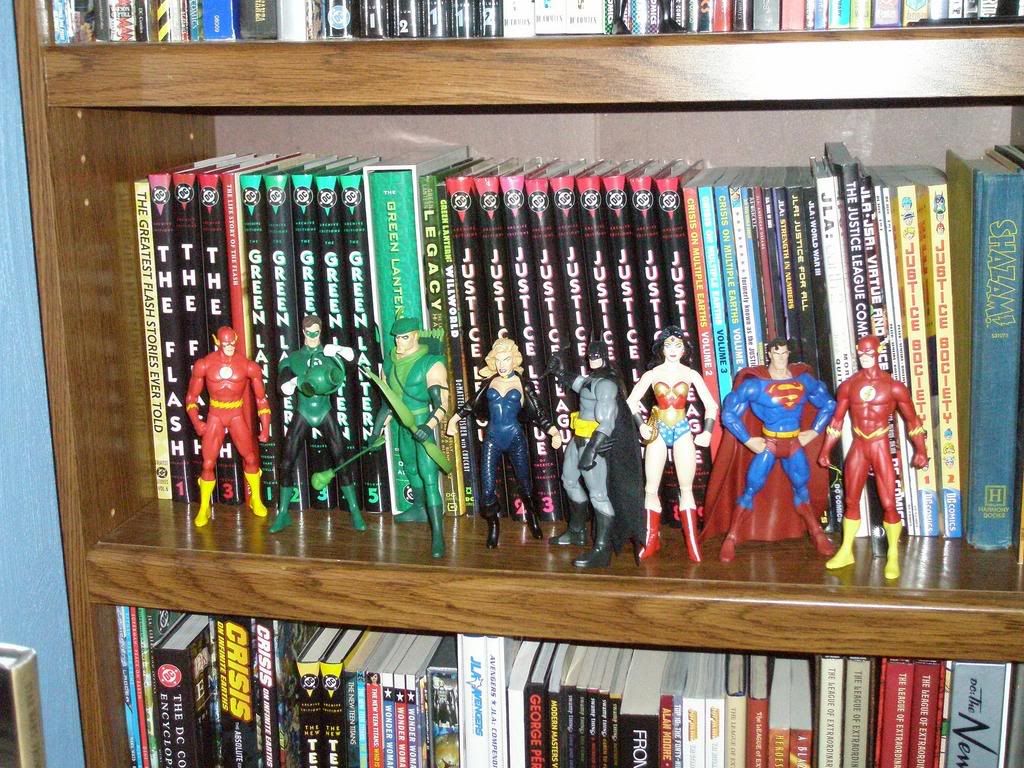
Everyone remember the Justice League bookshelf?


Wouldn't 'cha know, the Green Lantern figure has suffered a career-ending knee injury, and I'll be needing a new one.

However, thanks to the good folks at Mattel, I now have a choice. Do I replace the "Hard Traveling" Hal, thereby keeping that set of Hal/Ollie/Dinah intact; or do I go for the more articulated Mattel version? (If it makes a difference, I am planning to get a Mattel Aquaman as well at some point.) I don't think availability is an issue, since I got both Ollie and Dinah off teh Ebay.

Thanks!

[EDIT] P.S. If you have any preference for a particular John Stewart figure, I'd love to hear it. (The Guy and Kyle figures may have to wait until a future League expansion.)
Full Post

Friday, August 29, 2008

Friday Night Fights

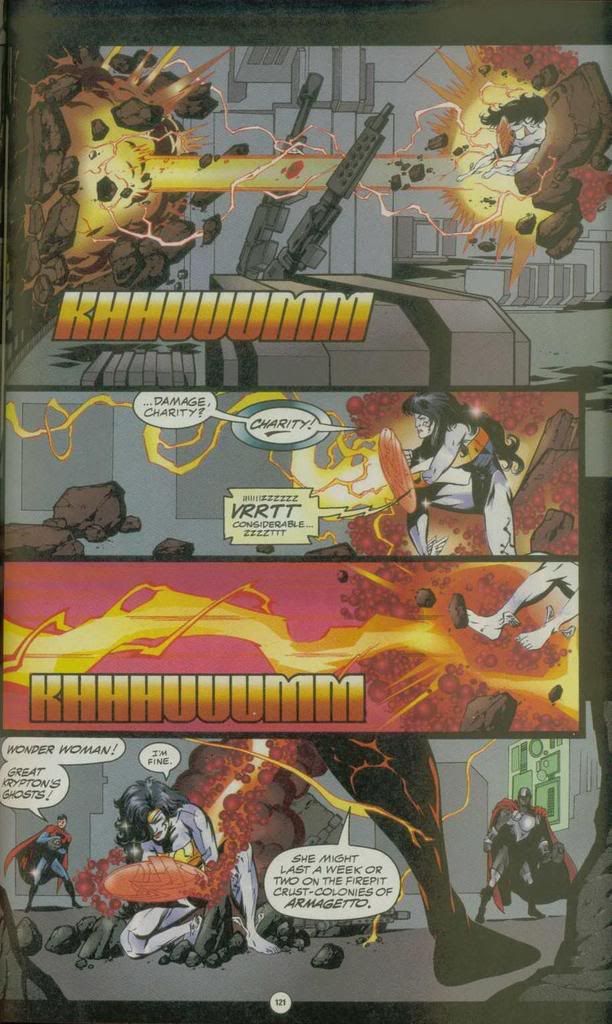
The Fourth World takes on the future as the 853rd Century's Justice Legion A invades the Justice League Watchtower!

In case you can't read the captions, Wonder Woman's bracelets are named Harmony and Charity. Harmony, Charity ...


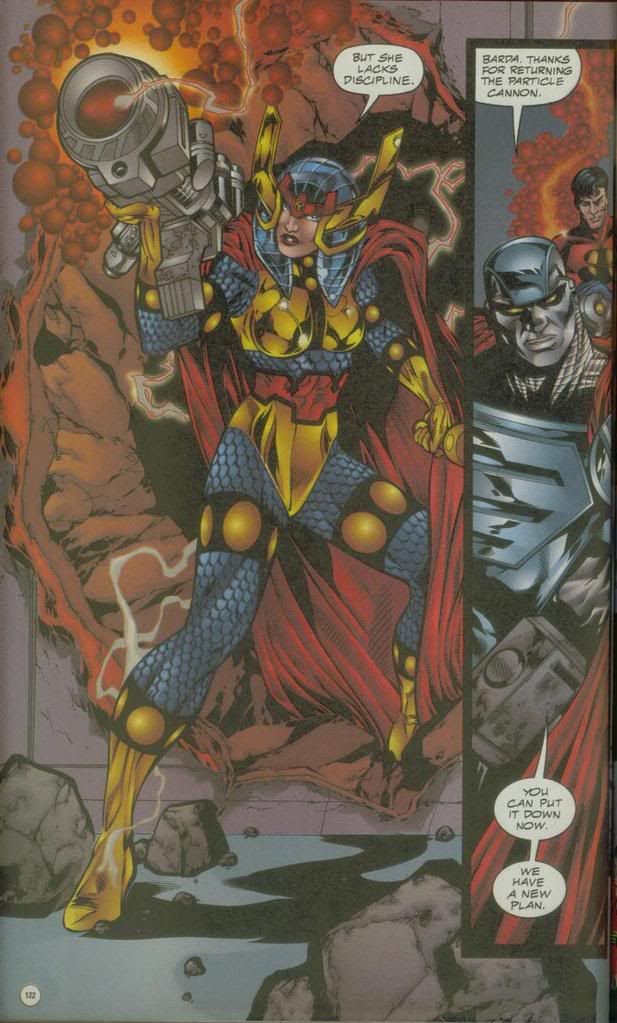
... meet Mega-Rod!


This isn't the only fight, of course; but by the time we check in with these combatants, it's pretty much over.


A particle cannon (with Kirby Dots (TM), even!) might seem like cheating, but hey -- it's not like Wonder Woman didn't know who she might run into, back in the mists of history....


It's always the right time for Bahlactus!

[From "Prisoners of the Twentieth Century" in JLA #1,000,000, November 85,271. Written by Grant Morrison, pencilled by Howard Porter, inked by John Dell, lettered by Ken Lopez, colored by Pat Garrahy.]
Full Post

Saturday, July 26, 2008

New comics 7/23/08

Apropos to the release today of the new X Files movie, let's start with The X Files vol. 2 #0, written by show writer/producer Frank Spotnitz and drawn by Brian Denham. It's a 22-page comic book which tells a self-contained story that -- as far as I know -- doesn't tie into the movie at all. Instead, it's chock fulla references to the show, including the "Post Modern Prometheus" episode and the "I made this!" sound bite. Most of its first page is a sequence of images pulled from the opening titles. In short, it seems to want most to say how great!, just great! it is to be back in the saddle.

And an old saddle it is, too -- this is an episode which could have taken place at any time after "PoMoPro" and before Mulder's abduction. I could try to pinpoint it from Scully's hairdo, but I don't have all my DVDs at the moment. The story won't be unfamiliar to fans of the series, since it involves kidnapping, body-hopping, and arrested aging. I wish I could say it was a more lively affair, but what would probably sound natural coming from the actors just comes across flat on the page. Maybe it's because there is little space for anything but the main plot -- very little humor, and nothing in the way of meaningful Mulder/Scully interaction. The plot itself is hard to keep straight, mostly since one of the main players is never seen.

The art, however, is fairly good, and it gets a big boost from Kelsey Shannon's coloring. Shannon keeps things moody for the most part, but occasionally enhances the wide-open spaces which helped convey the show's sense of isolation. (Clouds reflected on a car hood are a nice touch.) Denham does likenesses well, although at times his faces seem two-dimensional. Honestly, this issue reads like one of those 8-page stories TV Guide would advertise in some Special Collector's Issue. I read a good bit of Topps' X Files comic back when the show was in its heyday, so I know that translation need not be a problem. I want to believe (sorry) that this issue's done-in-one format contributed to my problems. This creative team is certainly worth watching, and I'll probably pick up X Files #1.

And as long as we're talking about licensed properties, Star Trek: New Frontier #5 (written by Peter David, drawn by Stephen Thompson) wraps up the current miniseries with an issue which does little to untangle any of its confusing bits. I might read it again, and if I ever decide to catch up on the prose NF offerings, I might find this miniseries more enjoyable. Wish I didn't have to have those conditions, though.

In a nice change of pace from wacky setting-based antics, The Spirit #19 offers three stories, each written by Sergio Aragones and Mark Evanier. They're all fairly pleasant. The first (drawn by Jason Armstrong) reveals how the Spirit dealt with a childhood bully; the second (pencilled by Aluir Amancio and inked by Terry Austin) finds the Spirit catching up to a reformed criminal; and the third (drawn by Paul Rivoche) is a whodunit about the murder of a comic-book artist. Again, it's not that they're done poorly -- far from it -- but nothing strikes me as especially innovative.

I hesitate to say that something like Batman: Gotham After Midnight (#3 written by Steve Niles and drawn by Kelley Jones) comes closer to what I expect from a Spirit book, but GAM does have a unique sense of design. This particular issue features a monstrous Clayface, engorged on the bodies of random Gothamites, and a very silly ending. It's a superhero comic book which isn't ashamed to be a superhero comic book. As part of that aforementioned silly ending, Clayface calls the screaming rabble "puny humans," and Batman commands him to "pick on someone [his] own size." If you don't mind that level of dialogue, and you like Kelley Jones, you'll like this book. In any event, it's better than the Millar/Hitch Fantastic Four.

Green Lantern Corps #26 (written by Peter Tomasi, pencilled by Patrick Gleason, inked by Drew Geraci) concludes the Black Mercy/Mongul storyline in a way that, were Alan Moore dead, might just get him spinning in his grave. I didn't mind it, but I'm a little more forgiving. Mongul suffers an ironic punishment, and Mother Mercy herself ... well, that's the part which I suspect would offend whatever's left in him that hasn't yet been offended by DC. Aah, I'm probably making too much of it. The issue was fine. Tomasi seems to fit better here than at Nightwing, and Gleason and Geraci are reliably good.

Penciller Renato Guedes, inker Wilson Magalhaes, and colorist Hi-Fi provide a nice Jack Kirby pastiche in Superman #678 (written by James Robinson). It fills in the background of Kirby's one-off character Atlas, revealing who brought him into the 21st Century, plus why and how. The rest of the issue continues the fight between Atlas and Superman, ending (much as #677 did) with the promise of more fighting. For his part, Robinson's omniscient narration gives Atlas' story a somewhat wistful tone, although Atlas doesn't seem entirely sympathetic. The present-day scenes are pretty good too -- Atlas is basically a big slab of muscle, drawn beefy and bulky so that he can stand believably against Superman. This is basic superhero stuff -- active figures against believable backgrounds -- but it's all done very well.

More action in Justice League of America #23 (written by Dwayne McDuffie, drawn by Ed Benes), as the JLA takes on Amazo. This time, though, Benes doesn't seem as concerned with his female figures, and the issue benefits as a result. Practically the whole thing is devoted to the fight, with a dozen or so Justice Leaguers each getting their licks in, but Benes keeps everything moving. There are a couple of awkward panels (one where Amazo holds a helpless Flash, one where perspective makes Wonder Woman look about 8 feet tall), but on the whole it was a good issue. McDuffie's script makes Amazo a credible threat and the Leaguers capable opponents.

It wasn't until about halfway through The Brave and the Bold #15 (written by Mark Waid, drawn by Scott Kolins) that I realized this issue's headliners (Nightwing and Hawkman) were intended to match up with last issue's (Deadman and Green Arrow). Nightwing and Deadman both come from the circus (Deadman's costume even inspired Nightwing's first one), and Green Arrow and Hawkman have a longstanding friendly rivalry. Anyway, this issue boils down to pushing the Reset Button, but first, Nightwing must trick every other superhero (including Ambush Bug!) into leaving the planet. Therefore, he and Hawkman (the designated expert on magic) have no backup as they storm the demon-possessed Nanda Parbat. Like JLA, it's well-choreographed action backed up by snappy dialogue.

And finally, if snappy dialogue is what you crave, look no farther than to Ambush Bug: Year None #1 (plotted and pencilled by Keith Giffen, scripted by Robert Loren Fleming, inked by Al Milgrom). Its sense of humor might not be for everyone. This particular issue mocks DC's alleged misogyny, with the Bug asking right off the bat "[d]o you have any major appliances that don't come with a dead body in it?" and the female salesperson replying "It's a standard feature." Indeed, throughout the issue female corpses are used as cannon fodder (which I think refers to something tasteless Bill Willingham said last year in San Diego). Anyway, ABYN's targets are many and varied, but modern storytelling techniques get hit pretty hard, especially narrative-caption boxes. Oh, how I laughed. This may be 2008's Architecture and Mortality; and if you remember how much I liked that story, that's pretty high praise.
Full Post

Monday, July 21, 2008

New comics 7/16/08

We begin with Birds Of Prey #120 (written by Tony Bedard, pencilled by Michael O'Hare, inked by John Floyd), the first issue in a lonnnnng time neither written by Gail Simone nor pencilled by Nicola Scott. However, it's also continued directly from #119, so I'm guessing that the departure of Scott and inker Doug Hazlewood wasn't going to come at a clean break.

Anyway, it focuses on Infinity, a character new to me who's basically invisible, immaterial, and electronically undetectable. While she sneaks into a bad guy's lab, Black Canary and Oracle have the awkward beginnings of a conversation about the death of BC's daughter. That's over pretty quickly, though, and the rest of the issue involves Infinity's escape and the surprise appearance of a Major Villain.

Since Bedard's been writing BOP for a few issues now, the big news this month is the art. O'Hara and Floyd's work reminds me of a more sedate Ed Benes -- scratchy lines, but no radical departures, and fairly functional. Fight choreography is fine (although there's a bit of a narrative gap -- no pun intended -- between pages 1 and 2) and expressions are decent. I'll stick with the book until this arc ends and evaluate the new creative team then.

The first few issues of Tangent: Superman's Reign were enjoyable, but tentative, steps establishing the parallel Earth and its stable of characters. With issue #5 (written by Dan Jurgens, pencilled by Jamal Igle, inked by Robin Riggs), the plot starts to lurch forward. The good guys' forces must retreat from Tangent-Powergirl, and Tangent-Superman gets more proactive with regard to his DC-Earth counterparts. There's not much technically wrong with the issue, although it's not clear what happens to Hal Jordan after the first few pages. Actually, one of this issue's highlights is the history of Tangent-Joker (written by Ron Marz, pencilled by Fernando Pasarin, inked by Matt Banning), augmented by playful poses of the character. Overall, still a fine Justice League story, and I hope it picks up steam.

The Flash #242 (written by Tom Peyer, drawn by Freddie Williams II) finds the Wests in Gorilla City looking for a cure for Iris' condition. I view the West twins with a mix of affection and cynicism: affection because I think they're good characters, cynicism over the fact that they could literally die whenever the story requires it. In other words, they're around for exactly as long as DC considers them viable, and if getting rid of them means a bump in sales, well....

Still, this is a my-kid's-gonna-die story, so its success depends upon whether Peyer and Williams can generate sympathy for a character who the audience has known for only a year. Call me a sap, but I got invested in Iris' well-being. Williams' expressive faces do much of the work, but Peyer's dialogue keeps Iris' mental age consistent even as her body grows older. Good work from all corners, and I'll be waiting for next issue's conclusion.

Captain America #40 (written by Ed Brubaker) features the return of artist Steve Epting for the big Cap vs. Cap fight (and Sharon vs. Sin on the undercard). Since it's pretty much 22 pages of combat, I don't feel bad about saying simply that it's nicely choreographed. It should go without saying by now that Captain America is a mighty fine superhero comic which inspires multiple readings from issue #1 forward, but some months I just get tired of typing all that.

And on that tired-of-typing note, I will once again record my weekly purchase of Trinity (#7), observing merely that it too was reliably good.

Full Post

Saturday, June 28, 2008

New comics 6/18/08

Catching up, yet again....

I'm a little torn about the format of Secret Invasion: Fantastic Four (#2 written by Roberto Aguirre-Sacasa, pencilled by Barry Kitson, inked by Mick Gray). On one hand I don't like crossovers disrupting a regular creative team's groove, especially if that team does Culturally Significant work. On the other, it's always nice to see how the regular creative team handles the shared-universe responsibilities. Besides, at some point I just want a singular creative voice.

Still, I know it's naive to wish that SI: FF were three issues of the regular book; and it's somewhat petty to say that it's better than Mark Millar and Bryan Hitch's work. For someone not reading Secret Invasion, and therefore not looking to reconcile the FF miniseries with the bigger picture, it's simply a story about Johnny fighting his Skrull ex-wife while Ben protects Franklin and Valeria from the horrors of the Negative Zone. Everyone involved has good handles on the characters. There's nothing wrong with it, but it's not Culturally Significant either. At times It can be pretty cute, though ("Yay, prison!").

Tangent: Superman's Reign #4 (written by Dan Jurgens, pencilled by Jamal Igle, inked by Robin Riggs) also falls in the "why isn't this in the main book?" category. It's basically a Justice League story, superficially very close to the JLA/JSA multiversal team-ups of yore. However, it's also something of a sequel to the "Tangent Comics" specials from ten years ago, so I guess that's why it gets its own maxiseries. It's been consistently entertaining, and this issue provides a little more insight into what Tangent-Superman sees as his benevolent dictatorship. Otherwise, more Justice Leaguers (Batman, GL/Hal Jordan, Black Canary, Black Lightning) join Flash and GL/John Stewart on Earth-Tangent, there's a stunning reversal, and we have our cliffhanger. The art is good -- I like Jamal Igle, and while Robin Riggs' inks are a little more loose than I'm used to seeing on Igle's work, he keeps the book from getting bogged down. Every time I read an issue I feel like I'm farther into the story than I actually am. On balance I suppose that's a compliment.

Via Annie, the Long-Suffering Girlfriend, RASL #2 (by Jeff Smith) offers a little more background on our hero and his dimension-hopping, and sets up the next bit of plot. The rest is tone and attitude -- Rasl likes the ladies, Annie has an holistic approach to parallel universes. The issue feels like it's about 8 pages long, not 32, but that's part of Smith's sparse approach. Still, there's enough in the issue (both implicit and explicit) that I didn't feel shortchanged, and I'll be waiting for #3.

Paul Smith returns as penciller of The Spirit (#18 written by Sergio Aragones and Mark Evanier and inked by Walden Wong), tackling a story which sends our hero to Egypt to deal with -- what else? -- mummies. This is getting to be the Adam West version of The Spirit, but that's not necessarily bad. Anyway, the ending is a bit predictable, so not quite as enjoyable as the other Aragones/Evanier done-in-one stories; and the art is good as always.

Wonder Girl and Speedy go on a date -- with danger!! -- in Teen Titans Year One #5 (written by Amy Wolfram, pencilled by Karl Kerschl, inked by Serge LaPointe), a thoroughly charming story which incorporates an old Titans villain, the Batmobile knock-off called the Arrow-Car, and a Green Arrow who's about as good a foster parent as you'd think. Of course the date goes wrong; of course Wonder Girl saves the day (the date's told mostly from her perspective, after all); but that's not the end of the story, and that ending sets the story apart. What's more, the art is a very nice blend of linework and painting which I'm guessing was run through some PhotoShop filter ... but technical details aside, it sets a dreamlike tone perfect for a first date. Really great work from Kerschl, LaPointe, and colorist John Rauch. I'll be very sorry to see this miniseries end.

Speaking of Green Arrow, here he is in The Brave and the Bold #14 (written by Mark Waid, drawn by Scott Kolins), essentially providing a body for Deadman to inhabit. Accordingly, this isn't so much a team-up as it is a takeover, but it's still a suspenseful Deadman story. See, Deadman needs to get back to his spiritual home of Nanda Parbat to free it from some evil presence, but along the way said presence keeps throwing mind-controlled pawns in his way. Waid and Kolins effectively evoke the spirit (so to speak) of paranoid thrillers like Invasion of the Body Snatchers; and while I didn't quite buy what the cliffhanger ending was selling, I can't complain about the execution.

The Flash #241 came out almost concurrent with the news that writer Tom Peyer and artist Freddie Williams II may well be leaving. That's too bad, because the current issue manages to use Gorilla Grodd, multiple Flashes, the Fourth-World-flavored bad guys behind the Dark Side Club, and Wally's ironic punishment (torture?) of Flash-killer Inertia, in a fairly cohesive story. It's a little too much to explain, but it all works. Both Peyer and Williams have found their grooves on the title, and Williams especially does good work with Wally's kids.

Birds Of Prey #119 (written by Tony Bedard, pencilled by Nicola Scott, inked by Doug Hazlewood) is, at first glance, a "moving-in" story about the Birds (don't call them that!) relocating to the Silicon Valley-esque town of Platinum Flats. However, in conjunction with Justice League of America #22 (written by Dwayne McDuffie, pencilled by Ed Benes, inked by Sandra Hope), it could be a lesson on How To Draw Super-Women.

On BOP, Nicola Scott draws a virtually all-female cast: the wheelchair-bound Oracle, the teenager Misfit, and the well-built Huntress, Lady Blackhawk, Manhunter, and Black Canary. Black Canary also appears in Justice League, along with Hawkgirl, Vixen, and Wonder Woman, and Zatanna. In the current issue of BOP, the women mostly do mundane things: talk, unpack, lift and tote boxes, etc. There are a couple of fight scenes, but more character interaction. Over in JLA, the women have some character scenes too -- especially Vixen and Black Canary. However, this reader was distracted by penciller Ed Benes' fascination with Vixen's dinners (her costume's zipper can't take the strain!) and Black Canary's rear. BC gets a Dramatic Reveal as a prelude to a fight in BOP, but Scott makes it heroic and not particularly sexualized. In JLA, though, when the same character delivers a bit of straight talk about the future of the Justice League, Benes gives her the beginnings of a wedgie and thrusts out her butt. What's weird is that Benes used to draw both BOP and Supergirl, and wasn't this blatant on either.

JLA has story problems too -- it focuses yet again on Red Tornado's Search For Humanity, a topic former writer Brad Meltzer pursued at his peril. I will say that if the Vision is currently out of commission, the comics world may be in desperate need of emotive androids, but it feels like this title has had maybe four different plots in almost two years. There's also some business about Red Arrow's relationship with Hawkgirl, and the aforementioned Vixen subplot, and I wonder whether those wouldn't also have come off better had they not been portrayed by Mr. Benes. His work is just too sketchy, scratchy, busy -- you get the idea -- and at this point it's become a distraction. McDuffie I still have faith in; but Benes needs to go.

Finally, I continue to like Trinity #3 (main story written by Kurt Busiek, pencilled by Mark Bagley, inked by Art Thibert). This issue brings in the Justice League and also (in the Fabian Nicieza/Mike Norton & Jerry Ordway second story) introduces Tarot, and it's a pretty decent, old-fashioned superhero story.
Full Post

Saturday, May 31, 2008

New comics 5/21/08

Yes, these are comics from ten days ago. Memorial Day Weekend was just too jam-packed, and I came out of it apparently itching to write a 2200-word dissertation on Crisis On Infinite Earths, the original JLA/JSA team-ups, and the problems with line-wide events.

Therefore, might as well begin with the lead-in to the latest LWE, Justice League of America #21 (written by Dwayne McDuffie, pencilled by Carlos Pacheco, inked by Jesus Merino). I really, really hope that this is the last crossover-affected issue of JLA for a while. It begins with a 9-page sequence of the "Trinity" sitting around a table talking about how they're not really running the League from behind the scenes. I thought the dialogue was good ("I had a run-in with Mr. Polka-Dot." "Is that a euphemism?"). However, although Pacheco kept the talking heads from getting too boring, he could have used a few flashback images. Overall, it assumes a little too much knowledge, even on the part of the longtime reader. I presume this will have repercussions in JLA itself, but I wouldn't be at all surprised if it showed up later in Trinity.

The bulk of the issue concerns the Human Flame, his fight with Red Arrow and Hawkgirl, and his recruitment by Libra. HF is a schmoe, that's for sure; but he's not the stereotypical lovable-loser supervillain schlub. McDuffie gives him a mean streak that undercuts whatever sympathy we might be starting to feel. Likewise, Pacheco doesn't play up any endearing parts of his dumpy appearance. Overall, this was a well-told story, but I still think it should have been in a Secret Files.

For those of you who know the dirty secret of cruise ships -- namely, that they give the surviving passengers hush money to cover up all the deaths -- the nautical nastiness depicted in The Spirit #17 (written by Mark Evanier and Sergio Aragones, pencilled by Aluir Amancio, inked by Terry Austin) will come as no surprise. This was yet another light-hearted, compact caper using Will Eisner's characters and designs; but one of the subplots seemed pretty obvious and the other only slightly less so. Also, from what little I've read of the original Spirit stories, I don't remember Ellen Dolan being such a self-absorbed Barbie doll. Amancio and Austin's work is more cartoony than Paul Smith or Mike Ploog, but it gets the job done.

According to the first page of Fantastic Four #557 (written by Mark Millar, pencilled by Bryan Hitch, inked by Paul Neary), I should have read Mighty Avengers #11 first. However, I don't know why; and I'm not eager to track down a 3-month-old issue to find out. Anyway, I did like how Reed and Sue celebrate their anniversary, but the rest of it is a bunch of exposition wrapped around a one-joke fight scene. I can kind-of accept "the Anti-Galactus," but things like Johnny's nympho supervillain girlfriend and the faux-drama about Reed being tempted just seem artificial. The snow effects look better this time, though.

Captain America #38 (written by Ed Brubaker, pencilled by Steve Epting, inked by Epting and Mike Perkins) (re)introduces what I presume is the last player in this particular arc, and sets him up against Bucky/Cap. It's hard to explain without giving everything away, but I'll try. Using a raid on an AIM base as its main sequence, the issue examines the relationships of mentors and proteges, and inspirations and successors; and observes that, for the three principals involved, those roles have shifted, if not outright reversed. It's a neat little chapter which probably sums up at least one of Brubaker's overriding themes, and while it might appear to be a simple action issue, there's a lot more going on.

For the second straight month, Tangent: Superman's Reign (#3 written by Dan Jurgens, pencilled by Jamal Igle, inked by Robin Riggs) focuses on the squad of Tangenteers trying to free the Tangent Atom. While that subplot achieves some closure, and the two worlds' characters actually come into conflict (as opposed to comparing notes), it still feels a little redundant. I like Igle's work fine, although Riggs' inks are looser than what Igle usually gets. It feels more like a Justice League story than what's been in JLA lately; and next issue I bet things will pick up.

The "Dark Side Club" banner started appearing on particular DC titles last week, and it looks like the kind of underground fight-club we've seen before. Specifically, Birds Of Prey #118 (written by Tony Bedard, pencilled by Nicola Scott, inked by Doug Hazlewood) opens with a fight involving Sparx, a D-list character whose abduction we see in the first issue of Final Crisis. So, you know, there's that crossover element we like so much. The rest of the issue involves Black Alice and Misfit fighting, again. This issue introduces a new aspect of their relationship which leads to a result I wasn't expecting. However, I wasn't expecting it because their relationship feels artificially manipulated to begin with, and the latest twist just seems like another manipulation. Scott and Hazlewood are good as always, with (I hate to say it) a grisly, shadowy death being a particular highlight.

The new issue of The Flash (#240, written by Tom Peyer, drawn by Freddie Williams II) also sports a "Dark Side Club" banner, but it's incidental to the main story of Wally and Jay vs. Grodd and Spin. I can't complain any more about Williams' chunky Flash, because he seems to have gotten through that phase. I also got a kick out of this issue's mind-control victims talking in Local-Newscast-ese -- it's funny 'cause it's true. The cliffhanger makes me wonder about the length of the current setup, though....

Finally, here's Jay Garrick again, teaming up with Batman in The Brave and the Bold #13 (written by Mark Waid, pencilled by Jerry Ordway, inked by Scott Koblish and Bob McLeod). They make a good team, because the easygoing Jay not only provides a good counterpoint to Batman's intensity, Batman respects him and so dials it back a few notches. The plot, involving an old Bat-villain, a mad scientist, killer robots, and Jay's chemist colleagues, may be more complicated than it needs to be, but it's probably necessary to get these two characters together. I daresay Ordway's more understated style is better-suited to this story's amiable nature than George Perez's would have been; and Waid provides good conversation amongst all the robot-smashing.

Look for the comics from Thursday (Happy Grant Morrison Day!) in the next couple of days.
Full Post

Friday, May 30, 2008

Friday Night Fights

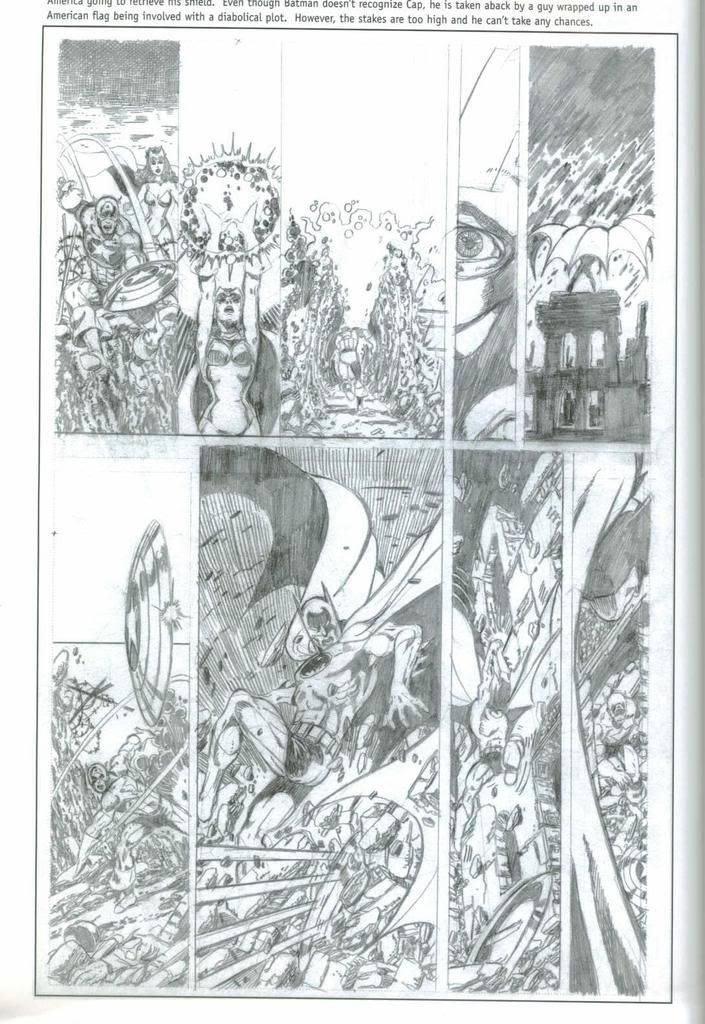
If a tree falls in the forest and no one is there to hear it, does it make a sound?


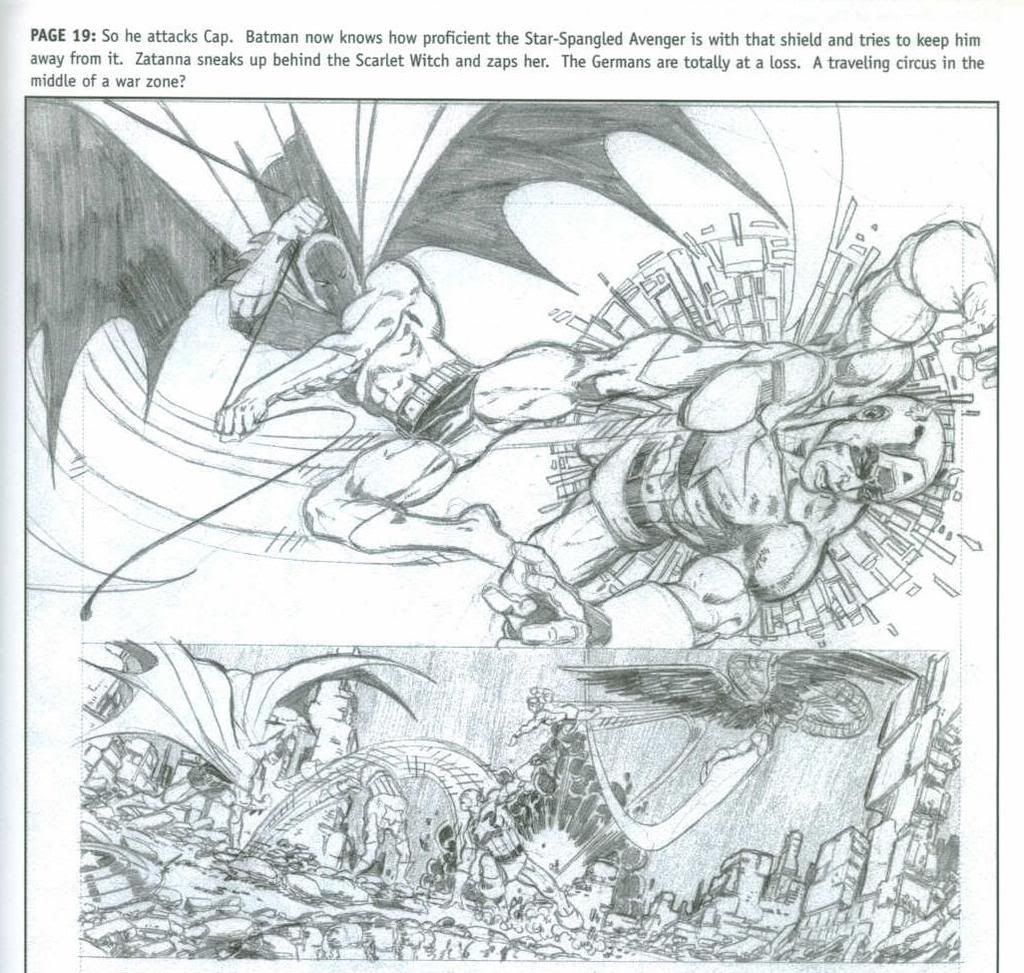
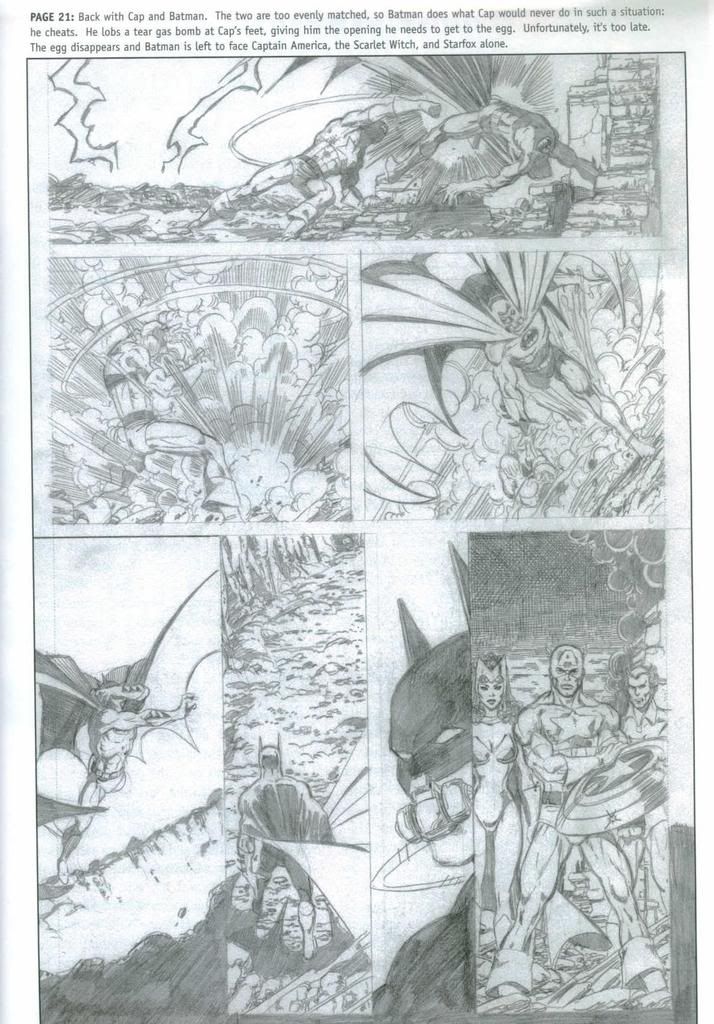
If an intercompany crossover gets scrapped after 21 pages are pencilled, do Batman and Captain America really fight?


Now, that's not entirely fair. After all, when JLA/Avengers was eventually published, it made the original 1983 plot one of the teams' "annual meetings." Therefore, from a certain point of view, it did happen.


It was in an alternate reality, of course ... but aren't they all?

Bahlactus has all the answers!

[From the unpublished first meeting of the Justice League of America and the Avengers, planned for publication in 1983. Plot by Gerry Conway and Roy Thomas, pencils by George Perez. Reprinted in Avengers/JLA Compendium, 2004.]
Full Post

Sunday, April 27, 2008

New comics 4/23/08

Well, Countdown ended on Wednesday, so I talked about it on Thursday. I thought it suffered from a lack of focus which, while understandable, was also avoidable.

Still, I did buy other comics, and here they are.

Star Trek: New Frontier #2 (written by Peter David, drawn by Stephen Thompson) brings in a couple more NF characters, just when I was starting to get used to the ones already in play. Essentially, everything's moving towards a confrontation with Jellico and the stolen timeship at New Thallon, but the waiting gives us time for some character interaction. Overall the issue was fine. Exposition was integrated pretty well into dialogue. (There are no narrative captions -- not even a Captain's Log -- in the entire issue, which is a little odd for a Trek comic.) A new Galaxy-class starship comes into the picture too, which is confusing for those of us expecting the only such ship to be the Excalibur. Anyway, the art is about the same as last issue -- rougher than I'm used to for a Trek comic, but true to the aesthetic. Three issues to go, and I have a feeling everything will happen in the last one.

It looks like Sergio Aragones and Mark Evanier put all their social commentary into the latest Groo miniseries and let themselves go wacky with The Spirit (#16 written by them and drawn by Paul Smith). Denny Colt is hardly as dense as Groo, but in this issue he errs -- in a well-meaning way, of course. The Spirit goes Hollywood to solve an on-set murder. While it looks play-fair at first, about halfway through it starts getting deliberately convoluted, so the reader is left to relax and let everything play out. Since that includes, among other things, a Carson Kressly parody and a stuntman gig (reminiscent of "bring in the double!" from that one Daffy Duck cartoon), the murder seems almost beside the point. With Paul Smith showing off his cartooning chops, the issue looks really good, but again, it's only Eisneresque on the surface.

Dwayne McDuffie devotes most of Justice League of America #20 (drawn by Ethan Van Sciver) to Wally West's struggle with rejoining the JLA. In its way, it's reminiscent of the "should I be a superhero?" angst which Wally went through 25 years ago, back in the New Teen Titans days -- only now, Wally has his own family, instead of worrying about his parents and girlfriend back home. Thus, Wally and Wonder Woman fight the Queen Bee while WW prods him to live up to his League responsibilities. I thought this issue was executed pretty well. McDuffie writes Wally and Diana well, and while Van Sciver's art is a little stiff, it's miles ahead of Ed Benes' sketchy, pose-heavy work. (The storytelling involving WW at the end is a little unclear, though.) I'd have liked more than two JLAers and a Black Lightning cameo in McDuffie's first crossover-free issue, but it sounds like he'll have time to do his own thing soon enough.

I don't know what happened to regular artists Tony Daniel and Jonathan Glapion, but fill-in penciller Ryan Benjamin and fill-in inker Saleem Crawford bring a bit too much '90s Image overthinking to Batman #675 (written, of course, by Grant Morrison). This issue is the bridge between the alternate-Batmen arc and next issue's "Batman R.I.P.," and it exists apparently to elevate Bruce's girlfriend Jezebel Jade to Silver St. Cloud status. It's the secret-identity dilemma of a familiar "Bruce is trapped in public" situation, only this time Bruce is somehow unable to find a good spot to change. Maybe it's the presence of a Ten-Eyed Assassin, the cult which was part of Bruce's epiphany during the Year of 52. Anyway, I don't have much of a problem with Morrison's script (which also includes scenes for Robin, Nightwing, and Talia), but the art is pretty distracting.

Sean McKeever's last issue of Birds Of Prey (#117, pencilled by Nicola Scott and inked by Doug Hazlewood) turns out to be his best. Misfit gets to show off without being annoying. The Platinum Flats supervillains are both believably low-rent and scary. Oracle makes good decisions. It's a good issue which tests our heroes but doesn't dwell on their troubles, and as always it's told well sequentially by Ms. Scott and Mr. Hazlewood. The bar has been set high for Tony Bedard.

Finally, I say goodbye to Checkmate, as writers Greg Rucka and Eric Trautmann turn in their last issue (#25, drawn by Joe Bennett and Jack Jadson). I can't say much about the plot without spoiling it, except that the Rooks take advantage of a truly scary and dangerous mind-link to do their thing as well as they do. Sasha gets a scene with Batman, Wonder Woman and Superman compliment Checkmate, and the final twist took me completely by surprise. Rucka and his co-writer(s) went out on top, and I think it's best to go out with 'em.
Full Post

Monday, April 21, 2008

New comics 4/16/08

Let's begin with Captain America #37 (written by Ed Brubaker, drawn by Steve Epting), an issue where everybody hassles Bucky and/or Tony Stark for the whole New Cap thing. Its tone is lighter than the book's been in a while, with Bucky commenting on everyone hassling him and a weird anachronistic dream sequence. After the relentless pace of the last few issues, though, it's a welcome change. There are also some nice moments involving the Falcon which I appreciated more in light of plok's advice on the '70s Steve Englehart run. My one complaint involves a certain ex-Avenger who shows up at Bucky's loft. I wouldn't have known who it was without his being identified in dialogue; and I know that's part of what dialogue does, but I see "burly blond guy" as drawn by Epting and I think Steve Rogers. Either him or Aquaman. In other words, he didn't look like ******* to me. Nitpicky, I know.

Bat Lash #5 (written by Sergio Aragones & Peter Brandvold, drawn by John Severin) finds Bat looking to settle affairs with Brubaker and Wilder, the story's main villains. Helping matters along are the rest of the town and Bat's Native American allies, all of whom want the bad guys dead. It's a darkly comic issue which doesn't zip along as quickly as it wants to. It's decent enough, I guess. It does set up what I presume will be the final showdown, which in turn should form the foundation of Bat's familiar personality. So, looking forward to next issue, because it needs to make up for the shortcomings of its predecessors.

Exposition balances action in Tangent: Superman's Reign #2 (written by Dan Jurgens, pencilled by Jamal Igle, inked by Robin Riggs), as the Tangent GL revives one of the Tangent Jokers for one last adventure. That has to wait, however, because the Joker needs to tell us about her death at Tangent Superman's hands. The other action sequence involves more Tangent heroes trying to free the Tangent Atom, and that's balanced against a scene with the Tangent Superman intimidating some sheiks. Tangent, Tangent, Tangent. Still, I'm surprised at how well the Tangent U. holds together, considering it started life as a series of one-shots. This continues to be one of Jurgens' better writing efforts, and I like Jamal Igle a lot already.

Superman #675 (pencilled by Renato Guedes and Jorge Correa Jr., inked by Jose Wilson Magalhaes and Correa) is Kurt Busiek's last issue as writer before he moves over to the weekly Trinity starting in June. Accordingly, he can go out on a story where Superman fights Daxamite priests (I thought they were pacifists), the power-duplicating Paragon, and the new Galactic Golem. Busiek has done a great job recreating the feel of a Superman comic from the 1970s, when the conflicts came from disruptions to the character's semi-formal routines. Here, Busiek has been building those routines, so the normal super-fights tend to come across like days at the office. This particular arc has been a little more shaggy than some, but it still holds together well, even in the parts describing the Golem and how to defeat it. The art is good -- Guedes' work is very similar to what I'd call the thin-lined, "open" style of Pete Woods, who started with Busiek two years ago. Superman is big but not bulky or overmuscled, and everybody moves well. Correa picks up the spare without being too noticeably different, so god work all around.

I liked The Flash #239 (written by Tom Peyer, drawn by Freddie Williams II) more than I did Peyer's first issue, and that's mostly due to the rationalization of Wally's behavior. An increasingly cranky Jay Garrick gets a lot of attention this time out, which leaves Wally free to act more like the Wally we know. He does get a pretty good gig this issue, but doesn't get a chance to enjoy it. Peyer's script is effective at portraying the tide of public opinion turning against Wally. While a lot of that might be mind control, Peyer gives it enough nuance that we're never quite sure. I also liked Williams' art throughout this issue, which I think is a first. He's finally getting a good feel for Wally's figure and his movement. (Hey, it took me a while to come around to Pat Gleason too.)

The Brave and the Bold #12 (written by Mark Waid, pencilled by Jerry Ordway, inked by Bob Wiacek) finishes the "Megistus" storyline with a plethora of characters including Superman, the Challengers, Green Lantern, and Metamorpho. However, the star turns out to be Challenger June, who apparently has some inferiority issues over not "living on borrowed time" like the original Challs. Why she has these issues after forty-odd years with the group is never quite explained, but not being a COTU scholar I'll defer to Waid on that one. The script is a little more clunky than is usual for this book, probably due to the number of characters and the wonky element-transmuting mechanics of the plot. Ordway does well with it, though; and he delivers customarily solid work here. Although there's a clever nod to Final Crisis, here's hoping that this book continues to be the tonic for the constant-crossover mentality.

... And speaking of which, the penultimate issue of Countdown (#2 written by Paul Dini and Sean McKeever, story consultant Keith Giffen, drawn by Scott Kolins) starts with Giant Turtle-Boy Jimmy and ends with what looks like the series' most obvious setup for Final Crisis. (That is, before DC decided that this series wouldn't really lead into FC quite so much.) It's pretty straightforward stuff -- two interconnected fights bridged by some Atom heroics, portrayed well by Kolins and colorist Tom Chu. (I'm guessing Giffen might have contributed to the breakdowns, but I don't know for sure). Let's put it this way -- this issue made me think Kolins would be a good fit for a Hulk series. It didn't redeem all of Countdown, and I doubt there'll be much in this week's final issue to do that, but on its own it was a good fight.
Full Post

Sunday, March 30, 2008

New comics 3/19/08

Thanks to Easter last weekend and the Siegel ruling this week, it's time to play catch-up. Here are last week's books.

Let's start with Captain America #36 (written by Ed Brubaker, pencilled by Butch Guice, inked by Mike Perkins), a mostly-action issue which eventually finds our hero failing to fill his mentor's inspirational role. It's a moment I'd been anticipating for a couple of issues -- except for the heckling, naturally -- and it speaks to the power of that costume. James B. Barnes looks like Captain America, fights like Captain America (if a little dirtier), and carries Cap's shield. As far as the "living symbol" stuff goes, though, the people aren't convinced. On the action side of the equation, the extended fight scene which takes up the first part of the issue is exciting enough. However, its capper -- Cap being thrown through a window, landing on a hovercar, and blowing away his attacker -- ends up a little static. Maybe some speed lines would have helped me, or maybe devoting just one panel to the fall drained some of the suspense. Overall, though, a consistently satisfying title.

It was a weird issue of Birds Of Prey (#116 written by Sean McKeever, pencilled by Nicola Scott, inked by Doug Hazlewood). I didn't think Black Alice was supposed to be that ... well, mean; and there was a very unsettling vibe running through the Lady Blackhawk/Killer Shark/Huntress scenes. I never expected to see Huntress in a damsel-in-distress situation in this title, that's for sure. Oh well, at least Scott & Hazlewood aren't going anywhere, right?

Like the cover blurb, I'm hesitant to call The Brave and the Bold #11 (written by Mark Waid, pencilled by Jerry Ordway, inked by Bob Wiacek) a "team-up." Instead, it trades mostly on a reversed Superman setup to amusing effect. Ordway fits Superman like a glove, not surprisingly. I think I even saw some of his old Daily Planet staffers (especially "Whit") in the background. I'm sure he'll do fine on the rest of the DC characters, but this issue was a perfect way to kick off his tenure.

Not so successful, unfortunately, was Superman/Batman Annual #2 (written by Joe Kelly, drawn by Scott Kolins), a reworking of a World's Finest two-parter from 1968. A mystical bad guy takes away Superman's powers and renders Batman helpless, and it's only through feeling good about themselves that they get their mojoes back. Really, I might have liked this issue more if not for the extraordinarily dark color work of Jorge Molina. Everything seems to occur against an indigo backdrop, and when you're talking about the black-robed villain, the deep blues, grays, and blacks of our heroes' costumes, and even the muted red and yellow of Robin's costume, it's like reading through sunglasses. Kelly's script doesn't help, since it neither sets up nor resolves the central problem (Superman's loss) with adequate explanation. I like these retro-style stories, obviously, but here things just didn't work out.

Serenity: Better Days #1 (written by Joss Whedon and Brett Matthews, drawn by Will Conrad) kicks off the second Dark Horse miniseries featuring the crew of everyone's favorite Firefly-class freighter, and the good news is, it reads like a pretty decent episode of the TV show. The bad news is, it took me a few passes to figure out how the big action sequence at the beginning was concluded. This was apparently not my week for action sequences. Art is fine; everyone looks about like you'd expect, with only a panel or two where Inara might be mistaken for River, or vice versa. Dialogue is typical for a Whedon-run production, although not too satisfied with itself. Better on subsequent readings, which helps justify me, y'know, buying it.

Unfortunately, I don't know that I can buy (see what I did there?) the central premise of The Flash #238 (drawn by Freddie Williams II), the first issue for new ongoing writer Tom Peyer. It's the old "Wally needs a job" plot, explored by Bill Messner-Loebs several years ago, but still. This time it's augmented by the "Wally openly admits he'd feel better getting paid" subplot; and again, I thoguht we'd settled this. When Wally's Flash identity was public knowledge, somebody (Messner-Loebs, I think) said he got trust-fund income from a charitable foundation set up in Barry Allen's name. When Geoff Johns restored his secret identity, he got a job as an auto mechanic. I guess that's gone away in the flurry of a) being thought dead and b) living on another planet for around a year. Anyway, the central question is, do Peyer and Williams sell this new development? Does the issue work? By those criteria, yeah; I guess so. The new money concerns are exacerbated by a new mind-controlling supervillain. I'm still not entirely sure Williams is a good fit for the Flash -- he's better on Wally's physique, but some of his expressions seem off. Peyer I like a lot, so I'll give him some time to convince me.

I probably should have figured out that Justice League of America #19 (written by Alan Burnett, pencilled by Ed Benes, inked by Sandra Hope, Mariah Benes, and Ruy Jose) wouldn't really cross over with the Salvation Run miniseries. Therefore, I should give it some credit for the misdirection, and some more for bringing back a classic JLA villain as the real menace. That's about it, though. For a one-and-out issue (which this is, essentially, despite its two issues' worth of lead-in), said villain gets defeated much too quickly, because there's too much time spent on Earth arguing over the civil rights issues of exiling supervillains. At least these crossover issues are coming to an end.

Ah, but speaking of which, here's Tangent: Superman's Reign #1 (written by Dan Jurgens, pencilled by Matthew Clark, inked by Jesse Delperdang), the story I almost wish was in JLA instead of its own miniseries. Basically, the Flash and Green Lantern travel to a parallel Earth quite different from their own, where they meet a Flash and Green Lantern who are the same in name only. The issue also introduces an all-new Mirror Master, well-suited for DC's multiverse, and has a nice "Deep Space Nine" reference. The plot isn't anything innovative -- Tangent's Superman is now the absolute ruler of his Earth, and I presume our heroes will spend the next 11 issues trying to overthrow him. However, it's nice to see a multiversal crossover where the only similarities are the names, and even the archetypes are different. Clark's figures are a little too splashy at times, but overall the issue flows well. I also can't fault Jurgens' dialogue, and believe me that's not something I say every day.

Clark used to draw Adventures of Superman from the scripts of one Greg Rucka, who continues the tour-de-force wrap-up of his run on Checkmate (#25 co-written by Eric Trautmann, pencilled by Joe Bennett and inked by Jack Jadson) with an extended guest appearance by the Man of Steel and certain other high-profile superheroes. It's been a change of pace for the title, but it gets no complaints from me. This arc not only answers the "why don't they get Superman to do it?" complaint, it draws some pretty clear lines between the world of bright spandex and the world of Checkmate. Bennett and Jadson are a little more suited for the superhero side of things, but that's a stylistic nitpick. They're good storytellers, and they keep a number of balls in the air. The only good thing about the end of this team's run is the fact that I won't feel bad about not following their replacements.

Finally, Countdown #6 (written by Paul Dini and Adam Beechen, story consultant Keith Giffen, pencilled by Mike Norton, inked by Jimmy Palmiotti) kicks off the End Of The World ... or, more precisely, the "Great Disaster" which will lay the foundation for Kamandi's Earth. It has the same doomsday appeal as the apocalyptic flashbacks in post-apocalyptic movies, only this time with people turning into animals and vice versa. Mike Norton's pencils are a little too clean, simple, and just plain pleasant for this sort of descent, although Beechen's script chooses wisely to have survivor Buddy Blank narrate it. For once, I approve of first-person narration! We know how this ends, though: the boat sinks. The question is whether Leo DiCaprio dies. For that, tune in next time....
Full Post

Monday, March 17, 2008

New comics 3/5/08 and 3/12/08

I've got a lot of these to go through, so I'll try to keep it short.

3/5/08

Justice League: The New Frontier Special #1: Very nice all around. I probably didn't need to see how another Batman/Superman fight would play out, but it's justified as a "lost chapter" of NF. The Robin/Kid Flash and Wonder Woman/Black Canary stories are cute, the period ephemera is well-done, and the behind-the-scenes look at the DVD adaptation is pure eye candy.

Teen Titans Year One #3: Was a little surprised at the pacing of the overall miniseries, as depicted in this issue; but better earlier than later, I guess. Besides, the story's new direction looks intriguing. It's been good so far, so I'm in for the rest.

Supergirl #27: It's an understatement to say that this book hasn't been what I expected. If you remember the Steven T. Seagle/Scott McDaniel run on Superman a few years back, it's kinda like that, except on downers. I'm pretty much buying this book to see if it all makes sense. Plus, I like Drew Johnson and this issue's guest (fill-in?) artist, Rick Leonardi. S'girl isn't frustratingly bad like, say, early Hawkgirl or late Gotham Knights. It's just frustrating.

Countdown To Adventure #7: I read this book for the Adam Strange/Animal Man/Starfire story. I have no idea what's going on with the Forerunner story.

Nightwing #143: I like the fact that writer Peter Tomasi isn't afraid to plug Nightwing firmly into the center of DC's superhero culture. It can get a little precious, and sometimes -- not so much in this issue, but certainly in the last one -- it distracts from the main plot. This issue was fine, but I bet if it were your first DC comic in a while, you'd be mystified.

Detective Comics #842: Batman must deal with an EVIL! suit of armor that he ended up wearing in the Ra's Al Ghul storyline from a couple months back. You know Spider-Man's black costume? Like that, except Batman doesn't destroy it, it doesn't make him dance like a poser, and (so far) it hasn't come to life. I'm not sure why the world needed this story.

Green Lantern #28: The "Lost Lantern's" trial results in the creation of a Red Lantern. Hal has a Clarice Starling moment with Sinestro. We check in with the demons on Ysmault. The Guardians issue a radical new law. I can see how it all fits together, but I know the dots won't be connected for about another year.

Countdown #8: Yay, Ray Palmer's back as the Atom! Yay, Firestorm is back (although whither Martin Stein?)! Yay, Habitat, the Hairies, and the rest of Jack Kirby's Jimmy Olsen creations! Boo, all the bickering and running around pointlessly.

3/12/08

JLA Classified #54: Will probably read better in the trade. Since this is the last installment of the Titus storyline, the "past" narrative takes up the top half of each page, and the "present" gets the bottom half. Sometimes that trick works, sometimes not. Here, it might've been better to split the pages vertically. As for the story, Titus beats the tar out of the League for as long as is dramatically appropriate. The ends on an ecumenical note, which is always nice, but a bit treacly for the Justice League. Overall, though, pretty good.

Batman Confidential #14: Part 2 of a new look at a one-off villain from the '80s, The Wrath. As a modern-style story with an out-of-date setting, it's not exactly a nostalgia-fest. However, I give it points for picking a time period other than "Year One." Otherwise, I'm not sure what the general appeal would be.

The Last Defenders #1: The Defenders are famous as Marvel's "non-team." This book goes a step further, taking pains to point out how its characters are nowhere near as cool as the original Defenders. It's a weird little exercise in obstinance wrapped in a story about white supremacists and big snake-monsters. I'll probably stick with it.

Fantastic Four #555: Boring. Bryan Hitch and Paul Neary are fine craftsmen, but there's still no life in an issue which features an illicit tryst, a duplicate Earth, and a giant killer robot. It's all hat and no cattle.

Superman Confidential #13: Part two of the Toyman/Jimmy Olsen story is okay, and I like Phil Hester and Ande Parks' art, but it feels a bit padded and lethargic. Probably could have used some pruning.

Star Wars: Rebellion #12: Part two of yet another "infiltrate an Imperial base" story that just kinda sits there. Colin Wilson's art reminds me of early Howard Chaykin, and his Luke doesn't look much like Mark Hamill either.

Bat Lash #4: The big apocalyptic issue which sets up the climax. This miniseries has been decent, but it's hard to reconcile all the blood and death with the happy-go-lucky tone which got me interested in the character. (Lots of cattle, but I thought the hat would be different, in other words.) Maybe Sergio Aragones can do it. We'll see.

Countdown To Mystery #4: I continue to like the Doctor Fate story as it plays with the (pretty much inevitable) conclusion that has Kent Nelson become the latest Doctor F. This installment includes the most traditional superhero action we've seen since early on, but the pieces still haven't fallen into place. Most origin stories seem to place the origin alongside another threat, in order to give the new hero something to do in the third act. This one is all about the origin process itself, with Inza's comic-book ventures serving as metacommentary. Makes me miss Steve Gerber that much more. P.S. This book also contains an Eclipso story which is once again threatening to meander.

Booster Gold #7: It's The OMAC Project, Take Two, as we see how Max Lord took over the world once Booster saved Beetle from an (untimely?) death. (By the way, I've just started the second season of "Star Trek Voyager," and Tom and Harry are reminding me a lot of Beetle and Booster.) More subplots converge alongside more trips into DC's nostalgia mine, so for me, pretty good.

Superman #674: New artist Renato Guedes brings a nice "bigness" to the proceedings. Outgoing writer Kurt Busiek brings back an old JLA villain (from just before the Detroit days) to threaten Superman. Meanwhile, Supes has problems with Mon-El and the Kents have a new apartment. It's a full issue which doesn't feel overstuffed.

Wonder Woman #18: Guest artist Bernard Chang helps Gail Simone send WW into space, in what looks like an oblique sequel to the "Space Pirate" storyline from the early '90s. Basically, she's challenged by the Khunds (who act like Klingons) to stop an unstoppable race which threatens Khundia. Also, she gets pre-engaged to Tom Tresser, and Etta Candy shows up too. Chang makes WW look like someone familiar, but I can't think of who. His art is a lot less porntastic than I feared it would be.

Countdown #7: Yet another parallel world, 90% close to the familiar DC-Earth. Another Tom Derenick-pencilled issue too. I swear, this series would be twice as good if it were half as long.

Green Arrow and Black Canary #6: This issue seemed so indebted to "Alias" (the TV show, not the comic book) that I'm starting to think Connor Hawke is the Michael Vaughn designated-victim figure. Remember when Vaughn drowned at the end of Season One, or when he got shot like Bonnie & Clyde at the beginning of Season Five? My money is therefore on Connor to pull through.

Green Lantern Corps #22: Part two of the Boodikka/Alpha Lantern storyline seems pretty forgettable, although it'll probably look a lot more important in 2009. Today, though, I'm tempted to think that all the procedural GLC stuff would fit better in this book than in Green Lantern, with the Boodikka story as a backup.
Full Post

Thursday, February 28, 2008

New comics 2/27/08

I think I understand what's going on in the current Batman storyline, and that scares me a little. However, issue #674 (written by Grant Morrison, pencilled by Tony Daniel, inked by Sandu Florea) was -- Bat-Mite channeling Hot Cylon No. 6 notwithstanding -- a great example of Morrison's take on the character.

Morrison writes a really entertaining Batman. He's super-capable without letting it go to his head. His inner monologue this issue, about how he spends all his time thinking of impossible scenarios and how to get out of them, captures the very heart of the character -- not just hitting the "Batman is a jerk" days of the '90s, but the Bat-Shark-Repellent camp era, the wacky '50s, and even back to 1939. In the seminal two-issue "Batman Vs. Werewolves and Vampires" storyline, adapted most recently by Matt Wagner in Batman and the Mad Monk, Batman's got the tools ready to make silver bullets. Silver bullets! "Always has a plan," indeed.

Anyway, Batman #674 tells the chilling story of the three alternate Batmen, and it too is an homage to "The Secret Star," a story from almost 600 issues prior (1953's issue #77). Everybody's trying to figure out what makes Batman tick, and Morrison evidently sees turning over all the old, forgotten stories as one of the best ways to do this. It's a well-executed high concept, and heck, it makes sense to me. Of course, I've got my trusty Batman Encyclopedia handy....

What else--? Daniel and Florea turn in a pretty good job. There are so many Batmen flying around that it can get a little confusing (look to the utility belts, for example), and their work is solid but not exceptional. They remind me of a cross between Dick Giordano and Andy Kubert. Also, for all the praise I've laid on Morrison's Batman, I have to point out that his Commissioner Gordon, and in fact the other Gotham cops, don't sound quite right. The cops sound very "Morrisonian," if that makes sense; and Morrison hasn't given Morrison the gruff edge we've grown accustomed to.

Next up is Rasl #1, by Jeff Smith. It's the story of a youngish (indeterminate-20s, probably) thief who can travel to alternate universes and who leaves the word "RASL" spray-painted as his calling card. This introductory issue has two tracks, the first with our anti-hero in disarray, wandering through a desert, and the second with him fleeing from his antagonists who've finally figured out how to track him. It's a lot of style and attitude, and it may read better collected, but it's designed to plant enough hooks to keep periodical readers coming back. Worked for me.

All-Star Batman & Robin #9 (written by Frank Miller, pencilled by Jim Lee, inked by Scott Williams) is a strange, almost disjointed issue that spends its first half taunting Green Lantern like he's Elmer Fudd, and its second getting the Dynamic Duo to collapse in the pathos of their collective grief. It's certainly the most idiosyncratic take on Batman and Robin I've seen in a while, it makes them a formidable pair, and I'd like it a little better if it weren't done at the expense of just about everyone else in the book. That said, I thought the book did a credible job of switching moods, and the new one is certainly different enough to hold my interest.

The "Terror Titans" storyline begins in earnest in Teen Titans #56 (written by Sean McKeever, pencilled by Eddy Barrows, inked by Jimmy Palmiotti and Julio Ferreira), and so far I'm getting a "Judas Contract" vibe off of it. This issue finds Kid Devil generally screwing up, and thus leaving himself open to being co-opted. I kinda figured out the plot shortly after KD's party got underway, but I thought the ending left some options open for him, character-wise, so overall I liked the issue. It fostered the right sense of dread that these kinds of storylines need. The art was, quite frankly, better than I have seen from Barrows, but some of that probably came from Palmiotti's inks and Rod Reis's colors.

It's not that I don't like the Legion arc in Action Comics (#862 written by Geoff Johns, pencilled by Gary Frank, inked by Jon Sibal), but it does feel like it's gone on about an issue too long. This issue particularly seems concerned with spotlighting more Legionnaires, which is nice, but I'd also liked to have seen more movement towards re-yellowing Earth's Sun and restoring Superman's powers.

There's a neat visual gag in the middle of JLA Classified #53 (written by Roger Stern, pencilled by John Byrne, inked by Mark Farmer), but it requires advanced geek knowledge (or does that go without saying?). See, this story apparently takes place in the days when Black Canary, and not Wonder Woman, was the League's pre-eminent female member. Furthermore, back then BC wore a blonde wig over her black hair. Therefore, when foe du jour Titus decides he's had enough of thoroughly pwning the League, and offers instead to make them part of his "pantheon," he dresses Black Canary in a very WW-inspired costume, and gets rid of her wig, so that she looks a lot like Wonder Woman. That's the most clever thing about the issue, which otherwise finds the League utterly bumfuzzled about how to stop this guy. As with the Action arc, next issue's the big finish, so I'm hoping it will elevate the story as a whole.

Speaking of endings, Crime Bible #5 (written by Greg Rucka, pencilled by Manuel Garcia, inked by Garcia and Jimmy Palmiotti) finds the Question fighting the leader of the Cain sect for what he claims is leadership of said sect. Thus, the issue is an extended fight scene, which comes off fairly well -- Garcia and Palmiotti are fine storytellers, and the action isn't hard to follow. The problem is the ending, which leaves (you'll forgive me) a big question hanging. Ironically, part of the Question's dialogue during the fight references the end of Renee's previous series, Gotham Central, which went out on an ambiguous note so that it could lead into her transformation into the Question. Now Crime Bible seems to be doing the same thing. We kinda know how it should end, but it'd be nice if our suspicions were confirmed.

Lots of death and exploding in Countdown #9 (written by Paul Dini and Justin Gray & Jimmy Palmiotti, story consultant Keith Giffen, pencilled by Tom Derenick, inked by Wayne Faucher). Derenick and Faucher portray this pretty well, albeit in a sort of DC-house-standard way. For an issue that concerns a bunch of superheroes trying to reunite with colleagues and get the heck off Apokolips, it's about as good as you'd think. A couple of old friends return, the cliffhangers are good, and who knew the Pied Piper had it in him?

Finally, Captain America #35 (written by Ed Brubaker, pencilled by Jackson Guice, inked by Guice and Mike Perkins) wasn't quite as good as last issue. The new Cap fights rioters, and especially those causing them to riot, in Washington, D.C. Given the character's symbolic nature, I was expecting the riot to contain an inspirational moment -- a "Look! Up in the sky!" moment, if you will -- but I guess that would have been something of a cheat, and not quite within Brubaker's downbeat tone. Perkins' inks do a lot to connect this issue visually to regular penciller Steve Epting's work, but Guice's storytelling is just as good. There's also a fair amount of plot, and Brubaker uses a good bit of the book's large cast. It's a middle-act issue which has me excited for the conclusion.

Full Post