Wednesday, January 04, 2006

2005 In Review, Part 4: We've Avoided It Long Enough

It hasn't been easy to sort through my feelings about the mega-story which has been running through the DC superhero books since the summer of 2004. I did feel baited-and-switched at the end of Identity Crisis, since I had supposed it to be a self-contained story, not the spark of a longer fuse. What's more, this is a 2005-in-review essay, and the actual Infinite Crisis miniseries still isn't at its halfway point.

Therefore, by way of concluding my look back at last year, let's focus on the five summer miniseries which set up the event, and the series affected most by it.

Greg Rucka's two ongoing series, The Adventures of Superman and Wonder Woman, started the year with their own storylines, but soon became wholly-owned subsidiaries of Infinite Crisis. I thought WW was the better series, because I was never quite sure Rucka really had the same kind of handle on Superman. Not that Rucka didn't have his moments on Adventures, most notably the last Mr. Mxyzptlk story; but for a while his Wonder Woman was really firing on all cylinders, on par with the best of his superhero work.

That makes WW's surrender to Infinite Crisis and its machinations all the more puzzling. Judging by the most recent installments, Diana will close out her first 19-year post-Crisis series having failed utterly at her mission to enlighten Patriarch's World through Amazon philosophy. Regardless of whether this will usher in a new era of fantastic Amazonian adventure in 2006, it's still a depressing way to end a tenure, and a series, which made the most out of the character's potential.

Another post-Crisis book being ushered out by Infinite Crisis is Superman, although it's the 19-year-old book, not the 66-year-old one now set to regain its original title. After finishing up Brian Azzarello and Jim Lee's inconsistent "For Tomorrow," Mark Verheiden and Ed Benes took over in order to tell a series of stories about people becoming paranoid of Superman. While not a direct tie-in to Infinite Crisis at first, its connection grew stronger until it too was subsumed into the larger story. Thus, two out of the three (or four, counting Superman/Batman) Superman titles spent most of 2005 complementing Infinite Crisis, which made for an unrelentingliy dark take on the character.

JLA was the last of the regular series I read which tied into Infinite Crisis, and it was the most consistently entertaining. The year started with the unrelated Kurt Busiek/Ron Garney "Syndicate Rules," which recalled Busiek's glory days on Avengers and contained a few clever mirror-Earth moments to boot. However, even the knowledge that Infinite Crisis elements were upcoming was enough to taint what might otherwise have been meant as moments of genuine character interaction and/or drama. Now those moments were "oh no, they're starting to fight and The League Will Never Be The Same!" Surprisingly, though, when "Crisis of Conscience" began, it turned out to be a good Justice League story for the most part, even if it did end with some awkward setup for Infinite Crisis and the book's final arc. Now, the current "World Without A Justice League" is just marking time until the end. It consists of unremarkable arguments, strung together by a slow-moving Key plot, and it is probably interesting only to longtime fans who at last get to see Satellite-era Leaguers interacting on a case again.

DC Special: The Return Of Donna Troy wasn't billed as an Infinite Crisis lead-in, but her multiple-choice history made her a good choice to realize that the Multiverse wasn't quite forgotten. Beyond that, it was an adequate New Titans story which made more sense if one had just read Wolfman and Perez's "Who Is Wonder Girl?" from The New Titans #s 50-54. I read those issues in 1988-89 when they first came out, but I was glad of the paperback reprinting them this summer.

Now for the main events. I have written already about the bulk of The OMAC Project, Villains United, The Rann-Thanagar War, and Day of Vengeance. (I also did a "2/3 mark" essay back in October.) Villains United turned out to be the best of the four, followed by OMAC, Rann-Thanagar, and DoV. I initially resisted buying Day of Vengeance, and I still think it was the weakest of the three for its treatment of the Spectre. True, the Spectre has been set up for the past several years as an instrumentality of God, which necessarily makes him a tough character to make interesting, but "horny" is still a very hard choice to justify.

Thankfully, Infinite Crisis itself has been pretty good. The lead-in miniseries do seem to have helped streamline InfC's plot, leaving room for Geoff Johns and Phil Jiminez to craft their tale as a standalone story. I haven't read the three issues on their own, but so far I don't think anything major has happened outside their pages. Jiminez especially seems to be enjoying himself, filling the series with allusions to classic DC stories and the original Crisis on Infinite Earths.

It is the nature of current serialized superhero comics that creators don't think fans will accept wholesale changes without being taken along for the process step-by-step. Another version of this was on display in Supreme Power, and the deliberate speed at which that series crept along really turned me off. However, the Infinite Crisis machine set up a number of minor events which could be checked off the list as each little story arc played out. Therefore, instead of devoting X number of issues to accomplish one huge goal, DC let readers choose the little goals they wanted to follow, and the strategy seems to have worked so far.

Still, I don't know if I will want to revisit the "checklist" for a while after it's all over. There's an old saying that "you might like sausage, but you don't want to see how it was made." As far as Infinite Crisis is concerned, 2005 may be remembered as the year in which the sausage-making was put on full display. I'm now ready for the sausage of 2006.
Full Post

Tuesday, January 03, 2006

2005 In Review, Part 3: From Slott To Shanna and Seven Soldiers In-Between

In 2005 I read just about as many miniseries as regular series. Even with my miniseries intake inflated by Seven Soldiers and the Infinite Crisis cottage industry, that's still significant. 7S gets discussed here; InfC later.

Some minis began (or resumed) too late in 2005 to finish before the end of the year. Batman and the Monster Men and Defenders are currently enjoyable. Captain Atom: Armageddon and Spider-Man/Black Cat could go either way.

Picking a favorite miniseries for 2005 was tricky, but for me it was Spider-Man/Human Torch (written by Dan Slott, drawn by Ty Templeton). As pervasive as they were, both Seven Soldiers and Infinite Crisis are technically still ongoing, so it’s hard to judge them based at least partially on expectations. Therefore, I can understand wanting to put an asterisk next to my choice, but in its own way I think it’s as ambitious and far-ranging as either of DC’s events. Each issue had several tasks: 1) evoke a particular era of Marvel Comics, including storytelling style; 2) satisfy longtime fans who bought it for that “historical perspective”; 3) satisfy new readers who just liked Spider-Man; and 4) be funny. S-M/HT did all that, topping everything off with a new development in the relationship between our heroes, and a genuinely touching denouement.

Almost as good were Adam Strange (a 2004 carryover), Batman: Dark Detective, Astro City: The Dark Age Book One, and G.L.A. Each had some minor shortcoming: Adam Strange was hijacked by Infinite Crisis; Dark Detective had a weird Young Bruce Wayne flashback that didn’t seem to fit with the rest of the story; Astro City sometimes struggled to find a balance between its feuding brothers and the Silver Agent’s trial; and G.L.A. ended up becoming almost as grim as the comics it parodied (although the GLX-Mas special was great).

City of Tomorrow, “Nightwing: Year One” (in Nightwing #s 101-06), and Serenity were enjoyable but not particularly memorable. I’ve written already about CoT and NWY1; so with regard to Serenity I will say that it was very evocative of “Firefly’s” crew, but just seemed like an appetizer for the movie and not a complete story in itself.

As for Shanna The She-Devil, the less said, the better, especially with regard to a certain hideous attempt at catchphrase.

By virtue of its volume, scope, and pedigree, Seven Soldiers almost dared readers to ignore it. Every miniseries began in 2005, and four concluded. Of those four, I liked The Manhattan Guardian best, followed by Klarion, Zatanna, and Shining Knight. Maybe this is because MG required the least amount of brainpower from me. Apparently each of these miniseries had deeper levels of meaning and interconnection than I had time, energy, and/or inclination to discern, but on balance that may be my loss for not devoting sufficient effort to analyzing them (or, in Zatanna’s case, reading all of Promethea). Among the final three, the single issue of Frankenstein was as good as the two issues of Bulleteer, but Mr. Miracle may turn out to be the project's only real clunker.

Other commentators have really taken to Seven Soldiers, and from reading their essays I get the sense I have missed out on a lot of subtext. In my own defense, part of my problem with Seven Soldiers has been its publication schedule. It’s easy enough for me to remember what happens from month to month, but once issues start coming out less frequently, it gets harder for me to enjoy them. There are exceptions, naturally: Planetary produced maybe two issues in 2005, but I was still able to enjoy each on its own terms. Maybe if Seven Soldiers’ components had stayed fairly disconnected from each other, I could have assimilated them better. I don't want to sound like I am either railing against "the elite" or saying I am too stoopid for the work -- just that I think it will be several more months before I can really give Seven Soldiers the attention it requires.

Next: the elephant in the corner.
Full Post

Monday, January 02, 2006

2005 In Review, Part 2: Beyond The Infinite

Here are two words for devoting Part 1 to numbers: Infinite Crisis. While I can't avoid talking about it, I do want to mention the rest of the field.

My favorite regular series, month in and month out, were Captain America (written by Ed Brubaker, drawn by Steve Epting and Michael Lark) and Firestorm (written by Dan Jolley and Stuart Moore, drawn by Jamal Igle). Both were satisfying on almost every level, including effective use of color. Captain America wove an intricate blend of espionage and superheroics into a very personal story about the possible return of Cap's revered sidekick; and Firestorm was a refreshing new look at the classic "teen superhero" setup. Its accomplishments are even more impressive considering they occurred across two writers' tenures.

Just short of that level of enjoyment were a number of very good series with only a few missteps. Batman and Detective Comics each saw their year-long story arcs interrupted by what turned out to be the frustrating, if not outright infuriating, "War Crimes." Gotham Central suffered similarly from a less-than-its-usual-standard Day of Vengeance crossover. With Green Lantern, Geoff Johns seemed to be using his talents mostly for good, including no Infinite Crisis intrusions, but the level of grue in the Shark storyline was a little off-putting. While I liked She-Hulk 2 well enough, it did start to feel a bit familiar. As for Legion of Super-Heroes, sometimes I just felt like Mark Waid thought I knew more about the plot than I actually did. Again, I really liked these books, except for the nitpicks.

A change in creative teams was either a big boost to some books (Chuck Austen to Gail Simone on Action Comics) or a big letdown to others (on Fantastic Four, Waid and Mike Wieringo giving way to J. Michael Straczynski and Mike McKone). Peter David's return to Incredible Hulk was good for about six months before House of M pretty much ended it. (I couldn't get to the shop early enough to get any of the HoM issues.) Star Wars: Empire featured rotating creative teams which, until the current arc, didn't really do anything spectacular.

Anthology series were also somewhat inconsistent. Batman: Legends of the Dark Knight started the year by finishing an enjoyable Riddler story, but over the summer preceded a good Mr. Freeze arc with a middling, unrelated Freeze two-parter. JLA Classified followed Grant Morrison's inaugural 3-parter with the Giffen/DeMatteis "I Can't Believe It's Not The Justice League," but ended the year with Warren Ellis' only intermittently entertaining "New Maps Of Hell." The best anthology series I read was Solo.

I have dropped Astonishing X-Men, JSA, and Teen Titans, mostly because the books just weren't doing anything for me. I know there are a lot of folks who feel differently, so far be it from me to harsh anyone's buzz. Still, Astonishing didn't work that classic Whedon magic on me; JSA's Per Degaton storyline collapsed under its own weight; and Teen Titans got too wrapped up in Identity Crisis fallout. (However, I don't think that one needs to have read Teen Titans to enjoy Infinite Crisis, and this means I did miss part 1 of the Captain Carrot arc.)

I was struggling with whether to drop Batman: Gotham Knights, The Flash, and Superman/Batman, because I was getting really tired with the directions in which their creative teams were taking them, but cancellations and/or news of creative changes have since spared me from making those decisions.

Finally, a few series started this year but haven't accumulated too many issues yet. The "oldest," All-Star Batman & Robin, reads like a decompressed gonzo nightmare, but the more of it I see the more fun it seems. At the opposite end of the spectrum, Dan Slott's two issues of The Thing have hit the ground running, starting from the simple premise that Ben Grimm is a superhero with nothing else to do except have adventures. If it can keep that up it has a long and happy future ahead. Similarly, Grant Morrison and Frank Quitely's All-Star Superman has produced one very engaging issue which aims to encompass as many classic Superman riffs as possible.

Next: miniseries!
Full Post

Sunday, January 01, 2006

2005 In Review, Part 1: Attrition And Subtraction

Here is Part 1 of my 2005 year-in-review. You will probably call it "the boring part." Because I buy so much DC, and DC has put out so much this year with an (apparently) leaner 2006 in mind, I wanted to see how the numbers stacked up against previous years.

It seems like, with regard to entertainment, this has been a year of attrition generally. Probably a lot of that is due to our big interstate move and its attendant issues, but we went to fewer movies, and I am definitely set to watch less TV in 2006. Between dropping "Desperate Housewives," the cancellations of "Arrested Development," "Alias," and "Kitchen Confidential," and the move of NBC's Tuesday-night comedies to Thursday, I now watch no network TV on Monday and Tuesday nights, and only "The Simpsons" on Sunday (other than football).

Therefore, going into the comics analysis, I had a feeling I might be in a period of actual fiscal responsibility, and was buying most books because I enjoyed them (or at least expected to), not out of inertia. The raw numbers seem encouraging in this regard. The following totals represent both floppies and collected editions over the past five years.
2001: 399
2002: 343
2003: 367
2004: 379
2005: 369

After the extremes of 2001 and 2002, a steady pattern seems to be emerging. Of the 369 individual items I bought in 2005,
  • 65% (240) came from 29 regular series (22 DC, 6 Marvel, 1 Dark Horse)
  • 28% (104) came from 29 miniseries (23 DC, 5 Marvel, 1 Dark Horse)*
  • 2% (5) were special issues (3 DC, 2 Marvel); and
  • 5% (20) were collected editions (12 DC, 8 Marvel)

Across the board, I bought 80% DC (297), 17% Marvel (66), and 2% Dark Horse (6; the Serenity miniseries and Star Wars: Empire).

These numbers are not completely accurate, since they only include data from my monthly Previews budgeting. That goes into an Excel spreadsheet which, although I am not an Excel pro, has spit out a fairly accurate summary of my weekly habits. I will say that I also bought the two Complete Peanuts volumes which came out this year, and I may have come into some back issues, but certainly not as many as in previous (i.e., Comic-Con) years.

Now for the 2006 outlook. Right now it looks like 22 of 29 regular series, and at least one issue for 16 of 29 miniseries, will survive into the new year. Gone from my regular list are Astonishing X-Men, Batman: Gotham Knights, Gotham Central, Incredible Hulk, JSA, Superman (1986-2005), and Teen Titans. Also set to wind up early in 2006 are 11 of the 16 miniseries, including Infinite Crisis and its miniseries' specials, Green Lantern Corps, Defenders, Spider-Man/Black Cat, and Seven Soldiers. (I am counting the continuations of/sequels to Astro City, Batman and the Monster Men, Dark Detective, and Captain Atom in those 16.)

Regular series which I may add in 2006 currently include Aquaman, Hawkgirl, and Robin. Miniseries include Sgt. Rock, 52, and maybe Batman: Year 100 (the price makes me nervous). That would be 25 regular series and 19 miniseries, which sounds steady, if not exactly responsible. If I get back to Comic-Con this summer, that may be a truer test of how "responsible" my shopping can be....

Next up: likes and dislikes for the books themselves!


* including Nightwing #s 101-06, comprising "Nightwing: Year One"; and lead-ins like DC Countdown and Seven Soldiers. I also counted each 7S miniseries separately.
Full Post

Friday, December 30, 2005

Fast Away The Old Year Passes

This is not my big year-in-review post. I am still doing the research for that one. However, I did want to get in one last post before the end of the year, just in case I get stuck doing something fun (and yet mysteriously not blog-related) tomorrow.

Even though my comics reading habits work out to about 80 percent DC, 20 percent Marvel, and a tiny percentage for a few other publishers (see? research), I do like to think I have a healthy awareness of this particular shortcoming. Another big shortcoming, of course, is my Grumpy Old Coot tendency to wish that everything was as good as it had been in any random year before this one.

I got on this kick thinking about the old Batman/Superman team-up books that were pretty much gone twenty years ago: World’s Finest Comics, The Brave and the Bold, and DC Comics Presents. Of the three, World’s Finest was my favorite, because it guaranteed Batman and Superman, the superheroic ideals. Next was The Brave and the Bold, which guaranteed Batman every issue, and that usually meant more suspenseful stories than the Superman team-ups of DCCP. The exception, and the one time I really paid attention to DC Comics Presents, was a three- or four-part saga in #s 26-29 (Oct. 1980-Jan. 1981), drawn by Jim Starlin, which introduced Mongul. The guest stars were Green Lantern, J’Onn J’Onzz, Supergirl, and the Spectre, and the highlight was Superman and Supergirl’s takedown of Warworld in #28. The kicker was, Supergirl was lost at the end of #28, and next up was the Spectre, so things didn’t look too good for her. Really fantastic cosmic stuff, which actually tested the heroes’ abilities, or so I seem to remember.

Anyway, the point is, Superman team-ups tended not to work because Superman was almost too powerful for his solo adventures. Today, since he’s less powerful, maybe a Superman team-up book would be fun, but most of the other heroes tend to revere Superman, and although I have not experienced it myself, constant adulation might get a little old, even if you are the one being adored.

Conversely, though, a new Batman team-up book might be fun precisely because all the other heroes would either be scared of him, or secretly thinking he’s a tool, or both. If visiting Superman is like going to see Santa at the mall, visiting Batman is like going to the dentist – and not the happy-happy dentist with the toy chest, but the one who works out of a trailer, thinks anaesthetic is for sissies, and would just as soon be left alone. A Batman team-up book would have to be done from the guest’s perspective, because issue after issue of Batman going from disapproval to grudging acceptance in 22 pages would definitely get old.

As for World’s Finest, it has come back, kind of, in the form of Superman/Batman, a title short on imagination but apparently beloved by focus groups. I’m not going to dwell on my least favorite part of S/B’s format (dueling first-person narration), so instead I will note that it has tended towards highlighting the differences between blasé, trusting Superman and practical, paranoid Batman. Every issue talks about how dissimilar they are and how they manage still to overcome it all to remain secretly close chums. Imagine the nightmare if "The Odd Couple" or the average buddy-cop movie had its protagonists talking constantly about their conflicted feelings toward the other. ("I admire Oscar, and would trust him with my life, but I do wish he would make his bed so I didn't have to do it every day. Still, having lost his parents to crime, it is so hard for him to trust in a person's basic goodness....")

What does this have to do with the end of the year? Just that fond memories don't mean that some old comics need revival, because their times may actually have passed. With regard to the Superman/Batman relationship, I also feel compelled to add the recurring caveat that It Could All Change After Infinite Crisis, which is another reason to be glad 2005 will soon be in the rear-view mirror.

If I don't get a chance to say it before 11:59 EST tomorrow, have a safe and happy New Year's!
Full Post

Tuesday, December 27, 2005

Golden Moments

What a Christmas we had! It was 9 1/2 hours driving to Chattanooga from Williamsburg on Thursday the 22nd, and 9 hours back yesterday. (The difference was not getting caught in Knoxville's rush-hour traffic.) In between my mother-in-law and the Best Wife Ever's sister-in-law both got sick with stomach flu. I had a cold on Thursday, but a big dose of Nyquil and about 13 hours of sleep took care of that.

We still had an enjoyable holiday with our families, and while others recuperated, I had the foresight to bring along A Christmas Story, "A Charlie Brown Christmas," Elf, and the MST3K editions of Santa Claus Conquers The Martians and the Mexican Santa Claus. (Thanks to Netflix, the first disc of "Aeon Flux" was in there too, but that's not so Christmas-y.)

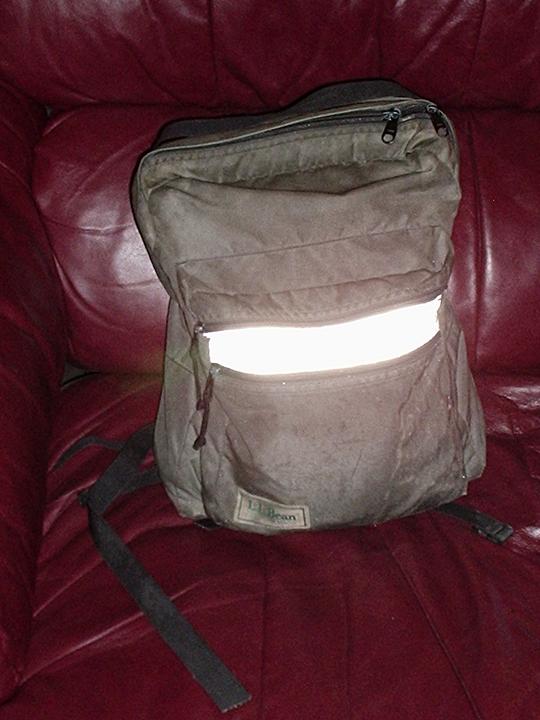
This year also marked the end of an era. A little over twenty years ago, I began my junior year of high school with a new backpack. It was sturdy and well-designed, with pockets upon pockets -- just the thing for schoolwork on weekdays and D & D on weekends. I used it through college and law school, and it went with me on excursions far and near. It has been from the Jersey Shore to the Pacific Coast Highway and from Florida to Niagara Falls. Lately I started calling it "Golden Boy," probably out of recognition that it was due to retire. When the Best Wife Ever asked what I wanted for Christmas this year, naturally I wanted Golden Boy to get a good sendoff.

So it was with a certain twinge of guilt that I opened the gold-wrapped present from the Best Wife Ever to find Golden Boy's successor. I don't know if it will put in the mileage that Golden Boy logged, and of course I'm tempted to say they don't make 'em like they used to. There may well be a display case and plaque in Golden Boy's future, but for now it will get a well-earned rest.

1985-2005

Full Post

Sunday, December 18, 2005

Infinite Christmas

Fans of a certain age -- let's not be coy, my age -- remember the event twenty years ago that was supposed to set everything straight. In Christmas on Infinite Earths, the Anti-Santa sought to stop Christmas from coming, but was thwarted by a vast assemblage of heroes from across time and space. Who could forget the opening scenes of issue #1, as onetime toy deliverer Jack Skellington was obliterated by the Anti-Santa's wave of all-consuming ennui?

We thrilled to revisit classic team-ups like Rudolph the Red-Nosed Reindeer and Frosty the Snowman (the "Season's Finest"), and witness new alliances like Clarence the Angel and Charlie Brown, Emmett Otter and the Little Drummer Boy, and Clement C. Moore (or was it Henry Livingston?) and David Sedaris. The sight of Santa wielding both Ralphie Parker's Red Ryder BB Gun and Linus van Pelt's security blanket came off surprisingly well; and even though they were villains, it was still disturbing to see Scrooge, the Grinch, the Bumble, and a group of Martians lose their time-traveling battle to stop the 31st Century Santa-Bot from freeing the Anti-Santa. Finally, lest we forget, it was the Herdmans' and Misfit Toys' emotional plea to the Angel Gabriel that convinced him to intervene, thereby giving Santa the fighting edge he needed over his evil opposite.

Seems like Christmas preparations start earlier every year, but this year March had Countdown to Infinite Christmas, a one-shot which killed Yukon Cornelius and introduced four summer-spanning miniseries. Aside from fueling speculation that Buddy the Elf would become the new Cornelius, it was all a big buildup to the current holiday apocalypse. Along the way, Santa's army of helpers got turned into killer cyborgs and put everyone on the "naughty" list; a weird spatial anomaly opened up over the North Pole; a duplicate Scrooge was revealed; and Clarence was seduced by Eclipso, who in turn was defeated by the Nutcracker. Yeah, I didn't understand that last one either.

So now Infinite Christmas is here, revealing the original Saint Nicholas' plan to restore the holiday to its religious roots and have folks "keep Christmas all year 'round." I have to say, Geoff Johns and Phil Jiminez certainly treat Nick reverently, even if objectively he is the villain of the piece. Although the chaos he kicked off was entertaining, the Anti-Santa wasn't much more than a scary plot device.

It's also tempting, in the face of rampant Christmas commercialism, to applaud such a back-to-basics approach. Nostalgia is essentially a rebellion against the perpetual march of time, and the fact that Christmas comes at the end of every year just makes nostalgia for its traditions more powerful. Who wouldn't want to have a few more child's-eye holidays, when two weeks of vacation could start with a leisurely walk home from school under slate-grey clouds fat with snow -- when the wind wasn't cold but bracing, and your only responsibilities were to keep your nose clean and your questions to yourself until the morning of December 25?

And yet the most powerful aspects of Christmas, anticipation and hope, are always with us. Early Christian public-relations gurus knew what they were doing when they scheduled Christ's birth celebrations around the winter solstice, because the darkest time of the year is perfect for ushering in the light.

A slightly twisted version of that approach is on display in Infinite Christmas. We know that Rudolph, Santa, and Frosty will become friends again. We know the reindeer will reunite (and in their absence, Earth-2 sleigh-pullers Dunder and Blixem can help pick up the slack). We know that as with every new year, change is inevitable, but perhaps only incremental; and nothing we can't handle.

When I was a kid I got excited over a few weeks of vacation from school. As I grew up I learned to keep hope alive all year. Even if I don't have a long vacation anymore, Christmas still gives me a bit of a break. Like the song says (watch out for the auto-play music past the link):

And ye, beneath life’s crushing load,
Whose forms are bending low,
Who toil along the climbing way
With painful steps and slow,
Look now! for glad and golden hours
Come swiftly on the wing.
O rest beside the weary road,
And hear the angels sing!

Happy Holidays, blogosphere!

(P.S. The GLX-Mas special was brilliant.)
Full Post

Tuesday, December 13, 2005

Smells Like Team Spirit

[Looks like I published a draft of this accidentally. Enjoy the finished product!]

The Justice Society of America was made up of the highest-profile superheroes under what became the DC umbrella. Later, so was the Justice League of America. The third of DC's three long-lived teams, the Teen Titans, tended to be more of a niche group, being composed largely of junior partners. Other teams have come and gone, and some (like the Doom Patrol and the Outsiders) have had multiple incarnations, but the JLA, JSA, and Titans have permanent spots in DC's lineup. Still, why does DC need them?

In dramatic terms, each was organized as a social club, with only the Justice League being structured enough to have regularly scheduled "monitor duty" and signal devices. As it happens, though, each team corresponds to an heroic generation. Nowadays, from oldest to youngest, we have the Justice Society, Justice League, Outsiders, and Teen Titans. (The generational divides were easier to see when the two youngest teams were the no-modifier Titans and Young Justice.) This reinforces the social-club idea, but by the same token, it's a little unsettling to think that groups of ultra-powerful costumed vigilantes would just "hang out." I'm sure there are psychological and sociological underpinnings, as with Watchmen's Minutemen, but outside of hijinks in Justice League International and the "Teen Titans" cartoon, I can't say DC has really made a point to explore them.

With the Infinite Crisis-related dissolution of the Justice League, the opportunity exists for the Justice Society to get back on top of the superhero world. The JSA could even take in former Leaguers, as it did with Black Canary II. Unfortunately, in the wake of InfC, the Leaguers aren't really in a position to get the band back together. Superman, Batman, and Green Arrow may not be speaking to each other; Wonder Woman, Flash, and Atom may be in limbo; and Aquaman and Green Lantern have enough to handle undersea and in space.

Granted, it would be clever of DC to let the JSA "take over" for the League on what might look like a permanent basis. One could argue that the JSA was the most powerful team fielded during Crisis on Infinite Earths, which was during the "JL Detroit" period. I've said it before, but at no point during COIE was the original Justice League -- the team whose multiple-Earth adventures inspired Crisis, remember -- reunited, even superficially, in the face of almost certain extinction. The opening pages of Crisis drive this point home by showing both the League's evil counterparts (no "Crime Syndicate Detroit?" Now there's a missed opportunity!) and the gutted JLA Satellite.

The "One Year Later" books therefore have the chance to emphasize and clarify the role of the Justice League in the larger scheme of things. The current situation, with a Justice League having to reinvent itself from the ground up, may be unique in that the world already has an established Justice Society. When the League first formed, the JSA had disbanded. The JSA was in Limbo (literally) from 1986-92, and when it returned, the League had long been established. When the JSA was revived in 1998 after disbanding again in 1994, the League was still there. Now, the current JSA is in a position to fill the League-sized void, and DC may well let it for a while.

Not forever, to be sure. I imagine various JSAers and Teen Titans working with Batman, Superman, and other expatriate Leaguers separately, but "matchmaking" with each of them in attempts to get the League back. At the risk of recycling another old thought, it would also be nice if the reorganized JLA had its roots in Mark Waid's new The Brave and the Bold.

It would be a little silly for me to spend a lot of time on a dream-team JLA, not least because we don't know who will be around to join. However, for the bulk of its history, the JLA has been DC's all-star team. '70s Tom might not have been a regular reader of the heroes' solo books, but he always liked seeing everyone in Justice League of America. '80s Tom appreciated the unique post-Crisis membership of the Giffen/DeMatteis League; and early '90s Tom respected Dan Jurgens and Gerard Jones' attempt to fuse together the JLI and classic League. Of course, late '90s Tom was positively giddy over the Morrison League, but I doubt we'll see anything like that again.

In restating the JLA's purpose, DC can also address the need for a Justice Society and Teen Titans. I haven't read JSA or TT in about a year, mostly because I was getting the sense that regardless of their stated purposes, they existed pretty much as legacies. The "reunions of names" took its cue from the Morrison JLA, and for a while both teams got by on the novelty of seeing Jack Knight or Tim Drake carrying on their respective traditions. The Titans also benefited from saying openly that they were a social group set up to handle the angst of being a teenaged superhero.

Still, a world with a Justice League may find it difficult to justify a Justice Society. I'm not saying that the JSA should be subsumed, ABA- or AFL-like, into the JLA; and I don't necessarily want the group disbanded. However, it may be time for the JSA to also embrace its "social" underpinnings. It is arguably just as exclusive a club as the JLA; and perhaps more so, due to the legacy element. James Robinson's Starman, which did a lot to birth the current JSA, really explored these aspects of generational superheroics. To me that is the JSA's strength, even if it doesn't lend itself to a steady diet of combat.

However the JLA is reorganized, DC should make sure its members will be sticking together for the duration. The Giffen/DeMatteis Leagues lasted five years, and the current title has made it through about nine. Unfortunately, the team's history also includes a few short-lived rosters, not all based out of Detroit. The potential for a 21st-century Justice League is limitless, and I'm eager to see what DC does with it.
Full Post

Saturday, December 10, 2005

New comics 12/7/05

Detective Comics #814 (written by David Lapham, pencilled by Ramon Bachs, inked by Nathan Massengill) is a somewhat confusing conclusion to "City of Crime," the twelve-part epic that was interrupted by a crossover and so took over twelve months to tell. It ends on the note of cheerful nihilism that marked the rest of the arc, but it asks the reader to remember characters and subplots from about a year ago, and so may be more appreciated in collected form. Overall I enjoyed "City of Crime," and if I get time may do an omnibus recap.

More to the point is Batman and the Monster Men #2 (by Matt Wagner), which also intends to use a large cast -- including Hugo Strange, Boss Maroni, Julie Madison, and her father -- but so far keeps better track of them. Wagner has always drawn a great-looking Batman, and here the minimalist "Year One" style isn't far from his own. My one quibble is a familiar one, namely first-person narration from various perspectives. It's not hard to tell who's speaking, but there's not a lot to differentiate the speakers when they switch.

Gotham Central #38 (written by Greg Rucka, pencilled by Kano, inked by Stefano Gaudiano) starts what will probably be the book's last arc. Despite the cover, and the rumors swirling around bad cop Jim Corrigan, there are no hints that he was the original Spectre or will be again. (Still, if a murdered do-gooder were to become the Spectre's new host, like good cop Jim Corrigan did back in the day, one could make an argument for a candidate in this issue.) Better characterization of Montoya and Allen this issue, and I continue to be amazed with how consistent the look of the book has been.

Superman #224 (written by Mark Verheiden, pencilled by Tom Derenick, inked by Wayne Faucher) presents a compare-and-contrast story of Superman vs. Blackrock and Luthor vs. an OMAC which actually comes off fairly well. While I don't want to say that there were no good "corporate Luthor" stories, in the old days he couldn't just steal a plane and kill a pilot; and not having to get through those plot mechanics makes things go faster. The issue includes another switch-to-Superman moment, which I am noticing more and more in recent months, and which I applaud for purely sentimental reasons.

Superman Secret Files 2005 includes two stories, a kids'-eye view, a Lois-meets-Superman tale, and an odd Bizarro two-pager. The first story, written by Devin Grayson with art by Ariel Olivetti, is sweet, if a little mawkish. The Lois story, written by Jami Bernard with art by Renato Guedes, is fine, but I can't decide if its slightly revisionist take on Lois' early relationship to Supes puts her in a good light. It has an uncanny Christopher Reeve evocation on the last page. The Bizarro "origin," written by Christine Boylan with art by Carlos Ferreira and Drew Geraci, starts out as a parody and ends up in pathos. None is absolutely essential, but then again, none are really the kinds of Superman stories the monthly books have been telling, so on balance it may be worth a look.

Seven Soldiers: Mister Miracle #2 (written by Grant Morrison, pencilled by Billy Patton and Freddie Williams II, inked by Michael Bair) reveals more of the "disguised" New Gods, and I start getting confused. Not because I'm trying to fit this into a convoluted DC-mainstream timeline, or trying to decide whether this is "real" or an alternate universe, but because I'm looking for familiar faces and everybody is drawn as hulking bald men. Still, by the end Darkseid and DeSaad are revealed, and that helps things get creepier. Maybe the larger plot will turn out to be "Shilo Norman escapes from the alternate universe," which would be OK but not very imaginative (considering I thought of it), so I hope Morrison ramps things up a little more and eases up on all the bald guys.

She-Hulk 2 #2 (written by Dan Slott, pencilled by Juan Bobillo, inked by Marcelo Sosa) features the big Return Of Hawkeye, sort of, and it may or may not be permanent. There are some funny bits, and a couple of heartfelt ones. However, the whole plot also revolves around a weird time paradox which exists for its own sake. Now, that's fine, and I can accept it, but I'm still trying to work out the mechanics.

Finally -- and I do mean "finally" -- Spider-Man/Black Cat #4 (written by Kevin Smith, drawn by Terry & Rachel Dodson) is an extended set of conversations between BC and Matt Murdock and Matt and Peter Parker; and it ends with a Spidey/Daredevil/mystery villain fight. "Oh, a dialogue-driven Kevin Smith book," you say,"how innovative." Yeah, it's like that, but it doesn't seem as witty as Smith's earlier Marvel work. (And when I say "earlier" ... oh, it's just too easy, isn't it?) Moreover, Smith makes a big deal of not revealing Matt Murdock, when it's patently obvious virtually from the cover. The other thing is, I'm not sure about the Daredevil timeline. I am not a real DD scholar, but I think it refers to events from the intervening years, and that seems like cheating to me.
Full Post

Another Saturday, another mea culpa

Most of the week I was in Lexington getting CLE (continuing legal education) credits and catching up with various folks. This had me avoiding supposedly scary winter weather on Tuesday and Thursday and trying not to get caught on the West Virginia Turnpike after dark. I kid the WVTP, but really, much of it is like a downhill slalom, and it's better negotiated without ice. Still, a friend of mine mentioned that until about 20 years ago, I-64 ended at Charleston, WV, and if that were still the case, my trips would be a lot longer and less pleasant.

So last night, after work, I picked up new comics and caught up on all the TV I missed. I hope to have a new-comics post up tomorrow afternoon. I am also working on a Christmasy essay which could potentially turn into something strange.

Back soon.
Full Post

Saturday, December 03, 2005

New comics 11/30/05

Adventures of Superman #646 (written by Greg Rucka, pencilled by Karl Kerschl, inked by Wayne Faucher) was a really good issue, and possibly Rucka's best single issue on the book. Although many writers, including Rucka, have played Mxyzptlk as a buffoon, here he really jerks at the ol' heartstrings, showing Mxy stripped of his powers and much of his faculties. The confrontation with Ruin also hearkens back nicely to the beginning of Marv Wolfman's run on Adventures, almost twenty years ago. What works about this issue is its uncomplicated nature. Superman, Mxy, and Ruin are all laid out in simple terms, and after months of everything tying into something else, it's a nice change. (There is a bit of crossover business with Lois and her shooter, which is good and doesn't distract.) Now clap your hands, kids, if you want the imp to get his powers back....

Rucka's other book this week, Wonder Woman #223 (pencilled by Rags Morales and Cliff Richards, inked mostly by Ray Snyder), was also in last-stand mode. It may be just a coincidence, but the pre-Crisis WW title ended with a siege of Paradise Island by shadow-demons. Substitute OMACs for the demons and here we are again. Rucka does a good job building suspense about who lives and who dies, and naturally Wonder Woman gets a chance to be hardcore. The art is a little too busy, though, such that it's hard to tell who's fragging who. As carnage-filled as the issue is supposed to be, I don't think that was the desired effect.

Since reading last week's Captain America, Batman #647 (written by Judd Winick, pencilled by Doug Mahnke, inked by Dustin Nguyen) can only suffer in comparison. The comparison itself may be a little unfair, since Batman and the Red Hood are ostensibly working together and Cap and the Winter Soldier aren't, but as you might expect, Batman betrays very little of the emotion here that Cap did last week. The story itself is a straight-up superhero fight involving C-list villains sent by the Secret Society to take out the Hood, and on those terms it's pretty entertaining. I will say, though, that Winick's use of first-person narration is another strike against it. He starts off with Alfred and switches to Batman, and back to Alfred again. While it's not like I expect to be spoon-fed, I think he could have accomplished the same thing by using a third-person narrator. He is still no Jeph Loeb, thank goodness.

JLA Classified #14 (written by Warren Ellis, art by Butch Guice) also trod familiar ground, this time the old "your fears will destroy you" dodge. The art is good, and the story holds some surprises, but not many.

Finally, the first year of Waid and Kitson's Legion of Superheroes (#12) ends with an all-action issue finding the Legion fighting on three fronts. It's pretty good, espeically if you don't mind a couple of the surprises to be reveals of familiar Legionnaires. Still, every time Waid mentions "Terror Firma," I think of "Terror Incognita," the better pun which he used in JLA. The issue also features a Lightning Lad/Saturn Girl backup, by Stuart Moore and Ken Lashley, which was clever but probably makes more sense in the context of the larger story.
Full Post

Monday, November 28, 2005

New comics 11/23/05

Apparently a shipping snafu delayed last week's comics two days, but we were having so much fun entertaining my parents over the holidays that I didn't get to the shop until today. Thus, here are very raw impressions of books which have probably already faded into distant memories.

I'm guessing Seven Soldiers: Zatanna #4 (written by Grant Morrison, pencilled by Ryan Sook, inked by Mick Gray) is best appreciated in the contexts of both its preceding issues and the larger 7S project as a whole, because on its own its conclusion left me scratching my head. The art was good as always, there were some interesting attempts to break the fourth wall, and the banter between Zatanna and her sidekick was entertaining too. It just felt like overhearing the end of somebody else's conversation.

On the other hand, Seven Soldiers: Frankenstein #1 (written by Morrison, drawn by Doug Mahnke) was quite good, in the vein of vintage Swamp Thing or Sandman stories. Like those, it didn't spend much time on the hero, but focused instead on a Carrie-style magic-powered geek whose goal is revenge on his tormentors -- and who instead brings the monster's wrath on his head. It'll take me a couple more readings to get a feel for the monster's background, but gosh this was a good issue.

Maybe I'm feeling a bit more charitable now that it's a lame duck, but Batman: Gotham Knights #71 (written by A.J. Lieberman, pencilled by Al Barrionuevo, inked by Bit) wasn't too bad. Although the cover is completely misleading, once you get inside it's a decent caper story about Batman having to break into Arkham Asylum to save Alfred's life. The action scenes are the best part, because the rest has to wrap up an impenetrable plot about Hush creating a Clayface to both frame and kill Alfred, and those parts are either glossed over or sound like bad Gotham Central impersonations. Anyway, at least Lieberman has Batman acting like a human being for a few pages.

Flash #228 (written by Joey Cavalieri, pencilled by Val Semeiks, inked by Livesay) was okay. It's better than last issue, because it turns away from being another dark-alternate-future story, but then it brings in Nightwing, Cyborg, a locked-room mystery, and Dexter Myles, longtime curator of the Flash Museum. The scenes with Dexter are kind of sweet, if only because this is probably his first appearance in at least 15 years, but again, it's just marking time until the end of Infinite Crisis.

The best book of the week was Captain America #12 (written by Ed Brubaker, pencilled by Steve Epting and Michael Lark), in which Cap comes to grips with the identity of the Winter Soldier. As much as anyone can feel sorry for a fictional character, this issue made me feel for Cap. Meanwhile, Lukin puts the Cosmic Cube on the open market, with unexpected, but appropriate, results. As if that weren't enough, Brubaker and Lark throw in some zombies! What more could anyone ask?
Full Post

Thursday, November 24, 2005

Made By Me


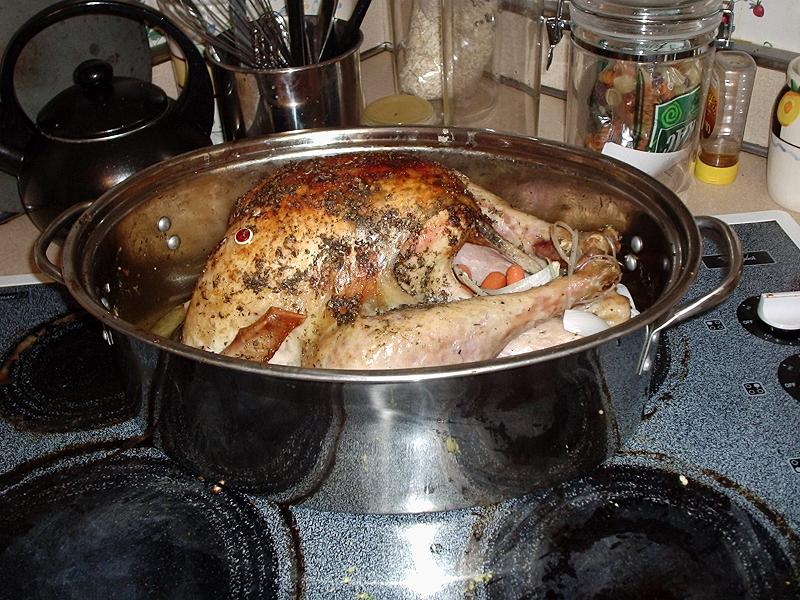
Happy Thanksgiving!
Full Post

Wednesday, November 23, 2005

Move over, Clapton

The new Superman Returns teaser trailer doesn't reveal a whole lot of plot, or even show a lot of characters (our hero, maybe Ma Kent, maybe Lois). Instead, it sets a tone which might best be described as "reverent." As the teaser shows a stunned crowd looking up in the sky, Marlon Brando intones "They can be a great people, Kal-El, if they wish to be." As Superman rises above the clouds, silhouetted by the sun, Brando continues, "They only lack the light to show them the way."

It's a very effective presentation, thanks in no small part to John Williams' epic "Planet Krypton." However, its effectiveness comes from its imagery of Superman being "above" humanity -- someone who, as a boy, learned to stop himself from falling, and indeed to leap high above the Kansas plains. Later, the trailer shows Superman taking off from a rooftop, and it concludes with Superman in space, looking down on the Earth like the Star Child at the end of 2001.

While I'm no film student, to me the trailer's emphasis on flight seeks to convey two aspects of Superman: freedom, as in Clark's childhood exultations; and also that "above"-ness. Combined, the message is "He can do whatever he wants" -- and the unspoken amendment of the message, alluded to in the last shot of Superman rocketing back to Earth, is that "he wants to help you."

The cover of All-Star Superman #1, showing a relaxed Superman sitting on a cloud high over Metropolis, conveys the same comfort. The rest of the issue brims with the kind of assurance that Grant Morrison had already summarized eight years before in JLA #1: "No sweat, kids, the crisis is over. The big guy's on the case." I wish I could remember the preamble of "Whatever Happened to the Man of Tomorrow," but from memory I believe it talks about "a man from the sky who did only good." Put them all together and Superman is more than the fatherly George Reeves, more than the big-brotherly Christopher Reeve, and certainly more than the superpowered pretty boys Dean Cain and Tom Welling. Right now, the trailer for the new movie paints Superman as God.

Clearly this is not a new idea. I'm not even sure it's a conscious idea, much of the time. However, it makes Superman unique among other superheroic icons. Batman represents the apex of human potential, and Wonder Woman an idealized female warrior. The major Marvel heroes represent different aspects of human behavior. Only Superman has developed into a paragon of moral virtue, whose strict adherence to such a code is as much a part of his portrayal as his powers are.

The flip side of this portrayal is the notion that Superman is so powerful, he's not interesting. One way to get around that is the current monthly books' route of challenge through emotional manipulation. The Superman Returns trailer exemplifies another way, and that is to define Superman through the perceptions of those around him. It's easier to do Superman-as-God the second way, because honestly, after a while the first way just ends up feeling forced.

Still, the second way results in a somewhat unknowable Superman, and that doesn't sit with the regular-guy picture of Clark. It fits better with the pre-Crisis model of a "Clark Kent" persona created and shaped by a being who knew at his core he was Kal-El. Under that way of thinking, Superman doesn't really make "human" mistakes, even as Clark -- he only makes mistakes resulting from approximations of human behavior.

That sounds a little extreme, doesn't it? Probably so, and I would argue that regardless of the era, Jonathan and Martha Kent deserve a lot of credit for shaping Clark into a more socialized being. Otherwise you get true "approximations of humanity" like Watchmen's Dr. Manhattan or Supreme Power's Hyperion.

That, I think, is the subconscious difference between Superman and various other omnipotent comic-book figures -- Superman relates to the public (and thus the reader), even as he hovers over them. If he is God, he's the God of miracle and wonder, not an Old Testament deity desiring sacrifice and dispensing retribution. In that light, Superman Returns' notion that the world has learned to live without him takes on an extra layer of significance.

Not that I expect the movie to be so deep, mind you; but based on the trailer, who knows?
Full Post

Sunday, November 20, 2005

New comics 11/16/05

The biggest compliment I can pay All-Star Superman #1 (written by Grant Morrison, drawn by Frank Quitely) is that it's the kind of Superman story people expect to read. Morrison and Quitely invest so much in making Superman likeable that the ending twist, which likely provides the spine of their 12-issue macro-arc, really carries an emotional kick. If you're reading this, odds are you at least have a passing interest in the book; so why haven't you gotten it yet?

Likewise, Batman and the Monster Men #1 (by Matt Wagner) begins what should be a fun retelling of the first Hugo Strange story from (I think) Detective Comics #37. It's dolled-up with the usual Year One additions of now-familiar Gotham gangsters, but its heart is with Batman fighting giants. As with All-Star Supes, Wagner has eleven more issues, and that's all to the good.

Two months late, Green Lantern #5 (written by Geoff Johns, pencilled by Ethan van Sciver, inked by Prentiss Rollins) concludes the Shark story from last issue, and begins a completely weird Black Hand arc. There's a lot of grue in this issue, and I'm not sure why. I think at some point we actually see one of Hal's armbones sticking out of his sleeve. Yes, I'm sure it would hurt to fight a giant mutated shark, but it never seemed to involve this much blood before, and it's not quite explained why it does this time. Van Sciver's art is a little too busy and intense for me, compared to the laid-back Carlos Pacheco; but at least Johns has some odd German-speaking gremlins wander through the proceedings, adding another layer of mystery.

Captain Atom: Armageddon #2 (written by Will Pfeifer, pencilled by Giuseppe Camuncoli, inked by Sandra Hope) finds Cap touring the WildStorm universe, trying to find a way back to DC-Earth. Along the way, he meets Majestic, who's already done that, but still can't help Cap. There's a lot of WildStorm history in this issue, which didn't really bother me, since the most I know about it comes from a 1997 JLA/WildCATS crossover. Along those lines, though, I get the feeling that this is a backdoor reintroduction of a few key WildStorm titles. Still, so far it doesn't feel too much like a marketing strategy, and I still like Cap enough to keep getting it.

Apparently, Hero Squared #3 (written by Keith Giffen and J.M. DeMatteis, drawn by Joe Abraham) is the conclusion of a 4-part miniseries introducing the characters and leading into an ongoing series. That would be fine with me, although this issue doesn't really feel like the end of a story. Instead, it's more an exploration of the awkwardness which results from the interaction between normal people and their super-counterparts. I like it fine, even if it does tend to trade on Giffen and DeMatteis' old JLI schtick. Also, Abraham's art is good enough, but the proportions of Lord Caliginous' battle armor could really use some work.

This may be an obscure reference, but remember that Secret Origins Annual which revealed that Barry Allen, circa Crisis on Infinite Earths #8, was the bolt of lightning that hit him in Showcase #4? Apply that to Reed Richards and you've got Fantastic Four #532 (written by J. Michael Straczynski, pencilled by Mike McKone, inked by Andy Lanning). It's a nice story, but as an ending to an allegedly big cosmic saga it's kind of meh.

Not so The Thing #1 (written by Dan Slott, pencilled by Andrea DiVito, inked by Laura Villari), which was a lot of fun. Slott seems to be testing the hearts of Marvel's lawyers, as he has Ben Grimm dating Eva Longoria, going to a Martha Stewart party, and running afoul of Paris Hilton. The Thing isn't wacky like She-Hulk or blackly comic like GLA -- instead, it's just plain superheroics, done well. My one complaint is with the opening fight sequence, which took me a few tries to get all the perspectives right. However, that is a very minor quibble.
Full Post

Monday, November 14, 2005

Take Your Time

If the Chronicles of Narnia all get adapted for film the way The Lion, The Witch & The Wardrobe has, at some point the producers will have to decide the order in which to film them. If memory serves, the fifth book in the series, The Magician's Nephew, is a prequel taking place a few decades before LW&W. My recent editions of the Narnia books have been re-ordered, apparently in line with C.S. Lewis' wishes, so that Nephew is #1 and LW&W is #2.

Naturally this brings me to Star Wars, and the opportunity which exists now to watch all six movies in succession. The end of Revenge of the Sith is objectively a downer, but not really, because longtime fans are happy that at last it's time for the originals. Thus, the reversed order of the movies' releases makes it impossible for us today to gauge fully the intended emotional impact of Episode IV.

Of course I watched Episode IV not long after finishing ROTS, but I tried to see it through those hypothetical new eyes, which would be making connections from the point of view of the prequels. In that respect it does play out a little differently. At first everything is familiar: there are the droids, still on Bail Organa's starship, and there's Anakin/Vader, still in the suit; but hey! that must be Leia, all grown up! Spotting Jawas a few scenes later, the hypothetical viewer might then realize we're back on Tatooine, and so not far from our first glimpse of Luke.

Thus, Star Wars (the original, that is) still holds some surprises, and some key scenes gain a little weight. Regardless, the tone of Episodes IV-VI is significantly different, and I wonder how much time one should let pass between the end of Episode III and the beginning of Episode IV. Fans of the original trilogy brought 16 years' worth of expectations to their first viewing of The Phantom Menace. What sort of expectations will those hypothetical viewers of tomorrow bring to Episode IV, having been exposed first to the prequels?

Whatever those expectations are, it's fairly certain that they won't have twenty-some years to form -- or even the three years us old-schoolers spent stewing over the end of The Empire Strikes Back. I do think a bit of down time -- maybe a day, maybe a week -- might be in order, just to get one's imagination flowing about the next installment. It's nice that the six movies can now be watched over the course of one (very long) day, but I know from personal experience that four in a row is pretty taxing.

Back in 1998 the Kentucky Theater showed each of the Special Editions as Saturday matinees over three weeks. That worked out well, and was eminently appropriate considering the films' serial ancestry. Revenge of the Sith presents an extensive set of cliffhanger endings, with heroes in exile and twin suns setting on a galaxy in turmoil, but as convenient as it is to salve the hurt by popping the originals immediately into the DVD player, arguably that's not how they were intended to be viewed.

Today the end of Sith plays on the audience's memories of the originals. Future fans should allow themselves the time to imagine their own second trilogy, just as we imagined our own prequels.
Full Post

Sunday, November 13, 2005

New comics 11/9/05

I liked quite a few things about Infinite Crisis #2 (written by Geoff Johns, pencilled by Phil Jiminez and George Perez, inked by Andy Lanning and Jerry Ordway), but I'd like to think the Perez cover (showing Power Girl from the rear) is a none-too-subtle dig at the fascination with PG's chest. Perez and Ordway's contribution to the interior consists of a few pages telling the history of the old Multiverse, and while some might say that's proof that the whole magilla is too complicated, I think it's a fine tip of the hat to the original Crisis on Infinite Earths artists and to COIE itself. As exposition goes, it's fairly economical too.

The spotlight is on Power Girl in issue #2, and speaking of exposition, I'm now glad I didn't spend the money on her JSA Classified origin issues. InfC #2 is the emotional payoff of the former arc's false starts, but it doesn't need those issues to work well. Power Girl might well have been better off consigned to Earth-2 oblivion, for all the mucking around with her backgrounds various writers have performed over the last twenty years, but Johns takes good advantage of her confusion.

The issue's other plots all work as well. I especially enjoyed the interlude with Clark and Lois at the Daily Planet, culminating in a neat little "job for Superman!" moment. As much as I love Perez's work, Jiminez has become a fine storyteller in his own right. I just wonder if there's not an Earth-2 homage to COIE #7 in Power Girl's future....

JLA #122 (written by Bob Harras, pencilled by Tom Derenick, inked by Dan Green) is another "[MAIN CHARACTERS] vs. OMACs" story, just like half of DC's books from the past few months. I hope the number of these decreases after the events of Infinite Crisis #2. There's not much more to it than that, except the kind-of creative notion that the Key is attacking anything with the initials "JLA." (The Best Wife Ever is in the Junior League, so word of warning to the Key: they are tough.) It's nice to see some old familiar faces back in the fold, but I wish they had something more exciting to do.

Gotham Central #37 (written by Greg Rucka, drawn by Steve Lieber) is the big Infinite Crisis crossover issue, and I hate to say it, but it's not as good as I've come to expect. Sure, I like Allen and Montoya; sure, they react believably to the mystic carnage going on around them; and sure, this was probably a decent introduction to the characters for the hypothetical first-time reader -- but it just didn't have the punch of, say, the Poison Ivy one-off issue of a few months ago. It wasn't bad, it just wasn't as good as it has been. Good ending, though; and I do hope the Crisis completists pick up multiple copies, because the book deserves all the support it can get.

Action Comics #833 (written by Gail Simone, pencilled by John Byrne, inked by Nelson and various others) begins what looks to be a fun little story pitting Supes against an old Justice League foe. It doesn't appear to have much to do with Infinite Crisis, so instead it's free to weave in scenes for Lois and Jimmy. I'm not saying who the villain is, because Simone takes her time in building up the revelation, and packs a lot into the first half of the issue. For that I was pleasantly surprised.

As the first part of "Blaze of Glory," Batman: Legends of the Dark Knight #197 (written by Will Pfeifer, drawn by Chris Weston) also unloads a lot of plot. The story concerns a supervillain wannabe who blames Batman for his problems, which isn't overly original, but Pfeifer makes his antagonist a fairly smart guy who just happens to have wound up on the C-list. The one strange thing about the issue is the art. Weston's heads seem just a little too large (or the bodies a little too small), kind of like Mike Grell. Still, like Grell, once you get past that it's pretty good.

Finally, Star Wars: Empire #37 (written by Welles Hartley, pencilled by Davide Fabbri, inked by Christian Dalla Vecchia) continues "The Wrong Side Of The War" in fine fashion. As the Rebels put their undercover plans in motion, Imperial Lt. Sunber becomes acclimated to his new assignment. While Sunber takes on the alpha male in his barracks, though, the Rebels discover they may have to rescue all the slaves from Jabiim. Hartley portrays the Imperials as evil bureaucrats -- not so much mustache-twirling, but you can see they're not particularly nice. The art is also good, with bright colors (thanks again to Fabbri) and big, expansive layouts. Nothing groundbreaking, but a good Star Wars story nonetheless.
Full Post

Saturday, November 12, 2005

Devin Grayson's Nightwing: Worth the Search?

That's my question. Reading this interview with Ms. Grayson has made me curious about her run on the title, especially now that it's winding up. I don't dislike her work, and I thought her stints on The Titans and Gotham Knights were fairly decent. Like her, I am also a fan of the Bruce/Dick relationship. However, I haven't read Nightwing regularly, and don't really have an opinion on what she's done with the character, because I haven't really seen it reflected in other books. I do know a lot of people don't like it.

So, any recommendations on whether to start seeking out her back issues? Do you think I would like 'em? If so, where should I start, and what are the high and low points? I know the broad outline of the Tarantula arc, but should probably avoid spoilers beyond that.

Thanks!

P.S. New comics roundup probably coming tomorrow.
Full Post

Sunday, November 06, 2005

New comics 11/2/05

Apparently I missed Wonder Woman #222 (written by Greg Rucka, pencilled by Cliff Richards, inked by Ray Snyder) last week. Not surprisingly, it's plugged into the rest of DC's crossover madness, but the bulk of the issue is a straightforward Wonder Woman/Cheetah fight. Despite being saddled with a bad case of the Eartha Kitts during her Legion of Doom tenure on "Super Friends," the Cheetah has historically been an interesting villain. George Perez revamped her as a maverick archaeologist who stumbled into an Edgar Rice Burroughs-esque pulp-fiction cat-god religion, and she went after Wonder Woman for (among other things) her magic lasso. Rucka revisits that, but also brings in a bit of the old "Wonder Woman is too perfect" jealousy which informed the character originally. In any event, it all meshes well with other current events surrounding Diana, and plays much better than the star-crossed Cheetah-Zoom team-up from the recent Flash crossover. The art is good enough, although some of the shading reminded me of woodcuts.

Superman #223 (written by Mark Verheiden, pencilled by Ed Benes and Marc Campos, inked by a platoon) is likewise a Superman/Supergirl/Blackrock fight, with Infinite Crisis implications. Basically Superman tries to teach Supergirl, who's been trained by Wonder Woman, not to cross the line into killing the way WW has. I like Supergirl as a concept well enough, but this Supergirl still hasn't emerged as a real person for me, and sadly this issue didn't do much to advance that.

Firestorm #19 (written by Stuart Moore, pencilled by Jamal Igle, inked by Rob Stull and Keith Champagne) is also an Infinite Crisis tie-in, but it inserts Firestorm into the proceedings with the happy-go-lucky style and charm this title has developed. Jason merges with a couple of fun "partners," and meets up again with Gehenna, the strange girl from a couple of issues back. Along the way Firehawk introduces him to the Outsiders and Donna "No New Hero Name, Evidently" Troy, who have recruited him for a big space mission evidently meant for Infinite Crisis #2. This book is DC's She-Hulk, showing just as much love of the superhero milieu without being so silly. (Not that silly is bad.)

Detective Comics #813 (written by David Lapham, pencilled by Ramon Bachs, inked by Nathan Massengill) presents the penultimate chapter of "City of Crime," and as a single installment it's pretty good. Lapham basically tells a straightforward story of Batman riding to the rescue, throwing in Robin, Gordon, the Batcopter, the Batmobile, and an omnipresent Bat-Signal. Batman also confronts the mind behind the conspiracy. In short, this issue brings everything to a boil for the big finish next month. Honestly, I realize this may be at best just an above-average Batman story in the whole scheme of things, but as I said it pushes a number of good buttons and helps remind me what I like about Batman. These days that's pretty good.

Opening Seven Soldiers: Bulleteer #1 (written by Grant Morrison, pencilled by Yanick Paquette, inked by Michael Bair), I noticed two things right away, and they kept popping up the rest of the issue. Man, Bulleteer has a nice set of ... hair. Seriously, for a comic that explores the quasi-pornographic aspects of superhumanity, what's the message here? My guess is, we're all voyeurs, because check out our heroine's huge ... tracts of land! I did like the issue -- for the writing, too, perverts.

And then I read Captain Atom: Armageddon #1 (written by Will Pfeiffer, pencilled by Giuseppe Camuncoli, inked by Sandra Hope), about a guy also trapped in silver skin, and it was okay. I've followed Cap from his post-Crisis series through pretty much all his DC appearances, but once he was outed as a government agent, he lost a lot of what made him compelling. Now that his "man out of time" aspects have also been downplayed, he's just another indestructible guy who flies, shoots, and leaves. (Okay, maybe not "leaves," but you saw where I was going.) Anyway, I'm hoping that this miniseries, which once again makes Cap a fish out of water, will help spark the character. So far not bad, although no cheesecake. At least it's a good introduction to Cap.
Full Post

Saturday, November 05, 2005

The Week That Was

I don't know about you guys, but for me, it feels like I haven't posted since World War I. Not that I've had the chance -- it's been pretty busy around here....

Monday: First thing in the morning, drove to Richmond for a big new-lawyer swearing-in ceremony; passed out candy Monday night.

Tuesday: Turned 36; celebrated with the Revenge of the Sith DVD.

Wednesday: Started a new job; celebrated it (and my birthday, because the Best Wife Ever had a meeting Tuesday night) at a nice restaurant.

Thursday-Saturday: Tried to catch my breath from the first part of the week.

Don't worry, I have thoughts on last week's crop of comics, but it's getting late. Maybe tomorrow.
Full Post