Thursday, January 26, 2006

New comics 1/25/06

Sorry it took so long to get back to weekly comics roundups. This week's may well seem shorter, because I'm kind of tired. Still, I do want to say a few words about this week's books.

First up is Batman #649 (written by Judd Winick, pencilled by Eric Battle, inked by Rodney Ramos). In this issue we get to watch Batman, the Red Hood, the Joker, and Black Mask each psychoanalyze each other while they try to figure out whether the Red Hood is dead or whether the Joker soon will be. I thought Winick did a good job keeping the tension going, and for the first time I really believed that this was Jason Todd back from the dead -- and it didn't make me entirely sick. The guest artists did well, too, although Mahnke and Nguyen had quietly established themselves as good Batman artists in their own right. I'll be sorry to see them all go.

I don't have much in the way of specific cheers and boos for Green Lantern Corps: Recharge #4 (written by Dave Gibbons and Geoff Johns, pencilled by Patrick Gleason, inked by Prentiss Rollins), except to say that I liked it too. There were a few points during the more complex fight scenes where I felt Gleason dropped the ball, specifically in a last-minute rescue situation where everyone turns out OK, but the reader's not sure how. Anyway, dialogue was good here too, and the book was an entertaining space opera featuring a handful of Green Lanterns against alien spider bad guys. As much as I'd like a Green Lantern Corps book to tackle more cerebral issues of jurisdiction and due process, fighting the Spider Guild has a certain appeal too.

Speaking of jurisdiction and due process, here's JLA Classified #16 (written by Gail Simone, pencilled by Jose Luis Garcia-Lopez, inked by Klaus Janson), Part 1 of "The Hypothetical Woman." After the JLA removes a dictator at the UN's request, said dictator gets together a bunch of his totalitarian-minded third-world buddies and plots to destroy the League. I like Gail Simone fine, and she writes a smart story that rises above the typical frustrated-with-diplomatic-immunity tropes. My main problem with the book is Klaus Janson's inks. Again, I like Janson fine, especially when he inks his own pencils. Here, though, he gets the clean, almost porcelain-elegant Garcia-Lopez linework, and the styles just don't match. To me, Janson has a similar style to Bill Sienkiewicz, and I wouldn't want Sienkiewicz inking someone like Garcia-Lopez either.

Two big Marvel miniseries ended this week, Spider-Man/Black Cat (written by Kevin Smith, drawn by Terry Dodson and Rachel Dodson) and Defenders (written by Keith Giffen and J.M. DeMatteis, pencilled by Kevin Maguire, inked by Joe Rubenstein). Of the two, Defenders had the better ending. I don't know, maybe once I sit down with all six issues of Black Cat, I'll appreciate it more; but this was hardly the end of the story. It was a decent enough look into the Black Cat's past, but it did little else but set up a sequel.

By contrast, Defenders #5 was a fun issue which not only wrapped up the plot, but also took care of lingering character threads, and provided one last joke about the role of the Silver Surfer. Get this paperback if you didn't get the individual issues, but wait for Black Cat and its sequel to be collected before checking them out.

Dan Slott also finished his first arc on The Thing (drawn by Andrea DiVito) this week, and did so in style. Ben Grimm escapes Arcade's murder-island with the help of Tony Stark, a couple of other colleagues, and a surprise guest. He even gets in a little of the old "I'm a hideous monster" schtick. If this were the only Marvel comic I bought, it would still be satisfying.

Now to the Greg Rucka Farewell Tour, starting with Wonder Woman #225 (pencilled by Cliff Richards, inked by Ray Snyder). If this isn't Rucka's last issue, it sure reads like it. I have been saying for months that Rucka will end Diana's book with her mission to Patriarch's World in tatters, but his rebuttal is pretty effective. It is basically a lesson in faith and hope, illustrated by Diana's visits to Olympus and her old embassy. While the mission might still objectively be a failure, Rucka goes a long way in convincing the reader it's not.

And that brings us to the sappiest book I've read in a long time, Adventures of Superman #648 (written by Rucka, Nunzio DeFilippis, Christina Weir and Jami Bernard, drawn by Karl Kerschl and Renato Guedes). If you like the idea of Superman as an inspiring figure, you will like this book. If you think the whole Superman-worship thing is an overblown exercise in infantilism and a need for an all-powerful father figure, probably not. I liked it, maybe more than I should have, but I am a sucker for super-sentimentality. Not to be too flip about it, but I do think Superman is like Santa Claus in that both represent indefatigable spirits of goodness and light. "Look! Up in the sky!" can be ironic, but it's also a reminder to the people of DC-Earth both of the otherworldly powers with whom they have to grapple, and the notion that at least one guy with those powers is on their side. Making Superman an inspirational figure, and not just the strongest guy on the block, distinguishes him from much of the rest of the spandex crowd, and after a year of drama with the Ruin story and Infinite Crisis, I'm glad Rucka closed out his Super-tenure with a little bit of corn.
Full Post

Sunday, January 22, 2006

Turn On The Answering Machine, Turn Up The Mellow

When it comes to my 1970s childhood, some things can still justify my fond memories and some things I am eager to experience because I missed them the first time. "The Rockford Files" is a bit of both. I remember watching it when it aired originally, but I don't remember specifics. It's also been a hard show to track in syndication. It was on A&E regularly about ten years ago, and I tried unsuccessfully to make a habit out of it.

Thank goodness for Netflix, then, to help me catch up now. I just finished the first disc, which has the first three regular-series episodes (and not, apparently, the 90-minute TV-movie pilot -- rights issues, I'm sure), but even at this early point I find the show tremendously endearing. Most of this is due to James Garner's charm. While private eye Jim Rockford is world-weary and pragmatic, he takes life in stride and with a good deal of humor -- even suffering frequent beatings from a steady stream of goon squads. Having served prison time for a crime he didn't commit, Rockford is cautious and keeps an eye out for himself, but this doesn't stop him from being good-hearted.

Equally as important to my enjoyment of the show, though, is its evocation of the Southern California of the early '70s. "The Rockford Files" doesn't dwell on the glamorous aspects of its setting (especially since our hero is perpetually broke and lives in a mobile home on the beach), but it makes its workaday scenery look almost as rugged as the Old West. The show seems shot like a Western, in fact, with long tracking shots of desert highways framed by distant mountains. (Either a Western or an independent film.)

The music is another highlight. Mike Post and Pete Carpenter wrote the unmistakable main theme, a funky blend of synthesizer and harmonica, and regular series composers Dick DeBenedictis and Artie Kane kept the same mellow feel going. Post and Carpenter guided the musical fortunes of a lot of other shows, from "Magnum, p.i." to "L.A. Law" and "NYPD Blue" (and some others without initials in their titles), but here the music matched the visuals perfectly. (The opening titles begin with Rockford's answering machine recording some funny message, so naturally I have used the theme for my own machine.)

Everything seemed to come together well in this show. Co-creator Stephen J. Cannell went on to be an extremely prolific producer, creating "The Greatest American Hero," "The A-Team," "Hunter," and "Wiseguy," among many others. I'm much more familiar with them, but so far "The Rockford Files" has a verve which seems to say that all those later efforts came just short of recapturing this show's special appeal. It's not really "quirky" in a self-conscious "Northern Exposure" or "Monk" kind of way (and I liked both of those, don't get me wrong) -- it's just affable and laid-back. If it were a cowboy it would mosey.

I was only in Rockford country briefly, if at all, driving up the Pacific Coast Highway in the summer of 2000 during the week between the San Diego Comic-Con and a poverty-law conference in Berkeley. I don't know whether my affection for "The Rockford Files" comes from nostalgia for those bucolic few days in the country, or whether I enjoyed the drive out of subconscious memories from an old TV show. Regardless, while I'm not sure I'm ready to live in 2006 California, Rockford's California of 1974 remains eternal.
Full Post

Thursday, January 19, 2006

Quick Thoughts On Infinite Crisis #4

Call me an old softie, but Infinite Crisis #4 was one of the more emotionally affecting comics I have read in recent months. At the very least, Geoff Johns, Phil Jiminez, and George Pérez know which middle-aged fanboy buttons to push.

SPOILERS FOLLOW

6

5

4

3

2

1

First off, dropping Chemo on Blüdhaven? Genius.

Next, the Nightwing/Batman scenes really captured both how I view the characters and how their fictional peers view them. Given what he’s been through during the Devin Grayson run, is it ironic that they still trust Nightwing?

The big fight with Superboy-Prime was chilling, with a bit of gratuitous violence (oh sure, rip apart the Titans nobody likes), but his reaction to it was almost heartbreaking. Remember, this was the kid from “our” Earth, where the only superheroes were fictional – but by the same token, this kid grew up with the perfect fictional ideal of Superman. Not just the Superman of Julius Schwartz, but of “Super Friends,” George Reeves, and Christopher Reeve (and before Superman IV, too!). Imagine a young “Clark Kent,” who grows up looking like his namesake, and upon discovering he can fly, almost literally runs into the real thing (or at least one of them). Talk about a reader-identification character!

Naturally, by the time of Infinite Crisis, he’s been isolated for who-knows-how-long and fed a constant diet of good ol’ days reminiscing mixed with growing frustration. Sure he’s come unhinged; but Johns, Jiminez, and Pérez made me feel for him. Never mind whether he represents some segment of the DC audience whose mind has been warped by the unrealistic expectations of the older fans – from the beginning he’s been in over his head, and in hindsight it’s a wonder he lasted this long. What’s more, he’s not done yet, if his new DC Direct action figure is any indication.

Still, the sequence that haunted me in this morning’s wee hours was the Pérez-drawn “deaths” of the Flash and Kid Flash, with special appearances by DC’s honored dead speedsters. Obviously I don’t believe there’s anything permanent about the fates of Wally or Bart, and I would be very surprised if there were. Nevertheless, when Jay Garrick said the Speed Force was gone, it told me that DC was serious about putting its speedsters out of action at least until the summer.

Oh, and Detective Allen becoming the Spectre? Who had this issue in the pool?

Time will tell whether Infinite Crisis #4 was the start of an epic struggle that truly rivaled its predecessor, or just a collection of emotionally manipulative scenes. If it’s the latter, for me the manipulation was skillfully done.
Full Post

Monday, January 16, 2006

Cult Classic: The New Teen Titans #s 21-22

As The New Teen Titans #21 (July 1982) opens, Raven and Starfire race to stop a bomb from exploding at a baseball game. (Hard to say which team -- the players wear Yankee pinstripes with Met-colored caps, and have players named "Mack" and "Stern" who must have been MLBers on Earth-1 only.) That takes five pages, during which I noticed that Romeo Tanghal's inks have gotten tighter. Anyway, the terrorists are only there to test the Titans, so that takes care of the immediate suspense. However, their mysterious employer isn't Brother Blood, as one might have expected, but some guy in a satellite. I'm sure Marv forgot about him.

The actual plot begins outside Buzzard's Bay (our fair city) MA, with former Vic Stone girlfriend Marcy Reynolds running for her life from a red-and-black robed Gun-Totin' Nun. I have to say, this page looks cool, but makes no sense, and both Wolfman and Perez are to blame. Basically, GTN wings Marcy with a laserbeam, and it looks like Marcy's stuck on the railroad tracks, but really GTN is the one on the tracks, completely oblivious to the train as it runs her down. Neither Marv nor George thought GTN would notice, what with the bright headlights and the CHUGCHUGCHUGs? Crikey.

Anyway, as Cyborg is finally unburdening himself to Sarah Simms (she just wants to be friends), Marcy calls to tell him she's on the run from "Brother Blood" and (SKRA-BLAM) AGGHHH! Vic leaps across town to the rescue, but too late. Perez makes up for the train scene with the next page's sequence of Vic mourning.

Back in Massachusetts, Sister Karyn gets fed to the Ranc-- that is, to the giant mutated spider, for failing to vet "Sister Marcy" fully with regard to her former boyfriends. At this point we get the big reveal of Brother Blood, a caped-and-masked supervillain type flanked by a blonde henchwoman with Farrah hair (another example of '70s turtlenecked horror, I think). Blood wears what I always think looks like a giant ant skull on his head, and below that a full-head mask that only exposes his ears, mouth, and chin. Even for a cult leader, he looks creepy. Even for a cult leader in the spandex-filled DC universe, he looks creepy. As we will learn, however, he covets mainstream legitimacy, and I'm sorry -- maybe I just don't get how acceptable the creepy supervillain suit is supposed to be. (Like black clothes and Nikes, maybe?) If I had to pledge my life to Jim Jones, David Koresh, or this guy, I'd take bad hair and weird glasses over ant skulls. Did I mention he sits in an animal-skull-shaped throne?

Vic asks the Titans to investigate Blood. Starfire wonders angrily, "Is this the way things are on your world? You fall in love and your lover has to die?" With the help of Marcy's dad, the Titans get some background info on Blood, and the infiltration is afoot. Robin, Raven, Wonder Girl, and Kid Flash (i.e., the Titans without exotic features) get trucked into Blood's castle, which has the same kind of neogothiclassical architecture as Azarath, except colored darker. The Titans soon learn that Blood's been alive for over 700 years and his home base was the Baltic island of Zandia. Small world.

Blood's scanners blow the Titans' cover, picking up "biological anomalies" in everybody but Robin. Meanwhile, Wally laments that "[s]omething twisted like this thrives while real religions are in trouble." Over in the girls' dorm, Raven finds her first experience wearing pants uncomfortable, but not as much as the fight-the-power portrait of Blood.

At the deliberately unpleasant prayer meeting, Blood dishes out punishments for the repentant and the unbelievers. After Blood roasts a mouthy convert with an energy blast from his forearm, Raven feels her pain, and is exposed. Blood commands the congregation to attack the Titans. In the melee that follows, each Titan falls one-by-one to Blood. However, Raven's soul-self escapes.

On to NTT #22 (August 1982), where Blood has his Mother Superior, "Mother Mayhem," throw the three powered Titans in the spider pit. Blood then gets a videophone call from a Senator who's having trouble drumming up the palm-greasing cash necessary to have Congress recognize Zandia as a nation and the Church of Blood as a religion. (The Senator mentions ABSCAM; insert Jack Abramoff joke here.) Blood says that after the recent coup in Zandia, the new president will be more democracy-friendly, but he'll work on some good PR anyway.

Meanwhile, Robin's in with "The Confessor," who I like to think was named after the Joe Walsh song.. Robin's manacled to a wall, costume in tatters, with only his mask, gloves, boots, and chainmail Speedos intact. It's awfully fan-fic-y, especially considering the caption about "the electronic lash whip[ping] across his naked chest...." (Insert Devin Grayson joke here.)

At Titans' Tower, Cyborg is lashing out at the exercise equipment, eager to go after Blood. Starfire's also ready for action, but Changeling tries to hold them both back. Although Raven's soul-self appears at that point, Cyborg is still keyed-up, and the scene closes oddly, with Vic's hand around Gar's throat.

The Confessor still can't get Robin to crack, so Blood decides to throw him in the pit with the others. They're all unconscious, so Robin has to fend off the giant spider by himself. He keeps his cool, evades the spider, and tries to use Wonder Girl's lasso to lift his teammates to safety.

As the T-Jet streaks towards Massachusetts, Blood has arranged for his personal journalist, Bethany Snow, to put a happy face on the Church of Blood. "My name should no more frighten people than my traditional ceremonial garb," Blood muses, and ... yeah. Blood says that people fear his church for "no reason," and even now the church fears a superhero attack. On cue, Starfire, Cyborg, and Changeling start tearing the place apart.

Let's pause here and note that Bethany Snow may be one of George Perez's most underappreciated characters. She has a certain just-past-her-prime look, with a well-coiffed hairdo and slightly matronly clothes. Her face is filling out and she has a bit of a double chin, which comes out in these scenes when she's caught terrified in the middle of a super-fight. You know she's playing a part, but she's drawn so well you still sincerely loathe her. Ah, Bethany -- as we will see, you were truly ahead of your time.

While Cyborg confronts Blood, Robin has secured Wonder Girl high above the spider. Unable to save the unconscious Raven from the looming spider, he voices a last lament to Bruce Wayne before Raven's soul-self zaps the beast and reunites with her body. As she teleports out, she delivers the unfortunate line, "Try to arouse Wallace while I open the pit door." Just wait a few years, Raven, and Wallace will be plenty aroused. Bada bing!

Somehow Blood's gotten away from Cyborg, and somehow Raven knows where, because she teleports right to him. However, Blood steps right through her soul-self. Cyborg bursts through the wall, only to be downed by Blood. Raven, still reeling from psychic feedback, opens up the Rancor pit, allowing Kid Flash, Robin, and Wonder Girl to come up. Starfire zaps Blood, and Kid Flash and Wonder Girl punch him, but he still manages to get away.

Cyborg catches up to Blood as he takes off in a futuristic plane. Cyborg leaps onto the plane and pulls off one of its tail fins. The plane crashes, apparently killing Blood, but Raven says Blood was never aboard. Indeed, Blood watches Bethany on TV intone "You've seen the facts -- you decide what is the truth." I'm not making this stuff up, folks.

There's a lot of goofiness in the first Brother Blood story, but in many ways it's the start of a great run by Wolfman and Perez. This story laid the groundwork for many others, both in the immediate future and years down the road. The Blood/Zandia connection was played up, as was Blood's ability to ignore Raven's soul-self. Bethany Snow also returned to bedevil the Titans. In short, this essay will get a workout as we go further into the series.

As if all that weren't enough, the last two pages of #22 led directly into the long-promised Blackfire story, which in turn ushered in the Titans' third -- and perhaps most consistently compelling -- year.

Next: return to Tamaran!

Full Post

Sunday, January 15, 2006

DC Comics Presents #s 28-29: A Good "Omnipotent Superman" Story

I found a couple of those DC Comics Presents issues.

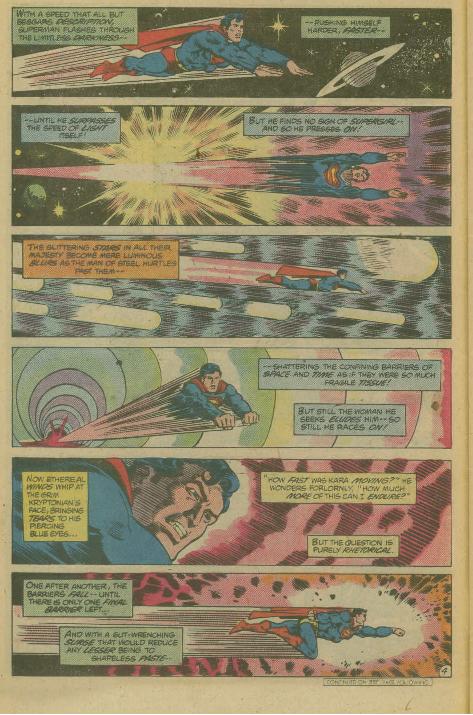
DC Comics Presents #28 (December 1980) was written by Len Wein, drawn by Jim Starlin and Romeo Tanghal, and edited by Julius Schwartz. It opens with Superman and Supergirl on the trail of Mongul and his Death Star knockoff "Warworld." Say, wouldn't last issue's guest star, J'Onn J'Onzz, have been good to bring along? Well, Supergirl's helpful exposition tells us that in order to get Warworld's Crystal Key, Mongul kidnapped Lois Lane, Jimmy Olsen, and Steve Lombard to force Superman into fighting J'Onn for it. (Steve was the office jackhole, but I guess two out of three was good enough for Supes.) The implication is that the fight took so much out of Supes and J'Onn that although J'Onn took the worst of it, Supes still had to call in Supergirl.

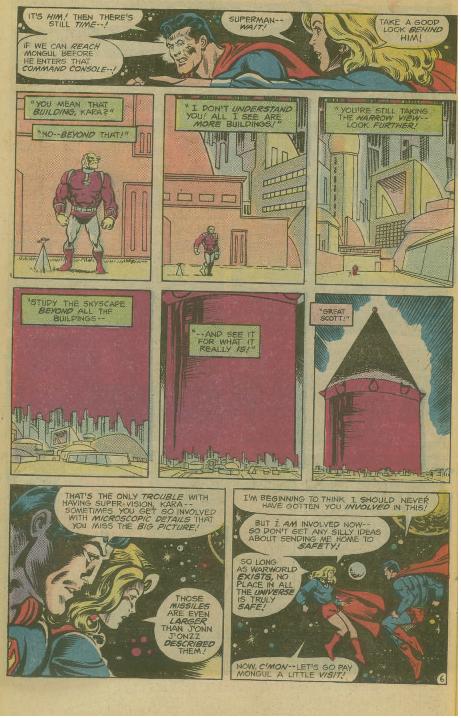
Like I said before, I didn't buy much DC Presents as a youngster. I'm confident I bought this one because I wanted to see what could have been so important that it needed Supergirl's help. I was not disappointed. This issue revels in that very notion, making Warworld bigger, badder, and meaner than just about anything either Super-cousin had yet encountered. What's more, it does so almost playfully, using variations on the same trick of perspective to convey the enormity of Warworld's various dangers.

Here's the first sighting of Warworld:

I'm sure that sequence only pays lip service to physics (like much of this issue and the next) but it's still pretty impressive. (And even though Warworld could eat stars for dinner and planets for dessert, as we can see from panel 5, it would do so with a smile. Just an indication, I suppose, that in the end the creators still have a sense of humor.)

Telescopic vision gets a good workout on the next page, as Superman and Supergirl analyze every detail of Warworld, from its weapons to its computers to the mountain of graves outside its main city. Although the page suggests that Kryptonian eyes could practically read Mongul's driver's license from two light-years away, the page after that turns the idea on its head:

Smiley-face aside, the bigness of Warworld earns our heroes' respect. Naturally, its sensors pick them up, and after Mongul recalls the events that led to his ouster, scratches his itchy trigger finger.


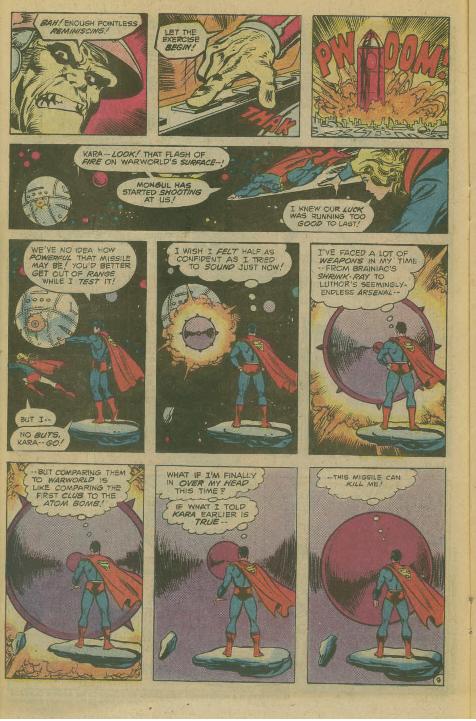
This next page really captures the flavor of the issue. Not only is it another exercise in perspective, it has Superman shooing Supergirl away so he can "test" the potency of a mountain-sized missile. Superman's already given Supergirl a warning about the limits of invulnerability, and once again he takes the big-brother role. To him it makes perfect sense, because although they are pretty equal in power and ability, he's more experienced, she's too impulsive, etc. It almost make Superman look condescending. However, it does set up the last panel....

This page ends with a variation on the same gag, but it hasn't gotten old yet. Again, it reinforces the point that the Kryptonians can't match Warworld for straight-ahead brute force, so Supes decides to employ some "strategery." The cousins make Warworld work overtime to try and kill them, which ends up overloading the cybernetic controls plugged into Mongul's brain, and Mongul keels over. Given that Supes got the idea from the mountain of graves next to the control center, this seems a bit outside his usual ethics. Still, Supergirl's telescopic vision confirms that Mongul is just unconscious, and also an organ donor.


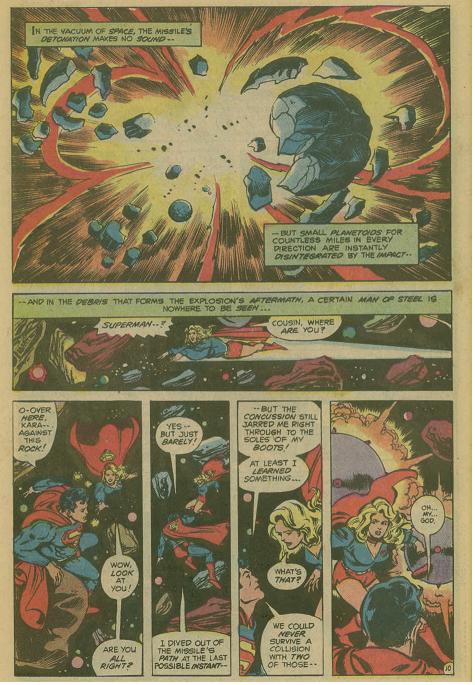
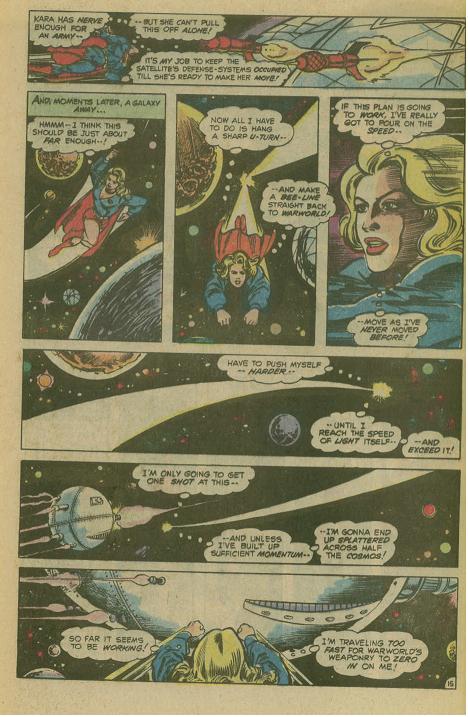
Unfortunately, Mongul's incapacitation has the opposite effect -- Warworld goes off on automatic. Change in plans: while Superman distracts it, Supergirl aims to punch a hole through it by moving faster than its sensors can follow. There's nothing technically adept about this next page, but I couldn't resist another shot of the deadliest smile in the galaxy.

Supergirl's feat allows Superman to fly into Warworld's computer core and reprogram it for self-destruct. Mysteriously, Mongul's not around to slow Superman down as he escapes. Warworld blows up, but now there's a new problem -- where's Supergirl?

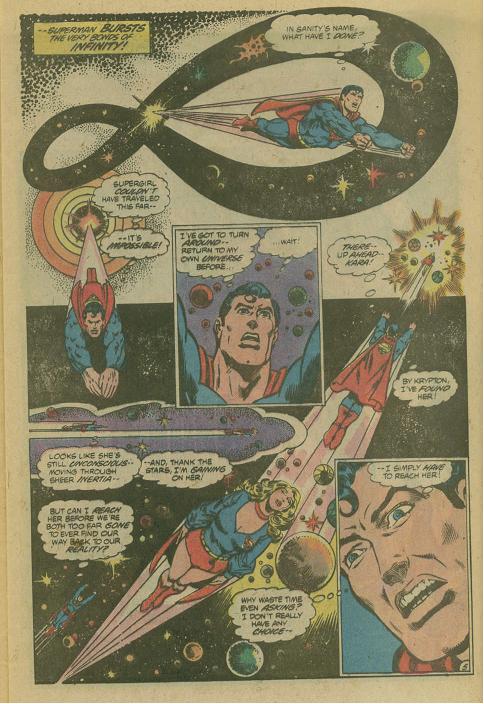
DC Presents #29, by the same creative team, finds Superman tracing his cousin's trajectory. Problem is, she was moving so fast that she's probably way ahead of him by now, so he starts going faster and faster, probably not even paying attention to his speed, until...

... he "bursts the very bonds of infinity!" This snaps him back to reality (so to speak), but before he can try to get back to his "own universe," there's Supergirl, up ahead. On he goes, but not too far, before he literally runs into the Spectre.

Spectre won't let Superman catch up to Supergirl, so Supes tries brute force. No good. He tries to outrun the Spectre, but again, Spectre is faster. Growing until he dwarfs Superman, the Spectre picks Supes up by his cape and intones, "You are one of the most powerful beings in all of creation -- and yet, in so many ways, you are little more than a child! There is so much you have yet to learn ... perhaps it is time your education begin in earnest!"

Spectre shows Superman Jor-El's futile attempts to save Krypton, which Superman imitates with similar results. Spectre then shows Superman literally unable to save Jonathan Kent from the Grim Reaper. Finally, three years before Superman III, Spectre has Superman's dark side attack him. Dark Supes is "pure, unadulterated power, without rein, without restriction ... without conscience or remorse ... power that can ultimately destroy you ... if you allow it to run amok!" What to do?

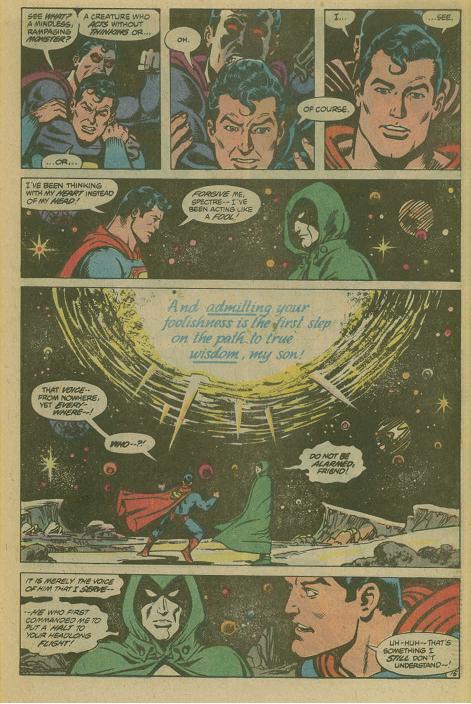
Superman's sarcastic observation turns into a moment of reflection which allows him to see that he's been thinking with his heart, not his head. The Spectre's boss also makes an appearance, more or less, blessing Supes' newfound clarity.

Still, why did Spectre stop Supes from catching Supergirl? The answer is that Superman was "traveling far faster than [he] ever had before ... shattering barrier after barrier until only one remained ... that golden veil beyond which no living man may trespass!" Somehow, according to the Spectre, that "risked the ultimate destruction of civilizations beyond numbering!" Either that means Superman was going to kill himself -- thereby depriving said civilizations of a protector -- or by breaking the "heaven barrier" he would have released some ultra-powerful cosmic energy. In other words, don't cross the streams.

Anyway, Supergirl turns up fine, Superman has learned a valuable lesson, and everyone goes away happy. The End.

Now, clearly this is not the most serious examination of the implications of the Earth-1 Superman's power, but I like these issues because they go from reverence to irreverence and back again. The Warworld attacks in #28 manage to be both suspenseful and over-the-top, and the amount of power being thrown around there sets up the deeper discussion of #29. I'm sure there have been other Superman stories questioning why he can't be everywhere and save everybody, but this one handled the question briefly and well. You say there's nothing too powerful for Superman, let alone Supes and Supergirl? Wein and Starlin cheerfully present Warworld. Well, what about the potential abuse of that power? Wein and Starlin use the Spectre to remind Superman that vast though it may be, there are limits, self-imposed and otherwise, on his power.

In hindsight, of course, these issues help reinforce the impact of Supergirl's death in Crisis on Infinite Earths. They show the Kryptonian cousins in their prime, and especially present Supergirl as a happy warrior, more eager and exuberant than Superman. It's easy to see the Supergirl of DCCP #28 charging at the Anti-Monitor, which makes it all the sadder to see the Superman of COIE unable to bring her back one last time. One only hopes that in his mourning, he remembered the lessons the Spectre taught him just a few years before.
Full Post

Wednesday, January 11, 2006

The Sucker and the Suck

I am a sucker for '70s Marvel. Lately I am tempted by the Essential Nova solicitation. (Naturally, while I was noodling around with this post, Jim Roeg professed his love for '70s Marvel and the Onion AV Club posted its list of Essential Essentials. That's me, always a half-step behind the zeitgeist.)

Sometimes the temptation pays off, as with Essential Howard the Duck and most of Essential Tomb of Dracula, but sometimes it just yields cultural relics like Essential Super-Villain Team-Up and Essential Spider-Woman. (Spider-Woman wasn't exactly headlight comics; but if there had been a WB Network in the mid-'70s, "Spider-Woman" would have been on it, complete with Mike Post soundtrack.)

Still, why the '70s? In those grade-school days, I did read a decent amount of Marvel, probably even approaching my DC intake. Most of it was Avengers, Iron Man, and Spider-Man (both monthlies and Marvel Team-Up), with the odd issues of What If?, Fantastic Four, Howard the Duck, Godzilla, and (yes) Spider-Woman.

Since the late '80s, though, my Marvel intake has been creator-driven. I got the Michelinie/McFarlane Amazing Spider-Man, the Peter David Incredible Hulk (probably kicked off by David and Perez' Future Imperfect miniseries), the Waid/Garney Captain America, the Busiek/Perez Avengers, and the Busiek/Chen Iron Man. Now I get the Brubaker/Epting/Lark Captain America. As for the other current Marvel buys, all the great word of mouth on She-Hulk convinced me to pick it up, because I had no particular affection for the character and didn't know much more about Dan Slott. Fantastic Four is the only Marvel book I read solely for the characters, although Walt Simonson first got me to buy it regularly.

The thing about Marvel, of course, is that its superhero line aims for consistency, as if all the books were charting the same fictional history. It's therefore easy to justify a love of '60s Marvel, when the stories were relatively simple but the foundations were still being laid. Accordingly, it's harder to love Marvel the farther away it gets from those foundations.

While I'm sure someone has tried, I don't know where the line is which separates the foundations of Marvel from the structures resting upon them. I do think the '70s represent the beginnings of those structures. Although Marvel in the '70s tried to expand its line around Spidey and the Hulk, it hadn't yet exploded with miniseries and spinoffs. Instead, there were new characters like Howard, Dracula, Shang-Chi, and Killraven, which today inspire curious old fans like me to plop down $16.99 for their Essential collections.

To me the Essentials represent two categories of comics: those I'd revisit out of nostalgia and curiosity to see how well they held up; and those I only remember by reputation. Essential Nova is in the first group, and Essential Killraven is in the second. (Essential Howard the Duck was good either way.) I tend to be more satisfied with the second group, but because I am a sucker, the first group will always be well-represented.
Full Post

Tuesday, January 10, 2006

The Circle Is Now Complete

Sorry about not posting over the weekend, despite Ragnell's best efforts. Instead, the Best Wife Ever and I spent Saturday and Sunday on household chores and errands. We are steadily getting organized, even if it's taking a while. So I started this last night, but went to bed early with a nagging headache.

Anyway.

Last week I finished watching Return of the Jedi, which wraps up my several-weeks-long attempt to view all six Star Wars films in episodic order. As a standalone movie Jedi has its flaws, but as the last part of the cycle it's not bad.

Naturally, its best parts concern Luke and Vader. In that respect it gets some retroactive help from Episode III. For example, Ep III ends with Yoda and Palpatine squaring off while their apprentices also duel. Although Yoda and the Emperor never meet in Jedi, the scene of Vader greeting the Emperor immediately precedes the Yoda/Luke scene on Dagobah, so it gave me a similar vibe. Likewise, the big Luke/Leia revelatory scene on Endor brought back memories of their birth. (I still think Padme should have died a few years after Ep III ended.)

Apart from that scene, though, one of Jedi's big faults is its failure to use Han and Leia to their fullest. The movie seems to consider the issue of their relationship settled once she unfreezes him, except for a bit at the briefing where she acts surprised that he's staying with the Rebels. (If he were going to leave, wouldn't he have split before then? Jabba wasn't getting any deader.) The rest of the time everyone's doing something loud and/or fast, and there's not much opportunity for witty banter in the style of previous episodes. Again, the point of the movie is to show Luke's triumph and the defeat of the Empire -- in other words, big fight sequences.

Those Jedi does well, even with the despised Ewoks. (Lucas' DVD commentary opines that the Ewoks were cannon fodder until the Rebels could gain the upper hand, and let's not forget that Chewie in a scout walker played a big role too.) The tripartite Battle of Endor makes an appropriate bookend for the four-front Battle of Naboo (even if it's really vice versa), but what's interesting to me is the type of special effects employed. Jedi accomplishes pretty much the same spectacle as Phantom Menace without using any computer graphics. Obviously, after Episode III, the amount of computer-generated imagery dwindles. It could even be that the additions to the original Star Wars help ease the transition from CGI-heavy prequels to the original vintage effects. With relatively few CGI additions in Jedi, and none that stand out from the beginning of the Sail Barge sequence to the end of the Death Star, I felt "weaned off" CGI before the big battles started.

One of those concluding additions, of course, is the replacement of armor-less Anakin with a somewhat sheepish Hayden Christensen. I respect the opinions of others, but I liked it. Not only did it supply another link between trilogies, it allowed Luke to see his father in his prime, not as the Jedi he might have grown into. Lucas has suggested that Anakin looks like Hayden now because that's how he looked when he "died in the good side," or some such. I'll accept that, but I'd also like to think Luke sees his own idealized version of Anakin -- a young Jedi, around his own age, wearing robes more reminiscent of Obi-Wan than of Vader.

Ironically, one of the more unfortunate comparisons between Jedi and Episode III is that both movies find Vader utterly defeated after the big saber duels. Vader may get the worst of it in Jedi, since all it seems to take is one last, furious burst from Luke to catch him off guard. Most other times I've watched that scene, I've focused on Luke finally tapping into the dark side to defeat Vader. That's clearly where the emphasis is supposed to be, but with the prequels fresh in mind I suppose the emphasis shifted.

Nevertheless, the parallels are still there. At the end of Episode III, Palpatine rescues Vader and puts him in the suit. At the end of Jedi, Vader kills Palpatine and Luke helps him unmask. It's a neat way to balance everything out, and it illustrates how the cycle manages to hold together almost in spite of itself.
Full Post

Friday, January 06, 2006

Streaks And Geeks

Last night's post sounded a little cranky to me, so sorry for that. I do enjoy maintaining this blog, and if I were to become an everyday blogger, that wouldn't be so bad.

If I get the chance, I will look for that Sandman letter column, to see if it's worth keeping.

And yes, this post keeps the "everyday" streak alive. No promises for the weekend, though.
Full Post

Thursday, January 05, 2006

When The Trades Just Aren't Enough

For a while I have struggled with replacing certain series with trade paperbacks. I have the first two trades each of Sandman and Starman (1994), and from there started getting each on a monthly basis. Each ran about 80 issues, including annuals, specials, and Secret Files, so going to trades would free up a lot of space, and it would probably result in me reading them more often.

However, Starman also had an occasional text-page backup series, "From The Shade's Journal." Usually this would be something about the Shade having lunch in Los Angeles with Mickey Rooney or some such, and he'd make fun of Mickey before skipping out on the check. (He was a villain, after all.) I don't know; I never really read "FTSJ," because 1) I wasn't that into the Shade and 2) it's text, man, and I read the funnybooks so I can look at the pictures. Also, the "Journal" pieces came out irregularly, and I could never remember what the story was from one installment to the next. In other words, I don't think I missed a lot, but I'd hate to get rid of everything and find out later what I did miss. There were some rumors a few years ago about the Shade miniseries being collected along with the "Shade's Journal" pieces, and I would get that if it ever came out.

Along the same lines, selling off the single issues of Sandman to finance the purchase of trade paperbacks would mean losing the Sandman letters pages. Not that I remember a particularly steamy letter from Tori Amos or anything; but there was one letter, shortly before the Vertigo changeover, which still brings back fond memories. It basically made cruel sport of those who would write in claiming never to have read a comic book before, "but then, after a transcendent evening of physical pleasure, my lovah reached under his bedside table and handed me a copy of issue #29...." The guy then went on to say "we all know you have copies of every JLA/JSA crossover in your closet, so get over yourselves," etc., and I'm really not doing it justice. Either that or I have much fonder memories than it deserves. Maybe I'll keep that one issue.

Still, the nonlinear timelines of both books brings up another question: in what order should the stories now be read? Isn't the Ramadan story in Sandman #50 now collected with the "Convergences" stories from about a year before; and aren't a lot of Starman's "Times Past" stories similarly lumped together, when before they were sprinkled in-between arcs? If the collections reflect the authors' true intentions, that's one thing, but I'd rather know the order in which they first appeared, because by and large that's how I first read them.

So there you go. I do think it will be easier for me to convert JSA and Teen Titans to trade paperbacks, thanks to the demise of the letters pages....

P.S. I know this makes five entries in five days, but it's just a happy accident so far. As much as I like doing this, I sure didn't make a New Year's resolution to become an everyday blogger.
Full Post

Wednesday, January 04, 2006

2005 In Review, Part 4: We've Avoided It Long Enough

It hasn't been easy to sort through my feelings about the mega-story which has been running through the DC superhero books since the summer of 2004. I did feel baited-and-switched at the end of Identity Crisis, since I had supposed it to be a self-contained story, not the spark of a longer fuse. What's more, this is a 2005-in-review essay, and the actual Infinite Crisis miniseries still isn't at its halfway point.

Therefore, by way of concluding my look back at last year, let's focus on the five summer miniseries which set up the event, and the series affected most by it.

Greg Rucka's two ongoing series, The Adventures of Superman and Wonder Woman, started the year with their own storylines, but soon became wholly-owned subsidiaries of Infinite Crisis. I thought WW was the better series, because I was never quite sure Rucka really had the same kind of handle on Superman. Not that Rucka didn't have his moments on Adventures, most notably the last Mr. Mxyzptlk story; but for a while his Wonder Woman was really firing on all cylinders, on par with the best of his superhero work.

That makes WW's surrender to Infinite Crisis and its machinations all the more puzzling. Judging by the most recent installments, Diana will close out her first 19-year post-Crisis series having failed utterly at her mission to enlighten Patriarch's World through Amazon philosophy. Regardless of whether this will usher in a new era of fantastic Amazonian adventure in 2006, it's still a depressing way to end a tenure, and a series, which made the most out of the character's potential.

Another post-Crisis book being ushered out by Infinite Crisis is Superman, although it's the 19-year-old book, not the 66-year-old one now set to regain its original title. After finishing up Brian Azzarello and Jim Lee's inconsistent "For Tomorrow," Mark Verheiden and Ed Benes took over in order to tell a series of stories about people becoming paranoid of Superman. While not a direct tie-in to Infinite Crisis at first, its connection grew stronger until it too was subsumed into the larger story. Thus, two out of the three (or four, counting Superman/Batman) Superman titles spent most of 2005 complementing Infinite Crisis, which made for an unrelentingliy dark take on the character.

JLA was the last of the regular series I read which tied into Infinite Crisis, and it was the most consistently entertaining. The year started with the unrelated Kurt Busiek/Ron Garney "Syndicate Rules," which recalled Busiek's glory days on Avengers and contained a few clever mirror-Earth moments to boot. However, even the knowledge that Infinite Crisis elements were upcoming was enough to taint what might otherwise have been meant as moments of genuine character interaction and/or drama. Now those moments were "oh no, they're starting to fight and The League Will Never Be The Same!" Surprisingly, though, when "Crisis of Conscience" began, it turned out to be a good Justice League story for the most part, even if it did end with some awkward setup for Infinite Crisis and the book's final arc. Now, the current "World Without A Justice League" is just marking time until the end. It consists of unremarkable arguments, strung together by a slow-moving Key plot, and it is probably interesting only to longtime fans who at last get to see Satellite-era Leaguers interacting on a case again.

DC Special: The Return Of Donna Troy wasn't billed as an Infinite Crisis lead-in, but her multiple-choice history made her a good choice to realize that the Multiverse wasn't quite forgotten. Beyond that, it was an adequate New Titans story which made more sense if one had just read Wolfman and Perez's "Who Is Wonder Girl?" from The New Titans #s 50-54. I read those issues in 1988-89 when they first came out, but I was glad of the paperback reprinting them this summer.

Now for the main events. I have written already about the bulk of The OMAC Project, Villains United, The Rann-Thanagar War, and Day of Vengeance. (I also did a "2/3 mark" essay back in October.) Villains United turned out to be the best of the four, followed by OMAC, Rann-Thanagar, and DoV. I initially resisted buying Day of Vengeance, and I still think it was the weakest of the three for its treatment of the Spectre. True, the Spectre has been set up for the past several years as an instrumentality of God, which necessarily makes him a tough character to make interesting, but "horny" is still a very hard choice to justify.

Thankfully, Infinite Crisis itself has been pretty good. The lead-in miniseries do seem to have helped streamline InfC's plot, leaving room for Geoff Johns and Phil Jiminez to craft their tale as a standalone story. I haven't read the three issues on their own, but so far I don't think anything major has happened outside their pages. Jiminez especially seems to be enjoying himself, filling the series with allusions to classic DC stories and the original Crisis on Infinite Earths.

It is the nature of current serialized superhero comics that creators don't think fans will accept wholesale changes without being taken along for the process step-by-step. Another version of this was on display in Supreme Power, and the deliberate speed at which that series crept along really turned me off. However, the Infinite Crisis machine set up a number of minor events which could be checked off the list as each little story arc played out. Therefore, instead of devoting X number of issues to accomplish one huge goal, DC let readers choose the little goals they wanted to follow, and the strategy seems to have worked so far.

Still, I don't know if I will want to revisit the "checklist" for a while after it's all over. There's an old saying that "you might like sausage, but you don't want to see how it was made." As far as Infinite Crisis is concerned, 2005 may be remembered as the year in which the sausage-making was put on full display. I'm now ready for the sausage of 2006.
Full Post

Tuesday, January 03, 2006

2005 In Review, Part 3: From Slott To Shanna and Seven Soldiers In-Between

In 2005 I read just about as many miniseries as regular series. Even with my miniseries intake inflated by Seven Soldiers and the Infinite Crisis cottage industry, that's still significant. 7S gets discussed here; InfC later.

Some minis began (or resumed) too late in 2005 to finish before the end of the year. Batman and the Monster Men and Defenders are currently enjoyable. Captain Atom: Armageddon and Spider-Man/Black Cat could go either way.

Picking a favorite miniseries for 2005 was tricky, but for me it was Spider-Man/Human Torch (written by Dan Slott, drawn by Ty Templeton). As pervasive as they were, both Seven Soldiers and Infinite Crisis are technically still ongoing, so it’s hard to judge them based at least partially on expectations. Therefore, I can understand wanting to put an asterisk next to my choice, but in its own way I think it’s as ambitious and far-ranging as either of DC’s events. Each issue had several tasks: 1) evoke a particular era of Marvel Comics, including storytelling style; 2) satisfy longtime fans who bought it for that “historical perspective”; 3) satisfy new readers who just liked Spider-Man; and 4) be funny. S-M/HT did all that, topping everything off with a new development in the relationship between our heroes, and a genuinely touching denouement.

Almost as good were Adam Strange (a 2004 carryover), Batman: Dark Detective, Astro City: The Dark Age Book One, and G.L.A. Each had some minor shortcoming: Adam Strange was hijacked by Infinite Crisis; Dark Detective had a weird Young Bruce Wayne flashback that didn’t seem to fit with the rest of the story; Astro City sometimes struggled to find a balance between its feuding brothers and the Silver Agent’s trial; and G.L.A. ended up becoming almost as grim as the comics it parodied (although the GLX-Mas special was great).

City of Tomorrow, “Nightwing: Year One” (in Nightwing #s 101-06), and Serenity were enjoyable but not particularly memorable. I’ve written already about CoT and NWY1; so with regard to Serenity I will say that it was very evocative of “Firefly’s” crew, but just seemed like an appetizer for the movie and not a complete story in itself.

As for Shanna The She-Devil, the less said, the better, especially with regard to a certain hideous attempt at catchphrase.

By virtue of its volume, scope, and pedigree, Seven Soldiers almost dared readers to ignore it. Every miniseries began in 2005, and four concluded. Of those four, I liked The Manhattan Guardian best, followed by Klarion, Zatanna, and Shining Knight. Maybe this is because MG required the least amount of brainpower from me. Apparently each of these miniseries had deeper levels of meaning and interconnection than I had time, energy, and/or inclination to discern, but on balance that may be my loss for not devoting sufficient effort to analyzing them (or, in Zatanna’s case, reading all of Promethea). Among the final three, the single issue of Frankenstein was as good as the two issues of Bulleteer, but Mr. Miracle may turn out to be the project's only real clunker.

Other commentators have really taken to Seven Soldiers, and from reading their essays I get the sense I have missed out on a lot of subtext. In my own defense, part of my problem with Seven Soldiers has been its publication schedule. It’s easy enough for me to remember what happens from month to month, but once issues start coming out less frequently, it gets harder for me to enjoy them. There are exceptions, naturally: Planetary produced maybe two issues in 2005, but I was still able to enjoy each on its own terms. Maybe if Seven Soldiers’ components had stayed fairly disconnected from each other, I could have assimilated them better. I don't want to sound like I am either railing against "the elite" or saying I am too stoopid for the work -- just that I think it will be several more months before I can really give Seven Soldiers the attention it requires.

Next: the elephant in the corner.
Full Post

Monday, January 02, 2006

2005 In Review, Part 2: Beyond The Infinite

Here are two words for devoting Part 1 to numbers: Infinite Crisis. While I can't avoid talking about it, I do want to mention the rest of the field.

My favorite regular series, month in and month out, were Captain America (written by Ed Brubaker, drawn by Steve Epting and Michael Lark) and Firestorm (written by Dan Jolley and Stuart Moore, drawn by Jamal Igle). Both were satisfying on almost every level, including effective use of color. Captain America wove an intricate blend of espionage and superheroics into a very personal story about the possible return of Cap's revered sidekick; and Firestorm was a refreshing new look at the classic "teen superhero" setup. Its accomplishments are even more impressive considering they occurred across two writers' tenures.

Just short of that level of enjoyment were a number of very good series with only a few missteps. Batman and Detective Comics each saw their year-long story arcs interrupted by what turned out to be the frustrating, if not outright infuriating, "War Crimes." Gotham Central suffered similarly from a less-than-its-usual-standard Day of Vengeance crossover. With Green Lantern, Geoff Johns seemed to be using his talents mostly for good, including no Infinite Crisis intrusions, but the level of grue in the Shark storyline was a little off-putting. While I liked She-Hulk 2 well enough, it did start to feel a bit familiar. As for Legion of Super-Heroes, sometimes I just felt like Mark Waid thought I knew more about the plot than I actually did. Again, I really liked these books, except for the nitpicks.

A change in creative teams was either a big boost to some books (Chuck Austen to Gail Simone on Action Comics) or a big letdown to others (on Fantastic Four, Waid and Mike Wieringo giving way to J. Michael Straczynski and Mike McKone). Peter David's return to Incredible Hulk was good for about six months before House of M pretty much ended it. (I couldn't get to the shop early enough to get any of the HoM issues.) Star Wars: Empire featured rotating creative teams which, until the current arc, didn't really do anything spectacular.

Anthology series were also somewhat inconsistent. Batman: Legends of the Dark Knight started the year by finishing an enjoyable Riddler story, but over the summer preceded a good Mr. Freeze arc with a middling, unrelated Freeze two-parter. JLA Classified followed Grant Morrison's inaugural 3-parter with the Giffen/DeMatteis "I Can't Believe It's Not The Justice League," but ended the year with Warren Ellis' only intermittently entertaining "New Maps Of Hell." The best anthology series I read was Solo.

I have dropped Astonishing X-Men, JSA, and Teen Titans, mostly because the books just weren't doing anything for me. I know there are a lot of folks who feel differently, so far be it from me to harsh anyone's buzz. Still, Astonishing didn't work that classic Whedon magic on me; JSA's Per Degaton storyline collapsed under its own weight; and Teen Titans got too wrapped up in Identity Crisis fallout. (However, I don't think that one needs to have read Teen Titans to enjoy Infinite Crisis, and this means I did miss part 1 of the Captain Carrot arc.)

I was struggling with whether to drop Batman: Gotham Knights, The Flash, and Superman/Batman, because I was getting really tired with the directions in which their creative teams were taking them, but cancellations and/or news of creative changes have since spared me from making those decisions.

Finally, a few series started this year but haven't accumulated too many issues yet. The "oldest," All-Star Batman & Robin, reads like a decompressed gonzo nightmare, but the more of it I see the more fun it seems. At the opposite end of the spectrum, Dan Slott's two issues of The Thing have hit the ground running, starting from the simple premise that Ben Grimm is a superhero with nothing else to do except have adventures. If it can keep that up it has a long and happy future ahead. Similarly, Grant Morrison and Frank Quitely's All-Star Superman has produced one very engaging issue which aims to encompass as many classic Superman riffs as possible.

Next: miniseries!
Full Post

Sunday, January 01, 2006

2005 In Review, Part 1: Attrition And Subtraction

Here is Part 1 of my 2005 year-in-review. You will probably call it "the boring part." Because I buy so much DC, and DC has put out so much this year with an (apparently) leaner 2006 in mind, I wanted to see how the numbers stacked up against previous years.

It seems like, with regard to entertainment, this has been a year of attrition generally. Probably a lot of that is due to our big interstate move and its attendant issues, but we went to fewer movies, and I am definitely set to watch less TV in 2006. Between dropping "Desperate Housewives," the cancellations of "Arrested Development," "Alias," and "Kitchen Confidential," and the move of NBC's Tuesday-night comedies to Thursday, I now watch no network TV on Monday and Tuesday nights, and only "The Simpsons" on Sunday (other than football).

Therefore, going into the comics analysis, I had a feeling I might be in a period of actual fiscal responsibility, and was buying most books because I enjoyed them (or at least expected to), not out of inertia. The raw numbers seem encouraging in this regard. The following totals represent both floppies and collected editions over the past five years.
2001: 399
2002: 343
2003: 367
2004: 379
2005: 369

After the extremes of 2001 and 2002, a steady pattern seems to be emerging. Of the 369 individual items I bought in 2005,
  • 65% (240) came from 29 regular series (22 DC, 6 Marvel, 1 Dark Horse)
  • 28% (104) came from 29 miniseries (23 DC, 5 Marvel, 1 Dark Horse)*
  • 2% (5) were special issues (3 DC, 2 Marvel); and
  • 5% (20) were collected editions (12 DC, 8 Marvel)

Across the board, I bought 80% DC (297), 17% Marvel (66), and 2% Dark Horse (6; the Serenity miniseries and Star Wars: Empire).

These numbers are not completely accurate, since they only include data from my monthly Previews budgeting. That goes into an Excel spreadsheet which, although I am not an Excel pro, has spit out a fairly accurate summary of my weekly habits. I will say that I also bought the two Complete Peanuts volumes which came out this year, and I may have come into some back issues, but certainly not as many as in previous (i.e., Comic-Con) years.

Now for the 2006 outlook. Right now it looks like 22 of 29 regular series, and at least one issue for 16 of 29 miniseries, will survive into the new year. Gone from my regular list are Astonishing X-Men, Batman: Gotham Knights, Gotham Central, Incredible Hulk, JSA, Superman (1986-2005), and Teen Titans. Also set to wind up early in 2006 are 11 of the 16 miniseries, including Infinite Crisis and its miniseries' specials, Green Lantern Corps, Defenders, Spider-Man/Black Cat, and Seven Soldiers. (I am counting the continuations of/sequels to Astro City, Batman and the Monster Men, Dark Detective, and Captain Atom in those 16.)

Regular series which I may add in 2006 currently include Aquaman, Hawkgirl, and Robin. Miniseries include Sgt. Rock, 52, and maybe Batman: Year 100 (the price makes me nervous). That would be 25 regular series and 19 miniseries, which sounds steady, if not exactly responsible. If I get back to Comic-Con this summer, that may be a truer test of how "responsible" my shopping can be....

Next up: likes and dislikes for the books themselves!


* including Nightwing #s 101-06, comprising "Nightwing: Year One"; and lead-ins like DC Countdown and Seven Soldiers. I also counted each 7S miniseries separately.
Full Post

Friday, December 30, 2005

Fast Away The Old Year Passes

This is not my big year-in-review post. I am still doing the research for that one. However, I did want to get in one last post before the end of the year, just in case I get stuck doing something fun (and yet mysteriously not blog-related) tomorrow.

Even though my comics reading habits work out to about 80 percent DC, 20 percent Marvel, and a tiny percentage for a few other publishers (see? research), I do like to think I have a healthy awareness of this particular shortcoming. Another big shortcoming, of course, is my Grumpy Old Coot tendency to wish that everything was as good as it had been in any random year before this one.

I got on this kick thinking about the old Batman/Superman team-up books that were pretty much gone twenty years ago: World’s Finest Comics, The Brave and the Bold, and DC Comics Presents. Of the three, World’s Finest was my favorite, because it guaranteed Batman and Superman, the superheroic ideals. Next was The Brave and the Bold, which guaranteed Batman every issue, and that usually meant more suspenseful stories than the Superman team-ups of DCCP. The exception, and the one time I really paid attention to DC Comics Presents, was a three- or four-part saga in #s 26-29 (Oct. 1980-Jan. 1981), drawn by Jim Starlin, which introduced Mongul. The guest stars were Green Lantern, J’Onn J’Onzz, Supergirl, and the Spectre, and the highlight was Superman and Supergirl’s takedown of Warworld in #28. The kicker was, Supergirl was lost at the end of #28, and next up was the Spectre, so things didn’t look too good for her. Really fantastic cosmic stuff, which actually tested the heroes’ abilities, or so I seem to remember.

Anyway, the point is, Superman team-ups tended not to work because Superman was almost too powerful for his solo adventures. Today, since he’s less powerful, maybe a Superman team-up book would be fun, but most of the other heroes tend to revere Superman, and although I have not experienced it myself, constant adulation might get a little old, even if you are the one being adored.

Conversely, though, a new Batman team-up book might be fun precisely because all the other heroes would either be scared of him, or secretly thinking he’s a tool, or both. If visiting Superman is like going to see Santa at the mall, visiting Batman is like going to the dentist – and not the happy-happy dentist with the toy chest, but the one who works out of a trailer, thinks anaesthetic is for sissies, and would just as soon be left alone. A Batman team-up book would have to be done from the guest’s perspective, because issue after issue of Batman going from disapproval to grudging acceptance in 22 pages would definitely get old.

As for World’s Finest, it has come back, kind of, in the form of Superman/Batman, a title short on imagination but apparently beloved by focus groups. I’m not going to dwell on my least favorite part of S/B’s format (dueling first-person narration), so instead I will note that it has tended towards highlighting the differences between blasé, trusting Superman and practical, paranoid Batman. Every issue talks about how dissimilar they are and how they manage still to overcome it all to remain secretly close chums. Imagine the nightmare if "The Odd Couple" or the average buddy-cop movie had its protagonists talking constantly about their conflicted feelings toward the other. ("I admire Oscar, and would trust him with my life, but I do wish he would make his bed so I didn't have to do it every day. Still, having lost his parents to crime, it is so hard for him to trust in a person's basic goodness....")

What does this have to do with the end of the year? Just that fond memories don't mean that some old comics need revival, because their times may actually have passed. With regard to the Superman/Batman relationship, I also feel compelled to add the recurring caveat that It Could All Change After Infinite Crisis, which is another reason to be glad 2005 will soon be in the rear-view mirror.

If I don't get a chance to say it before 11:59 EST tomorrow, have a safe and happy New Year's!
Full Post

Tuesday, December 27, 2005

Golden Moments

What a Christmas we had! It was 9 1/2 hours driving to Chattanooga from Williamsburg on Thursday the 22nd, and 9 hours back yesterday. (The difference was not getting caught in Knoxville's rush-hour traffic.) In between my mother-in-law and the Best Wife Ever's sister-in-law both got sick with stomach flu. I had a cold on Thursday, but a big dose of Nyquil and about 13 hours of sleep took care of that.

We still had an enjoyable holiday with our families, and while others recuperated, I had the foresight to bring along A Christmas Story, "A Charlie Brown Christmas," Elf, and the MST3K editions of Santa Claus Conquers The Martians and the Mexican Santa Claus. (Thanks to Netflix, the first disc of "Aeon Flux" was in there too, but that's not so Christmas-y.)

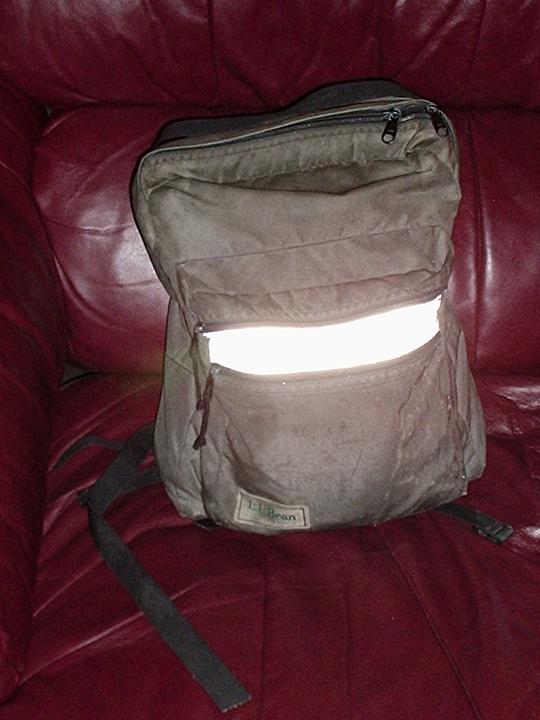
This year also marked the end of an era. A little over twenty years ago, I began my junior year of high school with a new backpack. It was sturdy and well-designed, with pockets upon pockets -- just the thing for schoolwork on weekdays and D & D on weekends. I used it through college and law school, and it went with me on excursions far and near. It has been from the Jersey Shore to the Pacific Coast Highway and from Florida to Niagara Falls. Lately I started calling it "Golden Boy," probably out of recognition that it was due to retire. When the Best Wife Ever asked what I wanted for Christmas this year, naturally I wanted Golden Boy to get a good sendoff.

So it was with a certain twinge of guilt that I opened the gold-wrapped present from the Best Wife Ever to find Golden Boy's successor. I don't know if it will put in the mileage that Golden Boy logged, and of course I'm tempted to say they don't make 'em like they used to. There may well be a display case and plaque in Golden Boy's future, but for now it will get a well-earned rest.

1985-2005

Full Post

Sunday, December 18, 2005

Infinite Christmas

Fans of a certain age -- let's not be coy, my age -- remember the event twenty years ago that was supposed to set everything straight. In Christmas on Infinite Earths, the Anti-Santa sought to stop Christmas from coming, but was thwarted by a vast assemblage of heroes from across time and space. Who could forget the opening scenes of issue #1, as onetime toy deliverer Jack Skellington was obliterated by the Anti-Santa's wave of all-consuming ennui?

We thrilled to revisit classic team-ups like Rudolph the Red-Nosed Reindeer and Frosty the Snowman (the "Season's Finest"), and witness new alliances like Clarence the Angel and Charlie Brown, Emmett Otter and the Little Drummer Boy, and Clement C. Moore (or was it Henry Livingston?) and David Sedaris. The sight of Santa wielding both Ralphie Parker's Red Ryder BB Gun and Linus van Pelt's security blanket came off surprisingly well; and even though they were villains, it was still disturbing to see Scrooge, the Grinch, the Bumble, and a group of Martians lose their time-traveling battle to stop the 31st Century Santa-Bot from freeing the Anti-Santa. Finally, lest we forget, it was the Herdmans' and Misfit Toys' emotional plea to the Angel Gabriel that convinced him to intervene, thereby giving Santa the fighting edge he needed over his evil opposite.

Seems like Christmas preparations start earlier every year, but this year March had Countdown to Infinite Christmas, a one-shot which killed Yukon Cornelius and introduced four summer-spanning miniseries. Aside from fueling speculation that Buddy the Elf would become the new Cornelius, it was all a big buildup to the current holiday apocalypse. Along the way, Santa's army of helpers got turned into killer cyborgs and put everyone on the "naughty" list; a weird spatial anomaly opened up over the North Pole; a duplicate Scrooge was revealed; and Clarence was seduced by Eclipso, who in turn was defeated by the Nutcracker. Yeah, I didn't understand that last one either.

So now Infinite Christmas is here, revealing the original Saint Nicholas' plan to restore the holiday to its religious roots and have folks "keep Christmas all year 'round." I have to say, Geoff Johns and Phil Jiminez certainly treat Nick reverently, even if objectively he is the villain of the piece. Although the chaos he kicked off was entertaining, the Anti-Santa wasn't much more than a scary plot device.

It's also tempting, in the face of rampant Christmas commercialism, to applaud such a back-to-basics approach. Nostalgia is essentially a rebellion against the perpetual march of time, and the fact that Christmas comes at the end of every year just makes nostalgia for its traditions more powerful. Who wouldn't want to have a few more child's-eye holidays, when two weeks of vacation could start with a leisurely walk home from school under slate-grey clouds fat with snow -- when the wind wasn't cold but bracing, and your only responsibilities were to keep your nose clean and your questions to yourself until the morning of December 25?

And yet the most powerful aspects of Christmas, anticipation and hope, are always with us. Early Christian public-relations gurus knew what they were doing when they scheduled Christ's birth celebrations around the winter solstice, because the darkest time of the year is perfect for ushering in the light.

A slightly twisted version of that approach is on display in Infinite Christmas. We know that Rudolph, Santa, and Frosty will become friends again. We know the reindeer will reunite (and in their absence, Earth-2 sleigh-pullers Dunder and Blixem can help pick up the slack). We know that as with every new year, change is inevitable, but perhaps only incremental; and nothing we can't handle.

When I was a kid I got excited over a few weeks of vacation from school. As I grew up I learned to keep hope alive all year. Even if I don't have a long vacation anymore, Christmas still gives me a bit of a break. Like the song says (watch out for the auto-play music past the link):

And ye, beneath life’s crushing load,
Whose forms are bending low,
Who toil along the climbing way
With painful steps and slow,
Look now! for glad and golden hours
Come swiftly on the wing.
O rest beside the weary road,
And hear the angels sing!

Happy Holidays, blogosphere!

(P.S. The GLX-Mas special was brilliant.)
Full Post

Tuesday, December 13, 2005

Smells Like Team Spirit

[Looks like I published a draft of this accidentally. Enjoy the finished product!]

The Justice Society of America was made up of the highest-profile superheroes under what became the DC umbrella. Later, so was the Justice League of America. The third of DC's three long-lived teams, the Teen Titans, tended to be more of a niche group, being composed largely of junior partners. Other teams have come and gone, and some (like the Doom Patrol and the Outsiders) have had multiple incarnations, but the JLA, JSA, and Titans have permanent spots in DC's lineup. Still, why does DC need them?

In dramatic terms, each was organized as a social club, with only the Justice League being structured enough to have regularly scheduled "monitor duty" and signal devices. As it happens, though, each team corresponds to an heroic generation. Nowadays, from oldest to youngest, we have the Justice Society, Justice League, Outsiders, and Teen Titans. (The generational divides were easier to see when the two youngest teams were the no-modifier Titans and Young Justice.) This reinforces the social-club idea, but by the same token, it's a little unsettling to think that groups of ultra-powerful costumed vigilantes would just "hang out." I'm sure there are psychological and sociological underpinnings, as with Watchmen's Minutemen, but outside of hijinks in Justice League International and the "Teen Titans" cartoon, I can't say DC has really made a point to explore them.

With the Infinite Crisis-related dissolution of the Justice League, the opportunity exists for the Justice Society to get back on top of the superhero world. The JSA could even take in former Leaguers, as it did with Black Canary II. Unfortunately, in the wake of InfC, the Leaguers aren't really in a position to get the band back together. Superman, Batman, and Green Arrow may not be speaking to each other; Wonder Woman, Flash, and Atom may be in limbo; and Aquaman and Green Lantern have enough to handle undersea and in space.

Granted, it would be clever of DC to let the JSA "take over" for the League on what might look like a permanent basis. One could argue that the JSA was the most powerful team fielded during Crisis on Infinite Earths, which was during the "JL Detroit" period. I've said it before, but at no point during COIE was the original Justice League -- the team whose multiple-Earth adventures inspired Crisis, remember -- reunited, even superficially, in the face of almost certain extinction. The opening pages of Crisis drive this point home by showing both the League's evil counterparts (no "Crime Syndicate Detroit?" Now there's a missed opportunity!) and the gutted JLA Satellite.

The "One Year Later" books therefore have the chance to emphasize and clarify the role of the Justice League in the larger scheme of things. The current situation, with a Justice League having to reinvent itself from the ground up, may be unique in that the world already has an established Justice Society. When the League first formed, the JSA had disbanded. The JSA was in Limbo (literally) from 1986-92, and when it returned, the League had long been established. When the JSA was revived in 1998 after disbanding again in 1994, the League was still there. Now, the current JSA is in a position to fill the League-sized void, and DC may well let it for a while.

Not forever, to be sure. I imagine various JSAers and Teen Titans working with Batman, Superman, and other expatriate Leaguers separately, but "matchmaking" with each of them in attempts to get the League back. At the risk of recycling another old thought, it would also be nice if the reorganized JLA had its roots in Mark Waid's new The Brave and the Bold.

It would be a little silly for me to spend a lot of time on a dream-team JLA, not least because we don't know who will be around to join. However, for the bulk of its history, the JLA has been DC's all-star team. '70s Tom might not have been a regular reader of the heroes' solo books, but he always liked seeing everyone in Justice League of America. '80s Tom appreciated the unique post-Crisis membership of the Giffen/DeMatteis League; and early '90s Tom respected Dan Jurgens and Gerard Jones' attempt to fuse together the JLI and classic League. Of course, late '90s Tom was positively giddy over the Morrison League, but I doubt we'll see anything like that again.

In restating the JLA's purpose, DC can also address the need for a Justice Society and Teen Titans. I haven't read JSA or TT in about a year, mostly because I was getting the sense that regardless of their stated purposes, they existed pretty much as legacies. The "reunions of names" took its cue from the Morrison JLA, and for a while both teams got by on the novelty of seeing Jack Knight or Tim Drake carrying on their respective traditions. The Titans also benefited from saying openly that they were a social group set up to handle the angst of being a teenaged superhero.

Still, a world with a Justice League may find it difficult to justify a Justice Society. I'm not saying that the JSA should be subsumed, ABA- or AFL-like, into the JLA; and I don't necessarily want the group disbanded. However, it may be time for the JSA to also embrace its "social" underpinnings. It is arguably just as exclusive a club as the JLA; and perhaps more so, due to the legacy element. James Robinson's Starman, which did a lot to birth the current JSA, really explored these aspects of generational superheroics. To me that is the JSA's strength, even if it doesn't lend itself to a steady diet of combat.

However the JLA is reorganized, DC should make sure its members will be sticking together for the duration. The Giffen/DeMatteis Leagues lasted five years, and the current title has made it through about nine. Unfortunately, the team's history also includes a few short-lived rosters, not all based out of Detroit. The potential for a 21st-century Justice League is limitless, and I'm eager to see what DC does with it.
Full Post

Saturday, December 10, 2005

New comics 12/7/05

Detective Comics #814 (written by David Lapham, pencilled by Ramon Bachs, inked by Nathan Massengill) is a somewhat confusing conclusion to "City of Crime," the twelve-part epic that was interrupted by a crossover and so took over twelve months to tell. It ends on the note of cheerful nihilism that marked the rest of the arc, but it asks the reader to remember characters and subplots from about a year ago, and so may be more appreciated in collected form. Overall I enjoyed "City of Crime," and if I get time may do an omnibus recap.

More to the point is Batman and the Monster Men #2 (by Matt Wagner), which also intends to use a large cast -- including Hugo Strange, Boss Maroni, Julie Madison, and her father -- but so far keeps better track of them. Wagner has always drawn a great-looking Batman, and here the minimalist "Year One" style isn't far from his own. My one quibble is a familiar one, namely first-person narration from various perspectives. It's not hard to tell who's speaking, but there's not a lot to differentiate the speakers when they switch.

Gotham Central #38 (written by Greg Rucka, pencilled by Kano, inked by Stefano Gaudiano) starts what will probably be the book's last arc. Despite the cover, and the rumors swirling around bad cop Jim Corrigan, there are no hints that he was the original Spectre or will be again. (Still, if a murdered do-gooder were to become the Spectre's new host, like good cop Jim Corrigan did back in the day, one could make an argument for a candidate in this issue.) Better characterization of Montoya and Allen this issue, and I continue to be amazed with how consistent the look of the book has been.

Superman #224 (written by Mark Verheiden, pencilled by Tom Derenick, inked by Wayne Faucher) presents a compare-and-contrast story of Superman vs. Blackrock and Luthor vs. an OMAC which actually comes off fairly well. While I don't want to say that there were no good "corporate Luthor" stories, in the old days he couldn't just steal a plane and kill a pilot; and not having to get through those plot mechanics makes things go faster. The issue includes another switch-to-Superman moment, which I am noticing more and more in recent months, and which I applaud for purely sentimental reasons.

Superman Secret Files 2005 includes two stories, a kids'-eye view, a Lois-meets-Superman tale, and an odd Bizarro two-pager. The first story, written by Devin Grayson with art by Ariel Olivetti, is sweet, if a little mawkish. The Lois story, written by Jami Bernard with art by Renato Guedes, is fine, but I can't decide if its slightly revisionist take on Lois' early relationship to Supes puts her in a good light. It has an uncanny Christopher Reeve evocation on the last page. The Bizarro "origin," written by Christine Boylan with art by Carlos Ferreira and Drew Geraci, starts out as a parody and ends up in pathos. None is absolutely essential, but then again, none are really the kinds of Superman stories the monthly books have been telling, so on balance it may be worth a look.

Seven Soldiers: Mister Miracle #2 (written by Grant Morrison, pencilled by Billy Patton and Freddie Williams II, inked by Michael Bair) reveals more of the "disguised" New Gods, and I start getting confused. Not because I'm trying to fit this into a convoluted DC-mainstream timeline, or trying to decide whether this is "real" or an alternate universe, but because I'm looking for familiar faces and everybody is drawn as hulking bald men. Still, by the end Darkseid and DeSaad are revealed, and that helps things get creepier. Maybe the larger plot will turn out to be "Shilo Norman escapes from the alternate universe," which would be OK but not very imaginative (considering I thought of it), so I hope Morrison ramps things up a little more and eases up on all the bald guys.

She-Hulk 2 #2 (written by Dan Slott, pencilled by Juan Bobillo, inked by Marcelo Sosa) features the big Return Of Hawkeye, sort of, and it may or may not be permanent. There are some funny bits, and a couple of heartfelt ones. However, the whole plot also revolves around a weird time paradox which exists for its own sake. Now, that's fine, and I can accept it, but I'm still trying to work out the mechanics.

Finally -- and I do mean "finally" -- Spider-Man/Black Cat #4 (written by Kevin Smith, drawn by Terry & Rachel Dodson) is an extended set of conversations between BC and Matt Murdock and Matt and Peter Parker; and it ends with a Spidey/Daredevil/mystery villain fight. "Oh, a dialogue-driven Kevin Smith book," you say,"how innovative." Yeah, it's like that, but it doesn't seem as witty as Smith's earlier Marvel work. (And when I say "earlier" ... oh, it's just too easy, isn't it?) Moreover, Smith makes a big deal of not revealing Matt Murdock, when it's patently obvious virtually from the cover. The other thing is, I'm not sure about the Daredevil timeline. I am not a real DD scholar, but I think it refers to events from the intervening years, and that seems like cheating to me.
Full Post

Another Saturday, another mea culpa

Most of the week I was in Lexington getting CLE (continuing legal education) credits and catching up with various folks. This had me avoiding supposedly scary winter weather on Tuesday and Thursday and trying not to get caught on the West Virginia Turnpike after dark. I kid the WVTP, but really, much of it is like a downhill slalom, and it's better negotiated without ice. Still, a friend of mine mentioned that until about 20 years ago, I-64 ended at Charleston, WV, and if that were still the case, my trips would be a lot longer and less pleasant.

So last night, after work, I picked up new comics and caught up on all the TV I missed. I hope to have a new-comics post up tomorrow afternoon. I am also working on a Christmasy essay which could potentially turn into something strange.

Back soon.
Full Post

Saturday, December 03, 2005

New comics 11/30/05

Adventures of Superman #646 (written by Greg Rucka, pencilled by Karl Kerschl, inked by Wayne Faucher) was a really good issue, and possibly Rucka's best single issue on the book. Although many writers, including Rucka, have played Mxyzptlk as a buffoon, here he really jerks at the ol' heartstrings, showing Mxy stripped of his powers and much of his faculties. The confrontation with Ruin also hearkens back nicely to the beginning of Marv Wolfman's run on Adventures, almost twenty years ago. What works about this issue is its uncomplicated nature. Superman, Mxy, and Ruin are all laid out in simple terms, and after months of everything tying into something else, it's a nice change. (There is a bit of crossover business with Lois and her shooter, which is good and doesn't distract.) Now clap your hands, kids, if you want the imp to get his powers back....

Rucka's other book this week, Wonder Woman #223 (pencilled by Rags Morales and Cliff Richards, inked mostly by Ray Snyder), was also in last-stand mode. It may be just a coincidence, but the pre-Crisis WW title ended with a siege of Paradise Island by shadow-demons. Substitute OMACs for the demons and here we are again. Rucka does a good job building suspense about who lives and who dies, and naturally Wonder Woman gets a chance to be hardcore. The art is a little too busy, though, such that it's hard to tell who's fragging who. As carnage-filled as the issue is supposed to be, I don't think that was the desired effect.

Since reading last week's Captain America, Batman #647 (written by Judd Winick, pencilled by Doug Mahnke, inked by Dustin Nguyen) can only suffer in comparison. The comparison itself may be a little unfair, since Batman and the Red Hood are ostensibly working together and Cap and the Winter Soldier aren't, but as you might expect, Batman betrays very little of the emotion here that Cap did last week. The story itself is a straight-up superhero fight involving C-list villains sent by the Secret Society to take out the Hood, and on those terms it's pretty entertaining. I will say, though, that Winick's use of first-person narration is another strike against it. He starts off with Alfred and switches to Batman, and back to Alfred again. While it's not like I expect to be spoon-fed, I think he could have accomplished the same thing by using a third-person narrator. He is still no Jeph Loeb, thank goodness.

JLA Classified #14 (written by Warren Ellis, art by Butch Guice) also trod familiar ground, this time the old "your fears will destroy you" dodge. The art is good, and the story holds some surprises, but not many.

Finally, the first year of Waid and Kitson's Legion of Superheroes (#12) ends with an all-action issue finding the Legion fighting on three fronts. It's pretty good, espeically if you don't mind a couple of the surprises to be reveals of familiar Legionnaires. Still, every time Waid mentions "Terror Firma," I think of "Terror Incognita," the better pun which he used in JLA. The issue also features a Lightning Lad/Saturn Girl backup, by Stuart Moore and Ken Lashley, which was clever but probably makes more sense in the context of the larger story.
Full Post