Thursday, March 02, 2006

Quick Thoughts On Batman Annual #25

Last week, after reading Batman #650, I thought that the “Red Hood” storyline suffered by association with Infinite Crisis. To that point I had enjoyed both, but both were (no pun intended) worlds apart in terms of tone. The Big Event moment came out of left field, introducing an element of cosmic hoodoo into a tale which acknowledged the larger DC universe but wasn’t affected significantly by it. However, the crossover stuff wasn't that prevalent, and I went into Batman Annual #25 wondering how integral it would be to the return of Jason Todd.

SPOILERS FOLLOW for Batman Annual #25:

5

4

3

2

1

The Annual confirms that the re-animatory spark was a kind of all-purpose Get Out Of Jail Free card, courtesy of Infinite Crisis. Writer Judd Winick linked it to Superboy’s pounding on the walls of netherversal reality, but it might just as well have been a tap on the forehead from the Blue Fairy.

Admittedly, the Batman titles have historically been in something of a bind when it comes to cosmic themes. The books pride themselves on not getting too far from the plausible, but they have to exist side-by-side with characters who travel through space and time at will. Despite conventional wisdom which holds that Batman could single-handedly neutralize most of the Justice League, any incursion of the science-fictional into a “regular” Batman story will likely be greeted with skepticism. Batman’s “sci-fi closet,” postulated by Grant Morrison in the context of a Justice League story, was arguably one of the more daring departures of recent years. However, given the strategic thinker into whom Batman had evolved, he would have been stupid not to have such an arsenal.

Therefore, on one hand it is similarly practical to have Infinite Crisis facilitate Jason’s return. In the larger scheme of things, it’s just as good a mechanism as any other, and probably no less convoluted to explain.

Still, though, it feels like a cheat, given that Infinite Crisis had played such a small role in the story. Winick had already used a number of more traditional superheroic elements in his Batman issues, including Amazo, the android with all the powers of the Justice League. Working a similar established plot device into the story would have drawn both on Batman’s history in the larger DC universe, and would have felt more organic than the almost-literal bolt from the blue Infinite Crisis provided. Heck, Amazo himself could have used Zatanna's powers to re-animate Jason.

In a way this situation reverses the equities of previous comfort-zone-busting story arcs like “Knightfall” and “No Man’s Land.” In both of those arcs, the main problem suggested a quick solution via one or more of DC’s ultra-powerful characters. Zatanna or Dr. Fate could have repaired Bruce’s broken back, and a crew of superheroes could have rebuilt Gotham like they rebuilt Metropolis a few years before.

Both of those arcs therefore illustrate the need for the key to the mystery to be planted within the story itself. In the inevitable comparison with its Captain America counterpart "The Winter Soldier," "Under the Hood" will surely come up short for having to go outside its own boundaries. (The Cap story didn't depend on House of M to bring Bucky back, and even eschewed the Cosmic Cube as a possible explanation.) The fact that most of "Under the Hood" was handled well makes the big revelation of Batman Annual #25 harder to take.
Full Post

Tuesday, February 28, 2006

"Me fail English? That's unpossible!"


While researching Clark Kent's departure from WGBS-TV for his old Daily Planet gig, I came across this laughably incompetent shareware term paper comparing Beowulf and Superman. Now, my own academic career was littered with various attempts at genre references, some more successful than others, but this is just so bad. You ghost-write something like this for someone you hate.

Enjoy these unadulterated selections:

The Old English epic of Beowulf spins the magic tale of a man of unimaginable strength who can save people from any danger and whose is extraordinarily endowed both physically and mentally.

[...] More striking is the fact that both Beowulf and Superman have their own individualistic attire. While Beowulf wears a chain mail armor dress that protects him in a very special way, the Superman has his dress protected in a special room in his house. The blue and red dress of the superman gives him his identity. Their powers are capable of deserting them. Superman's powers had to be recovered in the town of Smallville.

[...] Although Beowulf does not sport the name and Superman does, it does not make him any less of a superhero. Beowulf, the hero of the epic poem Beowulf, and Superman, the man of steel from Marvel Comics, both act as superheroes of their time, gaining the admiration of all the people looking on.


There's so much more, including sentence fragments, misplaced punctuation, and another reference to Supes belonging to Marvel. Really, people, don't cheaters have at least some dignity? Handing in this piece of skata is practically an admission that you had nothing else, you were completely wasted when you "wrote" it, and you would be overjoyed with a D. (That's D as in DC, Fact-Checker Lad.)

Probably what's saddest is that it denigrates the value of nerds everywhere. Come on, folks, we're supposed to be the smart ones!
Full Post

Sunday, February 26, 2006

There's A Land That Is Fairer Than Day

As many of you know, yesterday Don Knotts died. That saddens me on a few levels, even though my relationship was more properly with Barney Fife. I suppose I am sad mostly because the death of Don Knotts removes the town of Mayberry a little further from our reality.

At various points in its existence, Mayberry has become synonymous for both the good and bad elements of small-town life. Today I want to focus on Mayberry as a constant -- not quite a place, not quite a state of mind.

Last night the Best Wife Ever and I watched Finding Neverland, the fictionalized account of the creation of Peter Pan. Throughout the movie, "Neverland" is used as a metaphor for creativity, imagination, and even an afterlife, with the constant theme being that in Neverland, one never grows old. Implicit in that theme is not just immortality, but a lack of progression from one state to the next. Not a lack of change, mind you, and maybe even allowing for superhero comics' "illusion of change."

The appeal of Mayberry has a lot to do with that kind of stasis, and even with fans' approach to "The Andy Griffith Show." After Don Knotts left, the show continued without him for a few more seasons, but it was never the same. Ironically, Barney was often the shrill voice of progress, always demanding unsuccessfully that Andy bring a more modern sensibility to the sheriff's office. "The Andy Griffith Show" doesn't lend itself readily to deconstruction, or at least the sort of gentle deconstruction that subverts the milieu without destroying its charm -- but in their buffoonish futility, Barney's challenges allowed the show to address various deconstructionist impulses. Put another way, his constant comparing of Andy's stewardship with the "real world's" ways was the show's method of commenting on itself. Thus, without him, the show lost both its main antagonist and its main source of metacommentary, and had to settle for just being heartwarming.

Finding Neverland is a bit treacly too, staying just on the good side of the standard Hollywood believe-in-yourself message, but its heart is in the right place and I found myself genuinely affected.

Fantasy of any kind creates its own eternal now, and with it a self-preserving conservatism that frowns upon change of any kind. However, the corresponding notion that every generation rediscovers the heroes of childhood is, almost by definition, predicated on the fact that children do grow up, at some point shelving the fantasies of youth. In Finding Neverland, playwright J.M. Barrie (or at least Johnny Depp's Barrie) is anomalous in British society for precisely this reason: he presents a children's fantasy to a largely adult audience, and (at least in the movie) insists that children be present at the premiere. He figures they would respond more appropriately to the fantasy than the ordinary audience of snobbish adults would. (Perhaps debunking this, one of the DVD's featurettes suggests that the first Peter Pan audience was entirely made of adults, who still enthusiastically clapped Tink back to life.)

The picture of adults needing children to appreciate a fantasy may be especially resonant with today's superhero fans, whose long-term fidelity to their favorite comics has forced the comics themselves to "grow up" alongside the audience. Today's DC and Marvel readers struggle with how "realistic" their favorite titles should be, and how much whimsy can be tolerated.

Paradoxically, then, the immortality of a Mayberry, a Metropolis, or a Marvelized New York may depend on the ability of us tourists to give up going there, or at least to stop corrupting those places with our demands. In fact, the movie Pleasantville had Don Knotts go against Barney Fife's standard role. There he played the guardian of a world based on 1950s sitcoms and compelled to mature by a couple of "real-world" visitors. They deconstructed "Pleasantville" in just about every sense of the word, bringing social change and a more progressive sensibility to a realm that had become too perfect. While the movie was a metaphor for the kind of societal change necessary to keep a community vibrant and equitable, it also lamented the loss of innocence that such change brought. (Sounds like a typical "Star Trek" episode too, now that I think of it.)

I should probably put Pleasantville on the Netflix list. I remember it as somewhat heavy-handed and obvious, but with enough redeeming qualities to make it rewatchable.

Anyway, you see my point. On some level we expect our fantastic places to be eternal, and part of that means they are unchanging, but at some point our influence may well make them grow up whether we like it or not. Perhaps we older readers have clung to Marvel's and DC's output for so long out of fear that we have become the guardians of those fantastic places, and without our attention they will wither and die forever. It is much easier to give something up if you know it will be safe. I honestly don't know whether I'm ready to do that yet, or at what point I will be.

I do know that a good ending can provide both the means to make a work eternal and the closure necessary to move on. I hear "second star to the right ... and straight on 'til morning!" and I don't picture a green-clad boy -- I see a 60-year-old James T. Kirk with a twinkle in his eye, giving the order to steer his Enterprise into history. I see old black-and-white footage of a rail-thin Don Knotts in a khaki deputy's uniform, and it represents a bucolic village of happy people, forever untouched by anything that would disturb them for more than 20-odd minutes a week.

Now, that may only be a story I tell myself, but it gives me comfort and peace. Like the man said, it's an imaginary story. Aren't they all?
Full Post

Saturday, February 25, 2006

New comics 2/22/06

For certain DC books, this was the Week of the Anti-Climax, which might well turn into the Month thereof. We begin with Wonder Woman #226 (written by Greg Rucka, pencilled by Cliff Richards, inked by Ray Snyder), a retrospective of interstitial moments from Diana's relationship with Superman throughout the past several Big Events. For the most part it's good enough, and pretty clever in its way, but I have the feeling that it may be too much for anyone without at least a passing knowledge of the post-Crisis WW. Rucka also commits an error in timeline (Artemis' WW stint preceded Diana's death) that, in light of the ending, might not be an error after all.

You'll remember from the end of the last issue that Batman and the Red Hood's final battle takes place just as Chemo gets dropped on Bludhaven. As much as I like the "superhero Batman" interacting with the rest of the DC universe, I had hoped that the Red Hood storyline could exist on its own, without crossover interference. Therefore, imagine my frustration at the last page of Batman #650 (written by Judd Winick, pencilled by Eric Battle, inked by Rodney Ramos), which threatens to open the door to all kinds of cosmic fiats for explaining the return of Jason Todd. Other than that, I thought it was a wonderfully tense standoff between Bats, RH, and the Joker, with Batman once again ultimately finding a third way around two unpleasant alternatives. I do look forward to this story's conclusion in Batman Annual #25, but if it depends on Infinite Crisis I won't be happy.

Green Lantern #9 (written by Geoff Johns, pencilled by Ethan van Sciver, inked by Prentiss Rollins) took what could have been another bloodthirsty makeover of a goofy '60s villain and turned it into a pleasant, straightforward buddy-cop story featuring Batman's reconciliation with Hal Jordan. Hal even says "I don't usually bleed this much on a team-up." You didn't used to bleed this much period, Hal -- but it's nice to see Batman can get along with somebody.

In JLA Classified #17 (written by Gail Simone, pencilled by Jose Luis Garcia-Lopez, inked by Klaus Janson), Part 2 of "The Hypothetical Woman" finds the League buffeted both by Flash's Starro virus and its newer cousin, which has afflicted a small island. Since there are a few more installments to go, I didn't expect this one to end on quite so dire a series of cliffhangers just yet, but the point is to keep me coming back month after month, and I'll sure be doing that. My earlier complaints about Janson's style not meshing with JLGL's are also a thing of the past.

Does anyone out there know if Blok's math on the cover of Legion of Super-Heroes #15 is correct? I'm sure it is; but I don't know the numbers in my head like some others probably do. Inside it feels like a fill-in issue. The first story (written by Stuart Moore, drawn by Pat Olliffe and Livesay) is a series of "campfire tales" about the Legion popping up in key events of the present-day heroic age, with the point being it's not whether these stories happened, it's that they continue to inspire. The second (written by Mark Waid, pencilled by Adam DeKraker, inked by Rodney Ramos) is essentially an extended lettercolumn designed to introduce each Legionnaire to the uninitiated. It does a decent job for what it is, but it all seems to anticipate Supergirl's joining next issue.

Speaking of anticipation, Captain America #15 (written by Ed Brubaker, drawn by Mike Perkins) uses old newsreel footage of Cap and Bucky vs. the Red Skull to lead into Crossbones' deprogramming of the Skull's daughter. The ending's not hard to guess, so this is more in service of bringing us new readers (again, the uninitiated) up to speed. Perkins also does a fantastic job fitting into the book's usual Epting/Lark style.

Fantastic Four #535 (written by J. Michael Straczynski, pencilled by Mike McKone, inked by Andy Lanning) concludes both the Thing/Hulk fight and the Reed/Sue Social Services subplot, and I have to say, the Hulk plot was handled better. In fact, these past couple of issues have felt like Hulk has hijacked the book, which wouldn't be a bad thing, but it doesn't leave much room for exploring the title characters. Again, a passing knowledge of Hulk history is probably required.

Not so for The Thing #4 (written by Dan Slott, drawn by Andrea DiVito), which feels more like this month's FF book. Ben has to babysit his niece and nephew with the help of Lockjaw, the teleporting dog. Hijinx ensue, although Franklin also learns a valuable lesson about money. The best part of the book is the Watcher gag near the beginning, but that doesn't mean it peaks early. Very well done.
Full Post

Saturday, February 18, 2006

The Bat-Brand

Jim Roeg's blog has led me to Plok's A Trout In The Milk. If you like Jim, you'll like Plok. Of special note are his seven-part musings on Fantastic Four and the creation of Marvel continuity (handily accessed from his front page). One of those essays, "Crisis on Infinite Roys," contains this digression:


[A poster on the John Byrne forum] wonders how Batman's origin can possibly make sense as it stands in the fully-unified and rationalized DCU, and he's got a point. If such a rationalized universe had existed at that time, then Bruce Wayne might very well already have known of Superman's existence, and so his decision to put on a cape and tights could not have been...um, unforced, shall we say? In fact as this guy over at JBF pointed out, if you had the example of Superman before you, you would probably not decide to dress like a bat in order to frighten criminals, so much as you might decide to frighten them by dressing to resemble that scary indestructible guy a couple counties over who keeps sending crooks to the chair. And then, you know, throw in some spooky bat-imagery too, just for pizzazz.


Now, I think Plok and this unnamed JBF poster are onto something. Of course Bruce dresses like Superman, because of course he knows about Superman. (Remember Alfred's line in "Year One" about "that fellow in Metropolis?") It still doesn't take anything away from Bruce's motivations. In fact, it arguably makes them more subversive.

As you know, I think one of the great unexplored notions of the Batman milieu is the "Bat-Brand." This is my bit of fanwankery which explains why someone would take the time to make every bit of (unique, expensive) equipment the public sees, from boomerangs to jet aircraft, fit the same bat-winged theme. It's all propaganda, like Zorro slashing his initial, with the biggest instance being the Bat-Signal. That tells the crooks they can't even count on the cops' good graces anymore, because they're on the Batman's side too.

But why a superhero suit? Specifically, why one which so clearly follows the Superman cape/tights/boots/briefs model? After all, in the recent movies the costume has been turned into black-on-black body armor, with no gray portions and certainly no undies on the outside. However, in those movies Batman was not born into a superheroic environment, and I think therein lies the difference.

Plok states, quite reasonably, that Batman dresses like a superhero "just because," and the style of costume has more to do with selling comics to the kids of the '40s than it does with rationality or "realism." Again, to me the "in-continuity" explanation also goes back to marketing, and the subliminal associations a superstitious and cowardly lot would make. Batman's schtick involves not staying still long enough to give people a good look at the costume, but if it ever got to that point, the costume itself would provide a final distraction.

Consider: if "I shall become a bat" means trying to convince criminals he's some kind of bat-human hybrid, then preserving that illusion becomes more important, and any holes in that illusion become more significant. This happens in the first Burton movie, when crooks observe the dazed Batman's body armor and note "he's human after all." Likewise, the notion that Batman depends on body armor carries with it the converse that Batman is weaker without the armor.

However, it seems to me that when a crook gets too close to a Batman who looks, even superficially, like Superman -- with a chest symbol, briefs on the outside, and an obvious set of spandex tights -- it makes him wonder if Batman is similarly superhuman, and that momentary pause gives Bats the edge. It's a choice between physical advantage and psychological advantage, with the awareness that a physical advantage might be taken away more easily. Indeed, the realization that Batman is a normal guy, who's still got the upper hand despite the lack of body armor, may be just as unsettling.

Perhaps more importantly, though, reminding folks of Superman has a wider societal effect. Superman clearly becomes omnipresent in Metropolis very soon after his debut, and Bruce no doubt seeks the same kind of ubiquity for his alter ego. Casting himself as the "Gotham Superman" doesn't just imply that he has Superman's powers, it also implies that he has Superman's reach. In fact, Batman has to go further, first uprooting the corrupt authorities and then co-opting the legitimate ones. Batman becomes omnipresent in Gotham by virtue of these changes, and stays that way through the brand-identification tactics of the Bat-Signal and the various bat-themed doodads.

Even the original Robin outfit may play on some collective societal memories. In hindsight it seems to incorporate elements of Dr. Mid-Nite's costume and Green Lantern's red/green/yellow color scheme, and therefore could remind Gothamites of better days with the JSA. Moreover, Robin and Batgirl can be seen as Batman's "franchisees," officially-sanctioned emissaries of the head office further extending the head office's reach.

Okay, those last bits might be stretching it, but you see where I'm going. Batman can't be Superman, giving personal attention to each and every transgression, but he can be as big as Superman through active brand marketing and other forms of propaganda. "No Man's Land" touched on this a little, with Batgirl offering an initial Bat-presence and spraypainting bat-symbols all over town, but it wouldn't hurt DC to acknowledge it from time to time. It fits perfectly with the rest of Bruce's campaign, and even argues for the return of the yellow oval....
Full Post

Thursday, February 16, 2006

Lieberman On Finishing Gotham Knights

Andy Lieberman gives The Pulse some insight on his just-concluded Gotham Knights run. When I get around to revisiting Lieberman's two years -- which will probably be sooner than I had planned, since this interview is fresh in my mind -- this will come in handy.

For example, I had no idea Hush was supposed to be the main character. That explains a lot.

As for Lieberman's last issue itself, I thought it started off very promising, particularly where the Joker was concerned. I also didn't mind the last page all that much, considering its potential as a setup for "One Year Later." Yes, that sounds a little hypocritical of me considering all the kvetching I've done about pass-through storytelling, but I think there is a subtle distinction.

Anyway, Lieberman is done with Gotham Knights, but so far I'm not.
Full Post

Wednesday, February 15, 2006

Costumes Optional

Now that there's going to be an Aquaman TV series, the only original Justice Leaguers without their own shows are Green Lantern and J'Onn J'Onzz. To me, J'Onn is particularly ideal for today's don't-call-it-a-superhero trend. "Smallville's" motto has been No Tights, No Flights, "Birds of Prey" stayed away from costumes for the most part, and beyond a fondness for orange and green, I don't expect to see the familiar Aqua-duds on the new guy. Again, though, this plays to the Martian Manhunter's strengths as a shape-shifter. J'Onn doesn't need a costume -- his disguise is other people.

Moreover, J'Onn's multiple Earth identities would make a Martian Manhunter show a virtual anthology -- "Quantum Leap" meets "The X Files." Here's an alien stranded on Earth, with all the Superman powers plus shape-shifting, invisibility, and telepathy, and a history of fighting crime "undercover" among humans in the paranoid 1950s. It practically begs to be adapted! Of course, now that I think about it, it does sound like "Something Is Out There" or "Hard Time On Planet Earth," both of which were gone before too many people had a chance to watch them.

Thinking about similar setups, "Quantum Leap" plus "X Files" is probably also a good description of what a "Deadman" TV show would be like, with mysticism taking the place of science fiction. A "Spectre" TV show would be a different kind of cop with superpowers, and might even play up the religious angle. ("Touched By An Angel" meets ....)

Still, why are we not hearing more about adaptations like these? (Because, idiot, similar pitches produced "Something Is Out There" and "Hard Time On Planet Earth," not to mention movies like The Hidden, none of which had any particular staying power?) I don't think producers are particularly scared of being tarred with the "geek" brush if they focus on costumes and powers -- after all, "Lois & Clark" went four seasons, which isn't bad even compared with at least six for "Smallville." Instead, I think it's more budgetary -- costumes and powers are expensive. That's why I think Martian Manhunter, Spectre, and Deadman would make good, economical series. (I'm thinking there was talk of a "Deadman" series a few years ago, but can't remember specifics.) Come on, Warner Bros., prove me wrong!
Full Post

Tuesday, February 14, 2006

My Top Five Comics Couples

I've been lucky enough to spend the past six Valentine's Days with the Best Wife Ever, but for this list I'm casting my mind back to the bitter days of singlehood, when these comics couples helped sustain my lonely heart.

(Actually, I was never particularly bitter on Valentine's Day -- more grateful that I didn't have that particular stressor. Not that it's stressful now. In fact, I daresay that when you are planning for the love of your life, it's not stressful at all. The only stress comes when you're in the early days of dating and you're not sure how it'll come across. Anyway....)

MY TOP FIVE MOST MEMORABLE COMICS COUPLES

5. Dick Grayson and Koriand'r: In the mid-'80s, after George Perez left the book, one of the big subplots involved Starfire going back to Tamaran for an arranged marriage, and Dick freaking out as a result. While I wasn't that emotionally invested in them, as soap opera they were tremendously entertaining.

4. Donna Troy and Terry Long: Sure Terry is Marv Wolfman's surrogate, but for a while there every real-world wedding I attended was compared to theirs. I lobbied hard for "Annie's Song" at my own wedding, but the Best Wife Ever hates John Denver and that was shot down faster than a Dick Cheney hunting buddy.

3. Brenda and Eddie Valentine: As a huge Billy Joel fan, how could I not love their comic-book counterparts?

2. Ralph and Sue Dibny: Of all the couples who adventure together, these two were the most fun. Keep your Hawks, your Stranges, your Green Arrow and Black Canary, your Allens, even your Kents -- with the Dibnys, it was even money as to who was the smarter half of the couple. Honorable mention goes to Gabe Webb and Jennifer Mays from The Maze Agency, but neither of them could stretch.

1. Bruce Wayne and Silver St. Cloud: Silver's probably the most popular Bat-character who was hardly even touched after their creative team left. To me that says Englehart, Simonson, and Rogers got it right the first time, and honored it well enough with Dark Detective.

If you're single and/or bitter this Valentine's Day, I've been there. It gets better, and if you don't mind being bitter, that's OK too.
Full Post

Sunday, February 12, 2006

Buckle Up, Boys And Girls: New Teen Titans #s 23-25 and Annual #1

I have been trying to alternate these long retrospectives so I spread the love around, but sorry, Geoff Johns Flash fans -- it can't compete with Wally's old team.

The Tamaran storyline which closed out New Teen Titans' second year offers a chance to survey the Titans landscape. The title hadn’t peaked yet, but in hindsight these issues come at the halfway point of PĂ©rez’s main body of work. This particular storyline also revisited Starfire’s pre-Titans antagonists, the Gordanians (last seen in issue #1) and her own sister (teased in issue #3, finally seen at the end of #22, given a backstory in TotNTT #4).

However, this storyline was more than just another Titan vanquishing the ghosts of his/her past. It was an expansive romp across the fairly unexplored Vegan System, and therefore a DC space odyssey which didn't involve the more longstanding DC sci-fi characters. Instead, it showcased the Omega Men, who Marv Wolfman and artist Joe Staton had introduced in June 1981 during Marv's stint on Green Lantern. It's also noteworthy for getting away, for the most part, from the book's ongoing subplots. Although the story's seeds had been planted early, the rest of the book hadn't been building towards their resolution. As such, this storyline was almost a vacation from the regular subplots.

It was a long vacation, too: no other arc had lasted more than three issues, or featured so many main characters. There really wasn't room for the book's usual subplots, since Wolfman and Pérez had a lot of ground to cover with Vegan politics. Add in a special surprise guest-star, a MegaForce ad on the inside cover of #23, and the first-ever Titans Annual, and the heads at ESPN would call this saga an instant classic.

Now then. I complained earlier that Blackfire seemed almost woodenly evil in the Tales miniseries, but Pérez has a bit of fun introducing her to the main book. On the cover of #23 (September 1982), she blasts a helpless Starfire as the other Titans flounder in the vacuum of space. On the first page, Pérez puts the camera in a For Your Eyes Only angle, looking out from between Blackfire's three-inch heels. She wants nothing more than revenge, both on the sister of whom she is jealous and the monarchy that denied her the Tamaranean throne, and Pérez has her stride through these pages, owning them in a leather, metal, and caped outfit.

As for the Titans, they're being escorted to the D.A.'s office by the Army after their alleged murder of Brother Blood. Bethany Snow, drawn with a perfect little crazy true-believer glint in her beady eyes, is there too, propagandizing for Blood. As Starfire dodges an anvil with "I'll never allow myself to be chained up again," we also meet the aquiline district attorney Adrian Chase. Away from the press, he chews out the group for playing into Blood's PR campaign. It recalls the hard-nosed King Faraday guest shot from issue #18 – plus he's a smoker, so you know he's tough.

But who cares about lawyers? Signaling the end of subplot maintenance, three Gordanian attack ships buzz Manhattan, setting off a psychic whammy in Starfire's head. Out in the hall, Chase tells Snow that Brother Blood survived and is dropping the charges against the Titans. Unfortunately, Chase's office explodes from Starfire going nuts. The Titans try to stop her, but the Gordanians get there first, and abscond with the captive princess.

When the Gordanians demand Earth's surrender, Robin turns the tables, telling the lead alien that Earth's superheroes will destroy the Gordanian fleet unless they surrender. Before an enraged Gordanian can disintegrate Robin, a couple of Army sharpshooters kill him. This unnerves Kid Flash, and Raven is similarly shocked to learn she's inadvertently killed a Gordanian with her soul-self. Meanwhile, the main Gordanian ship is making tracks for Vega.

Nobody's answering at the JLA Satellite, so the Titans must salvage two Gordanian spacecraft. Since one of the ships is at the bottom of the East River, Aqualad gets a chance to feel good about himself, but mopes about not being much use on a space mission. That's nice -- see you later! "Several hours later," in fact, the two flyers take off, soon catching up to Blackfire's flagship. As Blackfire tortures Starfire, tractor beams bring the Titans’ flyers aboard, and the Gordanian's security drones make surprisingly short work of the team. The helpless Starfire watches her friends blown out an airlock....

... only to be gathered up by Raven's soul-self, and pulled aboard the JLA Satellite in a tractor beam manned by none other than Superman! Robin's ecstatic, thinking now that the mission will be over in a few more pages, but the Man of Steel has had a severe drop in power level and can't help them. However, as issue #24 (October 1982) opens, we learn he's been hosting the Omega Men, who also hail from the Vega system and would love to punish the Gordanians and their Citadel masters. The Omegas are Primus, his wife Kalista, the feline Tigorr, the blockish Broot, the mist-powered Nimbus, the winged Harpis, and a few others we'll meet later.

Back aboard Komand'r's starship, Koriand'r breaks free of another Pérez-designed torture rack, but Komand'r wins their brief battle. The ship arrives at the Citadel homeworld, which is ringed by a series of asteroid fortresses that used to be the planet's moon. That's some hard-core "when life gives you lemons" stuff right there. As Blackfire takes the unconscious Starfire to the snowy Citadel castle, the captions fill us in on the victorious campaigns of Lord Damyn, the Citadel leader, who among other feats, personally exiled Vega's "living goddess," X'Hal. He is one bad dude, and Komand'r wants to unseat him.

On the Omega Men's starship, the Titans are learning the finer points of hoisting the space-mainsail and battening down the space-hatches, and also enduring the contemptuous mutterings of Demonia, the serpentine Omegan. Raven senses evil, and Robin wonders if the Titans are in the way, but Nimbus and Broot tell him to ignore her. Besides, to paraphrase Sideshow Bob's parole board, "no one named Demonia could be evil...."

Meanwhile, Komand'r uses Starfire as an opportunity to see Lord Damyn, and here things might get a little confusing. See, the Gordanians are green frog-guys with big tails and gold armor. The Citadel types have kind of purple-black skin with no tails, but they're also fairly bulky and have gold armor. Are they related? I don’t know. What's more, their guards (the Branx) have grey fur and four arms and wear parkas. Anyway, Damyn talks like a slightly denser Ralph Wiggum with a sociopathic streak, and after another brief Starfire outburst, Blackfire joins Damyn for the royal dinner. Here we learn from an expatriate Psion (the Citadel's mortal enemies -- more green reptile-guys, dressed like old-school Brainiac 5) that the Citadel plans to kidnap X'Hal.

As it happens, Primus has been telling the Titans about how slow-witted Damyn is in everything except warfare. They're on their way to Okaara, the warrior planet, to get reinforcements, and joining them on the shuttle down is Auron, an energy-being. Turns out Auron is X'Hal's son, and X'Hal is dead, but she's now an energy-being too. The two have some parent-child issues, which should give Auron a lot to talk about with the Titans. The Gordanians interrupt their reunion, and despite Auron's whining about how he's forced to kill, he starts tearing up Gordanian starships. While the other Titans and Omegas fight to defend X'Hal from the Citadel, Changeling turns into a Gordanian (both green, after all) and tries to sneak Robin and Cyborg into the stronghold.

New Teen Titans #25 (November 1982) amps up both plot and action. The Omega Men plus Raven, Wonder Girl, and Kid Flash fight the Citadel on Okaara. In the midst of the fighting, Raven (who freaked out about killing the Gordanian accidentally on Earth, remember) is trying to heal all the wounded on both sides, but it's all too overwhelming -- and the evil spirit of Trigon starts breaking through Raven's defenses. The almost-forgotten romance between Raven and Kid Flash resurfaces briefly, to allow Wally to comfort her as she collapses exhausted after fighting off Trigon's influence. The battle turns into a stalemate, so X'Hal gives herself up to the Citadel.

The main plot, though, is with Robin, Cyborg, and Changeling catching up with Komand'r and Koriand'r. There are some nice sequences with each hero individually taking out some alien baddies, and it too comes to a head when Robin sees the bloodied, near-death Starfire lying at her sister's feet. Tears in his eyes and screaming with rage, he jumps out of the shadows to attack Komand'r's party. Perez only devotes a couple of panels to this, but as with the other action bits, they're so efficient and dynamic he doesn't need many more.

When the dust settles, Komand'r is threatening X'Hal, but Cyborg has his white-noise blaster at Lord Damyn's head. Standoff, right, just like the cover says? Not quite -- obviously the Titans don't know that Komand'r wants Damyn's job herself, and vaporizes him. Komand'r proclaims herself leader of the Citadel, and Robin tries to convince her to let the Titans take Kory back with them. Komand'r says no -- she's been taught to destroy her enemies, and she only wants Kory to live long enough to see Tamaran destroyed. As the issue closes, Starfire has recovered, and assumes a fightin' pose.

This brings us to the grand finale, New Teen Titans Annual #1 (1982). Taken up largely with the big battle between Starfire and her sister (hereinafter just "The Fight"), it also includes the origin of X'Hal (who wore armor very similar to Hippolyte's) and the Omega Men's big assault on the Citadel's fortress. The Fight is actually organized by the Psion, who offers Koriand'r the chance to spare Tamaran and Komand'r the legitimacy a systemwide-broadcast victory over Koriand'r would bestow.

The Fight is quite patently To The Death, because we know both characters hate each other just that much. Indeed, in a way this issue is the culmination of all those "why must I hold myself back?" statements Kory has uttered in the past couple of years. The Fight takes 8 1/2 pages, including 6 pages nonstop, and at the end apparently Komand'r is dead. However, the Psion has rigged the outcome so that either woman's death would trigger a series of explosives throughout the system, destroying the Citadel bases and allowing the Psions to pick up the pieces. In a bit of deus ex machination, though, X'Hal uses her energy powers to disarm all the devices, saving the Vegan worlds but sacrificing herself.

In the epilogue, Kory learns that her parents and brother are still alive (Komand'r had said that Ryand'r, their brother, had gone mad and killed their parents), but she can't stay on Tamaran because their pact with the Citadel which exiled her in the first place is still operative. That's okay, Robin says, the Titans are your family too, and you can come home with us. The End.

I've talked a lot about this storyline's independence from the book's regular subplots, and it's tempting to look at this arc as a backdoor pilot for the Omega Men's regular series, which launched in April 1983. However, as mentioned above, it was a chance to address the issue of Starfire cutting loose, and it would provide the final spark for the Robin/Starfire romance which had been percolating almost subliminally since issue #2. Still, Tamaran was going on the back burner for the next two years, and the Titans wouldn't return for another three.

Again, though, this arc requires so much for its own maintenance that there's little room for the regular subplots. Still, with so much of the arc concerned with fighting, killing, torture, and violence in general, I wonder how much of an ironic coincidence it is that #22 begins with the Titans under guard for the alleged murder of Brother Blood. With the exception of Raven, raised by pacifists, the other Titans seem to accept that they've been drafted into the Omega Men's army, and therefore they'll have to kill some extraterrestrials. Indeed, even something relatively benign like Kid Flash's super-speed piloting leads directly to the Omegas' assault on Citadel headquarters. Wolfman and Pérez don't really gloss over the issue, but neither do they dwell on it.

Going along with this theme is the recurring image (from #22 through #25) of Koriand'r shackled, bloodied, and abused. On one level it's a necessary component of this kind of revenge story, degrading the hero so her final victory over her enemy will be that much sweeter. Moreover, it's not particularly surprising, given Komand'r's actions in the Tales miniseries; and at least Kory is of age here, so we're not seeing these horrors visited on a child. However, it skirts very close to being gratuitous, and as with the larger issue of the Titans' killing during wartime, Wolfman and Pérez don't really comment on it.

Probably the more charitable view is that these comics were meant to be read month-to-month, and the cumulative effect of all this violence would be abated by the intervening weeks. Starfire needed to be in the background but still in jeopardy until the closing pages of #25, and her fight with Komand'r in the Annual would make up for all the mistreatment. I'm not saying it's right, just trying to imagine a rationale.

Anyway, moral implications aside, this arc still gets big ups from me for its scope. It was the book's biggest storyline to date, and it was some of the creators' best work. Every Titan got a little moment to shine, with Changeling even single-handedly short-circuiting Demonia's attempted betrayal. Year Three was off to a fast start, with one of the book's most memorable characters waiting for the group's return to Earth.

Next: runaway teens, super-powered and not.
Full Post

Saturday, February 11, 2006

Periodic TV Update, Winter 2006

There are good reasons why I haven’t been posting as much, but I’m sure they are either a) too complicated, b) too boring, or c) both. Suffice it to say that this continues to be a strange leisure season for me. As I wait for "One Year Later" to alter my comics-reading habits, I'm listening to more NPR and Tony Kornheiser, and my TV-watching is at an all-time low. Most of this is attrition; but I have also gotten tired of a few shows, “Lost” and “Desperate Housewives” among them.

So Thursday night was the big TV night for me, and as I watched “Everybody Hates Chris,” the last half of “Smallville,” and “The Office,” it hit me that in various ways, I knew how each of these series would end, should end, or has ended. Chris grows up to be Chris Rock (albeit a Chris Rock whose timeline is a few years behind the real one). Clark Kent becomes a reporter for the Daily Planet, falls in love with his old Smallville friend Lois Lane, and squares off as Superman against his old Smallville friend Lex Luthor. At least, that’s how you’d think “Smallville” would harmonize its continuity with the familiar Superman mythology.

Likewise, the original British version of “The Office” wrapped up its main subplots in a Christmas special which was the de facto series finale. The American version is clearly distinct from the British version, even down to character names, so we are not meant to think that these are the same people. (The fanboy in me wonders if there’s not an “Office Of Two Worlds” somewhere down the line.) Therefore, what happened to David, Tim, Gareth, and Dawn may not repeat itself with regard to Michael, Jim, Dwight, and Pam – or, because its “Americanization” may demand more big events to drive ratings, those things might happen sooner or in a different order, and then be reversed to restore the status quo.

With “Smallville,” the status quo still has some radical changes to make before it will look like the "adult" Superman. Clark has to craft his civilian and superhero disguises, Lois has to show a little more interest in journalism, and Lex has to embrace his dark side more fully. Right now Chloe seems more like "Lois" and Lionel Luthor acts more like "Lex," so maybe some brain-switching is in the pipeline before the series ends. Perhaps in all of that confusion, people will forget all the supernatural things they’ve seen Clark do over the years, and Clark himself will figure out how to use all his powers more effectively.

Still, it's not like everything I watch is a prequel or remake. Why, just last night, after the last four "Arrested Development" episodes, I turned on "Battlestar Galactic"-- d'oh!
Full Post

Thursday, February 02, 2006

New comics 2/1/06

This week was unusual for a couple of reasons. First, it featured new issues of Green Lantern and Legion of Super-Heroes after only two weeks, since both series are trying to get back to a regular monthly schedule. Second, I expected both Gotham Central and the Rann-Thanagar War Special to have endings, but instead both seemed beholden to larger corporate storytelling concerns. In the case of GC, take that as a spoiler.

Other than that, not a bad week. Batman and the Monster Men #4 (by Matt Wagner) and Detective Comics #816 (written by Shane McCarthy, art by Cliff Chiang) both featured good, straightforward, entertaining Batman stories. BMM relates Batman's narrow escape from the lair of Hugo Strange's monsters; and 'Tec finishes up the Mr. Zsasz two-parter with the cops chasing both hero and villain. Both explore the balance between mundane crime and super-crime, and both feature healthy doses of Bat-mystique.

Green Lantern #8 (written by Geoff Johns, drawn by Carlos Pacheco) finishes its latest two-parter with Mongul (and Mongal, his unfortunately-named sister), and since half of it is Pacheco-illustrated dream sequences, I had much the same reaction as I did with Pacheco's Superman/Batman arc: very pretty, and it gives him room to draw all kinds of outlandish situations, but ultimately it doesn't add up to much. I'm still trying to work out how Hal's fantasy would be so seductive to him. Either Johns doesn't quite get the Black Mercy, or he's just throwing in wild scenarios and teasing the explanations. Anyway, once GL and Green Arrow get back to reality, it's all fun and games until somebody's head comes off, and I'm wondering -- between this and Infinite Crisis, can I bring the "Four Beheadings And A Funeral" joke out of storage?

Legion #14 (written by Mark Waid, pencilled by Ken Lashley and Adam DeKraker) continues with the political and personal fallout from the Legion's victory over Terror Firma. Again, it's probably a cop-out, but I need to read this book from the beginning. There was a point when it all seemed familiar but radically new, and now it seems to have assumed that the reader is familiar with the radically-new aspects. It's not poorly done by any means, and I don't dislike the characters, but I get the feeling I've spent too little time with them.

Seven Soldiers: Bulleteer #3 (written by Grant Morrison, pencilled by Yanick Paquette) was a fun issue mostly for the inclusion of Mind-Grabber Kid, a one-off Denny O'Neil character from the late �60s post-Gardner Fox era of Justice League of America. Now MGK is an adult trying to trade on his moment of fame at a superhero convention. Yes, it's easy to mock comic conventions, but it's also fun, and Morrison does it with a knowing wink. There was a lot of cheesecake in this book at first, but now I can see where Morrison has been going with it.

Fantastic Four #534 (written by J. Michael Straczynski, drawn by Mike McKone) continues Ben and Johnny's fight with the Hulk, but throws into the mix the notion that the Hulk is acting out all of his most painful memories in a gamma-fueled haze. It feels a bit more like a Hulk story than an FF story, and it probably requires at least a passing knowledge of Hulk history to understand completely, but it works. Ben and Johnny are handled well too. A fun "Franklin Richards" story rounds out the issue.

Captain America #14 (written by Ed Brubaker, drawn by Steve Epting) concludes "The Winter Soldier" and, in fact, wraps up a dangling plotline from as far back as issue #1. Although it's a Cap/WS fight, it builds both on Cap's emotions for Bucky and WS's confusion about his own origins, so there's more dramatic heft to it.

It also provides an ending, which brings me to Gotham Central #40 (written by Greg Rucka, drawn by Kano and Stefano Gaudiano) and Rann-Thanagar War Special #1 (written by Dave Gibbons, drawn by Ivan Reis and Joe Prado). With RTWS I kind of understand, and arguably I have tacitly bought into the whole concept of this sort of "half-issue" (as in, this should have been Infinite Crisis #4.5) on the front end.

RTWS does three things: it allows everyone in space to point and gawk at the big hands coming out of the space-warp; it resolves the Rann-Thanagar war; and it sets up the new Ion series. Now, maybe when I see this in the larger Infinite Crisis context, I will understand the editorial meeting at which it was decided that these three things should happen in a special outside the main miniseries. Right now, though, this particular issue just feels very padded. It contains one extremely unfortunate (and I hope accidental) reference to the big "footprints" revelation in Identity Crisis, and the Ion setup also comes out of left field (and will probably be revisited even further in Ion #1). I was sorry to see the one person die, though, and that was handled decently.

In hindsight, though, this last arc of Gotham Central has been nothing but setup for future series -- specifically, Detective Allen as the new Spectre, and Detective Montoya working out unresolved issues about Allen�s murder. As setup it's okay, but I was expecting some closure and I don't feel like this last issue of the series was a fitting end for the arc, let alone the series itself. I had thought Gotham Central was insulated somewhat by larger editorial dictates, and it's disappointing to see so patently that in the end, it wasn't.
Full Post

Thursday, January 26, 2006

New comics 1/25/06

Sorry it took so long to get back to weekly comics roundups. This week's may well seem shorter, because I'm kind of tired. Still, I do want to say a few words about this week's books.

First up is Batman #649 (written by Judd Winick, pencilled by Eric Battle, inked by Rodney Ramos). In this issue we get to watch Batman, the Red Hood, the Joker, and Black Mask each psychoanalyze each other while they try to figure out whether the Red Hood is dead or whether the Joker soon will be. I thought Winick did a good job keeping the tension going, and for the first time I really believed that this was Jason Todd back from the dead -- and it didn't make me entirely sick. The guest artists did well, too, although Mahnke and Nguyen had quietly established themselves as good Batman artists in their own right. I'll be sorry to see them all go.

I don't have much in the way of specific cheers and boos for Green Lantern Corps: Recharge #4 (written by Dave Gibbons and Geoff Johns, pencilled by Patrick Gleason, inked by Prentiss Rollins), except to say that I liked it too. There were a few points during the more complex fight scenes where I felt Gleason dropped the ball, specifically in a last-minute rescue situation where everyone turns out OK, but the reader's not sure how. Anyway, dialogue was good here too, and the book was an entertaining space opera featuring a handful of Green Lanterns against alien spider bad guys. As much as I'd like a Green Lantern Corps book to tackle more cerebral issues of jurisdiction and due process, fighting the Spider Guild has a certain appeal too.

Speaking of jurisdiction and due process, here's JLA Classified #16 (written by Gail Simone, pencilled by Jose Luis Garcia-Lopez, inked by Klaus Janson), Part 1 of "The Hypothetical Woman." After the JLA removes a dictator at the UN's request, said dictator gets together a bunch of his totalitarian-minded third-world buddies and plots to destroy the League. I like Gail Simone fine, and she writes a smart story that rises above the typical frustrated-with-diplomatic-immunity tropes. My main problem with the book is Klaus Janson's inks. Again, I like Janson fine, especially when he inks his own pencils. Here, though, he gets the clean, almost porcelain-elegant Garcia-Lopez linework, and the styles just don't match. To me, Janson has a similar style to Bill Sienkiewicz, and I wouldn't want Sienkiewicz inking someone like Garcia-Lopez either.

Two big Marvel miniseries ended this week, Spider-Man/Black Cat (written by Kevin Smith, drawn by Terry Dodson and Rachel Dodson) and Defenders (written by Keith Giffen and J.M. DeMatteis, pencilled by Kevin Maguire, inked by Joe Rubenstein). Of the two, Defenders had the better ending. I don't know, maybe once I sit down with all six issues of Black Cat, I'll appreciate it more; but this was hardly the end of the story. It was a decent enough look into the Black Cat's past, but it did little else but set up a sequel.

By contrast, Defenders #5 was a fun issue which not only wrapped up the plot, but also took care of lingering character threads, and provided one last joke about the role of the Silver Surfer. Get this paperback if you didn't get the individual issues, but wait for Black Cat and its sequel to be collected before checking them out.

Dan Slott also finished his first arc on The Thing (drawn by Andrea DiVito) this week, and did so in style. Ben Grimm escapes Arcade's murder-island with the help of Tony Stark, a couple of other colleagues, and a surprise guest. He even gets in a little of the old "I'm a hideous monster" schtick. If this were the only Marvel comic I bought, it would still be satisfying.

Now to the Greg Rucka Farewell Tour, starting with Wonder Woman #225 (pencilled by Cliff Richards, inked by Ray Snyder). If this isn't Rucka's last issue, it sure reads like it. I have been saying for months that Rucka will end Diana's book with her mission to Patriarch's World in tatters, but his rebuttal is pretty effective. It is basically a lesson in faith and hope, illustrated by Diana's visits to Olympus and her old embassy. While the mission might still objectively be a failure, Rucka goes a long way in convincing the reader it's not.

And that brings us to the sappiest book I've read in a long time, Adventures of Superman #648 (written by Rucka, Nunzio DeFilippis, Christina Weir and Jami Bernard, drawn by Karl Kerschl and Renato Guedes). If you like the idea of Superman as an inspiring figure, you will like this book. If you think the whole Superman-worship thing is an overblown exercise in infantilism and a need for an all-powerful father figure, probably not. I liked it, maybe more than I should have, but I am a sucker for super-sentimentality. Not to be too flip about it, but I do think Superman is like Santa Claus in that both represent indefatigable spirits of goodness and light. "Look! Up in the sky!" can be ironic, but it's also a reminder to the people of DC-Earth both of the otherworldly powers with whom they have to grapple, and the notion that at least one guy with those powers is on their side. Making Superman an inspirational figure, and not just the strongest guy on the block, distinguishes him from much of the rest of the spandex crowd, and after a year of drama with the Ruin story and Infinite Crisis, I'm glad Rucka closed out his Super-tenure with a little bit of corn.
Full Post

Sunday, January 22, 2006

Turn On The Answering Machine, Turn Up The Mellow

When it comes to my 1970s childhood, some things can still justify my fond memories and some things I am eager to experience because I missed them the first time. "The Rockford Files" is a bit of both. I remember watching it when it aired originally, but I don't remember specifics. It's also been a hard show to track in syndication. It was on A&E regularly about ten years ago, and I tried unsuccessfully to make a habit out of it.

Thank goodness for Netflix, then, to help me catch up now. I just finished the first disc, which has the first three regular-series episodes (and not, apparently, the 90-minute TV-movie pilot -- rights issues, I'm sure), but even at this early point I find the show tremendously endearing. Most of this is due to James Garner's charm. While private eye Jim Rockford is world-weary and pragmatic, he takes life in stride and with a good deal of humor -- even suffering frequent beatings from a steady stream of goon squads. Having served prison time for a crime he didn't commit, Rockford is cautious and keeps an eye out for himself, but this doesn't stop him from being good-hearted.

Equally as important to my enjoyment of the show, though, is its evocation of the Southern California of the early '70s. "The Rockford Files" doesn't dwell on the glamorous aspects of its setting (especially since our hero is perpetually broke and lives in a mobile home on the beach), but it makes its workaday scenery look almost as rugged as the Old West. The show seems shot like a Western, in fact, with long tracking shots of desert highways framed by distant mountains. (Either a Western or an independent film.)

The music is another highlight. Mike Post and Pete Carpenter wrote the unmistakable main theme, a funky blend of synthesizer and harmonica, and regular series composers Dick DeBenedictis and Artie Kane kept the same mellow feel going. Post and Carpenter guided the musical fortunes of a lot of other shows, from "Magnum, p.i." to "L.A. Law" and "NYPD Blue" (and some others without initials in their titles), but here the music matched the visuals perfectly. (The opening titles begin with Rockford's answering machine recording some funny message, so naturally I have used the theme for my own machine.)

Everything seemed to come together well in this show. Co-creator Stephen J. Cannell went on to be an extremely prolific producer, creating "The Greatest American Hero," "The A-Team," "Hunter," and "Wiseguy," among many others. I'm much more familiar with them, but so far "The Rockford Files" has a verve which seems to say that all those later efforts came just short of recapturing this show's special appeal. It's not really "quirky" in a self-conscious "Northern Exposure" or "Monk" kind of way (and I liked both of those, don't get me wrong) -- it's just affable and laid-back. If it were a cowboy it would mosey.

I was only in Rockford country briefly, if at all, driving up the Pacific Coast Highway in the summer of 2000 during the week between the San Diego Comic-Con and a poverty-law conference in Berkeley. I don't know whether my affection for "The Rockford Files" comes from nostalgia for those bucolic few days in the country, or whether I enjoyed the drive out of subconscious memories from an old TV show. Regardless, while I'm not sure I'm ready to live in 2006 California, Rockford's California of 1974 remains eternal.
Full Post

Thursday, January 19, 2006

Quick Thoughts On Infinite Crisis #4

Call me an old softie, but Infinite Crisis #4 was one of the more emotionally affecting comics I have read in recent months. At the very least, Geoff Johns, Phil Jiminez, and George Pérez know which middle-aged fanboy buttons to push.

SPOILERS FOLLOW

6

5

4

3

2

1

First off, dropping Chemo on BlĂĽdhaven? Genius.

Next, the Nightwing/Batman scenes really captured both how I view the characters and how their fictional peers view them. Given what he’s been through during the Devin Grayson run, is it ironic that they still trust Nightwing?

The big fight with Superboy-Prime was chilling, with a bit of gratuitous violence (oh sure, rip apart the Titans nobody likes), but his reaction to it was almost heartbreaking. Remember, this was the kid from “our” Earth, where the only superheroes were fictional – but by the same token, this kid grew up with the perfect fictional ideal of Superman. Not just the Superman of Julius Schwartz, but of “Super Friends,” George Reeves, and Christopher Reeve (and before Superman IV, too!). Imagine a young “Clark Kent,” who grows up looking like his namesake, and upon discovering he can fly, almost literally runs into the real thing (or at least one of them). Talk about a reader-identification character!

Naturally, by the time of Infinite Crisis, he’s been isolated for who-knows-how-long and fed a constant diet of good ol’ days reminiscing mixed with growing frustration. Sure he’s come unhinged; but Johns, Jiminez, and PĂ©rez made me feel for him. Never mind whether he represents some segment of the DC audience whose mind has been warped by the unrealistic expectations of the older fans – from the beginning he’s been in over his head, and in hindsight it’s a wonder he lasted this long. What’s more, he’s not done yet, if his new DC Direct action figure is any indication.

Still, the sequence that haunted me in this morning’s wee hours was the PĂ©rez-drawn “deaths” of the Flash and Kid Flash, with special appearances by DC’s honored dead speedsters. Obviously I don’t believe there’s anything permanent about the fates of Wally or Bart, and I would be very surprised if there were. Nevertheless, when Jay Garrick said the Speed Force was gone, it told me that DC was serious about putting its speedsters out of action at least until the summer.

Oh, and Detective Allen becoming the Spectre? Who had this issue in the pool?

Time will tell whether Infinite Crisis #4 was the start of an epic struggle that truly rivaled its predecessor, or just a collection of emotionally manipulative scenes. If it’s the latter, for me the manipulation was skillfully done.
Full Post

Monday, January 16, 2006

Cult Classic: The New Teen Titans #s 21-22

As The New Teen Titans #21 (July 1982) opens, Raven and Starfire race to stop a bomb from exploding at a baseball game. (Hard to say which team -- the players wear Yankee pinstripes with Met-colored caps, and have players named "Mack" and "Stern" who must have been MLBers on Earth-1 only.) That takes five pages, during which I noticed that Romeo Tanghal's inks have gotten tighter. Anyway, the terrorists are only there to test the Titans, so that takes care of the immediate suspense. However, their mysterious employer isn't Brother Blood, as one might have expected, but some guy in a satellite. I'm sure Marv forgot about him.

The actual plot begins outside Buzzard's Bay (our fair city) MA, with former Vic Stone girlfriend Marcy Reynolds running for her life from a red-and-black robed Gun-Totin' Nun. I have to say, this page looks cool, but makes no sense, and both Wolfman and Perez are to blame. Basically, GTN wings Marcy with a laserbeam, and it looks like Marcy's stuck on the railroad tracks, but really GTN is the one on the tracks, completely oblivious to the train as it runs her down. Neither Marv nor George thought GTN would notice, what with the bright headlights and the CHUGCHUGCHUGs? Crikey.

Anyway, as Cyborg is finally unburdening himself to Sarah Simms (she just wants to be friends), Marcy calls to tell him she's on the run from "Brother Blood" and (SKRA-BLAM) AGGHHH! Vic leaps across town to the rescue, but too late. Perez makes up for the train scene with the next page's sequence of Vic mourning.

Back in Massachusetts, Sister Karyn gets fed to the Ranc-- that is, to the giant mutated spider, for failing to vet "Sister Marcy" fully with regard to her former boyfriends. At this point we get the big reveal of Brother Blood, a caped-and-masked supervillain type flanked by a blonde henchwoman with Farrah hair (another example of '70s turtlenecked horror, I think). Blood wears what I always think looks like a giant ant skull on his head, and below that a full-head mask that only exposes his ears, mouth, and chin. Even for a cult leader, he looks creepy. Even for a cult leader in the spandex-filled DC universe, he looks creepy. As we will learn, however, he covets mainstream legitimacy, and I'm sorry -- maybe I just don't get how acceptable the creepy supervillain suit is supposed to be. (Like black clothes and Nikes, maybe?) If I had to pledge my life to Jim Jones, David Koresh, or this guy, I'd take bad hair and weird glasses over ant skulls. Did I mention he sits in an animal-skull-shaped throne?

Vic asks the Titans to investigate Blood. Starfire wonders angrily, "Is this the way things are on your world? You fall in love and your lover has to die?" With the help of Marcy's dad, the Titans get some background info on Blood, and the infiltration is afoot. Robin, Raven, Wonder Girl, and Kid Flash (i.e., the Titans without exotic features) get trucked into Blood's castle, which has the same kind of neogothiclassical architecture as Azarath, except colored darker. The Titans soon learn that Blood's been alive for over 700 years and his home base was the Baltic island of Zandia. Small world.

Blood's scanners blow the Titans' cover, picking up "biological anomalies" in everybody but Robin. Meanwhile, Wally laments that "[s]omething twisted like this thrives while real religions are in trouble." Over in the girls' dorm, Raven finds her first experience wearing pants uncomfortable, but not as much as the fight-the-power portrait of Blood.

At the deliberately unpleasant prayer meeting, Blood dishes out punishments for the repentant and the unbelievers. After Blood roasts a mouthy convert with an energy blast from his forearm, Raven feels her pain, and is exposed. Blood commands the congregation to attack the Titans. In the melee that follows, each Titan falls one-by-one to Blood. However, Raven's soul-self escapes.

On to NTT #22 (August 1982), where Blood has his Mother Superior, "Mother Mayhem," throw the three powered Titans in the spider pit. Blood then gets a videophone call from a Senator who's having trouble drumming up the palm-greasing cash necessary to have Congress recognize Zandia as a nation and the Church of Blood as a religion. (The Senator mentions ABSCAM; insert Jack Abramoff joke here.) Blood says that after the recent coup in Zandia, the new president will be more democracy-friendly, but he'll work on some good PR anyway.

Meanwhile, Robin's in with "The Confessor," who I like to think was named after the Joe Walsh song.. Robin's manacled to a wall, costume in tatters, with only his mask, gloves, boots, and chainmail Speedos intact. It's awfully fan-fic-y, especially considering the caption about "the electronic lash whip[ping] across his naked chest...." (Insert Devin Grayson joke here.)

At Titans' Tower, Cyborg is lashing out at the exercise equipment, eager to go after Blood. Starfire's also ready for action, but Changeling tries to hold them both back. Although Raven's soul-self appears at that point, Cyborg is still keyed-up, and the scene closes oddly, with Vic's hand around Gar's throat.

The Confessor still can't get Robin to crack, so Blood decides to throw him in the pit with the others. They're all unconscious, so Robin has to fend off the giant spider by himself. He keeps his cool, evades the spider, and tries to use Wonder Girl's lasso to lift his teammates to safety.

As the T-Jet streaks towards Massachusetts, Blood has arranged for his personal journalist, Bethany Snow, to put a happy face on the Church of Blood. "My name should no more frighten people than my traditional ceremonial garb," Blood muses, and ... yeah. Blood says that people fear his church for "no reason," and even now the church fears a superhero attack. On cue, Starfire, Cyborg, and Changeling start tearing the place apart.

Let's pause here and note that Bethany Snow may be one of George Perez's most underappreciated characters. She has a certain just-past-her-prime look, with a well-coiffed hairdo and slightly matronly clothes. Her face is filling out and she has a bit of a double chin, which comes out in these scenes when she's caught terrified in the middle of a super-fight. You know she's playing a part, but she's drawn so well you still sincerely loathe her. Ah, Bethany -- as we will see, you were truly ahead of your time.

While Cyborg confronts Blood, Robin has secured Wonder Girl high above the spider. Unable to save the unconscious Raven from the looming spider, he voices a last lament to Bruce Wayne before Raven's soul-self zaps the beast and reunites with her body. As she teleports out, she delivers the unfortunate line, "Try to arouse Wallace while I open the pit door." Just wait a few years, Raven, and Wallace will be plenty aroused. Bada bing!

Somehow Blood's gotten away from Cyborg, and somehow Raven knows where, because she teleports right to him. However, Blood steps right through her soul-self. Cyborg bursts through the wall, only to be downed by Blood. Raven, still reeling from psychic feedback, opens up the Rancor pit, allowing Kid Flash, Robin, and Wonder Girl to come up. Starfire zaps Blood, and Kid Flash and Wonder Girl punch him, but he still manages to get away.

Cyborg catches up to Blood as he takes off in a futuristic plane. Cyborg leaps onto the plane and pulls off one of its tail fins. The plane crashes, apparently killing Blood, but Raven says Blood was never aboard. Indeed, Blood watches Bethany on TV intone "You've seen the facts -- you decide what is the truth." I'm not making this stuff up, folks.

There's a lot of goofiness in the first Brother Blood story, but in many ways it's the start of a great run by Wolfman and Perez. This story laid the groundwork for many others, both in the immediate future and years down the road. The Blood/Zandia connection was played up, as was Blood's ability to ignore Raven's soul-self. Bethany Snow also returned to bedevil the Titans. In short, this essay will get a workout as we go further into the series.

As if all that weren't enough, the last two pages of #22 led directly into the long-promised Blackfire story, which in turn ushered in the Titans' third -- and perhaps most consistently compelling -- year.

Next: return to Tamaran!

Full Post

Sunday, January 15, 2006

DC Comics Presents #s 28-29: A Good "Omnipotent Superman" Story

I found a couple of those DC Comics Presents issues.

DC Comics Presents #28 (December 1980) was written by Len Wein, drawn by Jim Starlin and Romeo Tanghal, and edited by Julius Schwartz. It opens with Superman and Supergirl on the trail of Mongul and his Death Star knockoff "Warworld." Say, wouldn't last issue's guest star, J'Onn J'Onzz, have been good to bring along? Well, Supergirl's helpful exposition tells us that in order to get Warworld's Crystal Key, Mongul kidnapped Lois Lane, Jimmy Olsen, and Steve Lombard to force Superman into fighting J'Onn for it. (Steve was the office jackhole, but I guess two out of three was good enough for Supes.) The implication is that the fight took so much out of Supes and J'Onn that although J'Onn took the worst of it, Supes still had to call in Supergirl.

Like I said before, I didn't buy much DC Presents as a youngster. I'm confident I bought this one because I wanted to see what could have been so important that it needed Supergirl's help. I was not disappointed. This issue revels in that very notion, making Warworld bigger, badder, and meaner than just about anything either Super-cousin had yet encountered. What's more, it does so almost playfully, using variations on the same trick of perspective to convey the enormity of Warworld's various dangers.

Here's the first sighting of Warworld:

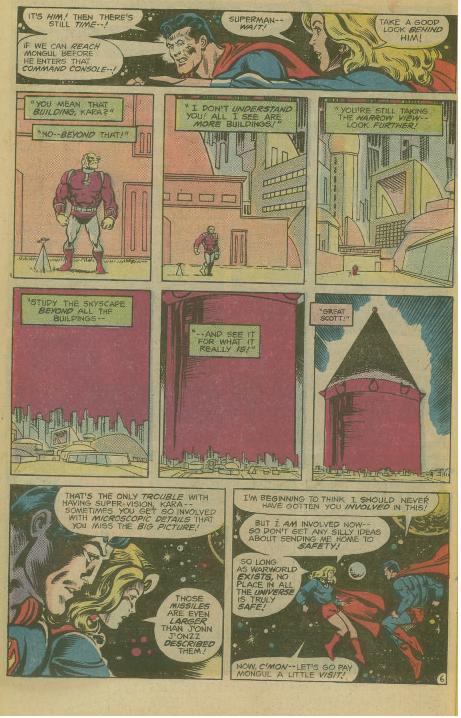
I'm sure that sequence only pays lip service to physics (like much of this issue and the next) but it's still pretty impressive. (And even though Warworld could eat stars for dinner and planets for dessert, as we can see from panel 5, it would do so with a smile. Just an indication, I suppose, that in the end the creators still have a sense of humor.)

Telescopic vision gets a good workout on the next page, as Superman and Supergirl analyze every detail of Warworld, from its weapons to its computers to the mountain of graves outside its main city. Although the page suggests that Kryptonian eyes could practically read Mongul's driver's license from two light-years away, the page after that turns the idea on its head:

Smiley-face aside, the bigness of Warworld earns our heroes' respect. Naturally, its sensors pick them up, and after Mongul recalls the events that led to his ouster, scratches his itchy trigger finger.


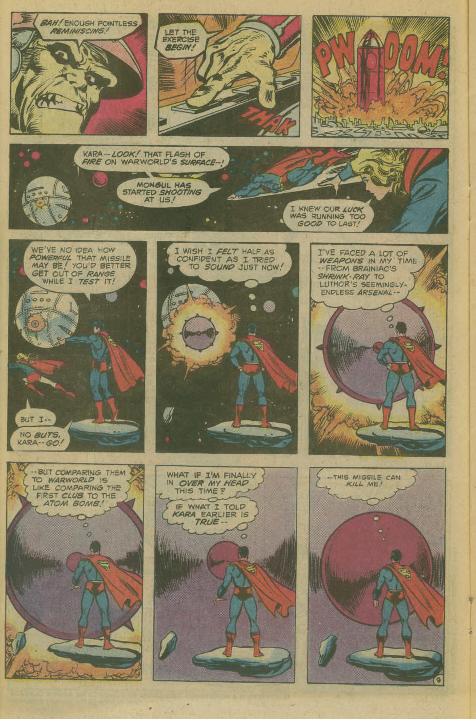
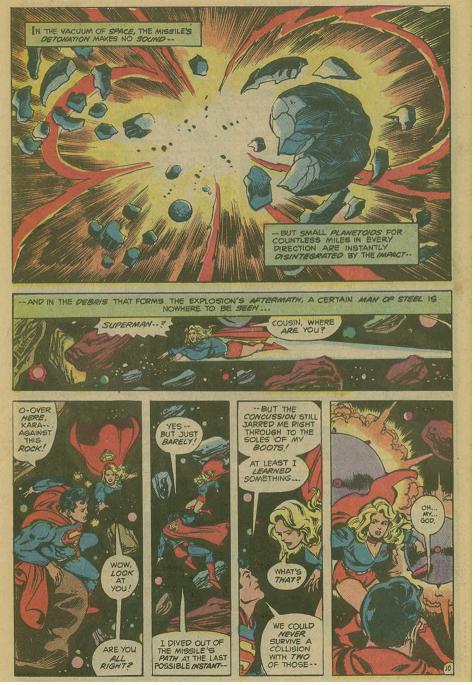
This next page really captures the flavor of the issue. Not only is it another exercise in perspective, it has Superman shooing Supergirl away so he can "test" the potency of a mountain-sized missile. Superman's already given Supergirl a warning about the limits of invulnerability, and once again he takes the big-brother role. To him it makes perfect sense, because although they are pretty equal in power and ability, he's more experienced, she's too impulsive, etc. It almost make Superman look condescending. However, it does set up the last panel....

This page ends with a variation on the same gag, but it hasn't gotten old yet. Again, it reinforces the point that the Kryptonians can't match Warworld for straight-ahead brute force, so Supes decides to employ some "strategery." The cousins make Warworld work overtime to try and kill them, which ends up overloading the cybernetic controls plugged into Mongul's brain, and Mongul keels over. Given that Supes got the idea from the mountain of graves next to the control center, this seems a bit outside his usual ethics. Still, Supergirl's telescopic vision confirms that Mongul is just unconscious, and also an organ donor.


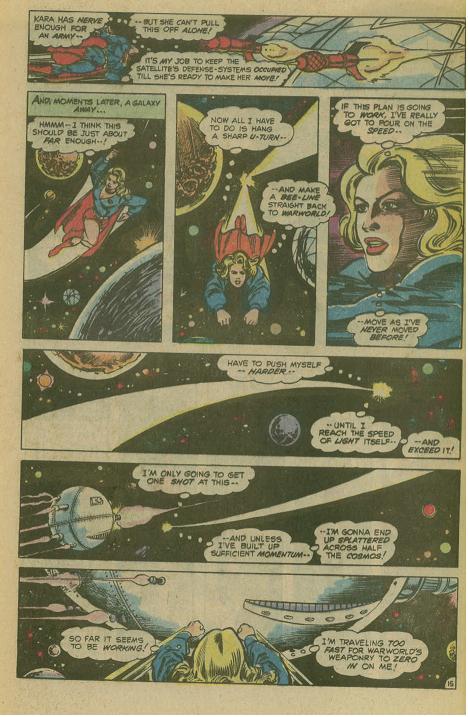
Unfortunately, Mongul's incapacitation has the opposite effect -- Warworld goes off on automatic. Change in plans: while Superman distracts it, Supergirl aims to punch a hole through it by moving faster than its sensors can follow. There's nothing technically adept about this next page, but I couldn't resist another shot of the deadliest smile in the galaxy.

Supergirl's feat allows Superman to fly into Warworld's computer core and reprogram it for self-destruct. Mysteriously, Mongul's not around to slow Superman down as he escapes. Warworld blows up, but now there's a new problem -- where's Supergirl?

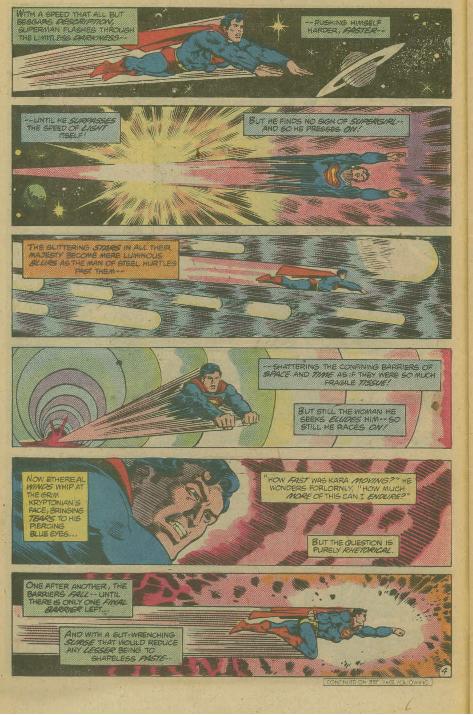
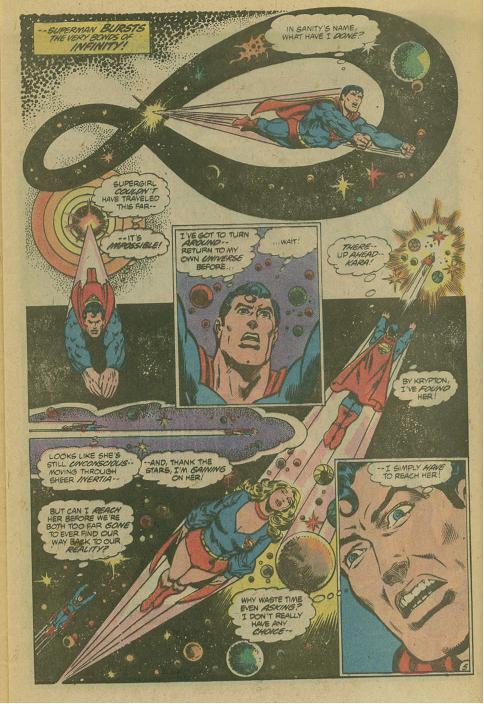
DC Presents #29, by the same creative team, finds Superman tracing his cousin's trajectory. Problem is, she was moving so fast that she's probably way ahead of him by now, so he starts going faster and faster, probably not even paying attention to his speed, until...

... he "bursts the very bonds of infinity!" This snaps him back to reality (so to speak), but before he can try to get back to his "own universe," there's Supergirl, up ahead. On he goes, but not too far, before he literally runs into the Spectre.

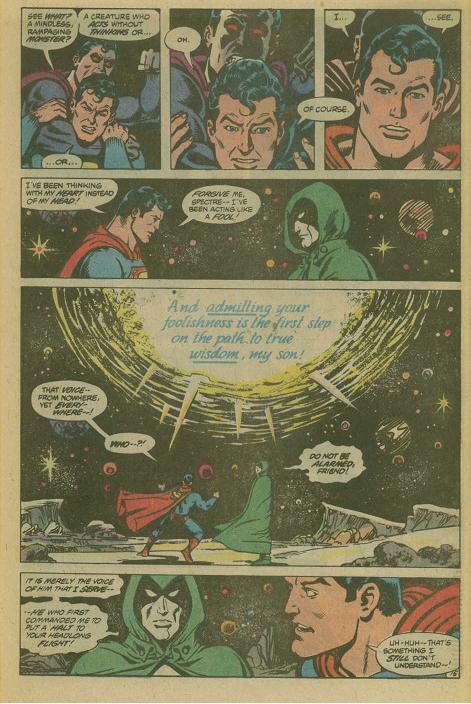
Spectre won't let Superman catch up to Supergirl, so Supes tries brute force. No good. He tries to outrun the Spectre, but again, Spectre is faster. Growing until he dwarfs Superman, the Spectre picks Supes up by his cape and intones, "You are one of the most powerful beings in all of creation -- and yet, in so many ways, you are little more than a child! There is so much you have yet to learn ... perhaps it is time your education begin in earnest!"

Spectre shows Superman Jor-El's futile attempts to save Krypton, which Superman imitates with similar results. Spectre then shows Superman literally unable to save Jonathan Kent from the Grim Reaper. Finally, three years before Superman III, Spectre has Superman's dark side attack him. Dark Supes is "pure, unadulterated power, without rein, without restriction ... without conscience or remorse ... power that can ultimately destroy you ... if you allow it to run amok!" What to do?

Superman's sarcastic observation turns into a moment of reflection which allows him to see that he's been thinking with his heart, not his head. The Spectre's boss also makes an appearance, more or less, blessing Supes' newfound clarity.

Still, why did Spectre stop Supes from catching Supergirl? The answer is that Superman was "traveling far faster than [he] ever had before ... shattering barrier after barrier until only one remained ... that golden veil beyond which no living man may trespass!" Somehow, according to the Spectre, that "risked the ultimate destruction of civilizations beyond numbering!" Either that means Superman was going to kill himself -- thereby depriving said civilizations of a protector -- or by breaking the "heaven barrier" he would have released some ultra-powerful cosmic energy. In other words, don't cross the streams.

Anyway, Supergirl turns up fine, Superman has learned a valuable lesson, and everyone goes away happy. The End.

Now, clearly this is not the most serious examination of the implications of the Earth-1 Superman's power, but I like these issues because they go from reverence to irreverence and back again. The Warworld attacks in #28 manage to be both suspenseful and over-the-top, and the amount of power being thrown around there sets up the deeper discussion of #29. I'm sure there have been other Superman stories questioning why he can't be everywhere and save everybody, but this one handled the question briefly and well. You say there's nothing too powerful for Superman, let alone Supes and Supergirl? Wein and Starlin cheerfully present Warworld. Well, what about the potential abuse of that power? Wein and Starlin use the Spectre to remind Superman that vast though it may be, there are limits, self-imposed and otherwise, on his power.

In hindsight, of course, these issues help reinforce the impact of Supergirl's death in Crisis on Infinite Earths. They show the Kryptonian cousins in their prime, and especially present Supergirl as a happy warrior, more eager and exuberant than Superman. It's easy to see the Supergirl of DCCP #28 charging at the Anti-Monitor, which makes it all the sadder to see the Superman of COIE unable to bring her back one last time. One only hopes that in his mourning, he remembered the lessons the Spectre taught him just a few years before.
Full Post

Wednesday, January 11, 2006

The Sucker and the Suck

I am a sucker for '70s Marvel. Lately I am tempted by the Essential Nova solicitation. (Naturally, while I was noodling around with this post, Jim Roeg professed his love for '70s Marvel and the Onion AV Club posted its list of Essential Essentials. That's me, always a half-step behind the zeitgeist.)

Sometimes the temptation pays off, as with Essential Howard the Duck and most of Essential Tomb of Dracula, but sometimes it just yields cultural relics like Essential Super-Villain Team-Up and Essential Spider-Woman. (Spider-Woman wasn't exactly headlight comics; but if there had been a WB Network in the mid-'70s, "Spider-Woman" would have been on it, complete with Mike Post soundtrack.)

Still, why the '70s? In those grade-school days, I did read a decent amount of Marvel, probably even approaching my DC intake. Most of it was Avengers, Iron Man, and Spider-Man (both monthlies and Marvel Team-Up), with the odd issues of What If?, Fantastic Four, Howard the Duck, Godzilla, and (yes) Spider-Woman.

Since the late '80s, though, my Marvel intake has been creator-driven. I got the Michelinie/McFarlane Amazing Spider-Man, the Peter David Incredible Hulk (probably kicked off by David and Perez' Future Imperfect miniseries), the Waid/Garney Captain America, the Busiek/Perez Avengers, and the Busiek/Chen Iron Man. Now I get the Brubaker/Epting/Lark Captain America. As for the other current Marvel buys, all the great word of mouth on She-Hulk convinced me to pick it up, because I had no particular affection for the character and didn't know much more about Dan Slott. Fantastic Four is the only Marvel book I read solely for the characters, although Walt Simonson first got me to buy it regularly.

The thing about Marvel, of course, is that its superhero line aims for consistency, as if all the books were charting the same fictional history. It's therefore easy to justify a love of '60s Marvel, when the stories were relatively simple but the foundations were still being laid. Accordingly, it's harder to love Marvel the farther away it gets from those foundations.

While I'm sure someone has tried, I don't know where the line is which separates the foundations of Marvel from the structures resting upon them. I do think the '70s represent the beginnings of those structures. Although Marvel in the '70s tried to expand its line around Spidey and the Hulk, it hadn't yet exploded with miniseries and spinoffs. Instead, there were new characters like Howard, Dracula, Shang-Chi, and Killraven, which today inspire curious old fans like me to plop down $16.99 for their Essential collections.

To me the Essentials represent two categories of comics: those I'd revisit out of nostalgia and curiosity to see how well they held up; and those I only remember by reputation. Essential Nova is in the first group, and Essential Killraven is in the second. (Essential Howard the Duck was good either way.) I tend to be more satisfied with the second group, but because I am a sucker, the first group will always be well-represented.
Full Post

Tuesday, January 10, 2006

The Circle Is Now Complete

Sorry about not posting over the weekend, despite Ragnell's best efforts. Instead, the Best Wife Ever and I spent Saturday and Sunday on household chores and errands. We are steadily getting organized, even if it's taking a while. So I started this last night, but went to bed early with a nagging headache.

Anyway.

Last week I finished watching Return of the Jedi, which wraps up my several-weeks-long attempt to view all six Star Wars films in episodic order. As a standalone movie Jedi has its flaws, but as the last part of the cycle it's not bad.

Naturally, its best parts concern Luke and Vader. In that respect it gets some retroactive help from Episode III. For example, Ep III ends with Yoda and Palpatine squaring off while their apprentices also duel. Although Yoda and the Emperor never meet in Jedi, the scene of Vader greeting the Emperor immediately precedes the Yoda/Luke scene on Dagobah, so it gave me a similar vibe. Likewise, the big Luke/Leia revelatory scene on Endor brought back memories of their birth. (I still think Padme should have died a few years after Ep III ended.)

Apart from that scene, though, one of Jedi's big faults is its failure to use Han and Leia to their fullest. The movie seems to consider the issue of their relationship settled once she unfreezes him, except for a bit at the briefing where she acts surprised that he's staying with the Rebels. (If he were going to leave, wouldn't he have split before then? Jabba wasn't getting any deader.) The rest of the time everyone's doing something loud and/or fast, and there's not much opportunity for witty banter in the style of previous episodes. Again, the point of the movie is to show Luke's triumph and the defeat of the Empire -- in other words, big fight sequences.

Those Jedi does well, even with the despised Ewoks. (Lucas' DVD commentary opines that the Ewoks were cannon fodder until the Rebels could gain the upper hand, and let's not forget that Chewie in a scout walker played a big role too.) The tripartite Battle of Endor makes an appropriate bookend for the four-front Battle of Naboo (even if it's really vice versa), but what's interesting to me is the type of special effects employed. Jedi accomplishes pretty much the same spectacle as Phantom Menace without using any computer graphics. Obviously, after Episode III, the amount of computer-generated imagery dwindles. It could even be that the additions to the original Star Wars help ease the transition from CGI-heavy prequels to the original vintage effects. With relatively few CGI additions in Jedi, and none that stand out from the beginning of the Sail Barge sequence to the end of the Death Star, I felt "weaned off" CGI before the big battles started.

One of those concluding additions, of course, is the replacement of armor-less Anakin with a somewhat sheepish Hayden Christensen. I respect the opinions of others, but I liked it. Not only did it supply another link between trilogies, it allowed Luke to see his father in his prime, not as the Jedi he might have grown into. Lucas has suggested that Anakin looks like Hayden now because that's how he looked when he "died in the good side," or some such. I'll accept that, but I'd also like to think Luke sees his own idealized version of Anakin -- a young Jedi, around his own age, wearing robes more reminiscent of Obi-Wan than of Vader.

Ironically, one of the more unfortunate comparisons between Jedi and Episode III is that both movies find Vader utterly defeated after the big saber duels. Vader may get the worst of it in Jedi, since all it seems to take is one last, furious burst from Luke to catch him off guard. Most other times I've watched that scene, I've focused on Luke finally tapping into the dark side to defeat Vader. That's clearly where the emphasis is supposed to be, but with the prequels fresh in mind I suppose the emphasis shifted.

Nevertheless, the parallels are still there. At the end of Episode III, Palpatine rescues Vader and puts him in the suit. At the end of Jedi, Vader kills Palpatine and Luke helps him unmask. It's a neat way to balance everything out, and it illustrates how the cycle manages to hold together almost in spite of itself.
Full Post

Friday, January 06, 2006

Streaks And Geeks

Last night's post sounded a little cranky to me, so sorry for that. I do enjoy maintaining this blog, and if I were to become an everyday blogger, that wouldn't be so bad.

If I get the chance, I will look for that Sandman letter column, to see if it's worth keeping.

And yes, this post keeps the "everyday" streak alive. No promises for the weekend, though.
Full Post

Thursday, January 05, 2006

When The Trades Just Aren't Enough

For a while I have struggled with replacing certain series with trade paperbacks. I have the first two trades each of Sandman and Starman (1994), and from there started getting each on a monthly basis. Each ran about 80 issues, including annuals, specials, and Secret Files, so going to trades would free up a lot of space, and it would probably result in me reading them more often.

However, Starman also had an occasional text-page backup series, "From The Shade's Journal." Usually this would be something about the Shade having lunch in Los Angeles with Mickey Rooney or some such, and he'd make fun of Mickey before skipping out on the check. (He was a villain, after all.) I don't know; I never really read "FTSJ," because 1) I wasn't that into the Shade and 2) it's text, man, and I read the funnybooks so I can look at the pictures. Also, the "Journal" pieces came out irregularly, and I could never remember what the story was from one installment to the next. In other words, I don't think I missed a lot, but I'd hate to get rid of everything and find out later what I did miss. There were some rumors a few years ago about the Shade miniseries being collected along with the "Shade's Journal" pieces, and I would get that if it ever came out.

Along the same lines, selling off the single issues of Sandman to finance the purchase of trade paperbacks would mean losing the Sandman letters pages. Not that I remember a particularly steamy letter from Tori Amos or anything; but there was one letter, shortly before the Vertigo changeover, which still brings back fond memories. It basically made cruel sport of those who would write in claiming never to have read a comic book before, "but then, after a transcendent evening of physical pleasure, my lovah reached under his bedside table and handed me a copy of issue #29...." The guy then went on to say "we all know you have copies of every JLA/JSA crossover in your closet, so get over yourselves," etc., and I'm really not doing it justice. Either that or I have much fonder memories than it deserves. Maybe I'll keep that one issue.

Still, the nonlinear timelines of both books brings up another question: in what order should the stories now be read? Isn't the Ramadan story in Sandman #50 now collected with the "Convergences" stories from about a year before; and aren't a lot of Starman's "Times Past" stories similarly lumped together, when before they were sprinkled in-between arcs? If the collections reflect the authors' true intentions, that's one thing, but I'd rather know the order in which they first appeared, because by and large that's how I first read them.

So there you go. I do think it will be easier for me to convert JSA and Teen Titans to trade paperbacks, thanks to the demise of the letters pages....

P.S. I know this makes five entries in five days, but it's just a happy accident so far. As much as I like doing this, I sure didn't make a New Year's resolution to become an everyday blogger.
Full Post