Saturday, August 19, 2006

Terra Who? and "Who Is Donna Troy?": New Teen Titans #s 35-38 and Batman and the Outsiders #5

In The New Teen Titans #34, Marv Wolfman and George Perez revealed a side to Tara Markov that was sure to shock readers who had been following the plucky young heroine for the past several months. What's more, the Titans were completely clueless about Tara's real motives, having decided already to tell her all their secrets at the first possible opportunity. The team was already beset with internal problems, and this latest development could either mean its end, or an opportunity for a new beginning.

Naturally, Marv and George sat on Terra for a while.

Now, to be fair, Perez probably wanted to be involved in the issues that decided Terra's fate, and his plate was getting pretty full -- the just-completed Titans Annual, probably some SwordQuest tie-in comics for Atari, and a little thing called JLA/Avengers (speaking of delayed gratification). Also, the book had a few more matters to take care of before Terra's other shoe would drop.

These issues don't quite forget about the major development of issue #34, but neither do they expand upon it. Although they're not really "inventory" issues, in the larger scheme of things, you'd think the focus would be a little different.

Keith Pollard pencils New Teen Titans #35 (October 1983), a hostage drama involving Sarah Simms, her psycho ex-fiance Mark Wright, and Cyborg, Changeling, and Raven. (See, Terra's not even in the issue.) Mark used to be a military sniper, so he's pretty successful at holding off the cops, and even manages to shoot Vic in one of the unarmored areas on his shoulder.

The upshot of the story is that Mark doesn't want to lose Sarah like he lost his previous girlfriend. For a while it looks like Mark might have killed her, albeit by accident, but at the end it's revealed that no, she's just "dead to him." While I don't think this backstory would have been a woman-in-refrigerator situation, exactly, it feels like Mark's crazy was toned down at the last minute. Assuming, of course, that it's somehow less crazy for a guy to take someone hostage for fear that he wouldn't, uh, not kill her like he didn't kill his girlfriend before. Yeah, that makes the ending much easier to take.

Anyway, the three Titans save Sarah and console nutty ol' Mark, and Vic finally gets to make up for her being kidnapped in #10. Fun fact: Marv Wolfman and Keith Pollard worked together on The Amazing Spider-Man, so guess what Changeling changes into this issue? You guessed it -- Seabiscuit!

New Teen Titans #36 (November 1983) wraps up the plot threads from issue #32's introduction of Thunder & Lightning. Remember, the kids were left with STAR Labs so their powers could be studied and maybe wouldn't end up killing them. Apparently "studying," as interpreted by DC go-to scientist Dr. Jenet Klyburn, means "strap to a table and shoot with high-powered lasers." It's a new field of study, Dr. K muses.

As it happens, the lasers aren't so good at "probing" T&L, and overload their powers, or something. A brief fight ensues, stopping when both sides realize it won't get them anywhere. Raven then offers -- despite the extreme risk of unleashing her Trigon side -- to try and cure the boys in her soul-self. It envelops them, and soon becomes all tentacle-y, lashing out at the Titans. When things calm down, T&L tell the group that the tentacled thing was a manifestation of their father, and he's being held prisoner. They don't know it's by a HIVE branch, which doesn't like holding Dad too much itself.

It won't be their problem much longer, though -- the Titans and T&L start wrecking the place. The HIVErs have gotten some control over Dad, and he unwillingly attacks the teenagers. Did I mention that Dad's really a centuries-old alien who apparently looks otherwise human, except when he's an 8-foot dinosaur-thing with one eye, two big fangs, and a pair of tentacles? Only T&L's powers can stop him, and he pleads with them to kill him. They do, and are suitably horrified, but Robin tries to ease the pain by telling them they "freed" him. Apparently he dies a human, because his touching final metamorphosis happens off-panel.

I therefore get the feeling that, for the second issue in a row (and the second non-Perez issue ... hmmm) the ending was "toned down" to make it less disturbing. Still, T&L clearly had to deal with a Bad Father in the classic New Teen Titans mold, and his final fate makes their story that much more hardcore. Raven came the closest to "killing" her BF, but she only put him in limbo. The issue ends with T&L saying yeah, they'll probably use their powers for good -- but first they'll tell their mother they love her.

Subplot watch: Robin thinks everyone hates him because of his involvement with Adrian Chase, and maybe he doesn't deserve to lead the Titans. Kid Flash is still quitting, and he still hates Raven for trying to kill him. Raven, as mentioned above, is still filled with worry about letting her Trigon flag fly. (Pollard does a good job conveying the group's support of Raven, just by arranging the group around her in close, comforting poses.) As for Terra, there is nary a mention of her real agenda, for the second straight month. Wally and Raven make up this issue, however, in a fairly understated couple of scenes. Before that, though, Wally gets a silent scene with Donna, where she comforts him after he lashes out at Raven.

FYI, according to a lettercolumn, George Perez had to take these issues off after getting very busy with a number of projects, including the original JLA/Avengers. Regular inker Romeo Tanghal finished Pollard's pencils, giving the issues a fairly consistent look. Pollard and Perez had worked together on a few issues of Justice League of America, so their styles were hardly incompatible.

Perez returned in fine fashion for New Teen Titans #37 (December 1983), the first part of a crossover with Batman and the Outsiders #5 (written by Mike W. Barr and drawn by Jim Aparo). Even the jokes work, and that's saying something. It's the Fearsome Five vs. the Titans and Outsiders, so #37 promises more main characters than even the Titans/Omega Men or Titans/JLA issues, and Perez, of course, delivers.

The plot is this: Gizmo breaks his Fearsome Five teammates out of prison, although nobody's really happy about having Dr. Light along again. Light just wants to do a big robbery, but Shimmer and Mammoth remember a Dr. Jace from back in Australia who was experimenting with giving ordinary people super-powers. The F5 decide to kidnap Jace and force her to augment their own powers. (I'm not quite sure how much "augmentation" a transmuter like Shimmer or a psionic like Psimon could use, but whatever.) This ends up changing into "Dr. Jace creates an army of lava-men," probably because that was more practical.

Dr. Jace also gave Terra and her brother Brion Markov, a/k/a Geo-Force of the Outsiders, their powers, so when the F5 kidnap her, she sends out a distress call on receivers built into their costumes. After the Traditional Superhero Misunderstanding Fight, the groups team up. (In a sensible touch, parties on both sides who should know each other well enough actually say, "Hey, I know [him/her]....")

However, as you might have guessed by now, the real through-line of the story is the Batman/Robin relationship, and it's handled very well. It begins with a scene at Wayne Manor, where Dick tells Bruce he wants to end their partnership -- not their friendship, Dick is careful to point out, and Dick's not giving up his Robin identity. His experiences with Chase have clarified the differences between him and his mentor. (I'm not sure this is quite fair, because I don't believe Batman -- especially the '80s Batman -- is quite the Punisher-type that Chase's Vigilante is, but Dick might not think that either.)

Once the two teams start tracking the Five, Batman takes charge. Given how Perez draws him, it's hard not to see why. His Batman is all shadows and sharp lines, and he dominates a scene. It's different somehow from the earlier Batman appearance with the JLA in issue #4, perhaps because there Batman was part of the Justice League, and therefore one of a few higher-profile heroes. As among the Titans and Outsiders, though, he's BATMAN!, like, OMG!!!11 It helps prove Marv & George's point, too -- next to Batman, Dick is "just" Robin, and it's hard not to make Robin automatically subordinate. I'm a little surprised some of the more experienced Titans and Outsiders didn't fall into an old habit of assuming Robin would follow his lead. I think Wonder Girl and Kid Flash might even have done this despite their relationships with Dick.

Anyway, this carries through until the big fight in the Empire State Building, when Batman barks out an order that would end up misusing a couple of characters. Robin calls him on it, says he's better at leading a team than Batman is, and takes charge. For his part, Batman respects Robin's authority and lets him do his thing. The Fearsome Five are defeated, and Batman acknowledges Robin's leadership skills. "You lead the Titans well, Robin -- I guess even the teacher can learn from his pupil ... his former pupil!"

"Thanks, Batman!" Robin replies. "But you know what they say ... a pupil is only as good as his teacher ... and I had the best there is!"

Mike Barr wrote those words, in case we need to reconcile them with the more "official" story from Wolfman & Perez. Not long after this, of course, Chuck Dixon and Scott Beatty have told us that Dick got "fired" again, this time for good. But that's a while in the future....

Since the plot concerns Terra and Geo-Force, they get a few sweet moments of sibling bonding, although at the very end Terra worries that she doesn't want her brother to "go down with" the Titans when she betrays them. So, in both issues, there are reminders that Terra's a rotten egg ready to crack, just to keep readers up to speed.

The last issue of this particular batch is New Teen Titans #38 (January 1984), "Who Is Donna Troy?" Fittingly enough for us, as #35 focused only on three Titans, this spotlights only Dick and Donna. It still packs an emotional wallop, because despite Dick's narration about his relationship with Batman, at its core it's the story of a woman who finds herself. Because Dick narrates, we see his detective work, and we get a little quasi-purple prose about his own abiding (platonic) love for Donna, but we also see her reactions to each new discovery.

The issue is a paen to the idea of "Donna Troy," a beautiful young woman who started life passed around from family to family, but who was always loved. It's not hard to imagine that someone who's always received that treatment -- and who, in fact, was an Amazon princess, right? -- would start to wonder if there were anything in her past that could bring all that down. There's little of that here, in a story that doesn't put Donna on a pedestal as much as it reassures her.

There's also the tendency to see Donna as Marv Wolfman's idealized woman, through the lens of Terry Long as Marv's somewhat self-effacing stand-in. However, I think that's an unnecessarily contorted view of this story. Its pathos is balanced by the routines not only of Dick's forensics, but also a few scenes of the characters traveling.

Perez and Tanghal do a great job with this issue. Tanghal's inks seem exceptionally tight, such that it almost looks like Perez inked his own work. (He might well have inked the figures, I don't know.) The noirish opening and closing scenes are rendered mostly in shadow, suggesting a downbeat detective story that counterbalances Donna's growing elation. In fact, for his part Dick is pretty even-tempered throughout, smiling only at the end when he reflects on his work.

So, who is Donna really? Well, it starts with a battered old doll that Dick discovers in an old coal bin in the soon-to-be-demolished apartment building where Wonder Woman found Donna. (Donna last visited in issue #1.) Scraps of the doll's dress reveal writing that, according to Dick's computer, might have said "HELLO MY NAME IS DONNA."

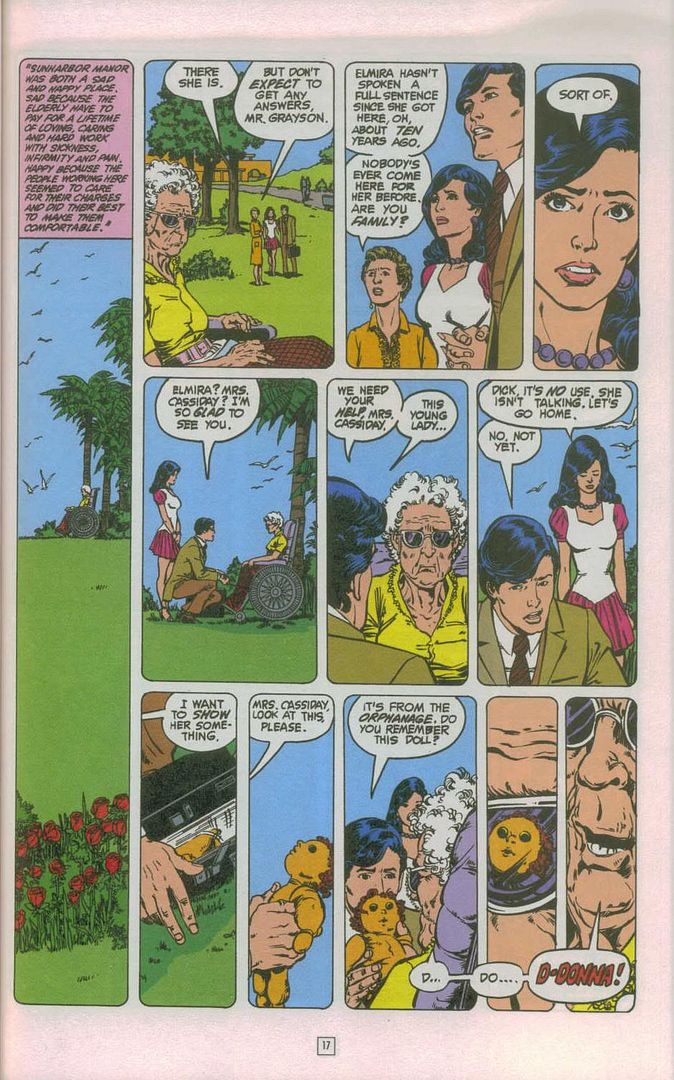
That leads to a toymaker in Newport News, Virginia (right down the road! w00t!) who remembers the doll. (It has orange skin and curly auburn hair, and looks disturbingly Tamaranean.) He fixed up all the dolls for the kids at the orphanage, so from there Dick finds the orphanage's former owner, in a Florida nursing home. Dick and Donna visit, Ms. Cassidy remembers the doll, and tells Donna about her real mother, Dorothy Hinckley. Ms. Cassidy also remembers that the Staceys adopted Donna.

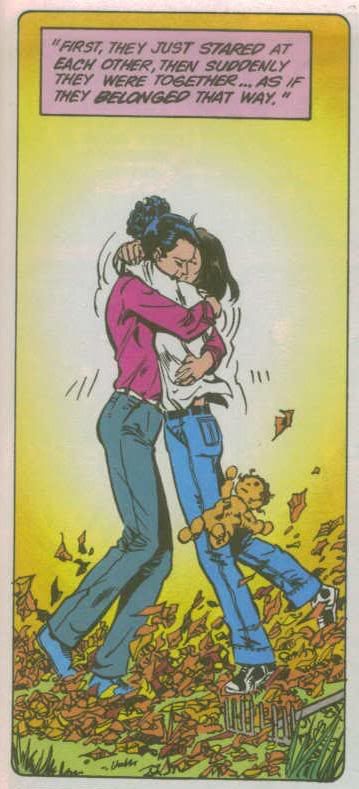
It's not too long before Donna's hugging her adoptive mother fiercely, in the front yard of Fay Evans (nee Stacey)'s Newport News home. I really like this page and how it flows into the next one, because Perez and Tanghal absolutely nail Donna's quick trip from peppy nostalgia to complete emotional collapse:


So who was in the fire that gutted the old apartment building? Fay's husband Carl Stacey died in an accident, and Fay basically got pressured by a crooked lawyer (not a redundancy) into selling Donna as a black-market baby. Robin tracks down the lawyer in prison, uses a little of the Bat-mojo on him, and gets out of him that a furnace exploded before the deal for Donna could go down. That's about the only scandal in Donna's past, at least according to this story. "WIDT?" also skirts the question of Donna's paternity, saying it's not important. Rather than this being a plot hole left open for later exploitation, though, I tend to think that Marv & George knew they had a good enough issue without it, and chose to address it thusly rather than gum up the works with it.

Again, I'm sure there are a couple of different ways to mock "Who Is Donna Troy," or to look at it as the biggest step in the idealization of a character conceived as an impossible fantasy (Wonder Woman's imaginary childhood) and given life by mistake (the first Titans editor didn't realize she didn't exist). There's a strong undercurrent of irony and metacommentary running beneath this story, and it's entirely possible that Donna herself, with all the goodwill she's generated from fans, is nothing more than the coalescence of that goodwill -- optimism given form, as it were. However, even with all of that, my experience with the story is that it does humanize Donna. Its emphasis is on a series of Oprah-worthy tearjerkers, but darn if they're not skillfully paced and masterfully depicted. When Dick returns the Donna doll, fully repaired, to her owner, I found myself getting a little misty-eyed. Call me a sucker, but I bought into this story almost unexpectedly.

What about next month, though? Could The New Teen Titans get any better?

Three words: "The Judas Contract."
Full Post

Thursday, August 17, 2006

New comics 8/16/06

Congratulations, Green Lantern Corps #3 (written by Dave Gibbons, pencilled by Patrick Gleason, inked by Prentis Rollins, Mick Gray, and Wayne Faucher) -- you won me over. This was the best issue so far, including the miniseries. I figured out the murderer's motivation early in the issue, but that's not a knock on it. In fact, I got the feeling I was supposed to figure it out at around that point, and from then on the plot takes a "Mission: Impossible"-esque turn. It ends pretty brutally for the murderer as a new Lantern is chosen and a rookie looks on impassively. This introductory storyline touched on the blend of politics, police work, and (for lack of a better term) knighthood that, in combination, should define the Corps, and it made me hopeful that the future holds more of the same. For now, I'll be happy with the all-Dave Gibbons spotlight on Guy Gardner, starting next time.

Secret Six #3 (written by Gail Simone, pencilled by Brad Walker, inked by Jimmy Palmiotti) practically gave me whiplash with all the reversals of allegiance. It begins in a place that seems incongruous with last issue's cliffhanger, so when the first reversal comes, it feels more like a course correction. The bulk of the issue concerns the Six's trip to Lady Vic's base, out for revenge after her goons attacked them in #2. There are complications, naturally. Scandal gets a spotlight, and Catman is once again seen as prime father material. Simone keeps everyone likeable, with a couple of exceptions: I'm getting a little tired of Ragdoll being so precious (on good days, I hear David Hyde Pierce; more recently, it's been Dr. Smith from "Lost In Space'); and the super-Catman-sperm idea seems, well, less fresh the second time around. The art seems to be settling more into a Tim Sale style, but that's not bad and for the most part everything is clear and understandable. A double-page spread with Vandal Savage and Scandal is a highlight.

Checkmate #5 (written by Greg Rucka, pencilled by Jesus Saiz, inked by Fernando Blanco) featured the selection of a new Black Queen's Knight, along with the fallout from Alan Scott being "fired" as White King. It was a decent done-in-one issue, although I did wonder about the utility of one part of the selection process: what's it do to your candidates' morale after you reveal they weren't in any danger? Maybe it's helpful; I don't know. Anyway, all of the candidates are unknown, and none of them really jump out otherwise, so the eventual winner doesn't seem preordained. You'll probably make an educated guess about halfway through. I like Blanco inking Saiz; not that Saiz is a bad inker of his own stuff. With Blanco on inks and Santiago Olmedo on colors, the figures pop a little more than they might have in previous issues. I'm eager to see what Rucka does with the Suicide Squad next time.

52 #15 (written by Frodo, Sam, Merry, and Pippin, breakdowns by Keith Giffen, pencilled by Shawn Moll, inked by Tom Nguyen) gives us a little Montoya and Question in Kahndaq and a lot of Booster and Supernova (and Clark Kent) in Metropolis. It's all pretty effective, with the possibility of death hanging over a couple of characters. After a touching reunion in the Kahndaq prison, however, we're off to the races with Booster. He gets a good sendoff, I have to say; regardless of whether he's really dead (or, more to the point, whether this is the "right" Booster). If an issue can leave you feeling sorry for a computerized sidekick, not to mention feeling the frustration of a powerless Man of Steel, it must have done something right.

Now that I'm bummed out again, I almost feel guilty telling you how fun Nextwave #7 (written by Warren Ellis, drawn by Stuart Immonen) was. Pretty daggone fun, I have to say. It picks up from last issue's fight against the Aeromarine, sets up the new menace from ... Dormammu's kid brother, looks like (have we seen him before?), and gets right into the crew fragging Mindless Ones. Like the caption says, "Nextwave: when America can only be saved by killing a butt-load of monsters." Ellis' script is a sprightly affair, and I have always been a big fan of Stuart Immonen, but I particularly like the slightly stylized approach he uses here. Still no signs of this book running low on attitude anytime soon.
Full Post

Sunday, August 13, 2006

Terra Incognito: New Teen Titans #s 32-34 and Annual #2

In terms of plot, New Teen Titans #32 (June 1983) is pretty unremarkable. It's the story of two Vietnamese brothers, Siamese twins Gan and Tavis (or "Thunder and Lightning"), who use their weather-control powers to bust up Saint Louis looking for an American ex-GI. Considering this was the early '80s, it's not too far of a stretch to suppose the boys had a personal connection with Lt. Walter Williams, and in fact I doubt few were surprised to learn he's their dad. At least for now, Williams isn't a Bad Father, but his genetic experiments gave them their powers, which are also killing them.

Gan and Tavis think their powers came from their mom's exile to a mystic island (shades of Arella) where they were separated. The local shaman said their dad's blood would cure them, so they came to the States looking for him. However, the Army has no record of him in the 'Nam because officially, he wasn't there. Much of the issue consists of G & T fighting the Army and/or the Titans, all the while pleading for their dad and warning everyone they can't control their powers. The issue ends with the brothers referred to STAR Labs, and a few plot threads (including Dad's whereabouts) left hanging until a promised follow-up. And that, my friends, may be the shortest plot synopsis I've done for these here recaps.

That's because the real meat of this issue is in the Titans' interactions. Augmented by Speedy, Terra, and Frances Kane, the group's headed from Zandia, where by the way Raven just tried to kill them all. It's a tense flight: Dick's ready to quit, Raven says she should quit, Wally (shooting her a dirty look) silently agrees, and Terra's mad no one will tell her their secret identities. Before they all go their separate ways, Starfire blasts Speedy when he tries to kiss her, so that's pretty funny. Wolfman and Perez do a great Speedy, I have to say. Anyway, Robin's off to Gotham, Speedy goes to Washington, and Fran returns to Blue Valley before the Titans face Thunder & Lightning. In another bit of subplot maintenance, Donna and Vic compare notes on her potential engagement to Terry (she still hasn't said yes yet) and Sarah Simms' apparent engagement to someone other than Vic.

And that's issue #32 -- pretty straightforward, with the team divisions taking a backseat to a couple of antagonists who could have been Titans themselves. New Teen Titans #33 (July 1983) is also pretty decent on its own terms, with a still Robin-less group trying to figure out the mystery behind the death of new villain Trident. Three pairs of Titans each faced Trident, but outside of costume and powers, there seem to be no commonalities between any of their encounters. Leave it to Koriand'r, who hears about 5 minutes' worth of recap, to solve the mystery (SPOILER!) it was three different guys, and when one betrayed the others, they iced him.

This issue has even less macro-plot advancement than last time, but it makes up for that in little moments. Aqualad appears at the very beginning of the issue to haul Dead Trident out of the river, and stops just short of asking "do I leave my trash on your doorstep?" Kid Flash and Terra bond while trying to stop a Trident from trashing a drive-in movie (showing E.T.). Changeling turns into a shark to "attack" Terra in the swimming pool, so she socks him in the nose. Starfire, looking for Robin, finds red-haired pre-Crisis Jason Todd at Wayne Manor instead. Terra gets scared that the Titans will kick her off the team. Finally, we learn that Robin is back with Adrian Chase, trying to make drug charges stick against mobster Anthony Scarapelli. (You'll remember him from the "Runaways" arc.)

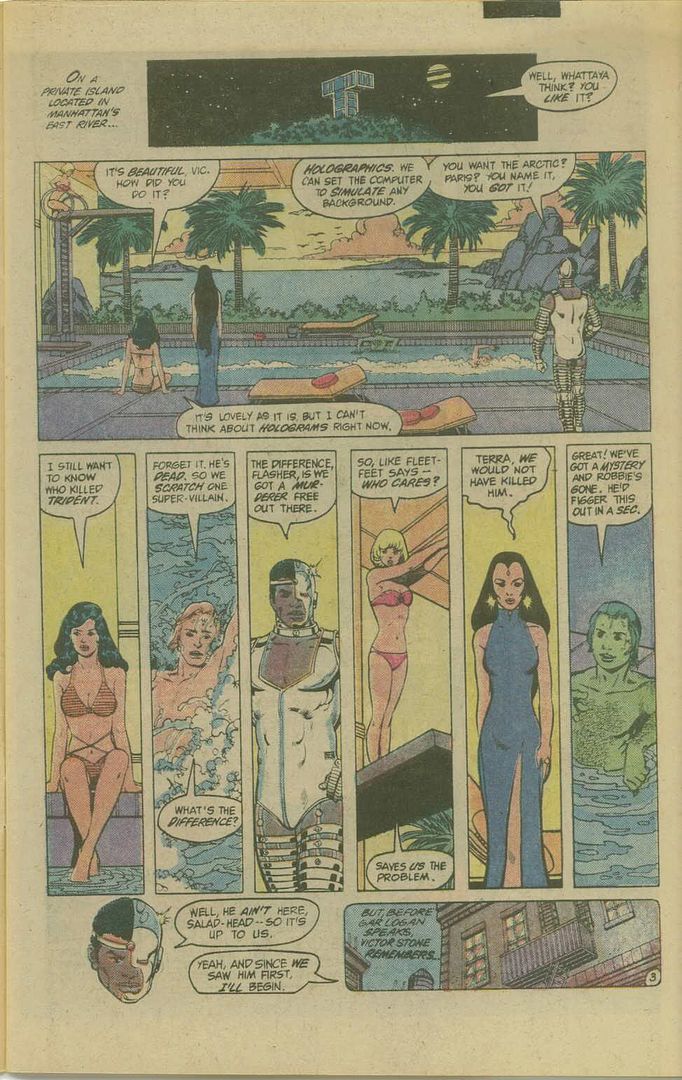
Since a lot of this issue takes place with the Titans lounging around comparing notes, Perez's skill at portraying "casual" almost goes unnoticed, but that in itself is a compliment. An early poolside scene in Titans' Tower recalls a similar one at Steve Dayton's mansion in #2, but unlike that one, Perez has the characters move more, swimming through panels and even popping up in each other's scenes. There is motion, but it's the motion of relaxation, if that makes sense, and it's choreographed pretty well. (Oh, and by the way -- Cyborg in "casual mode" apparently means Cyborg without the utility belt.)

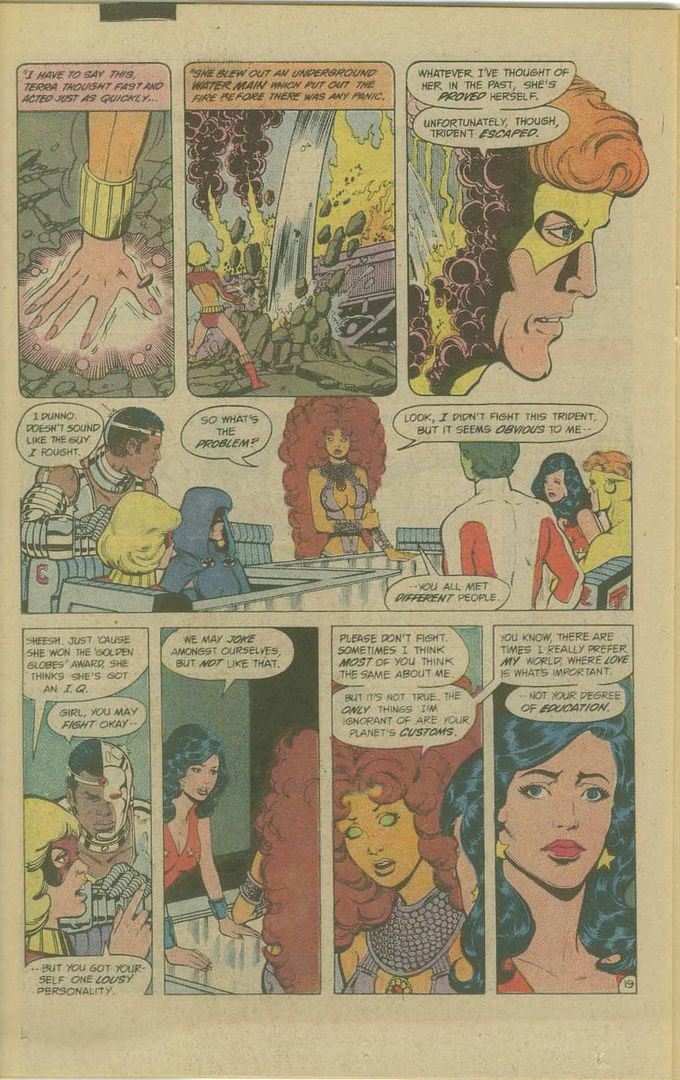
The only glitches are in Raven's fight scenes, where apparently she has the power to change clothes while teleporting; and in a later scene that stops the issue dead. After Kory tells the group duh, it's more than one guy, Terra calls her "golden globes" and questions her intelligence. In the next few panels, Vic and Donna jump down Terra's throat for being insensitive, and Kory laments that on Tamaran, what's in your heart matters more than your degree. Donna and Kory then hug it out.

It's not that Terra wasn't rude, but Kory taking offense here always seemed kind of disproportionate, even whiny, to me. For one thing, Kory has never been the thinker of the group, consistently proud of letting her emotions guide her. Furthermore, the Titans' banter is filled with good-natured ribbing, on the order of "rust-bucket" and "salad-head." No jabs at intelligence, true, but it's not like they never tease each other. Finally, in this very issue, Terra got only mildly rebuked for suggesting that Trident's death was a no-harm, no-foul circumstance. Spending more time (and more page space) making sure she didn't hurt Kory's feelings therefore seemed misplaced, and disrupted the issue's flow to a greater extent than it really should have.

Perhaps to make it up to her, the Titans throw Terra a 16th birthday party in New Teen Titans #34 (August 1983). Tara says she's "never had a birthday party before," which is kind of suspicious given that she didn't spend all her time either with the Titans or being held hostage by terrorists. Anyway, I'm getting ahead of myself, since this issue deserves a bit more attention.

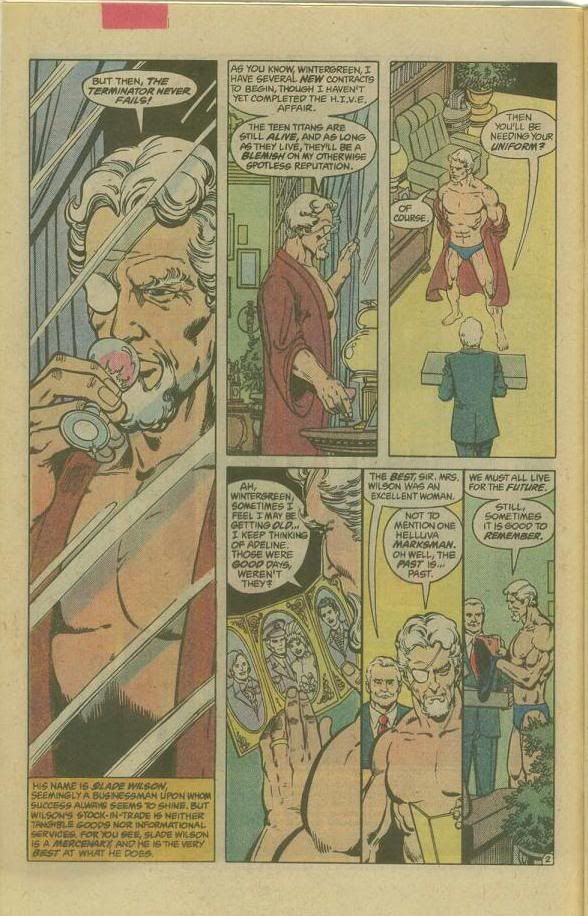
Pages 1 and 2 reintroduce Slade "Deathstroke" Wilson and his manservant Wintergreen. Beefcake shots of Slade in a Speedo are perhaps the highlight of the sequence, as Slade ruminates on his next assignment ("Project 'T'"), his kids (Grant died in issue #2, but here's a photo of the curly-haired other one), and his wife ("one helluva marksman," in a panel that seems to emphasize his eyepatch).

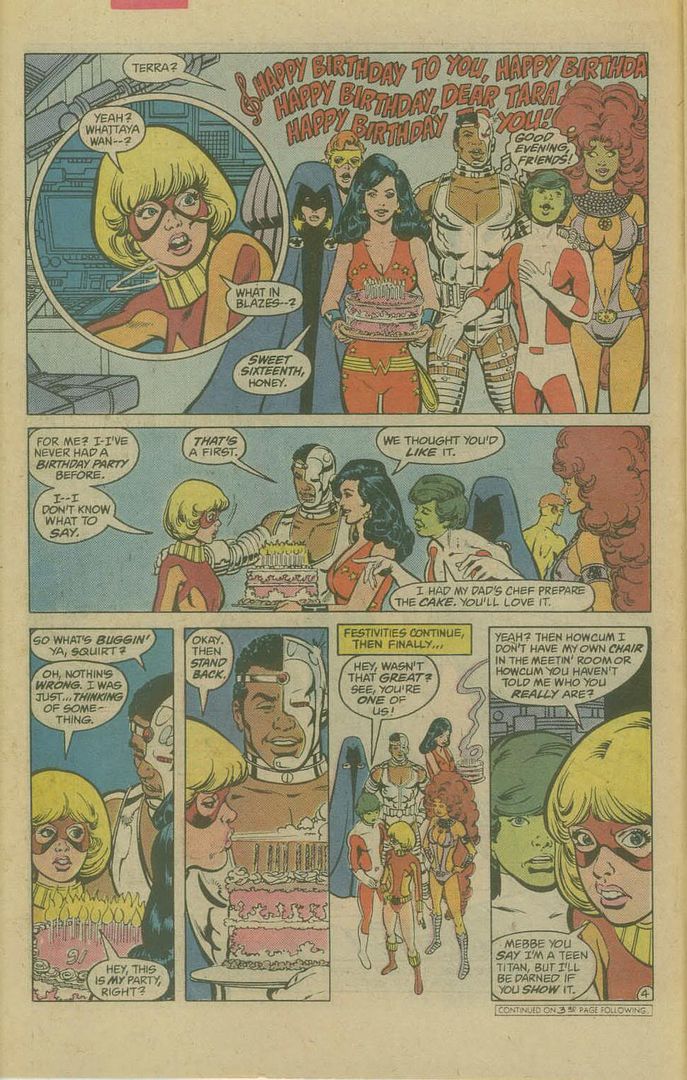
Pages 3-4 begin Tara's party, but when the singing stops, Kid Flash ambles, almost unnoticed, into another room. Tara's lost in thought too, although she complains again that she still hasn't been let fully into the team's confidences. A narrative caption establishes that Tara's been with the group for "several months" (officially since #30, which was New Year's Eve), and while it doesn't seem like that long, reading the issues in a batch, this issue itself plays a little funny with the timeline.

Case in point: when we left Robin and Adrian Chase last issue, they were smashing through a window at Anthony Scarapelli's mansion. Now, on pages 5-6, it's morning, and while Deathstroke's covering the Speedo and the Titans are celebrating Tara, Robin and Chase are fighting Scarapelli's goons. Why, you ask? It comes out that Chase, the district attorney, has a warrant to search the mansion for any illegal guns. Scarapelli doesn't have a gun license, so when he pulls a gun on Chase, that's apparently enough for Robin, the deputized law enforcement official, to arrest him.

From my hazy memories of criminal law and procedure classes (and old "Law & Order" episodes), there are many problems with this plan, not the least of which is Chase's insertion of himself right in the middle of the facts. Scarapelli's defense attorney could at least argue that Chase's vendetta against Scarapelli has tainted the investigation into Scarapelli's "legitimate business activities" enough to get Chase off the case and perhaps get a change of venue. Speaking of venue, I thought Robin was only a deputy of the Gotham City Police Department, although spending time in NYC with the Titans, he might have gotten deputized by the NYPD as well. Still, I wouldn't think that a Gotham cop could make an arrest for a New York crime, but that's getting a little outside my expertise.

In any event, this little exchange confirms for Robin that Chase is muy loco, and at the bottom of page 6 we head back to the party. Tara is really playing the "I had a hard life" tune on the world's smallest violin, but Wonder Girl ("We know your parents were killed, but that's not unique in this group"), Starfire ("I was a slave for almost five years") and Raven put it in perspective.

On her way out the door to meet Terry Long, Wonder Girl stops by a mopey Kid Flash. The Titans have been using code names throughout, but when he reveals he's leaving the group, she responds with "Wally," and he with "Donna." It's a nice moment, with Wally telling her "you always seem to know what to say and do." Thus is Donna's queen-of-nice reputation solidified.

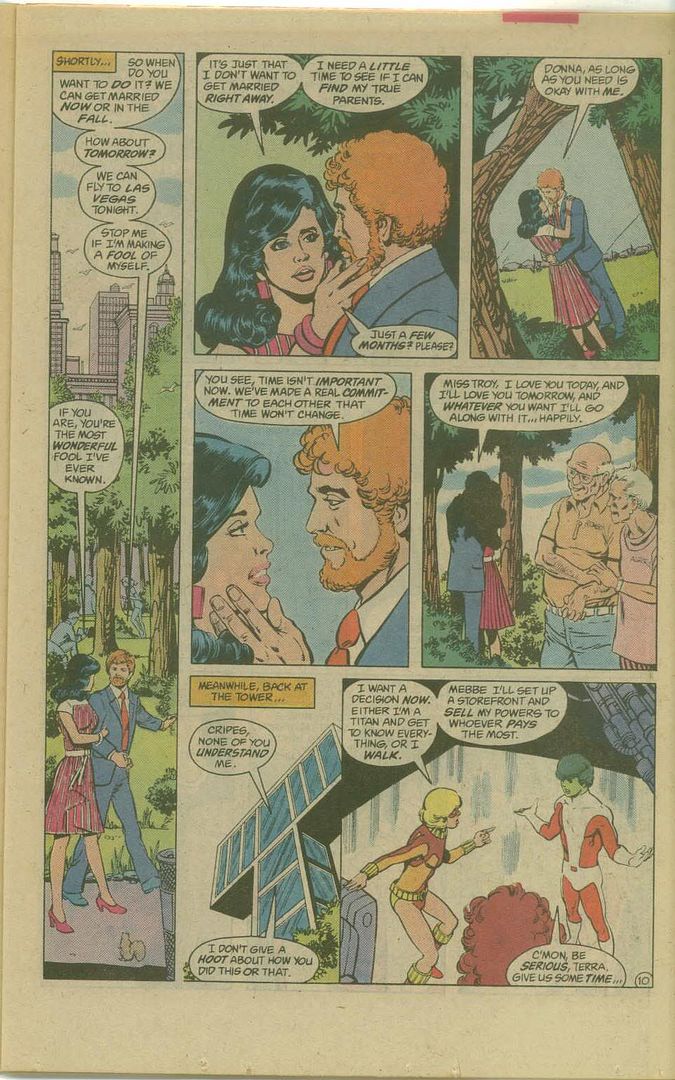
On page 8, Deathstroke stakes out his Wall Street target. This gives Donna enough time to get to Terry's "city community college" classroom on page 9, and accept his proposal in front of the brazen little hussy who wants some "private tutoring ... just you and me. Oh, and the Greeks, of course." No time for you, tramp; Terry has to smooch his barely-legal fiancee! (To be fair, Wolfman and Perez might well have intended Donna to be 19 at this point, and "married at 19" does sound a smidge better than "married at 18," but not by much. Oh, and Terry is a community-college professor? How did I fail to notice that over these many, many years?)

While Donna and Terry walk through the park on page 10 (next to the Elderly Couple Who Still Remember Young Love), back at Titans' Tower, the party's winding down, and the airing of the grievances has begun. Tara's revved up her angry body language, all finger-pointy and adrenaline-charged: "Either I'm a Titan and I get to know everything, or I walk." After Changeling says something that basically boils down to "oh, g'wan," Tara amends her threat to "one week" -- and then she's outta there! "Mebbe the JLA'll hire me." Raven and Starfire try to help too, but just as quickly, she's feeling rejected again: "Lord, I can't take it anymore. I've been kicked outta everything I ever really wanted."

The phone gets Gar out of the drama. It's Sarah Simms, hoping to plead with Vic to save her from her deluded, abusive ex-boyfriend Mark, who thinks he's still engaged to her. However, because Vic believed Mark's fantasy about said engagement, he's mad at Sarah and won't take her call. No problem -- Sarah knees Mark in his special area (FAM!) and throws him out of her apartment. Aaand we're up to the top of page 13 ... but let's go back to Tara's tantrum.

Honestly, the moment she said "JLA," I think a lot of readers in the Titans' place would have said "Okay, right this way to the teleport tube! You don't have to go home, but you can't stay here!" Now, there are good in-story reasons why they didn't do that, among them the oft-repeated notion that they are Their Own People, not beholden to their League mentors. Furthermore, the Titans appear to be all about creating new familial bonds to replace or supplant the ones fractured by their troubled childhoods -- which, incidentally, helps explain Wally's imminent departure. They do want to "hug it out," and convince Tara to stay, almost as if her rejection of them would start another cycle of "what's wrong with us?" Why indeed wouldn't Tara Markov, little match girl practically straight from Dickens, with the power to manipulate volcanoes, want to stay with such a supercool group as the New Teen Titans? Conversely, why wouldn't the Titans, who have known Tara for lo these many months, want to take her into their bosom? (Insert Starfire joke here.)

Therefore, the whole thing seems kind of preordained, even before Deathstroke shows up on the viewscreen, demanding the Titans trade themselves for an anonymous stockbroker (just like Sarah Simms in #10). Terra and Changeling take the call, and Gar's ready to go, but Terra knocks him out and races off on her own. Wally watches her go ("Maybe she's found someone she hasn't insulted today. Strange kid.") but then he hears Gar call for help....

Terra gets pages 15-17 alone fighting the Terminator, but lucky for her the other Titans appear on page 18. Unfortunately, on page 19 Deathstroke gets the drop on a slightly-slower Kid Flash, knocking him cold. With a sword at the speedster's throat, things look grim, but then Terra buries Deathstroke in a mound of earth and Starfire rescues Kid Flash. Deathstroke vanishes in an explosion, and the other Titans congratulate Terra. Kid Flash saved her life on page 18, and now she's returned the favor. Tears in her eyes, she excuses herself.

At the top of page 21, Cyborg, Changeling, Kid Flash, and Starfire all agree that Terra should be a full member of the team. However, one panel later, we're back in the apartment where Terra told Gar she'd been held captive. "They swallowed everything," she tells the shadowy figure she meets there. "They didn't know it's all been a set-up. They didn't suspect the terrorists work for you. They don't suspect that I've been planted in their stupid group." And there, in the lamplight, is Deathstroke.

(I know, at least 95% of you knew that was coming, but I'm taking this at face value!)

The rest of page 22 has Robin chewing out Chase over being used. After he storms out of Chase's apartment, Chase's wife Doris worries about their safety. Also, look at this clown doll Uncle Arthur sent our boy Adam!

"My God, Doris -- I don't have an uncle..."

BOOM!!!

And with that, we take a break from Terra's story for New Teen Titans Annual #2 (1983). It's what the TV folks would call a backdoor pilot, in which a character is introduced to be spun off into his own series. Here the character is the new Vigilante, a cross between the Punisher (gritty gun-toting urban crimefighter) and Deathstroke (mercenary with a sleek Perez-designed costume), and most of the story services his origin.

As backdoor pilots go, it's not bad, although it does put the Terra subplot on the back burner. I wonder if this Annual was meant to be the resolution of Terra's story, but the logistics of launching the new Vigilante series knocked Terra out of the spotlight for another several months. Probably not, since the Annual does advance Robin's subplot about his differences from Batman, and that plays into the Terra plot too. In other subplot maintenance, Raven finds out she's been barred from Azarath forever, I suppose for calling them a bunch of do-nothing peaceniks back around issue #5.

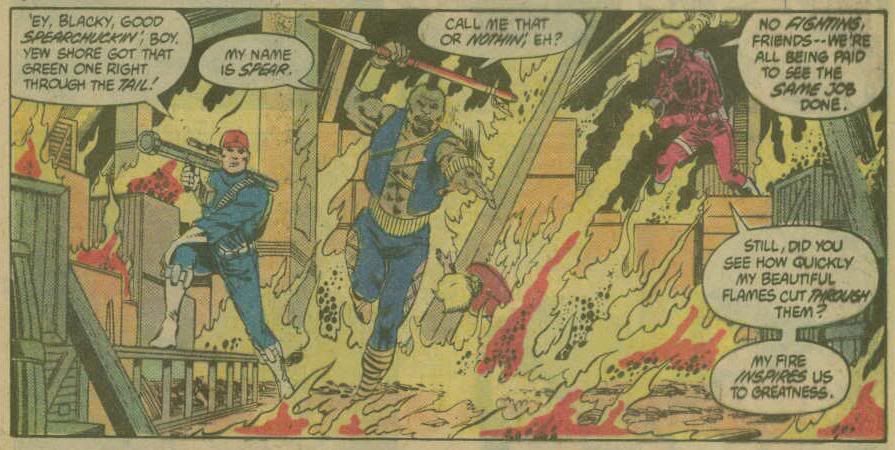
With his family dead from the bombing, Chase leaves the country to recuperate. The Annual's main plot finds Robin taking up Chase's cause, only slightly less willing to bend the law to bring Scarapelli to justice. However, he's chastised by Wonder Girl, who says the Titans won't break the law for him. Scarapelli has problems of his own -- targeting Chase has put him in the doghouse with Donna Omicidio, the godmother (?) of the local mob, who wants to schedule a performance review ... with extreme prejudice, if you get my drift. To protect himself (mostly from Omicidio, he says), Scarapelli goes to the Monitor for some super-powered muscle. Said muscle ambushes the Titans, who really get taken to the cleaners before being saved by a mysterious sniper. Later, at the "performance review," Scarapelli's Monitor-supplied shock troops ambush Omicidio's men, but the Titans try to calm things down. Scarapelli gets away to his mansion and is accosted there by the sniper, revealed as that guy in the black suit from the cover. He unmasks before Scarapelli and (surprise!) it's Adrian Chase, ready to gun down Scarapelli. Robin stops him, but Greedo -- I mean, Scarapelli -- shoots first, wounding Robin and Chase and causing Chase to ventilate Scarapelli reflexively. On the last page, a news anchor asks whether this signals a "new kind of hero." You Make The Call....

At first this feels like a random '80s "rogue cop catches drug dealers who hide behind technicalities" movie, but the Titans' commitment to the law ends up winning out. Chase does save just about every Titan's life with his sniper rifle, and while he is therefore presented somewhat heroically, the issue isn't very rah-rah about his activities. Of perhaps more interest to readers today is the inclusion of the Monitor in his early supervillain-supplier role. (His "job-referral service" line gives a new meaning to "Monster-dot-com"....) One of the mercenaries he supplies to Scarapelli is Cheshire, who may be the most familiar (other than the Titans) character in the whole issue.

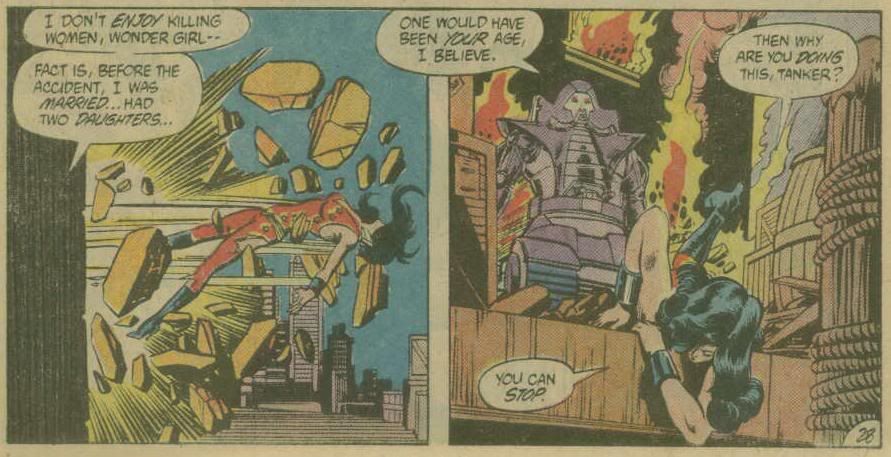
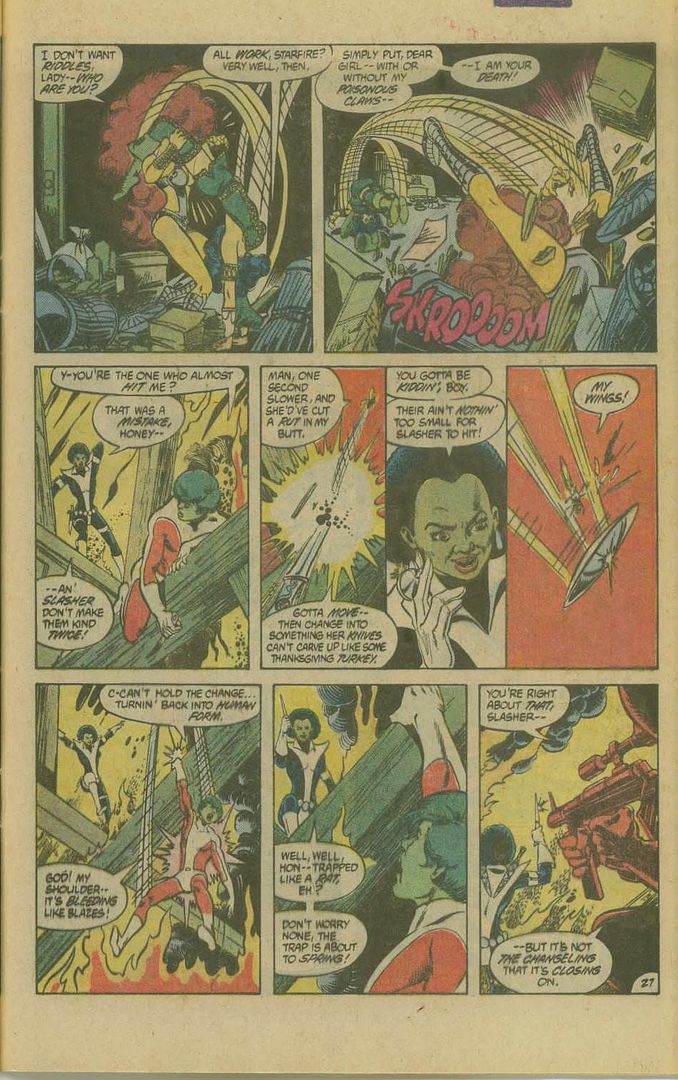
The other super-mercenaries are pretty forgettable, even comical. There's Scorcher, the fire-fetishist and Slasher, the fanfic writer. Tanker looks like the Crushinator. Spear is a Mr. T wannabe, so he gets called racial insults (really) by Bazooka, a bubblegum-chewing bigot with yet another obvious weapon of choice. Bazooka is really named Joseph, so that should give you an idea of the issue's weird balance between grim 'n' gritty and goofy humor. By the way, Chase kills Slasher and Scorcher.

I leave you with a page that not only spotlights Slasher just before her untimely demise, it begins with one of the more ... intriguing panels George Perez may ever have drawn for a mainstream comic:


As you can see, for the most part subplots connect these fairly disparate issues. That will continue for the next few months, before everything comes to a head and Wolfman and Perez finally finish almost four years' worth of building their ideal Titans team.

Next: George Perez takes a break, Thunder & Lightning return, and the (first) definitive origin of Donna Troy!
Full Post

Wednesday, August 09, 2006

New comics 8/9/06

Well, I've got the time and the motivation, so let's knock these out while they're still fresh.

First up is 52 #14 (written by Crosby, Stills, Nash, and Young, breakdowns by Keith Giffen, pencils by Dale Eaglesham, inks by Art Thibert), which finds itself in a more familiar groove after last week's near-exclusive focus on Ralph Dibny. This time the issue's split between Montoya and the Question's trip to Kahndaq, and Steel's despair over his niece's allegiance to Luthor. Will Magnus is visited by "men in black" (who don't wear black, thus the quotes) and the capper is a two-page origin of Metamorpho. The Metamorpho origin makes him seem like an Indiana Jones-type adventurer before the accident that gave him his powers, and while I'm no Metamorpho scholar, I don't seem to remember that kind of swashbuckling surviving to his superhero days. Maybe I just didn't notice. Anyway, it's a neat idea to emphasize, and by that I mean "hit me over the head with it so I don't miss it again." Back in the main book, the Kahndaq stuff is good, but the scene with Magnus got a little confusing during the prisoner takedown. The Steel scenes were effective, although that plot seems to be in a holding pattern.

I bought JSA Classified #15 (written by Steve Englehart, pencilled by Tom Derenick, inked by Mark Farmer) partly out of curiosity to see if Part 2 of ... well, Part 2, counting the JLA Classified arc, would improve on a lackluster couple of installments. I suppose it depends on accepting a side of Gypsy's powers I hadn't seen before. Is this an astral form? Did she study with Doctor Strange? Anyway, the setup is pretty intriguing, as far as supervillain plots go -- basically, the stronger Wildcat gets, the madder he gets, or the unluckier his foes get. It might not be plausible, but it's effectively unbeatable, at least to my mind that hasn't had time to consider it. Ultimately, not as bad as it could have been, and I'll be back for Part 3.

Superman #655 (written by Kurt Busiek, pencilled by Carlos Pacheco, inked by Jesus Merino) was good from start to finish, including the pleasingly old-school cover. (Word balloons? How kicky!) Much of the issue is told in flashback as Clark brings us up to speed on two old double-L girlfriends, Callie Llewellyn and Lana Lang. The latter, in fact, is the new CEO of Lexcorp, which, considering all the trouble she's been through ever since her ex-husband was elected VPOTUS, is a pleasantly surprising change in the status quo that I hope is long-lived. It sure is a good distance from her Chuck Austen "homewrecker" role, and Busiek gives her and Clark a more dignified airing of their old romance.

As for Callie, the big mystery centers around just what she knows of Clark and Superman, but her status as Clark's post-Lana flame allows Clark a non-milquetoasty exchange with a fellow reporter interested in the nudge-nudge aspects. Indeed, Clark has apparently adopted the Jim Rockford blazer-no-tie style, and via Pacheco, makes it work. Also, Superman's in this issue, fighting a Doomsday-type brute engineered by the USSR. Busiek uses Supes' senses for exposition, putting in narrative captions information about the setting that Pacheco then doesn't have to show. It works better than I can describe. Except for a few confusing pages with Arion in 17th-century France, that holds true for the entire book.

If it turns out I have correctly guessed the identity of the Mystery Villain glimpsed in Firestorm #28 (written by Stuart Moore, pencilled by Jamal Igle, inked by Keith Champagne), I will be very impressed with myself and may well be even more insufferable. (The guess is at the bottom of the page.) This was another solid issue, moving things along nicely and bringing back a few familiar faces. Speaking of which, it feels like Moore is playing the single-dad angle with Jason as a counterpoint to Ronnie Raymond's (widower?) father, only where Ronnie had to deal with a stepmother, Jason's real mom is now back in the picture. Anyway, Mikhail Arkadin (one of Ostrander's Firestorms) returns officially in this issue, everybody fights foot soldiers in battlesuits, Firestorm unloads a massive amount of power on a big blob-beast, yadda yadda yadda. It's all good.

Beyond! #2 (written by Dwayne McDuffie, drawn by Scott Kolins) is mostly a big fight between Medusa and Venom, during which Medusa is shown to be quite hardcore. Also, the group winds up on a mysterious planet, Hank Pym apparently pulls an Avengers Quinjet out of his pocket, and surprisingly, I remember that the one guy with the hair is the new Kraven. All in all, not a bad second issue, with enough happening to be entertaining. For #2 out of 8, that's about right.

She-Hulk #10 (written by Dan Slott, pencilled by Rick Burchett, inked by Nelson) also has a lot going on, from Jen's role as Registration Act enforcer to Pug's attempts to break Starfox's love spell (and, therefore, destroy Shulkie's new marriage), the repercussions of said marriage on the new hubby, both personally and with an old Spider-Man villain, and the revelation of another villain from the previous She-Hulk series who, quite honestly, I had forgotten. Sure, it's fun, but it feels like we've been dealing with these issues for a while now and it's time for some resolutions.

And speaking of resolutions, Fantastic Four: First Family #6 (written by Joe Casey, pencilled by Chris Weston, inked by Gary Erskine) wraps up the miniseries in a decent way. I wasn't crazy about this issue, but it might improve once the whole thing is read in one setting. Mostly I kept waiting for Reed to get the crew out of those clunky unstable-molecule suits and into some more comfortable unstable-molecule duds. Also, this issue Reed tends to look like Peter Lorre, which I might have mentioned before. The power of love saves the day, too, but again that fits with another subplot, so it's not so egregious. The whole thing is redeemed, though, by closing with the classic FF mission statement, so all is forgiven:


*** I think it's Tokamak, Lorraine Reilly's father, who tried to become a nuclear-powered supervillain a few years into the Fury of Firestorm series.
Full Post

Sunday, August 06, 2006

New comics 8/2/06

Well, it's been a hectic couple of weeks. I have been traveling, first with the Best Wife Ever and then alone, for at least part of both the past weekends. Got back into town yesterday afternoon, which meant I had to spend today (after church, of course) running around doing all the things I could have done yesterday. Including, I suppose, writing this post, so here we all are again. Not to sound like this is some kind of leaden obligation; I'm just a little tired. Also, traveling gave us the chance to see friends and family, so there was an upside.

Ach! Enough dithering!

We begin this week with The Spectre #3 (written by Will Pfeifer, drawn by Cliff Chiang), in which the late Detective Allen makes his peace with his being the Ghostly Guardian's host. I have to say, I read none of the John Ostrander Spectre series and all of the J.M. DeMatteis version, and being otherwise familiar with the character only as an agent of God Almighty I have to say I like the way the New-For-2006 version is set up. It does not offend my Methodist upbringing and it is a good compromise between the "classic" ironic-punishment model and the more huggy DeMatteis take.

Next up is 52 #13 (written by Mickey, Mike, Peter, and Davy, breakdowns by Keith Giffen, pencilled by Todd Nauck, inked by Marlo Alquiza), which I had thought would be pretty fun, having reunited many of Ralph's formerly-dead JLA colleagues. However, as they used to say on Mystery Science Theater 3000, "it seemed like a good idea ... at first!" SPOILER ALERT -- things do not go well for Ralph. Coincidentally, re-reading Waid's Fantastic Four now makes me wonder if a similarly uplifting finale is in the works for Ralph. Maybe he'll get to meet God, played by Julie Schwartz? That's about the only way I can see this issue's creepy ending being balanced out.

I did like Detective Comics #822 (written by Paul Dini, pencilled by Don Kramer, inked by Wayne Faucher), in which the Riddler -- the classic Riddler, not the LOTDK makeover, I hasten to add -- plays Marty Eels to Batman's Monk. (Oh, if we had only seen Riddler's mother this issue!) There are lots of neat little character bits, as you'd expect, but my favorite is the one involving who's more recognized at a hardcore sex club. It reminded me of Mike Barr and Alan Davis' over-too-soon Detective issues from 20 years ago, and I hope Dini sticks around a lot longer.

I hadn't planned on getting The (All-New) Atom (#2 written by Gail Simone, pencilled by John Byrne, inked by Trevor Scott), but I'm glad I did. Our hero starts his costumed career in earnest, while the mysteries of both his anointment and the tiny alien invasion deepen. (I do hate sounding like a press release, just so you know.) Simone writes a group of scientists struggling believably to explain superhero tech in a world that must also acknowledge omnipotent magical beings. Accordingly, it's quite plausible that even a scientist would respond simply by letting himself enjoy the experience. It makes for a fun book, and it might end up being my favorite superhero reinvention since Firestorm.

Marvel Adventures: Spider-Man #18 (written by Peter David, pencilled by Mike Norton, inked by Norman Lee) is a fairly insubstantial Spidey/Man-Thing team-up (as much as one can team up with Man-Thing) involving a guy and his daughter on the run from unsavories in the Everglades. It's nothing special, but there's nothing really wrong with it either. I also got the Untold Tales of Spider-Man paperback (or, as Marvel calls it, Spider-Man Visionaries: Kurt Busiek Vol. 1), and just read the latest Spider-Man Masterworks, so I am apparently all about the classic Spidey.

Finally, I suspected that Fantastic Four #539 (written by J. Michael Straczynski, drawn by Mike McKone) borrowed liberally from other parts of Civil War which, naturally, I have not and probably will not read. It also struck me that this issue's focus on Ben Grimm -- including the ending -- might well have been handled better in, say, his own solo title ...? Too bad Ben apparently can't support such a thing, because I bet it could attract a really great writer who could have made Ben's climactic decision that much more poignant. As it is, the poignancy for me comes from realizing that this is, in fact, the last nail in the coffin of Dan Slott's The Thing series, because Slott really could have made something special out of this issue's cliffhanger. I would love to see Slott's take on Ben traveling Marvel-Earth, but alas....

Anyway, I feel like I can't really evaluate this issue either on its own or as part of "Civil War," so I'll just say it didn't feel much like a Fantastic Four story to me and leave it at that. It should have been The Thing #9.
Full Post

Tuesday, August 01, 2006

New comics 7/26/06

It'll be nice to get back into a regular schedule, but unfortunately that probably won't happen until the weekend. Last week's big week should be followed this week by a drought. I'm tending to get most comics around the end of the month now, which is starting to feel like the old familiar ship weeks of yore. However, it tends to create these marathon recap posts....

First up this week is 52 #12 (written by Dino, Jerry, Frank, and Sammy; breakdowns by Joey Bishop; pencilled by Eddy Barrows, inked by Rob Stull). It's mostly a Black Adam story about his budding relationship with Stor-- I mean, Isis. She's not the Filmation character, but really, who pays attention? Black Adam starts to look more Biblical, if not outright mythological, and we find out why Captain Marvel has gotten cabin fever over the past, say, twelve weeks. I have to say, I'm philosophically opposed to the perpetual remaking of Captain Marvel and his associates, but overall this isn't bad. I'm still not getting the Trials of Shazam! miniseries, though.

P.S. Montoya and Ralph Dibny each get a few pages, and Waid and Adam Hughes present the two-page Wonder Woman primer.

I would have liked Action Comics #841 (written by Kurt Busiek & Fabian Nicieza, drawn by Pete Woods) better if the villain hadn't been so Manga Khan-esque. However, it was good on its own, showing Superman interacting both with ordinary folk and fellow super-types. It has the same kind of feel that I got from Busiek's Avengers, where you don't have to know who everyone is, but you know they're all part of the same community and you get a sense of the pecking order. Superman, naturally, is at the top, but the story is about the public's readiness to put him back up there. As plugged-in as the Superman books were to all the Infinite Crisis hoo-rah, under Busiek they' seem more integrated with the larger DC-Earth, and that in turn feeds Superman's status at the top of that ol' pyramid.

The various threads of wackiness all seem to be coming together in Hawkgirl #54 (written by Walt Simonson, drawn by Howard Chaykin), which is nice. It doesn't mean all is forgiven, and Kendra still spends too much time showing off her underwear, but on balance there was more good than bad.

Checkmate #4 (written by Greg Rucka, drawn by Jesus Saiz) wraps up its first story arc pretty well, setting up the character relationships and infusing what could have been a foregone conclusion with a bit of cliffhanging. Re-reading these first few issues would probably pay off, since between the Checkmaters and the Great Ten there are a fair amount of unfamiliar characters, not to mention the characters in similar uniforms drawn similarly. In other words, I are stupid and can't tell some of the players apart on my first quick read.

Steve Englehart, Tom Derenick, and Mark Farmer wrote, pencilled, and inked both JLA Classified #25 and JSA Classified #14, which (respectively) closed out the Detroit League's adventure with the Royal Flush Gang back in the day, and kicked off Stargirl's adventure with Gypsy and Vixen set in the present. I had enjoyed the first few parts of the JLA arc, but this last one seemed a bit too breathless, and I don't remember Gypsy being so powerful, then or now. As for the JSA arc, it also seemed a little too credulous, what with Stargirl copping an attitude towards the more experienced ex-Leaguers, and the thought that "villain mind-controls heroes to fight" is an innovative plot. I like Englehart generally, but this tries my patience.

Marc Singer has commented already on the religious symbolism of Astro City Special: Samaritan (written by Kurt Busiek, drawn by Brent Anderson), which I didn't notice upon first reading. I was trying to decide whether Infidel was more of a Luthor- or Brainiac-analogue. Symbolism aside, it was a good story of Samaritan's number-one foe, and I suppose its main mission was to emphasize how dangerous this dude would be if he ever decided to take over all of creation again.

Speaking of number-one foes, the Red Skull pops up quite creepily in Captain America #20 (written by Ed Brubaker, drawn by Steve Epting), the penultimate (?) chapter of "Twenty-First Century Blitz." Cap and his British allies fight Nazi strongmen on a blimp, and it is awesome, even before the giant Nazi robot appears. The prospect of a Cap/Winter Soldier team-up is also teased to great effect.

Finally, as you might have guessed, I saved Batman #655 (written by Grant Morrison, drawn by Andy Kubert) for last, because it too was awesome. There's more Bruce Wayne than Batman in this first issue, but Morrison presses all the major Bat-buttons. Short scenes with Gordon and Robin (and even the Joker) seem poised for later payoffs, the "Zur En Arrh" graffiti hints at a return to '50s-style sci-fi (however brief), and Alfred almost steals the book from under his boss. There are a couple of clunky points, like the blocking of the initial action sequence, the thought that the one-year layoff didn't rejuvenate Bruce, and the too-obviously-nervous Kirk Langstrom, but on the whole this is a refreshing change for a book that at times seemed more dedicated to maintaining its hard-boiled reputation. I don't think Morrison is the only one who could have pulled Batman back from the brink of excessive grimness and grit, but he shore does a fine job here.
Full Post

Tuesday, July 25, 2006

New comics 7/12/06 and 7/19/06

Yeah, I know, another two-weeks-at-a-time thing. Last week was a killer, though -- the Best Wife Ever went to a (practically) week-long conference in Dallas and I had to make sure the house was in as good or better condition than when she left it. So far, so good. Also, we've got another couple of hectic weekends ahead, so between keeping an eye on San Diego over the weekend, I've been working on making sure the next couple of Grumpy Old Fans get done.

Since you've probably read most of these already, I'll try to be brief.

THE VERY GOOD

52 #10, for Clark's shenanigans and Lois' reaction.

She-Hulk #9, for the priceless dinner with Jen's future in-laws.

Hero Squared #2. This really needs to be a sitcom. If "My Name Is Earl" can be a comic, this can be a sitcom. And a comic too, of course.

Firestorm, The Nuclear Man #27. I wish I knew more creative ways to say "good, solid superhero stories" every month, because that's the only bad thing about reading this book.

Superman #654. The only bad thing about this book is Lois' hair, and that's because it makes her look like Luthor's ex The Contessa. If this is what the Busiek run is going to deliver every month, for goodness' sake, DC, don't let him go!

Green Lantern #12. It might be the one book I think Geoff Johns gets consistently right, but just like with Busiek, whatever he's on when he writes it does the trick. I'm also a lot fonder of Ivan Reis than I was of Ethan van Sciver, and that's not really a slight on the latter.

And finally, Justice League of America #0, about which I have already gushed.

THE PRETTY GOOD

52 #11. Would have been better if the DC hype factory hadn't spoiled Batwoman's secret identity a couple of months ago.

The (All-New) Atom #1. A fine introduction to the new guy, and more fun than his Brave New World teaser.

Aquaman: Sword of Atlantis #43. Pieces are put together and old Aqua-characters come back as the other new guy finally decides to be Aquaman. It took Busiek a little longer to find his groove with this title, but I think it's all starting to click.

Supergirl and the Legion of Super-Heroes #20. Come for the rampaging giants, stay for Brainy's creepy Dream Girl fixation. I want to like this book more, but every month I feel like there's more going on than I can keep up with. Paperbacks, I know; or maybe I could just find time to actually read the floppies some weekend.

THE ONE THING WAS COOL...

Green Lantern Corps #2. Less murky art would help this book. That sounds like I should get the Dave Gibbons-drawn issue in a couple months, doesn't it? Anyway, I can't tell which Alien Of The Week is which, but I did like the Giant Guy Construct.

Star Wars: Rebellion #4. The cliffhanger ending was cool. I can't say much more.

JLA Classified #24. Nice spotlight on old-school Aquaman, and it is kind of fun to see Amos Fortune comfortable enough with his tub-of-goo body to squeeze it into white spandex.

THE REST

Superman/Batman #28. The new team of Mark Verheiden and Ethan van Sciver start their run with a story about J'Onn J'Onzz going nuts on Batman. Good concept, decent mystery, and no dueling narration, but somehow it just feels kind of stiff.

The Flash: Fastest Man Alive #2. I know, every dork with an Internet connection thinks he can write comics, but this Flash storyline is so predictable it's sad. We know Griff the Annoying Roommate will be Bart's newest supervillain. We know Bart will overcome his Speed Force trauma and his reluctant-hero stance. We know he'll get together with the cute STAR Labs techie.

Why didn't this book play around a little more with the mystery of who could be in the Flash suit? Why spend two issues convincing Bart to get back in harness when the two issues have been screaming he's going to? This book could have started out with a mysterious Flash speeding through town saving people, solving crimes, etc., while leaving clues that it could be Bart, Wally, Walter West, one of Wally's kids, Griff, or even Valerie. It would be a real mystery, because a Flash could effectively be in two places at once. We'd have gotten more Flash-action and less angst to boot, and the book could even have kept the shifting-narrator flashbacks. In fact, that could have been the "reveal" -- when the narration started syncing up with the Flash's exploits. I almost think this book is being deliberately obtuse, and still has a few surprises in it. I'm fairly sure that gives all involved too much credit, but you never know.
Full Post

Monday, July 17, 2006

"Just My Job, Five Days A Week": Diffusing Star Trek's Allegorical Shorthand For The 24th Century

(Wow, now I have to live up to that title....)

First off, Rick Berman is the Roy Thomas of Star Trek.

As plok so thoroughly discusses, Roy the Boy was the first writer to take Stan Lee and Jack Kirby's immortal Fantastic Four (along with a few other Marvel titles) and "consolidate" it, by refining, rationalizing, harmonizing, etc., the stories into a coherent whole upon which he and future writers could build. Plok observes that Roy had to figure out how to do FF right, because with both Stan and Jack gone it became possible to do FF wrong.

Somewhat similarly, Rick Berman worked with Original Trek creator Gene Roddenberry on "Star Trek: The Next Generation"’s all-new cast. As Roddenberry's influence over TNG waned, Berman's grew; and Berman eventually guided TNG's movies and successor series.

Berman took Star Trek "from idiosyncratic vision to corporate property," to borrow plok’s words, which to me makes him a more pivotal figure than later Original Trek producers Fred Freiberger and John Meredyth Lucas. TNG under Berman codified and (at the risk of misusing the term) objectified Star Trek, making systems and rules out of dramatic conceits.

Well, what about the "Phase II" producers, or Harve Bennett, smart guy? Yes, I know ... but "Phase II" never got off the ground, otherwise we might be discussing Jon Povill and/or Harold Livingston. As for Bennett, his Star Trek movies (and The Motion Picture too, although he had no part in it) were opportunities to capitalize upon the original cast's continued appeal. TMP was very much in the mold of the TV show's Guest-Star-of-the-Week format, so much so that it might well be considered the 80th episode; and Bennett’s movies (as he's said) are their own animal, looking at the characters themselves. If they don't have much to do with Gorns or guys with half-black faces, it's by design. The Bennett movies are Trek deconstructed, not Trek rehabilitated; and rehabilitation works better over the long run than deconstruction does.

There is a providential symmetry to all of these developments, because a lot of Star Trek is (or has become) about the framework. Trek trivia not only makes some story point about how far humanity has come, it adds another item to How Things Work In The Future. Star Trek’s producers wanted everything to be believable not just for believability’s sake, but also because an idyllic future was part of the point of the series. An excerpt from the original Star Trek proposal (reprinted in Stephen Whitfield’s The Making Of Star Trek) states that the show would have all the advantages of an anthology series, and none of the limitations. That means having a consistent background. Perhaps the closest comparison we have today is "Law & Order," which by the way didn’t have to first invent the American judicial system and thereafter maintain its believability.

From this perspective, the more fleshed-out the future was, the easier it would be to craft new characters to take over for the old ones. (Again, think "L&O’s" revolving-door casting, which starts from the premise that you need two Detectives and two Lawyers, details to follow.) As we’ve seen, Star Trek had already replaced virtually its entire cast in the housecleaning between pilot episodes. However, when the crew turned out to be popular, gradually the show learned to focus on them more.

This focus developed into the allegorical personifications of Kirk the Mediator (or the Decider, as I originally adapted the Bushism), Spock the Brains, and McCoy the Heart. By allowing the three leads to comment on the story of the week, even in somewhat predictable fashion, the show developed their characters while staying true to its anthological aspirations.

Now, this might have been character development only in the sense of maintaining or reinforcing existing tendencies, but that kind of thing can accrete over time into something that can at least be deconstructed later. In his seminal criticism The World of Star Trek, David Gerrold called the negative aspects of this "hardening of the arteries." Gerrold argued that Star Trek’s main dramatic focus shouldn’t be Kirk In Danger, but Kirk Makes A Decision. In this light, the movies are about the choices the aging crew makes, with the aggregate effect thereof being everyone back aboard a new Enterprise.

Along the way, whether coincidentally or by design, the movies kill and revive Original Trek’s two constants, Spock and the Enterprise. The series always had contingency plans for the loss of Spock, namely Xon and Saavik; and but for Leonard Nimoy’s continued enthusiasm, would have used them. Spock’s death ended Original Trek’s continuity of character, or at least put it in serious question.

Likewise, the destruction of the Enterprise ended (or at least, etc.) Original Trek’s continuity of setting. From Star Trek IV forward, the setting would be "an" Enterprise, not "the" Enterprise, and I think that makes an important tradeoff. If all you need is the name, the ship itself becomes less important. Although Kirk in Star Trek IV declares (with some irony) that "a ship is a ship," taken together, the "replacement Spocks" and the replacement Enterprise suggest that particular individuals indeed don’t matter as long as core storytelling functions are covered.

While this all suggests that Spock (the original Friendly Alien Outsider) and the Enterprise (as the vehicle for exploring space) are core storytelling elements critical to any series incarnation, it also suggests that all one needs are those functions, because (as "Deep Space Nine" and "Voyager" make clear) even the ship’s name is unnecessary.

Back to "Phase II." It not only took into account the lack of Spock, it also had a contingency plan for William Shatner bailing out. As First Officer, Cmdr. Will Decker would take part of Spock’s duties, and was also imagined as being the Young, Swashbuckling Kirk Figure. (Kirk was apparently going to be older, wiser, and perhaps more distinguished. These are not traits one might associate with Shatner in the '70s, but let's cruise on.)

The bulk of Spock’s Friendly Alien Outsider role would be played in "Phase II" by Lieutenant Xon, another Vulcan science officer. Additionally, Decker’s old girlfriend Ilia would have been a kind of Bizarro-Spock (or Spock for the Sexual Revolution), an empath for whom sexuality was the new logic. In a weird ‘70s way, then, Decker/Xon/Ilia could have been mapped to the old Decider/Brains/Heart model, with Ilia’s hyper-femininity taking the place of Bones’ humanism in the "Heart" category.

Much of this translated to TNG. Distinguished Kirk became Picard, Decker/Young Kirk became Riker, Xon became Data (although Data also owed a bit to Roddenberry's "Questor Tapes" android), and Ilia became Troi. However, somewhere along the way Ilia’s overt sexuality was toned way down into Troi’s first-season frumpiness. If Ilia were truly going to represent the Heart (or perhaps the Id), there was little hint of that in the way Troi was utilized.

The rest of the TNGers seem to have come from outside the "Phase II" playbook. Tasha Yar was inspired by Aliens’ Lt. Vasquez, and was originally called "Macha Hernandez," apparently because "Manlia McStudly" wasn’t ethnic enough. Wesley represented Roddenberry’s vision of a family-friendly Enterprise-D, as opposed to the "militaristic" starship of Bennett's films. Geordi was a tribute to a paraplegic Trek fan, George LaForge. Worf was the Chekov of the new crew, and the last added, intended to show the progress in intergalactic superpower relations.

That leaves Dr. Crusher, chief medical officer. Although "Phase II" would have featured a female doctor in the person of Christine Chapel, she would still have been second to McCoy. Apart from specialities in psychotherapy and holistic medicine, and even as a potential McCoy contingency plan, Chapel wouldn't have brought much more to the dramatic table than she did in the Original Series. Indeed, her most notable subplots there centered around a mad scientist fiance in "What Are Little Girls Made Of?" and her unrequited lurve for Spock in "The Naked Time" and other episodes. The latter was hardly even superficially similar to the relatively complex Crusher/Picard relationship. However, Beverly's role in the ensemble cast was defined mostly by males -- Picard and Wesley, who were connected to her through her late husband.

I find this curious because it suggests that McCoy was a truly irreplaceable character. TNG admits as much through two examples: having the doctor himself give the Enterprise-D a proper sendoff in "Encounter at Farpoint," and making Dr. Pulaski a (wait for it) Bones clone in the second season. Still, in something of an homage to Kirk, McCoy, and Spock, TNG's Captain, Doctor, and Brains were featured on the cover of The Continuing Mission, its tenth-anniversary coffee-table book.

Not having McCoy-like skepticism meant that TNG would have to play the Captain off the Friendly Alien Outsiders, or off the other "regular humans" in the cast. I suppose one could see this as a further diffusion or fragmentation of McCoy among said regular humans, but in the longer view it looks more like McCoy just had a more distinct personality than a lot of other Trek crewmembers.

And therein lies the end of Kirk/Spock/Bones particularly, and maybe the Decider/Brains/Heart triangle generally, in favor of the Captain and (more often than not) the FAO.

For the most part I think this holds up. Picard played off Data, Worf, and (when she was around) Guinan; Sisko likewise got paired with Dax, Odo, Quark, and Worf; and Janeway started out already chummy with Tuvok and ended up BFF with Seven of Nine.

However, the Captain/First Officer relationship also gets a lot of attention. In every Modern Trek case I think it has to do with built-in conflict. Sisko/Kira and Janeway/Chakotay are obvious in this respect. Likewise, Picard/Riker initially seemed poised for a turf war, but the two ended up getting along.

Again, I’m probably forgetting more than a few, but you see my point. Most of the big relationships involve the Captain-figures. This makes sense, because the Captain needs information from just about everybody, and the episodes don’t usually leave room for a lot of other relationships. The TNG movies even tended to split the crew between a Picard team and a Riker team, with the focus being on Picard and Data. (The exception was the scattershot Generations, which still paired Captains Picard and Kirk.)

Other recurring relationships tend to be familial (the Siskos, the Crushers), romantic (too many to list), or just "buddies" (Data/La Forge, Bashir/O’Brien, Paris/Kim). This, I believe, is the source of the workaday attitude fostered by TNG. These relationships are valuable in an ordinary dramatic way, but they're not charged with the same dramatic responsibility as Kirk/Spock/Bones or (for example) Sisko/Kira. They do lend themselves to the ubiquitous pedeconference, and they make the characters more accessible.

However, that workaday attitude tends to demystify the original Star Trek atmosphere of boldly going, etc. By and large I still believe all five Trek shows expressed the "Risk is our business!" attitude described in the previous post, but if nothing else, the sheer volume of Modern Trek allowed more opportunities to highlight the mundanities of Starfleet life. (Who knows, at this point, whether "Enterprise" would have fallen into this pattern? I tend to think it would not have, mainly because it wasn't anywhere close to developing the large supporting casts the other shows did. Also, "Enterprise" pretty plainly aimed to recreate Kirk/Spock/Bones with Archer/T'Pol/Trip.)

Thus, the lyrical choice for this post's title. "All the science I don't understand," indeed! Ah, if only I were in charge of Paramount's promos for its Trek syndication packages....

One of the best examples of the NextGen-era diffusion comes in the big finale of "The Best Of Both Worlds, Part 2." Riker's on the Bridge, ready to ram the Enterprise into the Borg Cube in a last, desperate attempt to save Earth. Meanwhile, Picard/Locutus is in Sickbay, with Data, Dr. Crusher, Troi, and O'Brien trying to hack the Borg communications grid through him. Data handles the actual communication, with Troi around to sense whether the real Picard can take control.

Watching the episode today made me wonder how the Original Series would have played the situation. Would Spock's place have been as Captain, on the bridge, or mind-melding with Lo(Kirk)us in Sickbay? If the latter, I guess Scotty would have been in the center seat -- but wouldn't he have wanted to be in Sickbay too, monitoring the Borg comm grid? That would leave Sulu with the conn, and wouldn't that have been a sight -- the Enterprise's finest helmsman, juking and swerving the great starship, narrowly evading Borg fire.... Well, anyway, it probably would have been Scotty at the conn, Sulu at the helm, and Chekov monitoring Borg chatter.

Still, what a corker it would have been! Because Lokirkus knows full well that Spock will try logic first, he has every advantage -- until Spock gets a visit from McCoy, who tells him he has to let go of Kirk. (It's almost a reprise of "The Tholian Web," except Spock and Bones wouldn't necessarily be fighting, and there would be no taped farewell from Kirk giving both men the critical advice.) Of course, Guinan does this for Riker in "BOBW2," which I think is as close to a Kirk/Bones moment as TNG may ever have come. However, imagine the emotions accompanying that Spock/Lokirkus mind-meld! "BOBW2" does have the hint of a comparable scene between Locutus and Beverly, but it never materializes; and likewise there's not much subtext to Troi's witnessing of Picard's final emergence. Again, the most powerful part of the sequence, in this respect, is when Picard grips Data's arm; and not just because it reminds me of Spock and Kirk's handclasp after the V'Ger mind-meld.

To sum up, then, across the five series, the pattern to me has always been the Captain and the FAO. The difference with the Original Series was the elevation of McCoy to an equal partner in the relationship. With his distinct personality unavailable for subsequent series, his similarly unique contribution was abandoned (or at least diminished) in favor of the viewpoints of the non-FAO crew, making their roles more mundane in the process.

Does that sound right? Because he couldn't replace Dr. McCoy, Rick Berman ended up reviving the original Star Trek dramatic dynamic. Well, that might not exactly have been his intent, but that seems to have been the effect. Every new series must necessarily be at least a little different from the old, for obvious reasons; but at the same time, the spinoffs must be familiar enough to keep from alienating the lifers. I don't mean to characterize the process as one from Column A, two from Column C, etc., because I have enjoyed all of the series, and the characters are naturally big parts of that. However, I do think that "dilution" might be the best way to describe the transformation of Star Trek's dramatic structure. Roy Thomas didn't dilute Fantastic Four, certainly, so the comparison might not hold up absolutely; but both works came out of their "consolidations" ready to be perpetuated for decades to come.
Full Post

Friday, July 14, 2006

And Happy Bastille Day, Too

Good grief, I can hardly believe it's this humble site's 2-Year Blogoversary!! What's more, I am just now finding out I share it with the always-excellent Jog; and both blogs are just a few days younger than also-always-excellent Josh. Happy 2-year blogoversaries to you both!

If you need other reasons to celebrate, it's the birthdays of (among many others) Woody Guthrie (1912-1967), Isaac Bashevis Singer (1904-1991), William Hanna (1910-2001), and my fellow native Kentuckians A.B. "Happy" Chandler (1898-1991; former Governor and baseball commissioner) and Harry Dean Stanton (1926-). (Where's the cake?)

Thanks to all of you for reading, both here and at the (former) Great Curve. Year Two was lots of fun -- now on to Year Three!
Full Post

Thursday, July 13, 2006

Bloggers gotta eat


You may have noticed the new Google ads....
Full Post

Thursday, July 06, 2006

New comics 7/6/06

Sweet fancy Moses, I read some good comics today! Just when I thought I had things figured out, quite a few of these books surprised me. Hardly a clunker in the bunch!

We begin with Detective Comics #821 (drawn by J.H. Williams III), the first of what I hope are many consecutive issues written by Paul Dini. If JHW3 were sticking around longer, I might be calling this the next great Batman team ... but then again, Grant Morrison and Andy Kubert are on deck, so we'll just have to see. Crikey, I'm negative, and for no good reason except being burned by so many Batman comics in the past several years. Anyway, buy this issue. Savor its done-in-oneness, and remember the years of line-wide crossovers. Notice the painted scene transitions, the deco-font captions, the fact that Robin (!) gets a dramatic reveal. Ponder whether the opening two-page spread, with its judicious use of white impact marks and sound effect, is an homage to the Adam West show. Everything about this comic feels right.

Secret Six #2 (written by Gail Simone, pencilled by Brad Walker, inked by Jimmy Palmiotti) sports a cover that would send Sir Mix-A-Lot into orbit, but it's actually kind of a fakeout. The Six spend much of the issue getting back on those that done them wrong, including a torture scene that ends unexpectedly. Art is still rather murky, and the colors this issue don't help much. A flashback scene involving Scandal swimming uses much the same shade of orange for the water and land elements, making me wonder how long she could hold her breath. Also, one of the Six is the subject of a cliffhanger, but because it wasn't telegraphed earlier in the book, it's somehow not as suspenseful. I know that sounds fallacious, but I don't want to spoil anything. Still, I thnk Deadshot makes a Batman Begins joke, and everything else seems to hold together, so I'm on board for another month.

52 #9 (written by Ace, Rocky, Prof, and Red, breakdowns by Keith Giffen, pencils by Shawn Moll, inks by Tom Nguyen) tracks two main stories: Steel confronts Luthor over Natasha's powering-up; and Buddy, Adam, and Starfire escape Devilance the Pursuer. Also, Montoya meets an unmasked Question, and her old girlfriend gets a costumed cameo. ("History of the DCU" covers Identity Crisis, so you can imagine how that goes.) It's rather predictable to have Natasha and Steel fight, but I like Natasha so far, so I'm rooting for her to have a happy ending. However, the question for the other main story is, how blind is Adam Strange? At one point he can tell that Devilance is looking into the unfriendly end of Adam's jetpack. Did I miss the part where Adam now has radar sense from the truck full of chemicals passing by the spatial anomaly? Maybe I did; but please, 52, have mercy on us slow folk.

Neck-and-neck with Detective #821 in for this week's Why Aren't All Comics Like This? award is The Thing #8 (written by Dan Slott, drawn by Kieron Dwyer), featuring Ben Grimm's spectacular Marvel Universe-wide poker party, in celebration of a true milestone in his life. Yes, Alicia is involved, but it's not what you might think. I thought it was a terrifically charming issue built around nothing more than colleagues gathering for a good time, and if I start to think about how much of Marvel and DC's recent sales are based around blood, death, and artificial bids for relevance, while this title never found its audience, it will just make me madder. If you are enjoying "Civil War," I can understand why; but if you have a spare $2.99 for this issue, or you want to splurge on the upcoming paperback, you could do worse. Dan Slott loves Marvel's characters like family, and this series has been a great showcase for him and them.

I wanted Fantastic Four: First Family #5 (written by Joe Casey, pencilled by Chris Weston, inked by Gary Erskine) to step up the pace, and it did. As Sue struggles with her feelings for Reed and Johnny tries to save his mechanic buddies from burglars, Reed is called in to stop Evil Peter Lorre from irradiating upstate New York with cosmic rays. It's all good setup for what could be a very satisfying conclusion.

Ever since seeing that Peter David was writing Marvel Adventures: Spider-Man (#17 pencilled by Mike Norton, inked by Norman Lee), I had been meaning to get it. This issue features Spidey (still in high school) trying to cure Flash Thompson's lycanthropy, with the help of special guest star Doctor Strange. I didn't think David would dumb down an all-ages story, and I wasn't disappointed. Predictable elements of the story are given good twists, and while David's trademark sense of humor isn't front and center, the story is very good-natured. Art is also simple and straightforward, but professional, in the mold of Paul Smith, Ty Templeton, or cover artist Cameron Stewart. If I were feeling more cynical, I'd say sure, Marvel, get the kids hooked on this, and in a few years they'll be ready for civil liberties and ugly art. Next issue: Man-Thing!

Finally, an impulse buy: Beyond! #1 (drawn by Scott Kolins), bought on the strength of writer Dwayne McDuffie. It's a sequel to Secret Wars, featuring Spider-Man, Venom, the Wasp, Gravity, Firebird, Hank Pym, a new Kraven, Medusa, and (unfamiliar to me) The Hood. The story is told from Gravity's perspective, which is nice for someone like me who needs to be introduced to him and some of these others. Now, you might think that some of the big names involved here would be safe from death and carnage, but let me tell you, you would be wrong. While there might be a reset button at the end of issue #6, it looks like an entertaining ride nonetheless.
Full Post

Monday, July 03, 2006

New comics 6/28/06

So ... last Wednesday I got home from work with just enough time to change clothes and head out the door with the Best Wife Ever to meet our neighbors for a quick dose of fast food, and then we were off to the 7:15 Superman Returns. I liked it, and I want to see it again, but the best feeling was afterwards, coming out of that movie to a big stack of superhero comics. I have never seen a comic-book movie that made me gladder to be a comic-book fan, and I mean that in the best way possible for both media.

Of course, getting home at 10:30 meant I was up for a couple of hours reading comics, and while that was fun at the time, it put me in a foul mood the next day. It also didn't help that one of the smoke alarms started its low-battery chirp while I was trying to sleep.

Naturally, first off the stack was Action Comics #840 (written by Geoff Johns and Kurt Busiek, drawn by Pete Woods), the conclusion of "Up, Up and Away!" I really liked this issue, and not just from the residual movie high. It was a conclusion that actually felt like a conclusion, wrapping up loose ends like the reconstruction of Metropolis and the "reintegration" of Clark's life with Superman's. With this issue, the new/retro status quo is established concretely, while still managing to be self-contained. Take a bow, guys; you did "One Year Later" right.

In a nice bit of timing, Batman #654 (written by James Robinson, pencilled by Don Kramer, inked by Wayne Faucher) also wrapped up its "OYL" storyline, "Face The Face." This was a bit more scattered, with the misdirection involving Two-Face going off in (yes) two different directions. That's appropriate enough, I suppose, and I believe this was a play-fair mystery, unlike "Hush," but there's a fine line between clever use of obscure villains and pulling something out of one's hinder. Still, the closing scenes with Bruce, Tim, and Alfred were worth it. Next up, Morrison and Dini!

52 #8 (written by Clubs, Hearts, Spades, and Diamonds, breakdowns by Keith Giffen, pencilled by Eddy Barrows, inked by Rob Stull) was a pretty solid issue. With most of the focus on Steel's metallification, there was still room for a good Ralph Dibny/Ollie Queen scene, teasing Supernova, and checking in with Adam Strange, Animal Man, and Starfire. Oh, yeah, and "History of the DCU" covered about 1996-2004, for those who came in late. Overall I still like this series, but I don't know if that has more to do with its immediacy or its underlying quality. Ironically, it's hard for me to read it in real time, and when a character refers to "weeks ago," it almost throws me out of the story.

Brave New World #1 (written and drawn by a whole lot of people) didn't really have much of an effect on me. I still have little interest in any of these series beyond the Atom, and if I didn't already like Gail Simone, I wouldn't be too excited about that one.

I liked Supergirl and the Legion of Super-Heroes #19 (written by Mark Waid, drawn by Barry Kitson) pretty well, although the reveal of the murderer wasn't entirely unexpected. It did showcase Chameleon's detective skills effectively, and the image of a murderous Robotman was a surreal homage to "our era."

Then there's Hawkgirl #53 (written by Walter Simonson, drawn by Howard Chaykin). Yes, I'm going to talk about the bra, so Mom, if you're reading, maybe you should skip this one. Seriously, though, I know it's just Chaykin's fondness (and talent) for drawing well-built women, but come on! Why not a sports bra, as opposed to the lacy number revealed in the course of this fight? And since she is wearing a bra under the costume, in Louisiana, howcome she's still all nipply on the outside? (Actually, Mom is fond of criticizing any movie where the heroine finds herself in trouble while in eveningwear, so this would be another strike against Hawkgirl for her.) As for the merits of the issue otherwise, at least I was able to follow it for a few more pages than usual. I really hate to say this, and it doesn't reflect on my love for Chaykin otherwise, but I'm giving this book a reprieve to see how the new artist works out.

Meanwhile, over with the other company, I bought New Avengers #21 (written by Brian Michael Bendis) solely for Howard Chaykin drawing Captain America. For that, it was good. It didn't give me any more insight into "Civil War," but I wasn't looking. One question, though: on the page with Spider-Man, what's the big tower with the spider-thing on top? It looks like Aku from "Samurai Jack" has taken over NYC.

Sticking with "Civil War," Fantastic Four #538 (written by J. Michael Straczynski, drawn by Mike McKone) spends a few pages on Reed and Sue fighting beside Johnny's hospital bed, a few more with Ben establishing solidarity on Yancey Street, and a few more on getting "DB" to make Thor's hammer go nuts. So there you go. Six more months of this, at least.

JLA Classified #23 (written by Steve Englehart, pencilled by Tom Derenick, inked by Mark Farmer) presents part 2 of the Detroit League vs. the Royal Flush Gang. I can't remember my RFG timeline that well, but I think this storyline might be explaining the different Gangs which attacked the League during the '80s. The one introduced this issue went on to fight Max Lord's League early in its history, if my memory's correct. Anyway, it's a nice take on the characters, and since this issue spotlights Vibe, it's good that Englehart's made his accent a little less stereotypical. I daresay those who have a soft spot for the Detroit League will like this, and those who don't, won't.

Picked up Eternals #1 (written by Neil Gaiman, drawn by John Romita, Jr.) based on good word of mouth from last week, and it was a decent introduction, but I'm still on the fence about whether to get #2. However, I am a little more motivated to save up for that big hardcover, so curse you, Marvel! for making me want more expensive Kirby reprints.

Nextwave #6 (written by Warren Ellis, drawn by Stuart Immonen) was another romp through fights with samurai robots and ptero-men. Underlying it, though, was the message that the Nextwavers really are pretty dangerous people, and it's all fun until they decide it's gone too far. I'm sure there's some metacommentary hidden in that sentiment, but it's probably unintentional. This is a comic for folks who like a little wacky with their carnage, and so far it's all good.

Finally, the penultimate issue of Solo, #11, spotlights Sergio Aragones, and it's maybe the most fun issue of this gone-too-soon series since Mike Allred's. Sergio's style is warm and inviting, and reading it felt like a visit from a friend who loves to tell stories. The only thing that could justify cancelling this series would be knowing for sure it would only get worse from here on out.
Full Post