Thursday, July 24, 2008

To Ramble Boldly Where Others Have Rambled Before

Everybody's talkin' Next Generation -- hey, me too!

It took me about six months, but I watched every episode of TNG, DS9, and "Voyager," plus the four TNG movies, in a rough Stardate order. (I had to use a spreadsheet.)

Now I'm on "Enterprise," heading into the home stretch after polishing off the season-long Xindi storyline ... but there'll be time for that later. Back to the 24C shows.

I feel pretty confident in saying that TNG's greatest asset was Patrick Stewart. Stewart sold even the goofy early-season episodes with a great combination of calm and charm, taking that stuff seriously, although not to the point of camp. Plus, he had that British accent which, with us Yankees, counts for a lot. Stewart made Picard cool, so Picard helped make TNG cool.

TNG also benefited from Paramount's seven-year commitment. Despite how you count the Original Series episodes, TNG had almost one hundred more. Clearly this provided room for all those character spotlights and political arcs. Yes, traveling from one mission to another no doubt leaves a lot of down time -- perfect for rehearsing that play or practicing that instrument -- but sometimes it felt like Picard's crew spent as much time with their hobbies as they did with the lateral sensor array.

Allow me to digress for a moment. As it happens, here's plok/pillock, commenting on his own post:

[...] clearly the main problem that faces the crew of the Enterprise-D is that they’ve got entirely too much free time on their hands. Christ, don’t these people have jobs? Everybody plays the violin, and everybody reads Shakespeare, and an awful lot of the military personnel of the future seem to be heavy into sculpting…and all the chicks wear high heels, and there! I’ve just summarized their culture pretty decently, I think. BOOOOOO-RING!

Of course, Riker's trombone and Crusher's dancing were meant to round out the characters precisely by getting them away from gadgets and technobabble. Still, when the Season 6 opener featured the crew hiding out in old San Francisco as a wobegone troupe of frustrated actors ...well, I suspect you either thought that was an hilarious extrapolation of all those shipboard plays, or you wondered how much time there was on the Enterprise to kill.

And yet, the one character on TNG who I wouldn't have expected to be exported so well was O'Brien. Sure, there was his star turn with his old captain in "The Wounded," and his and Keiko's wedding in "Data's Day," and he was showing up pretty reliably by the time he left. However, watching all those TNG DVDs, I was on the lookout for signs of DS9's O'Brien, and I didn't see too many.

It's funny, and a little cruel, to realize that O'Brien -- the guy TNG fans could look to on DS9, at least until Season 4, for a familiar Enterprise face -- becomes DS9's designated punching bag. He's thrown into two different Jails Of No Return. He has to face the possibility of a suddenly-grown, feral daughter. His wife is possessed by a Pagh-Wraith. He's briefly, but intensely, attracted to Kira while she's carrying his child. He's even replaced with a time-displaced duplicate about halfway through the series. Naturally, DS9 respected O'Brien's TNG hobbies (kayaking, the cello), but pairing him with Bashir both expanded his horizons and gave his free time some structure.

Maybe that's part of my frustration with the TNG cast's free time -- those hobbies are all so random. Picard loved literature, archaeology, and the theater, but had a wild streak finally curbed by that Nausicaan. Riker loved jazz and cooking, Crusher the performing arts, and Troi chocolate. Even O'Brien's TNG hobbies seem to have come off some wheel of fortune.

What annoys me about the hobbies is that they distract from the more interesting parts of the show. Remember when the crew's memory gets wiped by the new First Officer, and Riker and Ro theorize that maybe they were really lovahs? That never went anywhere. (Heck, nothing with Ro ever went much of anywhere.) Instead, we got Worf/Troi ... which also went nowhere, except to show (in "All Good Things") how much Riker still lurved her. Furthermore, would it have killed TNG to explain Geordi's transition from navigator to engineer a little better? What about an episode where Wesley hijacks the holodeck for his own onanistic purposes? Yes, that's what Barclay was doing, but who's to say a desperate Wesley, petrified of his secrets being laid bare before a crew of a thousand, might not just blame the malfunctions on poor ol' Reg?

(Speaking of whom, note how easily Barclay transfers to late-period "Voyager," which also constructed episodes out of the crew's leisure-time pursuits. Now, obviously the Voyager crew has more justifiable reasons for their hobbies, but still.)

I realize I'm not addressing either Tim's central point (TNG was trapped by its fidelity to the sensibilities which millions of Trekkies held dear) or plok's (TNG ignores its own implications about the universe in favor of a bland status quo). Well, from what I understand, TNG's relentless devotion to camaraderie came from Gene Roddenberry's directive that there is no conflict in Starfleet. (This, of course, led pretty directly to the built-in three-way crew conflicts of "Deep Space Nine" and "Voyager.")

However, another Roddenberry directive, going back to the original "Star Trek," was that Kirk et al. needed to be recognizable as 20th-Century humans. David Gerrold's The World Of Star Trek quotes Roddenberry's Star Trek Guide:

[T]he only Westerns which failed miserably [at the time] were those which authentically portrayed the men, values, and morals of 1870. The audience applauds John Wayne playing what is essentially a 1966 man. It laughed when Gregory Peck, not a bad actor in his own right, came in wearing an authentic moustache of the period [emphasis in original].

Gerrold then goes on to say, "What Star Trek is, is a set of fables -- morality plays, entertainments, and diversions about contemporary man, but set against a science fiction background. The background is subordinate to the fable [emphasis in original]."

Now, to me that sounds more like "Galactica 2.0" than any of the 24C Trek shows. Just about every installment of the current "Battlestar Galactica" fits into the macro-plot. It has never engaged in the kind of navel-gazing, look-how-this-works episodes which were staples of Ron Moore's previous employment, because by and large the show uses familiar, even retro gadgets. Sure, there are FTL spaceships and the corners have been cut off the paper, but one of the early Caprica episodes had Starbuck driving a Hummer, f'r goshsakes. There are no salt shakers standing in for laser-scalpels -- the scalpels look like scalpels, and the salt shakers like salt shakers. The tech is not the point -- "the background is subordinate."

Of course, that could also have been the mantra of much of "Voyager," with its self-repairing corridors and spontaneously-reproducing shuttlecraft. Ironically, I think of "Galactica 2.0" as "Voyager" crossed with late-period "Deep Space Nine" -- all politics, intrigue, and survival, with a dollop of religious commentary. However, "Voyager's" weekly renewals were in the service of its secondary message; namely Janeway's desire to preserve Federation ideals and protocols thousands of light-years from home. "Galactica," like DS9 before it, ponders what kinds of catastrophes must necessarily alter a society's most cherished beliefs. "Voyager" responds overwhelmingly in the negative: the Federation is what we know, and true to the Federation we will remain, right down to steam-cleaning the carpets and replacing the lightbulbs after each week's space battle.

And yet, "Voyager" is known for that episode where Tom Paris evolves into the lizard (making lizard-babies with Lizard-Janeway), plus a good bit of altered timelines and holodeck emergencies. Remember the 29th-Century Captain Braxton, stuck for 30 years as a homeless person in 20th-Century Los Angeles, cursing Janeway's name the entire time? "Gritty Voyager" gets explored via "Year of Hell's" alternate timeline, and in a roundabout way through the beleaguered crew of the Equinox [not Phoenix -- must proofread more!]. The alt-crew even gets mashed up with the holodeck in "The Killing Game," when they're brainwashed into thinking they're fighting Nazis in WWII France. Seven threatens to re-Borgify, the Doctor becomes an entertainer on two different planets, Janeway fancies herself da Vinci's assistant. For a while the whole ship is even duplicated, and the duplicates have their own set of adventures before dying anonymous, ignominious deaths. Trek lore holds that Kirk's Enterprise was the only Constitution-class starship (out of twelve!) to return from its five-year mission relatively intact -- well, Voyager spit itself out of that Borg transwarp conduit better than new. No wonder Janeway (again, like Kirk) was made an Admiral....

And that brings us back to "Deep Space Nine," a show that at times seemed all about the background. Not quite in the techno-philic way that TNG or "Voyager" were, but in the sense that a working knowledge of about a dozen characters' backgrounds was really necessary to appreciating all the subtleties. There were no subtleties on the other two shows; at least not like on "Deep Space Nine." Its characters, and I suppose its Starfleet characters particularly, were transformed from TNG's brand of idealized-human into more recognizable people.

This was the exact opposite of "Voyager's" secondary mission statement, which had Janeway and Chakotay reorienting their Maquis crew to regular Starfleet practices. Instead, DS9 found not just O'Brien, but Sisko, Bashir, the Daxes, and even Eddington, changed by their time on the station. The non-Starfleet characters (Kira, Jake, Odo, Quark) grow and change too, but their fundamental orientation to society isn't challenged in the same way. (Well, okay, Odo's is; but he's a special case, needing first to find said orientation.)

See, if Starfleet represents the baseline code of ethics for the fictional Trek universe, it follows that challenging that code takes a lot. Even when Kirk or Picard runs up against Starfleet, it's in the service of remaining true to the code itself, as opposed to the people trying to enforce an alternate interpretation. It didn't take too long, though, for "Deep Space Nine" to have its characters explore those alternate interpretations themselves.

Both TNG and DS9 were self-referential. However, TNG concerned itself with refining the traditional Trek ethos whereas DS9 allowed itself to test the ethos' limits. To appreciate those tests, though, required that aforementioned working knowledge of Trek.

Also, "Deep Space Nine" made much better use of its holodecks than did either TNG or "Voyager" (a baseball diamond! a Vegas nightclub!) ... but I'm getting tired and this has gone on too long. I welcome your comments, because I hope it'll help me focus my thoughts more.
Full Post

Monday, July 21, 2008

New comics 7/16/08

We begin with Birds Of Prey #120 (written by Tony Bedard, pencilled by Michael O'Hare, inked by John Floyd), the first issue in a lonnnnng time neither written by Gail Simone nor pencilled by Nicola Scott. However, it's also continued directly from #119, so I'm guessing that the departure of Scott and inker Doug Hazlewood wasn't going to come at a clean break.

Anyway, it focuses on Infinity, a character new to me who's basically invisible, immaterial, and electronically undetectable. While she sneaks into a bad guy's lab, Black Canary and Oracle have the awkward beginnings of a conversation about the death of BC's daughter. That's over pretty quickly, though, and the rest of the issue involves Infinity's escape and the surprise appearance of a Major Villain.

Since Bedard's been writing BOP for a few issues now, the big news this month is the art. O'Hara and Floyd's work reminds me of a more sedate Ed Benes -- scratchy lines, but no radical departures, and fairly functional. Fight choreography is fine (although there's a bit of a narrative gap -- no pun intended -- between pages 1 and 2) and expressions are decent. I'll stick with the book until this arc ends and evaluate the new creative team then.

The first few issues of Tangent: Superman's Reign were enjoyable, but tentative, steps establishing the parallel Earth and its stable of characters. With issue #5 (written by Dan Jurgens, pencilled by Jamal Igle, inked by Robin Riggs), the plot starts to lurch forward. The good guys' forces must retreat from Tangent-Powergirl, and Tangent-Superman gets more proactive with regard to his DC-Earth counterparts. There's not much technically wrong with the issue, although it's not clear what happens to Hal Jordan after the first few pages. Actually, one of this issue's highlights is the history of Tangent-Joker (written by Ron Marz, pencilled by Fernando Pasarin, inked by Matt Banning), augmented by playful poses of the character. Overall, still a fine Justice League story, and I hope it picks up steam.

The Flash #242 (written by Tom Peyer, drawn by Freddie Williams II) finds the Wests in Gorilla City looking for a cure for Iris' condition. I view the West twins with a mix of affection and cynicism: affection because I think they're good characters, cynicism over the fact that they could literally die whenever the story requires it. In other words, they're around for exactly as long as DC considers them viable, and if getting rid of them means a bump in sales, well....

Still, this is a my-kid's-gonna-die story, so its success depends upon whether Peyer and Williams can generate sympathy for a character who the audience has known for only a year. Call me a sap, but I got invested in Iris' well-being. Williams' expressive faces do much of the work, but Peyer's dialogue keeps Iris' mental age consistent even as her body grows older. Good work from all corners, and I'll be waiting for next issue's conclusion.

Captain America #40 (written by Ed Brubaker) features the return of artist Steve Epting for the big Cap vs. Cap fight (and Sharon vs. Sin on the undercard). Since it's pretty much 22 pages of combat, I don't feel bad about saying simply that it's nicely choreographed. It should go without saying by now that Captain America is a mighty fine superhero comic which inspires multiple readings from issue #1 forward, but some months I just get tired of typing all that.

And on that tired-of-typing note, I will once again record my weekly purchase of Trinity (#7), observing merely that it too was reliably good.

Full Post

Tuesday, July 15, 2008

New comics 7/10/08

I read a good bit of Marvel in the '70s, but I never got into the Marvel Universe the way I did the DC Multiverse. I think that's part of the reason I have such affection for The Defenders. Both book and concept are hard to define, and deliberately so. Therefore, their possibilities are wide open, and they can provide a consistent, perpetual "outsider" perspective because their status quo is constantly changing.

All of that means I'm not quite sure what to make of the latest issue of The Last Defenders (#5 written by Joe Casey, pencilled by Jim Muniz, inked by Cam Smith). On one hand it's clever that our protagonist, Nighthawk, is constantly being foiled in his attempts to re-form the Defenders. They're a non-team, with little "form" anyway. On the other hand, though, the miniseries implies rather strongly that there is a "Platonic ideal" of the Defenders ... which would, paradoxically, defeat the entire purpose of having a non-team. So I'm curious to see how Casey resolves that little conundrum.

I'm still not sold on Jim Muniz and Cam Smith's art. This is a black comedy, and the thick, blocky Ed McGuinness style doesn't quite work. Maybe Kevin Maguire would have been too much to ask for, but he or someone like him could have conveyed both Nighthawk's schlubbiness and the big-super-action aspects of this story. Even so, I'm enjoying the miniseries, and like I said, curious to see how it works out.

Wonder Woman #22 (written by Gail Simone, pencilled by Aaron Lopresti, inked by Matt Ryan) is likewise an arc's penultimate issue, wherein Diana struggles mightily with the dark forces roiling inside her. Pretty good struggle, too, although I got a little lost in all the reversals and betrayals. Lopresti and Ryan continue to turn in good work. It's not over-rendered, and it's well within the Adam Hughes/Terry Dodson-esque style the book favors. However, it's intricate enough in spots to evoke a more ... ornamented? ... feel, and that reinforces the "medieval" barbarian feel which has characterized Diana's quest. Oh, and there's another wacky misunderstanding involving Nemesis and Diana's ape-warrior houseguests. It goes on a bit too long, but ends in a way which I hope forestalls future shenanigans.

Perhaps the most pleasant surprise of Action Comics #867 (-5309 ... sorry ... written by Geoff Johns, pencilled by Gary Frank, inked by Jon Sibal) is its portrayal of Supergirl. She only shows up for a few pages at the beginning, but she comes across very well. She's not a fantasy-teen with an impossibly thin frame; and neither is she mopey and consumed with questions of her place in the world. Instead, she's very believable both as Superman's protege and as someone with personal experiences of her doomed home planet. Much of this comes from Frank and Sibal, who give Kara the body language and expressions first of boredom, and then of creeping dread. For Supergirl, Brainiac is literally the bogeyman, and she's not too far removed from being a frightened child. Here's hoping we see more of this Supergirl in the future.

And yeah, Superman fights Brainiac too, in all its Terminator+Borg implacability. It's a virtually dialogue-free sequence lasting eight pages, and it wisely relies upon the art (no narrative captions, either). I used to be very hard on Geoff Johns, but he's really starting to find a good groove here. I wouldn't be surprised if he's growing more fond of his Action work than he is of Green Lantern, which by now must be very familiar to him.

Speaking of being particularly hard on something, Paul Dini will have to work overtime to convince me that Hush is a credible Bat-villain. His first effort, Detective Comics #846 (pencilled by Dustin Nguyen, inked by Derek Fridolfs) still falls short, although it's due more to Hush than to Dini. See, Tommy "Hush" Elliott was set up as an evil counterpart to Bruce Wayne: a bratty rich kid who tried to kill both parents but who blames Dr. Thomas Wayne (and, by extension, Bruce) for saving his mom's life. So -- stick with me here -- Tommy grows up to be a world-famous surgeon, engineers attacks on Bruce Wayne and Batman through Batman's greatest foes, and for some reason dresses in a trenchcoat, body-suit (with "H" symbol on the left breast), and hey-I'm-disfigured bandages around his head. Maybe he is disfigured now; I dunno. Anyway, Hush struck me as a collection of so-so ideas wrapped into a poor excuse for a supervillain. Consequently, I don't relish the idea of a five-part story focused on him.

However, "Heart of Hush" Part 1 does bring Catwoman back into the main line Bat-books, and Dini, Nguyen, and Fridolfs produce a neat story about Catwoman and Batman trying to bring down a much better idea for a wannabe supervillain, Doctor Aesop. That part of the issue was fun. Who knows, maybe the Hush parts will end up being worthwhile too.

Catwoman is, of course, a big part of Batman Confidential #19 (written by Fabian Nicieza, drawn by Kevin Maguire). This is the first part of the storyline which doesn't dwell on how she and Batgirl are Teh Sexxxay, and I think it allows everyone to settle down and concentrate on the characters themselves. I thought writer and artist had almost been working independently of one another the first couple of issues, so this was a good installment which advanced the plot well and also gave our heroines some good interaction.

I liked Booster Gold #1,000,000 (written by Geoff Johns and Jeff Katz, pencilled by Dan Jurgens, inked by Norm Rapmund) a lot. More about Booster's relationship with Rip than the cover-featured Peter Platinum, it serves as a nice wrap-up to Johns' time on the title. Booster gets closure on what he considers his failures, and an old cast member from the original BG series rejoins. Chuck Dixon comes aboard for two issues before the new writer debuts, and whoever that is will have a lot to live up to.

Green Arrow And Black Canary #10 (written by Judd Winick, pencilled by Mike Norton, inked by Wayne Faucher) is a Big Fight involving the League of Assassins' super-powered flunkies, Team Arrow, and Batman and Plastic Man. As these things go, it's choreographed well, although I'm not sure how close Dodger (a/k/a Smarmy British Rogue) is coming to Mary-Sue status. At one point, Speedy observes she's got "half the Justice League" on her side, which is a pretty accurate assessment; but the villains are credible enough that they don't go down too quickly.

Finally, of course I bought Trinity #6, but I spend enough time talking about that as it is. So far it's been reliably entertaining, and if it does something especially good or horribly bad, I'll let you know.
Full Post

Monday, July 14, 2008

Vive le blog!

If it's Bastille Day, it must be this blog's birthday ... or is that the other way around?

Yep, it's been four years since I started Comics Ate My Brain. In that time I've met a lot of great people, gotten a second blogging gig, and moved twice! Thanks to all who have visited, commented, or otherwise supported the site -- it's all appreciated, and it makes everything here worthwhile.

Okay, now back to work!
Full Post

Sunday, July 13, 2008

New comics 7/2/08

I've been saying for a while that DC should (once again) just let the Marvel Family have its own little corner of the Multiverse where Billy and co. don't have to age too quickly and whimsy can be the order of the day. Well, here's Mike Kunkel's Billy Batson And The Magic Of Shazam! #1, taking me up on it. Except not quite, because this is a Johnny DC title and therefore has no influence on the main-line Marvels. Instead, it's a sequel to Jeff Smith's Monster Society miniseries, picking up with Billy and Mary in their familiar roles.

Kunkel has redesigned Cap slightly, giving him a ridiculously broad chest and a how-you-doin'? look. This goes with Kunkel's take on Billy, who always tries to do the right thing but who realizes without much prompting just how good he has it. For example, Captain Marvel poses as Billy and Mary's father, but naturally favors Billy in parent/teacher conferences. Of course, hilarity ensues, especially since Kunkel shows that Mary is the smarter of the pair.

Kunkel also introduces Black Adam, but leaves the resolution of his subplot for a future issue. I haven't read hardly any of the Johnny DC books, but I suspect BBMOS is one of the few to employ multi-issue storytelling; and it makes me wonder who the real target audience is. This is a dense book which aims for rapid-fire delivery through small panels and packed word balloons. Not being 10 years old, I can't say whether this would appeal to kids, but it does seem like an older reader's idea of what a kid's comic book should be. Yes, that extends to the secret-code messages, which I thought were prohibitively long and which I still haven't tried to unscramble. Even so, I appreciated Kunkel's efforts, and I'll be back at least for the next issue.

Part 3 of "Batman R.I.P." hits in Batman #678 (written by Grant Morrison, pencilled by Tony Daniel, inked by Sandu Florea), in which our hero is reduced to his lowest point before meeting his spirit guide (did it have to be a Magical Negro?) and starting to rebuild. Also, other bad things happen to Robin and Nightwing (poor Nightwing...). Morrison's standard take on Batman in JLA was that "Batman always has a plan". Well, here, he's been completely cut off from his plans, thrown into a roiling sea of anarchy by the Black Glove, and made to put the pieces back together using stone knives and bearskins. As with Final Crisis, it's pretty nerve-wracking stuff, but at least we're at the halfway point.

I'm getting frustrated with House Of Mystery (#3 written by Matthew Sturges and drawn mostly by Luca Rossi). Its first arc seems determined to establish that Fig can't leave the House. However, we know this to be true, because that's the point of the book. Thankfully, that also seems to be the point of the issue, so I hope that settles it for Fig for a while. The issue does introduce a new antagonist, with a callback to the mysterious couple seen earlier, so maybe there'll be a more entertaining twist next time out. Still, if this arc ends only with Fig accepting her new status, I'll be pretty disappointed. I'm getting tired of books which take five issues to lay out what could have been one issue's worth of setup. I do like the art, though.

I'm also getting a little tired of Nightwing (#146 written by Peter J. Tomasi, pencilled by Don Kramer, inked by Sandu Florea), likewise because "Freefall" seems to have gone on for a couple issues too many. Yes, Dr. Kendall was a bad man; yes, it's good that Dick stopped him. However, the story seemed rather lifeless (no pun intended), and I don't know if that's due to Don Kramer's art not being quite as expressive as Rags Morales'; or Tomasi's talky scripts sapping the energy out of the action. Next up is a "Batman R.I.P." tie-in, so maybe things will pick up.

I did like Supergirl #31 (written by Kelley Puckett, pencilled by Brad Walker, inked by Jon Sibal and Jesse Delperdang), despite the jarring change in art style from the soft lines of Drew Johnson and Ron Randall to the quirkier combination of Walker et al. Basically, Supergirl convinces the dying boy's mother to accept the Resurrection Man's treatment by a) flying her to a distant mountaintop and b) telling her how her parents shot her into space. It's the kind of thing which has to be handled very carefully, because once superhero comics get into real-world ramifications of godlike behavior, they're already pretty far down a mighty slippery slope. This time I bought Supergirl's argument and the mom's response, but next time might be different. As it is, this time the argument had to get past Supergirl's bare midriff.

I continue to like Manhunter (#32 written by Mark Andreyko and drawn by Michael Gaydos). The current issue tracks Kate's continuing investigations into the women's disappearances, and features a couple of good scenes with Blue Beetle (super-suits hissing at each other like unfriendly dogs!) and Mr. Bones. Gaydos' art is "realistic" without sacrificing expression, and Andreyko has a good feel for the dialogue of a superheroic world.

Finally, I bought Star Trek: New Frontier #4 (written by Peter David, drawn by Stephen Thompson), the penultimate issue of the miniseries. Thankfully, things start to happen at a little more rapid pace this issue. However, the plot deals with duplicates of people; and the scenes shift so abruptly you're never sure whether, say, the Lefler who was on that planet is the same Lefler who's on this ship. I guess I have to get issue #5 to see whether the whole thing makes sense.
Full Post

New comics 6/25/08

You would not believe the week I have had. Actually, it's been more like two weeks.

Actually, you probably would believe it; but since a lot of it involves finishing up the 3-part Grumpy Old Fan look at DCU miniseries, 2001-08, it's kind of dull.

Regardless, it's been pretty busy for me in the Real World, so I'm on the road to recovery as far as this here blog is concerned. What say we get cracking on that backlog?

Obviously this week's big release was Final Crisis #2, which quite honestly scared me. When you have one of DC's major characters locked into an Apokoliptian torture machine and screaming "CALL THE JUSTICE LEAGUE!" to an apparently random person who wouldn't have any way of knowing how to do so, that's a pretty dire circumstance. Grant Morrison and J.G. Jones have thrown our heroes into the deep end of the pool and are now pouring even more water on top of them. It's not exactly a new thought to say this is the JLA arc "Rock Of Ages" from a slightly different perspective, but what makes it more immediate, and more scary, is the notion that it's happening right now, without the comfort of a reset button that the original had.

Superman #677 was the start of James Robinson's run as writer, and he chose to begin with heavy doses of Krypto and the Science Police troopers. I'm not looking for him to make this particular SP squad into a higher-tech O'Dare family, because clearly this isn't Starman and Robinson's not that repetitive anyway. Still, there are Starman-esque touches in the omniscient narration's bullet points and the characters' self-awareness; and they're certainly not unwelcome. The "new guy wants to replace Superman" story is pretty well-worn, though, so I'll be expecting some new twist from Robinson. On the art side, I have no complaints with Renato Guedes except that he (like Gary Frank) is using Christopher Reeve pretty clearly as Supes' model. While I love Reeve's Superman, actually seeing him in print pulls me out of the story.

What If This Was [sic] The Fantastic Four? (written by Jeff Parker, illustrated by various people) is a perfectly charming tribute to the late Mike Wieringo, postulating (for the second time) that the Spider-Man/Hulk/Ghost Rider/Wolverine team had stayed together. I encourage you to pick it up.

Back in the regular book, though, Mark Millar and Bryan Hitch ... well, I think you know how I stand on their tenure so far. Fantastic Four #558 brings in the "New Defenders," a team with some similarities to the FF, who've captured Doctor Doom and apparently are less than charitable in dealing with them. There's also a new nanny whose subplot was pretty obvious to me from the moment of her introduction. Therefore, I have a pretty good idea as to how this arc will play out, but I am in fact curious to see what Millar will do with the issue's Big Revelation about one of the Richards clan. Otherwise, I wonder if the story would read any better with Alex Ross on art. That's how static Hitch and inker Andrew Currie's work seems to me now.

The newest Captain America meets the public in Captain America #39 (written by Ed Brubaker, drawn by Rob De La Torre). The issue presents a familiar story about manipulating the public through imagery and superficialities, and it winds up similar to Superman #677. De La Torre is new to me, although he (augmented by regular colorist Frank D'Armata) preserves the book's quasi-realistic style. However, his Bucky is a bit more buff than, say, Steve Epting's, which was a little distracting.

Was I saying that Batman: Gotham After Midnight didn't know how seriously to take itself? With issue #2 (written by Steve Niles, drawn by Kelley Jones), it seems to be saying "not very." That's hardly a bad thing, mind you. This particular approach to Batman casts him as the scariest dude in the room, except for the scarier dude who's working behind the scenes. I'm still not completely on board with it, but I do give it credit for being true to a gonzo sensibility. Let's put it this way: if you like scenes where Batman is lit apparently by a noir-ish light source independent of everything else, you'll love this book.

About Green Lantern #32: "Secret Origin" continues, and I think we're up to the point where Hal gets hired officially by Carol Ferris. Honestly, though, we've been down this road so many times I'm just picking out the "Blackest Night" clues and letting the rest go by. It's not a bad story, but it's like hearing another cover of "Yesterday."

The same goes for Teen Titans #60, which concludes the Terror Titans arc. Our heroes triumph, but one of 'em leaves the team. While I didn't dislike it, I found Clock King and his minions to be rather boring, and I'm not eager to see 'em again.

I also bought Trinity #4 and liked it fine.

Back before you know it with the first new comics of July!

Full Post

Sunday, June 29, 2008

Sunday Soliloquy

Oh, I've got a good one for you tonight, folks!

A few years after he was introduced, and eventually deposed, the Batman creative teams brought back corrupt councilman Rupert Thorne. However, where the original story had Thorne's downfall happen off-panel (while Batman was fighting the Joker and losing one of his great loves), the sequel features this face-to-face encounter.


In the original Steve Englehart/Marshall Rogers story, Thorne snapped after thinking he was being haunted by the ghost of Professor Hugo Strange, who he'd had beaten to death. Here, Strange's "hauntings" have been debunked (by no less than Dr. Terry Thirteen) -- but Thorne must now face a revenant Batman, miraculously recovered from the sniper fire he took earlier in the issue.


Anyway, before Thorne can curl into a fetal position, he accidentally starts a fire, gets away from Batman, and ends up making a spectacle of himself to finish off his political career. Therefore, for five minutes' worth of fill-in work, Dick should feel pretty good about himself--!

[From "Showdown," in Batman #354, December 1982. Written by Gerry Conway, pencilled by Don Newton, inked by Alfredo Alcala, colored by Adrienne Roy, inked by Ben Oda.]
Full Post

Saturday, June 28, 2008

New comics 6/18/08

Catching up, yet again....

I'm a little torn about the format of Secret Invasion: Fantastic Four (#2 written by Roberto Aguirre-Sacasa, pencilled by Barry Kitson, inked by Mick Gray). On one hand I don't like crossovers disrupting a regular creative team's groove, especially if that team does Culturally Significant work. On the other, it's always nice to see how the regular creative team handles the shared-universe responsibilities. Besides, at some point I just want a singular creative voice.

Still, I know it's naive to wish that SI: FF were three issues of the regular book; and it's somewhat petty to say that it's better than Mark Millar and Bryan Hitch's work. For someone not reading Secret Invasion, and therefore not looking to reconcile the FF miniseries with the bigger picture, it's simply a story about Johnny fighting his Skrull ex-wife while Ben protects Franklin and Valeria from the horrors of the Negative Zone. Everyone involved has good handles on the characters. There's nothing wrong with it, but it's not Culturally Significant either. At times It can be pretty cute, though ("Yay, prison!").

Tangent: Superman's Reign #4 (written by Dan Jurgens, pencilled by Jamal Igle, inked by Robin Riggs) also falls in the "why isn't this in the main book?" category. It's basically a Justice League story, superficially very close to the JLA/JSA multiversal team-ups of yore. However, it's also something of a sequel to the "Tangent Comics" specials from ten years ago, so I guess that's why it gets its own maxiseries. It's been consistently entertaining, and this issue provides a little more insight into what Tangent-Superman sees as his benevolent dictatorship. Otherwise, more Justice Leaguers (Batman, GL/Hal Jordan, Black Canary, Black Lightning) join Flash and GL/John Stewart on Earth-Tangent, there's a stunning reversal, and we have our cliffhanger. The art is good -- I like Jamal Igle, and while Robin Riggs' inks are a little more loose than I'm used to seeing on Igle's work, he keeps the book from getting bogged down. Every time I read an issue I feel like I'm farther into the story than I actually am. On balance I suppose that's a compliment.

Via Annie, the Long-Suffering Girlfriend, RASL #2 (by Jeff Smith) offers a little more background on our hero and his dimension-hopping, and sets up the next bit of plot. The rest is tone and attitude -- Rasl likes the ladies, Annie has an holistic approach to parallel universes. The issue feels like it's about 8 pages long, not 32, but that's part of Smith's sparse approach. Still, there's enough in the issue (both implicit and explicit) that I didn't feel shortchanged, and I'll be waiting for #3.

Paul Smith returns as penciller of The Spirit (#18 written by Sergio Aragones and Mark Evanier and inked by Walden Wong), tackling a story which sends our hero to Egypt to deal with -- what else? -- mummies. This is getting to be the Adam West version of The Spirit, but that's not necessarily bad. Anyway, the ending is a bit predictable, so not quite as enjoyable as the other Aragones/Evanier done-in-one stories; and the art is good as always.

Wonder Girl and Speedy go on a date -- with danger!! -- in Teen Titans Year One #5 (written by Amy Wolfram, pencilled by Karl Kerschl, inked by Serge LaPointe), a thoroughly charming story which incorporates an old Titans villain, the Batmobile knock-off called the Arrow-Car, and a Green Arrow who's about as good a foster parent as you'd think. Of course the date goes wrong; of course Wonder Girl saves the day (the date's told mostly from her perspective, after all); but that's not the end of the story, and that ending sets the story apart. What's more, the art is a very nice blend of linework and painting which I'm guessing was run through some PhotoShop filter ... but technical details aside, it sets a dreamlike tone perfect for a first date. Really great work from Kerschl, LaPointe, and colorist John Rauch. I'll be very sorry to see this miniseries end.

Speaking of Green Arrow, here he is in The Brave and the Bold #14 (written by Mark Waid, drawn by Scott Kolins), essentially providing a body for Deadman to inhabit. Accordingly, this isn't so much a team-up as it is a takeover, but it's still a suspenseful Deadman story. See, Deadman needs to get back to his spiritual home of Nanda Parbat to free it from some evil presence, but along the way said presence keeps throwing mind-controlled pawns in his way. Waid and Kolins effectively evoke the spirit (so to speak) of paranoid thrillers like Invasion of the Body Snatchers; and while I didn't quite buy what the cliffhanger ending was selling, I can't complain about the execution.

The Flash #241 came out almost concurrent with the news that writer Tom Peyer and artist Freddie Williams II may well be leaving. That's too bad, because the current issue manages to use Gorilla Grodd, multiple Flashes, the Fourth-World-flavored bad guys behind the Dark Side Club, and Wally's ironic punishment (torture?) of Flash-killer Inertia, in a fairly cohesive story. It's a little too much to explain, but it all works. Both Peyer and Williams have found their grooves on the title, and Williams especially does good work with Wally's kids.

Birds Of Prey #119 (written by Tony Bedard, pencilled by Nicola Scott, inked by Doug Hazlewood) is, at first glance, a "moving-in" story about the Birds (don't call them that!) relocating to the Silicon Valley-esque town of Platinum Flats. However, in conjunction with Justice League of America #22 (written by Dwayne McDuffie, pencilled by Ed Benes, inked by Sandra Hope), it could be a lesson on How To Draw Super-Women.

On BOP, Nicola Scott draws a virtually all-female cast: the wheelchair-bound Oracle, the teenager Misfit, and the well-built Huntress, Lady Blackhawk, Manhunter, and Black Canary. Black Canary also appears in Justice League, along with Hawkgirl, Vixen, and Wonder Woman, and Zatanna. In the current issue of BOP, the women mostly do mundane things: talk, unpack, lift and tote boxes, etc. There are a couple of fight scenes, but more character interaction. Over in JLA, the women have some character scenes too -- especially Vixen and Black Canary. However, this reader was distracted by penciller Ed Benes' fascination with Vixen's dinners (her costume's zipper can't take the strain!) and Black Canary's rear. BC gets a Dramatic Reveal as a prelude to a fight in BOP, but Scott makes it heroic and not particularly sexualized. In JLA, though, when the same character delivers a bit of straight talk about the future of the Justice League, Benes gives her the beginnings of a wedgie and thrusts out her butt. What's weird is that Benes used to draw both BOP and Supergirl, and wasn't this blatant on either.

JLA has story problems too -- it focuses yet again on Red Tornado's Search For Humanity, a topic former writer Brad Meltzer pursued at his peril. I will say that if the Vision is currently out of commission, the comics world may be in desperate need of emotive androids, but it feels like this title has had maybe four different plots in almost two years. There's also some business about Red Arrow's relationship with Hawkgirl, and the aforementioned Vixen subplot, and I wonder whether those wouldn't also have come off better had they not been portrayed by Mr. Benes. His work is just too sketchy, scratchy, busy -- you get the idea -- and at this point it's become a distraction. McDuffie I still have faith in; but Benes needs to go.

Finally, I continue to like Trinity #3 (main story written by Kurt Busiek, pencilled by Mark Bagley, inked by Art Thibert). This issue brings in the Justice League and also (in the Fabian Nicieza/Mike Norton & Jerry Ordway second story) introduces Tarot, and it's a pretty decent, old-fashioned superhero story.
Full Post

Friday, June 27, 2008

Friday Night Fights

I could set this up with some clever comment, but really -- it's Dracula versus Jack Russell, Werewolf By Night. How much more do you need?


The idea that Dracula thinks he can control Jack, just like any other dumb animal, is a nice touch.


Dracula still wins, of course. You think he'd go out to someone named Jack Russell? Charles "Kite-Man" Brown will defeat Batman before that happens....

I saw Bahlactus drinkin' a Pina Colada at Trader Vic's -- and his hair was perfect--!

[From "Enter: Werewolf By Night," in The Tomb of Dracula #18, March 1974, reprinted in Essential Tomb of Dracula vol. 1. Written by Marv Wolfman (no relation ... or is he?!?), pencilled by Gene Colan, inked by Tom Palmer, lettered by John Costanza.]
Full Post

Friday, June 20, 2008

Friday Night Fights

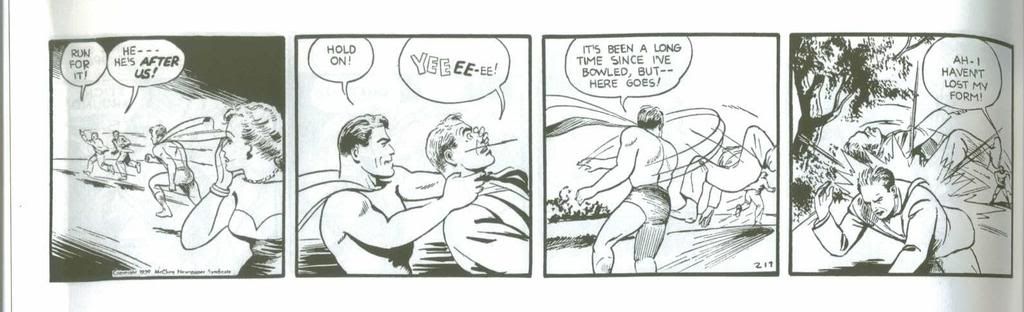
"Newspapers are dead," we hear. Still, history shows they can be smart, vital, and (yes!) more powerful than a locomotive:


Yeah, I know, Superman has shaken thugs out of cars before -- but it doesn't get old, now does it?


Bahlactus has even more good news!

[From the McClure Syndicate's Superman newspaper strips of September 22, 23, and 25, 1939. Written by Jerry Siegel with art by Joe Shuster, Paul Cassidy, and Wayne Boring. Collected as part of "Royal Deathplot" in Superman: The Dailies 1939-1940 (Kitchen Sink Press and DC Comics: 1999).]
Full Post

Tuesday, June 17, 2008

Spirits of the Times: Will Eisner's Life, In Pictures

The Will Eisner anthology Life, In Pictures (W.W. Norton, 2007) contains two substantial graphic novels, two shorter stories, and a vignette, each based at least in part on the personal experiences of the extended Eisner family. Those factual underpinnings help the stories avoid veering into melodrama. Combined with Eisner's considerable storytelling talents, the book as a whole is a sweeping, powerful survey of the society which shaped him and those he loved.

Of course, I come to Will Eisner's work largely through his most famous creation, the masked detective known as The Spirit. Eisner used the weekly Spirit stories as vehicles for his own experiments with the craft of writing and drawing comic books. Today, DC Comics publishes a Spirit comic book which at a minimum attempts to capture both Eisner's designs and the light-hearted attitude which infused most of those stories.

Nothing so portable is on display in Life, In Pictures. The story of interest to most superhero fans will probably be "The Dreamer" (1986), Eisner's autobiographical account of his early days as a cartoonist. Since "The Dreamer" also covers the birth of superhero comic books, it features thinly-disguised analogues of Harry Donenfeld, Major Malcolm Wheeler-Nicholson, Bob Kane, Jerry Iger, Jack Kirby, and other early luminaries. (Detailed annotations follow the story.) This is also perhaps the book's happiest story in the book. The four-page vignette "The Day I Became A Professional," which closes out Life, works well as a go-get-'em supplement to this story.

According to editor Denis Kitchen's introduction, "A Sunset In Sunshine City" (1985), which opens the book, came out of Eisner's 1984 move to Florida from his native New York City. There, apparently, the biographical portion ends, although apparently Eisner incorporated his changing attitudes about moving. The story begins as a bittersweet remembrance of the protagonist's long career running a local cafeteria, set against a snowy New York. As the memories wind down, though, Eisner leaves enough hanging that the reader wonders whether the story might shift gears; and sure enough it does, following our hero to his sunny retirement home and a different set of concerns. At twenty-eight pages, it's shorter than any of the other "big" stories, but it also does the most with its small cast. Characters win and lose the reader's sympathy, until everything finds an appropriate equilibrium at the end.

Perhaps the book's centerpiece is "To The Heart Of The Storm" (1990), Eisner's 204-page tale of family history. As Eisner rides the train which will take him to boot camp, and from there to the horrors of World War II, his memories reveal his family's struggles with anti-Semitism. Some give up their faith, some try to coexist, and some simply try to see the good in people. Through it all, Eisner manages his large cast well, connecting generations efficiently and using the view through the train's windows to set the flashbacks' scenes. Even the flashbacks-within-flashbacks avoid being confusing. While the reader might learn to expect the worst, somehow the family perseveres, and of course the reader is assured by Eisner's own success.

Following that tale is the slightly shorter (167 pages) "The Name Of The Game" (2001), Eisner's fictionalized account of his wife's family history. This is the book's most soap-operatic story, dealing with the constant struggle of German Jews to improve their status in life through marriage. Eisner jumps forward in time, and fills in background, with blocks of text, which only distracts from the story in the introduction of one character. The main character is the family's patriarch, seen first as a spoiled brat who grows into a stereotypical rich dilettante and must have responsibility practically shoved down his throat. Indeed, he looks better as the story progesses primarily because the people around him regularly act just as bad. This is also a tale of struggle, although it's a struggle to keep up appearances. It too achieves a kind of equilibrium, but the story's statement that the characters lived "happily ever after" is clearly meant ironically.

Speaking personally for a moment, I can't finish many "real-life" Will Eisner stories without having to sit and think about them for several minutes afterward. I don't want to dismiss any of this book as simple melodrama, because that implies that Eisner is manipulating the reader unfairly. Nothing about these stories strikes me as frivolous or gratuitous. With each story, Eisner knows the points he wants to make and makes sure each page reinforces those points. Characters cheat, drink, lie, and steal. Some receive an appropriate comeuppance, and some don't. Through it all, though, the reader becomes involved with their lives, even as he can see Eisner's hands guiding them through those lives. I'm glad I got to know these folks, and glad they could bring me closer to a creator I've long admired.
Full Post

New comics 6/11/08

Booster Gold #10 (written by Geoff Johns and Jeff Katz, pencilled by Dan Jurgens, inked by Norm Rapmund) feels a little "off" to me, and I don't quite know why. It's probably because there's so much going on. Rip Hunter narrates for a couple of pages, with his Chalkboard Of Destiny (TM) distracting the reader in the background. Booster takes over as the scene switches to the scrum with Max's forces ... and here, I think, is where things get too overloaded. Essentially the rest of the book takes place in and around a big superhero fight involving -- get ready -- a reunited Justice League International (including Guy Gardner, the good Doctor Light, J'Onn J'Onzz, and Batman); Superman; Max Lord; the original version of Despero; the white-ape Ultra-Humanite; Per Degaton; Black Beetle; Ted "Blue Beetle" Kord; Maximillian (the evil Skeets); Booster and his dad; and the Mystery Villain. Oh, and I forgot the interlude with Rip and the time bubble.

Johns and Katz and Jurgens do their best to break out of the fight the important character-based scenes involving Booster and his dad, the Beetles, and the sidekick droids; but even so, there's still a lot going on in the background. In other words, the scenes aren't put in perspective like they should be, so the rest of the players feel like distractions and/or afterthoughts. What's more -- and I admit this may be just me -- I couldn't remember the non-sacrificial function of the vehicle for the eventual heroic sacrifice. (Said sacrifice plays out like Wrath of Khan, or the last Lone Gunmen appearance, by the way.) There's a sacrifice, but I don't know what else it accomplished. We'll find out next issue, I guess.

Anyway, it's not a bad issue, and it may well play out better in context. It's just a frustrating installment for this month.

Most of The Last Defenders #4 (written by Joe Casey, pencilled by Jim Muniz, inked by Cam Smith) finds Nighthawk on the wrong side of just about everybody, as the term "non-team" starts to take on its most literal meaning. I thought it was fine, but once again, there's a lot going on in the background which apparently only has two issues to resolve itself.

Star Wars: Rebellion #14 (written by Jeremy Barlow, drawn by Colin Wilson) wraps up the current story arc with a lot of action, and a little denouement. There's a suggestion that Luke and Deena Shan are a little sweet on each other, and since this is the interstitial period leading up to Empire, I'm all for anything which gets him away from those understandable-but-creepy-in-hindsight feelings he showed for Leia. I have to admit I'm not as up on my Expanded Universe characters as I should be, or else I'd probably be more sympathetic to them. Still, I can accept how the narration builds Deena up, and I always like seeing spaceship combat. Once again the art reminds me of Howard Chaykin's early SW work from thirty years ago, except the brief glimpse we get of Han seems a little too paunchy for the whip-thin Harrison Ford of 1977. Pretty good if you've been with this story the whole way; probably better the more you know.

This month in Batman Confidential (#18 written by Fabian Nicieza and drawn by Kevin Maguire), Batgirl and Catwoman inch that much closer to making X-rated Internet fanfic mainstream, as they spend the first 10 pages naked from the neck down, fighting in a nudist club. The fact that Maguire draws Babs with all these extremely uncomfortable expressions and retreating body language doesn't make it better. If last month was an excuse for cheesecake, this month drops the pretense ... uh, as it were. As much as I like him, Maguire's figures are just rendered too literally for this extended sequence to be farcical. Maybe someone with a softer style could have pulled it off (what?!? sorry!) better. Cliff Chiang's "Naked Ollie" chases from Green Arrow/Black Canary come to mind, so Chiang or his designated replacement Mike Norton might have done well with this. Anyway, everyone puts their clothes on for the rest of the issue, and I presume the rest of the story. (There's only so many opportunities to play the nude card.) It's pretty entertaining, especially since it focuses on puppies. I am not kidding. It's almost like DC felt like it needed to atone for the nearly-nude scenes with, yes, puppies. So, in summary, come for the cheap thrills, stay for the puppies!

(P.S. DC, if you use that as a blurb, I'd at least like a free copy of the paperback.)

The "Barbarian Queen" scenes in Wonder Woman #21 (written by Gail Simone, pencilled by Aaron Lopresti, inked by Matt Ryan) are fine, but I want to mention the Sarge Steel/Tom Tresser bit which opens the issue. On its own it's good: a typical "walk with me" scene which sets up a few familiar conflicts and advances the plot. However, these are two well-established spy characters who, by virtue of their respective careers, should interact on a higher level. Tom "Nemesis" Tresser had his own backup series in The Brave and the Bold, teamed up with Batman a couple of times, and was in the Suicide Squad; and Sarge Steel was Charlton Comics' answer to Nick Fury. So if this scene involved, say, Dirk Anger and Jimmy Olsen, it'd be easier to take.

As for Wonder Woman, her posse of '70s DC barbarians continues to grow, along with the savagery of her fights. "Losing her grip" is, I think, a fairly radical direction for the character, because it seems like most writers want to portray her as always in control, diplomatic, etc. However, it's still a valid direction; and I think Simone has presented it well. Diana's finding out what she's like without the fundamental sources of her strength. The art in the "barbarian" section is also tighter and darker, with more attention paid to the blacks and a more washed-out color palette (credit colorist Brad Anderson for that). Add a couple of callbacks to Simone's first arc and it makes for a good issue.

Green Lantern Corps #25 (written by Peter J. Tomasi, pencilled by Patrick Gleason, inked by Drew Geraci) presents the origin of the Black Mercy plant. It's a sensible, space-opera-y origin which maybe brings in Mongul a little too neatly, but it sends the story in a very Star Trek direction. New inker Geraci fits well with Gleason's pencils, giving them a little more definition in places and even putting a "cartoony" sheen on some of the figures. There's a misplaced word balloon on page 2, and there's more foreshadowing about different-color lanterns, but other than that it's pretty good.

About half of Green Arrow And Black Canary #9 (written by Judd Winick, pencilled by Mike Norton, inked by Wayne Faucher) features Plastic Man, with the other half showing Speedy and the British guy fighting super-powered bad guys. Thanks to Norton and Faucher, it's all portrayed with a light, breezy tone, which certainly makes some of Speedy's quips easier to take. Norton and Faucher draw a good Plastic Man too -- perhaps even nicer than what cover artist Cliff Chiang might have done. The issue builds to a couple of Dramatic Reveals: the bad guys' employer (which is pretty obvious) and the next guest-star (also not unexpected, but not unwelcome either). I continue to like this book.

Action Comics #866 (written by Geoff Johns, pencilled by Gary Frank, inked by Jon Sibal) is a heck of a start to the latest Brainiac storyline. The Daily Planet newsroom welcomes Steve Lombard, sports brute; and welcomes back noted innuendophile Cat Grant. Frank and Sibal really lay on the Christopher Reeve and Margot Kidder references for Clark and Lois, but it's all good. (Cat looks like she had a familiar model too, but I can't place her.) However, the showpiece of the issue is Brainiac's abduction of Kandor, shown in flashback (naturally) with references to General Zod and Brainiac's Kryptonian origins. To say that Brainiac now = Borg + Alien wouldn't do it justice. It's cold, scary stuff which sets up his threat level very well. Still, there is a bit of Borg plotting in place: Superman defeats a pawn, but the "king" is still out there....

Trinity #2 (written by Kurt Busiek, pencilled by Mark Bagley, inked by Art Thibert) finds the Trinitarians battling personalized threats: rogue solar systems, giant robots, and a mystical metropolis. It's nice to see each handle their own in the space of a few pages or so. Meanwhile, in the second story (written by Busiek and Fabian Nicieza, pencilled by Tom Derenick, inked by Wayne Faucher), Green Lantern John Stewart fights Konvikt and Graak in a sleepy Massachusetts town square. So far Trinity looks like superhero comfort food, and if it continues like this I suspect I won't have too many bad things to say about it.

Finally, here's Titans #3 (written by Judd Winick, pencilled by Joe Benitez, inked by various people), a frustrating installment of a series which has yet to define itself. Benitez' art has personality, but he doesn't have a handle on these characters. I hate to go all fanboy, but in an early pedeconference scene, all the characters are the same height. At the very least Starfire should be the tallest, but in a long shot she looks shorter than the Flash. Likewise, Beast Boy and Raven should probably be the shortest. These aren't just stylistic choices, they inform the characters' personalities.

The plot of the issue involves the Titans pairing off, with unfortunate results. While there's an in-story explanation, the sad thing is that the book has already established its willingness to "push the envelope" with regard to these characters, so we don't know how much of their behavior was provoked. I'm not saying the Titans should always be hugging, but Winick hasn't done much to lay a foundation for their normal behavior. I'd like to think this book will find its equilibrium sooner rather than later, but it might not happen for a few more months.
Full Post

Sunday, June 15, 2008

Sunday Soliloquy

On Father's Day, a posthumous present for Dr. Thomas Wayne:


(Batman doesn't usually beat up aging gunmen, does he? "And here's a little something for yer arthritis, grampa!" I guess he's entitled in this case....)


Note that Batman says "his wife died from the shock." In this version of the story, Martha Wayne had a weak heart. That still didn't let Chill off the hook, though: an earlier caption says "that single bullet really killed two people...!"

Of course, Martha is killed outright in most other accounts, but that detail would've made this harder to use on, say, Mother's Day.

[From "The Origin Of The Batman!" in Batman #47, June-July 1948. Written by Bill Finger, pencilled by Bob Kane, inked by Charles Paris, lettered by Ira Schnapp. Reprinted in The Greatest Batman Stories Ever Told (1988), with color reconstruction by Adrienne Roy.]
Full Post

Friday, June 13, 2008

Friday Night Fights

The Spirit Jam teamed Will Eisner and his most famous creation with dozens of comics professionals.


Of course, one thing stayed the same ...


... the Spirit dished out, and took, a lot of punishment.

I'll try not to sing out of key, Bahlactus!

[From Spirit Jam, reprinting a story from The Spirit Magazine #30, July 1981. This sequence scripted by Mike W. Barr, pencilled by Joe Staton, inked by Bob Smith, and lettered by Todd Klein. Project coordinated by Will Eisner, Denis Kitchen, and Cat Yronwode.]
Full Post

Wednesday, June 11, 2008

Compare and contrast

Having trouble uploading images to the Blog@Newsarama gallery, so here's a little visual-aid supplement to tomorrow's post.

Here's page 234 of the 1976 Michael Fleisher Encyclopedia Of Comic Book Heroes Volume 1: Batman. Fleisher uses a lot of quotes and textual details in his articles.


Now, here's page 194 of Bob Greenberger's Essential Batman Encyclopedia, out this week.


Note that Greenberger covers the same subjects as Fleisher, includes more recent entries, and has reworked the "Joker" article to be more of an overview. It's less detail-oriented, but reaches further.

I can't count how many times I read Fleisher's book as a kid, and I was very thankful to Teh EBay for my replacement copy (this was before DC reprinted it last year). However, Greenberger has done a really great job in his own right. Well worth your disposable income.
Full Post

Monday, June 09, 2008

New comics 6/4/08

Hey, it's June! Who knew?

Lots of books this time, so no time for chit-chat.

Obviously I spent a lot of time with Trinity #1 (written by Kurt Busiek, pencilled by Mark Bagley, inked by Art Thibert), so it wasn't too bad, but OH DEAR LORD another scene of table talk! First Meltzer, then Dwayne McDuffie a couple of weeks ago, and now Busiek. I'm hoping this is the only such scene for, say, fifty issues. It's not like the Four Horsemen miniseries felt the need to sit the Trinitarians down for a Continental breakfast.

Other than that, I will say that I won't mind spending the next year with Busiek and Bagley. For his first big DC outing, Bagley shows he has the chops to do the company's most familiar characters. His Wonder Woman and Flash look especially good. I'm predisposed to like Busiek, so there you go.

Once again I get the feeling that Star Trek: New Frontier #3 (written by Peter David, drawn by Stephen Thompson) would mean a lot more to me had I been reading the NF books. This issue's plot features shocking! revelations about who's being impersonated, or who might be impersonated. The last page had me particularly confused. Two issues to go, so I might as well stick with it.

House Of Mystery #2 (written by Matthew Sturges, drawn by Luca Rossi) doesn't spend a lot of time on the "nested" story (written by Bill Willingham), which is good. The nested story isn't that compelling, despite some pretty Jill Thompson art. However, nothing much happens in the main story either. Its big emotional moment involves Fig, our heroine, discovering that she can't leave the HoM, but we kinda already knew that. The secondary emotional moment, where she starts to spill her guts to one of the housemates and ends up berating him, also doesn't ring quite true. The rest of the issue finds the housemates acting quirky without much to show for it. While I'd otherwise probably fault the book for being too broad, the characters haven't distinguished themselves from one another yet. Mostly issue #2 was just Fig acting out against a bland backdrop.

Much of Tor #2 (by Joe Kubert) is a flashback detailing Tor's pre-issue-#1 journey, which is fine; but it gets a little loopy towards the end and eventually acknowledges that maybe those psychotropic leaves might be affecting it. As with issue #1, Tor fights a prehistoric monster in order to protect his new little friend. Accordingly, as with issue #1, I appreciated #2 for its craft, because who am I to criticize Joe Kubert? Besides, I have to get #3 to figure out what's going on.

I don't have any strong feelings about issue #3 of Batman: Death Mask (by Yoshinori Natsume), so I'll just say it's nice for what it is -- an above-average Legends of the Dark Knight-style story -- and it is getting me used to reading manga. Learning can be fun!

With her own title cancelled, Catwoman is more free to roam around the main line Bat-books, so the cover of Detective Comics #845 (written by Paul Dini, pencilled by Dustin Nguyen, inked by Derek Fridolfs) plays up her appearance. However, the story itself is a nice little whodunit which manages to withstand its conclusory leaps of logic. As such, it focuses on the Riddler, who's been trying to upstage Batman at the whole consulting-detective thing. It also introduces a group who I can't help but think is the Internet version of the old Mystery Analysts of Gotham City. The idea that Batman has a group of online buddies who only know him through a generic username is still a terribly appealing one, so if you like that, you'll like this story.

Rounding out this week's Bat-books is Nightwing #145 (written by Peter J. Tomasi, pencilled by Rags Morales, inked by Michael Bair), an issue which starts to stretch the "Freefall" storyline past its point of usefulness. It wasn't too long ago that Nightwing and Robin brought this particular storyline to a stop, but we're apparently not done with it yet. The issue even appears to bring things back to that same point. Now, to be fair, this time around deals more with Talia al Ghul and Mother of Champions, incorporates Batman, and features the surprising return of another Bat-foe, but still. The concept of a mad scientist creating super-powered soldiers isn't specific enough to Nightwing to warrant this much focus. At least Rags and Bair are back for the whole issue.

Speaking of which, Supergirl #30 finds relief artist Ron Randall drawing the whole issue, with Will Pfeifer taking the place of regular writer Kelley Puckett. Looks like a fill-in issue to me, but it's not a bad one. It helps define the character in relation to Superman in a way which puts Puckett's storyline in a much different perspective, and it even incorporates the Box O' Universe from Puckett's first issue. Randall's art is clean and simple, although it flirts with being stiff and bland at times.

Overall, though, the issue I enjoyed the most was Manhunter #31 (written by Marc Andreyko, drawn by Michael Gaydos). It's the triumphant return of a title which has seen two long hiatuses (hiatii?), so it opens with an efficient two-page recap of the character's history. I'm not that familiar with Gaydos, but his work reminds me of early J.H. Williams, John Paul Leon, or maybe Tommy Lee Edwards -- thick lines and lots of blacks. The main story does proportionately as well with its 20 pages. After opening with the requisite superhero battle, it reintroduces our heroine's family and supporting cast, and through them sets up the current immigration-related arc. Last time I praised the new Action Comics for using its 22 pages well. This time, however, Manhunter really does a great job showing what a single issue can mean to a long-running superhero serial. High marks all around!
Full Post

New comics 5/29/08

May 29, 2008 was Grant Morrison Day for DC superhero fans, heralding the arrivals of Final Crisis #1, All Star Superman #11, and Batman #677. Those three issues made up half of my haul, so let's start with the other half.

Honestly, the most pleasant surprise was Action Comics #865, a Toyman spotlight written by Geoff Johns, with art by Jesus Merino. I never did like Johns' all-villain issues of The Flash, but those largely aimed to "grittify" old, goofy Rogues. Here, Johns aims to clean up some continuity issues surrounding the Toyman, and along the way to re-establish him as slightly less dark. The result is quite good, and shows what can be done in the space of 22 pages. Perhaps better known as an inker, Merino is also a fine storyteller with (if this issue is any indication) a good sense of design. His regular style isn't too far from DC's baseline, but he and the Hi-Fi colorist drop into a watercolor-y "Tim Sale" mode for the flashbacks. The best part of the issue, though, is its misdirection regarding the means of Jimmy Olsen's rescue. I wasn't expecting it, and I'm glad a comic book can still catch me off-guard.

Countdown To Mystery #8 will be remembered for its salute to Steve Gerber, and that's probably as it should be. Writers Adam Beechen, Gail Simone, Mark Evanier, and Mark Waid each offer short takes on how they would have ended "More Pain Comics," Gerber-style. Beechen invokes Howard The Duck. Waid uses a Gerber-esque text box. Evanier gives Kent Nelson a there'll-always-be-a-Fate speech that's equal parts cynicism and hope. Simone grounds her conclusion in psychology, this Fate's civilian calling. It's not fair not to list the artists, because they each do fine work, but the art is of the same piece as the regular team of Justiniano and Walden Wong: a sort of softer, fuller Walt Simonson. This Doctor Fate series was supposed to be a new and exciting take on a character DC loves to use, and I'm sure that had Gerber lived, there would have been at least a stab at a regular series and probably some form of lasting legacy in the pages of Justice Society. Wisely, though, DC chose to honor Gerber's work not by farming the conclusion out to another writer and continuing with those plans, but simply by assuring the readers that it all turned out well, and by the way be on the lookout....

The conclusion of the Spectre story (written by Matthew Sturges, pencilled by Chad Hardin, inked by Robert Campanella) was decent enough: for various reasons, the Spectre can't really fight Battle-Armor Eclipso one-on-one, so he encourages Bruce Gordon to re-absorb the dark god. It's nothing new, but it was presented well, and I'm sure we'll be seeing more of Eclipso in the months to come. I don't feel any better for having read the whole thing, though.

I bought Batman: Gotham After Midnight #1 (written by Steve Niles) mostly for the Kelley Jones artwork, and I'm sticking by that. It's not just his unique style, but his page layouts and his bits of marginal business, which really make the book enjoyable. Unfortunately, Niles can't quite decide how seriously to take things; so the combination of Jones' over-the-top storytelling and Niles' ultra-straight Batman tend to steer the issue towards self-parody. I'll be back next issue for the art, and I'll hope the script works with it a little more.

Batman #677 (written by Grant Morrison, pencilled by Tony Daniel, inked by Sandu Florea) gets into the meat of "Batman, R.I.P." by laying out the ultra-paranoid notions at the heart of the plot. I give Morrison a lot of credit for the audacity of these ideas. If true (which I doubt, and which the issue itself seems to question), they would be almost impeccable retcons which wouldn't invalidate a whit of Batman stories but which would redefine "Batman's" very existence. This issue thus accelerates the plot faster than just about every Bat-epic of the past twenty years, doing so largely through a conversation in the Batcave. There is, of course, the feeling that Jezebel Jet is behind the whole thing, but I think Morrison is better than that; and based on this issue, I have high hopes for "R.I.P."

The penultimate issue of All Star Superman (#11 written by Morrison and drawn by Frank Quitely) is pretty much wall-to-wall awesome, featuring a super-powered Lex Luthor, a dying Superman's battle with Solaris the Tyrant Sun, the introduction of Luthor's cheeky niece, and no sense that this will end with anything but the Man of Steel's heroic sacrifice. Never has the impending death of Superman seemed so obvious and yet so right. Can't wait for issue #12.

Finally (ha ha), here at last is Final Crisis #1 (written by Morrison, drawn by J.G. Jones), the start of DC's big run-out-the-year crossover. (By the way, last time I got Sparx and Live Wire confused -- that was Live Wire in Birds Of Prey, and it's Sparx here.) On the whole I liked it. It didn't try to be too loud or flashy, opting instead to start slow. Considering that Morrison's talked broadly about what's to come, I imagine things will get loud before too long. I liked the police-procedural approach, contrasting the Green Lanterns with the Justice League and the police themselves. I liked the use of "Terrible" Turpin as the point-of-view character. I don't think that you-know-who is really dead, but neither do I think that Libra is really you-know-who-else. I liked Jones' work, especially the "reveal" of Darkseid (it's the eyes) in the Dark Side Club, but my concern is that he can't do big-and-loud like, say, Howard Porter on Morrison's JLA. The best description may simply be "ominous," and that's just fine with me.
Full Post

Friday, June 06, 2008

Housekeeping

Well, here it is -- the end of another week and not much on this blog to show for it. In the corporeal world, however, my recycling bin overfloweth; the car's oil has been changed; and a lot of papers and knick-knacks have been reorganized.

Also, in addition to the regular Grumpy Old Fan column, I've started annotating Trinity over at the New-Look Blog@Newsarama. Check it out, won't you? -- and please, feel free to leave comments here (on both the annotations and the new GOF) until we get the bugs worked out over there.

A busy weekend awaits, so there might not be updates here until Monday. See you then!
Full Post

Sunday, June 01, 2008

Sunday Soliloquy

Today, an experiment.

"I know what you're thinking: 'did he fire six shots or only five?' Well, to tell you the truth, in all this excitement I kind of lost track myself.

"But being as this is a .44 Magnum, the most powerful handgun in the world, and would blow your head clean off, you've got to ask yourself one question: do I feel lucky?

"Well, do ya, punk?"


Let's take that little monologue, stretch it out, and reword it for someone who doesn't have the most powerful handgun in the world:


Now, if you're Marvel Comics at the start of the 1980s, try to estimate how much money you'll make from a lot more scenes like that.

[From "Wolverine: Alone!" in The Uncanny X-Men #143, May 1980. Co-plotted by Chris Claremont and John Byrne, script by Claremont, pencils by Byrne, inks by Terry Austin, colors by Glynis Wein, letters by Tom Orzechowski.]
Full Post

Saturday, May 31, 2008

New comics 5/21/08

Yes, these are comics from ten days ago. Memorial Day Weekend was just too jam-packed, and I came out of it apparently itching to write a 2200-word dissertation on Crisis On Infinite Earths, the original JLA/JSA team-ups, and the problems with line-wide events.

Therefore, might as well begin with the lead-in to the latest LWE, Justice League of America #21 (written by Dwayne McDuffie, pencilled by Carlos Pacheco, inked by Jesus Merino). I really, really hope that this is the last crossover-affected issue of JLA for a while. It begins with a 9-page sequence of the "Trinity" sitting around a table talking about how they're not really running the League from behind the scenes. I thought the dialogue was good ("I had a run-in with Mr. Polka-Dot." "Is that a euphemism?"). However, although Pacheco kept the talking heads from getting too boring, he could have used a few flashback images. Overall, it assumes a little too much knowledge, even on the part of the longtime reader. I presume this will have repercussions in JLA itself, but I wouldn't be at all surprised if it showed up later in Trinity.

The bulk of the issue concerns the Human Flame, his fight with Red Arrow and Hawkgirl, and his recruitment by Libra. HF is a schmoe, that's for sure; but he's not the stereotypical lovable-loser supervillain schlub. McDuffie gives him a mean streak that undercuts whatever sympathy we might be starting to feel. Likewise, Pacheco doesn't play up any endearing parts of his dumpy appearance. Overall, this was a well-told story, but I still think it should have been in a Secret Files.

For those of you who know the dirty secret of cruise ships -- namely, that they give the surviving passengers hush money to cover up all the deaths -- the nautical nastiness depicted in The Spirit #17 (written by Mark Evanier and Sergio Aragones, pencilled by Aluir Amancio, inked by Terry Austin) will come as no surprise. This was yet another light-hearted, compact caper using Will Eisner's characters and designs; but one of the subplots seemed pretty obvious and the other only slightly less so. Also, from what little I've read of the original Spirit stories, I don't remember Ellen Dolan being such a self-absorbed Barbie doll. Amancio and Austin's work is more cartoony than Paul Smith or Mike Ploog, but it gets the job done.

According to the first page of Fantastic Four #557 (written by Mark Millar, pencilled by Bryan Hitch, inked by Paul Neary), I should have read Mighty Avengers #11 first. However, I don't know why; and I'm not eager to track down a 3-month-old issue to find out. Anyway, I did like how Reed and Sue celebrate their anniversary, but the rest of it is a bunch of exposition wrapped around a one-joke fight scene. I can kind-of accept "the Anti-Galactus," but things like Johnny's nympho supervillain girlfriend and the faux-drama about Reed being tempted just seem artificial. The snow effects look better this time, though.

Captain America #38 (written by Ed Brubaker, pencilled by Steve Epting, inked by Epting and Mike Perkins) (re)introduces what I presume is the last player in this particular arc, and sets him up against Bucky/Cap. It's hard to explain without giving everything away, but I'll try. Using a raid on an AIM base as its main sequence, the issue examines the relationships of mentors and proteges, and inspirations and successors; and observes that, for the three principals involved, those roles have shifted, if not outright reversed. It's a neat little chapter which probably sums up at least one of Brubaker's overriding themes, and while it might appear to be a simple action issue, there's a lot more going on.

For the second straight month, Tangent: Superman's Reign (#3 written by Dan Jurgens, pencilled by Jamal Igle, inked by Robin Riggs) focuses on the squad of Tangenteers trying to free the Tangent Atom. While that subplot achieves some closure, and the two worlds' characters actually come into conflict (as opposed to comparing notes), it still feels a little redundant. I like Igle's work fine, although Riggs' inks are looser than what Igle usually gets. It feels more like a Justice League story than what's been in JLA lately; and next issue I bet things will pick up.

The "Dark Side Club" banner started appearing on particular DC titles last week, and it looks like the kind of underground fight-club we've seen before. Specifically, Birds Of Prey #118 (written by Tony Bedard, pencilled by Nicola Scott, inked by Doug Hazlewood) opens with a fight involving Sparx, a D-list character whose abduction we see in the first issue of Final Crisis. So, you know, there's that crossover element we like so much. The rest of the issue involves Black Alice and Misfit fighting, again. This issue introduces a new aspect of their relationship which leads to a result I wasn't expecting. However, I wasn't expecting it because their relationship feels artificially manipulated to begin with, and the latest twist just seems like another manipulation. Scott and Hazlewood are good as always, with (I hate to say it) a grisly, shadowy death being a particular highlight.

The new issue of The Flash (#240, written by Tom Peyer, drawn by Freddie Williams II) also sports a "Dark Side Club" banner, but it's incidental to the main story of Wally and Jay vs. Grodd and Spin. I can't complain any more about Williams' chunky Flash, because he seems to have gotten through that phase. I also got a kick out of this issue's mind-control victims talking in Local-Newscast-ese -- it's funny 'cause it's true. The cliffhanger makes me wonder about the length of the current setup, though....

Finally, here's Jay Garrick again, teaming up with Batman in The Brave and the Bold #13 (written by Mark Waid, pencilled by Jerry Ordway, inked by Scott Koblish and Bob McLeod). They make a good team, because the easygoing Jay not only provides a good counterpoint to Batman's intensity, Batman respects him and so dials it back a few notches. The plot, involving an old Bat-villain, a mad scientist, killer robots, and Jay's chemist colleagues, may be more complicated than it needs to be, but it's probably necessary to get these two characters together. I daresay Ordway's more understated style is better-suited to this story's amiable nature than George Perez's would have been; and Waid provides good conversation amongst all the robot-smashing.

Look for the comics from Thursday (Happy Grant Morrison Day!) in the next couple of days.
Full Post