Sunday, April 27, 2008

Sunday Soliloquy

I didn't know Zak Kebron had become Excalibur's Counselor (as well as security chief), but that probably made this scene funnier:


[From "Turnaround, Part II," in Star Trek: New Frontier #2, April 2008. Written by Peter David, drawn by Stephen Thompson, colored by Leonard O'Grady, lettered by Neil Uyetake.]
Full Post

New comics 4/23/08

Well, Countdown ended on Wednesday, so I talked about it on Thursday. I thought it suffered from a lack of focus which, while understandable, was also avoidable.

Still, I did buy other comics, and here they are.

Star Trek: New Frontier #2 (written by Peter David, drawn by Stephen Thompson) brings in a couple more NF characters, just when I was starting to get used to the ones already in play. Essentially, everything's moving towards a confrontation with Jellico and the stolen timeship at New Thallon, but the waiting gives us time for some character interaction. Overall the issue was fine. Exposition was integrated pretty well into dialogue. (There are no narrative captions -- not even a Captain's Log -- in the entire issue, which is a little odd for a Trek comic.) A new Galaxy-class starship comes into the picture too, which is confusing for those of us expecting the only such ship to be the Excalibur. Anyway, the art is about the same as last issue -- rougher than I'm used to for a Trek comic, but true to the aesthetic. Three issues to go, and I have a feeling everything will happen in the last one.

It looks like Sergio Aragones and Mark Evanier put all their social commentary into the latest Groo miniseries and let themselves go wacky with The Spirit (#16 written by them and drawn by Paul Smith). Denny Colt is hardly as dense as Groo, but in this issue he errs -- in a well-meaning way, of course. The Spirit goes Hollywood to solve an on-set murder. While it looks play-fair at first, about halfway through it starts getting deliberately convoluted, so the reader is left to relax and let everything play out. Since that includes, among other things, a Carson Kressly parody and a stuntman gig (reminiscent of "bring in the double!" from that one Daffy Duck cartoon), the murder seems almost beside the point. With Paul Smith showing off his cartooning chops, the issue looks really good, but again, it's only Eisneresque on the surface.

Dwayne McDuffie devotes most of Justice League of America #20 (drawn by Ethan Van Sciver) to Wally West's struggle with rejoining the JLA. In its way, it's reminiscent of the "should I be a superhero?" angst which Wally went through 25 years ago, back in the New Teen Titans days -- only now, Wally has his own family, instead of worrying about his parents and girlfriend back home. Thus, Wally and Wonder Woman fight the Queen Bee while WW prods him to live up to his League responsibilities. I thought this issue was executed pretty well. McDuffie writes Wally and Diana well, and while Van Sciver's art is a little stiff, it's miles ahead of Ed Benes' sketchy, pose-heavy work. (The storytelling involving WW at the end is a little unclear, though.) I'd have liked more than two JLAers and a Black Lightning cameo in McDuffie's first crossover-free issue, but it sounds like he'll have time to do his own thing soon enough.

I don't know what happened to regular artists Tony Daniel and Jonathan Glapion, but fill-in penciller Ryan Benjamin and fill-in inker Saleem Crawford bring a bit too much '90s Image overthinking to Batman #675 (written, of course, by Grant Morrison). This issue is the bridge between the alternate-Batmen arc and next issue's "Batman R.I.P.," and it exists apparently to elevate Bruce's girlfriend Jezebel Jade to Silver St. Cloud status. It's the secret-identity dilemma of a familiar "Bruce is trapped in public" situation, only this time Bruce is somehow unable to find a good spot to change. Maybe it's the presence of a Ten-Eyed Assassin, the cult which was part of Bruce's epiphany during the Year of 52. Anyway, I don't have much of a problem with Morrison's script (which also includes scenes for Robin, Nightwing, and Talia), but the art is pretty distracting.

Sean McKeever's last issue of Birds Of Prey (#117, pencilled by Nicola Scott and inked by Doug Hazlewood) turns out to be his best. Misfit gets to show off without being annoying. The Platinum Flats supervillains are both believably low-rent and scary. Oracle makes good decisions. It's a good issue which tests our heroes but doesn't dwell on their troubles, and as always it's told well sequentially by Ms. Scott and Mr. Hazlewood. The bar has been set high for Tony Bedard.

Finally, I say goodbye to Checkmate, as writers Greg Rucka and Eric Trautmann turn in their last issue (#25, drawn by Joe Bennett and Jack Jadson). I can't say much about the plot without spoiling it, except that the Rooks take advantage of a truly scary and dangerous mind-link to do their thing as well as they do. Sasha gets a scene with Batman, Wonder Woman and Superman compliment Checkmate, and the final twist took me completely by surprise. Rucka and his co-writer(s) went out on top, and I think it's best to go out with 'em.
Full Post

Friday, April 25, 2008

Friday Night Fights

Jonah Hex thinks he's J.M. Marberry's business partner. Therefore, the following comes as something of a surprise....


Tonight we ride with Bahlactus!

[From "The Hoax," in Weird Western Tales #18, April-May 1973, reprinted in Showcase Presents Jonah Hex Vol. 1. Written by John Albano, drawn by Tony DeZuniga, lettered by (I think) Milt Snapinn.]
Full Post

Monday, April 21, 2008

New comics 4/16/08

Let's begin with Captain America #37 (written by Ed Brubaker, drawn by Steve Epting), an issue where everybody hassles Bucky and/or Tony Stark for the whole New Cap thing. Its tone is lighter than the book's been in a while, with Bucky commenting on everyone hassling him and a weird anachronistic dream sequence. After the relentless pace of the last few issues, though, it's a welcome change. There are also some nice moments involving the Falcon which I appreciated more in light of plok's advice on the '70s Steve Englehart run. My one complaint involves a certain ex-Avenger who shows up at Bucky's loft. I wouldn't have known who it was without his being identified in dialogue; and I know that's part of what dialogue does, but I see "burly blond guy" as drawn by Epting and I think Steve Rogers. Either him or Aquaman. In other words, he didn't look like ******* to me. Nitpicky, I know.

Bat Lash #5 (written by Sergio Aragones & Peter Brandvold, drawn by John Severin) finds Bat looking to settle affairs with Brubaker and Wilder, the story's main villains. Helping matters along are the rest of the town and Bat's Native American allies, all of whom want the bad guys dead. It's a darkly comic issue which doesn't zip along as quickly as it wants to. It's decent enough, I guess. It does set up what I presume will be the final showdown, which in turn should form the foundation of Bat's familiar personality. So, looking forward to next issue, because it needs to make up for the shortcomings of its predecessors.

Exposition balances action in Tangent: Superman's Reign #2 (written by Dan Jurgens, pencilled by Jamal Igle, inked by Robin Riggs), as the Tangent GL revives one of the Tangent Jokers for one last adventure. That has to wait, however, because the Joker needs to tell us about her death at Tangent Superman's hands. The other action sequence involves more Tangent heroes trying to free the Tangent Atom, and that's balanced against a scene with the Tangent Superman intimidating some sheiks. Tangent, Tangent, Tangent. Still, I'm surprised at how well the Tangent U. holds together, considering it started life as a series of one-shots. This continues to be one of Jurgens' better writing efforts, and I like Jamal Igle a lot already.

Superman #675 (pencilled by Renato Guedes and Jorge Correa Jr., inked by Jose Wilson Magalhaes and Correa) is Kurt Busiek's last issue as writer before he moves over to the weekly Trinity starting in June. Accordingly, he can go out on a story where Superman fights Daxamite priests (I thought they were pacifists), the power-duplicating Paragon, and the new Galactic Golem. Busiek has done a great job recreating the feel of a Superman comic from the 1970s, when the conflicts came from disruptions to the character's semi-formal routines. Here, Busiek has been building those routines, so the normal super-fights tend to come across like days at the office. This particular arc has been a little more shaggy than some, but it still holds together well, even in the parts describing the Golem and how to defeat it. The art is good -- Guedes' work is very similar to what I'd call the thin-lined, "open" style of Pete Woods, who started with Busiek two years ago. Superman is big but not bulky or overmuscled, and everybody moves well. Correa picks up the spare without being too noticeably different, so god work all around.

I liked The Flash #239 (written by Tom Peyer, drawn by Freddie Williams II) more than I did Peyer's first issue, and that's mostly due to the rationalization of Wally's behavior. An increasingly cranky Jay Garrick gets a lot of attention this time out, which leaves Wally free to act more like the Wally we know. He does get a pretty good gig this issue, but doesn't get a chance to enjoy it. Peyer's script is effective at portraying the tide of public opinion turning against Wally. While a lot of that might be mind control, Peyer gives it enough nuance that we're never quite sure. I also liked Williams' art throughout this issue, which I think is a first. He's finally getting a good feel for Wally's figure and his movement. (Hey, it took me a while to come around to Pat Gleason too.)

The Brave and the Bold #12 (written by Mark Waid, pencilled by Jerry Ordway, inked by Bob Wiacek) finishes the "Megistus" storyline with a plethora of characters including Superman, the Challengers, Green Lantern, and Metamorpho. However, the star turns out to be Challenger June, who apparently has some inferiority issues over not "living on borrowed time" like the original Challs. Why she has these issues after forty-odd years with the group is never quite explained, but not being a COTU scholar I'll defer to Waid on that one. The script is a little more clunky than is usual for this book, probably due to the number of characters and the wonky element-transmuting mechanics of the plot. Ordway does well with it, though; and he delivers customarily solid work here. Although there's a clever nod to Final Crisis, here's hoping that this book continues to be the tonic for the constant-crossover mentality.

... And speaking of which, the penultimate issue of Countdown (#2 written by Paul Dini and Sean McKeever, story consultant Keith Giffen, drawn by Scott Kolins) starts with Giant Turtle-Boy Jimmy and ends with what looks like the series' most obvious setup for Final Crisis. (That is, before DC decided that this series wouldn't really lead into FC quite so much.) It's pretty straightforward stuff -- two interconnected fights bridged by some Atom heroics, portrayed well by Kolins and colorist Tom Chu. (I'm guessing Giffen might have contributed to the breakdowns, but I don't know for sure). Let's put it this way -- this issue made me think Kolins would be a good fit for a Hulk series. It didn't redeem all of Countdown, and I doubt there'll be much in this week's final issue to do that, but on its own it was a good fight.
Full Post

Sunday, April 20, 2008

Trading Places

The instructions, via plok:

“What creators who are usually associated with a certain company (or, indeed, medium) would you like to see writing someone else’s title? For example, would you want to see JMS on Hellboy? Which DC character should Bendis have a crack at? Should George Pelecanos write Batman? (Answer: Yes)

This could be a tough one. There aren't too many company-specific people left, what with Mark Bagley going to DC and Mark Waid having written some of Marvel's biggest characters (including, soon, a run on Amazing Spider-Man). But ... okay.

1. Michael Chabon and Mike Allred on Fantastic Four. It sounds like it would be a '60s pastiche, and to a certain extent it would be, but I think these two would bring a good mix of Lee/Kirby reverence, irreverence, and innovation to the book. Plus, aren't you curious to see how Chabon would do a multi-issue arc?

2. Greg Rucka and Joe Bennett on a S.H.I.E.L.D. book. Yes, it'd be Checkmate with a Helicarrier -- but also a high concept that actually pays off.

3. Geoff Johns and Scott Kolins on Incredible Hulk would give Johns a chance to indulge his bloodlust (I kid because I love); and Kolins does big, bulky carnage well.

4. I really liked plok's idea for a Hellboy-esque Mignola Captain America, so I'll appropriate the gist of it. How about Walt Simonson on a 1940s Justice Society of America?

5. Since Waid's going to be writing Spidey, I guess that particular pairing is off-limits; so let's put Paul Dini on Amazing Spider-Man instead, with Cliff Chiang drawing. (Mike Norton if Chiang's unavailable.)

6. I see that Jim Roeg has picked Ed Brubaker for New Teen Titans, and while I'd love to read that, I've gotta put Brubaker on Justice League of America, together with Alan Davis.

How's that?
Full Post

Saturday, April 19, 2008

Brief thoughts after re-reading Ronin

(By the way, I'm writing this while listening to "Night On Disco Mountain" from the Saturday Night Fever soundtrack. Wasn't intentional; just worked out that way. Seems eerily appropriate.)

Since DC's doing an Absolute Edition of Ronin, I thought it appropriate to re-read the thing for the first time in ... well, several years. Maybe even ten years. Heck, maybe closer to fifteen.

For those who don't know, Ronin was six issues, 48 pages each, of Frank Miller sci-fi samurai action. It came out in 1983, which I think was around the end of his first stint on Daredevil. (Not being a DD scholar I can't say for sure.) Anyway, it came out before The Dark Knight, and was collected in 1987 in order to capitalize on Dark Knight's success.

The plot concerns a few major characters. The title character (never named) is a warrior whose master was killed by a demon, Agat, in feudal Japan. Naturally, both the ronin and Agat show up in a dystopian future New York, which has at its center the bio-mechanical Aquarius complex. Aquarius is controlled by the supercomputer Virgo, but its human master is a man named Taggart, and its chief security officer is a woman named Casey McKenna. There's also Casey's husband, who created Virgo. Basically, the ronin takes over a limbless telekinetic boy, gets a set of artificial limbs, and tries once again to stop Agat (who's taken over Taggart).

There's more, of course, but I don't want to get too far into it. Wikipedia says Ronin is Miller's most manga-influenced work, but I'm tempted to describe it (glibly) as "Samurai Jack" meets Heavy Metal via Akira. It also seems to have been Miller's first "mature readers" book, although there's no such advisory on my paperback and none on the Absolute's solicitation. There are a lot of racial slurs and a decent amount of nudity to go along with all the hacking and slashing.

But I digress. If you've read it, you know how it ends, so my question is ...

(SPOILERS)

3

2

1

... what the heck does it mean?

I read Ronin the first few times mostly for the superficial elements: violence, robots, nudity, etc. If I'm going to even entertain the thought of an Absolute edition, I'll need something a little more thematically coherent. Miller spends a lot of the climax selling the reader on the idea that Billy is (re)creating the ronin and Agat in the context of Aquarius -- but the ending suggests both that the ronin is dead and that Billy has recreated himself as the ronin.

So, is that it? The book just stops cold at that point.

I guess I'm asking whether we like Ronin 25 years later; and/or whether we consider it an example of the style-over-substance, pants-seat-plotting Miller of, say, The Dark Knight Strikes Back.

Mostly I guess I'm asking whether we like the ending. I didn't a few days ago, but I'm starting to warm up to it the more I think about it.
Full Post

Friday, April 18, 2008

Friday Night Fights

Friday Night Fights is back! Here, Howard has finally gotten the hang of being Sorcerer Supreme -- but of course nothing satisfies like a little chin music!


Coming to you as Bahlactus demands -- in glorious "quack and white!"

(Sorry, couldn't resist....)

[From "The Duck and the Defenders," in Marvel Treasury Edition #12 (1976). Written by Steve Gerber, pencilled by Sal Buscema, inked by Klaus Janson, lettered by Joe Rosen. Reprinted, of course, in Essential Howard The Duck Vol. 1.]
Full Post

Monday, April 14, 2008

New comics 4/9/08

You might already have seen my lengthy (shocking!) post about Titans #1 and Batman Confidential #16 over at Blog@Newsarama. Regardless, there's still a truckload of new books to go through here.

First I want to mention Green Arrow And Black Canary #7 (written by Judd Winick, pencilled by Mike Norton, inked by Wayne Faucher). When I saw that Cliff Chiang would be leaving this title, I announced loudly that he was one of the big reasons I was buying the book. If he went, I might just follow him; and how would you like them apples, DC?

Well, as it happens, new artists Mike Norton and Wayne Faucher do their darndest to replicate Chiang's endearing thick-lined style, which is nice. It also doesn't hurt that there's a touch of Mike Parobeck in their work. So, well done all. As long as Norton and Faucher are on the book, I'll be getting it.

As for the story, it may not please readers who think that longtime Justice Leaguers shouldn't comport themselves like they've OD'ed on "Alias" reruns; but hey, I liked it. After Ollie, Dinah, and Mia interrogate the guys they captured last issue, it's off to England for more hijinx in a pub. The story seems to have gotten padded out by at least an issue, but that may be so that Winick can introduce the guy our heroes meet this issue. Anyway, the trail leads back to one of Dinah's old flames, which should be interesting....

I liked a lot of things about The Last Defenders #2 (script by Joe Casey, breakdowns by Keith Giffen, pencils by Jim Muniz, inks by Cam Smith), but it's hard to describe why. The book isn't so much about this weird little group of "Defenders" as it is about the idea of the Defenders, and I suppose the sense that you can't impose too much organization upon it or it all falls apart. This issue is divided essentially in two: the opening fight scene which picks up from last issue, and the "infiltration" scene which sets up the cliffhanger. Running through the book is a jaunty, smart-aleck attitude where Joe Casey (by his own admission) essentially becomes Giffen's Justice League scripter, following in the keystrokes of J.M. DeMatteis, Bill Messner-Loebs, and Gerard Jones. It's that kind of attitude, and it actually ends up propelling the overall plot. Accordingly, the somewhat chunky, Ed McGuinness-y figures Jim Muniz pencils sometimes seem out of place -- too macho where they should be more comical -- but once we get past an Iron Man whose head seems to be shrinking as we watch, the effect becomes negligible. Revealing the book's villains as a couple of obscure Jack Kirby creations from the '70s doesn't hurt either.

Who wants to bet that Marvel does a "Special Rough Cut!" of Fantastic Four #556 (written by Mark Millar, pencilled by Bryan Hitch, inked by Hitch and Andrew Currie) where the stupid "blizzard" effects are removed? If you've seen the issue you know the problem. If not ... well, let's just say there are probably a half-dozen better ways to depict a snowstorm via sequential art, but obviously none of them looked as "realistic" as just putting random white splotches all over the panels. Especially when said panels depict dozens of tiny superheroes attacking a big red-white-and-blue robot. Thanks, Marvel, for making Hitch's work unreadable. The rest of the book is about like you'd expect; namely, very pleased with itself. I didn't think FF could test my patience any more than the JMS run did, but maybe I was wrong.

Superman Confidential comes to an end with #14 (written by B. Clay Moore, pencilled by Phil Hester, inked by Ande Parks), the conclusion of the Jimmy Olsen/Toyman story. I liked it well enough. I like Hester and Parks' work generally, and this issue hit all the right Toyman, Jimmy, and Superman beats. The story itself wasn't anything special, but it wasn't egregiously bad either.

It was good to see the regular team of Peter Tomasi (writer) Patrick Gleason (penciller) and Prentis Rollins (inker) back in Green Lantern Corps #23. The Boodikka story was only two issues, but it felt like an eternity. However, we're now looking at a few months with Mongul, the Sinestro rings, and a garden full of Black Mercy. This issue introduces that arc, with most of it devoted to summoning Guy, Kyle, Dr. Natu, et al. to Oa for their mission to round up the aforesaid yellow rings. I liked it pretty well. Tomasi has a better handle on the dialogue here than he does in Nightwing, by which I mean that he doesn't seem to be trying as hard to make the characters sound cool. Gleason and Rollins have long since settled into a comfortable groove on this title. The Black Mercy might be getting overexposed of late, but I still have high hopes for this story.

Another Green Lantern shows up in Wonder Woman #19 (written by Gail Simone, pencilled by Bernard Chang, inked by Jon Holdridge), but since he's unfamiliar to us, Diana spends most of the issue fighting him. It's a good illustration of the "fighting shows the value of not fighting" philosophy that informs the modern take on Wonder Woman, and it has the added advantage of letting Diana go one-on-one with a Green Lantern. Meanwhile, Etta Candy and a couple of Khunds have their own roles to play in deciding the fate of the planet. The art is good, but I still can't put my finger on who Chang's WW looks like. I was also pleasantly surprised at the ending, which I hope has repercussions down the line.

Speaking of repercussions, Booster Gold #8 (written by Geoff Johns and Jeff Katz, pencilled by Dan Jurgens, inked by Norm Rapmund) finds the death-cheating Blue Beetle and Booster Gold teaming up with a motley crew of superheroes to invade Max Lord's headquarters and maybe try to free Superman from Max's mental control. Yeah, good luck with that. Johns and Katz's script is good as usual, and I notice this issue how much more fluid Dan Jurgens' figures have gotten over the course of this series. It's another solid issue of a title which might just make DC's labyrinthine history accessible to (and, more importantly, fun for) the casual reader.

On the other hand, there's Countdown #3 (written by Paul Dini and Sean McKeever, story consultant Keith Giffen, drawn by Freddie Williams II), a Superman/Darkseid fight involving Dark Mary Marvel, a Kryptonite-powered Jimmy Olsen, and the Atom. There's 40-odd pages left in this monster storyline, and they'll pick up on Wednesday with Jimmy Vs. Darkseid. I can't make that sound any better. Freddie Williams, bless his heart, isn't quite the right artist for this throwdown either -- his characters look just a little too goofy for what's obviously meant to be serious business. Well, except for the last page, but I think that on some level that's meant to be serious too ... and if so, that's just sad.

The serious/funny thing is handled much better, of course, in the concluding issue of Groo: Hell On Earth (#4 produced by Sergio Aragones, with help from Mark Evanier, Tom Luth, and Stan Sakai), in which the Sage manages to get everyone lined up so that war is averted and environmental catastrophe is at least mitigated. It's been a fun little story -- somewhat obvious as an allegory, but it's not like Groo has ever been subtle.

Serenity: Better Days #2 (written by Joss Whedon & Brett Matthews, drawn by Will Conrad) finds the crew imagining what they'll do when they're rich, which turns out to be quite entertaining whether presented in single-panel gags or more extended sequences. The art is fine, and Conrad captures the look of the show and its cast well. As was the case last issue, the mechanics of one scene still don't make sense to me after multiple readings, but again, maybe I am slow. Also, the cliffhanger seems a little confusing. I was entertained, but maybe the book isn't technically as good as I thought.

Finally, I did buy Batman: Death Mask #1 (by Yoshinori Natsume), the "look! Bat-Manga!" miniseries, because I try to keep an open mind. I don't read manga, and I don't watch much anime, mostly because I am too busy with other things to give those media any significant attention. However, I will say that this Batman manga doesn't seem very innovative either for Batman or for manga. It certainly doesn't have the energy that a rookie like me might have expected. Instead, it's a black-and-white Batman story told from right to left. Maybe the speed lines and hyperactivity have been toned down for us entry-level readers? That would be understandable, but unfortunately the story isn't much to recommend either. The titular death mask kills people, there's a mysterious woman from Bruce Wayne's past, and Bruce is having strange dreams. But for the format, it'd be an average arc from Legends Of The Dark Knight. I'll keep getting the miniseries to see how it turns out, and to support this kind of cross-pollenization, but so far it looks like a missed opportunity.
Full Post

Sunday, April 13, 2008

Sunday Soliloquy

In honor of finishing up our taxes, I was going to look for some speech from one of the "Wally West, IRS Agent" issues of Bill Messner-Loebs' Flash ... but a) I'm not sure there is such a thing; and b) I still haven't gotten the long boxes in a searchable state.

Accordingly, here's Zibarro, emoting:


The smartest man on a planet of idiots -- we've all been there, am I right?

[From "Us Do Opposite," in All Star Superman #8, August 2007. Written by Grant Morrison, pencilled by Frank Quitely, digitally inked and colored by Jamie Grant, lettered by Phil Balsman.]
Full Post

Thursday, April 10, 2008

Thursday Night Thinking

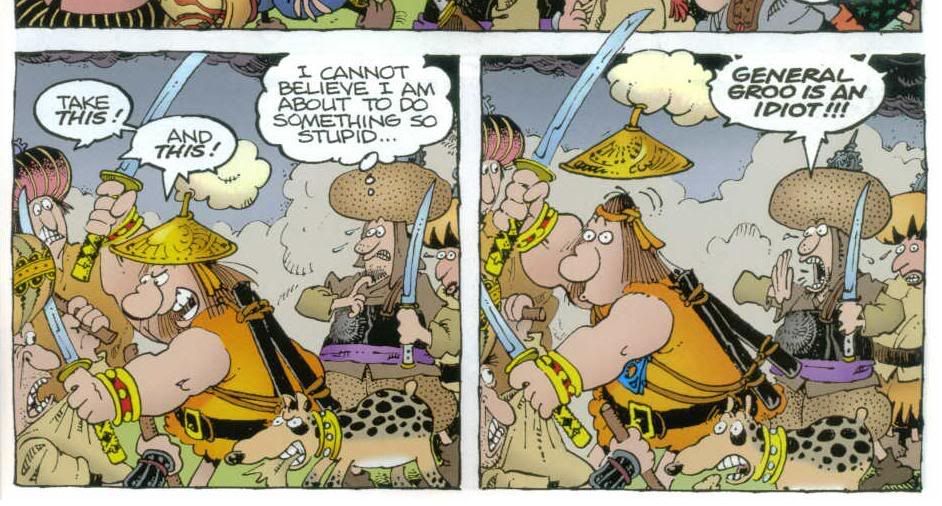
Groo has no plan for leading his troops -- so the troops devise a plan to distract Groo.

Of course, it's always dangerous to try and remove Groo from a fray, but at least this hapless soul is THINKING before he acts....


Over to you, General Diamondrock!

[From Groo: Hell On Earth #4, April 2008. By Sergio Aragones; with wordsmith Mark Evanier, colorist Tom Luth, and letterer Stan Sakai.]
Full Post

Sunday, April 06, 2008

Sunday Soliloquy

We all know about the original Hourman -- take a Miraclo pill and get an hour's worth of super-powers. What happens, though, when it turns out to be a false alarm?


The solution involves some odd jobs, pickup basketball, and (thank goodness!) a burning building -- but that's not a soliloquy, so maybe some other time.

[From "An Hour With Hourman," in Solo #7, December 2005. Written by Mike Allred and Laura Allred, drawn by Mr. Allred, colored by Ms. Allred, lettered by Nate Piekos.]
Full Post

Thursday, April 03, 2008

New comics 4/2/08

First up this week is Detective Comics #843 (written by Paul Dini, pencilled by Dustin Nguyen, inked by Derek Fridolfs), an issue which mixes the Penguin, Zatanna, the Ventriloquist, and a couple of characters from earlier in Dini's tenure. With all of those players, you'd think there's not much room for Batman, and indeed, Bruce Wayne is in it more than Batman is. It's a tightly-plotted issue revolving around a Gotham rich-kid opening a nightclub to compete with the Penguin's, and hiring Zatanna for a little extra sizzle. The Ventriloquist's new "voice" reveals a surprising secret, and the cliffhanger's pretty good too. As for the art, I don't dislike Nguyen and Fridoffs, but I'm still getting used to their style. Nguyen uses very thin lines and Fridoffs is heavy on the blacks, and it reminds me of early Mike Mignola.

Keeping with the Bat-theme, here's Nightwing #143 (written by Peter Tomasi, pencilled by Don Kramer, inked by Christian Alamy and Mark McKenna), a stopping point in the current grave-robbing-villain storyline. If you like Nightwing and Robin vs. an island base full of zombie super-soldiers, scenes punctuated by witty banter, and references to classic rock and Jaws, this is the issue for you. I found it to be a little too pleased with itself, but still an improvement for the title overall. Don Kramer fills in for Rags Morales this issue, but except for a little more stiffness I didn't really notice. Together with Alamy and McKenna, the art isn't too far from normal.

The fill-in work of Ron Randall is less noticeable on Supergirl #28 (written by Kelley Puckett, with the balance pencilled by Drew Johnson and inked by Ray Snyder), an issue that was actually pretty decent. After more than a few issues so inscrutable they'd make the average episode of "Aeon Flux" look like a flowchart, here's one which starts to pull everything together. Supergirl has promised an adorable moppet she'll find a cure for his cancer. Naturally, everyone (personified here initially by Wonder Woman) thinks she's nuts. Supergirl then finds a cult-favorite DC character from the '90s (I won't spoil the cover's tease!) to try and convert to her side. Most of the issue involves Supergirl talking to Wonder Woman and then to Mystery Character, and she does continue to act a bit weird, but with this issue I felt like there was a purpose.

Sadly, that provides an apt segue into Countdown #4 (written by Paul Dini and Sean McKeever, story consultant Keith Giffen, pencilled by Jamal Igle, inked by Keith Champagne), which once again seems to have lost sight of its purpose. After the last few weeks' detour with the Great Disaster, our heroes are back on the real Earth ... but, as the cover indicates, Mary Marvel has decided to go back to the black-cheerleader outfit which got her in so much trouble 30 years ago when this series was still young. So she fights the Atom and Green Lantern and Troia on the steps of the Hall of Justice (the JLA's not home, of course) in order to kidnap Jimmy Olsen for Darkseid. I like Jamal Igle and Keith Champagne's work a lot, although their Darkseid seemed a little off, so I didn't have many complaints with the art. I guess the overall story is starting to come together too. However, the Mary Marvel "reversion" still feels like a sharp yank after all that buildup to "redeem" her.

Finally -- and I do mean finally! -- Action Comics #863 (written by Geoff Johns, pencilled by Gary Frank, inked by Jon Sibal) provides the big blowout conclusion to "Superman and the Legion of Super-Heroes." The payoff is Superman (and, eventually, the Legion)'s fight with Earth-Man in the streets of Metropolis. The secondary payoffs are a couple of rah-rah spreads of the Legion. Sun Boy's role in the story seemed a little too convenient, but considering that this arc could easily have lost an issue without much trouble, I appreciated this installment's pacing. Also, remember last time how I didn't like the way Butch Guice "directed" Cap's fall onto the hovercar? This issue features Superman falling pretty much from orbit, to entirely predictable results, but I liked the way Frank laid out the sequence. Frank's faces are still a bit creepy (those eyes!) and everyone looks kinda pale (thanks to Dave McCaig), but on the whole I can't complain.
Full Post

Monday, March 31, 2008

New comics 3/26/08

Countdown #5 (written by Paul Dini and Adam Beechen, story consultant Keith Giffen, pencilled by Jim Starlin, inked by Rodney Ramos) continues the apocalyptic doings from last issue, with the ominous Buddy Blank narration, the expected trip to the bunker, and the also-expected departure of "our" heroes back to the main DC-Earth. It's a harrowing issue, but in the great scheme of things it's hard to say where it fits. I mean, we don't yet know how important Earth-Kamandi will be to the series as a whole; and if the point of these few issues was to show that Earth's origin, and leave it at that, like a Paul Harvey story, well ... it seems kinda perfunctory. I guess if any series can make the end of the world feel like a side trip, Countdown can. (In fact, it already has -- remember the Earth Superboy-Prime destroyed, a few months back?) Accordingly, I'm not sure why it took Jim Starlin to draw this issue, and why we needed to see a Legionnaire devoured by rats.

Countdown To Adventure #8's lead story (written by Adam Beechen, pencilled by Allan Goldman, inked by Julio Ferreira) concludes about how you'd expect, but it's still fun to see Ellen Baker team up with Adam Strange. On its own it's a lot of fighting and shooting and heroic poses, and overall the arc has been pretty good. I can't say the same for the Forerunner story (written by Justin Gray, drawn by Fabrizio Fiorentino and Adam DeKraker), which might make more sense if I ever decide to revisit it, but which does end on a somewhat unexpected note. The story and art have improved over the past few months, but I didn't have much interest in Forerunner before, and I don't appear to now.

Teen Titans #57 (written by Sean McKeever, pencilled by Eddy Barrows, inked by Jimmy Palmiotti and Ruy Jose) continues the "Terror Titans" arc. This issue focuses on Ravager's fight against a couple of Terror Titans, juxtaposed against Robin's attempts at making up with Wonder Girl. I liked the issue pretty well. I thought it was paced well, I liked Barrows' storytelling, I think Palmiotti and Jose improve on his pencils, and I liked how Ravager was written. So, good job, all; and see you next month!

Green Lantern #29 (written by Geoff Johns, pencilled by Ivan Reis, inked by Oclair Albert) begins "Secret Origin," yet another look at Hal Jordan's life. Apparently Hal did just about anything he wanted to from a very early age. The End. Oh, okay, this issue goes into Hal's combative relationships with his mother and brothers, which in turn are based in his hero-worship of his dad, who you'll remember crashed his jet as young Hal watched. If you've been following Johns' work on the character, there won't be too many surprises here, except maybe for the details about his mom. As for the art, I found myself wondering if maybe Reis and Albert might have stepped aside for the flashback scenes. They're quite good on the regular sci-fi superhero material, but somehow their work felt a little too meticulous for this kind of coming-of-age story.

For some reason that I only noticed with this issue, Jim Gordon looks like Captain Kangaroo (with glasses) all throughout Batman Confidential #15 (written by Tony Bedard, pencilled by Rags Morales, inked by Mark Farmer). It's Part 3 of "Wrath Child," in which we learn the origin of the original Wrath and the startling secret of the current one. I like this story because it's high-concept: a supervillain who's the evil duplicate of Batman, fighting Batman and the newly-emancipated Nightwing. It provides a few fun touches: a flashback reveals a '60s-TV-show-style Batcopter and Batboat, and at one point Dick slams fist into palm a la Burt Ward, exclaiming "Holy--!" to boot. Morales' and Farmer's work is dynamic and clean, and I note approvingly that Morales draws this Nightwing to look appropriately younger than the Nightwing he currently draws in the eponymous book. Looking forward to the end of this one, but wishing this team would do more of the same.

The Spirit #15 (written by Sergio Aragones and Mark Evanier, drawn by Paul Smith) presents a diamond-smuggling switcheroo farce. It wants to be witty and nimble, but sadly comes up short. Although Paul Smith is an able cartoonist who apes Eisner's character designs well, he doesn't go in for the storytelling or layout flourishes that helped distinguish Darwyn Cooke's work. As for the story, Aragones and Evanier are normally very witty on Groo, but many of the gags here seem forced and/or familiar.

The mostly-prose Star Trek spinoff, New Frontier, gets another comic-book story with the new miniseries "Turnaround" (issue #1 written by Peter David and drawn by Stephen Thompson). I haven't read a New Frontier story in a few years, and it looks from this issue that there have been some changes to the cast. Of course, that assumes you're familiar with the cast in the first place. Otherwise, the story doesn't do much to introduce the players. Essentially, an experimental starship goes missing, Captain Calhoun and the USS Excalibur investigate, there's unrelated political intrigue featuring an ex-officer, and another ex-officer is now one of Trek's ubiquitous omnipotent beings. Oh, and there's another familiar-looking person on Excalibur who can pop in, EMH-like, when the story requires. The art is decent enough -- everything and everyone look appropriately Trek-y, and there aren't too many likenesses to worry about. It's not the worst Trek comic art I've seen, but not the best either. I will admit to being intrigued enough by the setup to come back for issue #2, but part of that is the hope that various subplots will start to knit together.

Finally, All-Star Superman #10 (written by Grant Morrison, drawn by Frank Quitely) is a poignant look at the last days of Superman ... at least on his particular Earth. I'm sure you've read about the synchronicity of this issue's conclusion with the Siegel heirs' legal victory, but even before I learned about that I was struck by Morrison's ability to evoke Superman. Morrison and Quitely use the image of Superman's literary creation as a touchstone for the character as ideal, which is a little ironic considering that they're working on an "ideal" version of the character.

But it's only an ideal from our perspective, isn't it? We're used to Superman as a commodity -- as copyright maintenance, as trademark material. We see Superman used as a sales-goosing guest star, as the center of a mythology that expands or contracts with the times, as a paragon of virtue challenged endlessly by fans who want something darker and more realistic.

All-Star Superman #10 speaks instead to "Superman's" power to lead by example. It's about inspiration, creation, and imitation in an endless cycle ("neverending," per the story's title). The hero of this story may be dying, but his legacy lives; just as the hero created by Jerry Siegel and Joe Shuster all those years ago has produced a body of work full of its own entertainment and inspiration. I don't mean to evangelize in such a purple way, and the image of a dying Superman is certainly not the hardest way to create sympathy in a reader -- but this issue pulls together the thematic threads of the series so well, and sets up its climax so effectively.

Morrison and Quitely's Superman speaks in simple, declarative sentences. He wears a costume which looks homemade, but not undignified. He's the center of his world, and this issue shows him preparing that world for his departure. Whether the series will actually end with his death seems immaterial at this point.
Full Post

Sunday, March 30, 2008

Sunday Soliloquy

This week's soliloquy is a preview of the next Titans recap -- but really, how could I have gone so long without featuring this guy...?


I get the feeling that Chris Claremont read this and muttered, "Eeesh, too much." In other words:


[From "The Origin Of Lilith!" in The New Teen Titans Vol. 2 #7. Written by Marv Wolfman, pencilled by Jose Luis Garcia-Lopez, inked by Romeo Tanghal, lettered by Phil Felix, colored by Adrienne Roy.]
Full Post

New comics 3/19/08

Thanks to Easter last weekend and the Siegel ruling this week, it's time to play catch-up. Here are last week's books.

Let's start with Captain America #36 (written by Ed Brubaker, pencilled by Butch Guice, inked by Mike Perkins), a mostly-action issue which eventually finds our hero failing to fill his mentor's inspirational role. It's a moment I'd been anticipating for a couple of issues -- except for the heckling, naturally -- and it speaks to the power of that costume. James B. Barnes looks like Captain America, fights like Captain America (if a little dirtier), and carries Cap's shield. As far as the "living symbol" stuff goes, though, the people aren't convinced. On the action side of the equation, the extended fight scene which takes up the first part of the issue is exciting enough. However, its capper -- Cap being thrown through a window, landing on a hovercar, and blowing away his attacker -- ends up a little static. Maybe some speed lines would have helped me, or maybe devoting just one panel to the fall drained some of the suspense. Overall, though, a consistently satisfying title.

It was a weird issue of Birds Of Prey (#116 written by Sean McKeever, pencilled by Nicola Scott, inked by Doug Hazlewood). I didn't think Black Alice was supposed to be that ... well, mean; and there was a very unsettling vibe running through the Lady Blackhawk/Killer Shark/Huntress scenes. I never expected to see Huntress in a damsel-in-distress situation in this title, that's for sure. Oh well, at least Scott & Hazlewood aren't going anywhere, right?

Like the cover blurb, I'm hesitant to call The Brave and the Bold #11 (written by Mark Waid, pencilled by Jerry Ordway, inked by Bob Wiacek) a "team-up." Instead, it trades mostly on a reversed Superman setup to amusing effect. Ordway fits Superman like a glove, not surprisingly. I think I even saw some of his old Daily Planet staffers (especially "Whit") in the background. I'm sure he'll do fine on the rest of the DC characters, but this issue was a perfect way to kick off his tenure.

Not so successful, unfortunately, was Superman/Batman Annual #2 (written by Joe Kelly, drawn by Scott Kolins), a reworking of a World's Finest two-parter from 1968. A mystical bad guy takes away Superman's powers and renders Batman helpless, and it's only through feeling good about themselves that they get their mojoes back. Really, I might have liked this issue more if not for the extraordinarily dark color work of Jorge Molina. Everything seems to occur against an indigo backdrop, and when you're talking about the black-robed villain, the deep blues, grays, and blacks of our heroes' costumes, and even the muted red and yellow of Robin's costume, it's like reading through sunglasses. Kelly's script doesn't help, since it neither sets up nor resolves the central problem (Superman's loss) with adequate explanation. I like these retro-style stories, obviously, but here things just didn't work out.

Serenity: Better Days #1 (written by Joss Whedon and Brett Matthews, drawn by Will Conrad) kicks off the second Dark Horse miniseries featuring the crew of everyone's favorite Firefly-class freighter, and the good news is, it reads like a pretty decent episode of the TV show. The bad news is, it took me a few passes to figure out how the big action sequence at the beginning was concluded. This was apparently not my week for action sequences. Art is fine; everyone looks about like you'd expect, with only a panel or two where Inara might be mistaken for River, or vice versa. Dialogue is typical for a Whedon-run production, although not too satisfied with itself. Better on subsequent readings, which helps justify me, y'know, buying it.

Unfortunately, I don't know that I can buy (see what I did there?) the central premise of The Flash #238 (drawn by Freddie Williams II), the first issue for new ongoing writer Tom Peyer. It's the old "Wally needs a job" plot, explored by Bill Messner-Loebs several years ago, but still. This time it's augmented by the "Wally openly admits he'd feel better getting paid" subplot; and again, I thoguht we'd settled this. When Wally's Flash identity was public knowledge, somebody (Messner-Loebs, I think) said he got trust-fund income from a charitable foundation set up in Barry Allen's name. When Geoff Johns restored his secret identity, he got a job as an auto mechanic. I guess that's gone away in the flurry of a) being thought dead and b) living on another planet for around a year. Anyway, the central question is, do Peyer and Williams sell this new development? Does the issue work? By those criteria, yeah; I guess so. The new money concerns are exacerbated by a new mind-controlling supervillain. I'm still not entirely sure Williams is a good fit for the Flash -- he's better on Wally's physique, but some of his expressions seem off. Peyer I like a lot, so I'll give him some time to convince me.

I probably should have figured out that Justice League of America #19 (written by Alan Burnett, pencilled by Ed Benes, inked by Sandra Hope, Mariah Benes, and Ruy Jose) wouldn't really cross over with the Salvation Run miniseries. Therefore, I should give it some credit for the misdirection, and some more for bringing back a classic JLA villain as the real menace. That's about it, though. For a one-and-out issue (which this is, essentially, despite its two issues' worth of lead-in), said villain gets defeated much too quickly, because there's too much time spent on Earth arguing over the civil rights issues of exiling supervillains. At least these crossover issues are coming to an end.

Ah, but speaking of which, here's Tangent: Superman's Reign #1 (written by Dan Jurgens, pencilled by Matthew Clark, inked by Jesse Delperdang), the story I almost wish was in JLA instead of its own miniseries. Basically, the Flash and Green Lantern travel to a parallel Earth quite different from their own, where they meet a Flash and Green Lantern who are the same in name only. The issue also introduces an all-new Mirror Master, well-suited for DC's multiverse, and has a nice "Deep Space Nine" reference. The plot isn't anything innovative -- Tangent's Superman is now the absolute ruler of his Earth, and I presume our heroes will spend the next 11 issues trying to overthrow him. However, it's nice to see a multiversal crossover where the only similarities are the names, and even the archetypes are different. Clark's figures are a little too splashy at times, but overall the issue flows well. I also can't fault Jurgens' dialogue, and believe me that's not something I say every day.

Clark used to draw Adventures of Superman from the scripts of one Greg Rucka, who continues the tour-de-force wrap-up of his run on Checkmate (#25 co-written by Eric Trautmann, pencilled by Joe Bennett and inked by Jack Jadson) with an extended guest appearance by the Man of Steel and certain other high-profile superheroes. It's been a change of pace for the title, but it gets no complaints from me. This arc not only answers the "why don't they get Superman to do it?" complaint, it draws some pretty clear lines between the world of bright spandex and the world of Checkmate. Bennett and Jadson are a little more suited for the superhero side of things, but that's a stylistic nitpick. They're good storytellers, and they keep a number of balls in the air. The only good thing about the end of this team's run is the fact that I won't feel bad about not following their replacements.

Finally, Countdown #6 (written by Paul Dini and Adam Beechen, story consultant Keith Giffen, pencilled by Mike Norton, inked by Jimmy Palmiotti) kicks off the End Of The World ... or, more precisely, the "Great Disaster" which will lay the foundation for Kamandi's Earth. It has the same doomsday appeal as the apocalyptic flashbacks in post-apocalyptic movies, only this time with people turning into animals and vice versa. Mike Norton's pencils are a little too clean, simple, and just plain pleasant for this sort of descent, although Beechen's script chooses wisely to have survivor Buddy Blank narrate it. For once, I approve of first-person narration! We know how this ends, though: the boat sinks. The question is whether Leo DiCaprio dies. For that, tune in next time....
Full Post

Monday, March 24, 2008

Questions And Comments After Reading Essential Cap Vol. 4

I bought the first Essential Captain America volume for the Jack Kirby and Jim Steranko art, not really expecting to continue with the series much farther than that. Wrong again, of course -- I finished Volume 4 over the weekend, and am on the lookout for the next one.

Actually, thanks to the paperbacks of the second Kirby run, I just need to read issues 187-92 to bridge the gap. So that's the first question: anything noteworthy happen in those six issues? Kirby seemed to start fresh, which tells me there was probably some editorially-dictated wrapping-up during that time.

The second thing I wanted to bring up is more of an observation. Much of Englehart's run seemed pretty familiar: the Red Skull brainwashing one of Cap's allies, the Skull working to subvert the American economy, and "new" Captain(s) America. I think Brubaker has done a great job on the title from his first issue, but I can't help but wonder how longtime readers compare his stuff to Englehart's.

Finally, one of the noteworthy parts of Englehart's Green Lantern tenure was his "secret history of Star Sapphire" issue. Englehart pulled together plot elements from various Sapphire stories to link her with a new villain, and reading Cap #186, it seemed like he had already done something very similar for the Falcon.

Now, I know that Englehart isn't credited with the script for #186 (although "John Warner" may be one of his pseudonyms, for all I know), but he is credited with the plot, so I'm willing to make the connection between CA #186 and GL #192.

Speaking of Green Lantern, I wonder to what extent the socially-aware bent of Captain America was influenced by the O'Neil/Adams issues of GL. GL was a lot more direct about its messages, but CA might not have been as particularly concerned with changing the world.

So, any thoughts, Cap fans?
Full Post

Monday, March 17, 2008

New comics 3/5/08 and 3/12/08

I've got a lot of these to go through, so I'll try to keep it short.

3/5/08

Justice League: The New Frontier Special #1: Very nice all around. I probably didn't need to see how another Batman/Superman fight would play out, but it's justified as a "lost chapter" of NF. The Robin/Kid Flash and Wonder Woman/Black Canary stories are cute, the period ephemera is well-done, and the behind-the-scenes look at the DVD adaptation is pure eye candy.

Teen Titans Year One #3: Was a little surprised at the pacing of the overall miniseries, as depicted in this issue; but better earlier than later, I guess. Besides, the story's new direction looks intriguing. It's been good so far, so I'm in for the rest.

Supergirl #27: It's an understatement to say that this book hasn't been what I expected. If you remember the Steven T. Seagle/Scott McDaniel run on Superman a few years back, it's kinda like that, except on downers. I'm pretty much buying this book to see if it all makes sense. Plus, I like Drew Johnson and this issue's guest (fill-in?) artist, Rick Leonardi. S'girl isn't frustratingly bad like, say, early Hawkgirl or late Gotham Knights. It's just frustrating.

Countdown To Adventure #7: I read this book for the Adam Strange/Animal Man/Starfire story. I have no idea what's going on with the Forerunner story.

Nightwing #143: I like the fact that writer Peter Tomasi isn't afraid to plug Nightwing firmly into the center of DC's superhero culture. It can get a little precious, and sometimes -- not so much in this issue, but certainly in the last one -- it distracts from the main plot. This issue was fine, but I bet if it were your first DC comic in a while, you'd be mystified.

Detective Comics #842: Batman must deal with an EVIL! suit of armor that he ended up wearing in the Ra's Al Ghul storyline from a couple months back. You know Spider-Man's black costume? Like that, except Batman doesn't destroy it, it doesn't make him dance like a poser, and (so far) it hasn't come to life. I'm not sure why the world needed this story.

Green Lantern #28: The "Lost Lantern's" trial results in the creation of a Red Lantern. Hal has a Clarice Starling moment with Sinestro. We check in with the demons on Ysmault. The Guardians issue a radical new law. I can see how it all fits together, but I know the dots won't be connected for about another year.

Countdown #8: Yay, Ray Palmer's back as the Atom! Yay, Firestorm is back (although whither Martin Stein?)! Yay, Habitat, the Hairies, and the rest of Jack Kirby's Jimmy Olsen creations! Boo, all the bickering and running around pointlessly.

3/12/08

JLA Classified #54: Will probably read better in the trade. Since this is the last installment of the Titus storyline, the "past" narrative takes up the top half of each page, and the "present" gets the bottom half. Sometimes that trick works, sometimes not. Here, it might've been better to split the pages vertically. As for the story, Titus beats the tar out of the League for as long as is dramatically appropriate. The ends on an ecumenical note, which is always nice, but a bit treacly for the Justice League. Overall, though, pretty good.

Batman Confidential #14: Part 2 of a new look at a one-off villain from the '80s, The Wrath. As a modern-style story with an out-of-date setting, it's not exactly a nostalgia-fest. However, I give it points for picking a time period other than "Year One." Otherwise, I'm not sure what the general appeal would be.

The Last Defenders #1: The Defenders are famous as Marvel's "non-team." This book goes a step further, taking pains to point out how its characters are nowhere near as cool as the original Defenders. It's a weird little exercise in obstinance wrapped in a story about white supremacists and big snake-monsters. I'll probably stick with it.

Fantastic Four #555: Boring. Bryan Hitch and Paul Neary are fine craftsmen, but there's still no life in an issue which features an illicit tryst, a duplicate Earth, and a giant killer robot. It's all hat and no cattle.

Superman Confidential #13: Part two of the Toyman/Jimmy Olsen story is okay, and I like Phil Hester and Ande Parks' art, but it feels a bit padded and lethargic. Probably could have used some pruning.

Star Wars: Rebellion #12: Part two of yet another "infiltrate an Imperial base" story that just kinda sits there. Colin Wilson's art reminds me of early Howard Chaykin, and his Luke doesn't look much like Mark Hamill either.

Bat Lash #4: The big apocalyptic issue which sets up the climax. This miniseries has been decent, but it's hard to reconcile all the blood and death with the happy-go-lucky tone which got me interested in the character. (Lots of cattle, but I thought the hat would be different, in other words.) Maybe Sergio Aragones can do it. We'll see.

Countdown To Mystery #4: I continue to like the Doctor Fate story as it plays with the (pretty much inevitable) conclusion that has Kent Nelson become the latest Doctor F. This installment includes the most traditional superhero action we've seen since early on, but the pieces still haven't fallen into place. Most origin stories seem to place the origin alongside another threat, in order to give the new hero something to do in the third act. This one is all about the origin process itself, with Inza's comic-book ventures serving as metacommentary. Makes me miss Steve Gerber that much more. P.S. This book also contains an Eclipso story which is once again threatening to meander.

Booster Gold #7: It's The OMAC Project, Take Two, as we see how Max Lord took over the world once Booster saved Beetle from an (untimely?) death. (By the way, I've just started the second season of "Star Trek Voyager," and Tom and Harry are reminding me a lot of Beetle and Booster.) More subplots converge alongside more trips into DC's nostalgia mine, so for me, pretty good.

Superman #674: New artist Renato Guedes brings a nice "bigness" to the proceedings. Outgoing writer Kurt Busiek brings back an old JLA villain (from just before the Detroit days) to threaten Superman. Meanwhile, Supes has problems with Mon-El and the Kents have a new apartment. It's a full issue which doesn't feel overstuffed.

Wonder Woman #18: Guest artist Bernard Chang helps Gail Simone send WW into space, in what looks like an oblique sequel to the "Space Pirate" storyline from the early '90s. Basically, she's challenged by the Khunds (who act like Klingons) to stop an unstoppable race which threatens Khundia. Also, she gets pre-engaged to Tom Tresser, and Etta Candy shows up too. Chang makes WW look like someone familiar, but I can't think of who. His art is a lot less porntastic than I feared it would be.

Countdown #7: Yet another parallel world, 90% close to the familiar DC-Earth. Another Tom Derenick-pencilled issue too. I swear, this series would be twice as good if it were half as long.

Green Arrow and Black Canary #6: This issue seemed so indebted to "Alias" (the TV show, not the comic book) that I'm starting to think Connor Hawke is the Michael Vaughn designated-victim figure. Remember when Vaughn drowned at the end of Season One, or when he got shot like Bonnie & Clyde at the beginning of Season Five? My money is therefore on Connor to pull through.

Green Lantern Corps #22: Part two of the Boodikka/Alpha Lantern storyline seems pretty forgettable, although it'll probably look a lot more important in 2009. Today, though, I'm tempted to think that all the procedural GLC stuff would fit better in this book than in Green Lantern, with the Boodikka story as a backup.
Full Post

Sunday, March 09, 2008

Sunday Soliloquy

Vic just wants to unburden himself to his friends, so why does Dan Jurgens have him directing traffic?


ACTING!, I guess....

[From The New Teen Titans vol. 2 #6, March 1985. Plot by Marv Wolfman and George Perez, script by Wolfman, layouts by Jurgens, finishes by Romeo Tanghal, letters by John Costanza, colors by Adrienne Roy.]
Full Post

Saturday, March 08, 2008

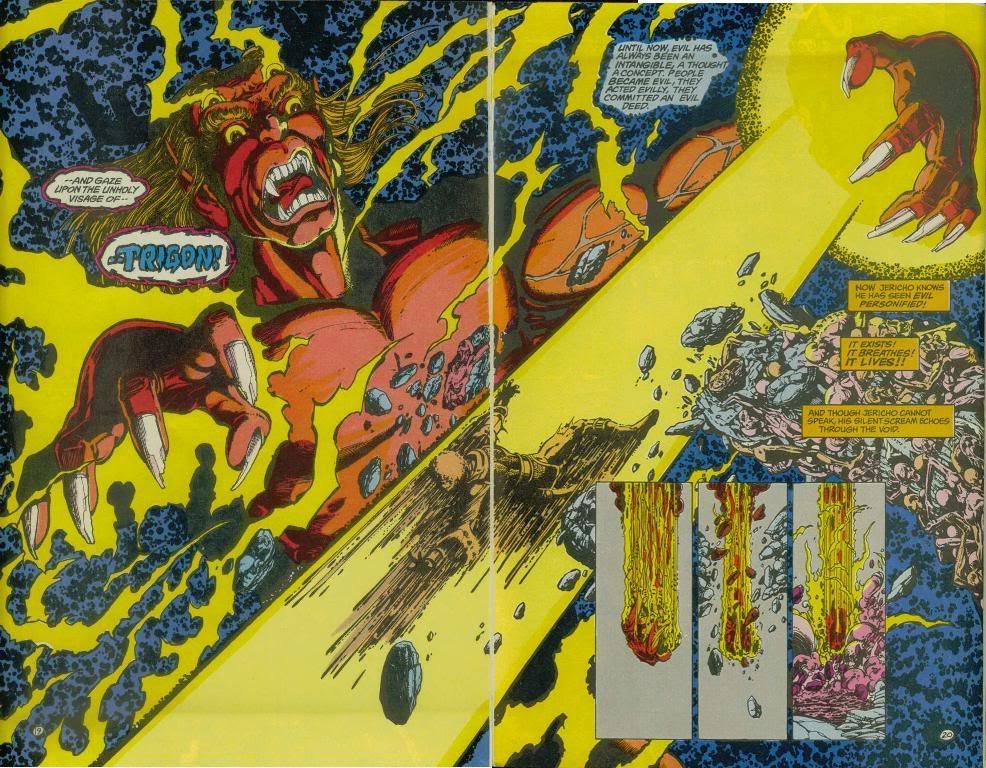
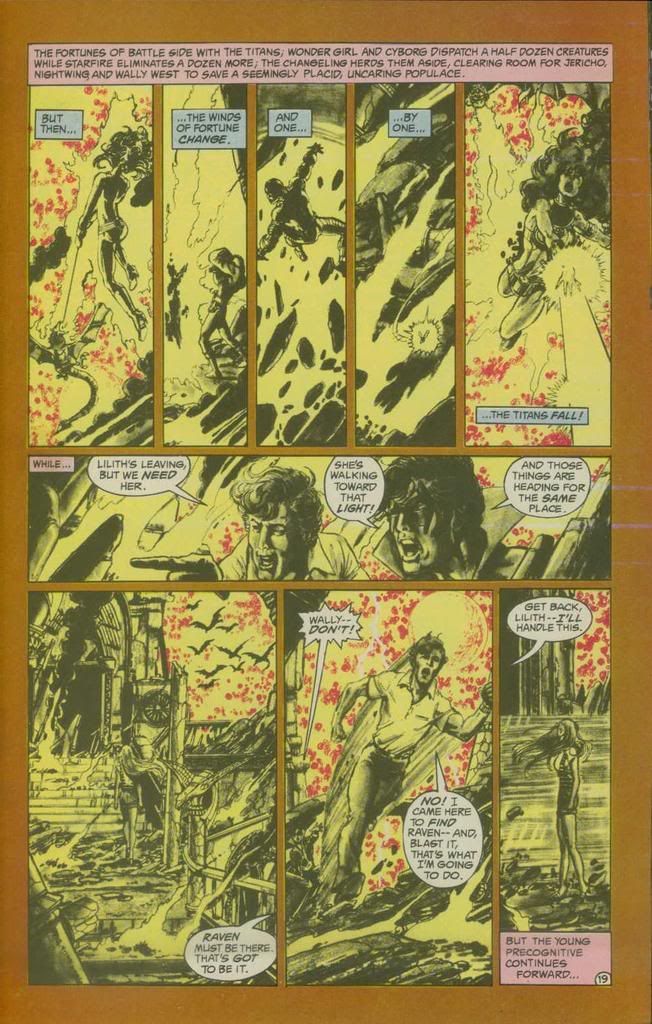
Who's Your Daddy? The New Teen Titans Vol. 2 #s 1-6

The first five issues of NTT2 are collected in a paperback called The Terror Of Trigon, but to me they work best as a showcase for George Perez. Appropriate to his last Titans work for four years, he goes out with a bang. He inks himself on issues 1 and 2, and portions of issue 2 are reproduced directly from his pencils. Although Romeo Tanghal returns to ink the last three issues, either his inks have gotten cleaner or the higher-quality paper allows them to be less muddy. Tanghal's inks compare pretty well to Bob McLeod's on the second Perez run ... but we've got a long way to go before that.

The story reminds me of "The Judas Contract," both in the sense that it caps a long-running subplot, its ending goes a bit beyond what you might have predicted, and it can't really be appreciated on its own. Just as the four installments of "TJC" are best seen in the light of almost two years' worth of Terra stories which preceded them, so "Trigon 2" is the culmination of the "Evil Raven" teases which date back to about the same period (if not farther).

Anyway, you want to know what happened, so let's cruise on....

Issue #1 (August 1984) opens with a training sequence in the Titans' Island woods (or, I guess, copse of trees). The object of the game is to capture Jericho, and everything's going well until Raven appears. She doesn't want anything to do with the game, but Joey doesn't know that, and tries to take her over. Raven "dodges" by teleporting away before he can merge into her body, leaving Joey -- who still managed to brush up against her consciousness -- seriously freaked out. The Titans want to help her, of course, so Joey volunteers to talk to Raven. In her pitch-black room, Raven tells Joey her destiny has finally arrived; and a few minutes later, she tells the Titans assembled in the meeting room that she's leaving.

(There's an interlude on Tamaran which shows the royal family sending a starship for Kory, but that's a couple of arcs away, so for now, it just lets Perez show off.)

While Cyborg and Changeling review old photos of Raven which show how Trigon's influence has changed her physically (and explain Perez's development with the character's features), Joey decides to sneak into Raven's room and take her over as she sleeps ... and here Perez really pulls out the stops. Joey/Raven trudges across bridges made of naked bodies and landscapes that would give Ditko's Doctor Strange nightmares. There he finds Arella, Raven's mother, naked herself; and as Arella cries that he's not her daughter, Trigon appears suddenly, blasting Raven's very form off of Joey.


Trigon treats Joey like a Nazi opening the Ark of the Covenant, but after a few moments Raven appears. Trigon shoos Joey back to Titans' Tower, where the Titans discover him, again, understandably Freaked Out. It's a dark, stormy middle of the night as Joey fills in the group, and as he finishes, the Titans hear Trigon's laughter....

Issue #2 (October 1984) opens with Perez on pencils only, following Arella (now fully clothed, so maybe her appearance in #1 was an illusion) and on the lookout for Raven. She's in Azar's dimension, but it's far from the calm star-studded place we've seen before. Now the skies crackle with energy and Trigon's bat-winged minions fly overhead. Arella catches up to Raven, terrified as Raven turns to face her, and Trigon cries out "She is mine!"

Meanwhile, the Titans have found Raven's rings, and wonder why Raven would have left them behind. Lucky for them Lilith shows up at that moment. The Titans apologize for the events of Tales #54 (specifically -- and foreshadowingly -- footnoted, since that issue was still about a year away), and Lilith says she was drawn to Titans' Tower because she could tell all the bad craziness was connected to Raven. As Lilith takes one of the rings, lightning strikes the tower (and Cyborg), a window blows out, and an unnatural wind whips the room into a frenzy. It's over just as quicly, though.

Lilith observes that "[t]hese rings are the nexus to [Raven's] soul. But we need to reach her heart as well." Thus, Dick and Donna take a T-Jet to Blue Valley to retrieve Wally West. The skies are stormy there too. Moreover, Frances Kane doesn't want Wally to leave her ... but he's gotta do what he's gotta do.

Back at the tower, Lilith summons a spectral, faceless Raven through a seance, but Raven doesn't stick around. However, the Azarites summon the Titans through Raven's rings, and the Titans are zapped to Azarath only to find it destroyed.

The Titans try to save as many Azarites from the bat-creatures as they can, but it's too late. Lilith, Arella, and the remaining Azarites gather at Azar's tomb to sacrifice themselves. The bat-creatures obliterate everything in their path ...

... and Raven, now completely transformed into a red-skinned, four-eyed replica of Trigon, appears with him over Titans' Tower.

Issue #3 (November 1984) begins with a full-page, full-face shot of the demonic Raven, inviting the people of New York (watching on TV) to please put their hands together for their new lord and master. Raven does in fact announce that "resistance is futile," about five years before the cool kids started saying it.

Meanwhile, the Titans and Arella wake up in what's left of Azarath, now basically an infinte white nothingness peppered by rocky outcroppings. Lilith informs the group that the Azarites have joined with Azar in the great beyond; that Raven has been taken over completely by Trigon; that Azar's rings protected the Titans from Trigon's destructive forces; and that Trigon is now on Earth. Azar's rings take the group back to New York, only to find it transformed into a literal concrete jungle similarly populated by souls writhing in torment. It's not long before the Titans run across Trigon (sleeping, lucky for them) and Raven (awake and upset). Raven downs everyone except Joey and Gar, and when Joey tries again to take her over, she repels him again -- this time with extreme prejudice.

As for the remaining six Titans, Raven sends them each into their own personal hells, where they must face black-and-white-and-red-eyed evil versions of themselves. Yes, like in the cartoon. However, the gore factor is significantly higher here, because each must also face his or her worst fear. Dick confronts a Jason Todd who couldn't save Batman from a grisly death. Vic's friends prefer his completely-human evil double. Gar's literally devours his loved ones; and Donna's kills Terry (but I'm sure is otherwise evil). Kory's invites her to submit again to slavery; and Wally's is a Trigon-eyed Kid Flash who taunts him for his wimpiness. These visions are all in the Titans' minds, naturally -- their bodies are trapped in a stone column, same as everyone else on Earth.

Issue #4 (January 1985) picks up there, and shows the Titans being run through familiar sets of angst. Each in turn gives in to his or her dark side, however, and as each kills an evil counterpart, his or her eyes turn glowy red. When the last Titan succumbs, their bodies are freed, but now they too have been transformed into black-and-red "negatives." Raven boasts that "Trigon has won," but Lilith says no -- thanks to the rings, she controls the Titans.

The transformed Titans attack Raven, chanting "Destroy her!" and absorbing her counterattacks. Trigon remains motionless atop Titans' Tower. Finally, the evil Starfire pumps a few lethal starbolts into Raven's "spiritless body," killing her.

This returns the Titans to normal, but of course they're horrified at what they've done. Lilith basically says don't sweat it -- "only in your evil forms would you have killed her," and "Trigon could not be defeated unless his daughter died." Speaking of Trigon, his voice now booms out over the landscape, vowing "vengeance" for Raven's death. He's awake, and he's about 300 feet tall.

Accordingly, issue #5 (February 1985) is the big Titans vs. Trigon blowout. Wally, despite his weak heart and the ongoing problems with his super-speed, is first out of the gate, but Trigon takes him out pretty quickly. The rest of the group (except Nightwing) then charges, only to have Trigon drop Titans' Tower on them. As Trigon strides through the wasteland that was New York, Nightwing lobs a grenade at him, but Trigon smites him with his staff. Trigon exposits about how Earth is the center of all his troubles -- the Azarites, who imprisoned him, came from here, as did Arella; and Earth has constantly resisted his power, "longer than any other." Thus, Earth must be destroyed.

However, Lilith still senses that the Titans are alive, and guess what -- Starfire has been protecting them with an energy shield. She shrugs off the rubble of Titans' Tower, the group plucks a still-breathing Nightwing out of his own pile of wreckage, and Lilith starts to outline their plan. Wally, unfortunately for his fans, is ready to give up in the face of Trigon's overwhelming power, but nobody else is.

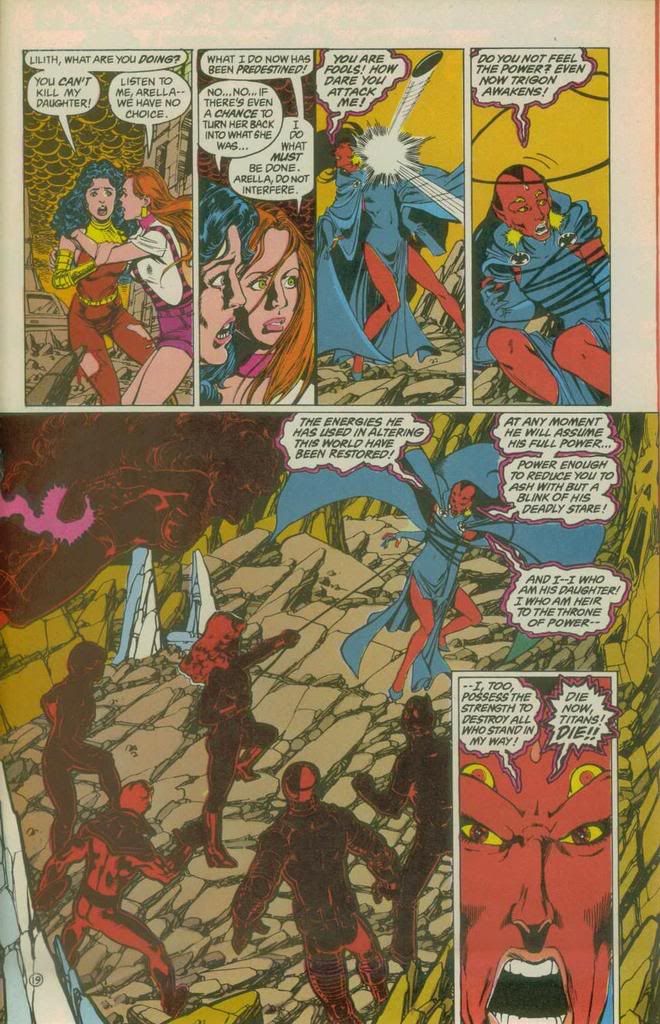
Trigon, standing atop the Twin Towers, opens a gateway into his home dimension so that he can project Earth's energy into it. Azar, speaking through Lilith, tells Arella to put Raven's rings back on Raven's hands -- turns out she's not dead, "[s]he has only been emptied ... for no soul-filled life could survive what comes next." Replacing the rings distracts Trigon, and gives the Titans an opening. They attack, but they know they're not doing much harm. The real action is back with Arella, Lilith, and Raven, who's starting to sparkle and glow. Here, then, is the big finish:


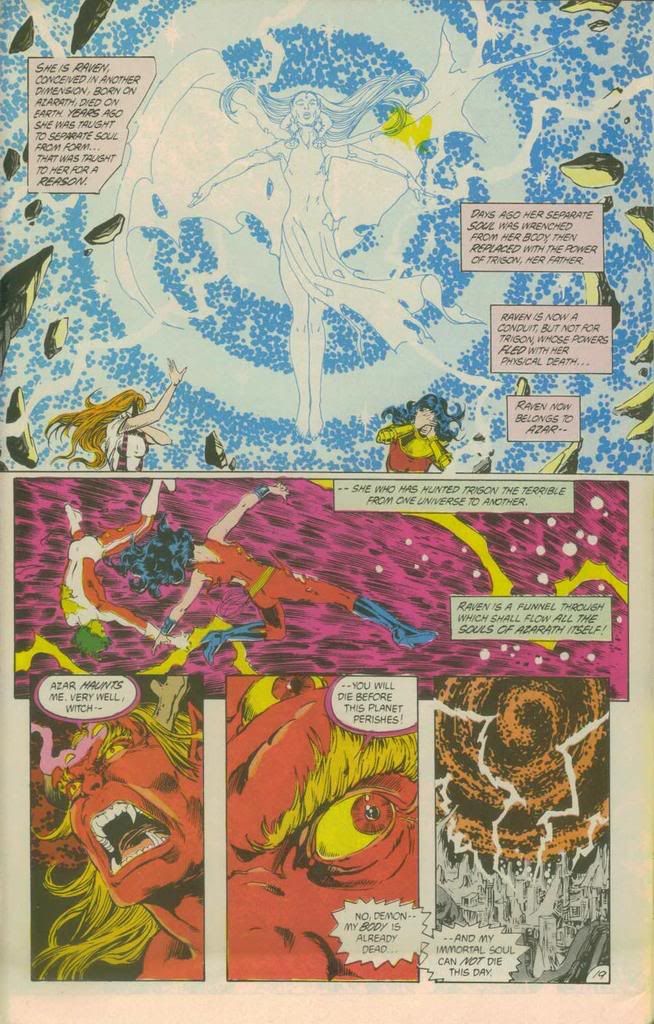
In a nutshell, Raven's soul-self -- which, you'll remember, had been corrupted by Trigon when she was still a girl in Azarath -- had been replaced completely with Trigon's energies. Now that she's been "emptied," Azar had space to insert Azarath's energies in its place. They now destroy Trigon, ghostly faces swarming over him like locusts, picking the flesh from his bones until nothing remains. Raven herself fades away, a beatific expression on her once-again-human face. With the explosion of light that marks her passing, the world returns to normal...

... except for Titans' Tower, which is just a stump of girders.

Issue #6 (March 1985) -- again, not included in the paperback -- is an epilogue pencilled by "Daniel" Jurgens wherein the Titans and New York recover from Trigon's takeover. A lot of it is devoted to characters giving speeches -- not like the past five issues didn't have their share of speechifying, but here the words get more attention than the pictures do. Besides, the speeches start out as news reports celebrating the Titans' victory before segueing into subplot maintenance. Wally and Frances Kane restate their commitments to not using their powers. Azrael (or Emo-Angel-Guy, since he still doesn't have a name) sees Lilith on the teevee and waxes poetic about her. (An old feller, seeing him and apparently not hearing his pronouncements, calls him the "Angel of Death." Oh, Marv.) Arella announces she's going to search for Raven.

Ultimately, Terry Long suggests that the group (minus Joey, who's recovering in the hospital) take another camping trip to the Grand Canyon and reconnect there. Each of the Titans recaps their Trigon-nightmares and explains how they continue to feel weighed down by them. (Well, Starfire is upbeat, but that's to be expected.) Terry then instructs them to turn those frowns upside down, because the fact that they're worried about these things means that they've got control of their fears.

I'm including issue #6 in the Trigon arc because it does provide some closure, but it would have worked better with Perez art. That's not the fairest comparison, and Jurgens tries hard, but his figures just lack the subtleties that Perez would have brought to this kind of issue. Let's put it this way: without Perez, I get the feeling that Wolfman wanted to write that much more dialogue to drive the various points home. Well, mission accomplished, Marv.

* * *

This arc has some very spooky moments, an horrific, gory second act, and a climax of almost Biblical proportions. However, it's also very "inside baseball" in parts, asking longtime readers to remember virtually back to the beginning of the series. The humor also seems somewhat forced, like Marv is trying to "write funny" It then connects those various storylines and subplots in a way that might actually be more friendly to new readers, but then the departure of George Perez leaves the book on a different footing than it started. Overall, though, it's very satisfying, especially if you believe that this puts the Titans' various Trigon-aggravated hangups to rest once and for all. (I don't know that it does; that's part of the reason I'm reading these again.)

The arc also works well as a commentary on the final "newsprint" storylines. Wally gets one last adventure with the Titans, after refusing to go after the HIVE undersea base. Lilith has both some tension with the group and a reason to be attuned to their needs. Vic's all-human evil twin probably helps him overcome any lingering doubts about his recent surgery. Gar has had a chance to work through his feelings about Terra, Joey, and Deathstroke. Having since married Terry, Donna has more of a need to affirm her commitment to him.

I also have to note that, once again, Wally West comes across as both craven and ineffectual. I presume that Marv and George considered this an outgrowth of his "retirement." It might also have been a way to provide an audience-identification character whose "game over, man!" pronouncements could have further heightened the tension. Wally does have some heroic moments in Azarath, and he's first to challenge Trigon, but his particular character arc doesn't end well. Maybe, even as close in time to Crisis On Infinite Earths as this arc comes, Wally was still meant to be retired permanently, so to have him struggle with his powers, and continue to pine for a superheroic life, might have been too much of a tease. Regardless, he'll get turned around before too long, so I can't complain too much.

Finally, this arc brings the stories of Raven and Trigon to a pretty definite end. Anytime you can say that about a superhero serial, it's a good thing. That ending might not have held up over the long haul, but that's (literally) a story for another day.

Next: The Children of the Sun!
Full Post

Thursday, March 06, 2008

Thursday Night Thinking

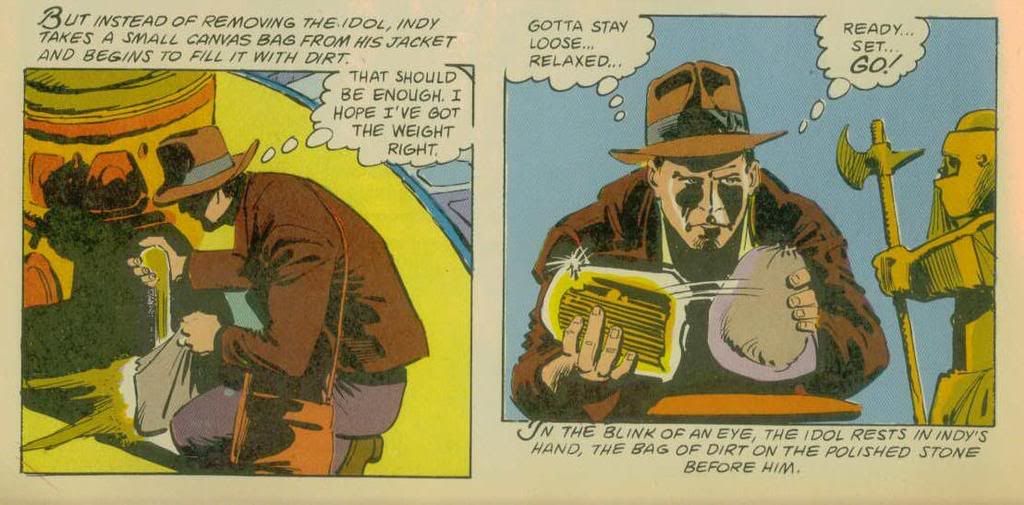
One of the great joys of being married is finding out new things to love about your spouse. For instance, I never knew (until she unpacked her office papers last weekend) that the Best Wife Ever had a copy of Marvel's all-star Raiders of the Lost Ark adaptation. Heck, I never knew there was a Raiders adaptation....

Anyway, because it's a comic book, writer Walt Simonson lets us see Indy THINKING--!


If adventure has a name, it must be Diamondrock!

[From Marvel Super Special No. 18, adapting Raiders of the Lost Ark. Adaptation written by Walt Simonson, pencilled by John Buscema, inked by Klaus Janson, lettered by Rick Parker, and colored by Michele Wolfman.]
Full Post