Monday, October 31, 2005

Carving-Man Begins

Yesterday I sat down with a pattern, a pumpkin, and my Swiss Army knife. This, my first attempt at a jack o'lantern, was the result:


Next year, maybe the Batman TV show logo.
Full Post

Saturday, October 29, 2005

A Personal History Of (Mostly) Failed Halloween Costumes

Halloween is my favorite non-religious holiday, mostly because it taps into these various geeky interests. Also, my birthday is November 1, so even if I had a crappy Halloween, the next day would almost inevitably be better.

When I was a little kid, my grandmother made our costumes. One of the first was a Brachiosaurus -- basically a yellow jumpsuit with a tail, and a mask for the head and neck. The eye-holes were at the bottom of the neck, so with the stuffed dino's neck and head towering a good two feet above my own, it effectively doubled my height. It was also tremendously hot, but I didn't mind.

Later, when I was about 9 or so, Granny made me a really rockin' Spider-Man costume, very faithful to the comics, and comfortable enough to just wear around the house (which I didn't do ... that often). Most of it was one piece, with boots, gloves, and a mask that I soon lost. A couple of years later, Granny and I collaborated on an X-Wing flight suit of which we were both deservedly proud.

Many years later, as a first-year law student in 1991, I went to the school's Halloween party in a Starfleet outfit and claimed to be "Commander Bondurant" of the Starfleet JAG. The puzzled, almost pitying stares this produced soon taught me that sometimes it's better to just wear the suit without putting too much thought into the backstory.

Case in point: my buddy Sam, also a 1-L, came as Peloquin from Nightbreed, with red skin, elaborate makeup, and snake-like hair. Unfortunately, the Nightbreed-illiterate crowd thought he was supposed to be Native American:

Random person: Wow, what a great Indian costume!
Sam: No, I'm Peloquin, from Nightbreed!
RP: ???
Sam: It's this horror movie, and Peloquin's this monster....
RP (backing away carefully): Oh, okay....


After a while, Sam just sighed and accepted the compliments on his "Indian costume."

Second year I went back to the law school Halloween party (Sam did not) as Luke Skywalker from Return of the Jedi. The costume was pretty good, although I could only find a red lightsaber. The only embarrassment was having another classmate put a cowboy hat on my head and call me "Garth Vader," and that wasn't so bad.

For a couple of years I rented some appropriate period clothes and went as Sherlock Holmes, but without the cape and deerstalker cap, people just thought I had come from a wedding.

In 1996, a few years out from law school, I was Clark Kent for Halloween. I bought a Superman costume, modified it to make it a little more sturdy, sprayed my hair black, and put on a suit and tie over the costume. I wore a white shirt, so you could see the "S" underneath, but it was pretty dark at the party and I ended up taking off the street clothes. It was a good idea (and I wore all of the costume, including cape and boots, under my clothes), but not very practical.

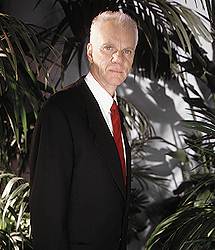
After going as Luke again in 1997, I was out of ideas for Halloween '98, and ended up going as the Malcolm McDowell Mr. Roarke. I had a black suit and yellow tie, and sprayed my hair white. Apparently this made me look more like either my grandfather or Bill Clinton, both of whom were undoubtedly more familiar than the '98 "Fantasy Island" remake.

At this point I vowed never to be without a decent Halloween costume, and in the summer of 1999 found a seamstress who was making Phantom Menace-era Jedi robes. However, because mine didn't arrive until December, I would have to wait to debut them until Halloween 2000.

And so it came to pass that, five years ago yesterday, I ventured out into the cold October night for what turned out to be an appointment with destiny -- for at that party, I met the Best Wife Ever. The outfit was a good icebreaker, and it probably also answered a lot of questions about just how big a Star Wars fan I was. (As my cousin later put it, "So ... she knows.")

Now, we just rack our brains trying to find her a costume every year....

Happy Halloween!
Full Post

Thursday, October 27, 2005

New comics 10/26/05

Pretty good crop this week, starting with Captain America #11 (written by Ed Brubaker, art by Steve Epting). However, before we get started in earnest, let me just say a few words about Marvel's new ad-saturation policy:

It stinks. (Stinks!)

The first ad in Cap #11 is on page 2, and it's a double-page Honda Civic spread. I know superhero comics would love to be taken as seriously as Newsweek, but having the same ad layout isn't exactly the right way to start. Remember the good old days when pages 2 and 3 could be used for a spectacular action scene, not a sensible sedan?

There are 48 pages between the covers of Cap #11, and 24 of them are ads. (Two pages are devoted to an ad for Dan Slott's new Thing series, Marvel's circulation statement, and the letters page.) Moreover, including the Civic ad, there are three double-page spreads. There are no two-page spreads of artwork anywhere in the issue. In fact, there's not a page of story in this issue that isn't right next to an ad. Is this Marvel's way of getting me to wait for the trade -- not just for the higher price point, but also so it doesn't have to fool with juggling pages to avoid those troublesome two-page spreads? It's a good thing the story works within these hideous restrictions.

And work it does, relating the history of the Winter Soldier between bookends showing General Lukin's and Cap's reactions to his file. I'm not going to say much more, except that Brubaker and Epting have convinced me they'll do right by this character, whatever his fate. It was worth slogging through all the commerce.

By contrast, Defenders #4 (written by Keith Giffen and J.M. DeMatteis, art by Kevin Maguire and Joe Rubenstein) opens with six straight pages of story before the first ad, and it has two double-page spreads. (Then again, it only has 10 pages of ads. Clearly Marvel hates America, or at least its musclebound avatar.) Reading the issue, with its twisted versions of Marvel heroes, you'd think I'd be reminded of the evil Super Buddies from G/DM/M's "I Can't Believe It's Not The Justice League," and you'd be right. Regardless, for the anti-team book, it's doing very well, and I'm anticipating the conclusion.

Speaking of anticipating the conclusion, Legion of Super-Heroes #11 (written by Mark Waid, pencilled by Barry Kitson, inked by Mick Gray) finds our heroes split up and trying to regroup after the devastation of last issue. It was good enough to hold my attention for another month, but beyond that I'll have to give the series more thought. This goes into the omnibus-review pile.

JLA Classified #13 (written by Warren Ellis, drawn by Butch Guice) sends the League to Hell, where they fight demons to a standstill, or some other ambiguous result. Meh.

Flash #227 (written by Joey Cavalieri, pencilled by Val Semeiks, inked by Livesay) starts up a new story arc involving a dark alternate future (oh boy) and the new church Wally's in-laws are attending. It's better than it sounds, although I don't know how well Livesay's inks go with Semeiks' pencils. Everything seems just a little ... off. Anyway, I"m sure the alt-future is tied to the church somehow, and it's not a bad beginning.

Adventures of Superman #645 (plotted by Greg Rucka, scripted by Nunzio DeFilippis & Christina Weir, pencilled by Karl Kerschl and Renato Guedes, inked by Wayne Faucher and Guedes) takes place just before Infinite Crisis #1, so there's OMACs a-plenty and lots of Wonder Woman neck-snapping footage. Parasite's with (a) Luthor, Lois is back in Umec looking for her shooter, and Superman learns more clues about Ruin. Good stuff, much like Rucka winding up his Wonder Woman storylines to get them out of InfC's way. The art is also uniformly good, although I wonder -- with so many creators working on this book, the burden seems to be on DC to say the editors didn't change at least half of it.

JLA #121 (written by Bob Harras, pencilled by Tom Derenick, inked by Dan Green) was decent. Turns out I don't really miss the "Magnificent Seven" JLA as long as the lineup contains stalwarts like Green Arrow, Black Canary, Green Lantern, and Aquaman. After an interlude with the Key, the not-the-JLA decides to visit Nightwing and enlist him in case Batman goes really nuts. The issue comes together in ways which are not surprising, but after the past few months' chaos that's not so bad. The art was better this issue too. In terms of angsty JLA breakups, I'd rate this as only slightly more painful than the post-"Rock Of Ages" reorganization.

Finally, I had to laugh upon seeing the cover to the week's best book, Mike Allred's issue of Solo (#7). First DC nixed his Adam West cover, and the Mr. Miracle cover which replaced it (now on the inside front cover) has itself given way to Wonder Girl. The issue is a self-proclaimed "love letter" to DC books of the '60s and '70s, especially Teen Titans, Doom Patrol, and Batman. In fact, I had thought the original Batman cover was 86'ed by DC because they have issues (including legal issues) with the Adam West TV show, but the main story is, in effect, a deconstructed episode of that show, including the actors, sets, and Batmobile.

Cynics will laugh bitterly at the none-too-subtle message of that story, a devastating critique of ... well, everything DC's been doing with its main line of superhero books for the past 18 months. Some may well say that this is DC's sop to its aging fanbase (as opposed to the young whippersnappers who like the gritty), and the exception that proves the rule. However, as an eternal optimist when it comes to these kinds of things, I'd like to think "Batman A-Go-Go" shows that DC is comfortable with even the most diametrically opposed symbol of its current editorial tone. Not that it's perfect, but its heart is in the right place.

The other stories are more superficial, but again, I could tell Allred just wanted to cram as many classic DC characters into his Solo issue as he could. This becomes literal by the end of the last story, which itself is a bit of wish fulfillment. Still, Allred is a great cartoonist, and the focus is on him, not literary merit. Like I said with the Darwyn Cooke Solo a few months back, buy this book.
Full Post

Wednesday, October 26, 2005

New comics 10/19/05

We begin this week with Green Lantern Corps: Recharge #2 (written by Dave Gibbons and Geoff Johns, pencilled by Patrick Gleason, inked by Prentis Rollins and Christian Alamy). It features two plots: one group of GLs visits Mogo, the antisocial Lantern introduced by Alan Moore; and a pair of antagonistic trainees (one from Rann, one from Thanagar) gets assigned to protect a boring shipping route. Neither rises much above standard super-hero fare, but both tie into a larger story involving galactic politics. Besides, I've always liked the Corps for its tremendous potential -- not just to show how different characters would use a power ring, but for its political and legal implications. Still, I have two complaints about the issue: the art seems sloppier than it was in #1; and since when does Thanagar have a reptilian race?

Batman #646 (written by Judd Winick, pencilled by Shane Davis, inked by various people) felt very familiar, since once again it revolved around the Batman/Red Hood/Black Mask triangle. By the last few pages a new player has been added, and that itself makes the story more interesting, but we're going on a year since the Hood's been introduced and there's only so far Winick can draw out the tension between him and Batman. Apparently the next (sorely missed) Batman Annual will wrap things up, but how long until then? I did enjoy the issue, since much of it was a well-done set piece involving Batman, a couple of scared hoods, and a bomb needing defusing. Davis' art was fine, although I hope Doug Mahnke isn't gone for good.

Meanwhile, Batman: Gotham Knights #70 (written by A.J. Lieberman, pencilled by Al Barrionuevo, inked by Bit) was okay, I suppose. It advanced the Alfred/Hush/Clayface plot significantly, even with some exposition about the nature of Clayface. By the way, that itself reminded me of Lieberman's recent Poison Ivy storyline, because it too seemed to spend a lot of time in laboratories wondering how to replicate/cure a villain's condition. Like the Poison Ivy story, this has been better than Lieberman's usual meanderings, although that's not saying much. Not that strict adherence to continuity is a requirement for me, but I do wonder about a series which picks up threads from other Bat-titles and doesn't get much going the other way.

Superman #222 (written by Mark Verheiden, pencilled by Ed Benes and Joe Prado, inked by various folks) was better than I expected. Lois finds herself the target of an OMAC after having a fight with Clark. Both get to be journalists, which is nice, although it too contributes to the tension. Lois' beef is presented well enough that I actually wondered whether splitting them up might not be part of the Big DC Plan after all. In other words, some good character work peeks through all the fight scenes. The different pencils are virtually indistinguishable to my casual eye, and they seem preoccupied with the shapely forms of Lois and her new assistant, if that's an enticement to any of you.

Seven Soldiers: Klarion #4 (written by Grant Morrison, drawn by Frazer Irving) was also basically a big fight issue. Klarion and his friends and neighbors repel invaders from the world above. The art was fantastic, and the dialogue was good, but that's about it for the plot. Like the other 7S miniseries, it's To Be Continued....

Astro City: The Dark Age #4 (written by Kurt Busiek, drawn by Brent Anderson) concludes Book One (the Silver Agent story arc) by using familiar superhero elements in an unconventional way. An invasion from Monstro City interrupts the Silver Agent's death sentence, and in the melee the brothers we've been following resolve their personal issues. However, the plot isn't really the point of the issue. Busiek is more concerned with cathartic emotional release, whether it be that of the public, the brothers, or even the reader. The Silver Agent's fate is simply the catalyst for that release. Busiek and Anderson do a great job of building the tension, piling on more and more developments and using those familiar elements to good effect. There is a twist of sorts at the end which may come off hokey, but I thought was satisfying regardless. Bring on Book Two!

I had been thinking about dropping Star Wars: Empire (#36 written by Welles Hartley, pencilled by Davide Fabbri, inked by Christian Dalla Vecchia), but Part 1 of "The Wrong Side Of The War" was very good. Picking up from last issue, the Empire is pacifying the resistance on Jabiim, allowing us to focus on Imperial Lieutenant Sunber. Sunber cares about his men, even the cloned infantry. He is also torn between duty and his feelings for the Empire's prisoners. This probably telegraphs his character arc for the rest of the story. Still, telling it from Sunber's perspective was a nice touch, and the art effectively portrayed all the familiar Imperial hardware mowing down resistance. A final revelation concerning a very familiar Star Wars character was an especially pleasant surprise. I'm looking forward to the rest of the arc.

Finally, She-Hulk (vol. 2) #1 (written by Dan Slott, pencilled by Juan Bobillo, inked by Marcelo Sosa) was just as fun as I would have expected. A time-travel case inspires Shulkie towards a unique jury pool, but along the way there are a couple of fights, a few Avengers, and a jab or two at the comics industry.

She-Hulk is a funny book, and not just in the literal sense. Because it's about a superheroic attorney, much of its humor comes from its perspective on How Things Work in the Marvel Universe. (Shulkie's researchers use comics alongside their casebooks, for example.) Accordingly, it's a style of realism that, to a certain extent, repudiates the more serious, allegedly more "mature" style on display elsewhere. Naturally, I don't expect She-Hulk's style to set the company-wide editorial tone anytime soon.

Speaking of which, as you know I have not read any of the Avengers/House of M stuff, so I have no frame of reference for Shulkie's flashbacks in this issue, but I didn't think that was detrimental. To me that's part of the charm of any superhero book -- if the cliches, references, and motifs are used properly, the reader can accept them for their effects without having to know everything about them. (See also Astro City, above.) Slott's pretty good at doing that, which is why I feel comfortable reading one of his Marvel books without being drowned in continuity. One of these days he'll slip up, but I hope I'm not there to see it.
Full Post

Tuesday, October 25, 2005

All Together Now: "Snow"

“Snow,” the five-part Batman:  Legends of the Dark Knight story which just concluded two weeks ago, is eminently predictable.  Its major character arcs deal with three well-established tropes:  his relationship with the police, his relationship to assistants; and the origin of Mr. Freeze.  Because “Snow” takes place early in Batman’s career, we know how each of these arcs should end.  However, writers D. Curtis Johnson and J.H. Williams III, and artist Seth Fisher, invest enough charm in “Snow” to overlook its predictability.  The plot is therefore secondary to the characters and to the story’s overall tone.

Naturally, Fisher’s art and Dave Stewart’s colors are key to setting “Snow’s” distinctive tone.  Unlike the overwhelming majority of Batman tales, the art and colors are bright.  Batman’s cape, cowl, and gloves are a lighter shade of blue, instead of their usual deep blue or black.  Fisher draws Batman with the yellow-ovaled chest symbol, giving him a bit more color.  Fisher also draws Batman’s costume slightly baggier than many other artists.  It looks even more homemade than the David Mazzuchelli model.  Although some might think this makes Batman goofier, it really drives home the point that this Batman is just a guy in a suit who needs allies, assistants, and friends.  He’s not the hyper-competent Batman of the mainstream books, or even the typical “Year One”-era LOTDK Batman who only makes occasional mistakes.  Instead, this is a Batman trying to live up to the reputation he’s already begun to acquire.  Fisher’s portrayal of him doesn’t over-emphasize his vulnerability, but from the very beginning of part 1 it certainly doesn’t hide it.

The story itself follows two intersecting tracks.  Discovering the disadvantages of working alone, Batman puts together a team of operatives to help him build a case against a local gang leader.  Meanwhile, Dr. Victor Fries juggles his cryogenic research with his wife’s deteriorating medical condition.  When Batman’s team gets in the way of the police once too often, it drives a wedge between Batman and Gordon.  

“Snow’s” big innovation is the Bat-Team, a collection of misfits who were never happy at the FBI, the military, or even Radio Shack.  While they are enjoyable enough in the context of the story, they didn’t leave much of an impression with me individually.  There’s the Jaded Soldier, the Cool Profiler, the Fat Electronics Nerd, the Shy Analyst, and the Ex-Con.  Each gets a clever recruitment scene with Batman, and each gets a chance to contribute.  At the end they haven’t quite bonded with Batman, but they’re all friends, so that’s something.

That sounds like a negative, and to a certain extent it is, but considering Batman, Alfred, Gordon, and Freeze, really there’s not much room in “Snow’s” five issues to give the Bat-Team any more depth.  It’s better to say that they’re a unique addition to the story, and they serve the larger purpose of advancing Batman’s character arc.  I wouldn’t be surprised if they showed up in Johnson & Williams’ dearly departed Chase series, or if they somehow contributed to the formation of Agent Chase’s Department of Extranormal Operations … but I digress.

“Snow” was a fun Batman story with a clever way to explore the character’s tension between being a loner and surrounding himself with associates. It’s bright, colorful, and even cartoony without straying far from Batman’s dark roots.  It shows that there are interpretations of Batman which need not fall into a certain grim blend of Tom Clancy high-tech and James Ellroy noir.  I hope it gets collected, but if not, it’s worth seeking out.

Batman:  Legends of the Dark Knight #s 192-96 (August 2005-December 2005) was plotted by J.H. Williams III and D. Curtis Johnson; scripted by Johnson; drawn by Seth Fisher; colored by Dave Stewart; and edited by Joey Cavalieri, Harvey Richards, and Andy Helfer.
Full Post

Monday, October 17, 2005

Rampages will live! Rampages will die! And the comics blogosphere will never be the same!

With the closing of Graeme's Fanboy Rampage! after only two short years, comics' little corner of the Internet is poorer tonight. In its way, it was as essential to the comics blogosphere as "The Daily Show" is to TV news. It poked fun at the self-important and self-serving, but at its core was a real love of comics. Although Graeme and his army of commentators (including such pros as Gail Simone, Darwyn Cooke, Neil Kleid, and Kurt Busiek) never suffered fools, neither did they put on airs; and for that Fanboy Rampage! was special.

Clearly a lot of work went into putting the site together, day in and day out, so I can understand why Graeme wants to take some time off. However, I hope that's all it is. There will always be a place where no Newsarama or Wizard item is safe ... where no message-board inanity goes unmocked ... where no press release escapes unparsed ... in short, there will always be a place for the Rampage!
Full Post

Sunday, October 16, 2005

Housekeeping, and a Were-Rabbit question

I have updated the "Great Curve Manifestos" part of the sidebar to include all my posts since July, right up to tonight's.

Also, tonight we saw the very enjoyable Wallace And Gromit: The Curse of the Were-Rabbit, apparently without the usual 15 minutes of previews. Since we got there late, and I was stuck getting snacks, this meant I missed the Madagascar-inspired short which opened the show. (That didn't bother me, because I have no interest in Madagascar.) Anyway, my question is this: did anybody else see W&G sans previews, or was it just our Regal theater in Newport News?
Full Post

Friday, October 14, 2005

Meanwhile, back in my chosen profession...

... I have passed the Virginia bar exam.

Thanks, everyone, for letting me take that time off in the summer to study; and thanks for coming back. Comics are more fun than lawyering, but lawyering is better at paying the bills. Now I get to be a lawyer in Virginia too.
Full Post

Thursday, October 13, 2005

New comics 10/12/05

Beware of SPOILERS, although I'm trying to avoid discussing them.

3

2

1

Batman: Legends of the Dark Knight #196 was the last part of the "Snow" arc, so I'm adding it to my omnibus-review inbox.

Action Comics #852 (written by Dan Abnett & Andy Lanning, pencilled by John Byrne, inked by Nelson) was a strange little Halloween-themed Spectre story wherein Superman must decide whether to protect Lord Satanus from the Spectre. It doesn't amount to much at the end, besides allowing Lois a last visit with the ghost of her father, so I thought the most interesting aspect of it was its relative normalcy. Except for the Spectre's current predicament, it could have come out of Satanus' last heyday in the Jurgens/Ordway/Stern '90s. I take that as a good sign for the Superman books, at least for the moment -- a brief respite in the midst of all the other strife.

Speaking of which...

Villains United #6 (written by Gail Simone, art by Dale Eaglesham and Wade von Grawbadger) provided the most satisfying conclusion of the four lead-ins, probably because this miniseries ties into Infinite Crisis the least. The revelation about Mockingbird's identity got a nice twist, and while there were some unexpected deaths (in the "I thought _____ was more valuable to DC" sense), overall they made sense within the context of the story. VU was a story about unsavory people, regardless of Catman's attempts at nobility, so the laws of crime fiction had to be followed.

Firestorm #18 (written by Stuart Moore, pencilled by Pat Olliffe and Jamal Igle, inked by Simon Coleby and Rob Stull) bills itself as an OMAC tie-in, but it really follows up on 'Stormy's escape from last issue's Villains United-related predicament. Anyway, he defeats an OMAC in such a way that one wonders whether it will be applied to the other 199,999. More important, though, is the fallout in Jason's personal life, which will be familiar to anyone who's read a few Lee/Ditko Amazing Spider-Mans. We'll see how long the new status quo holds, since the next-issue blurb promises big changes. I am still confident that the book is in good hands.

For an issue which apparently starts a new Justice League era, JLA #120 (written by Bob Harras, pencilled by Tom Derenick, inked by Dan Green) was decent enough. The threat of an escaped Arkham Asylum inmate bookends Aquaman's memorial service at the old Secret Sanctuary cave. Of the Big Three, only Batman shows up -- in daylight, even -- and soon fingers are pointed at him as the mastermind behind destroying the Watchtower. This is nothing new, given the events of the past year, but I hope it's among the last of these types of scenes. Derenick's art is fine, although his figures start breaking down towards the end. I don't know if that's meant to convey the members' tempers, but it ultimately came off sloppy. Anyway, it could be the start of a good story, now that all the preliminaries have been addressed.

And since all its preliminaries are out of the way, Infinite Crisis #1 (written by Geoff Johns, pencilled by Phil Jiminez, inked by Andy Lanning) was pretty good. Pulling together all of the lead-in elements, Johns and Jiminez establish the theme as "everything is in the toilet and the Big Three have split up." That may be enough for a new reader who's picked InfC as her first DC comic in 20 years, but clearly this is meant for someone who's done his homework. Besides its lead-ins and the original Crisis on Infinite Earths, InfC contains references to Kingdom Come, The Kingdom, and even the classic Alan Moore/Dave Gibbons story "For The Man Who Has Everything". That last carries with it a bit of irony, since it was (in a small way) a celebration of the Superman/Batman/Wonder Woman relationship, and quite the opposite is happening here. As for the technical aspects, Johns' dialogue is sometimes off, and Jiminez' figures are sometimes a little distorted, but overall not a bad beginning. It may well have been worth the wait.
Full Post

Friday, October 07, 2005

Men In Green

How much do the people of DC-Earth know -- I mean really know -- about the Green Lantern Corps?

We readers know that the GL Corps is billions of years old and consists of thousands of sentients patrolling the universe on behalf of a few dozen immortal beings. However, as far as Joe DC Sixpack is concerned, "Green Lantern" is just another super-guy's name. There was a Green Lantern in the '40s and '50s, but he retired. When the superheroes started appearing again en masse, a younger Green Lantern with a different suit was one of them. Since then, there have been a few more GLs flying around. For a while there were several in a California headquarters, but that didn't last long. Then there were three, including two in the Justice League; and for a while after that there was just one. (The old guy came back too, but with a different name.)

I tend to think it is better for the average DC denizen to think of a Green Lantern as just another superhero, because the truth is kind of mind-blowing on its face. The average GL has a broad mandate to keep the peace in its sector, and is answerable only to a small group of blue-skinned immortals, the Guardians of the Universe. While the Guardians do punish abuses of GL power, one can only imagine what it would be like to get on their bad side, even for a minor offense.

Imagine -- you're sitting around, minding your own business, when suddenly a green energy sphere scoops you up and hauls you across space to Oa. There it's explained that you are like the proverbial butterfly flapping its wings in Brazil, and if something isn't done about you, there will be tremendous consequences for your galaxy. Naturally, this all comes out of the Guardians' well-used brains, and they're the ones passing sentence on you.

It makes sense, therefore, that on Earth "Green Lantern" is just another superhero. From that perspective, defeating Star Sapphire isn't part of the ongoing struggle between factions of the Guardians' race, it's only a super-fight.

However, it is somewhat odd that Hal Jordan's new supporting cast includes a few military pilots. I'd imagine that the military keeps a very close watch on every Earth-based GL, because it knows any one of them could call down dozens, hundreds, or thousands more. I also wonder if the governments of Earth (and other planets too) have established extradition treaties with Oa, to make it simpler to transfer Star Sapphire or Sinestro from a terrestrial maximum-security prison to an Oan Sciencell. Probably not -- and I bet that troubles those governments even more, not knowing for sure even where these dangerous beings are headed.

The Guardians' jurisprudence doesn't appear to have changed since they originally sentenced Krona. If they determine you've done something wrong, that's it. You might get a trial, like Arkiss Chummuck, but the Guardians themselves pass judgment and carry out the sentences. (Moreover, Chummuck was a GL himself, so the trappings of that tribunal -- including defense counsel -- might only have been available to GLs. I don't remember Krona or Sinestro being represented.)

Clearly all this asks both the reader and the GLs to put a lot of faith in the Guardians. That's provided fodder not only for Hal's various rebellions, but also for more philosophical stories (mostly in the Denny O'Neil '70s and the Gerry Jones '90s) about the Guardians' fallibility. Regardless, the basic Green Lantern Corps setup hasn't changed since its introduction. Maybe Green Lantern and the new Recharge miniseries will address these issues, but they too seem focused more on the idea of GLs as policemen or soldiers than of the Guardians as judges.

Getting back to the original thought, I also hope the GL writers exploit this idea of "hiding in plain sight." It would add an air of mystery and might provide some more dramatic tension. (Cary Bates' Captain Atom used a similar premise to good effect.) Sure, the Justice League accepts that Kyle, John, Guy, and Hal have to answer to the Guardians, because as beings of great power themselves, they're used to taking those kinds of relationships on faith. However, I have a feeling that if the public were confronted with the whole truth about the Guardians, they'd be a lot less charitable towards the GLs in their midst.
Full Post

Wednesday, October 05, 2005

Idenfinite Crisis at about the 2/3 mark

Here's a new-comics-day essay which doesn't talk so much about the new comics. I did read the final issues of Rann-Thanagar War, OMAC Project, and Donna Troy, not to mention the new Wonder Woman (which follows the conclusion of OMAC, although nothing warns you to read OMAC first), so it looks like Infinite Crisis is just about ready.

This whole strange digression into grim 'n' gritty started last June with Identity Crisis. Now the start of the payoff is right around the corner -- but Infinite Crisis won't be over until April 2006, and then the magic will continue until April 2007 with the 52 sequel/spinoff/tie-in. By next April or May, the new status quo will be revealed, and if Mark Waid is to be believed it will look less gloomy -- so whatever of the grim 'n' gritty remains for the 52 flashbacks to tell, it should be tempered by the current books' lighter mood. Still, all that time...!

On one hand I have to admire DC's ambition. Tearing down and rebuilding its core characters ought not to be a simple affair, and DC may well feel like the process was botched when they did it the last time. On the other hand, though, reading all these books over all these months has been exhausting. Today I was glad for Gotham Central, a really great end to the "Dead Robin" storyline. It featured a classic Batman scene to boot. In a perfect world, GC would set the tone for the Bat-books, instead of being an exception or aberration. Of course, GC can afford to use Batman to maximum effect, because it doesn't have to deal with him every issue.

Really, it's the "every issue" part that gets to me. Since last June, the whole Identity/Infinite Crisis paradigm has been harder and harder to escape. Parts of it have been fun, and parts have been unpleasant (either in content or execution, or both). Moreover, DC must feel that what it has planned is so radical as to justify all the buildup -- kind of like the continuity gymnastics Geoff Johns performed in Green Lantern: Rebirth.

One suggestion has been the return of the DC Multiverse. In light of DC's strict no-takebacks policy in the late '80s and early '90s, having one of its characters even acknowledge the multiverse has been something of a radical act. Zero Hour couched its alternate timelines carefully, to avoid setting up circumstances where they could easily be accessed. Likewise, Hypertime was introduced as the continuity equivalent of the good china -- you needed special permission to use it, and only for special occasions. If the multiverse is coming back, even without altering the main post-Crisis DC timeline, that would be yooge.

I like the multiverse, and not just because I'm a crusty old dope who apparently belongs to DC's core demographic. The concept allows DC to exploit fully its 60-year publishing history -- even more so than Elseworlds, because it doesn't close off the alternate timelines or make them prohibitively difficult to access. However, DC also put a lot of effort into streamlining its stories 20 years ago, and I doubt it will reverse all of that with Infinite Crisis.

Whatever happens, at the end of the day, I just want the Earth(s) featured in DC's books to be an attractive escape from our dreary old Earth-Prime. I hope it's not a long wait until next April.

Full Post

Sunday, October 02, 2005

Follow the money

Tonight the Best Wife Ever and I saw Serenity. We both enjoyed it quite a bit, although the last act gets rather intense. (Let's put it this way: more than once I was reminded of the upcoming Doom movie.)

Many of you have probably already made up your minds about whether to see it. I will say that a healthy affection for "Firefly" is helpful going in; but otherwise that's about all the review you'll get. Instead, for me Serenity represents a new, or at least less conventional, way of doing the business of entertainment.

"Firefly's" entire history seems to have been dependent on cult followings. The first cult consisted of Whedon fans who the Fox Network assumed would give the show a chance. Fox Studios produced "Buffy The Vampire Slayer" and "Angel," but for WB and UPN; so "Firefly" was Fox's opportunity to keep those Whedon fans to itself.

When "Firefly" developed its own following, which became vocal after the show's quick cancellation, Fox was still able to profit from it. Almost immediately after the show went off the air, Whedon was championing a DVD set of all the episodes -- including ones unaired in the U.S. -- and a sequel of some sort. The DVDs helped grow the ranks of "Firefly" fans, and made the sequel more likely.

Such secondary-market salvation isn't unprecedented. "Star Trek" expanded its audience in post-cancellation syndication. Austin Powers: International Man of Mystery got a sequel on the basis of its home-video rentals, not its box-office grosses. "Family Guy's" DVD sales earned it a second life on the Fox schedule. However, "Firefly" had such a short run that the risk seems greater and the potential reward smaller. Fox isn't even in the picture anymore -- Serenity is a Universal release.

All this makes me curious about the whys and wherefores of Serenity's existence, and how low the bar for its success has been set. It may be that Universal doesn't expect big box-office returns (it made around $10 million this weekend, against a $39 million budget), and is counting on DVD sales to bolster the movie's profits. (After all, what "Firefly" fan won't want to complete her DVD collection?) In other words, Serenity may have mass-market appeal, but if I were a studio executive, I would have run the numbers on various alternative revenue opportunities before agreeing to make this movie.

Again, I'm no economist, but to me flip-flopping the markets seems to be the new direction for entertainment. The trailer advertises the movie, and the movie in turn advertises the DVD. The secondary market is becoming just as important as the primary one, assuming that hasn't already happened. (If trade paperbacks are supposedly the future of comics, are DVDs the future of movies and TV?) Accordingly, the success of Serenity may be judged on a curve that is more generous than we think.
Full Post

Friday, September 30, 2005

I've got the end-of-quarter blues

Be warned -- I am very close to turning this post into a Larry King-like stream-of-consciousness string of non sequiturs. Must -- stay -- focused!!!

At first I was going to list all the things I'd like to see out of the revitalized, post-Infinite Crisis DC, but that started to sound an awful lot like a wholesale regression to around 1991, as told by someone who's seen his parents fight once too many and just wants everyone to get along.

Then I was going to explain how the little weekly new-comics roundups aren't reviews, because I tend to gloss over a lot of the critical thoughts, and plus I just buy what I like and like what I buy. That ended up being an admission that I may well get burned out on new comics completely and devote the site to Teen Titans recaps.

In turn, that sparked a few sentences about peer pressure (real or not) from the rest of the blogosphere to start reading comics about normal people doing normal things, or at least to start reading more manga. I like to think my response wasn't too defensive, because after all I am fairly open-minded, but various factors (including a genuine affection for the genre) keep me in some familiar habits, so as much as I'd like to branch out, it won't be anytime soon.

Oh, the heck with it:

1. The new Justice League should include Aquaman, the Atom, Batman, Big Barda, Black Canary, Fire, Flash, Green Arrow, Green Lantern (either Hal or John), Huntress, Mr. Miracle, Superman, Wonder Woman, Zatanna, and Zauriel.

2. Superman should be happy. A tormented Supes is like a tormented Santa -- and here I'm talking about the real Santa, not just his David Sedaris-like or Billy Bob Thornton-esque helpers, entertaining as they may be.

3. Batman and Robin should work together a lot more. I know I keep harping on this, but I think it's necessary for a more well-adjusted Batman. For purposes of this argument, Nightwing counts as a Robin, and Red Hood does not. Dick and Tim working together also doesn't count, unless Dick is in the Batman suit. (Jeez, that whole paragraph sounds sick!)

4. Darwyn Cooke should write and draw The Flash.

5. George Perez should draw JLA, and either Kurt Busiek or Mark Waid should be coaxed back to write it.

6. Also, the League should go back to a satellite headquarters.

7. Failing either of the previous two, I would accept the rumor that Waid and Perez will handle the new Brave and the Bold team-up series.

8. Put Captain Marvel and his whole entourage in some idyllic corner of the DC cosmos where no deconstructionist notions can penetrate and Billy Batson never has to age. Cap works as a contrast to the rest of DC, not necessarily as a functioning part of it.

9. Put Peter David back on Supergirl, and give her a healthier body image.

10. Updating one of the Silver Age "we don't have superpowers but we're real smart" teams might be good. How about another crack at the Blackhawks?

Next time, content that's more well-thought-out. I promise.
Full Post

Tuesday, September 27, 2005

Tune In, Turn On, Veg Out

When I was a kid I loved TV. It provided all kinds of surrogate relationships. I would get the TV Guide fall preview special and look eagerly for the entries marked "Debut." I even remember the preview for Fall 1982, which made me anticipate "Knight Rider" but not so much "Cheers."

As I got older my TV-watching declined. Finally, at the end of last season, attrition had reduced it so far that this season I have been more actively evaluating new shows. So far nothing has really jumped out at me like "Knight Rider" did, but there may still be some "Cheers" in the mix.

Monday: Last year I watched one show on Monday, "Everybody Loves Raymond." This year I will watch at least one show, "Arrested Development." I can't say enough about this show, other than it works so well on so many levels. Please, tell all your friends to watch it, watch the reruns, and buy the DVDs, until FOX has no choice but to keep it on the air for as long as we say.

Last Monday I tried out the first episodes of "Kitchen Confidential" and "How I Met Your Mother." This, of course, represents the battle of the "Buffy"/"Freaks & Geeks" couples -- Nick "Xander" Brendon and John Francis "Sam" Daley vs. Allyson "Willow" Hannigan and Jason "Nick" Segel. Although "HIMYM" was a fun little half-hour with potential to transcend its "Friends"-ripoff milieu, I did enjoy "KC" more. Much of this was the presence of its leading man, "Alias" alum Bradley Cooper. "KC" also has a more distinctive setting, featuring a motley group of maverick chefs in a struggling New York restaurant. "HIMYM" probably has the longer life expectancy, but I'm more likely to buy the DVDs of "KC."

(I watched the first episode of "Out of Practice" too, but it didn't make much of an impression.)

Tuesday: "My Name Is Earl" and "The Office" brought me back to Tuesdays after they had dropped off my radar with the end of "Buffy." I thought both were very funny, and "The Office's" Dundle awards ceremony felt touchingly real to boot. (One thing about the American "Office" -- it sometimes invites you to feel sorry for Michael where the original never did.) I've been watching "Bones" too but it hasn't really grabbed me.

Wednesday: You know how after a while, the various Star Trek spinoffs started to repeat plots from previous shows? That's how "The Apprentice: Martha Stewart" felt right from the start. The details are different, but the core principles are the same. Among those principles: your team should win if you do market research and your project manager has a modicum of people skills. I kept thinking, Galaxy Quest-like, "Didn't these idiots watch the other show?"

"Lost" has kept me and the Best Wife Ever as viewers for now, but over the past few days I have been hearing "This had better not be another 'Twin Peaks.'" Revelations about the hatch were welcome, even if its tenant's identity wasn't so surprising. Personally, I think every season should put the castaways on a new "island" (underground, in space, in the Middle Ages, etc.) just to keep things fresh.

Thursday: "Everybody Hates Chris" is right up there with "Arrested Development" in terms of wit and originality. It's apparently doing great things for UPN, so let's hope it has a long run too. As for the original "Apprentice," see above -- the losers did their market research, and they didn't lose by a lot, but they quickly found a scapegoat. As it happens, the scapegoat turned out to be a paranoiac of Captain Queeg proportions, so at least they cut off that avenue of irritation early. Still, this could be the year "The Apprentice" tips over irredeemably into self-parody.

Friday: "Battlestar Galactica" showed its last episode before a 3-month hiatus, and I ended up not liking it. Not because I am squeamish, or disdainful of all things "dark and gritty," but because it was so one-sided. Everyone from Pegasus might as well have been from the Mirror Universe, so starkly did they contrast with the regulars. Many of you will snort with disgust when I say this, but I liked the setup better when it was a "Star Trek: Voyager" two-parter called "Equinox." At least there, the suggestion was that Voyager could adopt some of Equinox's radical survival strategies. Here, the cliffhanger hinges on how Adama and Galactica can outfight the higher-tech Pegasus to rescue its crewmen. While we're supposed to be shocked by how easily Pegasus' crewmen went over the edge, the episode portrayed them as so far gone that there'd be virtually no chance of Galactica's crew doing the same. Moreover, their tactics didn't seem to be working as well as Galactica's. "Galactica" is a fine show, but I expect more nuance from "the best show on television."

Saturday: I missed the first two episodes of this season's "Justice League Unlimited," but these were fairly good. I'm especially looking forward to the Batman/Orion/Flash/Rogues' Gallery installment.

Sunday: "The Simpsons" was OK. I keep watching because it's still more funny than not.

"Desperate Housewives" did a decent job of setting up a new status quo. I particularly enjoyed seeing flashes of the old "Sports Night"-style super-competent Felicity Huffman multitasking. However, I fear that before long, it will be back to the old klutzy Susan and scheming Gabrielle overshadowing the revitalized Lynette. I also don't quite know what will happen with the widowed Bree, who last season was my favorite DH. Rex's death deprived the show of a good, albeit strange, relationship, different enough from Lynette's more normal marriage and Gabrielle's broken one. And just what did happen to Paul in the desert?
Full Post

Friday, September 23, 2005

All Together Now: Rann-Thanagar War #s 1-5

At long last, I'm down to Rann-Thanagar War (written by Dave Gibbons, pencilled by Ivan Reis and others, inked by Marc Campos and others). The slog through these miniseries was more difficult than I expected, and I can only hope it pays off in Infinite Crisis, if not in the various issues #6. Thankfully, RTW seems to be the most straightforward of the lead-ins, overlaying interplanetary war with the resurrection of an evil Thanagarian cult leader whose followers instigated the fighting.

As with the other miniseries, the events of RTW were themselves set up elsewhere; namely, in the excellent Adam Strange miniseries by Andy Diggle and Pasqual Ferry. However, RTW stands on its own, thanks to Adam Strange's opening scenes of exposition with Hawkman and Hawkgirl. Basically, the planet Thanagar has fallen into a lower orbit around its sun, putting all its life-forms in danger of being burned up. Strange and his armies from Rann evacuated many of Thanagar's people to Rann, but the two planets were never chummy to begin with and fighting began almost immediately. The presence of the Onimar Synn death-cult didn't help any either. Thus, Strange teleports to Earth to fetch Hawkman and Hawkgirl, hoping they can help calm everyone down.

Unfortunately, though, the situation has only gotten worse, and Thanagarian hordes have spread to other planets. Soon, planetary leaders like Prince Gavyn (assisted by Tigorr of the Omega Men) and Queen Komand'r join up with the Rannians, and it becomes clear that the Synnites still want Zeta-beam devices so they can spread their evil across the galaxy. Meanwhile, as if all that weren't enough, Green Lanterns Kyle Rayner and Kilowog run afoul of Synn's followers while on an apparently unrelated mission. They meet up with Captain Comet, who eventually finds his way to Strange and the Hawks, but the GLs still haven't interacted with anyone else.

Those are a lot of characters fighting on a lot of fronts, and for the most part Gibbons manages to keep everything orderly. It helps that the plot isn't too complicated -- just Rann and its allies fighting Thanagar and, eventually, the resurrected Onimar Synn himself. The problem is, Reis and Campos' art is very busy. It tries hard to convey an epic scope, with thousands of soldiers exchanging laser fire in various sci-fi cityscapes, but it ends up being cluttered. The colors don't help much either. The battlefields are lit by fire and explosions, and so take on an orange hue that overwhelms characters and backgrounds alike. Even the characters themselves blend into the armies at times, especially Adam Strange, whose outfit has only minor differences from every other Rannian soldier. At least the Hawks from Earth are distinct.

Still, on the whole I like RTW. I only know interstellar DC politics second-hand, but Gibbons has been good at using dialogue to convey backstory without it sounding like exposition. Characterization suffers a little, although there's not much room for character moments when everyone is flying around, yelling, and shooting most of the time. Gibbons does have Kyle and Kilowog terraform the post-apocalyptic surface of Thanagar; and he also gives Hawkman and Hawkwoman a tender farewell. Even the hoary old "fake prisoner infiltration" scene gets a bit of a twist.

The resolution of this miniseries apparently depends on subduing the giant monster Onimar Synn has become, but I doubt the story will end there. For one thing, even without Synn, his followers must still be defeated. There is also the possibility that this miniseries will end on a cliffhanger, and Synn will be around to cause trouble in Infinite Crisis. I threw a hissyfit the other day over Day of Vengeance's ending, but this miniseries' conclusion probably won't provoke me as much. RTW never felt bloated or decompressed -- if anything, it felt like it was trying to move too fast and cover too much ground.

One last thing which occurred to me this morning: what exactly is Hawkman's pre-InfC timeline? He's in JLA arguing for more mindwiping, he's in RTW, and isn't he supposed to be dead in his own book? Surely someone out there in Internet-land has the answer.
Full Post

Wednesday, September 21, 2005

New comics 9/14/05 and 9/21/05

At the risk of sounding like the stereotypical frothing-at-the-mouth angry superhero fan, I have to get this off my chest:

Day of Vengeance #6 (written by Bill Willingham, pencilled by Justiniano, inked by Walden Wong) is the worst comic I have read in a while, even including Willingham's Leslie Thompkins kiss-off in Batman. As the last issue of a miniseries, it doesn't conclude the story it started. Instead, it goes for what I can only assume is a series of shocks -- cliffhangers, really, since the people and places affected are too important to "die" -- designed to get the reader to buy Infinite Crisis. News flash, DC: we were going to do that already, and it would have been nice if DoV had been able to streamline InfC's storytelling. The last few pages could easily have been, and probably will be, incorporated into Infinite Crisis itself, arguably making the entire miniseries pointless. As for the Shadowpact, it defeats one of its foes early on, spends the rest of the issue patting itself on the back, and stands around like disinterested spectators for the aforementioned cliffhangers. The last panel of the issue has the Shadowpacters rallying themselves unironically, and the "next issue" blurb encourages us to watch out for their further adventures. Not if Bill Willingham is anywhere near, I won't. (By the way, DC -- how does the destruction of you-know-what over here affect the status of you-know-who in Villains United?)

Speaking of writers whose work frustrates me, Batman: Gotham Knights #69 (written by A.J. Lieberman, pencilled by Al Barrionuevo, inked by Bit) might actually start Lieberman back on the road to redemption, at least in my eyes. He seems to be retconning away one of the biggest mistakes of the Jeph Loeb/Jim Lee crowd-pleaser "Hush," namely the identity of the eponymous villain. The flashbacks and flash-forwards are better this issue, the dialogue isn't as arch, and the art has been consistently good. I wonder if I have reached some kind of critical mass with Lieberman, where his stuff finally starts to make sense....

Captain America #10 (written by Ed Brubaker, pencilled by Lee Weeks) interrupts "The Winter Soldier" for a House of M crossover. So far this is the first and only House of M issue I've read, and only because Brubaker's writing it. As alternate histories go, things start off pretty well for Cap, but he soon finds himself unwelcome at both ends of the political spectrum. Brubaker presents a series of compelling vignettes -- the problem is, they never approach any real climax, and the book just runs out of pages after a while. It's well-executed otherwise.

Green Lantern Corps: Recharge #1 (written by Geoff Johns and Dave Gibbons, pencilled by Patrick Gleason, inked by Christian Alamy and Prentiss Rollins) is a fine introduction to the new GL Corps, focusing on Guy Gardner and a would-be Lantern from Sinestro's old space sector. Johns and Gibbons combine for some subtler dialogue than I usually associate with Johns. The Korugarian physician, clearly the main guest star, is fleshed out well, even if her story seems a bit predictable this early on. The art is decent too. Except for Guy's head looking like a helium balloon in some panels, everybody looks heroic and the aliens look appropriately alien.

Finally (for this week, at least), Seven Soldiers: Mister Miracle #1 (written by Grant Morrison, drawn by Pasqual Ferry) almost read like a Mister Miracle Elseworlds. It doesn't seem to have much to do with the other 7S projects, but that's not necessarily bad. Giving the New Gods the alternate-reality treatment is a good way to invest the longtime fan emotionally, and for a newcomer they are effective just as elements of another reality to which Mr. Miracle isn't quite sure he belongs. The art was different than I remember seeing from previous Ferry projects -- more painted and three-dimensional -- but still very good. Too bad he's not coming back next issue.

Now to last week, except I'm saving Rann-Thanagar War #5, Star Wars: Empire #34, and Batman: Legends Of The Dark Knight #195 for omnibus recaps.

Chris Eliopolous' Franklin Richards: Son Of A Genius was a fun special, kind of a cross between Calvin & Hobbes and "Dexter's Laboratory," but good on its own terms, and no previous knowledge of the Fantastic Four was required.

Action Comics #831 (written by Gail Simone, pencilled by John Byrne, inked by Nelson) featured both a Superman/Black Adam/Dr. Psycho fight and a Bizarro/Zoom race. Bizarro comes off a lot more fun here than he does in Superman/Batman (for example), and Simone uses him to good comic effect against the more businesslike villains of the Secret Society. The Superman/Black Adam stuff is entertaining too, but not as much. Jimmy Olsen is here too, drawn with a Beatle/Chekov mophead when he had more of a shaggy '70s 'do in the last Superman -- but I quibble. At least the Super-books are paying attention to Jimmy again. Simone also writes a funny Perry White. I mention these things because it's been easy for the Superman writers to get caught up in the whole "let's make everything big, cosmic, and gut-wrenching" paradigm, and miss the interaction with Supes' normal friends that was a hallmark for so long. Simone is the most evocative of those old tropes at the moment, and the books are better for it.

Black Adam (get 'im while you can, folks!) is also in Firestorm #17 (written by Stuart Moore, pencilled by Jamal Igle, inked by Prentiss Rollins and Rob Stull), trying to recapture 'Stormy after the Secret Six broke him out of Secret Society captivity over in Villains United. However, the real guest-star is Gehenna, a young woman also being used as a power source by the Society. Their escape from the Society's base is both exciting and romantic, and the issue does a good job of conveying Jason's thrills at both defeating super-baddies and flirting with a teenaged hottie.

Another immensely enjoyable issue last week was JLA #118 (written by Geoff Johns and Allan Heinberg, pencilled by Chris Batista, inked by Mark Farmer), in which J'Onn J'Onzz and Aquaman square off against Despero, Zatanna seeks sanctuary on Themyscira, and the rest of the JLA votes on further mindwiping. This would be a good story even without the Identity Crisis theatrics, and it left me anticipating the next issue.

Finally (for sure), All-Star Batman & Robin #2 (written by Frank Miller, pencilled by Jim Lee, inked by Scott Williams) felt a little better than last issue. It seems looser and more freewheeling now that it doesn't have to establish a certain mood or live up to first-issue expectations. The subtext of the issue deals with Batman's emotional manipulation of Dick Grayson, and Dick's realization he's being manipulated. I have a theory that Robin exists to show readers it would be fun to live Batman's life without actually being Bruce Wayne, so I wonder if Miller is headed someplace similar. Still, the true test will come once Dick gets into the short pants and elf shoes.
Full Post

Tuesday, September 20, 2005

All Together Now: Villains United #s 1-5

Villains United (written by Gail Simone, pencilled by Dale Eaglesham and Val Semeiks) uses the same slobs-vs.-snobs premise as Day of Vengeance and does right by it. Not just a story about glib super-powered outcasts, it takes full advantage of its circumstances and weaves an anything-goes tale filled with manipulation, treachery, and degrees of evil.

Proceeding directly from Identity Crisis' revelations while not relying on the reader's knowledge of same, VU picks up with Lex Luthor organizing a mammoth new, hundreds-strong, Secret Society of Super-Villains. Luthor's pitch is that the villains must, well, unite in order to avoid the Justice League mindwiping them like they did Dr. Light those many years ago. Opposed to Luthor, for reasons as yet unclear, is the mysterious Mockingbird, whose new Secret Six includes himself, undercover as one of the Sixers. At first the Six are Cheshire, Deadshot, a new Rag Doll, a random Parademon, Scandal (apparently new for this miniseries), and the Fiddler. However, when Fiddler botches his part of a mission, he's executed by Deadshot and replaced with Cat-Man.

Cat-Man is therefore the reader's guide to the DC underworld. Introduced in January 1963's Detective Comics #311, he was a criminal amalgam of Batman and Catwoman, with a Batman-like costume and cat-themed crimes. His main gimmick was a magical orange cloth, incorporated into his costume, which gave him nine lives. VU hasn't said anything about this so far, being content to make him as much like the strong, silent Bat-type as possible. In other words, his mad skilz belie his loser's reputation. When armies of Secret Socialites attack the Sixers, Cat-Man takes out several single-handedly; and when the Sixers are eventually imprisoned and tortured, Cat-Man (somehow) breaks them out. If VU has a flaw, it's in making Cat-Man a little too capable. I read the breakout scene a few times last night and still couldn't figure out how he did it, short of simply being tough. It might go back to the magic cloth; I don't know.

Cat-Man's main relationships in VU are with Deadshot, his alpha-male antagonist, and Cheshire, who wants him to bear her child. As for the other Sixers, Rag Doll and Parademon have an odd, half-HoYay, half-Of Mice and Men bond, and nobody really trusts Scandal. Moreover, there's a traitor in the group, so between looking for the traitor and looking for Mockingbird, there are a lot of shifty-eyed glances traded.

Simone pays a bit less attention to the Secret Society's brain trust, which starts with Luthor and his former corporate colleague Talia al Ghul, and descends through Calculator, Deathstroke, Black Adam, and Dr. Psycho. Each of these folks gets a couple of thumbnail traits too -- nobody trusts Luthor, Dr. Psycho is all id, Black Adam has some Klingon-like honor, and Talia still lusts after Batman. Basically, though, the Society wants to make an example of the Six, and so doesn't go after them right away. Naturally, this ends up giving the Six the opening they need to defy the Society, and eventually they destroy the Society's big weapon. As the penultimate issue ends, though, the traitor within the Six has been revealed, and has brought the Society down on the Sixers' heads.

Maybe the best scene in the miniseries comes at the beginning of issue #4, when a small-time supervillain wannabe explains, in chilling detail, how the Society's formation will mean the end of every prison on Earth. It's a great couple of pages, executed flawlessly by Simone and Eaglesham, and it does more to heighten the stakes than any doomsday-device scenario Luthor could describe.

VU's potential lies in its paranoia. Most of the time the reader can tell which characters are "safe," because those are the characters the companies need to sell toothpaste or underwear. With VU, though, those "name" characters are the bad guys -- or, I should say, the really bad guys. DC's not going to kill the Secret Society's leaders, but it has no such need for Cat-Man.

This leaves a few basic outcomes. First, the Society could crush the Six in a kind of Grand Guignol, blaze-of-glory tragic ending. Second, the Six could survive, and continue to be a thorn in the Society's side, probably coming to the heroes' aid at some point in Infinite Crisis. Third -- and perhaps most intriguing -- would be the revelation that Mockingbird was somehow working with the Society to consolidate Luthor's bid for power. Any one of these endings would be fine with me, because Simone has garnered a lot of goodwill along the way.
Full Post

Wednesday, September 14, 2005

All Together Now: Day Of Vengeance #s 1-5

Day of Vengeance #s 1-5 is, in a couple of significant respects, the opposite of The OMAC Project. Like Countdown to Infinite Crisis, it is the story of B-listers trying to stop an A-list threat, but there the comparison stops. No A-listers overshadow the main characters (Captain Marvel is merely a plot device), and where OMAC's narrative ranged far and wide, DoV's is almost maddeningly simple. Its focus is on the characters, but to such a degree that it forgets to ground them for the reader.

It begins with Eclipso seducing the host-less Spectre (as opposed, of course, to host-less Twinkies) into destroying all of Earth's magic. He does this by killing or otherwise incapacitating Earth's magic-users. The survivors begin gathering at a bar outside space and time, run by John "Nightmaster" Rook and having Dan "Blue Devil" Cassidy as its bouncer. Bobo, the Detective Chimp, decides he's not going to sit around and wait for the end of the world, and recruits Nightmaster, Blue Devil, Ragman, Enchantress, and Nightshade to help him try and stop the Spectre.

There's not much more to the plot than that. The group (eventually named the Shadowpact) takes two stabs at the Spectre -- first, by increasing the flow of magic to Captain Marvel and making him Spectre's equal in power; and second, by recruiting a heretofore unknown teenager who can steal others' magic briefly, and using her to steal Spectre's power. Issue #5 ends with a cliffhanger in the middle of that fight. Here's the issue-by-issue breakdown:

#1. 6 pages of Jean Loring becoming Eclipso; 4 pages of Ragman introduction; 6 pages of Ragman and Enchantress establishing the plot; 5 pages in the Oblivion Bar; and one page of Shazam and Captain Marvel.

#2. 6 pages of Spectre and Eclipso; 4 pages of the team assembling and expositing; 4 pages of Spectre and Eclipso taking out magical heavyweights; 3 pages with the team before Detective Chimp and Nightshade split off; 2 pages with Enchantress and Ragman; 1 page with the remaining members getting ready for Eclipso and the Spectre; 1 page of Spectre/Captain Marvel fight; and 1 page of the Shadowpacters preparing to face Eclipso.

#3. 6 pages of Spectre/Eclipso/Shadowpact fight; 4 pages of Detective Chimp/Nightshade conversation; 6 pages of Eclipso/Shadowpact fight; 4 pages of Enchantress powering up Captain Marvel; 2 pages of Detective Chimp and Nightshade finding Lori Zechlin.

#4. 3 pages of Detective Chimp origin; 2 pages of Chimp/Nightshade/Mr. Zechlin conversation; 4 pages of Spectre/Captain Marvel fight; 3 pages of Enchantress going nuts; 2 pages of Lori introduction; 5 pages of Enchantress/Shadowpact/Spectre/Captain Marvel fight; 2 pages of team-reassembling.

#5. 1 page of Spectre/Eclipso; 5 pages of Shadowpact/Captain Marvel in the Oblivion Bar; 2 pages of Shazam/Captain Marvel conversation; 1 page of Nightmaster/Detective Chimp/Phantom Stranger Mouse; 1 page of Spectre/Eclipso; 3 pages of Shadowpact planning; 3 pages of Nightshade/Lori conversation; 6 pages of Shadowpact/Spectre/Eclipso fight.

Based on that, I'd say the book is split 60-40 in favor of characterization, and there are some decent character moments. Ragman has unrequited feelings for Enchantress. Nightshade hates Enchantress, apparently from their time in the Suicide Squad together. Blue Devil hates Detective Chimp because the chimp's a mean drunk. Nightmaster's armor itches. These are sometimes effective, but they aren't enough to fill out a thin plot, and the characters themselves are obscure enough that even their little bits of business emphasize the lack of backstory. I know who Nightshade is generally, but here she's in a fairly new costume, and her name is not uttered until issue #3. Again, it can be hard to get into the bits when you're trying to figure out who the characters are.

Still, this loosey-goosey attitude makes the book somewhat unique. When I first heard about these Infinite Crisis lead-in miniseries, I imagined that they would establish backgrounds and foundations for the components of IC's plot. Let's say that during Infinite Crisis, the Spectre can't do X because Y happened to him -- well, DoV would have streamlined the IC plot by telling how Y happened. From that perspective, Day of Vengeance already feels half-empty. I admit I could be approaching this the wrong way, and DoV is actually designed to introduce the Shadowpacters to the larger DC audience. In that respect it's more successful, but obviously it could have done more than just throwing the reader into the middle of their conversations.

I can't close this essay without mentioning Day of Judgment, the 1999 miniseries by Geoff Johns and Mike Mignola-wannabe Matt Smith, because there are some weird comparisons. Day of Judgment also featured an unhinged, host-less Spectre controlled by an evil presence. Ragman, Enchantress, and Blue Devil had minor roles too. However, Day of Judgment was more of a JLA-centered adventure, with scenes in Heaven, Hell, and purgatory; and it focused on making Hal Jordan the new Spectre. As such, it had a lot more action and a lot less characterization. Moreover, the art was so Mignola-esque it was distracting.

It's unfortunate that none of the Day of Vengeance participants seems to remember Day of Judgment. Even something along the lines of "We beat the Spectre before -- but we were second-chair to the JLA then" might have reinforced the oh-no-it's-up-to-us? theme. I suppose that could be chalked up to more selective backstory, but it's a curious omission.

Day of Vengeance tries hard to be witty and irreverent in the face of certain annihilation. The art, by Justiniano and Walden Wong with help from Ron Wagner on one issue, establishes a good, creepy, apocalyptic mood. Most of the time, though, the miniseries is too detached and ironic for its own good. On principle I want to like it, but in practice it's hard to work up any excitement. Obviously this could change depending on how #6 ends, because that will determine whether DoV was about beating the Spectre or forming the Shadowpact.
Full Post

Tuesday, September 13, 2005

All Together Now: The OMAC Project #s 1-5, et al.

[Plenty of SPOILERS, but you've probably already heard them.]

As the title indicates, I didn't just read The OMAC Project #s 1-5, but included its prologue (Countdown To Infinite Crisis) and its digression ("Sacrifice"). I did this to be fair, and to get the most complete picture of the story writer Greg Rucka and his colleagues have been trying to tell.

The end result is a beast -- a tale which, with the addition of OMAC #6's 22 pages, will top out at an even 300 pages. Even with some editing in the Countdown and "Sacrifice" parts, that's still over twice as much as the other 6-issue, 132-page Infinite Crisis lead-in miniseries. I wrote earlier that it feels like more has been happening in OMAC than in those others, and clearly much of that is due to OMAC's expanded scope. It's tempting to observe that, like its villainous Brother Eye, The OMAC Project has slipped out of its creator's control and is growing dangerous and unwieldy, but I don't know how far that particular comparison goes.

Nevertheless, OMAC's strength is its air of doom. Brother Eye is strongly reminiscent of Solaris, the Tyrant Sun from Grant Morrison's 1998 company-wide crossover DC One Million, and perhaps in the DC timeline that's a happy coincidence. (Solaris, an artificial satellite, was a future enemy of Superman who had a brief "good" period. Also, where DC One Million featured the "Hourman Virus," OMAC's eponymous virus makes ordinary folk into killing machines.) Like another Morrison creation, Prometheus, Brother Eye has the advantage of knowing Batman's strategic mind and being able to think past it. An omnipresent satellite with an army of unstoppable cyborgs and a mandate to Kill All Hu-- uh, Metas is a pretty potent combination for an adventure tale. Rucka does a good job of making Brother Eye and the OMACs believably invulnerable.

OMAC's other big asset is its air of manipulation. At its core, Max Lord's plan is simply to eliminate all superheroes before they become too dangerous to be controlled. It's a self-fulfilling prophecy, since Max is able to demonstrate how "easily" Superman can be tricked into turning on his closest friends. Because that also forces Wonder Woman to choose between either killing himself or Superman, Max again makes sure his interests come out ahead. Diana killing Superman would have been too good to be true, but even Max's own death drives wedges between the Big Three. Batman is at odds with the JLA over their reaction to Dr. Light, and the JLA responds in kind to the creation of Brother Eye. Now Superman has attacked Batman, and Diana's actions have alienated her from both of them. This division and conquest must only make it easier for the OMACs to eliminate heroes one by one.

Unfortunately, the narrative itself is all over the place. Countdown was a tale of a B-list superhero uncovering an A-list plot, and being ignored by the A-listers along the way -- Death of a Salesman with Blue Beetle as Willy Loman. However, once Beetle was dead he became the McGuffin, and except for a few scenes where he serves as a martyr, the emphasis shifted quickly to the top of the A-list.

Speaking of McGuffins, perhaps none is more inexplicable to the uninitiated reader than this Sasha Bordeaux woman who Batman kisses passionately in issue #2. Batman isn't James Bond, so this just isn't something you think he does that often -- but Rucka acts as if everyone knows who she is. Maybe he's waiting for issue #6 for that bit of herstory. The OMAC artists don't do her any favors either, making her only just distinguishable from the other dark-haired, black-jumpsuited Checkmate flunky with whom she spends most of the miniseries. Sasha was Bruce Wayne's bodyguard, trained briefly by Batman once he learned she'd discovered his dual identity. She then spent some time in prison as a suspect in the murder of one of Bruce's girlfriends, but was spirited away by the shadowy government agency called Checkmate -- and now she's a cyborg who probably holds the deus ex machina key. Everything up to that last part could have been explained a little better.

Then there's the whole "Sacrifice" side trip, which highlights Superman's mind-control with chilling effect, but which also pulls the reader farther from the central narrative. It's basically a dream sequence that takes up about a third of the story, and was designed to take advantage of the periodical format. Thus, it comes off slightly less well when read all at once. I say "slightly" because I still think its repetitions work, but some of its twists are more obvious when all the parts are read in rapid succession. I don't know if the impact of "Sacrifice" would be as great if it were told more economically, and I think that impact is crucial to the larger OMAC plot. It just feels like a right turn into high grass in the context of the OMAC miniseries, especially when combined with Countdown.

Honestly, I'm not sure OMAC was intended to be read as a single story. Its three parts -- Countdown, the core miniseries, and "Sacrifice" -- all feel separate enough from each other that there doesn't seem to be a central plot thread beyond the looming threat of Brother Eye. The seeds of distrust sown among Superman, Batman, and Wonder Woman are naturally products of OMAC, but the miniseries seems to play out in "real time," acknowledging events in the larger DC universe without any other comment. In other words, OMAC is probably best appreciated that way -- read month-to-month over a six-month period not as a single narrative, but a series of waypoints; and probably read in conjunction with a handful of other titles.

Despite all of that, The OMAC Project has been a fairly exciting adventure story, with some genuinely scary moments. This helps redeem it from just being the chronicle of a process, but I am afraid that at the end of issue #6 the story still won't be over.
Full Post

Monday, September 12, 2005

All Together Now: City Of Tomorrow!

Howard Chaykin's City of Tomorrow! (DC/WildStorm, June-November 2005) is best appreciated as a unit, not as a monthly miniseries. At least, that's my conclusion, having just read its six issues in one setting. Chaykin wanted me to pay attention right from the beginning, but I treated each issue as if it could be enjoyed on its own for a few minutes every month.

City of Tomorrow! is the story of Tucker Foyle, his father Eli, and the independent utopian nation of Columbia that Eli founded. It takes place in the near future, but one not too far removed from today. Tucker is a jaded soldier marked for death by his superiors after following their orders to plant war-justifying WMDs. Thought dead, he returns to Columbia to find its robot underclass transformed by a computer virus into warring gangster factions. From there Tucker tries, in familiar Chaykinesque fashion, to clean up Columbia and confront his issues with his father.

That's only the barest hint of an intricate plot, which as I said requires strict attention. I haven't even addressed the women in the Foyle men's lives, each of whom plays a unique role. However, I don't want to spoil anything. Besides, the plot is complicated enough that I considered it an accomplishment to have kept up. Not that a complicated plot is a negative -- here, Chaykin makes watching it unfold a pleasure.

Nevertheless, Chaykin's character designs don't make the characters any easier to distinguish. Tucker and his father are identical except for different-colored hair streaks, and even those might fool a careless reader (like me) into thinking the white-streaked Eli was the older version of the red-streaked Tucker. Likewise, the two mob bosses might be confused, if not for different parts in their hair, and one having a mustache. Adding to the confusion is Chaykin's reliance on sound effects, which in the past has greatly enhanced the moods he sets, but here seem intrusive much of the time. Finally, it's hard to tell when the first issue is flashing back, and since that's the foundation for the rest of the story, the reader shouldn't just plow through it.

However, City of Tomorrow! presents a story which seeks to be rapid-fire and fast-paced. It is full of Chaykin's trademark noir-driven dialogue, which gives each character's voice a certain world-weary tinge and a few dramatic declarative statements. There's lots of gunplay, double-dealing, and sexual innuendo, which again comes with the territory. Some parts of the plot are easier to predict than others, and the whole thing ends up feeling like a pilot episode. (It even has a subtitle: "Human Nature, Metal Fatigue.") When I put down issue #6, I didn't feel like Tucker's story was finished -- instead, I appreciated how Chaykin had played out his various plot threads to get Tucker to a particular point.

I would probably read a sequel to City of Tomorrow!, and I'm not sorry I picked up these issues, but they don't offer much that is new or innovative. Still, even average Chaykin is better than a lot of comics. City of Tomorrow! was a well-made miniseries which should make a fine collected edition, and who knows -- maybe then we'll get a sequel which explores the issues this story produced.
Full Post