Saturday, May 20, 2006

New comics 5/17/06

After compiling data from dozens of 50 DC Characters entries I've received over the past few days, it's nice to sit down with a stack of new funnybooks.

Robin #150 (written by Adam Beechen, drawn by Freddie Williams III) was decent, but I'm ambivalent about picking it up again on a regular basis. This is not because I'm shocked and appalled at the treatment of another Bat-character within its pages, but maybe instead because I haven't really followed the character central to the storyline. These three issues have been a good showcase for Tim's one-year-better abilities, and this issue in particular hints at a further complication for his civilian life, but I still don't have a sense of Tim as a person. The art bears some responsibility for this, as Tim varies from somewhere around college-age to early high school. (He's still high-school-age, apparently.) Also, I don't like that the new costume doesn't have a red vest.

Sgt. Rock: The Prophecy #5 (by Joe Kubert) was a good, cathartic issue. Not only does it feature lots of Nazis getting killed, Easy Company kills them protecting a very sympathetic family. There's also a good, cathartic fistfight at the end. I can't say much more without spoiling the surprises. The issue also features a very innovative first-page recap which actually makes sense in the context of the story.

Aquaman: Sword Of Atlantis #42 (written by Kurt Busiek, drawn by Butch Guice) pulls back the curtain on a fair amount of the One Year Later backstory, so it has kept me interested for at least another month. I was starting to forget the details of this storyline, since the first couple of issues had blended together in my memories, but this issue grounds it more in the surface-dwelling DC universe. Also, last night I was looking through the DC Encyclopedia (that survey again!) and was reminded that King Shark was an early-90s Superboy villain, so that helped too.

52 #2 (written by GJ, GM, MW, GR, pencilled by Joe Bennett, inked by Jack Jadson) was much better than #1. Who's kidnapping mad scientists? What's the cryptic message on Sue Dibny's tombstone? Why do Renee Montoya and her fling sleep in their bras? This book feels like the window-on-the-world 52 promises. It takes the details and tone of a shared superhero universe (where a newspaper subhead can read "Mystery of the Wandering Witness") and presents them as the realities of everyday life -- without trying to conform them to our world's reality. Hope it's this good in, say, October.

On to Superman/Batman #25 (written by Jeph Loeb, pencilled by Ed McGuinness, inked by Dexter Vines) .... You know, there's a right way and a wrong way to do universe-spanning storylines with multiple versions/analogues of the main characters. There's even a right and wrong way to have omnipotent beings dictate the whole thing. This issue just doesn't feel right. It basically boils the "With A Vengeance!" storyline down to a satire poking fun not only at Marvel, but probably also at the book itself. (How else to explain Batzarro's narrative captions?) That's not a bad idea in and of itself, but as I probably said several months ago, the satire just lands with a thud. I can't hate this book, because it was obviously made with love. However, I can say that it is often painfully obvious, and often finds no new ways of approaching very old topics.

Speaking of which, here's All-Star Batman & Robin, The Boy Wonder #4 (written by Frank Miller, drawn by Jim Lee and Scott Williams), which I almost didn't buy because I thought #4 must have been published already. What happens this issue? "Dick Grayson visits the Batcave." That's pretty much it, except for brief appearances by Superman and Vicki Vale. Still, Miller does manage to frame explicitly Batman's rough treatment of his future sidekick in a way which might alter fans' hostility to the series. Unfortunately, a shot of the still-pneumatic Vicki on the operating table might pick at another scab....

In Fantastic Four: First Family #3 (written by Joe Casey, pencilled by Chris Weston, inked by Gary Erskine), the proto-FF fights the monster from the cover of FF #1 (1961). While the cover's not specifically re-enacted in the issue, it still shows the team creeping closer to the events of the series, and it's pretty well done otherwise. Maybe next issue will be the rematch.

Captain America #18 (written by Ed Brubaker, drawn by Steve Epting) was a great start to "Twenty-First Century Blitz," the story which takes Cap to London for a reunion with the Winter Soldier. It's more superheroic, perhaps, than even the Iron Man and Falcon issues from a few months ago, but it still has the understated spy-novel sensibility you'd expect from Brubaker and Epting. Plus, more Nazis!

I guess I went into Marvel Legacy: The 1970s Handbook expecting more spotlights on the major figures of '70s Marvel -- Spider-Woman, She-Hulk, Howard the Duck, Killraven, etc. Those must have been covered in the regular OHOTMU, because apart from a couple of entries for the Avengers and X-Men, the entries here approach the bottom of the barrel. That doesn't mean they're not fun, though. I had been ambivalent about getting the '60s volume (and the surely-forthcoming '80s volume), but now I'm interested in seeing what was in it.

Finally, I opened Star Wars: Rebellion #2 (written by Rob Williams, art by Brandon Badeaux) and started reading about ... Starbuck? Yep, Deena's a short-haired blonde with a fondness for tight tanktops and booze, so it's hard not to draw the comparison. The main plot still revolves around Luke and his old buddy (now Imperial lieutenant) Tank, and the ending is spoiled somewhat by the cover. The art is a bit stiff as well, with Leia in particular not looking quite right. I may give this one 'til the end of its story arc before deciding whether to continue.

Now back to the spreadsheet....
Full Post

Monday, May 15, 2006

Just Because It's Mass Transit Doesn't Mean It Can't Be Funny

I am not the most city-fied or worldly of people, but I am not a stranger to buses either. Still, I had to chuckle when I saw a local bus advertising its particular color-coded route ...

... the Tan Line.

(Notice that the Powers That Be are trying to call it the "Brown Line" in the page title -- but it'll always be the Tan Line to me!)
Full Post

Sunday, May 14, 2006

New comics 5/10/06

(Kate, I just saw your comment after posting this -- I missed doing them too.)

I don't think I ever consciously decided to discontinue these weekly wrap-ups, but somehow I just got out of the habit. We'll see how long I can keep this up. 52 is a big part of my desire to return to the weekly habit -- if it's coming out every week, I don't want to get behind.

However, we start with the immensely enjoyable Superman #652 (that number again!), written by Kurt Busiek & Geoff Johns, with art by Pete Woods. This story arc has been something of a revelation in its simplicity: a powerless Superman, a scheming Luthor (together with old Silver Age allies Toyman and Prankster), and a sort of winking acknowledgement that things will be back to normal before you know it. At the risk of gushing too much, as I read the opening pages (featuring Clark vs. a tall building), John Williams' 12/8 beats started thrumming in my mind's ear. When a Superman book spontaneously inspires the theme music, it's done its job well.

Also pleasantly old-school, as usual, is Firestorm, The Nuclear Man #25 (written by Stuart Moore, pencilled by Jamal Igle, inked by Keith Champagne), in which Stormy squares off against Killer Frost and Mr. Freeze. The story expands Frost's powers in ways which don't seem entirely plausible in hindsight, even for superhero comics, but it's refreshing to see the various parts of Firestorm having to work together to think their way out of problems. There are also cute moments with Gehenna and Jason's dad. The obligatory Batman appearance doesn't feel gratuitous, and gets its own funny little twist.

Apparently people have been talking (here, for example) about the sexual politics of She-Hulk #7 (written by Dan Slott, art by Will Conrad), and from what I've seen, they're doing a fine job without me. I have no particular problem with making Starfox an irredeemable lech, since I have no real emotional attachment to the character. However, I do wonder, as a practical matter, how someone with his abilities would get a fair trial. Isolating him, as the story does, seems to be the best short-term solution, but as Jen argues, it also pretty much admits that if he were physically present, he would use his powers to influence the jury. I suppose that a better solution for future reference might be to incorporate his isolation into voir dire before the trial even starts ("My client will appear via closed-circuit TV -- will that influence your deliberation in any way?"). As it stands now, Starfox should be in a whole lotta trouble with the State of New York, and a mistrial has probably been declared. You know, if only Marvel-Earth's governments had some kind of way to, say, keep track of its super-people....

With regard to the issue itself, it was the most "Ally McBeal"-like this series has been, and that's not necessarily good. I thought Slott handled the main issues appropriately, and the art was good too, but it just seemed like everything revolved around romance and sex. Not that I have a problem with that, but "Ally McBeal" was fixated upon those things, and it got tiresome. Looks like civil liberties are going to preoccupy She-Hulk for oh, about seven months.

It was good to see that Captain Atom: Armageddon #8 (written by Will Pfeifer, art by Guiseppe Camuncoli and Sandra Hope) hadn't forgotten Cap's marriage to Plastique. However, I'm not sure what this miniseries is supposed to accomplish beyond giving DC-centered readers like me a taste of the WildStorm universe. I spent most of the issue trying to figure out whether Majestic or Apollo was the better Superman analogue. The rest of it seems like the Captain Atom version of "Russell Crowe Fightin' 'Round The World." We know from Infinite Crisis that Cap survives, and we can probably guess that Earth-WildStorm will too, so I guess the burden is on issue #9 to make all these fight scenes worthwhile.

I liked the wrinkles introduced in American Virgin #3 (written by Steven T. Seagle, pencilled by Becky Cloonan, inked by Jim Rugg), but again, it looks like the conclusion of the first arc next issue will determine how this series will continue on an ongoing basis. I do like the series as a whole, because it raises valid questions about how we react when what looks like God's plan for us gets torpedoed by, well, an Act Of God.

Finally, here's 52 #1 (written by Mark Waid, Geoff Johns, Grant Morrison, and Greg Rucka, breakdowns by Keith Giffen, pencilled by Joe Bennett, inked by Ruy Jose -- whew!), and I'm not sure how to evaluate it in monthly-comic terms. As Part 1 of a month's worth of story, totaling 80-odd pages, I suppose it can afford to be a little decompressed. Wisely, it sticks with the story of Booster Gold's humiliation (and we know he's going to be humiliated, because the cover practically tells us so). The other major players (Renee Montoya, the Question, Ralph Dibny, Black Adam, and Steel) were pretty much just teased, so I'm holding off on evaluating their stories until some kind of format starts to take shape. For all the chefs stirring this particular pot, it held together fine, and was a good palate-cleanser after Infinite Crisis. I do wonder how accessible this would be to a new DC reader who (for some inexplicable reason) decided to start with this instead of all the Crisis hoo-rah. I don't think it would be so bad, because by and large these characters have been on the periphery for the past couple of years.

That felt good. Let's do it again next week!
Full Post

Wednesday, May 10, 2006

Keep Me Humble...

Please let me know if I ever get (or, indeed, am getting) this bad. Full Post

Sunday, May 07, 2006

Star Trek: The Middle Years

The Star Trek movies are not Star Trek: they are the Star Trek movies. They have an identity, they have a statement that is their own, that is in a true sense based on the television series created by a great man. [...] My Star Trek is: these are fascinating people, [...] in the middle ages of their lives as I am. This is what I identify with, this is what the first movie did not have, here's where the riches are. [...] "Wow, it sure doesn't have much to do with Gorns, and it doesn't have much to do with guys with black and white faces," and I say, "Correct." And you are in a different world now. You are in Star Trek -- The Middle Years, as opposed to the original series or Star Trek: The Next Generation.

Harve Bennett, in The Star Trek Interview Book


We're getting closer to Grand Unified Theory, but I still have a few points to make about the 23rd Century.

When the Enterprise left the Genesis Planet at the end of Star Trek II, the series had a wide range of options. The junior officers could have their own command opportunities, like Chekov on Reliant. Saavik and/or David Marcus could head up a second generation of crewpeople. Spock's return was advertised none too subtly, but the status quo need not have been restored.

More to the point, Kirk himself was arguably at his most fully realized, with the death of Spock having "freed" him (for lack of a better term) from the dramatic confines of an allegorical triangle, and even from being a starship captain. Nevertheless, Star Trek III: The Search For Spock had Kirk restore the former, if not quite the latter.

Although the volatile mix of Spock's katra in Bones' brain puts both in jeopardy, at the end of the movie Kirk makes it about himself. He tells Sarek "if I hadn't tried, the cost would have been my soul," and later tells Spock "the needs of the one outweighed the needs of the many." Before this devolves into an is-it-really-selfless-if-you-feel-good debate, in terms of the series it is, really, about Kirk. He can either go along with Starfleet and leave Spock's and Bones' fates to others, or he can chuck his Starfleet career -- which, by the way, made those friendships possible -- in favor of rescuing his friends.

Because he conceives the whole escape-to-Vulcan plan without Spock and McCoy, arguably TSFS demonstrates that he doesn't need either of them to be the "James T. Kirk" built up by the series thus far. There are no Kirk/Spock/Bones debates in TSFS, obviously; and no Guest Stars Of The Week learn life lessons thanks to the Enterprise crew. TSFS is the first Star Trek installment that serves only the interests of the series itself. It showcases the characters as people, not Starfleet officers or plot devices. It destroys the Star Trek format in the name of preserving it.

The politics of TSFS, and Kirk’s reaction to them, also signal a paradigm shift for the series. Star Trek postulated that any starship commander (including the ones that went renegade) was, almost by definition, the arbiter of Federation policy out there on the edge of the galaxy. In so doing it set up the Federation itself as a utopian society guided by principles so strong they could be transmitted to strange new worlds solely through its Starfleet. That’s a pretty strong symbiosis between captain and home base, and it speaks to high levels of trust on both sides. It takes a lot for you to betray the Federation, because you have to think the Federation is made up of people with the same basic principles, hopes, and fears as you. Yeah, yeah, infinite diversity and all that, but with the Federation you figure at least all the policy decisions are well-reasoned.

To counter this notion, TSFS presents a trio of officers so devoted to rules and regulations that anyone would be crazy to follow them. This may well be Star Trek's answer to putting a new crew on the Enterprise: you want the ship commanded by one of these jokers? I'm sure their hearts are all in the right place (no jokes about poor Capt. Esteban, please), but come on. Kirk's crew has apparently benefited from the five-year mission like none other in the entire fleet, such that it would be hard-pressed to find others similarly qualified to crew the Enterprise. As for a new generation, TSFS offers Mr. Adventure and Ensign Insensitive ("Will there be a reception?") against David and Saavik, and by the end of the movie Saavik's outnumbered.

In fact, TSFS hints pretty broadly that if this is what Starfleet, and by extension the Federation, have become, it's no place for Kirk's crew anyway -- so why not go out in style? "I give, and give, and she takes!" Kirk once said about the Enterprise, but it wouldn't be surprising if that applied to Starfleet as well. Can't they see he's better off with a healthy Spock and a refurbished Enterprise?

Not for a while -- and maybe Starfleet isn't too trusting of Kirk, either, but we'll come back to that.

Star Trek IV: The Voyage Home was, in many ways, a return to the classic format. There was social commentary, a guest-star helped by the crew, and the Kirk/Spock/Bones dynamic, all framed by 23rd-Century sequences designed to get Kirk back in harness. TVH's two major accomplishments were making Kirk a Captain again, and launching the Enterprise NCC-1701-A. The first effectively ended Kirk's yo-yoing up and down the chain of command ("don't let them promote you," he tells Picard), and the second made a lineage of Starships Enterprise possible.

It is curious to me that Star Trek attaches such significance to the name Enterprise and the NCC-1701 registry. In series terms I think these have to do with propaganda. Each starship has its number painted on the hull and well-lit. Each probably broadcasts its name and registry electronically, as well. Now, regardless of whether the various Enterprises through the years have all looked alike, at least subconsciously, seeing that 1701 probably resonates with the Klingons, Romulans, Tholians, Gorn, etc., who have encountered an Enterprise or two. (Yes, like the "Batman dresses like Superman" argument.) Of course, this means that every Enterprise has to live up to its predecessors, but if Starfleet only puts the best on whatever ship has that name, that ought to go a long way.

So, the end of TVH finds the newly-demoted Captain James T. Kirk in command of the new U.S.S. Enterprise -- but why is he joined on the bridge by Captain Spock and Captain Montgomery Scott? Again, I think this is Starfleet engaging in a little public relations. Starfleet has to deal with six troublemakers and a Vulcan whose katra has just been put back in its body, but it can't really punish them, because they've just saved the capitol of the Federation. Why not put them all on one ship? Don't demote Spock, because he was an innocent bystander throughout all the rule-breaking. (He did do something similar in taking Captain Pike back to Talos IV in "The Menagerie," but it's not clear whether Starfleet ever found out about that.) Don't demote anybody else, in fact, because they've all had pretty clean records. Most importantly, they can all keep their eyes on Kirk, who now doesn't outrank Spock or Scotty.

In terms of series format, I really don't have a lot to say about Star Trek V: The Final Frontier, except to note that it was the first opportunity to have a classic-format adventure that didn't have to worry about major structural changes to the series. I will say that the Kirk/Spock/Bones dynamic is on full display in TFF, and that Kirk's speech about dying alone speaks clearly to his recognition of how important his two friends are to his life.

Star Trek VI: The Undiscovered Country was, in some ways, the first "Next Generation" Trek film, because it was made against the backdrop of TNG's growing popularity. It showed the crew moving on, and doesn't quite say how long it's been since they've all been together. (Sulu's been captain of Excelsior for three years, and Kirk still has to ask where he is.) It is the tale of an era's end -- not that Klingon glasnost means that Kirk's crew has lost its motivation for exploring, but it does provide a capstone of sorts. The Klingon ambassador's "There will be no peace as long as Kirk lives" from Star Trek IV makes the viewer wonder if that prediction will bear out, especially since TNG's backstory describes that peace.

Therefore, TUC serves as both a sendoff to Kirk's crew and a lead-in to TNG's future. There is some social commentary with the Klingon/Soviet parallels, but it's not as prominent as TVH's ecological message, and it's wrapped up pretty quickly with Kirk's speech to Azetbur.

As for Kirk/Spock/Bones, once again Kirk and Bones are separated from Spock, with the latter spending most of his time guiding Scotty, Uhura, and Chekov through the conspiracy investigation. Still, near the end of the movie Kirk and Spock share a few moments about growing old and becoming irrelevant, with Kirk (naturally) brushing aside Spock's concerns. It's nice to see, given Kirk's own midlife crisis in TWOK.

TUC's conspiracy within Starfleet does, however, help bolster my theory about keeping Kirk and his troublemaking associates on one ship. The aftermath of that conspiracy's exposure also suggests that a lot of otherwise qualified officer candidates were court-martialed, making way for one John Harriman to ascend to the captaincy of NCC-1701-B.

And speaking of Star Trek Generations, for all its flaws it does present a Kirk who finally cedes the spotlight to the actual Enterprise captain. In Generations, Kirk pulls a Spock and sacrifices himself for the sake of the ship -- and that's just his first death. He dies alone twice, but the second time he gets to impart career advice to another Enterprise captain. Don't do anything that gets you out of the captain's chair, he tells Jean-Luc Picard, because it's the only place you can truly make a difference. Be the Decider, he might as well have said. He doesn't know anything about Picard except he's the current Enterprise captain, but somehow he knows that qualifies Picard as the Decider.

By the time of Generations, Kirk has been reduced somewhat, simply by virtue of his place in history. Like Christopher Pike before him, Kirk is now "an" Enterprise captain, and not "the" captain anymore. Once the spotlight was no longer exclusively on him, the series' dramatic perspectives changed accordingly. The uniqueness of Kirk's crew had ended a year after Star Trek IV, when "Star Trek: The Next Generation" premiered. TNG and its successors would attempt to take Star Trek back to its storytelling roots, but they would each have to abandon key elements of the Trek format to do so -- and that's where the Grand Unified Theory will start to emerge.
Full Post

Friday, May 05, 2006

"A Far, Far Better Thing I Do Than I Have Ever Done": Star Trek II: The Wrath Of Khan

Now that Star Trek: The Motion Picture is out of the way, is it time at last for the Grand Unified Theory Of Star Trek?

Not yet.

Almost everybody loves Star Trek II: The Wrath of Khan, even if it’s just for the “KHAAAAAAAN!” that bubbles up from somewhere past Kirk’s sternum. The movie more than makes up for the lack of growth afforded Kirk in ST:TMP. It is not so much a deconstruction (if I’m using the term correctly) of Star Trek as it is of Kirk himself.

TWOK begins with Kirk in the throes of a mid-life crisis. Promoted back to Admiral, somehow, he’s overseeing the training of Starfleet cadets with the Enterprise (or a simulator) as their classroom. He’s not out there himself, because “galloping around the cosmos is a game for the young.” Instead of Kirk being obsessed with regaining the Enterprise, as he was in TMP, he’s resigned to being supplanted by a new generation. Once again, McCoy is blunt with him: “Get back your command. Get it back ... before you really do grow old.”

TWOK’s strength is its treatment of Star Trek’s characters and settings. It’s not just Kirk getting older, either. The Enterprise herself was the most advanced ship in the fleet in TMP (some eight years ago, according to the Trek calendar), but now she’s relegated to training duty. We’ll see her replacement in the next movie.

Where TMP showed everybody promoted and/or otherwise upgraded, TWOK has them hitting career ceilings, even marginalized. Sulu and Uhura look like they would be pretty upwardly mobile officers, vying for their own commands, but they are apparently content to stay at this Academy gig. (From what I have heard, a subplot about Sulu getting command of the fancy new U.S.S. Excelsior first appeared in drafts of this movie, but it never made it into the final film.) At least Chekov has another gig, as first officer of U.S.S. Reliant (again, a job that may originally have been Sulu’s).

Still, the focus is once more on Kirk. As in TMP, a crisis provides an opportunity for him to regain command of the Enterprise. However, this time there is a clear chain of command, and Admiral Kirk is a lot more courteous to Captain Spock than he was to Captain Decker. In TMP Kirk turned in his flag rank for captain’s stripes, and forced Decker to take a step down in rank as well. Here Kirk and Spock have a conversation about how they’ll share the ship. There are a lot of practical factors which distinguish this situation from TMP, but right now let’s just note that Kirk is deferential to Spock and almost reluctant to take charge again.

There is one clear contrast, though. In TMP, Bones calls Kirk obsessed with the Enterprise. Here, both Bones and Spock tell Kirk flat-out to get back his command (Spock says it’s his “first, best destiny”), but Kirk isn’t in any hurry. Maybe there’s some self-awareness about his treatment of Decker earlier, but it seems like something happened to Kirk in those eight years (Trek time) between films. (The Marvel miniseries Star Trek: Untold Voyages offers an explanation, but I’m not including it here because I don’t want to get sidetracked.)

Anyway, if Kirk’s worried about his instincts being rusty, it doesn’t show. He fights off Reliant’s first attack and, while in the Genesis cave, suckers Khan into leaving the Enterprise alone. Throughout the movie Shatner gives Kirk an excellent balance of bravado and humility. Even “KHAAAAAAAN!,” with all its out-of-context cartoonishness, makes sense within the rest of his performance. I give Shatner a lot of credit for making Kirk really come alive, not just in the series or in a few of the movies, but over the course of his career. He allows Kirk to grow independent of William Shatner, and it’s nice to see.

Still, despite Kirk's heroics, TWOK’s message is that everyone must face the no-win scenario. Kirk has successfully avoided it his entire career, and it catches up with him with ... well, with a vengeance. His speech to his son David is a powerful description of his reversal of fortune: “I’ve cheated death. I’ve tricked my way out of death and patted myself on the back for my ingenuity. I know nothing.” David, who had seen his father as a manipulative, self-serving symbol of military control of science, now tells Kirk he was wrong about him, and he’s proud to be Kirk’s son. I’m not doing the moment justice, I know; suffice it to say that the scene lets us see Kirk as a person too, perhaps for the first time.

Good thing, too, because Spock’s death deprives Kirk of (arguably) the most important person in his life. (Also, please note – for the second movie in a row, the erstwhile Enterprise captain sacrifices himself.) Star Trek II forces Kirk to confront not just death, but also demystification. It’s easy to see the familiar swashbuckling Kirk from the series in the Kirk of TWOK, but the movie presents the character oddly removed from those exploits, like an athlete at an old-timer’s game. The Kirk/Spock/Bones scenes in this movie feel like the exercising of old muscles too, especially since there tend to be more Kirk-and-Spock and Kirk-and-Bones scenes than with the three together. In fact, this might not be entirely accurate, but it seems like Bones is there to guide Kirk through the “aging” scenes, whereas Spock’s scenes have more to do with Kirk commanding the ship.

In any event, TWOK has Kirk transcend his previous roles (as Captain, as allegorical figure) in favor of becoming a real person. If Kirk had been defined by those roles previously, he is defined by them no longer. Instead, TWOK leaves him with the ability to look back on his life honestly, and in so doing to chart his destiny accordingly. So what does he do in Star Trek III...?

We’ll get back to that soon enough, but first let’s see how Star Trek II expanded the scope of the series. For one thing, it showed audiences the first Federation starship that didn’t look like the Enterprise. By making Chekov the first officer of that ship, it showed that our crew could move on and still be part of the story. TWOK also hinted that a second-generation crew (or at least a second generation of crewmembers) could include Kirk’s son and Spock’s “daughter.” The movie ends with Kirk still an Admiral and the rest of the group presumably available to either be promoted off the ship a la Chekov or stick around with the Enterprise and her (new?) crew. In other words, TWOK offers a wide range of possibilities for a new Trek format involving all, some, or none of the old gang.

Nevertheless, few of them apparently included a scuttled Enterprise, David dead, and our heroes fugitives on Vulcan. We'll pick up there next time.
Full Post

Tuesday, May 02, 2006

Star Trek: The Motionless Post

For the past week or so I have been wrestling with a gargantuan Star Trek essay. Yes, it is like unto V’Ger, growing from a simple thought to an unimaginably huge construct, devouring everything before it in the name of information accumulation. Appropriately enough, I tend to get bogged down talking about Star Trek: The Motion Picture, so by way of setting up the Grand Unified Theory Of Star Trek I want to write, enjoy these musings on the first movie.

Star Trek: The Motion Picture is both a distillation of classic Trek themes and a corner-turning moment for the series. It recalls the show’s early episodes even as it breaks with the traditions of those episodes. It is, in a sense, its own metacommentary.

(By the way, I am trying very hard not to sound either too pretentious or too stoopid. No promises, though.)

The classic Star Trek formula was very close to allegory. Spock was the Brains, McCoy was the Heart, and Kirk was the Decider. Together they would tackle the problem of the week, usually some other allegorical personification. This POTW might have been a passenger on the ship or a whole planet full of metaphor. Whatever the result, though, the Enterprise sailed away every week pretty much unchanged. Sure, the crew might leave a little sadder or wiser, but with very few exceptions, Spock was still the Brains, McCoy was still the Heart, and Kirk was still the Decider. They were there to serve the story, because the whole format was designed to facilitate a wide variety of storytelling styles.

Even after Star Trek was cancelled, plans to bring it back weren’t far off. I won’t go into the whole convoluted history of the early movie scripts or "Star Trek: Phase II," except to say that the bulk of stories had to do with the crew coming back together after their mission had ended. Some of this included contingencies for people like William Shatner and Leonard Nimoy moving on, so when the dust settled, The Motion Picture had two new characters: Will Decker and his old flame Ilia.

Let me get this out of the way while I’m thinking about it: TMP was made with the fans in mind. This is not a movie that spends a lot of time explaining who the Klingons are, who Spock is, or why Kirk is jonesing for the Enterprise so badly. It is a movie that wants to be Bigger! Louder! and Techier! than the show could ever have been. It presumes that the viewer knows the show’s parameters well enough to see the degree to which they have been surpassed.

In that spirit, Kirk is now an Admiral, because why wouldn’t he be? But wait, the viewer wonders: if Kirk isn’t captain of the Enterprise any more, who is? After all, Kirk took over when Christopher Pike was promoted off the ship, and whether Kirk or Pike, the captain was always the storytelling focus of the show. Does that mean Kirk is no longer the center of attention?

Don’t be silly. Captain Decker is mentioned in dialogue before we meet him, but only to tell us he’s about to be booted out of the center seat in favor of James T. Kirk. Even so, TMP sends a little rumble through the old format by making the titular captain of the Enterprise into the guest-star-of-the-week.

Let's step back for a minute. TMP has three main characters: Kirk, Spock, and Decker. Each gets his own arc, and Kirk’s is the most prominent (of course) although it travels the least distance. Spock learns that logic is not enough; and Decker, through his union with V’Ger, gets to explore higher planes of being while being reunited with his one true love. Kirk gets thrown in the briar patch.

Decker’s story is actually pretty similar to that of David Bailey, the GSOTW in "The Corbomite Maneuver," the first episode filmed after the series went into production. Bailey was a whiny navigator who, when the Enterprise encountered an immense alien starship which threatened to destroy it, freaked out on a level equaled only by Guy Fleegman’s whimpering shuttlecraft breakdown. Kirk, Spock, and Bones took turns convincing Bailey that space was filled with grandeur and beauty, and never mind the giant killer starships. It ended with Bailey sipping tranya with the giant ship’s pilot, having agreed to an extended visit aboard the vessel. As for Decker, after Ilia is disintegrated by V’Ger, he snaps at Kirk, but next to Bailey he looks positively stoic.

Still, Decker, like Bailey, is a classic example of the passenger who finds what he needs during the voyage and leaves the ship somewhere other than his expected destination. This puts the crew of the Enterprise in familiar roles as facilitators, if you ignore the little detail of Kirk protesting Decker’s union with V’Ger. (It’s still in character for Kirk, who did spend five years defeating omniscient soul-killing computers.)

Decker’s joining V’Ger is also reminiscent of the choice presented to Captain Pike in "The Cage." Pike, burned out on command, is kidnapped by big-headed Talosians who want him and their female human captive, Vina, to repopulate their planet. The Talosians offer to use their vast mental powers to create convincing fantasy lives for the two of them, but Pike refuses, knowing that behind the illusions he’ll still be in a cage, father to a race of slaves. Naturally, Pike escapes, but Vina stays behind, because the Talosians’ illusions help her forget her horribly disfigured body. Indeed, Pike returns to Talos IV in a later episode, following his own crippling accident. Pike leaves his useless body behind so the Talosians can free his mind from it; and similarly, Decker gives up his corporeal existence for the exploration of higher realms.

Spock's arc may have the most emotional resonance for longtime Star Trek fans, but structurally it seems the least connected to the rest of the plot. Spock has spent the past few years on Vulcan, purging his mind of all remaining emotions. Finally, at the moment he's ready to graduate to a state of perfect Vulcan logic, he gets walloped with the psychic whammy of V'Ger's exactingly logical thought patterns. This stirs something in Spock's human half, causing him to fail the final exam. He links up with the Enterprise, en route to intercepting V'Ger, but Kirk and Bones suspect he has his own agenda.

Indeed, he sneaks out of the ship to mind-meld with V'Ger's CPU, and again the experience fries his brain. He awakens in sickbay to realize that for all its knowledge (V'Ger is basically a probe, reporting back to its creator after having analyzed the universe for almost 300 years), V'Ger is barren and cold. Spock's human half has given him the answer that V'Ger still seeks: logic is not enough. Spock sees himself in V'Ger, and realizes with a chuckle that he has, at last, come to terms with his human and Vulcan backgrounds.

I should mention here a couple of obvious episode parallels. The movie itself strongly resembles a grander version of "The Changeling," wherein NOMAD, an Earth probe from the late 20th Century, is lost in space, damaged, and rehabbed by an alien race which gives it immense power. NOMAD thinks Kirk is its creator, Jackson Roykirk, which allows Kirk to control it somewhat. Spock's story also recalls, at least superificially, the episode "The Immunity Syndrome," in which he pilots a shuttle on a suicide mission into the center of a giant one-celled organism.)

You can see how Spock's experience informs Decker's. Decker's human psychology helps complete V'Ger. Furthermore, I suppose the argument could be made that since V'Ger has absorbed and at least replicated Ilia's psychological emphasis on sensuality and (shall we say) more intense emotions, it can use those as well. Those three components, naturally, mirror the id/ego/superego trinity that the Kirk/Spock/Bones dynamic symbolize -- so, in a way, Decker, as the mediator between V'Ger's pure logic and Ilia's pure emotion, has, at last, become Kirk.

That brings us, of course, to the man himself. Kirk is, in many ways, the most important figure in TMP. All of his actions in the early part of the film are meant to recreate his glory days as Enterprise captain. Indeed, Kirk recommended that Decker succeed him, and recommended a Vulcan to replace Spock. (When Sonak dies in a transporter accident, Kirk still wants a Vulcan.) It's a little on the creepy side, almost a Vertigo situation. Bones calls it an "obsession," in the course of upbraiding Kirk for not doing his homework on the ship's new capabilities. (Kirk learns from this -- in Star Trek II, he says "We're only alive because I knew something about these ships [Khan] didn't.")

And yet, he loves the Enterprise and her crew, and they love him. A mouthy ensign snits that Captain Decker has been with the ship every moment since her refitting, but Uhura puts him in his place with "Our chances of coming back from this mission in one piece may have just doubled." Kirk's story plays just on the "driven, decisive" side of obsession, like Vertigo when you think Jimmy Stewart has finally figured things out.

The positive aspect of Kirk's story is mentioned as he tells Decker he's back: Kirk has "five years, out there, dealing with things like this," and Decker doesn't. Metatextually, this suggests to me that Kirk has to be in command, because those five years as The Decider have made him better qualified. You don't just get to be The Decider overnight, after all.

It also suggests that Kirk had come to define himself by his role, both dramatically and in terms of career. I don't mean Shatner had become so identified (although of course he had) -- rather, Kirk the allegorical personification couldn't play the same kind of dramatic role as a desk-bound admiral, and Kirk the admiral similarly couldn't traverse the final frontier. This is why Kirk drafts Bones back into service, telling him "I need you -- badly!" It's why he wants a Vulcan as science officer. The character is returning to his comfort zone, and the show is restoring its familiar format.

What Kirk's arc ignores, and indeed what TMP was somewhat forced to ignore, is the ability of Star Trek to absorb changes in cast in the name of preserving format. Only Spock survived the housecleaning from the first pilot to the second. Likewise, "Star Trek: Phase II" was prepared to absorb the loss of Leonard Nimoy. It would have replaced him with Xon, a young Vulcan lieutenant who wanted to act more human. By the time Star Trek did return to television in 1987, Xon had evolved into the android Data, just as Riker and Troi were clear descendants of Decker and Ilia.

Therefore, to me, Star Trek: The Motion Picture contains the seeds of its own criticism. It offers different permutations of the Kirk/Spock/Bones id/ego/superego dynamic, but it doesn't spend a lot of time on them. Instead, it prefers to focus on reuniting the originals. Once that's taken care of, though, it settles into some very familiar rhythms, because it has to attend to the guest-star-of-the-week. As a bonus, it allows Spock some significant character development. Unfortunately, everyone else will have to wait until at least the next movie.

By confirming Kirk and company as the only viable crew for the Enterprise, Star Trek: The Motion Picture also laid the groundwork for a more definite shift in the series' format. The next movie would force the series to choose whether it was going to be about the characters, or about the voyages.

The Blogging Adventure Is Just Beginning... (I hope)
Full Post

Monday, April 24, 2006

Who, Williams, and Wall-Crawling Work

I have been watching the next-to-latest "Doctor Who" under what I understand are less-than-optimal conditions; namely, cut up for commercials by the Sci-Fi Channel. It also doesn’t help that the actual newest series has apparently already begun in the UK. So far it’s pretty fun, but admittedly my only other exposure to the Doctor consists of the ‘90s FOX TV movie and scattered "Mystery Science Theater 3000" references. (When the Dalek started spitting out “EX-TER-MI-NATE!”s I could only think of Tom Servo.)

So here’s my question: how connected is this show to the rest of Whovian mythology? I know all the Doctors are part of the same continuity (this guy is the ninth, right?) which goes back decades, so everything has to make sense somehow; but are there a lot of Star Trek-style in-jokes and references? Has the show started to repeat its plots (again, unfortunately, like Trek)? Is the music even similar? I don't feel lost, but I don't know if I'm missing any layers.

The second item is simply to wish composer John Williams a happy 65th birthday. He’s 5-for-45 on Oscar nominations, with his last win 12 years ago (Schindler’s List), and arguments can be made that he’s past his prime, but he’s also responsible for some of the most recognizable music in history. Many a long, lonely car trip in the past few years has gone by faster with an MP3 player full of Williams' scores.

EDIT 4/25/06: Actually, that John Williams turned 74 on February 8. This John Williams, the classical guitarist, just turned 65. I must have heard the birthday wishes out of the corner of my ear on the classical music station and confused one for the other. Still, happy belated birthdays to both!

Finally, Josh wonders (legitimately, I think) why the Peter Parker of Earth-Newspaper-Strip doesn't
use his wall-crawling powers to become the world’s greatest paparazzo. He could kiss the Daily Bugle goodbye and make the big bucks sending photos of Paris Hilton, Tara Reid, Lindsay Lohan, and other typical celebutants to Us and InStyle and the like [...] and then we’d have a whole story arc about the morality of his new way of earning a living. “They chose a career in the public eye … they’re asking for it!” Peter would say. “But Peter … I’ve chosen that life too!” Mary Jane would retort. Eventually, he’d be assigned to take pictures of his own wife, and they he’d have some hard choices to make.
I haven't really kept up with Spidey in a long while, but hadn't he give up freelance photography to become a teacher? (Before he became a full-time Avenger/Tony Stark aide and stopped worrying about money, that is.) I don't think this kind of approach was ever explored in the old days -- it sounds like a variation on the old "why doesn't he patent the web-fluid formula?" don't-go-there question -- but again, I dunno.
Full Post

Tuesday, April 18, 2006

Why No G'Nortest Green Lantern Stories?

Green Lantern: The Greatest Stories Ever Told is coming in August from DC:
The greatest adventures of the Emerald Gladiator, collected in one volume! Thrill to the exploits of several Green Lanterns in stories from GREEN LANTERN ('40s) #1; ALL-AMERICAN COMICS #89; GREEN LANTERN ('60s-70s) #1, 9, 87, 172; SUPERMAN #257, TALES OF THE GREEN LANTERN CORPS ANNUAL #3, GREEN LANTERN ('90s) #3, 0; GREEN LANTERN: MOSAIC #5; GREEN LANTERN GALLERY and GREEN LANTERN SECRET FILES 2005.

It looks like there are at least two Alan Scott Golden Age stories, a couple of John Broome/Gil Kane tales of Hal Jordan, the O'Neil/Adams introduction of John Stewart, Elliott S! Maggin's "Greatest Green Lantern Of Them All," and fights between Hal and Guy Gardner, Hal and Kyle Rayner, and Hal and John. I think the Alan Moore story, just from eyeballing, is a Katma Tui tale about a GL who can only use sound, but I could be wrong.


Anyway, not a bad selection, given the format. A bigger book (or maybe a GL in the [Decade] volume) could offer classics like the Steve Englehart/Dick Dillin JLA vs. Manhunters two-parter from Justice League of America #s 140-41 (March-April 1977), which was as much a GL story as a JLA story. I also have fond memories of the 3-part Marv Wolfman/Joe Staton Dr. Polaris arc from Green Lantern #s 133-35 (October-December 1980), the "secret origin" of Alan Scott's battery from Green Lantern #19 (December 1991), and the Lord Malvolio arc from Action Comics Weekly #s 632-34 (1989) and Green Lantern Special #2 (1989).

Still, the more I think about it, the more I'd like to see a G'Nort paperback. Start, of course, with Justice League International #10 (February 1988), which introduced G'Nort Esplanade Gneesmacher; and maybe include JLI #s 14-15 (June-July 1988), his first real adventure with the League. From there, unfortunately, things start to get a little too silly, but the introduction of JL Antarctica in Justice League America Annual #4 (1990) and the four-part "A Guy And His G'Nort" in Green Lantern #s 9-12 (February-May 1991) might make a respectable collection.

Now, I may be showing some bias by listing more "favorite" G'Nort stories than, say, Kyle Rayner stories; and it is also true that I could more easily put together Guy Gardner or John Stewart collections before getting to Kyle. I like Kyle fine -- I think it is just that I haven't spent the time with his stories that I have with the others. Besides, for me many of Kyle's brightest days (ha ha) have come with the JLA, so it's been harder for me to see arcs in his own book that have been better than JLA adventures. That Manhunter arc early in Judd Winick's tenure wasn't so bad, and the Effigy introduction was decent enough. I also liked the Kyle/Connor Hawke team-ups, and of course Kyle's banter with Wally West (although I don't think Wally was in Green Lantern a whole lot).

Besides, Kyle's got his own paperbacks. Time for G'Nort's!
Full Post

Thursday, April 13, 2006

More Library Books: A Contract With God and Teenagers From Mars

Good news for my fellow Williamsburgers (Williamsburgians?) who rely upon the local library for their comics: I have finished Teenagers From Mars (by Rick Spears and Rob G.) and A Contract With God (by Will Eisner).

Of course, I can’t say anything about the latter that hasn’t already been said more eloquently elsewhere. Naturally, I found “The Super” and the summer-vacation story very powerful. I mean, it’s Will Eisner, you know? And yet, I think I went into the book with no real expectations, so discovering these stories was that much more of a revelation as to how good he really was.

However, this doesn’t mean I will compare Teenagers From Mars to Contract With God. On the whole TFM was entertaining, if a bit bipolar. I appreciated its message, but when the big rampage at the end of the book started percolating, I wanted to step in and advise our heroes not to go so far with their rebellion. There’s one moment in Clerks where Dante, cited for selling cigarettes to a minor, is told there is no possibility of appeal. That moment has always seemed wildly unrealistic to me, and it therefore sacrifices a little bit of the movie’s credibility. Not that Clerks is a searing docudrama about the hideous conditions faced every day by heroic minimum-wage slackers, but most of the time it exists in the real world. TFM spends a little less time in the real world and ends up being a Kevin Smith movie with a bit of Natural Born Killers thrown in.

Still, I did enjoy Macon and Madison’s romance, and the individual issues flowed into each other almost seamlessly. Rob G.’s art is well-suited to the story, breaking out of a fairly standard grid for the big action sequences. He also includes a lot of detail, not just in backgrounds but on the main characters’ ubiquitous T-shirt iconography.

Anyway, maybe I am just naïve, but the extremes to which both sides go during the third act just seemed over the top. To that point, the book had done a good job setting up the main characters’ low-key existences. In a sense, then, the big ending keeps the book from being completely predictable, although some predictable plot elements set it up. I want to like Teenagers From Mars, and I think it’s worth reading. I am just not sure if I was in the right mood to appreciate it fully.
Full Post

Sunday, April 09, 2006

The Hinge Panel (With Apologies To Ragnell)

Last week was pretty busy. The Best Wife Ever's brother and his wife came into town for four days and three nights, and we went out every night they were here. At one point they asked me about the Fantastic Four movie, which they had just rented. Coming at it from a non-fan perspective, they weren't too impressed with its lack of coherence, and they wanted to know what I thought about it.

This set me off on a dissertation about Jack Kirby expanding the frontiers of comics, yadda yadda yadda, and how no movie could be as cosmic as Kirby's stuff warranted. Because their eyes hadn't yet started to glaze over, when we got home I pulled out the Masterworks volume which reprinted FF #s 41-50.

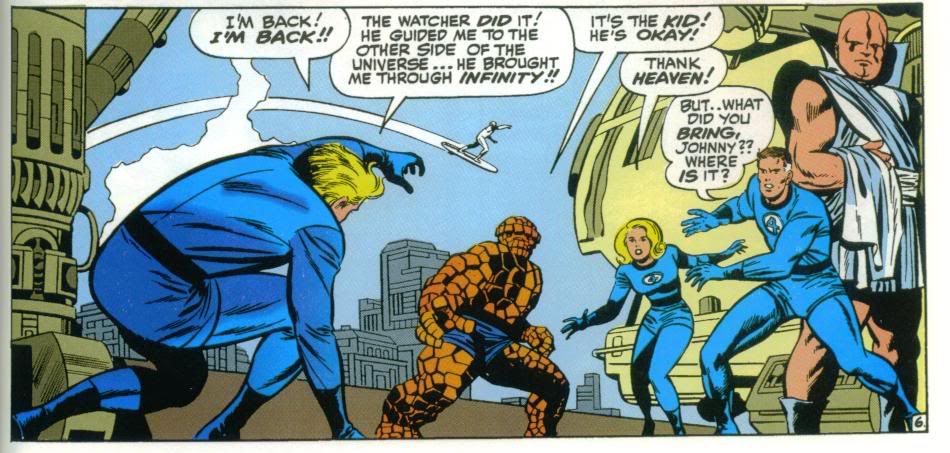
I had been talking about a single panel from Fantastic Four #50 which I had first seen printed by itself, out of context, in the old World Encyclopedia of Comics. Gazing upon that panel some thirty years ago, I had no idea what story it came from, who drew it, or even who apart from the FF were represented, but the volumes it spoke fascinated me:


Because almost every person visible is in motion, the panel creates tension. We can't see Johnny's face, but we know from his posture he's worn out. We can also tell from his dialogue he's more than a little on edge -- rattled upon his return, but glad to be back. Like Reed, we don't know what he's brought, but Johnny talks about "infinity" and "the other side of the universe," so it must have been worth the trip. Something big's going on, for sure. Who's that flying in the background? my grade-school self wondered; and why isn't the big bald guy doing anything?

What a great panel. I learned soon enough about the Silver Surfer and the Watcher, but I probably didn't see that panel in its proper context for another twenty years. At that point, I know it lived up to my expectations. There were the Fantastic Four at their apex, hip-deep in the seminal first encounter with Galactus, desperately trying to prevent Earth's destruction until their colleague could return. By then I knew the story before reading it, since it had been referenced so often throughout the years. In fact, I think I bought the Marvels paperback the same day as the Masterworks, and could therefore compare the original with the "documentary" approach -- but Alex Ross only works in the literal, whereas Kirby was free to throw whatever he needed on the page to give the reader the proper scope. How indeed would a movie portray Johnny's journey? Even 2001 used abstractions and false colors to traverse the infinite.

So when the grade-schooler of the '70s saw that panel in the mid-'90s, the circle, as they say, was complete. My hunger to know had been replaced with the revelation that my imagination was on target. This panel was, in recruiting terms, a "hinge" -- that is, the piece that allows the door to open. Rarely do we step through doors and find the new space exactly as we thought, but that's what happened here.

My brother-in-law's wife looked through the Masterworks volume for several minutes the other night. I think she got a little confused between Medusa being in both the Frightful Four and the Inhumans, and I don't think she's ready to convert to the Church of Jack Kirby, but who knows? At least she got to see what the original Fantastic Four was all about.
Full Post

Sunday, April 02, 2006

Mike W. Barr, Grant Morrison, and the '70s Love-God

Animal Man, Doom Patrol, and Seven Soldiers are all good examples of the notion that nothing is too lame or too obscure for Grant Morrison to make cool. Even Morrison's JLA started with the (self-imposed) restriction of using the seven original members as they presently existed. Maybe that last one wasn't such a handicap, but you see what I mean.


Now Morrison will be the new regular writer on Batman, which by itself sounds like DC's latest license to print money. I'd venture to say most fans today associate this pairing with JLA more than they do earlier ventures like the Legends of the Dark Knight arc "Gothic" or the Arkham Asylum graphic novel. And why not? The Morrison JLA's uber-Batman solidified the character's public perception as the one indispensable Leaguer, whose combination of intelligence and physical skills more than made up for his lack of superpowers. Just over a year into Morrison's run, his hype for new villain Prometheus was basically that he could defeat Batman.

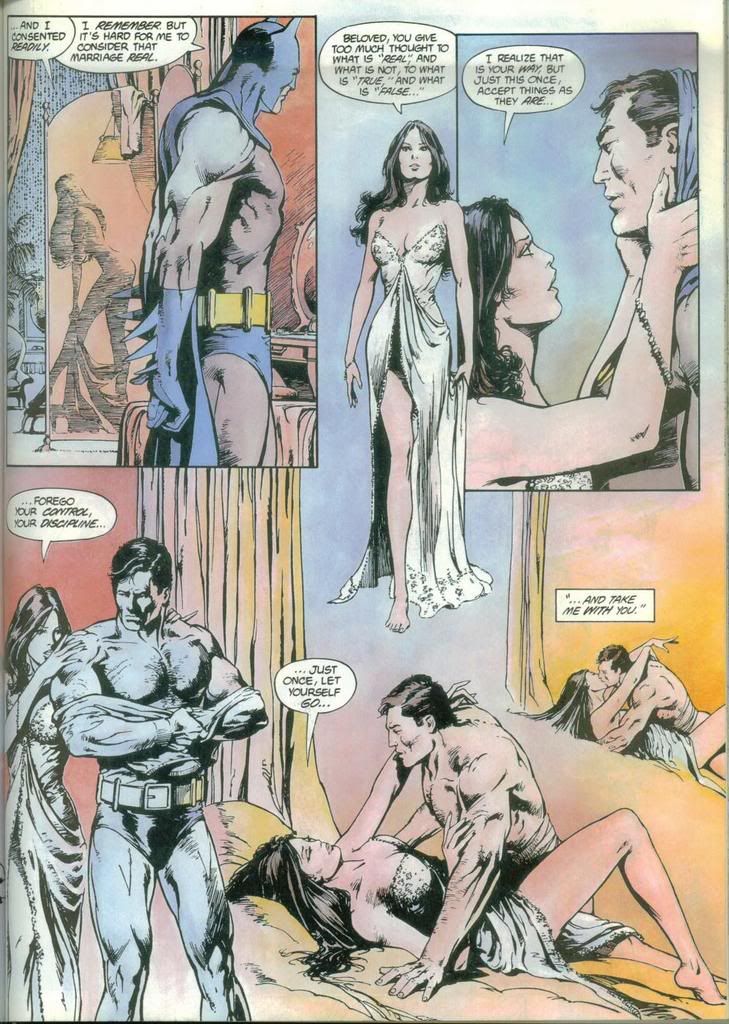
If Morrison's Batman has a handicap, it may be his stated focus on the "hairy-chested love-god" shaped by Denny O'Neil and Neal Adams, and an initial arc which could include revisiting the 1987 Mike W. Barr/Jerry Bingham graphic novel Son of the Demon. In SotD, Batman does more than team up with Ra's al Ghul -- he becomes second-in-command of al Ghul's empire, Talia's husband, and (eventually) the father of Talia's child.

Son of the Demon is best remembered today as the inspiration for Kingdom Come's Ibn al-Xuffasch ("Son of the Bat" in Arabic), the young man who Bruce thought Talia miscarried but who Talia gave up for adoption. That represents SotD's only legacy, since Denny O'Neil stated soon afterwards that it was not official DC continuity. (Denny O'Neil apparently didn't think Batman should be having sex.) Opinion on the story seems split -- here's a positive review, and here's a negative one.


At the time, though, it was a pretty big deal. It was the first hardcover Batman graphic novel. Mark Hamill, still five years away from Joker-hood, wrote the introduction. More violent and profane than the regular books, it showed a barely-clothed Bruce climbing into Talia's bed. In scope, Son of the Demon presented O'Neil and Adams' globetrotting "James Bond Batman" with a mature-for-1987 sheen -- the '70s love-god updated for PG-13 readers.

The theme of the book, not surprisingly, was "parents and children." Qayin, the villain of the piece, blames Ra's for the deaths of his parents, and took revenge by killing Talia's mother. Batman blames Qayin for Talia's miscarriage, and has issues with the "bat-demon" which seems to have replaced his own parents. Finally, Batman gets to be happy as a husband and father, before circumstances restore the familiar status quo. The rest of the plot involves terrorism, Bond-scale battles, and a weather satellite that could start World War III, all in just 78 pages.

Accordingly, while Son of the Demon moves at a pretty fast pace, it makes Batman's life-changing choices seem all the more capricious. Alfred and Commissioner Gordon appear briefly, establishing Batman's connection to Gotham City, but once Batman decides to join Ra's, he apparently leaves Gotham for several weeks without a word to either Alfred or Gordon. At that point I began to wonder how far the Bat-costume could go between washings.

I think this is where the book diverges from the Morrison paradigm of "Batman always has a plan." It is possible, and probably even Barr's intent, for us to believe that Batman would ignore his life in Gotham in order to stop Qayin. In Batman's mind it may be just a temporary absence, and a necessary part of completing the current mission. Once Talia gets pregnant, Batman may even feel justified in settling down with her, and perhaps taking her back with him. However, we see none of that, getting only a Batman caught up in the emotions of the moment.

It seems to me that the Morrison Batman could still have enjoyed his time with Talia, but the readers would have gotten at least a mention of Robin and/or Nightwing minding the store until he got back. The story might even have involved Batman going off the reservation, maybe severing his ties with Gotham completely, only at the last minute to reveal that his proteges, watching from afar, had provided him a safety net. The Batman who bought off Mirror Master in "Rock of Ages," and who beat Prometheus at his own game in "World War III," would have something like that in reserve. Even the O'Neil/Adams Batman of the original Ra's al Ghul stories faked Bruce Wayne's death so that Batman could track Ra's unhindered.

Still, for whatever reasons, the story only got 78 pages. For the most part it uses them well; but it doesn't seem concerned with convincing the reader that Batman is ready to be a husband and father. To be sure, it doesn't show Bruce Wayne's commitments, and the only person Batman seems to leave behind is Alfred, who merely tells Talia to "take care of him." The more those things were mentioned, the more they'd have to be addressed, I suppose, and probably pages were tight. In any event, the book presents Batman as Bruce's only real life, just as it presents the Bat-suit as Bruce's only real clothes, and that's hardly an invalid approach.

Nevertheless, Son of the Demon doesn't exist in a vacuum, or even in a sort of generic-Batman setting. It refers both to the original Ra's stories (a character from that arc is murdered) and to Barr and Trevor von Eeden's Batman Annual #8 (1982). And, of course, those life-changing events wouldn't have much meaning if they didn't happen to the "real" Batman. That's why I have the feeling that the story of Son of the Demon would be better served with more of an opportunity to explore its ramifications. Even the Bane of the Demon miniseries, which advertised the union of Talia and Bane, got four issues -- ten more pages than this graphic novel.

Since Morrison picks up after Batman's "One Year Later" reintroduction, maybe he can get into the emotional consequences of a Bat-child. Maybe he will even paint a plausible picture of a Batman ready to be domestic. However, I have a feeling that whatever Morrison's love-god gets into, he will have a plan for getting out.
Full Post

Wednesday, March 29, 2006

Essential Archives Of Absolute Masterworks

Here's a non-exhaustive list of collections I would buy, gladly and without hesitation, should they ever appear:

1. Absolute New Gods. I have been lucky enough to collect the six-issue New Gods reprints from 1985 (the last issue of which set up The Hunger Dogs), but to my knowledge, other than a black-and-white paperback, DC has never reprinted this series. That’s unfathomable to me. If Marvel thinks it can sell a pricey oversized hardcover of Eternals, why doesn’t DC want to do the same for its most famous Kirby work? Do two Absolute volumes, include Hunger Dogs, and throw in some behind-the-scenes information about how Kirby would have preferred the series to end.

2. and 3. Color reprints of Forever People and Mr. Miracle would be appreciated too. Again, the Kirby issues of Jimmy Olsen got their own color paperbacks, so why the black-and-white treatment for the rest of the Fourth World? Even Kamandi got an Archives volume.

4. The Greatest Wonder Woman Stories Ever Told. Sure, Diana got the Complete History treatment a few years ago, but that was just a bunch of words. Where is the career-spanning anthology volume? Is DC having trouble picking the most representative of the subtext-filled Golden Age stories? She warrants at least her own “Decades” series.

5. Essential Howard The Duck Vol. 2. Marvel has been pretty good about cleaning out its library, and their back-catalogue is varied enough that a casual fan like me doesn’t see huge holes. However, I’m surprised it hasn’t picked up the spare with Howard the Duck. It took four Essential phone-books, but Tomb of Dracula was collected in its entirety. C’mon, Marvel, let’s get this one moving.

6. Showcase Presents Secret Society Of Super-Villains. Between Identity Crisis, Villains United, and the upcoming revival of Secret Six, the time is right to revisit the troubled ‘70s series, and probably throw in the Society’s appearances in Justice League of America to boot.

7. and 8. In the same vein, how about some love for DC’s models of shadowy ‘80s government conspiracies, Captain Atom and the Suicide Squad?

9. Showcase Presents Firestorm. Hey, I like Firestorm, okay? Put together the first Gerry Conway/Al Milgrom series, a few Justice League of America stories, the backups from Flash, and the first year or so of Fury of Firestorm, and see how its numbers compare to Essential Nova Vol. 1.

10. And speaking of Flash backup series, if the Green Lantern Archives get that far, I hope they don’t forget about the early ‘70s backup strip, written by Denny O’Neil and drawn by Neal Adams, Dick Dillin, and Mike Grell. The various O’Neil/Adams reprints I have seen never seem to get into this material, which bridged the gap between issues when Green Lantern (Co-Starring Green Arrow) went on hiatus.
Full Post

Tuesday, March 28, 2006

Whither The Long-Form Recaps?

So here’s the thing: I like doing the hideously long, unavoidably verbose recaps of New Teen Titans (and its descendants) and Geoff Johns' Flash. At some point I will add the A.J. Lieberman/Al Barrionuevo Batman: Gotham Knights to that list. The common denominator, besides their publisher, is that at some point I really wondered what I was getting out of each of them. I even dropped New Titans for a few years after issue #100, but broke down and sought out the back issues just to be complete.

Thus, a bit of rationalizing goes into the recaps. You don’t see it right now with the Titans posts, because for the most part those stories hold up well on their own terms. That may change sooner rather than later. Honestly, my memories of “The Judas Contract” aren't as fond as for some of the earlier material from Year Three, because it seemed to me that Wolfman especially had let the title’s success go to his head by that point. Not so much in the larger plot, but in the execution. Anyway, I really can’t wait until the big 1985-86 mega-arc, and to a lesser extent “Titans Hunt” from 1990-91, because those stories, flaws and all, are real tours de force. I do plan to finish up Titans posts with the end of the 1999-2002 series, because as much as Geoff Johns went back to the Wolfman/Pérez well with the current Teen Titans, it is really an extension of Young Justice; and Nightwing and Arsenal aside, Outsiders to me is its own animal.

Johns’ Flash intrigues me through the character of Zoom. He’s created basically to test Wally, and thereby make Wally a better hero. If that’s not metacommentary (even unwitting) on the recent grim ‘n’ gritty resurgence at DC, I don’t know what is. Johns’ slow buildup to “Rogue War” also frustrated me, with its villain-spotlight issues seeming to derail whatever momentum the larger plot had going, and I am wondering whether the stories will read better in fewer sittings.

That’s also pretty much the main reason for revisiting the last couple of years of Gotham Knights. With its focus on Hush, the Poochie of Batman villains, it was either a near-complete train wreck or a masterwork of subtlety whose nuances can only be appreciated in slow, careful re-reading. I am trying not to be sarcastic here.

Fair warning, by the way: another candidate for the long-form treatment is (Fury of) Firestorm, but I don’t have the first Conway/Milgrom series. I would also like to revisit Steve Englehart’s Justice League of America issues, including the guest-written JLA/JSA/Legion team-up.

Still, though, I probably won't get to any of this until after we get the taxes filed. Talk about long forms....
Full Post

Thursday, March 23, 2006

A List, a League, and a Lame Reference

Probably won't be able to post until early next week, so here are some links to tide you over until then.

-- The Onion A.V. Club presents 20 Wonderfully Irrelevant "Andy Griffith Show" Conversations.

-- Via Newsarama, you could be in the JL6FNE! (Although, from a distance, what would be the difference between Tim Drake and Dick Grayson? Height? Short pants? Rubber nipples?)

... and finally ...

-- Would it be wrong to start calling Earth-8 "the Ocho?"
Full Post

Tuesday, March 21, 2006

Building Character

In these days of revamps, relaunches, adaptations, and deconstruction, there's a lot of talk about what constitutes the "essence" of a character. The problem is, multiple interpretations of a character can create questions about how faithful a given interpretation is.

To be clear, I�m not talking about a Supreme-style menagerie of variations, or a DC One Million-esque series of family trees. Instead, I�m interested in the evolution of a character (or "entity," if we're considering groups) from its original concept to what may be nothing more than a list of characteristics and defining events.

To me there are two main factors at work. The first is continuity, with which we are all intimately familiar. The second is what I would call "fidelity," and it's harder to pin down. Many times, the accretion of continuity helps to define fidelity, as with the gradual expansion of Superman's powers over his first few decades. However, fidelity can also be a check on continuity, by pushing aside established events because they were "out of character" or could otherwise be dismissed. Here the Spider-Clone Saga and the "Teen Tony" Iron Man come to mind.

Of course, sudden broad strokes of continuity can greatly affect public perception of a character. Death is especially powerful in this regard. For over twenty years, every new story featuring Barry Allen as the Flash has carried with it, consciously or not, the emotional impact of his death. This is still true to a slightly lesser degree for Hal Jordan, Jason Todd, and Bucky Barnes, despite their recent revivals.

Other major changes can have similar, if not greater, effects. Dick Grayson's development into Nightwing was seen or otherwise alluded to in "Batman: The Animated Series," the "Teen Titans" cartoon, the Joel Schumacher Batman movies, and (arguably) even his mention in the "Birds of Prey" TV show. Dick becoming Nightwing has eclipsed Dick's career as Robin, despite the former career being only half as long as the latter. Therefore, it seems that fidelity to Dick's character must include his becoming Nightwing at some point.

Sometimes those big events have direct effects on other characters. Wally West�s path from sidekick to headliner began with Barry�s disappearance in Crisis on Infinite Earths, and much of Wally�s early Flash career was spent trying to live up to Barry�s legacy. Because Wally would be a different character if Barry were still alive, Barry�s death takes on an air of inevitability.

This is not to say that such changes are inherently capricious or meaningless. Barry�s death certainly gives his story a meaningful ending � one last run to save the world, and in the process inspire his proteg� to succeed him � but that doesn�t stop us readers from asking if that is the only ending possible.

Along the same lines, we are also free to question the degree to which other events are critical to a given character�s development. In other words, if Character A is defined by a certain series of events, does it matter if those events were never part of the character's original premise? Is the original just a step along the way to an ur-character, or baseline, against which all the variations may be measured? In some cases, this is certainly true.

Take Wonder Woman, for instance. Her earliest adventures featured positive messages of compassion, tolerance, and understanding, right alongside a lot of strange sexual imagery. Today, the message of peace remains, but the subtext has been scrubbed significantly. In refocusing the character on her mythological roots and her diplomatic mission, the character�s post-Crisis caretakers did go back to the beginning, but they didn�t feel the need to use everything from the William Moulton Marston/H.G. Peter days. In fact, the current comics version of the character has become so successful that I would argue it is the baseline.

(Not having read much of the recent John Byrne Doom Patrol, I am loath to argue that its retro-continuity-rollback sensibilities are somehow less representative of the team than the Grant Morrison version, but from what others have said that may well be the case. Has the Morrison DP become the new standard, even compared with Byrne's recreation of the original?)

A superhero�s baseline interpretation might not even come from the comics at all. The Superman of the �70s and �80s movies, played by Christopher Reeve, is perhaps the biggest influence on the character in the past thirty years. At the time, though, it was a clear variation from the Earth-1 iteration then featured in the comics. Still, many of its aspects made their way into the 1986 comics revamp. From there it�s debatable whether "Lois & Clark," the animated series, and "Smallville" looked more to the movies or the comics. Regardless, the new Superman Returns apparently takes its cue pretty directly from the first two Reeve movies.

I realize here that I�m getting back into the "multiple distinct variations" paradigm, so perhaps it would be more accurate to say that those movies � specifically the first one�s origin sequences � made it more acceptable for the �86 revamp to discard a lot of the Silver Age trappings. In other words, continuity was sacrificed for the sake of fidelity.

Honoring both continuity and fidelity, the two Spider-Man movies drew great inspiration from the Lee/Ditko/Romita Sr. stories of the �60s. When the movies altered sequences, as with the "death of Gwen Stacy" scenes in the first movie, the changes served larger plot concerns. Gwen�s death was a pivotal moment in the comics, but in hindsight it allowed Peter and Mary Jane to solidify their relationship. While no one would argue that Gwen�s death should be forgotten, in the first movie she would have been superfluous. (She�ll be in Spider-Man 3, so go figure.) Again, fidelity to the character of Spider-Man now includes his successful romance with Mary Jane, not necessarily his continuing angst over Gwen�s death.

Similarly, the various Batman animated series skipped Jason Todd entirely, giving Tim Drake a version of Jason�s origin. When Green Lantern was introduced on the "Superman" animated series, he had Kyle Rayner�s name but Hal Jordan�s origin. The recent Flash-centered episode of "Justice League Unlimited" gave Wally West Barry Allen�s police-scientist job. Again, these changed elements must be judged, positively or negatively, in light of fidelity to the underlying character. While they lack the tragedies from which their print counterparts were born, that may not necessarily be a bad thing.

Fidelity includes tragedy and change, but clearly it doesn't have to stop there. It just has to make sense in the context established thus far, and ideally it will expand the character's horizons. Not a bad set of goals, even for the soulless world of corporate superhero comics.
Full Post

Tuesday, March 14, 2006

"Our Top Stories Tonight: Stuff I Did"

In the same way that I think of Batman being in marketing, I keep thinking about Clark Kent the journalist. The Golden Age Clark was a crusading reporter in an age when reporters could proclaim an agenda. The Silver Age Clark was an establishment type, a nerdy guy in a suit and glasses whose purpose was to fade into the woodwork and give Superman some cover.

(The Earth-1 Clark’s significant stint as a TV anchorman is still fascinating to me. Seems like Superman would often have a Clark robot cover the nightly news, which is clearly a jab at talking-head culture. However, in the ‘70s and early ‘80s, Clark would have been a nationally-known figure, alongside Walter Cronkite, John Chancellor, and Frank Reynolds. Clark was a precursor of sorts to young up-and-comers Dan Rather, Tom Brokaw, and Peter Jennings. Imagine a young Brokaw ducking into a storage closet to fly off and stop a tsunami – with plenty of time to write it up and report on it at dinnertime -- and you see why I want Grant Morrison to devote an All-Star Superman issue to Clark’s TV career.)

Today’s Clark falls somewhere between his predecessors in terms of social activism. Mild-mannered no longer, he has more freedom to crusade without endangering Superman’s secret identity, but by and large writers have given Lois Lane all the juicy reportage. This isn’t surprising -- with Lois being his fianceé/wife for the past fifteen years, she’s going to be around constantly and has to look good next to Clark/Supes -- but it takes away from the chance to use Clark’s job as a window on Superman.

The most significant paradigm shift of the post-Crisis Superman was the approach to Clark Kent. In the past, Clark was Kal-El’s disguise which allowed him to operate effectively as Superman. Today, Superman is Clark’s disguise. On Earth-1, Kal-El (as the teenaged Superboy) was a superhero before he became a journalist. Today, the sequence is also reversed. Clark’s social activism still springs in significant part from a desire to his powers productively, but (as seen in Superman: Birthright), his “streak of good” fuels both sides of his life.

Moreover, it makes sense that Clark would want to be a reporter. Clark clearly believes that people are fundamentally good, so if he can present them with the facts they need to make informed decisions, they will make the right decisions. The biggest check on Superman’s power is his own trust in the rest of humanity, just as the core of Superman’s appeal is the public’s trust in him. This two-way relationship keeps Superman from taking over the world and keeps the public from being afraid of him.

Of course, Clark’s crosstown colleague Peter Parker presents an alternate take on the superhero journalist. For Peter, photography isn’t a calling, just a way to pay bills. Clark is in a position to portray his alter ego favorably, but Peter isn’t -- the more foolish his photos make Spider-Man look, the more job security he has. Both men use their positions as cover for their heroic identities, and naturally both want to make the world a better place, but the similarities end there. Peter's experience as a journalist is fundamentally shaped by Jonah Jameson's announced agenda of ruining Spider-Man, whereas Clark's editors have never seriously crusaded against Superman.

In fact, didn't one DC/Marvel crossover make it a point to show Jonah applauding Superman in an editorial? Again, this issue of trust is at the heart of Superman's character, and today it can be played ironically against the sort of journalistic smorgasbord which the information explosion has given us. Clark-on-TV was, for its time, a simple updating of Clark-in-the-paper: Clark went where the public got its news, whether in print or on video. Today, Clark works for a "major metropolitan newspaper" not only to get instant access to breaking news, but also probably because a cable-TV head or (heavens!) some schmoe with a website would just fill a niche. It could be argued that newspapers are becoming their own niche, I know, but they are far from being marginalized -- and they still are seen as fulfilling a higher journalistic calling than either network or cable TV.

Makes me wonder why Clark never worked on radio. (Silver Age Clark could have done his reports through super-ventriloquism.) Having no personal experience with the golden age of radio news, I will still speculate that radio in the '30s, '40s, and '50s was seen as the TV news of today -- more immediate, more visceral, and therefore less intellectual than the newspaper. Electronic media, from Edward R. Murrow in London forward, arguably deals more in emotion and impression than print, which could actually separate Superman from his fellow citizens. Through the Daily Planet, Clark can bring stories to light that help people live their lives better. Showing Superman's exploits on TV makes him a spectacle, and he wants to be more of an example. Clark probably isn't above setting Supes' adventures in a context which emphasizes the latter.

Wow, sounds like I have talked myself out of the Clark-as-anchorman story, doesn't it? Oh well, probably best to keep the Ron Burgundy comparisons to a minimum....
Full Post

Sunday, March 12, 2006

More Library Books, Plus "Galactica's" Season Finale

Went back to the library yesterday and oh, the things I checked out. So far I have read Promethea Vol. 1 and 1000 Steps To World Domination. Thought Promethea was pretty good, but isn't Moore going back to the Supreme well a little with the multiple incarnations of Promethea? I know it gets more philosophical as it goes on, but I'll have to wait until Vol. 2 is returned to find out.

I found 1KSTWD kind of uneven and even a little meandering, but I didn't hate reading it and would probably give it another try. Also in the pile are Teenagers From Mars, Birth of a Nation, and A Contract With God, so the catching-up continues.

For some reason or another, I was pretty wiped out Friday night, so the Best Wife Ever stayed up until 11:30 watching the season finale of "Battlestar Galactica." After a Saturday's worth of "I wish you would watch the tape already so we could talk about it," I finally watched it today, and I have to say, it took a pretty giant step towards getting back into my good graces. SPOILERS FOLLOW, of course.

5

4

3

2

1

Pretty much since the beginning, the whole Baltar/Six subplot has really annoyed me. Most of that is frustration at Baltar's incompetence continually being concealed, so now that he appears to be completely exposed, that part of his arc seems to be at an end. Baltar may have been a tragic, misunderstood figure at the beginning of the series, but by now he is almost beyond redemption, and I look forward to his comeuppance, if not outright villainy.

Watching the end of the episode also made me remember the 1978 "Galactica" pilot, whose discussion of settling on a viable planet ended with a Cylon ambush. It's a compliment to the current show that I wondered whether it would devote a substantial series of episodes to planetside society, much like it has allowed the Pegasus to stick around. The Best Wife Ever considers the show more interesting ("more like Star Trek," in fact, which I know would cause many "Galactica" buffs to clutch their chests and/or rend their garments) when the fleet is in space exploring, not stuck in orbit.

And since I mentioned Star Trek, the occupation of New Caprica and the flight of the fleet (har har) also produced strong echoes of the Cardassian/Dominion occupation of Deep Space Nine. Here as there, I expect that the fleet will liberate the planet and restore some kind of familiar status quo, but instead of this being a temporary cliffhanger stunt, I get the feeling that it is more of a thought-experiment by the producers. "What if Baltar did win? What if they did colonize a planet?" Here are the answers, plus Lt. Castillo's old mustache and Tigh in a Floyd R. Turbo hat.

I do want to clarify that my satisfaction with the current cliffhanger doesn't stem from any familiarity or dumbing-down of the series. I'm not going to say that the familiar elements were handled with irony, because that probably reads too much into them. Moreover, I don't think the show will change Baltar's character enough to make him an outright black-hatted villain, like his '70s predecessor. I am glad the show seems to have taken a few big steps forward while leaving room for its original premise to remain valid, and that's why I'll still be watching in October.

Until then, it looks like we'll get the new "Dr. Who." Apparently the rest of the world loves this show, so I hope it's not wrong.
Full Post

Sunday, March 05, 2006

Tom Goes To The Library (And Starts Catching Up)

Yesterday I finally got a Williamsburg Regional Library card. My first checkouts included Good-Bye Chunky Rice, Bone Sharps, Cowboys, and Thunder Lizards, and Persepolis, and I read them last night and this afternoon. I also got Green Arrow: The Archer's Quest (because I am too lazy to dig out the back issues) and Kitchen Confidential for when I got tired of looking at pictures.

Of the first three, I liked Persepolis the most. It reminded me of Maus both structurally and thematically, and I thought Marjane Satrapi did an excellent job distinguishing several characters both visually and by "voice."

Bone Sharps I was familiar with through its Free Comic Book Day giveaway. Although I thought it was very ambitious, and certainly took great pains to balance good storytelling with historical accuracy, after a while some technical aspects of the art started to intrude on my enjoyment of the book. Mostly this happened when I started confusing the characters with Dilbert's Elbonians. Otherwise, the book reminded me pleasantly of Empire of the Air and similar tales of dueling scientists.

I'm still not sure if I liked Good-Bye Chunky Rice. For his first graphic novel, Craig Thompson certainly demonstrated a good command of the medium, but at times it seemed a little obvious. I mean, I picked up on the whole "I carry my home on my back" thing well before Chunky mentioned it. Casting the main characters as cute funny-animals also confused me a little, especially because Chunky seems at first to be the same kind of indeterminate-age man-child as, say, SpongeBob. However, over the course of the story he seems to be a little more worldly, and his relationship with Dandel seems more intimate than just "best friends." Accordingly, I didn't know how afraid to be for him during his journey. As a meditation on how we test the bonds we form with others (and how sometimes we can never break those bonds), the book holds together (no pun intended) pretty well, but I can't say I'm eager to plumb its hidden intricacies again anytime soon.

You-all are lucky, in fact, that I decided not to compare and contrast Chunky Rice with The Archer's Quest. Both explore "what we leave behind" from different perspectives -- one from that of the person who departs, and the other from that of the person who recollects. Honestly, I didn't expect to like TAQ after having been burned by Brad Meltzer's heavy-handedness in Identity Crisis, but compared to the latter the Green Arrow story is almost sublime. If Meltzer can dial back the melodrama for his Justice League stint, it could be a real treat.

The fact that I am winding up a post about three non-superhero graphic novels with a thought on one of the most mainstream superhero books there is, is probably more than a little sad, I know. I'm trying, people; I'm trying!
Full Post

Thursday, March 02, 2006

Quick Thoughts On Batman Annual #25

Last week, after reading Batman #650, I thought that the “Red Hood” storyline suffered by association with Infinite Crisis. To that point I had enjoyed both, but both were (no pun intended) worlds apart in terms of tone. The Big Event moment came out of left field, introducing an element of cosmic hoodoo into a tale which acknowledged the larger DC universe but wasn’t affected significantly by it. However, the crossover stuff wasn't that prevalent, and I went into Batman Annual #25 wondering how integral it would be to the return of Jason Todd.

SPOILERS FOLLOW for Batman Annual #25:

5

4

3

2

1

The Annual confirms that the re-animatory spark was a kind of all-purpose Get Out Of Jail Free card, courtesy of Infinite Crisis. Writer Judd Winick linked it to Superboy’s pounding on the walls of netherversal reality, but it might just as well have been a tap on the forehead from the Blue Fairy.

Admittedly, the Batman titles have historically been in something of a bind when it comes to cosmic themes. The books pride themselves on not getting too far from the plausible, but they have to exist side-by-side with characters who travel through space and time at will. Despite conventional wisdom which holds that Batman could single-handedly neutralize most of the Justice League, any incursion of the science-fictional into a “regular” Batman story will likely be greeted with skepticism. Batman’s “sci-fi closet,” postulated by Grant Morrison in the context of a Justice League story, was arguably one of the more daring departures of recent years. However, given the strategic thinker into whom Batman had evolved, he would have been stupid not to have such an arsenal.

Therefore, on one hand it is similarly practical to have Infinite Crisis facilitate Jason’s return. In the larger scheme of things, it’s just as good a mechanism as any other, and probably no less convoluted to explain.

Still, though, it feels like a cheat, given that Infinite Crisis had played such a small role in the story. Winick had already used a number of more traditional superheroic elements in his Batman issues, including Amazo, the android with all the powers of the Justice League. Working a similar established plot device into the story would have drawn both on Batman’s history in the larger DC universe, and would have felt more organic than the almost-literal bolt from the blue Infinite Crisis provided. Heck, Amazo himself could have used Zatanna's powers to re-animate Jason.

In a way this situation reverses the equities of previous comfort-zone-busting story arcs like “Knightfall” and “No Man’s Land.” In both of those arcs, the main problem suggested a quick solution via one or more of DC’s ultra-powerful characters. Zatanna or Dr. Fate could have repaired Bruce’s broken back, and a crew of superheroes could have rebuilt Gotham like they rebuilt Metropolis a few years before.

Both of those arcs therefore illustrate the need for the key to the mystery to be planted within the story itself. In the inevitable comparison with its Captain America counterpart "The Winter Soldier," "Under the Hood" will surely come up short for having to go outside its own boundaries. (The Cap story didn't depend on House of M to bring Bucky back, and even eschewed the Cosmic Cube as a possible explanation.) The fact that most of "Under the Hood" was handled well makes the big revelation of Batman Annual #25 harder to take.
Full Post