Friday, June 29, 2007

Friday Night Fights

Bahlactus is the sponsor, Roulette provides the venue ...


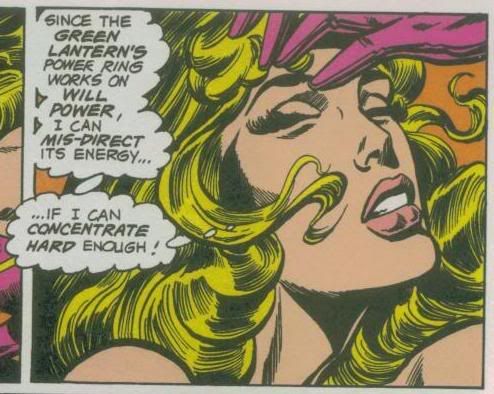
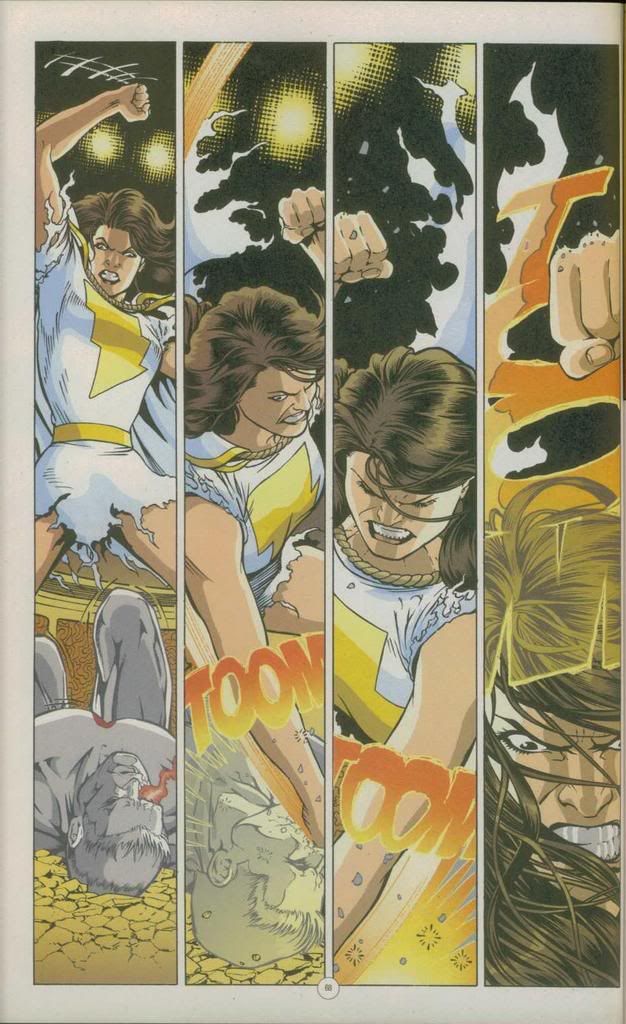
... and a mind-controlled Mary Marvel throws down on Captain Atom!

[From "Dead Man's Hand," Formerly Known As The Justice League #3, November 2003, written by Keith Giffen & J.M. DeMatteis, pencilled by Kevin Maguire, inked by Joe Rubenstein.]
Full Post

Thursday, June 28, 2007

Thursday Night Thinking

Diamondrock celebrates THINKING!...


... but poor Mr. Morden shows that it can be taken just a smidge too far!

[This sequence freaked me out 18 years ago, and it freaks me out today. From "Nowhere Man," Doom Patrol vol. 2 #26, September 1989. Written by Grant Morrison, pencilled by Richard Case, inked by John Nyberg.]
Full Post

Monday, June 25, 2007

New comics 6/20/07

We begin this week by picking up a spare from last week, Outsiders #48 (written by Judd Winick and Greg Rucka, pencilled by Ron Randall and Matthew Clark, inked by Art Thibert). It's Part 4 of the 6-part "Check/Out" crossover, and as such it features the Outsiders/Checkmate strike force's attempt to survive Oolong Island. Therefore, most of the issue is given over to shouting and fighting and movement and explosions and frantic dialogue. I was kind of surprised that I could follow the issue as well as I could, considering the fact that pencillers Randall and Clark seem to have divided up the issue pretty equally. Randall uses a thicker line, and I think his figures and composition are a bit more stable as a result, but really I couldn't tell much of a difference just reading the book. I ascribe that to inker Art Thibert, who's done his share of pencilling as well.

My main problem with the issue, and the crossover in general, was that it didn't make me any more sympathetic to the Outsiders themselves. I'm familiar with the well-established characters (Nightwing, Katana, Metamorpho), but I have to remind myself that "Owen"/"Boomer" is the new Captain Boomerang from Identity Crisis, and I know nothing about the two strong women (Grace and Thunder) beyond the broad strokes an action plot like this divulges. The book doesn't go out of its way to explain any of these people to this particular reader-just-along-for-the-crossover. (Each team having its own young red-haired guy doesn't help either.) This crossover also hasn't justified Outsiders' existence beyond being a random team of attitude-rich superheroes. Well, maybe it did a little, at the beginning, when there was some sense that Checkmate could take advantage of the group's cavalier approach to superheroics. Still, this title's got one more issue before Everything Changes with a new roster, and then it gets relaunched at some point in the future with Batman in charge. I guess what I'm saying is that this crossover could just as well have been a biweekly Checkmate arc for all it's made me care about the Outsiders. Still, this was a decent dumb-fun action issue.

Checkmate #15 (written by Rucka and Winick, pencilled by Joe Bennett, inked by Jack Jadson) presents Part 5 of "Check/Out," in which Nightwing, Boomer, and Sasha are tortured by Chang Tzu (can we call him "Egg Fu" anymore?) while the Checkmate high sheriffs negotiate with China for some assistance. In terms of craft, this was a better issue all around than Outsiders #48. Bennett and Jadson are a more solid team, and Rucka does a good job of laying out the various political issues and assigning their presentations to the appropriate characters. Checkmate has a much larger regular cast than Outsiders, but there they all are in roll-call format on the first page.

The one thing that I did not like about the issue, and it is not an insignificant complaint, is the attention paid to Boomer and Sasha's torture. The issue plays a darkly clever game with the reader by putting Nightwing -- who we know is "safe" from any permanent harm -- in a cell next to the torture chamber, thereby making him listen to his friends' anguished cries. In this way, and especially on the last page, "Check/Out" seems to set up pretty clearly the end of Nightwing's tenure as team leader. This is a particular blow to Nightwing's character, because for years, if not decades, it was the thing that most significantly separated him from Batman. As Titans leader, he was either rescuing his teammates (see "The Judas Contract" or "Titans Hunt") or sacrificing himself for him (i.e., in a few of the Brother Blood storylines). He's presented here as an ineffectual failure. Thus, while the issue does a good job of dramatizing just how deep these three are in their particular hole, the overall effect is not pleasant, and in fact kind of sickly voyeuristic.

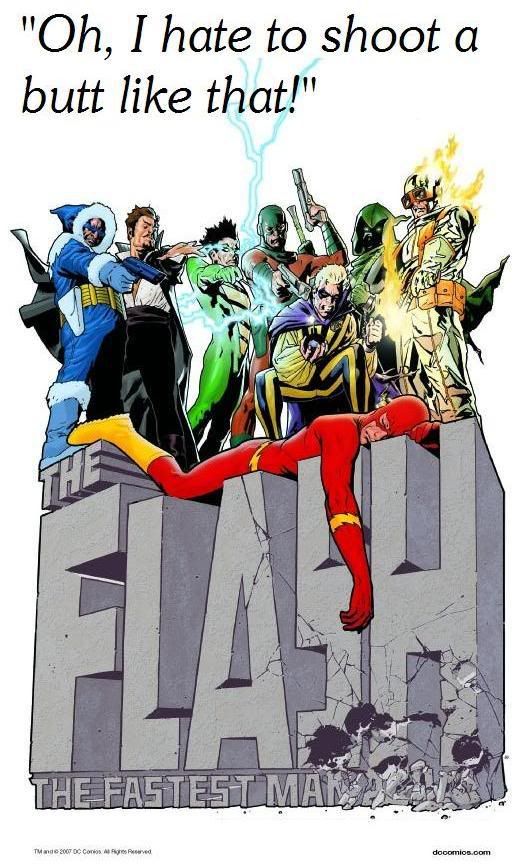
I got a similar feeling reading The Flash: The Fastest Man Alive #13 (written by Marc Guggenheim, pencilled by Tony Daniel, inked by Daniel, Jonathan Glapion, and Marlo Alquiza). It was a gut-punch of an issue that apparently wanted to leave little doubt about Bart's fate. As I said on Thursday, I felt bad for Bart, but a lot of that had to do with the editorially-mandated aspects of his death. The fact that I didn't think he needed to die also contributed to my sadness that he did. Guggenheim and Daniel put together a decent issue, just in service of an unfortunate cause.

The other part of the Flash re-relaunch was, of course, Justice League of America #10 (written by Brad Meltzer, pencilled by Ed Benes, inked by Sandra Hope). While I am very, very happy at the return of Wally West -- I actually teared up a little; don't judge me -- this was an incredibly haphazard way to end "The Lightning Saga." First of all, it's not really over, because it obviously sets up more Old-Legion adventures in Countdown and other DC titles. Second, what in the name of little baby ducks does Wally West have to do with the Legion anyway? Third, I understand the Legion not wanting to tell the JLA and JSA that one of them will die when "whoever" is brought back, but that just means this is the old "Why didn't you ask us for help in the first place?" plot. Fourth, do I really have to list all of the ways in which Meltzer and Benes use innuendo and shorthand to create an illusion that things are happening? There were no real resolutions in this issue, at least not to the larger plot elements presented at the beginning of the crossover. Meltzer has some appealing ideas, but he treats them so reverently that before you know it, five issues are up and nothing's really gotten done.

I could probably say the same thing about Captain America #27 (written by Ed Brubaker, drawn by Steve Epting and Mike Perkins), but the difference is that the character scenes are hung on a plot that makes sense within the larger story arc. The Winter Soldier wants to reclaim Cap's shield, Sharon Carter struggles with her role in Cap's death, and she and the Falcon figure out where Bucky's headed with the shield. Oh, and Bucky reconnects with the Black Widow, his old Soviet-spy buddy. Epting and Perkins do a collectively fine job overall. I don't like their Tony Stark, but that's just me. Also, I wasn't sure it was "the" Black Widow, Natasha Romanov, because dialogue calls her "Natalia" and I don't know if that's an acceptable nickname. Other than those nitpicks, though, a really fine issue that advances the plot while still keeping the reader guessing about when any Captain America will headline his eponymous book again.

I continue to enjoy The Brave and the Bold (#4 written by Mark Waid, pencilled by George Perez, inked by Bob Wiacek), probably because it is unashamed of being a light, fun superhero title. This issue begins and ends with Batrok, and features a Lobo/Supergirl story which is fairly predictable but still enjoyable. It does appear that Supergirl has gotten more mature around Lobo than she was around Green Lantern a couple of issues ago -- Waid writes her as (let's say) early-20s, as opposed to late-teens -- but I like her better this way, so it works out.

In the same vein, Marvel gives us Spider-Man and the Fantastic Four #3 (written by Jeff Parker, pencilled by Mike Wieringo, inked by Wade von Grawbadger), which finds Spidey and 3/4 of the FF fighting aliens and dropping in on Dr. Doom and the High Evolutionary. There is nothing objectionable about this book.

You can guess the obvious segue into Countdown #45 (written by Paul Dini and I think Tony Bedard, although Palmiotti & Gray are credited; pencilled by J. Calafiore, inked by Mark McKenna). Actually, I kind of liked this issue, because it shows Donna Troy as a competent superhero for the first time in a while. An incongruous scene of her blasting away with an automatic rifle notwithstanding, she comes across believably as an Amazon warrior. However, the rest of the book is still in setup mode: Jimmy Olsen investigates Sleez's old tenement, Holly shows up when Jimmy leaves, and meanwhile the Legionnaires stuck in our time after JLofA #10 whine some more about being stuck on the JLA Satellite. Also, there has got to be a better way to distinguish between Monitors than their hairstyles. I'm begging you, DC: symbols, numbers, tattoos, whatever -- I just can't keep 'em straight anymore.

Finally, The Spirit #7 features three guest creative teams, and is largely successful. The first story, written by Walt Simonson and drawn by Chris Sprouse and Karl Story, concerns a no-good socialite (we know she's no good, because she's obviously reminiscent of Par-- I mean, She Who Must Not Be Named) and the Spirit's search for a missing diamond. It's pretty fun. The second story, written by Jimmy Palmiotti and drawn by Jordi Bernet, is more of an Eisner pastiche, because it features the indirect effects of a Spirit chase on the lives of tenement dwellers. Bernet's style is perhaps even more successful than Darwyn Cooke's at capturing the sort of organic cartoonishness of Eisner's work, so I think this is the most successful story in the issue. The last one, a sort of Spirit/Frank Miller mash-up parody by Kyle Baker, is rather an acquired taste. I thought excerpts of it were funny when I saw them online, but even for a short story the joke gets a little old. Still, like the man said, two out of three ain't bad.
Full Post

Sunday, June 24, 2007

Sunday Soliloquy

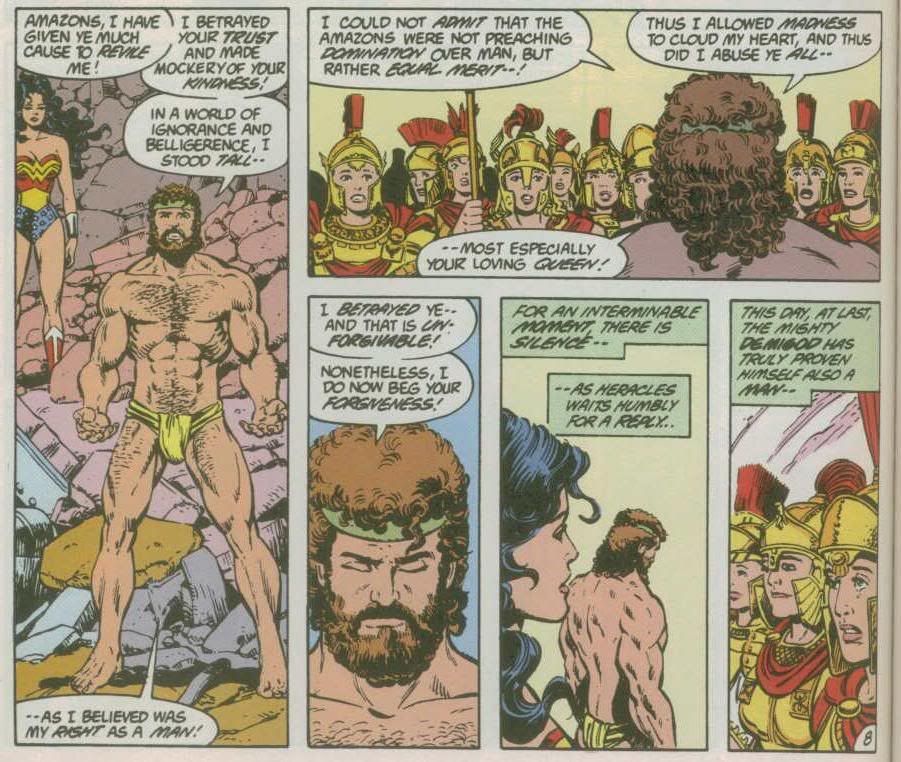
No, Heracles -- you picture the audience in its underwear!


You'll note that he doesn't have to remind the Amazons where his eyes are....

[From "For The Glory Of Gaea," Wonder Woman vol. 2 #14, March 1988, plotted and pencilled by George Perez, scripted by Len Wein, inked by Bruce D. Patterson.]
Full Post

Friday, June 22, 2007

Friday Night Fights

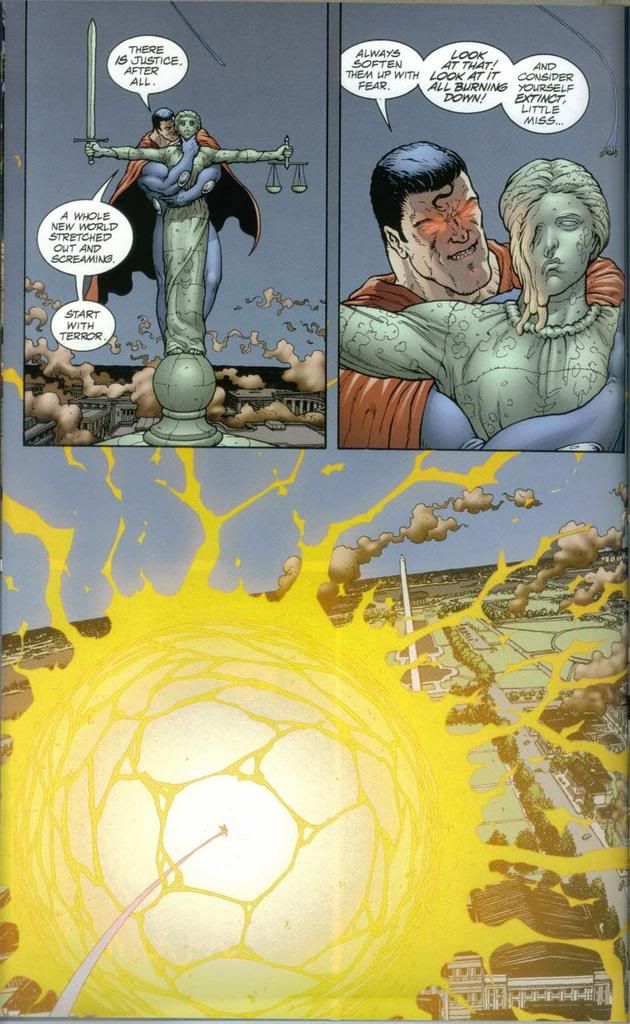
The flying figure in the distance is J'Onn J'Onzz ...


... slamming into Ultraman at Mach 11.

Thanks, Bahlactus, for letting me play!

[From JLA: Earth 2, written by Grant Morrison, drawn by Frank Quitely. Click to embiggen.]
Full Post

Thursday, June 21, 2007

Thursday Night Thinking

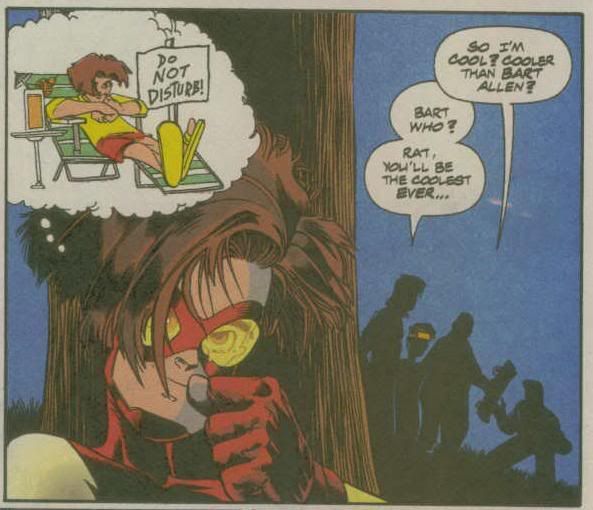
This week, there was only one choice: Bart "Impulse" Allen, contemplating his lofty social status.


Maybe not the kind of brainpower usage Diamondrock intended, but for Bart's streamlined synapses, this was practically meditation. Until we meet again, Bart....

[From "Water Rat," Impulse #13, May 1996. Written by Mark Waid, pencilled by Humberto Ramos, inked by Wayne Faucher.]
Full Post

Tuesday, June 19, 2007

The time-traveling crossover plok didn't quite demand

Okay. First plok suggested a Big Crossover meme, and I couldn't think of anything good for that. Now he's added a Time Travel meme. This is not exactly either one, but it has elements of both. It's probably also not very good.

... Yeah, like that's ever stopped me.

It’s a Star Trek idea which goes back almost twenty years, to the first few weeks of "The Next Generation" in 1987. Back then my biggest question about TNG was when its crew would meet the originals.

This idea didn’t quite do that ... or at least I don’t remember the crossover being the point. I do remember it was a decades-spanning story which started with Sulu’s promotion to Captain. It was therefore something like The Last Original Trek Story, told from the perspective of The Next Generation.

Since then, of course, most of the TOS-folk’s fates have been revealed. Kirk dies twice (only to be revived in the 24th Century in the “Shatnerverse” novels), Spock becomes an ambassador, Bones and Sulu stay with Starfleet well into their old age, and Scotty gets 70-odd years in the transporter. I like to think that Uhura and Chekov finally got their own ships, but probably not.

Anyway, we begin aboard Picard’s Enterprise, responding to an auto-distress signal. The SOS’s communication protocol is so old (how old is it?), it takes the ship’s computers a dramatically appropriate length of time to translate it. (The distress call transmits a coded signal instead of name and registry, to prevent enemy ships from pinpointing casualties. Enough technobabble.) The mystery ship is otherwise lifeless and drifting. However, as Data/Worf/whoever gulps, “It’s ... the Enterprise” -- oh, like you didn’t see it coming -- the Constitution-class ship’s lights blaze on, its warp core powers up, the whole deal.

Here’s the kicker: it is indeed the Constitution-class U.S.S. Enterprise, refit for the movie era, but as Picard et al. can plainly see from the lit-up saucer, it’s the oh-riginal NCC-1701. No bloody A, B, C, or D.

Doesn’t matter. Yellow alert! Whatever this is, the chances of it being the actual NCC-1701 are ... actually, Data offers a statistic, but that proves the point. Picard’s been burned by old starships before. Nevertheless, as Picard and Riker bark battle-stations-style orders, not five seconds pass before the mystery ship signals; and on the screen appear Captain Will Decker and Lieutenant Ilia, the ship’s only apparent crew. Dun dun dunnn!

Decker begins, “Sorry for the theatrics, Captain, but these aren’t the best of circumstances. There’s a war in Heaven, and we need your help.”

My thinking was that if Gene Roddenberry really wanted to replace the Omnipotent Alien Teachers of the Week (i.e., the Organians, the Melkot, Trelane’s parents, the Metrons, the Excalbians) with Q, then what did happen to all those OATOTWs? Specifically, why didn’t one of the OATOTWs come to the defense of the humans against the Q? And why weren’t the Organians more involved in the movies’ Klingon storylines?

So we jump back to 2293 and the then-new Enterprise-B, gearing up for a special diplomatic mission to Alderaa-- sorry; to Khitomer, along with Excelsior (so the Sulu-promotion scene is gone now, obviously), the new Constellation (prototype for Picard’s Stargazer) and at least one other Easter-egg ship. Kelsey Grammer's, maybe. They’re there solely for symbolic purposes. With the previous Enterprises’ (yes, even NX-01) histories with Federation-Klingon relations, it doesn’t matter whether Harriman drools on himself the whole way there and back. Besides, Sulu, Spock, Uhura, Bones, and Chekov are there too, again basically to be seen. Also Sarek, Curzon Dax, Tuvok, and even old T’Pol.

As the first day winds down, Spock’s in his room doing the meditation thing, when Ayelborne the Organian fades into view. Spock’s been expecting him. They’ve been talking secretly for a while (perhaps since before the events of Star Trek VI, but I don’t want to get too retcon-y) and Ayelborne’s come to offer clandestine congratulations. Except he pulls his non-corporeal mask off, and it’s not Ayelborne, it’s Trelane! Surprise! “I’ve seen what’s coming for you Federation types,” he says. “It’s not pretty at all. You’re going to need the Klingons’ help, and the Romulans’ too, before it’s all done. After the Organians disappeared, I knew I had to step in. You wouldn’t have listened to me, though, so I had to disguise myself.” He tells Spock this was his own little project -- he needed to prove to himself and to his parents that he’d grown up.

Spock’s still focused on the Organians: Trelane doesn’t know what happened? Nope, just that it happened about ten years before. The Organians were always pretty hands-off, and the Feds and Klingons never did anything too provocative, so neither side really noticed. Besides, how could a lasting peace be forged if it was forced on the two sides by omnipotent pan-dimensional beings? Trelane/Ayelborne was just a cheerleader, so therefore the mortals really did do all the hard work. “You should be proud,” Trelane says as he fades away.

Spock is flummoxed, which of course is saying something. He wakes up Bones, who naturally wants to investigate. "Won't we be missed?" Bones wonders, but as soon as he says it the two exchange a knowing look. "Aw, hell," Bones mutters, with a familiar smirk, "I should be used to jail by now."

That’s about as far as I’ve gotten in terms of details. Basically, I'm thinking that the conspiracy revealed in Star Trek VI succeeded in destroying/neutralizing the Organians through the use of an Ultimate Weapon. Specifically, the conspirators took just about every powerful alien race encountered in the Original Series and gave their super-soldier all of those powers. Thus, s/he's got Gary Mitchell's mental powers, Lord Garth's shape-shifting, maybe even Charlie Evans' Thasian-taught powers, etc. Yes, it's basically Sylar in the 23rd Century, but the Organians would detect any technology sent to destroy them. Thus, "Sylar" was able to sneak up on them.

After taking out the Organians, Sylar was caged before he could cut too big a swath through established continuity. A Q stopped Sylar, but in a moment of mischief, left a loophole -- a get-out-of-jail-free card that could be triggered by just the right circumstances. (Kind of a Black Adam/"Kltpzyxm" solution.) Everything lined up perfectly in Picard's time, freeing Sylar to wreak havoc in the higher dimensions again. One of the Omnipotent Aliens he attacked was V'Ger. The attack weakened V'Ger so much that it couldn't maintain its pan-dimensional status and had to "downshift" back into our universe, in the much smaller and more manageable forms of Decker, Ilia, and NCC-1701.

"So what's the problem?" asks one of the more pragmatic Enterprise officers (I'm thinking Beverly) after everyone's been introduced and set up in the conference room. "Won't the Q just stop Sylar again?"

"No, and that's the problem," Decker explains. "The Continuum is split over whether to stop Sylar. One faction thinks this is the mortals' punishment for creating him in the first place, so they're just as happy to let him do what he will. I'm sure you've noticed that irony is very big with the Q."

The story would then go off on a few tracks: a technobabblicious subplot where Data and Geordi try to come up with god-killing science; an attempt to communicate with the familiar John de Lancie Q; and an investigation into what exactly Sylar did to the Organians, including whether it could be reversed.

As cheesy as it sounds, I think it does invoke some classic Star Trek themes. The relationships between "higher" and "lower" beings in this case would force Picard et al. to put themselves in the position of the "primitive culture" -- if the situation were reversed, would the Prime Directive permit them to intervene? There's also the classic Kirk-esque struggle to shake off the influence of those higher powers.

Thinking about the bones of this story, much of which I've put together over the past week or so, naturally reminds me of the Could/Would/Does axes and how they relate to fan fiction. I can't just blatantly make the Q Continuum the bad guy in all of this, because Trek didn't make the Q evil. "Voyager" also did some weird things with the Q, so that's why this is set more in the TNG-series time period. (Maybe it would work better on the Enterprise-E, after the Q Civil War, but I haven't done enough research.)

Obviously this story extrapolates heavily from the setups of both the Original Series and TNG, and tries to find common ground between them. Its main indulgences are its image of Decker/V'Ger/Ilia divided again into separate beings, and the plot gymnastics required for that to "work." I'm also fascinated by the "Lost Era" between NCC-1701-B's first flight and the beginning of TNG, so that's another indulgence.

Really, that's what it's about, right? A fanfic writer knows what should happen and what s/he'd like to happen and connects the dots. The trick is to make the connection plausible in terms of the existing work.

Anyway, there it is. I'm sure if I ever did get around to writing something up -- maybe in comic-script format; you never know -- it'd either be massive and self-indulgent, or a poorly-fleshed-out short story. Either way, it's been bouncing around my head for too frickin' long, and I'm just glad it's out now.
Full Post

Sunday, June 17, 2007

New comics 6/13/07

We begin this week with Star Wars: Rebellion #7 (written by Brandon Badeaux & Rob Williams, drawn by Michel Lacombe), a decent second chapter for "The Ahakista Gambit." Our rag-tag group of lowlifes recruits its last member, a onetime Jedi Knight squirreled away in seclusion, and everyone then makes their way to Ahakista. So far there's just a lot of tension being built and mood being set. I'd rate this higher, but it uses caption boxes inappropriately. See, not only do the thoughts of the main character, Wyl, appear in caption boxes (with red letters), he's got a little speaker in his head that pipes in the taunts of the guy who sent him on this suicide mission. Those caption boxes have green letters. At the risk of being a Luddite who hates cool innovations like caption boxes, I think it would have been clearer to use differently-shaped thought balloons for these "tracks" of narration.

Other than that, the book does a good job of using Star Wars elements and design aesthetics. A particularly effective sequence has AT-ATs destroy a neighborhood like a kid stomping out sand castles. I also like the looks of our heroes' starship -- kind of a Y-Wing crossed with the Millennium Falcon. Overall, an appealing book, but it's a shame about those caption boxes.

Next is JLA Classified #39 (written by Peter Milligan, drawn by Carlos D'Anda), Part 3 of "Kid Amazo." The eponymous character isn't unsympathetic, but he does seem to tread the familiar ground of "must I follow my evil programming?" In this respect, making him a philosophy student was cute. I like D'Anda's art, and Milligan's dialogue is good too. There seem to be only a few ways this story can go, though, and I think we've seen them all already.

Batman Confidential #6 (written by Andy Diggle, pencilled by Whilce Portacio, inked by Richard Friend) finishes a bad story that never even touched on its goofy potential. At one point, Batman apparently reveals his secret identity to Lex Luthor (a reference to "my," i.e., WayneTech's, robots). I would much rather have read the story of how a novice Batman, whose most advanced bits of equipment were the hang-glider and sonic bat-call he had in "Year One," cobbled together the first Batmobiles, Batplanes, etc., and used those to fight Luthor's giant robots. Alas, this devolved pretty quickly into something better expressed with action figures. Portiaco's and Friend's art was not especially suited to the parts of the story not dealing with robot-combat. Characters just in this issue look manic when they're supposed to be inspirational, and sleazy when they're supposed to be noble. I expected more, especially from Diggle.

Countdown #46 (written by Paul Dini, Justin Gray, & Jimmy Palmiotti, pencilled by Jesus Saiz, inked by Palmiotti) was a weird mixed bag. Mary Marvel fights a demon made out of babies, which is all kinds of bizarre and should be Exhibit A to the "line between Vertigo and DCU is B.S." complaint. Jimmy Olsen visits Sleez, an Apokoliptian pornographer, who's killed before he can give Jimmy information on the late Lightray. There's another Tarantinoesque scene with the Rogues' Gallery, and the week's cliffhanger centers around Jason Todd, Donna Troy, and new villainess Forerunner. The art is good, although Jimmy looks a lot older than he probably should. However, it never quite comes together as a cohesive single issue. We hear a lot about Countdown's master plan, "bible," etc., but again, my fear is that it's a 900-1000 page story told in 52 unequal installments, and not a 52-week journey. In other words, even if this discombobulated opening actually starts to pay off in 6-8 weeks, the series hasn't earned a lot of goodwill on the way there.

Finally, Green Lantern Corps #13 (written by Dave Gibbons, pencilled by Patrick Gleason, inked by Prentiss Rollins & Tom Nguyen) finds Guy, Soranik Natu, and a few other Lanterns on Mogo, curing it of the disease that's been mind-controlling their colleagues for the past few issues. Everyone gets used well, especially Guy, Natu, and Mogo's insectoid partner. The cause of the disease is pretty clearly the Sinestro Corps, but the issue works well too on its own terms. Everyone involved with this book is doing fine work -- it's a well-executed space opera.
Full Post

Sunday Soliloquy

Although his consciousness has returned to his own body, the danger isn't over -- Superman is attacked by speech balloons!


You know, "mute" isn't quite the hurdle I'd pick for Joey to have overcome. The whole "childhood kidnapping by terrorists/being rescued by costumed mercenary dad/having throat cut as a result" thing would put me off superheroics more than not being able to talk.

Then again, I am neither mute nor a superhero, so I could be wrong.

[From Action Comics #584, "Squatter!", written and pencilled by John Byrne, inked by Dick Giordano.]
Full Post

Thursday, June 14, 2007

Thursday Night Thinking

Because Diamondrock demands it!


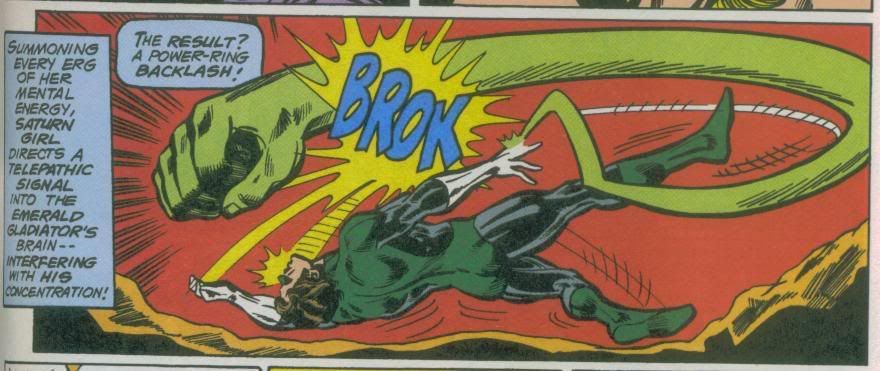
One of Young Tom's absolute favorite comics stories was the 1977 Justice League/Justice Society/Legion of Super-Heroes team-up. Here, Saturn Girl prepares to take out Hal Jordan through the power of THINKING!

Update: Yes, SallyP, Saturn Girl's THINKING pays off!


[From Justice League of America #148, "Crisis In Triplicate!", November 1977; written by Paul Levitz & Martin Pasko, pencilled by Dick Dillin, inked by Frank McLaughlin.]
Full Post

Sunday, June 10, 2007

Sunday Soliloquy

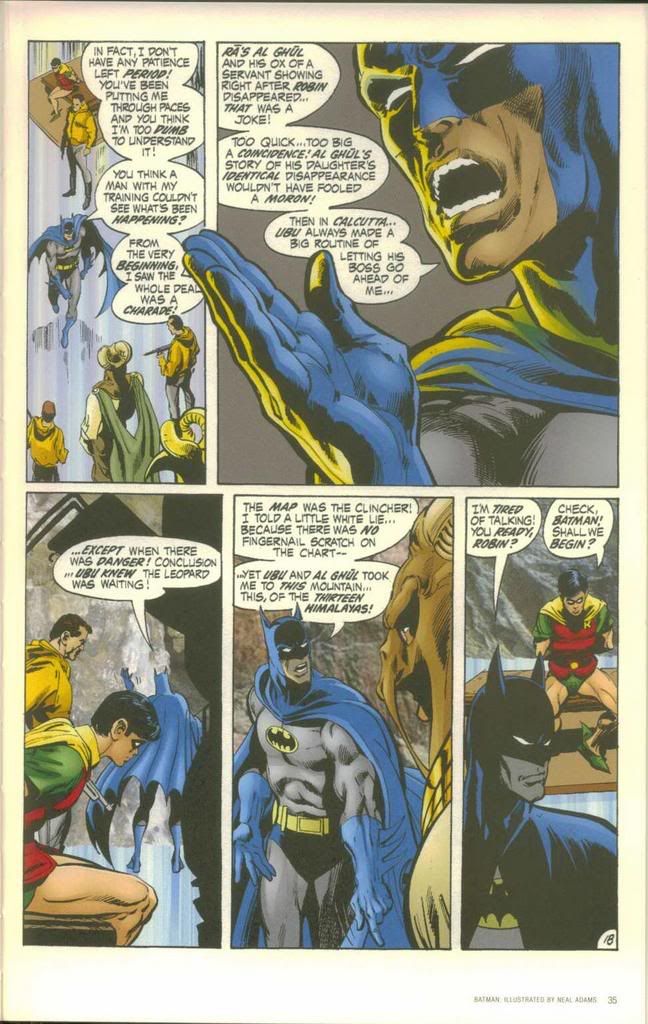
I would have selected something in an O'Neil/Adams/Giordano Green Arrow, but I like a Batman who's comfortable saying "moron":


Sadly, almost none of this speech made it into the animated-series version.

[From Batman #232, "Daughter of the Demon!", written by Denny O'Neil, pencilled by Neal Adams, inked by Dick Giordano, as reprinted and probably augmented in Batman Illustrated By Neal Adams Vol. 3.]
Full Post

Thursday, June 07, 2007

Thursday Night Thinking

I was all set to participate in Friday Night Fights last week, but circumstances conspired against me.

However, I'm more than happy to join Diamondrock in some Thursday Night Thinking!

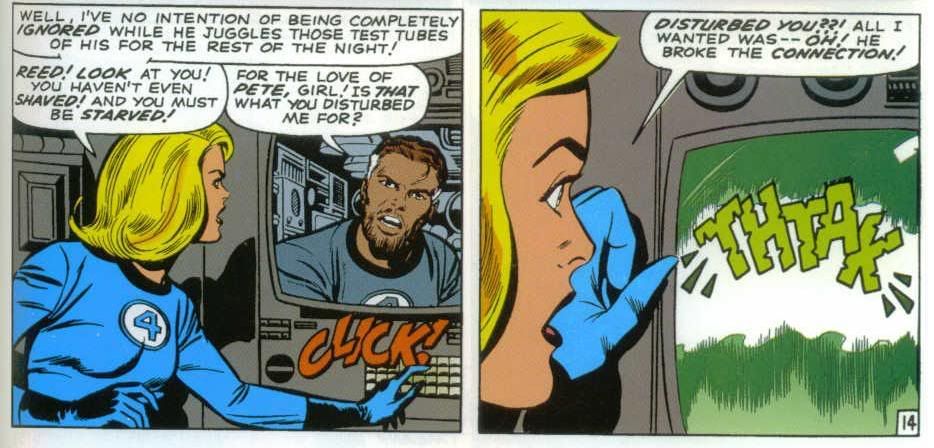
And who better than the guy who'd rather spend time in The Lab -- not a euphemism, I stress -- than pay attention to his frustrated bride: the Big Brain himself, Reed Richards!


"Dammit, woman! Leave me to my science!"


(From Fantastic Four vol. 1 # 48, March 1966, by Stan Lee & Jack Kirby, with Joe Sinnott on inks.)
Full Post

Wednesday, June 06, 2007

New comics 6/6/07

Is it Gail Simone Week so soon? Hooray!

Only one thing would have made Birds Of Prey #107 (written by Simone, pencilled by Nicola Scott, inked by Doug Hazlewood) dead solid perfect, and that would have been a more explicit reference to the Huntress nursing Ice back to health in 1989's Justice League America #35. Not that I'm complaining -- there's enough in the issue to satisfy this old JLI fan, especially the words Huntress speaks to bring Ice back to reality. The rest of the issue wraps up the BoP/Secret Six fight in fine fashion.

Welcome to Tranquility #7 (written by Simone, drawn by Neil Googe) is a bridge between arcs, largely wrapping up subplots from the first six issues, and otherwise focusing on the Emoticon, a minor character from the first arc. My problem with this issue is that it expects me to have kept up with all of these characters, most of whom are easy for me to confuse, simply by sight and subtle reminders of their character arcs. An omniscient narrator would have helped. It's very much written-for-the-trade, which on one level is a valid choice, but I'm not reading the trade. I put a little more blame for this on Googe for not making the senior-citizen designs distinct enough. I dunno; maybe it's just me. The Emoticon stuff is done well, and even shocking. There's also an obviously satirical backup story about Bunny (also pretty much unnamed throughout), and it's fine, but I'm not sure what the point is.

The trifecta is completed by (All-New) Atom #12 (written by Simone, pencilled by Mike Norton, inked by Dan Green), a prologue to the "Search For Ray Palmer" arc which finds Ryan encountering random wackiness on his way home through Ivy Town. The whimsical travelogue elements from the first few Tranquility issues show up here, but as over-the-top as this book is, they go just a smidge too far. At the end, the Atom fights some old Atom villains, all goofy, and (like Tranquility) none named. Here, though, I didn't miss them being identified (the only one I knew by name was Bug-Eyed Bandit), because the joke about them being lame didn't need it. I like Norton and Green on this book -- their style is cartoony enough to fit the overall tone, and I can't see Eddy Barrows or John Byrne doing the wacky travelogue stuff. By the way, it's been twelve issues and a short story -- can't we drop the "All-New?"

I went through most of Detective Comics #833 (written by Paul Dini, pencilled by Don Kramer, inked by Wayne Faucher) thinking it was a subtle nod to The Prestige, the steampunk magician movie starring Christian "Batman" Bale, Michael "Alfred" Caine, and Hugh "Wolverine" Jackman. I appreciated Dini's use of Zatanna and the evil guest magician, both of whom had appeared earlier in his run. I even thought there was some social commentary on the "audience likes girls tied up" element of the crime. Maybe all of this was distracting, but I did not expect the twist at the end. Good show, gentlemen.

The Black Adam/Mary Marvel parts of Countdown #47 (written by Dini and Sean McKeever, pencilled by Tom Derenick, inked by Andrew Pepoy, Jack Purcell, and John Stanisci) were actually kind of interesting this week. Adam is still a tiresome character as far as I'm concerned, and I know he's a bad guy, but throwing Mary around was rather uncomfortable to see. The interesting part to me was the way Mary got her powers back. The issue also checks in with Jimmy Olsen, the Monitors, and the Rogues, all in the name of hitting character and plot points. Holly Robinson (not the actress, the onetime Catwoman) is also brought into the story. Art is decent -- Derenick's a competent penciller, but again, the scenes with Mary getting slammed into walls were the weak points.

Superman #663 (written by Kurt Busiek, pencilled by Carlos Pacheco, inked by Jesus Merino) may represent the first weak link in the Countdown scheduling chain. Ideally, it should have come out last week at the latest, because it stars a character who "died" in last week's Countdown. Other than that, though, it's a very good issue, exquisitely drawn and colored (the latter by Alex Sinclair). Merino looks to be using a more intricate inking style, but it really works out well with Pacheco's pencils. My only question is, when did Lana Lang start stealing from Jean Grey's old Hellfire Club closet? I don't watch "Project Runway," but is the corseted look making a comeback? As for plot, basically the Young Gods of Supertown are in Metropolis on a road trip, with their good-natured hijinx giving Superman problems. The "Camelot Falls" subplot of Superman's necessity also runs through the book, giving continuity-mechanic Busiek a chance to clear up Arion's recent history. It ends on a cliffhanger which should advance the "CF" storyline, although I'd have thought we'd have seen more of the apocalyptic future by now.

Finally, Nightwing #133 (written by Marv Wolfman, pencilled by Jamal Igle, inked by Keith Champagne) is the best issue I've read so far. It opens with a well-choreographed fight scene, gives Dick some good "civilian time" (including a good bit of detective work), and brings in a mystery woman from Robin's past. Thus, it's not afraid to use Dick's history productively, beyond name-checking Batman, Robin, or their assorted trappings. The plot is nice and compressed, with Dick spending much of the issue trailing kidnappers, and actually having a couple of good action scenes with them. Wolfman's dialogue is improving too. The worst part involves the implausible mechanics of a mob hit, and even that feels retro enough that it's probably a criminal's "theme." Wolfman's first two arcs were so-so, but this is leaps and bounds better.
Full Post

Cosmic Cataloguing

Let's see if I understand the development of DC’s cosmology.

* * *

A. THE UNIVERSE

1. In the Original Beginning, right after the Big Bang at the Dawn of Time, a Giant Cosmic Hand spins the first building blocks of the Universe into their starting places, as if casting bread crumbs on a lake. There’s also a single antimatter universe.

2. Millions of years later, the Oan scientist Krona attempts to observe this event, but ends up unleashing Evil on the universe. Krona’s interference also reaches back to the Dawn of Time and retroactively creates a Multiverse of infinite worlds.

* * *

B. THE MULTIVERSE

1. In the Multiversal Beginning, right after the Big Bang at the Dawn of Time, a Giant Cosmic Hand spins the first building blocks of the Multiiverse into their starting places, as if casting bread crumbs on a lake. Each parallel universe occupies the same space, but vibrates at its own unique frequency. There’s also a single antimatter universe. The planet Oa is unique to the universe of Earth-1.

2. Millions of years later, the Oan scientist Krona attempts to observe this event, but ends up unleashing Evil on the universe.

3. Millions of years after that, the Earth-Omega scientist who will become Pariah conducts his own disastrous experiment. It wakes up the Anti-Monitor and results in the first universal casualty of the antimatter wave. Pariah survives, immortal and alone.

4. Eventually, the antimatter wave gets to the last dozen or so worlds that people have actually heard of. This causes the Monitor to get off his duff and start recruiting heroes from these worlds to fight the Anti-Monitor. Of course, these events are depicted in Crisis On Infinite Earths.

5. Harbinger kills the Monitor just before the universes of Earth-1 and Earth-2 are wiped clean. Psyche! The Monitor’s death has turned his energies into a backup disk for these two universes. Soon afterwards, the universes of Earth-4, Earth-S, and Earth-X are cut and pasted onto the backup disk. Problem is, it’s only a temporary solution. The whole thing must be restarted.

6. Two teams -- one of heroes, one of villains -- travel back in time to set events aright. The villains can’t stop Krona from completing his experiment. However, the Spectre and the assembled heroes confront the Anti-Monitor at the Dawn of Time. A big white explosion takes us to...

* * *

C. THE POST-CRISIS UNIVERSE

1. In the Post-Crisis Beginning, right after the Big Bang at the Dawn of Time, a Giant Cosmic Hand spins the first building blocks of the Universe into their starting places, as if casting bread crumbs on a lake. There’s also a single antimatter universe.

2. Millions of years later, the Oan scientist Krona attempts to observe this event, but ends up unleashing Evil on the universe.

Here’s where it starts to get tricky. If Pariah was originally from another Earth, where’s he from now? If an antimatter wave wasn’t destroying parallel universes, what was it destroying? In other words, how was the post-Crisis Crisis different?

There are a couple of answers, but they’re not entirely compatible with the “one universe, no exceptions” rule which post-Crisis DC sought to enforce. First, Pariah and the other Multiversal survivors might actually be from other dimensions, like the Avengers-analogues who show up in (the post-Crisis) Justice League #3. Second, Hypertime offers a catch-all solution for many of these problems. Third, Crisis #11 indicates that there’s still *something* where Earth-2 was, it’s just a yawning void. Basically, in the years following COIE, DC had at least a few in-continuity parallel-Earth stories which contradicted the spirit, if not the letter, of COIE; and for the most part, pros and fans shrugged and moved on. Thus:

3. The post-Crisis Crisis happens. Lots of people die. Things Are Never The Same.

4. After the Crisis, “waves of time” cause random changes in order to facilitate the rebooting of several superhero titles.

5. The events of Zero Hour, too complicated to summarize here, bring all these time-anomalies to a head. A small group of heroes tries to prevent the unbalanced Hal Jordan from restarting the universe in his own image. They succeed, but guess what?

* * *

D. THE POST-ZERO HOUR* UNIVERSE

1. In the Post-Zero Hour Beginning, right after the Big Bang at the Dawn of Time, a Giant Cosmic Hand spins the first building blocks of the Universe into their starting places, as if casting bread crumbs on a lake. There’s also a single antimatter universe.

2. Millions of years later, the Oan scientist Krona attempts to observe this event, but ends up unleashing Evil on the universe.

3. The post-Zero Hour Crisis happens, probably not too differently from how the post-Crisis Crisis did. Lots of people die. Things Are Never The Same.

4. Things go on fine for a while, until a) in DC One Million, the Justice League takes a trip into the 853rd Century to meet up with Superman, who’s still alive and (it turns out) immortal, and b) in The Kingdom, a villain from the future shows up in our present to kill Superman, having already killed boatloads of Supermen on his way back in time. This leads to the discovery of Hypertime, which basically says all the old stories still exist, just like they originally happened, in their own cubbyholes of space, time, and dimension. The thing is, they’re just really really hard to access. There’s a suggestion that the Earth-2 Superman, relegated to “not dead, but still gone” limbo at the end of COIE, is still alive and punching on some Hypertime dimensional wall.

5. Nobody much likes Hypertime.

6. Instead, ZOMG!!1!! the four COIE survivors -- Superman (Kal-L) of Earth-2, his wife Lois Lane Kent, Alex Luthor of Earth-3, and Superboy (Kal-El) of Earth-Prime -- have been biding their time in the years since COIE, waiting to spring into action and fix all the bad stuff which has befallen their beloved Universe. Alex Luthor hopes that by recreating the Multiverse, the infinite monkeys on their infinite typewriters will come up with the perfect Earth that won’t need changing or revision, ever.

* * *

E. THE POST-INFINITE CRISIS MULTIVERSE

1. In the Post-Infinite Crisis Beginning, right after the Big Bang at the Dawn of Time, a Giant Cosmic Hand spins the first building blocks of the Universe into their starting places, as if casting bread crumbs on a lake. There’s also a single antimatter universe. Additionally, all the excess energy from the aftermath of Alex Luthor’s experiment creates 52 additional parallel universes, each occupying the same space as New Earth’s but inhabiting its own vibratory frequency. The histories of these 52 are altered radically by the intervention of Mr. Mind.

2. Millions of years later, the Oan scientist Krona attempts to observe the creation of (as far as he knows) the Universe, but ends up unleashing Evil.

3. The post-Infinite Crisis Crisis happens, probably not too different from the Post-Crisis Crisis. Lots of people die. Things Are Never The Same.

4. Hypertime is discovered, as before.

5. Nobody much likes Hypertime.

6. Apparently there are now 52 Monitors. They are dedicated to cleaning up all the anomalies.

* * *

And here we are. I know it doesn’t quite account for Animal Man. Still, does it all sound right?


[P.S. Yes, "Post-Zero-Hour" does sound like a '50s variety show sponsored by a cereal company.]
Full Post

Saturday, June 02, 2007

New comics 5/31/07

Let's begin this (timely; keep your fingers crossed) roundup with Justice Society of America #6, Part 4 of "The Lightning Saga" (written by Geoff Johns, pencilled by Dale Eaglesham, inked by Ruy Jose). This chapter's big mash-up involves the reconstitution of old-timey Legion foe Computo in Suicide Swamp, itself the old home of both Solomon Grundy and the Legion of Doom's Vader-helmet headquarters. (Dialogue says it belonged to the Secret Society of Super-Villains, but same difference.) That the Justice League just got through fighting Solomon Grundy in its first arc is never brought up, although goodness knows everyone gets ample time to compare notes.

That brings me to my main complaint about the issue: ach, the talking! Right from the first page, the reader is bombarded with information -- head-shots of the JLA and JSA, paragraphs of Superman's exposition comparing and contrasting the various teams, panels cluttered with characters -- and we haven't even gotten to the Legion's formal introduction yet. Both Brad Meltzer and Geoff Johns are so enamored of the plain fact that the JLA and JSA are getting together again (eee!) and they're meeting the no-foolin' Earth-1 Legion (!!!) that all the teams can do is tell us about it. To me it's indicative of the story's tone that the actual three-team battle against Computo is summed up largely by one double-page spread. It goes on for some five pages after that, and it started three pages before, so it's about half of the issue, but it just doesn't seem paced right. Maybe it's Jose's inks: they don't quite flatten everything out, but they don't do a lot to make the characters pop against the dense swamp background. Neither do Jeromy Cox's colors, for that matter. Anyway, since the Legion's fighting Computo, someone's gotta die -- or does she? We're down to the last installment and it still feels like a long way to go.

(Finally, obligatory Alex Ross cover gripe: nothing whatsoever indicates this is Part 4 of an inter-title crossover, and it features only Damage, who's hardly the center of the story.)

Next up is the week's second Geoff Johns book, Green Lantern #20 (drawn and colored by Daniel Acuna), which wraps up the Star Sapphire arc for now. While the arc hasn't been nearly as bad as I thought, I'm still not quite sure how I feel about it. First, Acuna's art is very good, but he draws Hal about ten years younger than he should be. Second, I have an uncomfortable feeling that the whole Sinestro Corps/Sapphire Corps angle will wind up with some new Grand Unified Theory of Power Rings that the mythology doesn't really need. Third, I liked the idea that Carol Ferris had moved on after Hal, because as we all know, Hal and Carol's relationship was poison to the idea of him being Green Lantern. In fact, one of the things I did like about this arc was the maturity Hal and Carol showed with regard to each other. The suggestion that they're still in wuv is a frustrating indication that the title doesn't want to move forward. All that notwithstanding, the Sinestro Corps backup (drawn by Dave Gibbons) was another fine little horror story, and it gives me hope for the Sinestro Corps arc.

Are we really just on Amazons Attack #2 (written by Will Pfeifer, drawn by Pete Woods)? With two issues of Wonder Woman supplementing AA #1, it feels like we're a lot farther into the story than that. Because I read those issues (and the issue of Manhunter which linked Everyman with Circe), I felt a lot more comfortable with this issue. The Justice League starts making battle plans, Donna Troy confronts Hippolyta, and the Amazons open up two more fronts. I thought it was a well-paced issue, maintaining a lot of subplots fairly well. However, it has the potential to sprawl out into a big goopy mess, and I don't like the idea that Donna's story will continue in Countdown (with Jason Todd, I presume). As for the art, I like Pete Woods a whole lot, even if he does draw (regular) ears under the Bat-cowl.

I was a little disappointed by Action Comics #850, the week's third (yikes) Geoff Johns title (i.e., written by Kurt Busiek, Johns, and Fabian Nicieza, pencilled and colored by Renato Guedes, inked by Jose Wilson Magalhaes). Not because of Johns specifically, because I haven't picked out what his contributions were. No, I expected more of a resolution to the Supergirl-Legion (mainline, that is) question, but instead I got another retelling of Superman's origin and his relationship to Kara Zor-El. On balance, though, it read fine. There were the familiar skips through time, revisiting old moments and filling gaps with new ones. For all the subtle (and not-so-subtle) revisions to Superman's origin just in the past few years, this was a good way to harmonize them and even give us a look at some alternate-Earth incarnations. Since this is an anniversary issue, there's a shout-out to the cover of Action #1 as well. Guedes and Magalhaes do excellent work throughout, especially on Supergirl. Because Guedes will be her new artist, this was a preview of her future in more ways than one.

Last on this week's list is Countdown #48 (written by Paul Dini and Adam Beechen, pencilled by David Lopez, inked by Don Hillsman with Alvaro Lopez), and I think I've finally figured out the dirty little secret of this title: it's a big crossover series like all the others, but it's weekly and it aims to be self-contained. Maybe that's obvious to everyone else, but I think I had been subconsciously approaching it by remembering 52's "newsweekly" structure. Clearly Countdown is its own animal, but it looks like it'll have a significantly different approach than 52.

In any event, this issue was better than the last, although I do have some quibbles. First, Black Adam has reappeared too soon. Even if he doesn't have his powers, he's been reduced to the same kind of one-note "my family is (choke!) dead" mantra that plagued the worst Batman stories. Second, Lightray is familiar to me, but he hasn't been around a whole lot otherwise, perhaps even since the start of Infinite Crisis. (He was so out-of-sight I thought he might have been Supernova.) His death may therefore mean only about as much as Duela Dent's. Third, I'm still confused about the timing of the Karate Kid scenes.

I did like this issue's Jimmy Olsen scenes, especially for bringing in Superman. If this is supposed to be a weekly Big Event series featuring the big-name characters, it needs to start using more of them. Overall I thought the dialogue was better, and I liked David Lopez's storytelling, although the storm-cloud scenes were kind of hard to follow at times. I'm still on board with the title for now, but its grip is a lot more tenuous than 52's was this time last year.
Full Post

Friday, June 01, 2007

I Read The News Today, Oh Boy


Happy 40th anniversary to Sgt. Pepper's Lonely Hearts Club Band!

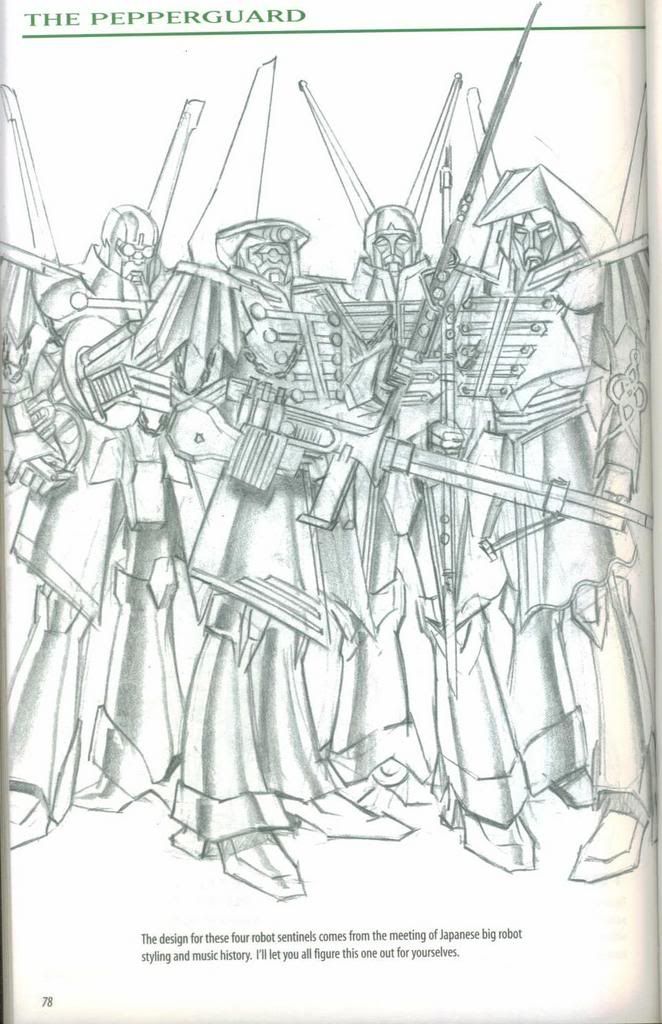
[Sketch by Alex Ross from the 1997 Kingdom Come supplement, Revelations.] Full Post

Wednesday, May 30, 2007

(It's an old MST3K line.)


(Original via Newsarama.) Full Post

Monday, May 28, 2007

New comics 5/16/07 and 5/23/07

Would have gotten these up last night, but the traditional Memorial Day allergies started to kick in....

MAY 16, 2007

The Flash: The Fastest Man Alive #12 (written by Marc Guggenheim, pencilled by Tony Daniel, inked by Art Thibert) is a fairly decent issue which suffers somewhat by the behind-the-scenes murmurings about Bart Allen's fate. I give it a lot of credit for setting up an inescapable doom-trap, but at the same time I have to think that the doom-trap won't actually kill Bart. I mean, that would be a little too grim, even for someone like me who still can't get past the arbitrary nature of his promotion. My appreciation of said trap is therefore blunted somewhat. I'm also kind of ambivalent about whether I want Bart to escape. I don't want him to die, but at the same time I don't think he should be the Flash just yet.

How was the book itself, you ask? Decent, like I said. No one seems to be out of character, but Bart himself is still such a cipher that it's hard to say at this point what would be in character. Daniel's storytelling skills are fine, but Thibert's inks are inconsistent. The "weight" of characters on the page varies, and more often than not the Flash especially looks two-dimensional. Still, there is that doom-trap, and the Black Flash, so I don't feel bad about coming back.

Countdown #50 (written by Paul Dini, Jimmy Palmiotti, and Justin Gray, pencilled by J. Calafiore, inked by Mark McKenna) has already been dissected by many of you, so I will just add some brief observations. First, if the cover suggests that the Joker has targeted Jimmy Olsen, that implies a much more exciting story than Jimmy happening to end up at Arkham Asylum for a stereotypical Hannibal Lecter conference. I'd want to read Joker vs. Jimmy, and I'd be lukewarm about Joker Talks To Jimmy. Second, the scenes with the Rogues go on far too long: five pages to establish a) they hate the Flash, whoever he might be, and b) Piper and Trickster's bona fides are in question. I thought this scene added nothing to the current Flash arc. I think Countdown is improving, but boy, it's not improving quickly.

Justice League of America #9 (written by Brad Meltzer, drawn by Ed Benes) gets a lot of things right -- the Gorilla City scenes, for instance -- but again, nothing much seems to happen. Teams of JLAers and JSAers just show up and collect Legionnaires like they were checking out library books. At least the three bad guys were revealed.

Action Comics #849 (written by Fabian Nicieza, pencilled by Allan Goldman, inked by Ron Randall) finishes the "Redemption" two-parter about like I figured. There are some intriguing ideas, and Kurt Busiek's social worker from an earlier Superman is used well, but ironically, I think Superman himself comes across as imposing his will on the common folk more than the story's antagonist does. The final confrontation features Superman hovering over the congregation making pronouncements, and while Clark muses later that his moral compass has to be pretty accurate, I don't think the congregants understood that point.

Aquaman: Sword Of Atlantis #52 (written by Tad Williams, drawn by Shawn McManus) finds our hero and his companions hatching a plan to free Sub Diego from Black Manta. This was not a dull issue, and I don't have much of a problem with the art, but the Sub Diego stuff is just not involving me like it wants to. Besides, both Busiek and Williams want Arthur to be The Decider, but so far neither of them have really presented a compelling case for that. Arthur's just a guy who can live underwater unaided and maybe occasionally talk to marine life, and right now that's not enough to get me excited about him. There are exciting and chilling moments in the issue, including the Black Manta fights and Aquagirl's story about the fate of some Sub Diegans, but Arthur should be the compelling center and he's not.

Checkmate #14 (written by Greg Rucka and Judd Winick, pencilled by Joe Bennett, inked by Jack Jadson) is a solid caper story wherein a Checkmate team and the Outsiders infiltrate Oolong Island. As usual, Rucka uses the caper to advance the book's various political subplots effectively. As a crossover, though, I have to say this storyline isn't encouraging me to pick up Outsiders on a more regular basis. Beyond Nightwing, none of these characters seem particularly exciting, and most of them are defined by their sarcasm and air of bad-assery. If Rucka and Winick each wrote their respective team's dialogue, Rucka wins. Bennett and Jadson do well enough, but the big action scene at the beginning suffers from faulty perspective. Specifically, I couldn't tell at first whether the monster was supposed to be looming over the ship or sitting atop it.

Where do I begin with All-Star Batman & Robin, The Boy Wonder #5 (written by Frank Miller, pencilled by Jim Lee, inked by Scott Williams)? First, I don't think anyone should look to this title for the Platonic ideals of Batman, Robin, or any of the other iconic characters it features. This is not a story about How Batman Should Work. I don't know what this story is about, and it's been five issues. Actually, I take most of that back: this is a story about making Batman first among alpha males, by giving every other possible contender some fatal character flaw. Of the various costumed characters portrayed so far, Batman is the only one who seems to get the colossal joke underlying the very pursuit of superheroics. This makes a lot of sense in light of the basic "Batman" idea, and it could be a pretty entertaining series of issues, but remind me again ... what's the basic plot of this series? Where are the conflicts? Batman is wanted by the cops generally, never mind for kidnapping Dick Grayson, and by the way Dick's parents have been murdered. Five issues in and we're still just introducing all the players. This is starting to feel like the sub-glacial pace of Supreme Power all over again. It's bad enough the issues are so late, but then to have virtually no plot advancement feels like Miller and Lee are just in it to put one over on the suckers.

Fortunately, Grant Morrison, Andy Kubert, and Jesse Delperdang offer Batman #665, which gets a lot of ASB&R's ideas across in a mode that's much easier to digest. "The Black Casebook" ascribes a certain supernatural dread to those old Batman stories no one likes to talk about because they're "not realistic." In this issue, Batman and Robin take out the Bane-themed Batman, in part because Bruce convinces himself that he needs to be, yes, the top alpha male. However, Morrison's Batman is more sedate, and perhaps more self-aware, than Miller and Lee's cackling dervish. He's playing a role, not thinking with his id. The issue also has some fine action scenes, including Batman and Robin both slamming into the Bat-Bane with their respective vehicles.

Star Wars: Rebellion #6 (written by Brandon Badeaux & Rob Williams, drawn by Michel Lacombe) begins a new arc focusing on a character who should be familiar to me, but isn't. He's a Rebel agent who gets found out by the mob boss he's infiltrated, and sent on a mission by said mobster. I liked this issue well enough, even if some parts of it (the opening flashback to Episode III, and an assassination) weren't connected to the main plot. It all felt like part of the comfortable SW setting, and with a book like this, that's what you want.

Finally for this week, Hero Squared #6 (written by Keith Giffen and J.M. DeMatteis, drawn by Joe Abraham) offers the origins of Captain Valor and Caliginous, each told by them in what has to be somewhat self-serving fashion. Captain Valor's is more funny, being a pretty obvious parody of Captain Marvel's (including a Mr. Natural-like Shazam figure), but the emotional heft comes at the end of the issue, when one of the book's main players reacts to Caliginous' story. This is another book that doesn't do much in the way of macro-plot, but at least it offers a fairly complete story in every issue. If, as I have read, it's ending soon, it should probably get to its larger point, but issue by issue, it's still fun.

MAY 23, 2007

Countdown #49 (written by Paul Dini and Tony Bedard, pencilled by Carlos Magno, inked by Jay Leister) uses Jimmy's elastic past to get him out of the cliffhanger with Killer Croc, and the Pied Piper and Trickster get a good double-agent-y scene to establish their bona fides with the other Rogues. The rest of the issue is taken up with exposition-happy Monitors, Karate Kid and Red Arrow trading quips (leading me to wonder about the timing of this issue relative to the JLA/JSA crossover) and a dismemberment-happy Black Adam. The art this issue was pretty good for a team I've not seen before -- very dynamic, although there has to be a better way than facial hair to distinguish the Monitors.

I'm genuinely torn as to whether to continue with Supergirl and the Legion of Super-Heroes (#30 written by Mark Waid, pencilled by Barry Kitson, inked by Mick Gray and Jimmy Palmiotti), because this was a very solid issue, but I think it's Waid and Kitson's last. They go out raising more questions than they answer, with those questions being very intriguing. Will Cosmic Boy join this mysterious new team? What will happen to Mon-El? Most importantly, will the new creative team be any good? I keep saying I want to re-read this series, so maybe this will give me the impetus to do it.

I thought The Spirit #6 (by Darwyn Cooke) was too ambitious. It tries very hard to be a real Eisner-esque story about a new character, with the Spirit in the background, but it just felt so familiar, and not in a good way. It's probably redundant to say that tortured musicians suffer for the sake of their art, and will do anything to perfect it, but there didn't seem to be much new (beyond the sci-fi trappings) of this musician's story. This title will always be worth reading as long as Cooke is on it, because Cooke is such a great storyteller and designer, but this issue falls short.

Wonder Woman #9 (written by Jodi Picoult, drawn by Terry Dodson and Rachel Dodson) doesn't skimp on plot. Superman, Batman, and the Justice League appear briefly, Circe's plans are revealed further, and Diana and Circe square off. The art is gorgeous, as you might expect. Picoult is improving, but her dialogue is still too clever and she can't quite manage all the plot. It continues to mystify me why DC would try to build up this title's profile with a prose novelist, and then plop said novelist right in the middle of a big event.

For some reason Fantastic Four #546 (written by Dwayne McDuffie, pencilled by Paul Pelletier, inked by Rick Magyar) didn't make much of an impression on me the first time around. That's probably my fault, because upon further inspection it's a neat little issue which references everything from the '70s Jack Kirby Black Panther series to Waid and Wieringo's last big FF arc. Oh, and Beyond!, of course, written by McDuffie. I didn't expect to see Reed and Sue back in the book (and apparently on their way to a healthy relationship) so soon, but that was a pleasant surprise, as was the combination of Pelletier and Magyar. Magyar really gives the pencils a good heft and a lot of weight, for a nice Alan Davis look. If this is just a temporary team, the long-term folks had better be absolutely stellar.

Arnim Zola, another '70s Kirby creation, shows up in Captain America #26 (written by Ed Brubaker, pencilled by Steve Epting, inked by Mike Perkins). A series of brief episodes -- the typography of which reminds me of old Spirit stories, for some reason -- check in on Sharon, the Winter Soldier, the Falcon, and Zola and the other villains, all getting back to their lives after Cap's death. Apparently this issue comes after all of those Fallen Son specials Marvel's been pushing since Cap #25, but I haven't read 'em, so this isn't overkill (you'll pardon the expression) for me. Brief glimpses of the Avengers both connect this book to, and distance it from, the larger Marvel Universe. These are people who don't quite fit into the land of crossovers and tie-ins. In that respect they're misfits, not unlike the time-lost Captain America whose memory now links them. If you can't already tell, I like this book a lot.

Aaand speaking of crossovers I haven't read and am not reading, here's She-Hulk #18 (written by Dan Slott, pencilled by Rick Burchett, inked by Cliff Rathburn), featuring Jen's battle with Iron Man on the SHIELD Helicarrier. That's about it, really. This issue uses Jen as a bridge between Civil War and "World War Hulk," getting her from one side to the other. There are some cute moments, but most of those involve Shulkie's regular supporting cast. It's not bad, it's just not as good as the book has been.

Finally, here's a book that may be better than ever: Birds Of Prey #106 (written by Gail Simone, pencilled by Nicola Scott, inked by Doug Hazlewood). Not just the Barda/Knockout fight, this matches up all of the Secret Sixers against the Birds, with Ice slowly regaining consciousness throughout. (Just noticed: on the cover, Barda's mega-rod looks a lot like Luke's green lightsaber....) It's pretty fun, especially the Misfit/Harley Quinn pairing. Nicola Scott's choreography isn't as fluid as I'm used to, so some of the figures are posed a bit awkwardly. Then again, they are fighting, so maybe that's how they're supposed to look. This team has succeeded in making a book I look forward to every month, and it's another situation where the new writer will have big shoes to fill.
Full Post
Thursday, May 24, 2007

Into The Woods: Star Wars, Episode VI: Return of the Jedi

I'm always a bit surprised by how much I like Return of the Jedi. There are parts of it I don't like (the Special Edition's musical number chief among them) and choices I think were ill-advised, but I give it credit for its central focus. As much as George Lucas claims the entire cycle is about Anakin/Vader, Jedi is about Luke.

Spooky Luke is in full effect from his first appearance in the film, hooded and cloaked as an obvious combination of Obi-Wan and Vader. Mark Hamill's Jedi-mind-trick voice sounds like it's been hollowed out with a battered wooden spoon, and his eyes are cold and penetrating: "You will bring Captain Solo and the Wookiee to me." Later, when he tells the Emperor "soon I'll be dead, and you with me," he's pretty convincing. He's come a long way from those power converters at Tosche Station. It's no accident that the final Jedi/Sith confrontation takes place high above the rest of the action. It would not have carried as much weight had the Emperor's throne room been a hellish environment, as originally conceived.

The rescue of Han particularly shows Luke in charge, and also ensures that Han will be in a secondary role throughout the film. Han spends most of the sail-barge fight flailing around trying to rescue Lando. He gets to bark orders and fight later on, but he's nowhere near the presence he was in Empire. He's also been separated from the Millennium Falcon, so the dynamic space-pirate mojo he was working in the other films is curtailed here. His presence on Endor, and that of Leia, does make the audience care about the ground battles, and gives Lando a chance to shine in his old ride, but those assignments seem more logistical than character-driven. The principals spent most of Empire apart, so Jedi naturally wants to have them together as much as it can.

There's still something missing from the Luke/Han/Leia relationship, beyond even the hint of a love triangle from the first film. Indeed, with Han and Leia free to be romantic, the Unresolved Sexual Tension which sparked their interactions in the previous films has been dimmed. One can see how they will grow into an old married couple in this film, but one still misses the "I am not a committee!" style of banter which made them appealing in the first place.

I tend to think that Leia gets the short end of the Jedi stick in this movie. I understand why, mind you; I just think Luke could have done a bit more planning, and maybe passed along a few simple Jedi exercises, before he strode off to face certain death at the hands of the Sith Lords. She does get to strangle Jabba with her chain, but her dealings with the Ewoks make her more of a nurturer. Obviously this is in keeping with the implication that she and Han are to breed the next generation of Jedi.

Like Han, Vader takes a more subordinate role in this movie. In this respect the prequels do Jedi a favor, showing us how fearsome Palpatine was (and may still be), but except for the beginning and the end, Vader is back to the same level on the organizational chart he had in Episode IV. Only in his climactic duel with Luke, when he ponders evilly the prospect of turning Leia to the Dark Side, does the Vader of Empire peek through.

For his part, the Emperor hasn't lost much from his last big appearance in Episode III. He's not as seductive or as scary, but he is more of a presence than Vader in the scenes they share. He's just as manipulative, too -- by making the Rebels aware of his Death Star visit, he sets the same kind of trap for Luke that he did for Anakin at the beginning of Episode III. When push comes to shove and he realizes he'll have to kill Luke himself, it connects him most clearly with the end of Episode III.

We'll come back to that in a moment, but I do want to talk about some technical aspects. Jedi has a very organic look, not surprising for a movie that spends most of its time in the redwood forest. It goes along with the general breakdown of structures that the two Star Wars trilogies chronicle. The Death Star is only half-finished, the Rebel fleet is an ad hoc collection of starships and fighters, and in fact the only major man-made structures in the movie belong to bad guys: Jabba's palace, the shield generator bunker, and the Death Star. (If memory serves, Yoda's house and the Ewok villages are the only other buildings.)

(The sight of the half-finished Death Star is nice and eerie. When I saw the first preview images back in 1983, at first I thought it was the wreckage of the old one. As it is, it's like a great metal skull made of scaffolding.)

However, the location scenes, especially on Endor, don't feel right somehow. The less built-up they are, the more they remind me of live-action role-playing. Aside from the original movie, and the prequels' Tatooine scenes, Star Wars tends not to do well with location shooting. I got the feeling the camera couldn't follow the Endor battles as well due to real-world restrictions, so they aren't quite as involving as the Hoth battle or especially the prequels' large-scale combat. Obviously, Jedi's space battle scenes could be choreographed more flexibly, and are more satisfying as a result.

The Ewoks can get annoying, but I still enjoy their schtick in moderation. Besides, the film doesn't take them all that seriously. Considering they're cuddly teddy bears who were more than ready to cook and eat Han, Luke, and Chewie, they're a lot like the killer dolls in Barbarella -- cute and fanged. Sure, given the choice, I would have liked a planet of Wookiees rising up against the Empire, but a) that would have been a much shorter battle and b) the Ewoks in large part buy time for the Rebel strike force to blow up the shield generator. In fact, I would put an Ewok village up against a village full of out-of-shape, overfed Hobbits any day. Last I heard, the Hobbits hadn't perfected hang-gliding.

Indeed, watching the Ewok flip switches knowingly in order to steal that speeder bike, I wondered whether the Ewoks weren't really just the last remnant of a more advanced civilization the Empire had subjugated a decade or ago to build this second (bigger, more powerful) Death Star. That would explain the Ewoks' "Gilligan's Island"-level of technology. It would also fit perfectly with the broken-systems motif I've been flogging throughout these disjointed little essays. The Ewoks are rebels too, of course, trying to throw the occupying Imperial forces out of their backyard, so they can go back to living in harmony with nature, or whaterver it was they were doing before.

Star Wars isn't an ode to anarchy, because it does believe in some systems -- remember Obi-Wan trying to convince the Gungans that they lived in symbiosis with the Naboo humans? It just doesn't like the artificial systems which can preoccupy the ruling classes of hominids. Its heroes are unconventional Jedi, whiny farmboys, politicians-turned-freedom-fighters, outlaws, and robots with minds of their own. Luke triumphs through the Power of Love, which isn't exactly the most original solution in all of fiction ... except that he does so while channeling a Force that's not supposed to favor such "attachments." Apparently, the Force needed Anakin to destroy the Jedi Order so that Luke could rebuild it. As the last of the Jedi, and the first in a long time with no exposure to the Order's practices, Luke is free to remold his students as the Force guides them.

Moreover, Jedi sees absolutely nothing wrong with Leia being a Jedi, a spouse, and presumably a mother, all at once. I've said before that through the Skywalkers, the Force sought to make itself more egalitarian, and I still see nothing to contradict that.

Accordingly, Jedi wraps up the cycle pretty well. It gets a bit draggy and repetitive for a good twenty minutes, when it bops back and forth among the Death Star, Endor, and space-battle threads, but watching it this time the end snuck up on me, and that gave the big climaxes an extra kick. Being a sentimental old softie, I still enjoy the brief surveys of Bespin, Tatooine, Naboo, and Coruscant, and the hugs-all-around montage. I even like the insertion of Hayden Christensen. He looks a little embarrassed -- as he should -- but it connects Anakin's experiences more to Luke's, and makes Anakin's journey more poignant as a result. The circle is now complete, indeed.

Fireworks, anyone...?
Full Post

Wednesday, May 23, 2007

Who's Your Daddy? Star Wars, Episode V: The Empire Strikes Back

There's an odd moment early in The Empire Strikes Back that encapsulates the halting pace of its opening scenes. It's the last shot of Leia in the "scruffy-looking nerf-herder" exchange, right after Han gets the last word. She really looks angry, like Han's just kicked her dog. It gives the scene a tension that probably wasn't intended, because the exchange moves just slower than it should and Leia's Look of Death is the capper. She seems madder there than she will later on when she lets Chewie strangle Lando.

The opening scenes play out mostly against blurry white backgrounds, giving them a kind of abstract unreality and not really grounding them. The exception is the sequence with Luke in the cave, which is dreamlike on purpose.

Everything kicks into high gear at the 20-minute mark, when Vader is introduced in a great little "big, bigger, biggest" progression. Vader was the henchman of evil bureaucrats in the previous movie, but Empire rightly capitalized on his popularity. His costume has been tweaked slightly and shined-up, so he appears even bigger and more imposing, and he is totally superbad. He wasn't exactly middle-management last time, but here he's the senior VP.

Han is Empire's other star. I don't know whether director Irvin Kershner made a big difference, Ford was just more accustomed to the role, or some combination thereof; but Han owns every scene he's in. He gets to do a lot, too: slapstick, seduction, swashbuckling, and points in between.

Not to say that the scenes with Luke and Yoda are somehow inferior; although prequel viewers might well think Yoda's gone off his nut when he first appears. Yoda questioning Luke's dedication also rings a bit hollow, considering that the Jedi are clearly best served training him. The Dagobah scenes build on the Wampa escape and transform Luke into the serene, somewhat scary character of Return of the Jedi. Whiny Luke was fun, but Spooky Luke seems more appropriate.

The raise-the-X-wing scene particularly illustrates why the Jedi recruited their padawans so young: kids don't know that things can't work. There are religious overtones in that too, of course, and also in the "I don't believe it"/"That is why you fail" bit that closes the scene. However, Luke's -- I hesitate to call it "insecurity," but there doesn't seem to be a better word -- gives him a strength of character that Anakin lacked. Anakin knew he was operating from a position of strength, and Luke's similar chosen-one status is similar, but Luke has the advantage of not knowing how powerful he can become, and not being cocky as a result. In fact, Vader gets progressively more angry as the climactic lightsaber battle goes on. At the beginning he's parrying Luke's swings one-handed, but by the end he's almost in berserker mode. Luke might be on the edge of panic, but he never gives in, and ultimately he sacrifices himself rather than join Vader.

As for Leia, aside from the aforementioned Look of Death, she has a pleasant Gillian Anderson-like quality in this movie that makes her appealing to this nerd even without the gold bikini. I keep thinking she doesn't have any chemistry with Han, but it's there; he's not the only one trying to make the relationship convincing.

The movie itself does the most with its raw footage. It's beautifully lit (by director of photography Peter Suskitzchy), with rich, warm, vibrant colors. The armor of Vader and the stormtroopers is sleek and glossy. The overall effect isn't as immersive as the previous film, although with the small spaces of the Falcon, Yoda's hut, and the carbon-freeze chamber, it's almost claustrophobic at times. Its characters and vehicles really move more too, and while that might sound hard to reconcile with the "non-immersive" and "claustrophobic" comments, that's how I see it.

For me it all comes together when Luke realizes Obi-Wan truly can't help him, and reaches out to Leia. It's the payoff for the end of Episode III, uniting both twins through the Force. It's a shame the Special Edition breaks up the flow of the sequence with its shuttle landing. The Falcon moves like a ballet dancer, rolling and juking away from TIE fighters and Star Destroyers, and you just don't interrupt that kind of thing.

But I digress. Luke spent a lot of the previous movie, and the first part of this one, being saved by other people. Although he has to call Leia to pick him off the bottom of Cloud City, he's still being proactive. He doesn't know (and apparently neither did Lucas, at this point) that Leia's potentially as strong in the Force as he is, so he has no idea whether he's broadcasting enough for her to hear. In other words, just like at the end of the last movie, he's taking a risk and trusting the Force.

I forgot to mention in my discussion of Attack of the Clones that Anakin is perfectly willing to stay on Tatooine and not try to rescue Obi-Wan. He might not be happy about it, but he's bound to follow orders. Instead, it's Padme who finds the "loophole" by "forcing" Anakin to "follow" her to Geonosis. Similarly, in Revenge of the Sith, Obi-Wan begs Yoda not to send him to kill Anakin, but Yoda rebuffs him: Sidious is too powerful for Obi-Wan. Empire offers a combination that appears to have inspired both prequel scenes: Luke chooses for himself, despite Yoda's protests about Vader's power level. For me, this raises the issue of "attachments," which I think is at the heart of the entire cycle, and about which I have already written at length. Luke's battle with Vader doesn't end well, but he's still not punished for his attachments as much as Anakin was for his. Arguably, Luke's attachments aren't as strong as Anakin's, but that may be splitting hairs.

Really, what can you say about Empire that hasn't already been said? It opened up Star Wars in new and different ways, it showed that the characters and situations could flourish outside of George Lucas' direct control, and it gave everything a new polish. Episode VI would have a lot to live up to....

Next: the big finish!
Full Post