Showing posts with label supergirl. Show all posts

Monday, September 28, 2009

New comics 9/23/09

Good grief, it's another huge week for the podcast, although this one comes in at just under 40 minutes. The lineup includes Beasts Of Burden #1, Blackest Night: Superman #2, Detective Comics #857, Fantastic Four #571, Final Crisis Aftermath: Dance #5, Galactica 1980 #1, Justice League of America #37, Madame Xanadu #15, The Simpsons Treehouse Of Horror #15, Supergirl #45, Superman: Secret Origin #1, and Wednesday Comics #12. Music, as always, is by R.E.M.

Download it here, stream it via the player on this page, or visit the podcast homepage here. Happy listening!
Full Post

Monday, September 21, 2009

New comics 9/16/09

Big agenda this week not just because a whole lot of comics came out, but also because we're catching up from last week. That means forty-odd minutes of laconic drawlin' 'bout Action Comics #881, Agents Of Atlas #11, Batman And Robin #4, Batman: Streets Of Gotham #4, Blackest Night #3, The Brave and the Bold #27, Captain America Reborn #3, Green Arrow & Black Canary #24, JSA Vs. Kobra #4, Marvels Project #2, Warlord #6, and Wednesday Comics #s 10 and 11.

Download it here, listen to it via the player at right, or visit the podcast homepage here. Music, of course, is by R.E.M.
Full Post

Friday, September 04, 2009

New comics 9/2/09

Not a big week this week, thank goodness -- just Agents Of Atlas #10, Batman #690, Justice League: Cry For Justice #3, Strange Tales #1, Supergirl Annual #1, and Wednesday Comics #9. As it happens, I'll be out of pocket next week, so check back in about ten days. Music, as always, by R.E.M.

Download it here, listen to it via the player at right, or visit the podcast homepage here. Happy listening!
Full Post

Monday, August 24, 2009

New comics 8/19/09

As promised, here's the podcast for last week's comics. Specifically, they're Batman: Streets Of Gotham #3, Blackest Night: Superman #1, The Brave and the Bold #26, Final Crisis Aftermath: Dance #4, Justice League of America #36, Supergirl #44, Superman Annual #14, and Wednesday Comics #7. The embarrassing reference this time out is to Ally McBeal. Music, of course, is by R.E.M.

Download it directly here, stream it directly from the player on this here site, or go to the podcast homepage here.
Full Post

Thursday, July 23, 2009

New comics 7/22/09

This week's podcast features Blackest Night: Tales of the Corps #2, Final Crisis: Legion Of Three Worlds #5, Final Crisis Aftermath: Dance #3, Gotham City Sirens #2, Green Lantern #44, Madame Xanadu #s 11-12, The Spirit #31, Power Girl #3, Supergirl #43, and Wednesday Comics #3.

Sorry in advance about some lingering sound-quality issues. This is also the second week in a row in which I use the phrase "boy band."

Once again, Olivia contributes from the peanut gallery, and R.E.M. supplies the music. Download it here, or visit the podcast homepage here.
Full Post

Monday, August 25, 2008

New comics 7/28/08 and 8/6/08

Here are some quick impressions of recent books, as I try to get rid of the accumulated baby-related backlog....

7/28/08

Batman: Death Mask #4: I stand by my original appraisal of this series, which is that it's more of a read-right-to-left exercise than a demonstration of manga's storytelling potential. It was a decent Batman story, but (as opposed to those Star Wars manga from ten years ago) nothing which really encouraged me to read more manga. If this were Batman/Punisher or some other outside-the-norm crossover, each "side" would get a chance to "win." Here, though, Batman is still Batman, just read differently; so he wins decisively.

Green Lantern #33: This was the penultimate chapter of "Secret Origin," wasn't it? Good. I get the feeling that "SO" could have been more interesting, and more to the point (leading up to "Blackest Night"), if it had been a couple of oversized issues told from the point of view of someone other than Hal. Also, I really think Johns et al. are pushing it to give Black Hand's mortuary the Black Lantern symbol.

Justice Society of America Annual #1: I talked about this one in a Grumpy Old Fan.

Teen Titans #61: Not a bad issue, although I am still not convinced that Kid/Red Devil is the breakout character everyone says he is -- and I say that as someone who looked forward to his appearances in the old Blue Devil series.

8/6/08

Detective Comics #847: Part 2 of "Heart of Hush" would have been better if it didn't have so much Hush.

Final Crisis #3: This is a scary, scary miniseries, and I admire its unwavering fatalism. I think I also like the way it paints its terrifying picture through individual snapshots, and not a "widescreen" overview.

House Of Mystery #4: Last month I think I said it's taking a while for Fig to realize what the readers already know (because it's the premise of the book). This month does nothing to change that. HOM isn't badly made, it's just slow; and I may have to give it another storyline to evaluate it properly.

Manhunter #33: I continue to like this series, and I want to learn more about it, but honestly I couldn't tell you why I liked this particular issue.

Nightwing #147: Part 1 of a 3-part Two-Face storyline is fairly entertaining, although for various external reasons I'm not sure how much longer I'll be with the book.

Supergirl #32: However, it looks like I'll be with this book for a while to come, as long as it ties into the Superman titles.

Tor #s 3 and 4: Tor starts a family in these issues. I'll probably finish out this miniseries, if only because I enjoy Joe Kubert's storytelling.

Of course, I also bought Trinity #s 9 and 10, and enjoyed them beyond my self-imposed obligation to annotate.

Back before too long to catch up on the next two weeks!
Full Post

Friday, August 15, 2008

Friday Night Fights

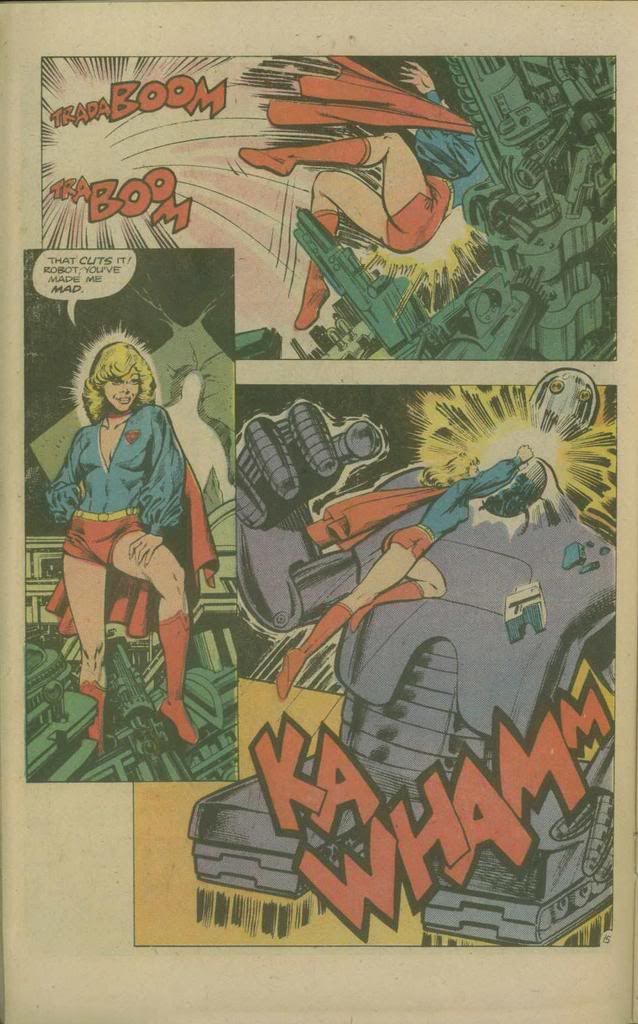
Someday, several years from now, when Olivia Bondurant and her dad sit down to talk about Supergirl -- as, inevitably, we will -- she'll bring up the Maid of Might's less popular fashion choices. She'll list the headband and perm of the '80s, the bare midriff of the '90s and '00s, and the hot pants of the '70s.


And I will reply that yes, these were all rather unfortunate to one degree or another; but through it all, Supergirl could still serve up a beatdown.

Strike a pose, Bahlactus!

[From "The Other Side Of Doomsday!" in Super-Team Family #11, June-July 1977. Written by Gerry Conway, pencilled by Alan Weiss, inked by Joe Rubenstein, colored by Jerry Serpe, lettered by Bill Morse.]
Full Post

Sunday, July 13, 2008

New comics 7/2/08

I've been saying for a while that DC should (once again) just let the Marvel Family have its own little corner of the Multiverse where Billy and co. don't have to age too quickly and whimsy can be the order of the day. Well, here's Mike Kunkel's Billy Batson And The Magic Of Shazam! #1, taking me up on it. Except not quite, because this is a Johnny DC title and therefore has no influence on the main-line Marvels. Instead, it's a sequel to Jeff Smith's Monster Society miniseries, picking up with Billy and Mary in their familiar roles.

Kunkel has redesigned Cap slightly, giving him a ridiculously broad chest and a how-you-doin'? look. This goes with Kunkel's take on Billy, who always tries to do the right thing but who realizes without much prompting just how good he has it. For example, Captain Marvel poses as Billy and Mary's father, but naturally favors Billy in parent/teacher conferences. Of course, hilarity ensues, especially since Kunkel shows that Mary is the smarter of the pair.

Kunkel also introduces Black Adam, but leaves the resolution of his subplot for a future issue. I haven't read hardly any of the Johnny DC books, but I suspect BBMOS is one of the few to employ multi-issue storytelling; and it makes me wonder who the real target audience is. This is a dense book which aims for rapid-fire delivery through small panels and packed word balloons. Not being 10 years old, I can't say whether this would appeal to kids, but it does seem like an older reader's idea of what a kid's comic book should be. Yes, that extends to the secret-code messages, which I thought were prohibitively long and which I still haven't tried to unscramble. Even so, I appreciated Kunkel's efforts, and I'll be back at least for the next issue.

Part 3 of "Batman R.I.P." hits in Batman #678 (written by Grant Morrison, pencilled by Tony Daniel, inked by Sandu Florea), in which our hero is reduced to his lowest point before meeting his spirit guide (did it have to be a Magical Negro?) and starting to rebuild. Also, other bad things happen to Robin and Nightwing (poor Nightwing...). Morrison's standard take on Batman in JLA was that "Batman always has a plan". Well, here, he's been completely cut off from his plans, thrown into a roiling sea of anarchy by the Black Glove, and made to put the pieces back together using stone knives and bearskins. As with Final Crisis, it's pretty nerve-wracking stuff, but at least we're at the halfway point.

I'm getting frustrated with House Of Mystery (#3 written by Matthew Sturges and drawn mostly by Luca Rossi). Its first arc seems determined to establish that Fig can't leave the House. However, we know this to be true, because that's the point of the book. Thankfully, that also seems to be the point of the issue, so I hope that settles it for Fig for a while. The issue does introduce a new antagonist, with a callback to the mysterious couple seen earlier, so maybe there'll be a more entertaining twist next time out. Still, if this arc ends only with Fig accepting her new status, I'll be pretty disappointed. I'm getting tired of books which take five issues to lay out what could have been one issue's worth of setup. I do like the art, though.

I'm also getting a little tired of Nightwing (#146 written by Peter J. Tomasi, pencilled by Don Kramer, inked by Sandu Florea), likewise because "Freefall" seems to have gone on for a couple issues too many. Yes, Dr. Kendall was a bad man; yes, it's good that Dick stopped him. However, the story seemed rather lifeless (no pun intended), and I don't know if that's due to Don Kramer's art not being quite as expressive as Rags Morales'; or Tomasi's talky scripts sapping the energy out of the action. Next up is a "Batman R.I.P." tie-in, so maybe things will pick up.

I did like Supergirl #31 (written by Kelley Puckett, pencilled by Brad Walker, inked by Jon Sibal and Jesse Delperdang), despite the jarring change in art style from the soft lines of Drew Johnson and Ron Randall to the quirkier combination of Walker et al. Basically, Supergirl convinces the dying boy's mother to accept the Resurrection Man's treatment by a) flying her to a distant mountaintop and b) telling her how her parents shot her into space. It's the kind of thing which has to be handled very carefully, because once superhero comics get into real-world ramifications of godlike behavior, they're already pretty far down a mighty slippery slope. This time I bought Supergirl's argument and the mom's response, but next time might be different. As it is, this time the argument had to get past Supergirl's bare midriff.

I continue to like Manhunter (#32 written by Mark Andreyko and drawn by Michael Gaydos). The current issue tracks Kate's continuing investigations into the women's disappearances, and features a couple of good scenes with Blue Beetle (super-suits hissing at each other like unfriendly dogs!) and Mr. Bones. Gaydos' art is "realistic" without sacrificing expression, and Andreyko has a good feel for the dialogue of a superheroic world.

Finally, I bought Star Trek: New Frontier #4 (written by Peter David, drawn by Stephen Thompson), the penultimate issue of the miniseries. Thankfully, things start to happen at a little more rapid pace this issue. However, the plot deals with duplicates of people; and the scenes shift so abruptly you're never sure whether, say, the Lefler who was on that planet is the same Lefler who's on this ship. I guess I have to get issue #5 to see whether the whole thing makes sense.
Full Post

Monday, June 09, 2008

New comics 6/4/08

Hey, it's June! Who knew?

Lots of books this time, so no time for chit-chat.

Obviously I spent a lot of time with Trinity #1 (written by Kurt Busiek, pencilled by Mark Bagley, inked by Art Thibert), so it wasn't too bad, but OH DEAR LORD another scene of table talk! First Meltzer, then Dwayne McDuffie a couple of weeks ago, and now Busiek. I'm hoping this is the only such scene for, say, fifty issues. It's not like the Four Horsemen miniseries felt the need to sit the Trinitarians down for a Continental breakfast.

Other than that, I will say that I won't mind spending the next year with Busiek and Bagley. For his first big DC outing, Bagley shows he has the chops to do the company's most familiar characters. His Wonder Woman and Flash look especially good. I'm predisposed to like Busiek, so there you go.

Once again I get the feeling that Star Trek: New Frontier #3 (written by Peter David, drawn by Stephen Thompson) would mean a lot more to me had I been reading the NF books. This issue's plot features shocking! revelations about who's being impersonated, or who might be impersonated. The last page had me particularly confused. Two issues to go, so I might as well stick with it.

House Of Mystery #2 (written by Matthew Sturges, drawn by Luca Rossi) doesn't spend a lot of time on the "nested" story (written by Bill Willingham), which is good. The nested story isn't that compelling, despite some pretty Jill Thompson art. However, nothing much happens in the main story either. Its big emotional moment involves Fig, our heroine, discovering that she can't leave the HoM, but we kinda already knew that. The secondary emotional moment, where she starts to spill her guts to one of the housemates and ends up berating him, also doesn't ring quite true. The rest of the issue finds the housemates acting quirky without much to show for it. While I'd otherwise probably fault the book for being too broad, the characters haven't distinguished themselves from one another yet. Mostly issue #2 was just Fig acting out against a bland backdrop.

Much of Tor #2 (by Joe Kubert) is a flashback detailing Tor's pre-issue-#1 journey, which is fine; but it gets a little loopy towards the end and eventually acknowledges that maybe those psychotropic leaves might be affecting it. As with issue #1, Tor fights a prehistoric monster in order to protect his new little friend. Accordingly, as with issue #1, I appreciated #2 for its craft, because who am I to criticize Joe Kubert? Besides, I have to get #3 to figure out what's going on.

I don't have any strong feelings about issue #3 of Batman: Death Mask (by Yoshinori Natsume), so I'll just say it's nice for what it is -- an above-average Legends of the Dark Knight-style story -- and it is getting me used to reading manga. Learning can be fun!

With her own title cancelled, Catwoman is more free to roam around the main line Bat-books, so the cover of Detective Comics #845 (written by Paul Dini, pencilled by Dustin Nguyen, inked by Derek Fridolfs) plays up her appearance. However, the story itself is a nice little whodunit which manages to withstand its conclusory leaps of logic. As such, it focuses on the Riddler, who's been trying to upstage Batman at the whole consulting-detective thing. It also introduces a group who I can't help but think is the Internet version of the old Mystery Analysts of Gotham City. The idea that Batman has a group of online buddies who only know him through a generic username is still a terribly appealing one, so if you like that, you'll like this story.

Rounding out this week's Bat-books is Nightwing #145 (written by Peter J. Tomasi, pencilled by Rags Morales, inked by Michael Bair), an issue which starts to stretch the "Freefall" storyline past its point of usefulness. It wasn't too long ago that Nightwing and Robin brought this particular storyline to a stop, but we're apparently not done with it yet. The issue even appears to bring things back to that same point. Now, to be fair, this time around deals more with Talia al Ghul and Mother of Champions, incorporates Batman, and features the surprising return of another Bat-foe, but still. The concept of a mad scientist creating super-powered soldiers isn't specific enough to Nightwing to warrant this much focus. At least Rags and Bair are back for the whole issue.

Speaking of which, Supergirl #30 finds relief artist Ron Randall drawing the whole issue, with Will Pfeifer taking the place of regular writer Kelley Puckett. Looks like a fill-in issue to me, but it's not a bad one. It helps define the character in relation to Superman in a way which puts Puckett's storyline in a much different perspective, and it even incorporates the Box O' Universe from Puckett's first issue. Randall's art is clean and simple, although it flirts with being stiff and bland at times.

Overall, though, the issue I enjoyed the most was Manhunter #31 (written by Marc Andreyko, drawn by Michael Gaydos). It's the triumphant return of a title which has seen two long hiatuses (hiatii?), so it opens with an efficient two-page recap of the character's history. I'm not that familiar with Gaydos, but his work reminds me of early J.H. Williams, John Paul Leon, or maybe Tommy Lee Edwards -- thick lines and lots of blacks. The main story does proportionately as well with its 20 pages. After opening with the requisite superhero battle, it reintroduces our heroine's family and supporting cast, and through them sets up the current immigration-related arc. Last time I praised the new Action Comics for using its 22 pages well. This time, however, Manhunter really does a great job showing what a single issue can mean to a long-running superhero serial. High marks all around!
Full Post

Friday, May 09, 2008

New comics 5/7/08

Just for fun, let's start with Supergirl #29 (written by Kelley Puckett, pencilled by Drew Johnson and Ron Randall, inked by Ray Snyder and Randall). In this issue Supergirl works with Resurrection Man and a mad scientist to make good on her promise to cure a dying boy of cancer. There always seems to be a lot of talk about what a Supergirl book "should" be like, and goodness knows I've done quite a bit of it myself. That said, I think this sort of approach is perfectly valid. Supergirl in this situation is what we lawyers call the Reasonable Person -- specifically, one with Superman's powers -- who can explore the kinds of issues Superman can't. It allows her to maintain the requisite connection to Superman (why would she be "Supergirl" otherwise?) without being redundant.

Anyway, this issue finds the Girl of Steel's plan put into action, and reveals its outcome. A lot of it involves Supergirl getting to know Rez. Man (who I know only from DC One Million, unfortunately) and, to a lesser degree, the mad scientist. The rest is a fight scene. It's all very dry and moody, thanks to a lot of black ink from Randall and Snyder. Randall and Johnson's pencils mesh pretty well -- you can tell the difference because Randall's work is a little more flat and tends not to go as well with the subtleties of Kahila Tripp's colors. It kind of takes your mind off the fact that a super-powered girl in a skimpy outfit (who still doesn't look skanky, by the way) is on a nigh-impossible mission. Nothing which happens in this book is completely unexpected, but I will say that it made me wonder about the consequences of Supergirl's plan, and I suspect that was at least part of the point. I'm eager to see what happens next, which is a pretty nice sentiment for a monthly comic book.

Nightwing #144 (written by Peter Tomasi, pencilled by Don Kramer and Rags Morales, inked by various people) also finds itself with two pencillers. This is officially another part of "Freefall," but it feels more transitory: the Great Ten's Mother of Champions is brought into the grave-robbing storyline; Talia shows up in New York to threaten Dick; Nightwing does some run-of-the-mill crimefighting; and Dick's new girlfriend (didn't cornrows go out 25 years ago?) helps him skydive. Morales contributes some good "acting" between Dick and Talia, but there's a lot packed into this issue (as usual) and it's hard to process out of the larger story's context.

Speaking of "the larger story," the new House Of Mystery (#1 written by Matthew Sturges and drawn by Luca Rossi) features a short story nestled within the main one. Seems that someone's stolen the HOM from the Dreaming and turned it into the Hotel California -- you leave when it says you can leave, and no sooner. Blondes are the protagonists here: Miss Keele, the architect who's been drawing the House, Close Encounters-style, runs to it in order to escape her macabre pursuers. Cress, the typical House resident, protests her captivity. Sally, a more mellow resident, tells her own gruesome story as "payment" for her tenancy. (It's written by Bill Willingham and drawn by Ross Campbell.) I thought the threads worked well together, although I had to work harder than usual to keep everyone straight. (That's what I get with Vertigo, I know.) Rossi was unfamiliar to me, but his work reminds me of a looser Michael Lark or a tighter Jesus Saiz -- thick lines and a little sardonic. Likewise with Campbell, whose work was much tighter and more "realistic," which made his story that much more effective. So, good job, Vertigo: you've gotten me reading one of your books for the first time since Army@Love #1.

I picked up Joe Kubert's Tor #1 (by guess who) based on the strength of Kubert's body of work. I'd barely heard of Tor, but Kubert + caveman seemed to be a good fit. It's a story told without dialogue, or balloons of any kind: an omniscient narrator describes Tor's thoughts. Tromping away from his dark past, Tor stops to treat his wounds and get some food, inadvertently eating some psychedelic fruit. Later, as indicated by the cover, he saves a hairy humanoid from a croc-o-saurus before running into the people who put the victim there. It's not an unfamiliar story, but it's told well (of course) and it is enticing enough to get me to stick around.

Evil demigods plague both stories in Countdown To Mystery #7. In the Eclipso story (written by Matthew Sturges, pencilled by Chad Hardin, inked by various people), Bruce Gordon and the accumulated superheroes (Hawk, Dove, Creeper, Plastic Man) take on an Eclipso cult and the badder-than-ever dark god himself. I get the feeling that this story depends on various ways to keep the Spectre in check, but since this is the penultimate issue, that's not quite as big a problem anymore. Hardin's pencils are fine; nothing flashy, more like cleaner Tom Grindberg back when Grindberg was trying to be Neal Adams. This story has jumped around so much I'm not sure who it's about anymore, and that makes it harder to tell if it's going anywhere.

The Doctor Fate story (plot by the late Steve Gerber, script by Adam Beechen, pencilled by Justiniano, inked by Walden Wong) finds the helmet in the hands of a young woman who's not ready for its power, and who gets taken on a trip through Hell as a result. You know the drill: the world is a cesspool of sweat and saliva, we're all just ants compared to the demons who really control things, yadda yadda yadda. Next issue is the multiple-choice ending necessitated by Gerber's death, so this could end up a few different ways.

The second issue of Batman: Death Mask (#2 by Yoshinori Natsume) was an improvement. Most of it is a flashback to Bruce's martial-arts training, with the requisite Batman foreshadowing. In the context of this story, though, the foreshadowing takes on a more mystical aspect which comes back to haunt Batman in the present. This issue has more action than the last one, which made it feel "more manga" to my untrained eyes.

Back in the land of left-to-right Batman, Detective Comics #844 (written by Paul Dini, pencilled by Dustin Nguyen, inked by Derek Fridolfs) concludes the Zatanna/Ventriloquist two-parter with the origin of the current Ventriloquist. Once the mousy daughter of a mob boss, she got glammed up after being left for dead and finding Scarface. Pretty good for a Bat-villain origin, and Dini ties it into "Face The Face," the One Year Later reintroduction to Batman. As for Zatanna, I have to say I liked the way Dini handled her mindwiping of Batman 'way back when, but I'm not buying her throwing herself at Bruce. Nice try, though.

Because I didn't have 1974's Justice League #111, I bought the DC Universe Special: JLA which reprinted it (the first appearance of Libra) and the 3-part Secret Society story which helped give Identity Crisis its foundation. I won't go into details, because these are pretty much research material, but the printing seemed off on the Secret Society story and Dick Giordano's inks seemed a bit too blotchy on the Libra story. Weird.

Finally, at long last here's Action Comics Annual #11 (written by Richard Donner and Geoff Johns, drawn by Adam Kubert), the conclusion of "Last Son." It's wall-to-wall combat, with the United States military, Superman, Luthor, Bizarro, Metallo, the Parasite, and (eventually) the Justice League and Justice Society versus a decent amount of Phantom Zone escapees. Luthor is the key to the issue, both in his motivation for helping Superman and the perverse glee he finds in killing Kryptonians. The ending is a little problematic given the current state of Superman comics, but maybe there will be an addendum which bridges the gap. Or maybe this takes place "now" (given one of Chris's comments) and it'll be a plot thread for Trinity. Anyway, it was a good issue, well-told by Kubert, which should make more sense once it's put in proper context.
Full Post

Thursday, April 03, 2008

New comics 4/2/08

First up this week is Detective Comics #843 (written by Paul Dini, pencilled by Dustin Nguyen, inked by Derek Fridolfs), an issue which mixes the Penguin, Zatanna, the Ventriloquist, and a couple of characters from earlier in Dini's tenure. With all of those players, you'd think there's not much room for Batman, and indeed, Bruce Wayne is in it more than Batman is. It's a tightly-plotted issue revolving around a Gotham rich-kid opening a nightclub to compete with the Penguin's, and hiring Zatanna for a little extra sizzle. The Ventriloquist's new "voice" reveals a surprising secret, and the cliffhanger's pretty good too. As for the art, I don't dislike Nguyen and Fridoffs, but I'm still getting used to their style. Nguyen uses very thin lines and Fridoffs is heavy on the blacks, and it reminds me of early Mike Mignola.

Keeping with the Bat-theme, here's Nightwing #143 (written by Peter Tomasi, pencilled by Don Kramer, inked by Christian Alamy and Mark McKenna), a stopping point in the current grave-robbing-villain storyline. If you like Nightwing and Robin vs. an island base full of zombie super-soldiers, scenes punctuated by witty banter, and references to classic rock and Jaws, this is the issue for you. I found it to be a little too pleased with itself, but still an improvement for the title overall. Don Kramer fills in for Rags Morales this issue, but except for a little more stiffness I didn't really notice. Together with Alamy and McKenna, the art isn't too far from normal.

The fill-in work of Ron Randall is less noticeable on Supergirl #28 (written by Kelley Puckett, with the balance pencilled by Drew Johnson and inked by Ray Snyder), an issue that was actually pretty decent. After more than a few issues so inscrutable they'd make the average episode of "Aeon Flux" look like a flowchart, here's one which starts to pull everything together. Supergirl has promised an adorable moppet she'll find a cure for his cancer. Naturally, everyone (personified here initially by Wonder Woman) thinks she's nuts. Supergirl then finds a cult-favorite DC character from the '90s (I won't spoil the cover's tease!) to try and convert to her side. Most of the issue involves Supergirl talking to Wonder Woman and then to Mystery Character, and she does continue to act a bit weird, but with this issue I felt like there was a purpose.

Sadly, that provides an apt segue into Countdown #4 (written by Paul Dini and Sean McKeever, story consultant Keith Giffen, pencilled by Jamal Igle, inked by Keith Champagne), which once again seems to have lost sight of its purpose. After the last few weeks' detour with the Great Disaster, our heroes are back on the real Earth ... but, as the cover indicates, Mary Marvel has decided to go back to the black-cheerleader outfit which got her in so much trouble 30 years ago when this series was still young. So she fights the Atom and Green Lantern and Troia on the steps of the Hall of Justice (the JLA's not home, of course) in order to kidnap Jimmy Olsen for Darkseid. I like Jamal Igle and Keith Champagne's work a lot, although their Darkseid seemed a little off, so I didn't have many complaints with the art. I guess the overall story is starting to come together too. However, the Mary Marvel "reversion" still feels like a sharp yank after all that buildup to "redeem" her.

Finally -- and I do mean finally! -- Action Comics #863 (written by Geoff Johns, pencilled by Gary Frank, inked by Jon Sibal) provides the big blowout conclusion to "Superman and the Legion of Super-Heroes." The payoff is Superman (and, eventually, the Legion)'s fight with Earth-Man in the streets of Metropolis. The secondary payoffs are a couple of rah-rah spreads of the Legion. Sun Boy's role in the story seemed a little too convenient, but considering that this arc could easily have lost an issue without much trouble, I appreciated this installment's pacing. Also, remember last time how I didn't like the way Butch Guice "directed" Cap's fall onto the hovercar? This issue features Superman falling pretty much from orbit, to entirely predictable results, but I liked the way Frank laid out the sequence. Frank's faces are still a bit creepy (those eyes!) and everyone looks kinda pale (thanks to Dave McCaig), but on the whole I can't complain.
Full Post

Monday, March 17, 2008

New comics 3/5/08 and 3/12/08

I've got a lot of these to go through, so I'll try to keep it short.

3/5/08

Justice League: The New Frontier Special #1: Very nice all around. I probably didn't need to see how another Batman/Superman fight would play out, but it's justified as a "lost chapter" of NF. The Robin/Kid Flash and Wonder Woman/Black Canary stories are cute, the period ephemera is well-done, and the behind-the-scenes look at the DVD adaptation is pure eye candy.

Teen Titans Year One #3: Was a little surprised at the pacing of the overall miniseries, as depicted in this issue; but better earlier than later, I guess. Besides, the story's new direction looks intriguing. It's been good so far, so I'm in for the rest.

Supergirl #27: It's an understatement to say that this book hasn't been what I expected. If you remember the Steven T. Seagle/Scott McDaniel run on Superman a few years back, it's kinda like that, except on downers. I'm pretty much buying this book to see if it all makes sense. Plus, I like Drew Johnson and this issue's guest (fill-in?) artist, Rick Leonardi. S'girl isn't frustratingly bad like, say, early Hawkgirl or late Gotham Knights. It's just frustrating.

Countdown To Adventure #7: I read this book for the Adam Strange/Animal Man/Starfire story. I have no idea what's going on with the Forerunner story.

Nightwing #143: I like the fact that writer Peter Tomasi isn't afraid to plug Nightwing firmly into the center of DC's superhero culture. It can get a little precious, and sometimes -- not so much in this issue, but certainly in the last one -- it distracts from the main plot. This issue was fine, but I bet if it were your first DC comic in a while, you'd be mystified.

Detective Comics #842: Batman must deal with an EVIL! suit of armor that he ended up wearing in the Ra's Al Ghul storyline from a couple months back. You know Spider-Man's black costume? Like that, except Batman doesn't destroy it, it doesn't make him dance like a poser, and (so far) it hasn't come to life. I'm not sure why the world needed this story.

Green Lantern #28: The "Lost Lantern's" trial results in the creation of a Red Lantern. Hal has a Clarice Starling moment with Sinestro. We check in with the demons on Ysmault. The Guardians issue a radical new law. I can see how it all fits together, but I know the dots won't be connected for about another year.

Countdown #8: Yay, Ray Palmer's back as the Atom! Yay, Firestorm is back (although whither Martin Stein?)! Yay, Habitat, the Hairies, and the rest of Jack Kirby's Jimmy Olsen creations! Boo, all the bickering and running around pointlessly.

3/12/08

JLA Classified #54: Will probably read better in the trade. Since this is the last installment of the Titus storyline, the "past" narrative takes up the top half of each page, and the "present" gets the bottom half. Sometimes that trick works, sometimes not. Here, it might've been better to split the pages vertically. As for the story, Titus beats the tar out of the League for as long as is dramatically appropriate. The ends on an ecumenical note, which is always nice, but a bit treacly for the Justice League. Overall, though, pretty good.

Batman Confidential #14: Part 2 of a new look at a one-off villain from the '80s, The Wrath. As a modern-style story with an out-of-date setting, it's not exactly a nostalgia-fest. However, I give it points for picking a time period other than "Year One." Otherwise, I'm not sure what the general appeal would be.

The Last Defenders #1: The Defenders are famous as Marvel's "non-team." This book goes a step further, taking pains to point out how its characters are nowhere near as cool as the original Defenders. It's a weird little exercise in obstinance wrapped in a story about white supremacists and big snake-monsters. I'll probably stick with it.

Fantastic Four #555: Boring. Bryan Hitch and Paul Neary are fine craftsmen, but there's still no life in an issue which features an illicit tryst, a duplicate Earth, and a giant killer robot. It's all hat and no cattle.

Superman Confidential #13: Part two of the Toyman/Jimmy Olsen story is okay, and I like Phil Hester and Ande Parks' art, but it feels a bit padded and lethargic. Probably could have used some pruning.

Star Wars: Rebellion #12: Part two of yet another "infiltrate an Imperial base" story that just kinda sits there. Colin Wilson's art reminds me of early Howard Chaykin, and his Luke doesn't look much like Mark Hamill either.

Bat Lash #4: The big apocalyptic issue which sets up the climax. This miniseries has been decent, but it's hard to reconcile all the blood and death with the happy-go-lucky tone which got me interested in the character. (Lots of cattle, but I thought the hat would be different, in other words.) Maybe Sergio Aragones can do it. We'll see.

Countdown To Mystery #4: I continue to like the Doctor Fate story as it plays with the (pretty much inevitable) conclusion that has Kent Nelson become the latest Doctor F. This installment includes the most traditional superhero action we've seen since early on, but the pieces still haven't fallen into place. Most origin stories seem to place the origin alongside another threat, in order to give the new hero something to do in the third act. This one is all about the origin process itself, with Inza's comic-book ventures serving as metacommentary. Makes me miss Steve Gerber that much more. P.S. This book also contains an Eclipso story which is once again threatening to meander.

Booster Gold #7: It's The OMAC Project, Take Two, as we see how Max Lord took over the world once Booster saved Beetle from an (untimely?) death. (By the way, I've just started the second season of "Star Trek Voyager," and Tom and Harry are reminding me a lot of Beetle and Booster.) More subplots converge alongside more trips into DC's nostalgia mine, so for me, pretty good.

Superman #674: New artist Renato Guedes brings a nice "bigness" to the proceedings. Outgoing writer Kurt Busiek brings back an old JLA villain (from just before the Detroit days) to threaten Superman. Meanwhile, Supes has problems with Mon-El and the Kents have a new apartment. It's a full issue which doesn't feel overstuffed.

Wonder Woman #18: Guest artist Bernard Chang helps Gail Simone send WW into space, in what looks like an oblique sequel to the "Space Pirate" storyline from the early '90s. Basically, she's challenged by the Khunds (who act like Klingons) to stop an unstoppable race which threatens Khundia. Also, she gets pre-engaged to Tom Tresser, and Etta Candy shows up too. Chang makes WW look like someone familiar, but I can't think of who. His art is a lot less porntastic than I feared it would be.

Countdown #7: Yet another parallel world, 90% close to the familiar DC-Earth. Another Tom Derenick-pencilled issue too. I swear, this series would be twice as good if it were half as long.

Green Arrow and Black Canary #6: This issue seemed so indebted to "Alias" (the TV show, not the comic book) that I'm starting to think Connor Hawke is the Michael Vaughn designated-victim figure. Remember when Vaughn drowned at the end of Season One, or when he got shot like Bonnie & Clyde at the beginning of Season Five? My money is therefore on Connor to pull through.

Green Lantern Corps #22: Part two of the Boodikka/Alpha Lantern storyline seems pretty forgettable, although it'll probably look a lot more important in 2009. Today, though, I'm tempted to think that all the procedural GLC stuff would fit better in this book than in Green Lantern, with the Boodikka story as a backup.
Full Post

Sunday, January 13, 2008

New comics 1/4/08 and 1/9/08

I was out of town last weekend and didn't get back until late Sunday night. That meant I didn't get to the comics shop until Monday night for the previous Friday's books. Naturally I was back there on Wednesday for this week's books. So it's all a big blur of spandex ... which, as I type that, seems sure to bring in the random Google hits....

JANUARY 9, 2008

Teen Titans Lost Annual #1 (Oh, like there's going to be a "Lost Annual #2."): I can see why DC didn't want to publish this back when it was completed a few years ago. It belongs to a different time -- a time when, for example, Robin could stay in the White House as a guest of the President and feel comfortable kicking back in his costume, sans mask but plus white gym socks. It's not a period piece in the manner of New Frontier, it's an unsubtle commentary on the way superhero comics used to work. I liked it pretty well. The story is pretty wild, by any objective standard, but it's still charming; and the art is accessible and makes the Titans look appropriately young and heroic.

Bat Lash #2: Because I am not reading the current Jonah Hex book, which apparently threatens rape pretty frequently, I'm not so burned out on said threats when they crop up here. Just need to get that out of the way. Otherwise, this miniseries seems to be an origin of sorts for Bat -- at least, I think it's the origin of the flower in his hat -- and it involving a number of standard Western plotlines. I'm still intrigued by the book, because I can see Bat developing into an interesting character, but I don't quite think he's there yet.

The Spirit #12: Darwyn Cooke gets a number of tools out of his kit for this issue, especially on the Eisneresque flashback scenes (and an equally Eisneresque rained-out final page). It's an I Can't Love You, I've Been Too Bad Too Long kind of plot, but it's still very effective. I don't mean this to sound dismissive -- rather, Cooke is such a fine storyteller that I don't have the space to gush about his work.

JLA Classified #50: A rampaging monster from the League's early days returns to wreak havoc on the current team. Thus, most of this issue is fight scenes. It's a lot like what you'd expect a Justice League comic to be, and I mean that in the best way possible. Problems will be solved, and adversities overcome, by the time this arc is over.

Superman #672: Same thing goes for Part 2 of "The Insect Queen," which uses young Chris Kent as its cliffhanger. This makes a lot of sense, considering that the other major Super-players (Superman, Lois, and Lana) are pretty much safe from harm -- but we don't quite know what to make of Chris, so he gets "volunteered." As for the main plot, Superman fights insectoid aliens, and Lana learns more about how her insectoid doppelganger has taken over the Moon. If you think that sounds like an entertaining Superman comic, you're right. Art is fine, but Lana's choreography is a little funky for some reason. She tumbles around a fair amount, and it never comes out quite right.

Nightwing #140: A decent start for new writer Peter Tomasi and new artists Rags Morales and Michael Bair. Morales and Bair are reliably good, but I found Tomasi's characters to be somewhat long-winded. The new woman in Dick's life speaks especially expositionally, and Dick isn't exempt either. The plot is much more DCU-centered, involving the robbing of super-folks' graves, and there are many of the guests you might expect in a Bat-title. Overall I liked it, but cut down on the balloon juice, okay?

Green Arrow And Black Canary #4: Beautiful art, but that should go without saying. As for the story, I was thinking the other day about how much I liked Green Arrow as a Justice Leaguer. He usually gets to spit sarcastic remarks at the rest of the team, and that's always fun. However, more often than not he gets to back that up with fearless derring-do, mostly involving some explosive arrows and a giant robot. However, you can't build an ongoing series around that kind of character unless you give him some depth, and I think that's where writer Judd Winick has been going with GA/BC. Unfortunately, Winick is building character through tragedy again, and while this issue gets a lot of things right (Ollie's friends coming through, good moments with Batman and Wonder Woman), at the heart of it is still the tragedy of Connor Hawke. Here's hoping it gets reversed soon somehow, so that Ollie can learn and the book can really enjoy the fantastic work of Cliff Chiang.

Green Lantern Corps #20: Peter Tomasi has already written part of "Sinestro Corps" for this title, but he starts his tenure as new writer in earnest here, with a picking-up-the-pieces story putting Kyle and Guy in Chandler-and-Joey roles on Oa. It is a very sitcommy setup, and while I don't have high hopes, it does have potential. Also, Mongul gets a Sinestro ring and gloats about it. Tomasi's talky here too, and the differing art styles of Patrick Gleason and Carlos Magno are fine on their own merits, but don't blend together well.

52 Aftermath: The Four Horsemen #6: Kind of a blah conclusion to what I'd hoped would be a more exciting miniseries. The Horsemen end up taking over our heroes, except they're surprisingly easy to get along with, and their eventual host doesn't seem to mind them too much. I did like seeing the Doom Patrol and Snapper Carr, though.

Countdown #s 17 and 16: I'll talk about these together because they're really pretty decent, at least as far as this series goes. Monarch's army comes to the idyllic Earth-51 and totally trashes it, killing its Justice League and assorted other heroes without much trouble. Meanwhile, Jean Loring loses the power of Eclipso in a fight with Mary Marvel, and Mary likewise loses her Shazam powers. One Earth's Jean dies, but another one lives, making me suspect that our Ray Palmer will have a tearful reunion with that Jean at some point. Finally, Jason Todd meets the Batman of Earth-51 and (judging by the previews for this week) learns that Earth's dark secret. Again, a lot of fight scenes, but as depicted by Pete Woods and Tom Derenick, pretty well laid out. Dialogue is okay, but not horrible. I have to say, this is the most interest I've had in Countdown since it's started. I may have a problem with the "message" of Earth-51, but that'll probably be a topic for next week.


JANUARY 4, 2008

Teen Titans Year One #1: Talked about this one in Thursday's Grumpy Old Fan, but not in much depth. I liked it a lot, even though Wally West acted more like Bart Allen than I would have expected, and I'm still not used to Aqualad being so "fishy"-looking. However, those are dramatic and stylistic choices which work within the context of the miniseries. As I said in GOF, despite the title, I don't think this is a continuity-oriented gap-filler like JLA Year One, and that's fine. It's enough for me that it evokes the spirit of a different time -- maybe not precisely the Silver Age, but something that still feels like a growing and developing DC-Earth. Oh, and I really like Karl Kerschl, Serge Lapointe and Steph Peru's art -- it reminds me of Stuart Immonen's Nextwave work, which is great.

Howard The Duck #4: Fine conclusion to a story that had to be reined in somehow before it collapsed under the weight of all the satire. Ty Templeton writes a funny George W. Bush. On the whole it's probably too broad, but I enjoyed it and wouldn't mind more Howard from these folks (assuming Steve Gerber's not coming back, of course).

Supergirl #25: The Girl of Steel has flashbacks to Argo City's destruction and then fights Reactron. The latter's design has been updated since his days as an obscure Who's Who entry, but it still took me a while to recognize him. That's about it for the plot. The fight scenes are portrayed very matter-of-factly, with a certain amount of distance, and that gives everything a decompressed feel. Accordingly, this was kind of a dull issue. I like Drew Johnson and Ray Snyder's art, but it's still kinda dull.

(All-New) Atom #19: I love Jerry Ordway, but here his guest-artist talents are in the service of a rather blah Lost Underground Amish Tribe story. Our hero basically gets saved because he's cute, not because he does anything heroic. Keith Champagne is no Gail Simone, that's for sure.

Detective Comics #840: Really good Batman-vs.-Ra's story. Batman basically renders the entire Ra's-is-back crossover moot by putting Ra's out of commission for as long as DC wants. Up to that point, though, it's a fairly suspenseful tale which centers around the fact that Ra's knows all of Batman's secrets and, being filled with revenge, is itching to exploit them. Dustin Nguyen and Derek Fridolfs are the new art team, and they're very good. Lots of blacks, and a dull color palette from John Kalisz. Nguyen has a very fluid approach, his figures are consistent and weighty, and he's a good choreographer. Hope this team sticks together for a while.

Finally, Countdown To Mystery #4 gets the Eclipso out of Jean (duplicating that part of Countdown) and back into Bruce Gordon; and introduces the new Doctor Fate to his "new" Inza. I continue to like the Fate series even if it doesn't seem to be going anywhere. Ironically, I'm also starting to like the Eclipso story more because it seems to be developing a plot. The art in "Eclipso" is a bit T&A oriented, and the dialogue isn't anywhere near Gerber's "Fate" work, but it's not as bad as it has been.

CREDITS

52 Aftermath: The Four Horsemen #6. Written by Keith Giffen, pencilled by Pat Olliffe, inked by John Stanisci.

The All-New Atom #19. Written by Keith Champagne, pencilled by Jerry Ordway, inked by Trevor Scott.

Bat Lash #2. Written by Sergio Aragones & Peter Brandvold, drawn by John Severin.

Countdown To Final Crisis #17. Written by Paul Dini and Justin Gray & Jimmy Palmiotti, story consultant Keith Giffen, pencilled by Ron Lim, inked by Jimmy Palmiotti.

Countdown To Final Crisis #16. Written by Paul Dini and Tony Bedard, story consultant Keith Giffen, pencilled by Pete Woods & Tom Derenick, inked by Wayne Faucher.

Countdown To Mystery # 4. "Eclipso" written by Matthew Sturges and drawn by Stephen Jorge Segouia; "Doctor Fate" written by Steve Gerber, pencilled by Justiniano, and inked by Walden Wong.

Detective Comics #840. Written by Paul Dini, pencilled by Dustin Nguyen, inked by Derek Fridolfs.

Green Arrow and Black Canary #4. Written by Judd Winick, drawn by Cliff Chiang.

Green Lantern Corps #20. Written by Peter Tomasi, pencilled by Patrick Gleason and Carlos Magno, inked by PRentis Rollins, Tom Nguyen, Drew Geraci, Rodney Ramos, & Rebecca Buchman.

Howard the DuckJLA Classified #50. Written by Roger Stern, pencilled by John Byrne, inked by Mark Farmer.

Nightwing #140. Written by Peter Tomasi, pencilled by Rags Morales, inked by Michael Bair.

The Spirit #12. Written and drawn by Darwyn Cooke.

Supergirl #25. Written by Kelley Puckett, pencilled by Drew Johnson & Lee Ferguson, inked by Ray Snyder.

Superman #672. Written by Kurt Busiek, pencilled by Peter Vale, inked by Wellington Diaz.

Teen Titans Lost Annual #1. Written by Bob Haney, pencilled by Jay Stephens, inked by Mike Allred.

Teen Titans Year One #1. Written by Amy Wolfram, art by Karl Kerschl, Serge Lapointe, and Steph Peru.

Full Post

Friday, November 30, 2007

Friday Night Fights

Happy birthday, Keith Giffen!


Superboy and Supergirl would love to celebrate, but first they've got to give Darkseid a message ...


... the 20th Century says "have fun getting sucka-punched!"

(Also, the future belongs to Bahlactus!)

[From "Darkseid," in The Legion of Super-Heroes vol. 1 #294, December 1982. Co-plotted and pencilled by Mr. Giffen, co-plotted and scripted by Paul Levitz, inked by Larry Mahlstedt, colored by Carl Gafford, lettered by John Costanza.]
Full Post

Monday, November 12, 2007

New comics 11/7/07

We begin this week with Supergirl #23 (written by Kelley Puckett, pencilled by Drew Johnson, inked by Ray Snyder), which I bought mostly out of past loyalty to these creators. By now these Supergirl relaunches have an air of "This time for sure!" about them, so I'll also admit to some morbid curiosity. In that respect I wonder if it's a bit of black humor that the cover has our heroine going up in flames....

Anyway, the issue itself is an enigmatic bit of decompression which starts and ends with a mysterious box delivered to Supergirl's apartment. After a brief, but funny, chat with Batman about the box, she's called away by Superman to help him and a squad of Green Lanterns stop an interstellar war. Things don't quite go as planned, but her reaction -- and the role of the box -- aren't quite explained, thereby theoretically encouraging us readers to come back next month.

Should we, though? I'm more intrigued by the storyline than I am by the title character, and I'm not sure that's a good thing. From what I can tell from this issue, Supergirl's kind of a spaz. She zones out when the GLs brief her. She's apparently responsible enough to have her own (spacious, nicely furnished) apartment, and that magazine subscription in her hand indicates she's put down some roots, but how old is she supposed to be -- late teens? Early twenties? What's her "secret identity" like? (Judging by this week's Superman, she doesn't have much of one ... but that's this week's Superman.) She's got all the powers of Superman, so how does she use them differently? In short, why should I care about her enough to pay $2.99 (plus tax, minus folder discount) every month?

Well, the art is quite good. Johnson and Snyder do meticulous work. I'm not entirely sure about their Supergirl anatomy, but that could just be an optical illusion from the costume. There's a long, wordless stretch in the second half of the book, and they handle that pretty well too. Like I said, I'm intrigued by the story, and this issue was good enough to make me want to see more. However, if I'm going to make a long-term commitment, I'd like to know more about Supergirl herself.

As for her cousin, Superman #670 (written by Kurt Busiek, pencilled by Rick Leonardi, inked by Dan Green) finishes up "The Third Kryptonian." It's a good conclusion to what was a somewhat predictable but still enjoyable arc. Busiek hit most of the "moody loner" character beats with Kristin Wells, including the "only out for herself" one. However, the issue is mostly action, which Leonardi and Green do nicely. I also like their Supergirl, who looks about five pounds heavier than Johnson and Snyder's; and their Power Girl, who looks about ten pounds lighter than, say, Michael Turner's. Anyway, the basic plot is that the Head Bad Guy has all kinds of weapons specifically designed to kill Kryptonians, so Superman and his allies (including Batman) have to figure out inventive ways to counter them. It's all fairly straightforward, although it apparently sets up a sequel and at least one other future story. That's not really a criticism, because I haven't been this consistently pleased with a Superman writer in a long time.

Countdown #25 (written by Paul Dini and Adam Beechen, pencilled by Ron Lim, inked by Jimmy Palmiotti & John Stanisci) finally checks in with the cliffhanger that closed out Firestorm, lo those many months ago. That's the bulk of the issue, and it's entertaining and somewhat satisfying. However, the other "check-in" scenes -- Jimmy and Mary Marvel on Apokolips, and Piper and Trickster escaping from Deadshot (?!?) -- are kind of lame. Art is good throughout, and I would expect no less from an old hand like Lim.

I was curious about The Search For Ray Palmer: Red Rain (written by Peter Johnson, pencilled mostly by Eric Battle and Angel Unzueta, inked by Derek Fridolfs, Vicente Cifuentes, and Jonathan Glapson, with a few pages drawn by Kelley Jones) because I enjoyed the "Bat-Vampire" trilogy by Jones and writer Doug Moench. However, this has all of the grue and none of the grim nihilism. It's not a very attractive book, mostly because it tries to ape Kelley Jones' style without much success. The colors (by Art Lyons) are muted and muddy, like a red filter has overlaid everything. The plot is moderately diverting, since it involves this Earth's Dick Grayson (and, in a small role, Barbara Gordon), but even that feels like something of a departure from the original material. The Batman/Dracula: Red Rain book was creepy precisely because it was set in a Bat-milieu that could easily have been the character's regular title. However, this special's Dick and Babs are just characters with the same names. What's more, our Challenger heroes really can't do anything to affect this Earth's status quo -- they can only introduce us to it and move on. Therefore, nothing of consequence happens. Unless you just like seeing alternate versions of familiar characters put through penny-dreadful situations, you don't need this issue.

In the regular Bat-books, "The Resurrection of Ra's al Ghul" begins officially in Robin #168 (written by Peter Milligan, drawn by Freddie E. Williams II). If you've seen one of those "Bad Seed" kinds of movies, where no one will believe the good kid who knows the evil kid's evil, that's about how Tim must deal with Damien. Also, Batman rescues Talia from what is apparently her bandage-enwrapped father. It's kinda unremarkable, except for the hints at the mysticism (Nanda Parbat, the Sensei, etc.) behind Ra's' return. Williams' work is fine; Robin is lean and muscular, and Batman is appropriately chunky.

The romance, or whatever it is, of Ryan and Doris "Giganta" Zuel is the best thing about (The All-New) Atom #17 (written by Gail Simone, pencilled by Mike Norton, inked by Trevor Scott). I found myself rooting for the two crazy kids despite the fact that she's a little unhinged. The weird androgynous villain (at least I think "he" and "she" are the same person) was hard to figure, but that's a good enough mystery for two issues. Norton and Scott turn in another fine issue. They work about as well with Simone as Nicola Scott did on Birds Of Prey, and considering how much I like Nicola Scott, that's high praise indeed.

I bought Welcome To Tranquility: Armageddon #1 (written by Christos Gage, drawn by Neil Googe and Horacio Domingues) out of loyalty to the regular title -- only one issue left, apparently -- and it was just okay. Basically, it focused on Tranquility's Captain Marvel-analogue, but let him stay "in costume" the whole issue, as opposed to his regular role of deus ex machina. Also, the time-travel involved in showing us the alternate future also made our hero's role that much more confusing. In short, he flies around while others tell him how bad things have gotten, and then he forgets about everything and the issue is over. It was kind of like the Ray Palmer: Red Rain issue, above, except without the muddy art.

Fantastic Four #551 (written by Dwayne McDuffie, pencilled by Paul Pelletier, inked by Rick Magyar) looks like it kicks off this creative team's last arc, involving a set of time-travelers bent on stopping Reed from saving the world. It ends on a heck of a cliffhanger, and it ties into Reed's "room of notes" from Civil War. That's not a lot in terms of plot, but it's executed well.

Howard the Duck #2 (written by Ty Templeton, pencilled by Juan Bobillo, inked by Marcelo Sosa) gets closer to its roots, as Howard and Bev must deal with Howard's sudden celebrity following his smackdown of the hunters last issue. Most of the issue finds Howard on a yelling-match talk show, and that goes about like you'd expect, or maybe a little worse. I might be easily amused, but I did like MODOT (Designed Only for Talking) a lot. This is not a bad miniseries by any means, even if it has a lot to live up to.

Finally, the satire is presented much more deftly in Groo: Hell On Earth #1 (by Mark Evanier and Sergio Aragones), in which Groo's bumbling leads to eco-unfriendly consequences. I'm not sure how this can be stretched out into four issues, but if the rest are as clever as this one, I definitely won't care. The latest Groo tale finds everyone at the top of their particular game, especially Aragones and colorist Tom Luth. Those two complement each other perfectly through Aragones' exquisite backgrounds and two-page spreads. This story aims for a broad scope and even an epic feel, and succeeds admirably.
Full Post

Thursday, August 30, 2007

Genes, Environment, and Kryptonian Body Types

I was admiring the new Darwyn Cooke drawing of Power Girl for The Comics Journal (on display, among other places, at Written World), and it made me wonder: aren't she and Supergirl supposed to be essentially the same person? Shouldn't this mean they look the same -- or at least as similar as their cousins do?

I understand that PG (Kara Zor-L) was rocketed from Krypton-2 as an infant, at the same time as the infant Kal-L. Her spaceship just took a lot longer to arrive on Earth-2. By contrast, Supergirl (Kara Zor-El) left Argo City as a teenager and didn't age much during her trip. Therefore, I guess it's possible that their different environments (suspended animation in a spacecraft vs. artificial gravity on an asteroid) would have made Power Girl bustier and more muscular than the comparatively willowy Supergirl. PG would have also been exposed to a greater variety of stellar and cosmic radiation than her counterpart. The Earth-2 Supes is beefier than the "regular" one, as well.

So, has everyone already figured this out? Am I that slow on the uptake? Could this justify more naturalistic proportions on both characters, or is the appeal of artistic license too strong?
Full Post

Sunday, May 01, 2005

New comics 4/27/05

First, an anniversary -- today marks 10 years of practicing law, all of it in Kentucky. I hope that when the results of this July's Virginia bar exam come out, I'll be licensed to practice law there too.

Less talk, more comics! Batman #639 (written by Judd Winick, with art by Doug Mahnke and Dustin Nguyen) ostensibly begins a new storyline, but really it just continues the mystery of the Red Hood. See, Winick's first issue started with Batman unmasking the Red Hood, and everything else proceeding in flashback. I liked that device, because it meant we'd work up to the unmasking. However, this issue Bats behaves as if he knows who the Hood is, but to the best of my knowledge we've never put the unmasking in any kind of timeline. Anyway, everybody's still around except Nightwing, who's been replaced by Onyx in the story structure. Batman also has some post-Identity Crisis moments with Zatanna and Green Arrow, in which Winick manages to make Batman arrogant, antagonistic, and sympathetic. While I like what Winick is doing with the book, I hope he wraps up this "new" arc fairly soon.

Winick also writes this month's Adventures of Superman (also #639), continuing the Captain Marvel/Eclipso story (art by Ian Churchill and Norm Rapmund). Superman fights an Eclipso-possessed scientist who's stolen a Kryptonian battlesuit. She wants him to get mad enough for Eclipso to possess him, but he knows that -- probably because this plot was used 13 years ago in the summer crossover series Eclipso: The Darkness Within. Based on that alone, this story still hasn't convinced me it needs to be told. Anyhoo, because this is Part 2 of 3 and Captain Marvel still has to beat the tar out of Supes, I'm sure you can guess how the issue ends. My only question is, does Lois usually type in her underwear?

Speaking of underwear, here's the new/old Supergirl, using Superman/Batman #19 (words by Jeph Loeb, pitchers by the same Ian Churchill) for what TV people would call a "backdoor pilot." I call it "Jeph Loeb's argument that this Supergirl deserves her own comic," and as with the other bit of Ian Churchill business this week, it hasn't convinced me. Basically it picks up where the previous Supergirl arc left off. Batman and Superman track Supergirl as she re-enacts key saves from the first two Christopher Reeve movies (eee! shout-outs!) and fights Bat-villains, all the while being tracked by a mysterious "Mr. X" whose identity is pretty much telegraphed from page 2. I know this incarnation of Supergirl is only a handful of issues old, but so far everything about her feels tacked-on. (Insert obligatory underwear joke here.)

Flash #221 (written by Geoff Johns, with art by Howard Porter and Livesay) gives us part 2 of "Rogue War." I liked this issue more than I have recent Johns issues, mostly because it has a fair amount of Flash in it. While Johns shows the dueling Rogues' power, he also conveys the extent to which their individual battles are devastating Keystone City. There's terse first-person narration and armchair psychology, but it all seems to work together. I don't remember if I noted a Reservoir Dogs influence in Johns' approach, but he comes closest to that in this issue.

Wonder Woman #215 (written by Greg Rucka, art by Rags Morales and Michael Bair) starts a new arc with Diana, Wonder Girl, and Ferdinand headed to Hades on a mission for Athena. Rucka's script is efficient and entertaining as always. The Morales/Bair art is more three-dimensional than the book's usual team, and I was reminded (surprisingly) of Kelley Jones. Given the issue's subject matter, that's not inappropriate; and overall, the book hasn't skipped a beat.

Legion of Super-Heroes #5 (written by Mark Waid, art by Barry Kitson and Art Thibert) delivers a full-length tale of the Legion struggling against its evil -- or possibly just more pragmatic -- counterpart. I wasn't sure exactly who they were or where Waid is going, but I liked the spotlights on Lightning Lad, Saturn Girl, and Timber Wolf; and so far the book seems headed in a good direction.

Captain America #5 (written by Ed Brubaker, with most art by Michael Lark and a few pages by Steve Epting) focuses on Cap's World War II days to give us some background on today's menace. Along the way we discover the startling secret of Bucky Barnes. David Welsh (and I'm sure many others) have written about the Buckster, and I agree with them that while it is startling, it also makes a certain degree of sense and even gives Bucky a bit more depth. You can't say that about a lot of retcons, so hats off to Brubaker. Lark does a fine job with the issue, and he and Epting complement each other well.

Finally, Star Wars Empire #30 (written by Kaare Andrews, with art by Adriana Melo) continues the compare-and-contrast Luke/Anakin arc. Although this issue went a long way towards explaining why the people of this planet hate heroic Jedi Anakin Skywalker, and by extension Luke, I was still confused by the artwork. Leia especially looks like someone grafted Carrie Fisher's face onto a taller, more zaftig body. I may drop this book after the arc is over, but it comes out so irregularly I can't say when that would be.
Full Post

Saturday, November 06, 2004

Must There Be A Supergirl?

Johanna comments on Superman/Batman #13:

No matter what's been done to her [...], people still feel an unexplainable attraction to the idea of a young blond female Superman. Maybe this try, the fifth? effort in the last few years, will last.

I'm with her. Now that Jeph Loeb and Michael Turner have returned Superman's cousin Kara Zor-El permanently to the DC universe, what is there for her to do?

Introduced in Action Comics #252 (May 1959), the original Supergirl started out as Superman's "secret weapon," developed into a sometime sidekick, and at the time of her death 26 years later was her own person, equal in power and ability to her cousin. I was never much of a Supergirl scholar, and didn't follow her beyond her appearances in the Superman books. If it weren't for Who's Who, I probably wouldn't have known she had a solo book in the 1980s. Therefore, my frame of reference for her is in relation to Superman; but in my own defense, it may well be that many fans' frames of reference are similar.

Accordingly, it seems like Supergirl's biggest contribution to the Superman mythology was her relationship with him. As an actual blood relative, she was the only other human survivor of Krypton to be a regular and friendly part of his life. This gave them a unique, special bond which made her death in 1985 that much more painful.

In one respect, her death was a sign that Crisis on Infinite Earths pulled no punches. Superman would have been killed had Supergirl not saved him; and the Anti-Monitor was powerful enough to kill a nearly-omnipotent Kryptonian. Supergirl's death also signaled the "back to basics" movement which characterized the immediate post-Crisis DC books. If Superman really was the last son of Krypton, DC was saying that had to mean something; and it meant further that no one but Kal-El should have survived. Period, paragraph, end of story.

Accordingly, the cover of 1988's Superman #21, showing Superman pressed into a wall by the red-booted woman who threw him there, was supposed to raise hackles in those Superman fans who knew that no way, no how, "read my lips," would DC bring back Kara Zor-El.

Of course, DC wasn't bringing Kara back. Instead, this Supergirl hailed from a "pocket universe," whose Superboy died in battle with our Earth's Legion of Super-Heroes, and could no longer protect his adopted planet from the villains in his Phantom Zone. The pocket Earth's Lex Luthor created a "protomatter" duplicate of the deceased Lana, endowed her with super-powers, and sent her to our Earth to bring back Superman and stop the Kryptonian criminals. After the fight, Superman brought this "Matrix" Supergirl -- the sole survivor of her universe -- back to live on the Kent farm.

Matrix, who could change shape, posed as Clark while Superman took an extended trip into space, but by 1991 decided she liked being Supergirl on a more permanent basis. She protected Metropolis during Superman's apparent death, and got suckered into a romance with Lex Luthor's heir. Beyond those plots, a miniseries which separated her from Lex, and a brief stint with the New Titans, nothing much was done with her.

However, in 1996, Peter David literally fused Matrix with elements of the pre-Crisis Supergirl to create a quirky, funny version of the heroine. The focus shifted to Supergirl's new "secret identity" of Linda Danvers, a wild young woman who was engaged in shady doings before waking up to find she was Supergirl. If that weren't enough, Linda soon discovered she was an "Earth Angel" with a divinely appointed purpose and new powers to boot. Linda was somewhat world-weary, which distinguished her immediately both from Kara in the early years and Matrix in the immediate past. Instead, she was presented (much like the Jack Knight Starman, come to think of it) as a reluctant hero with a legacy thrust upon her.

Linda's final story arc teamed her with Kara Zor-El, just landed on Earth by an accident of Hypertime. Linda ended up taking Kara's place in the Earth-1 timeline, eventually falling in love with Superman and marrying him. The cost of setting everything right -- including returning Kara to her own history -- compelled Linda to give up her Supergirl identity and hide herself away, never to be seen again. (Fans immediately speculated that Linda became the title character of Peter David's new Fallen Angel book.)

Almost immediately thereafter, though, Steven T. Seagle and Scott McDaniel introduced a new Supergirl (the third, by my count) in the pages of Superman. She was Cir-El, Superman's daughter from the future, and if I had paid closer attention to Seagle's time-twisting mechanics and ultimately confusing storyline, I could tell you more about her. Anyway, at the end of the storyline (around Superman #200), she was gone too.

And now Kara's back, a fresh-faced innocent with a bare midriff and Amazon combat training, ready to be -- what? Perky in the cause of justice, I guess. Because she's Superman's newly-discovered cousin, he immediately bonded with her and sought to protect her. Never mind that this Superman hasn't emphasized his Kryptonian heritage nearly as much as his ancestor; or that until very recently, Krypton was portrayed as a cold, emotionless society which wouldn't have produced the wide-eyed naif presented here. No, this Supergirl seems assembled from a wish list of retro-Silver Age sensibilities, and her relationship with her cousin established by fiat.

Of course, I can understand how the old Silver Age trappings are coming back. I didn't mind the changes Mark Waid made to the revised legend in Superman: Birthright. I just resent the idea of Kara Zor-El springing forth whole from the head of Jeph Loeb. The story was conceived to bring Supergirl back, and the justifications came later.

This Supergirl obviously doesn't have the decades of history her Earth-1 counterpart did. This is not to say that she won't -- but I'm not sure that this married Superman, with the Kents still alive, has the emotional need to bond with her. So much has been done with him to establish his connections to Earth, and contrast them with the distinctly alien Kryptonian culture, that it would be a stretch now simply to assume that Kara can provide, and Kal needs, the same kind of bond.

Speaking of Birthright, it may now be editorial policy that Krypton is/was closer to its Silver Age incarnation than its Byrne revisions. Ironically, that also undermines the effect this Supergirl could have had. Imagine a "Supergirl From Krypton" story where Kara is a true child of a Byrne-style Argo City. Byrne's Krypton was well-meaning at best and intent on "bringing order" to Earth at worst. Instead of a grumpy Batman who doesn't like Supergirl because he hasn't been able to figure out everything about her, we could have had a Batman who is legitimately concerned she's the herald of an invasion, contrasted with a Superman who attempts to "humanize" her as his upbringing did for him. The fact that this was so clearly the "real" Kara Zor-El removed a lot of suspense from the story, because DC wouldn't do anything bad to her again, would it?

I'm not opposed to a young woman with Superman's powers and heritage; I'm just not sure what kinds of stories she can tell. I almost hope that DC uses this to cajole Peter David into bringing Linda Danvers out of retirement. It was Linda's bond with the other Kara which drove her out of super-heroing -- how will she react to seeing this new Supergirl flying around? That's the story I'd like to read.

Full Post

Thursday, November 04, 2004

New comics 11/3/04

Yesterday was a pretty light day -- JLA Classified, Detective, and Superman/Batman. Apparently Astonishing X-Men and Star Wars: Empire also came out, but somehow I didn't get either and I haven't missed them.

I want to start with JLA Classified #1. Boy, did this feel good. There was very little of substance -- just a big fight between the Ultra-Marines and Super-Gorilla Grodd -- but a lot of it set my old geezer heart a-flutter. To me it took the elements of a '60s Justice League of America story and didn't quite update them as much as extrapolate from them. Grant Morrison takes probably his biggest liberty with Batman, giving him the sci-fi gadgetry you figure he would have had if (as in the '50s and '60s) he were traveling into outer space and through time on a regular basis. Morrison also reintroduces the Knight and the Squire, a pair of heroes from the '50s Batman's "Club Of Heroes." (The CoH was a kind of United Colors Of Batman, with every country having its own version of the Caped Crusader. The last time any of these folks showed up in a DC book was as Kingdom Come in-jokes.) What I love about this issue is that Morrison doesn't try to deny Batman's goofier adventures, he embraces them. Ed McGuinness' art also seems more disciplined here than it did in the Superman or Superman/Batman books. It still has a lot of energy, but it's more focused.

The Batman-centered week continued with Detective Comics #800, the last for a while by the team of Andersen Gabrych and Pete Woods. (There's also a moody backup by new writer/artist David Lapham, coming on board next month for a year's tour.) The story is a routine tale of Batman tracking drug dealers, but it highlights how Gotham City has changed in the wake of "War Games." I've talked before about the dopey "urban legend" conceit, so I'm glad it's officially gone. This issue plays on the new "public outlaw" Batman, with onlookers gaping at the Batmobile and the authorities openly skeptical of Batman's motives. It also catches us up with the various Batman family members, allowing Batman a few actual human moments with Barbara Gordon, Jim Gordon (who calls him "son"), and Catwoman. Again, I hope the Bat-office allows its hero more of these types of character bits. To me they're more "realistic" than the standard "Batman is a jerk" paradigm.

And finally, there's Superman/Batman #13, finishing up the Supergirl saga. I'll skip the running complaint about Loeb's dueling narrative captions and just say that this part felt very forced and anticlimactic. The arc's basic plot was sound -- Kara Zor-El comes to Earth and everybody wants to decide her future for her -- but the execution left a lot to be desired. Also, who could have guessed that Amazon formal dress involved bare midriffs? S/B is very frustrating because its heart is in the right place, but it is so eager to explain itself that all the joy is sucked out. Both this Supergirl story and the JLA Classified arc include elements familiar to longtime fans, but where Loeb takes pains to delineate them, Morrison throws them in without stopping.

I don't know why, but I still feel compelled to pick up Superman/Batman every month (or, more accurately, whenever it comes out). It's a guilty pleasure, I suppose, and the ideas behind it are good. Loeb has a year left on the book, so on balance it's worth it to me to see where he's going with his 25 issues. I wonder if the next writer will bring in the Super-Sons.
Full Post

Wednesday, September 29, 2004

New Comics 9/29/04

Pretty good week this week.

Green Lantern #181 (of 181): Written by Ron Marz, pencilled by Luke Ross, inked by Rodney Ramos. All things considered, it could have been worse. Marz gives his creation a decent way to exit center stage. There's a little bit of suspense involving whether Kyle would actually give up the power ring; Major Force reveals himself to be unkillable; and Kyle gets some good news about his mother.

Batman #632: "War Games" Act 2, Part 8. Written by Bill Willingham, pencilled by Kinsun, inked by Aaron Sowd. Batman fights Zeiss as Black Mask continues to plot. Turns out Orpheus had some weird super-spraying machine thing ready to go. The macro-plot has gotten more intriguing, but the execution in this issue is a bit flat. Kinsun looks like Paul Gulacy Lite, and Willingham actually has Batman tell Oracle to "grow up." Nice. At least he treats Alfred well.

Superman/Batman #12: Written by Jeph Loeb, pencilled by Michael Turner, inked by Peter Steigerwald. The penultimate part of the Supergirl story wraps things up on Apokolips, but ach! that dueling narration! Painful to read. As for the art, in the movie Kara will apparently be played by Calista Flockhart. The super-cousins fight each other, Batman stares down Darkseid, there are teary farewells on Themyscira and in Kansas, and while this is the book of Big Widescreen Events, I can't decide if they're presented with too much fanfare or just too matter-of-factly. Needless to say, the narration doesn't help.

JLA #106: Written by Chuck Austen, drawn by Ron Garney. Thank goodness this issue didn't involve Batman dealing with his inner failures. He actually gets some funny bits here, mostly interacting with the other children of the dad with super-powers who got killed 'way back in #101. To his credit, Austen ties the other issues together with this one, and the ending isn't entirely happy -- but I'm still excited about Kurt Busiek bringing the Crime Syndicate back next month.

Superman #209: Written by Brian Azzarello, pencilled by Jim Lee, inked by Scott Williams. Superman fights four elemental creatures, apparently sent by Aquaman (...huh?), including one which forms itself out of Mount Rushmore and makes me nostalgic for that old Justice League of America with "The Fiend With Five Faces!" (Either that or the "Dexter's Laboratory" where Dexter uses a George Washington giant robot to stop an Abe Lincoln giant robot. But I digress.) It's a well-done issue, and Superman defeats the giant elementals in a clever way. Next up, Wonder Woman.

Wonder Woman #208: Written by Greg Rucka, pencilled by Drew Johnson, inked by Ray Snyder.

(No, I meant next month in Superman.... Oh, forget it.)

An all-around winner of an issue, as Diana, Artemis, and Phillipus attend a state dinner at the White House. (FYI, the President is now somebody named Horne.) Veronica Cale arranges for Medousa and her pop-culture-loving assistants to be there too. Rucka gives us an excellent blend of politics, mythology, and monster-fightin', not to mention the return of an old friend. The book's been very good under his guidance; I hope this means it's going to be great.

Adam Strange #1 (of 8): Written by Andy Diggle, drawn by Pascal Ferry. So, Adam's in Gotham City collecting his things to move to Rann permanently, but then Superman shows up to tell him Rann's gone, and then he gets arrested, and then some big aliens show up to kill him, but he fights 'em off, and to be continued. I'm there for #2, all the way, baby!

DC: The New Frontier #6 (of 6): Written and drawn by Darwyn Cooke. The Best Wife Ever looked at this and said "What's that? Looks kind of '60s." I explained it was a period piece about the Justice League in the early '60s. I'm glad I didn't weep openly at the end of the issue like I wanted to, because that would have taken even longer to explain. It almost goes without saying that I loved this series. Cooke's art is cartoony, but it reminds us that superhero comics are aimed at the "kid inside." He also uses patriotic speeches a lot more effectively than Jeph Loeb. My only quibble is that there wasn't enough Batman in this one.
Full Post