Thursday, March 29, 2007

New comics 3/28/07

Let's begin on a positive note: the art in Wonder Woman #6 (written by Jodi Picoult, pencilled by Drew Johnson, inked by Ray Snyder) was really good. Johnson and Snyder are, of course, holdovers from the Greg Rucka days, when they were similarly good. There are loads of background gags and little bits of business, including a mysterious pair of eyes in a bathroom mirror on the first page. The book looks great. If this is your first Wonder Woman comic in twenty years, it may even read pretty well. However, in the context of a) Diana having been in Patriarch's World for an even longer period of time (in the revised timeline); and b) the story's lead villainess having been prominently featured in the last storyline, doing pretty much the same thing, this book is a horribly frustrating experience. It's as if -- and I really hate to sound provincial, like "don't bring your city-fied ways out here, missy" -- Ms. Picoult thought she could write this book in her sleep. Actually, I blame editor Matt Idelson, who might have clued her into the story's big problems and given her a chance to either fix or finesse them. A decent story may yet come out of this arc, but for now it looks like a first cousin to the last one.

I hit the Dwayne McDuffie trifecta this week, with Action Comics #847 (drawn by Renato Guedes), Firestorm #34 (pencilled by Pop Mhan, inked by Rob Stull and Ron Randall), and Fantastic Four #544 (pencilled by Paul Pelletier, inked by Rick Magyar). All were good, but I enjoyed FF #544 the most. Man, McDuffie continues to make silk purses out of the mess that Civil War made. I didn't know how Black Panther and Storm would fit into the group, but now I'm convinced. The first half of the book is housekeeping, and the second gets right into the cosmic. Pelletier and Magyar's art is livelier and more expressive than Mike McKone's, with some Kirbyesque flourishes and even a little Alan Davis influence. Fine work all around.

The Action story is a fill-in flashback framed with a sequence set in the middle of the current "Last Son" storyline. It tells a sweet, but somewhat by-the-numbers, story of Superman and Pa Kent going on a "fishing trip" into deep space, courtesy of a Kryptonian shuttlepod made by the Fortress of Solitude. (At this point I had to remind myself that the ancient Kryptonians were genetically incapable of leaving their home planet, and Kal-El didn't have that problem.) Art is good -- I like Renato Guedes pretty well -- although Pa looked beefier than normal. It's not a bad story, but it's nothing groundbreaking.

Firestorm continues the New Gods storyline in what I think the penultimate issue of the series. That means more fun with Mr. Miracle, Orion, and the Female Furies. Metron shows up too in an unexpected way. Everyone gets some good lines, including Metron (kind of like the Watcher's one-liner over in this week's FF). Art is nice and kinetic, appropriately so for an issue that's mostly fight scenes.

A different-looking set of some of the same Female Furies continues to appear in Hawkgirl #62 (written by Walt Simonson, drawn by Renato Arlem), as everyone takes on Giant Robot Hawkgirl. Honestly, this issue reminded me of a "Powerpuff Girls" episode, in both good and bad ways. It would have been a good Powerpuff episode. It's not really a good "straight" superhero comic. For one thing, the way to stop Giant Robot Hawkgirl turns out to be something that maybe the Furies should have thought of, and not Kendra, but she's the star, so she gets to use the brains, apparently. There's a lot about this book that I am willing to chalk up to Simonson's sense of goofy fun, but this issue went too far to the goofy.

Speaking of alien parasites that transform women, here's a twofer in Green Lantern #18 (written by Geoff Johns, drawn and colored by Daniel Acuna). The Star Sapphire seeks out Carol Ferris again, using her to attack Hal until it learns that Hal's now carrying a torch for Cowgirl. Leaving aside all the questionable messages about gender issues that the very idea of a maneating Star Sapphire raises, this was a fine-looking issue. Daniel Acuna has a distinctive style that serves the book fairly well, since it's pretty dependent on colors and a GL/SS fight is going to be pretty colorful. Hal looks about ten years younger than he should in spots, but I can live with that. As for the story ... I did like that once Carol was free of the Sapphire, she was actually helpful to Hal. Clearly Star Sapphire has a tremendous potential to be simply a repository of offensive female stereotypes, and while I think Geoff Johns is smart enough to avoid that, he also seems so wedded to the idea of "updating" the "traditions" associated with GL and his villains that he could make it much much worse. The "Sinestro Corps" backup story, drawn by Dave Gibbons, is a chilling little tale obviously in the mold of the more SF-oriented "Tales of the Green Lantern Corps" backups from the mid-1980s, and it's pretty successful.

52 #47 (written by JMRW, breakdowns by Keith Giffen, pencils by Giuseppe Camuncoli, inks by Lorenzo Ruggiero) got back to the old familiar multiple-focus format, checking in on various Bat-people, Wonder Woman, Intergang, Animal Man, the Steels, and Will Magnus. The art is a little more idiosyncratic than the standard 52 style, but that's not so bad. Overall, the issue flows well, and it's fairly satisfying.

The one problem I had with Superman Confidential #4 (written by Darwyn Cooke, drawn by Tim Sale) was one of perception. When we left him last issue, Supes' powers were draining under the influence of some offstage Kryptonite, and this issue finds him on the wrong end of a beatdown, Superman Returns style. Eventually, the Kryptonite is removed, and we think that Supes is going to get some sweet payback -- but then, the rest of the issue concerns Jimmy Olsen getting him out of harm's way. Given the ending, it could be a plot point, but right now it seems like a plot hole. Beyond that, and the question about how "alive" the Kryptonite is, the issue is pretty good. Sale does a good job conveying Supes' pain, the villains' perfidy, and Jimmy's eagerness, and Cooke's script is fine.

Finally, I quite enjoyed Batman #664 (written by Grant Morrison, pencilled by Andy Kubert, inked by Jesse Delperdang). It begins with a shameless James Bond (old-school, not Daniel Craig) parody designed solely to establish just how much cooler Bruce Wayne is. It uses a Little Nellie-style autogyro in a ski chase -- that's how Bondian it seeks to be. Once Bruce gets back to Gotham, an ordinary encounter with a pimp and some 'hos leads back to the Batman impersonator who shot the Joker in the face in Morrison's first issue. There are a few abrupt transitions in the issue, and it's not quite clear why Batman decides to question the pimp (just bored?), but the Kubert/Delperdang art, and Guy Major's colors, all looks fantastic. It may be this team's best issue yet, and it's starting to get into the '50s stuff I've been anticipating. Very cool.
Full Post

Thursday, March 22, 2007

New comics 3/21/07

Well, I'm done with Justice Society of America (#4 written by Geoff Johns, pencilled by Dale Eaglesham, inked by Ruy Jose), although I'll have to get it through the Justice League crossover. The big throwdown involves Vandal Savage versus junior Wildcat Tom Bronson (shout-out? Probably not). Meanwhile, the rest of the Justice Society smacks down various Nazi villains in a much more perfunctory manner. I did like how Dale Eaglesham organized the issue, making lots of action fit and flow smoothly, but on the minus side, there wasn't a lot of life in the main JSA-team action scenes. I understand the emphasis on character over action, and the two significant action scenes -- the Wildcats vs. Savage, and another involving Liberty Belle and Damage -- are set up to make character points. However, the pacing of the entire arc has front-loaded the issues with foundational character moments, so that the big team moments are almost in the background. Finally, the JLA crossover and the old-school Legion subplot are teased, as are the introductions of two new members. This title therefore seems to have a lot of housekeeping to tend, and I am frankly not so much into its housekeeping.

Flash: Fastest Man Alive #10 (written by Marc Guggenheim, pencilled by Paco Diaz, inked by Art Thibert) presents Part 2 of "Full Throttle," which wouldn't be a problem except last issue was the "Prologue," so you'd think this one would be Part 1. Anyway. Bart comes dangerously close to Mary-Suehood with his cracking of a legendarily unsolved LAPD case. Sure, Bart's got an unfair advantage being a superhero, but he doesn't seem to do anything a smart normal-speed detective couldn't have. Then Bart takes out the supervillain who did it, and Zoom too, in short order. The cliffhanger is pretty effective, though. The art is decent, although some of the figures are posed a little funny, like they're double-jointed. It's still an improvement over the previous regime.

I still want to read the whole thing, because I'm not sure what exactly happened, but I ended up liking Omega Men #6 (written by Andersen Gabrych, drawn by Henry Flint). Tigorr and Vril Dox are the stars of the show, and Flint's art is dynamic and ... full-to-burstin', for lack of a better term. It's not messy, it's unconventional, but it works.

Part 2 of the Stuart Moore/Andy Clarke siege of Wayne Tower in Detective Comics #830 was pretty good. The eventual Batman reveal was handled well. I didn't buy the drama associated with Robin's needing to blowtorch the trigger off his C4-encrusted shoulder, though. One could do worse than Moore and Clarke on a Batman story.

Birds Of Prey #104 (written by Gail Simone, pencilled by Nicola Scott, inked by Doug Hazlewood) was all kinds of fun. It recalls a couple of '90s comics, including the first BoP miniseries when Helena is hit upon in fancy dress by a charming rogue, and also a deathtrap from DC One Million (where the villain was Vandal Savage, also a Secret Six nemesis), but that's OK. The introduction of a Special Guest Bird (ha ha) was worth it. Best issue of BoP I've read lately, and that's saying something.

Was pleasantly surprised by 52 #46 (written by JMRW, breakdowns by Keith Giffen, pencilled by Pat Olliffe, inked by Olliffe, Drew Geraci, and Rodney Ramos), because I thought Adam would make short work of the Oolong Island crew. Turns out I didn't give them -- or at least one of them -- enough credit. This was also the best "action" issue of 52 in a while, and yes, I know I armchair-quarterbacked the 52 theory of action last week. This was better, I think, because it was on a much smaller scale and also involved a lot of little character bits. The eBay scenes were great, marred only by the fake lorem ipsum language. Also, I know I don't comment on the origin-story backups, but I really enjoyed the Batman origin. Andy Kubert took a well-worn series of events and made them into a fresh set of evocative images.

I almost didn't buy Batman Confidential #4 (written by Andy Diggle, pencilled by Whilce Portacio, inked by Richard Friend) because I'm not getting that much out of the story, and now I'm really not sure why I continue. As it happens, this was a good issue, art included, except for two things: the first Batplane looks a little too advanced; and the ending seems to torpedo Luthor's post-revamp "bad guy behind the scenes" persona.

Bane goes out a little too easily in Checkmate #12 (written by Greg Rucka, Nunzio DeFilippis, and Christina Weir, pencilled by Steve Scott and Cliff Richards, inked by Nathan Massengill and Steve Bird), but other than that this was a fascinating issue, crystallizing a lot of political subplots and probably setting up John Ostrander's Suicide Squad revival. It kept me guessing, which was great. The art is the usual thick-lined, moody, kinda muddy style that this title uses to good effect. It's helped greatly by Santiago Arcas' colors, which brighten up as more information is revealed and get darker again when the issues get murkier. I really liked this comic.

I'm also cautiously optimistic about Aquaman: Sword Of Atlantis #50 (written by Tad Williams, pencilled by Shawn McManus, inked by Walden Wong). It's a new creative team dealing with some of the old subplots, but the first thing you notice (obviously) is the different artistic style. Instead of Butch Guice's more washed-out pencils (no pun intended), McManus and Wong combine for an almost cartoony effect which migh tnot be entirely realistic, but it makes characters easier to distinguish. Ironically, though, that doesn't apply at first to "Narwhal," the new villain introduced on the first page, because he looks a lot like Our Hero. I think he's also meant to remind us of Koryak, Orin's son from the Peter David days of the early '90s. Williams also gives us a new Topo, presented without reference to Aquaman's old octopus sidekick. Topo II is more cute comic-relief, I take it, but I was never a big Topo I scholar so I can't really evaluate that. Also, Tempest and Mera look to be a big part of the book now too. Basically, the current Aquaman gets introduced to the ruins of Atlantis, there's some talk about the fate of San Diego (a plot from the days when I didn't read the book) and Narwhal cuts a swath of destruction through the ruins. Pretty intriguing stuff, and it'll keep me around for a while.

Reading Army@Love #1 (written and pencilled by Rick Veitch, inked by Gary Erskine) was almost a novel experience, because it seems that I had pretty much forgotten the accoutrements of a Vertigo book. The last Vertigo book I read was American Virgin #4, about six months ago, maybe, so I was a little surprised at how new the line seemed. How was A@L itself? Not too bad, and pretty entertaining. I expected it to be over about seven pages before it was, and I was reading it while trying to watch "Friday Night Lights" so I might not have been paying as close attention as I should've, but it was still very good.

The Spirit #4 (by Darwyn Cooke) was another fine issue. I halfway expected it to be continued from last time, since #3 ended on something of a cliffhanger, but that's OK. #4 (re)introduces Silk Satin, surely an Eisner creation who's now a top-notch CIA agent. I love how everyone the Spirit encounters is so much better at their particular job than he is at his; or at least has that impression of themselves in relation to him. With Satin and the Spirit on the run from bad guys for most of the issue, the dynamics are somewhat similar to the news-anchor story from #1, but Cooke makes Satin different enough, and likeable enough, that it doesn't matter. Art is impeccable, as usual. I especially enjoyed the clever logo-centered two-page spread.

Finally, I can't believe it's here so soon after #1, but The Brave and the Bold #2 (written by Mark Waid, pencilled by George Perez, inked by Bob Wiacek) is almost an improvement on what was a very good first issue. This time Green Lantern pairs with Supergirl, resulting in a sort-of-uncomfortable internal monologue about not succumbing to his primal urges vis-a-vis her nubile teenaged wiles. However, that even gets turned on its head in hilarious fashion. Perez and Wiacek really give their all this time, cramming even more detail into the backgrounds of the gambling planet Ventura. I made a point to look for Marvel's Grandmaster, one of the antagonists in the Perez-drawn JLA/Avengers, but didn't see anything, and that may be my only complaint.
Full Post

It was the best of times, it was the worst of times

Happy birthday to William Shatner, who turns 76 today!

Clearly my Shatner love comes from watching James T. Kirk all these years. I can’t bring myself to watch "Boston Legal," despite many well-meaning recommendations, because I have never gotten into the current Fat Elvis phase of Shatner’s career. (Also, "Boston Legal" has two strikes against it already because a) it is a lawyer show and b) I was over David E. Kelley by about 1999.)

As Kirk, Shatner was a great cheerleader for both "Star Trek" the show and Star Trek the way of life. It’s a cliché to say he made it look easy, but not only did he do that, he made it look fun. Kirk’s love for the Enterprise grew in large part out of its representation of his own youth, vigor, and station in life, and Shatner brought that love to life very naturally. Therefore, when Star Trek acknowledged its metafictional aspects in the Kirk-centered movies (including Star Trek Generations), Shatner let Kirk stand in for the fans in a way that the more “realistic” Modern Trek characters couldn’t. As Shatner grew old with Kirk, he made it okay for the fans to grow old with Kirk too.

Of course, that made his “get a life!” moments doubly effective, because here was the guy who had to look longingly at a blue screen and convince us was his beloved starship, telling the fans to grow the hell up. I can’t blame him, mind you; any actor so identified with a role must either really love it or really resent it after twenty years, and I’m glad Shatner found Denny Crane after years of just Kirk.

Still, I hope he’ll forgive me for my choosing to focus only on the one thing.

And at the risk of getting too geeky, with Leonard Nimoy's 76th coming up on Monday, I wonder if there shouldn't be a kind of President's Day-esque amalgamated holiday....
Full Post

Tuesday, March 20, 2007

New comics 3/14/07

We begin this week with 52 #45 (written by JMRW, breakdowns by Keith Giffen, pencils by Chris Batista and Jamal Igle, inks by Rodney Ramos). It's Week Three of the Black Adam World Tour, and for all the people who complained about too much time spent on the Space Heroes storyline, I think the Black Adam story suffers from the same problem. It's marginally better because Black Adam going nuts can be justified as the most important thing that happened this week. However, it strikes me -- the guy who only yodels about comics, I freely admit -- that there's a right way and a wrong way for 52 to present this.

The right way, I submit, is to take a step back and present this not quite clinically, but perhaps more through the reactions of various other countries, the Great Ten, Montoya, etc. In other words, everyone but Adam. That way, the implication of Adam's destructive rampage is arguably more powerful. Instead, 52 puts more focus on Adam, because we're supposed to feel sorry for him and his losses. Unfortunately, the nature of 52, plus the necessity of rehabilitating Adam as an anti-hero as opposed to just a straight-up villain, means that I for one did not find myself getting all that close to Adam over these past forty-odd weeks. Therefore, this issue left me kind of cold. Also, I thought the art was a little stiff, and that surprised me because I really like Jamal Igle and I usually like Chris Batista.

More carnage is on display in Tales of the Unexpected #6's Spectre story (written by David Lapham, drawn by Tom Mandrake), and it's all deliberately unsettling and frustrating. Diametrically opposed is the very witty Dr. 13 backup (written by Brian Azzarello, drawn by Cliff Chiang), in which I believe Azzarello recycles his Mount Rushmore Monster from "For Tomorrow." Oh my goodness, this is a fun story. When the Mount Rushmore Monster is used to poke fun at the 52 writers, that's comedy gold.

JLA Classified #36 (plotted by Dan Slott, scripted and pencilled by Dan Jurgens, finished by Steve Scott) presents yet more carnage in the service of an even dumber story. The whole alternative-timeline framework of the story needs to be handled pretty delicately in order to avoid it collapsing under its own weight, and here it's not. The internal rules are ultimately so haphazard that what should be an "aha!" moment ends up coming out of left field. Oh, and that's not even the worst part. Another key element hinges on Plastic Man impersonating a piece of furniture, as it were, but we don't know because the furniture isn't red and yellow. Jurgens and Scott are solid enough artists, but Jurgens' figures are very stiff and Scott's finishes add a lot of Image flourishes.

I want to like Wonder Woman #5 (written by Will Pfeifer, pencilled by Geraldo Borjes & Jean Diaz, inked by Wellington Diaz), because its heart is in the right place, but it just doesn't make a lot of sense. It tries to use WW's traditional inspirational role as the basis for a series of self-defense domestic violence stories, which makes sense, and it incorporates a super-guy's psychosexual issues, which is appropriate, but it doesn't bear too close scrutiny. It's fairly predictable; the art is decent; and like I say it tries hard, but it's a fill-in story that comes at possibly the worst possible time for a fill-in, ever.

Green Lantern Corps #10 (written and pencilled by Dave Gibbons, additional pencils by Patrick Gleason, inked by Gibbons and Christian Alamy) was a pretty darn good issue focusing on two GLs. Soranik Natu tries to practice guerilla medicine on Korugar, while Guy links up with two rookie GLs who end up not respecting his authority. Gibbons draws the Guy pages and Gleason and Alamy draw the Korugar scenes. For once I don't have a problem with Gleason and Alamy, and I continue to like Soranik Natu, so everybody's happy.

Finally, I know I am not the first to compare Superman #660 (written by Kurt Busiek, drawn by Mike Manley and Bret Blevins) to an Astro City story, but I think it's appropriate. It's a good little "criminal with style and honor" tale about the Prankster teaching the value of presentation to a poseur supervillain. Superman's not in it a lot, but that's OK. I can't argue with Manley and Blevins, two artists who don't get enough work lately, maybe because they are working more in animation. Busiek is such a good fit for Superman.
Full Post

Saturday, March 10, 2007

New comics -- lots of 'em -- 2/28/07 and 3/7/07

Grab a snack -- this could take a while.

Wednesday was not only the day of "LA LA LA I HAVEN'T READ CAP #25 YET," it was capped off (sorry) with a massive stack of 18 floppies, to go with the 7 issues I haven't gotten to from last week. (Three of yesterday's buys were delayed from last week, so that contributed.) I like comics a whole lot, but I can't take too many more Wednesdays like that.

2/27/07

The last week of February featured two themes, with the first being the New Gods. Hawkgirl #61 (written by Walt Simonson, drawn by Renato Arlem) picks up with the Apokoliptian gizmo (actually, a "gizmoid") that found its way to the St. Roch museum last issue. This time it's attracted the attention of the Female Furies. The Furies fight Hawkgirl for it, but it has ideas of its own and ... I'm not quite sure what happens, but a robot Hawkgirl wings away from a pile of unconscious superwomen, including Kendra. In subplot news, there's the usual workplace banter, and Hawkgirl gets a new set of shootin' irons (which don't do her much good, because: robot.) I'm not quite sure how to feel about this series, because on the one hand, I really liked Simonson's work on the Fourth World in Orion, but it was full of grandeur and pomp, and this is more irreverent. It's nicely done, but still. Also, this looks like a more sexx-ay version of the Female Furies than I'm used to, and it kind of reduces their appeal somewhat. I'm not saying that ugly = evil by any means, but the old-style Furies looked terrifying, and that was the point. These new ones ... eh. Arlem's art is fine, except for the ending, where first it's not clear how Robot Hawkgirl comes out of Human Hawkgirl (and that may be intentional) and then it's not clear whether Robot Hawkgirl is supposed to be human-sized or gigantic. (Maybe a callback to 52?)

Darkseid's uncle Steppenwolf fights Bart in Flash: The Fastest Man Alive #9 (written by Marc Guggenheim, pencilled by Ron Adrian, inked by Art Thibert), and that's pretty exclting, if a little generic, but most of the issue is concerned with Marc Guggenheim genuflecting towards the fans and basically trying to make his script as charming as possible. Combined with Adrian and Thibert's simple, straightforward art -- a lot less busy than Ken Lashley, but not as good as the Karl Kerschl fill-in from a few issues back -- the issue works pretty well. I'm still not convinced that DC needed to replace Wally with Bart, but this issue makes Bart a lot less unappealing than he was last time.

Because last week was also apparently Dan Jurgens Week, he provides the layouts for Firestorm #33 (written by Dwayne McDuffie, pencilled by Ken Lashley, inked by Rob Stull). As you might guess from the cover, most of the issue is a fight involving Orion, Firestorm, Mr. Miracle, and the Female Furies. I should point out that this is the Seven Soldiers Mr. Miracle, but the traditional versions of Orion and the Furies, and yes, the Furies look a lot scarier here. McDuffie writes some very witty banter between Shilo and Firestorm, and gives each his own clever introductory sequence. The Firestorm/Orion fight is also entertaining. Art is a little more severe than it has been, with the combination of Jurgens/Lashley/Stull being reminiscent of '80s Firestorm artist Tom Grindberg -- lots of slashy lines and "shiny" inks. Still, Jurgens is a good storyteller, so that helps. All in all a good issue, and a nice way to start the series' final arc.

Jurgens also lays out 52 #43 (written by JMRW, breakdowns by Keith Giffen, finishes by Norm Rapmund), the first part of the two-week How Tragic, Black Adam's Evil Again arc. Also, Buddy Baker finds out he can mimic Sun-Eaters, which apparently doesn't come with their craving for, you know, suns. More on Black Adam later.

Jurgens does most of the work in JLA Classified #35 (co-written by Dan Slott, inked by Al Milgrom), the part of the Red King's plan that works out the best for him. This means, to quote Dave Campbell, it's an Alternate Universe Where Everyone Dies. It doesn't seem necessary to show the grisly deaths of the Justice League, so I'm giving this particular issue a thumbs-down, but maybe the conclusion will justify its existence.

In non-Dan Jurgens, non-New Gods comics, Hal defeats Amon Sur and the Sinestro Corps makes its triumphant appearance in Green Lantern #17 (written by Geoff Johns, pencilled by Ivan Reis, inked by Oclair Albert). It got me thinking, though: Amon did have a point about Hal just burying Abin Sur under a mountain. Hal doesn't have the best reputation for tactfulness, so now maybe he can start atoning for his past misdeeds? "My Name Is Hal," coming soon....

Also, the Batman scene was pretty funny.

I liked Action Comics #846 (written by Johns and Richard Donner, drawn by Adam Kubert) because it aimed only to show the Phantom Zone villains' devastating first strike at Superman. It left me wanting to see the next issue, which is job one for any serial installment. I'm still not sold on the arc as a whole, but this issue was pretty good.

We close out February with Hero Squared #5 (breakdowns by Keith Giffen, script by J.M. DeMatteis, drawn by Joe Abraham), in which Captain Valor and Milo swap personalities, so to speak -- Milo explores his inner hero, and Valor continues to mope. Milo has a funny scene with Caliginous too. I continue to like this series, but I get the feeling we've been going over this ground for a few issues now, and five issues in, it's time to find the plot and stick with it.

3/7/07

Okay, here we go. I'm just going to try and knock these out.

52 #44: I know a few other bloggers have said it, but 52 doesn't do action well. It can make the case for a couple of weeks of all-action issues like #43 and #44, but it works best portraying slice-of-life snippets, because the action stuff makes you ask, "is this the most important thing that happened this week?" I don't think we needed to go into detail about something that has been foreshadowed pretty heavily ever since Isis was introduced, especially because her last bit of advice seems to contradict a lot of what she's espoused previously. Also, I wasn't too fond of the fight storytelling, not least because the Four Horsemen have a lot of parts that aren't easily recognizable, such that seeing only parts of them makes it hard for me to orient myself within the panel.

(The All New) Atom #9: Ryan Choi goes back home for "Sometimes They Come Back." It's pretty familiar: undead bullies are just as intimidating as regular bullies, yadda yadda yadda. The revelations about his old girlfriend are interesting, but we'll see next issue if they lead to anything more. This title seems to work better with the more science-y stuff.

The Authority #2: Now that the story of Ken, The Earth-Prime Submariner has given way to a more conventional superhero comic, our main cast has to adjust to life on Earth-Prime. I don't know if I'm on this book for the long haul -- I'm not that invested in the Authority, and this was a pretty unremarkable issue. Next issue might be fun, but who knows when that will be?

Batman Confidential #3: Still not making much of an impression.

Detective Comics #829: I'm resisting the Die Hard jokes (Die Battier? ... no) because this looks like a good fill-in from writer Stuart Moore. Bruce Wayne is trapped in Wayne Tower with dignitaries, and Robin has to do the costumed work. Andy Clarke's art is fine, although occasionally Bruce looks kind of doughy.

Justice League of America #6: The end of the Red Tornado story (I thought it had one more issue to go) isn't so bad in terms of efficiency, but it does confirm that this is a Red Tornado story and not so much a Justice League story. Also, reader discretion is advised for scenes of extreme dismemberment. Not to mention just talking about dismemberment: I echo the blogger who wondered, do they practice sawing off Amazo's legs? (Do they use Buster the dummy?)

Manhunter #29: I'm pretty new to the series, but it seems like Kate doesn't get in the costume a whole lot. When she does at the end of this issue, it's pretty cool. This arc has been about the Special Guest Stars, though, with subplots about other D-list characters (Cameron Chase, Mark Shaw, Azrael; not that they're not cool), so I guess I shouldn't be surprised. It feels like DC's She-Hulk, and that ain't bad.

Nightwing #130: Marv, you're starting to lose me. I kind-of understand the Bride and Groom relationship. However, maybe I'm not paying enough attention, but I don't quite understand how their victims are important to Nightwing. I did like the setpiece on the ferry, though.

Shazam! The Monster Society Of Evil #2: What a fun book this has turned out to be, and what a clever homage it presents to the original Mr. Mind story. If memory serves, he wasn't seen fully until well into the storyline, so assuming Jeff Smith sticks to that, his "big reveal" (so to speak) here should be pretty fun. Also, DC Direct, please make a Mary Marvel plush toy for me to give to my 4-year-old niece.

Supergirl and the Legion #27: The Ranzz brothers make up as Cosmic Boy and Brainiac 5 have an accident with their dimension doors. Basically, a lot goes wrong for the Legion this issue, and only a Dave Cockrum tribute can save them.

Superman/Batman #32: I think the best thing about this issue is the scary Batman it presents towards the end. Oh, and the obscure DC alien heroes (the Vanguard? Seriously?) that make cameos. Otherwise, I'm about done with this series.

Welcome To Tranquility #4: A decent issue, but I want to read 'em all to make sure I have everything straight.

Captain America #25: This would have worked a lot better without all the hype. As a Big Death Issue, it's hardly suspenseful. For one thing, there's no body (promises of an upcoming autopsy notwithstanding -- and why do you need an autopsy if it's pretty obvious how he died?). For another, the death is, as the Klingons say, without honor: he gets shot on the courthouse steps while unmasked and handcuffed. Superman died delivering a mortal blow to a monster on the front porch of the Daily Planet. I'm just saying, if you give that to the New York Times, it seems more permanent. That said, as Part 1 of a new Cap story, and as someone's introduction to the idea of Captain America, it's a good gateway book.

Criminal #5: I understand why this story had to end the way it did, and I appreciate a format that lets a story end this way, and it's all executed (ahem) very professionally, but right now it doesn't sit well. I'll have to read this one again too.

Planetary Brigade: Origins #2: The PB cartoon gives a couple of members a chance to reflect on the team's history, and it occurs to me that maybe I'm getting a little burned out on the Giffen/DeMatteis schtick-for-its-own-sake. It's still witty, but between this and Hero Squared, it's just kind of there.

Marvel 1602: Fantastic Four #5, Fantastic Four #543, Fantastic Four: The End #6: The 1602 miniseries ended in a flourish of cataclysm and incomprehensibility, the Alan Davis miniseries ended rather predictably (for all those who thought that we weren't done with the tragic events of #1), and the anniversary issue was good for its second and third stories. I like Mike McKone, but he's not the right artist for the book, and the bridge from Reed & Sue to T'Challa and Ororo is a rickety one.
Full Post

Friday, March 09, 2007

Is She Really Going Out With Him?

Here's the Lois Lane-centered follow-up to my earlier Clark Kent post.

In the traditional setup, Lois sees Superman as a perfect specimen of ... well, anything; and Clark is just some nebbish she works with. Back in the day, the stories tacitly affirmed her behavior, because why wouldn't she have gravitated towards Superman and brushed off Clark? Today she tends to look pretty superficial, which in turn gets countered with the notion that Superman must have seen something pretty special in her. That then might make her something of a trophy for him, so I'll try not to dwell on his perspective.

Just about every iteration has Clark deciding to become a reporter before he meets Lois. The Byrne origin changes the sequence, with Clark meeting Lois first (while saving the shuttle) and then getting the Daily Planet gig; but even then I don’t think Byrne had Lois being the reason Clark works specifically at the Planet. That would be creepy. Besides, the point of "Clark" is not to get closer to Lois, it's to hide Superman. Getting close to Lois is just a bonus. The irony is that Clark can't get too close, or Lois might catch on -- so Clark's job is to stay unobtrusive. We know what Lois sees in Superman, so the question then becomes, "what would Lois see in Clark?"

In this respect, I think Superman Returns might have artificially distorted the traditional Clark/Lois dynamic, producing atypical, but understandable, results. In the first two Christopher Reeve movies, Lois and Clark aren’t all that close, not even by the time of their Niagara Falls trip in Superman II.

Movie Lois’ indifference to Clark is played mostly for laughs. Oh sure, she’s worried about him when she thinks the mugger’s shot him, but the rest of the time, zip. When, on the terrace with Superman, she mentions Clark, Superman asks "Is that your boyfriend...?" and she responds, "Oh, no, he’s nothing." Accordingly, Superman eclipses Clark completely, just as he hopes -- good news for the secret identity! They work together for a couple of years, at most (i.e., the time between movies), but Lois is also interacting with Superman, and Superman definitely leaves a bigger impression ... uh, so to speak. Giving birth to their child can’t help but remind her of him, and the fact that he’s not there. (I didn’t read the "Lois" installment of the Superman Returns comics, so I don’t know how much it might have addressed this.)

So when Superman and Clark both come back into her life, naturally she focuses on Superman, because he’s made the biggest difference. Clark’s just some guy. We’ve all known someone, whether at work or school, who we see every day, to whom we are friendly and vice versa, but whose 5-year trip to Outer Mongolia wouldn’t make a ripple in our daily lives. That’s Clark to Lois in the Reeve/Donner/Singerverse.

In the comics, and even on "Lois & Clark," the week-to-week schedule can show the relationship(s) growing and developing. This was the approach when they started dating in the late '80s and early '90s (they got engaged in late 1990, and he "came out" to her in early '91). Otherwise, a static take on the triangle just reinforces the extremes of Lois cuckoo for Superman and just friendly to Clark. Therefore, when no gradual development is (or can be) shown, it's not unreasonable to think that Lois sees very little in Clark beyond the stereotypical nice guy, and we all know where nice guys finish.

Also, Movie Lois' indifference sets up her learning the secret in Superman II. In the original release, Lois' suspicions appear to be quashed, but dumb luck intervenes and Clark falls into a fireplace. She's vindicated, but her still-fresh humiliation takes some of the triumph out of it. Not so in the "Donner cut," where Lois shoots a freaked-out Clark and gets additional pwnage by revealing she was shooting blanks. In both instances Lois pursued Superman with an investigator's zeal, and doesn't look shallow or petty; but I think the Donner version lets her keep more of her dignity.

Speaking of which, one take on the relationship holds that, upon learning the truth, Lois should reject Clark/Superman for, essentially, lying to her all those years. In the Mad parody "Superduperman!", Bark Bent (right?) grovels along behind a completely oblivious Lois Pain, who calls him a creep; but when Superduperman tells Lois his secret at the end, she stuffs him in a trash can and stalks off: "Yer still a creep!" Again, without some development in the relationship, Superman/Clark continues to look like a tool for stringing Lois along.

Thus, it seems that for Lois and Clark to work as a couple, Lois must overcome her perceived superficiality in the reader/viewer’s eyes, and Clark must convince the reader/viewer that he’s not just making her look stupid. Again, the movies make Lois appealing through a few deft strokes (including pounding that champagne bottle on Perry’s desk, which facilitates Clark’s perfectly innocent line "Why would anyone want to make a total stranger look like a fool?"). We can see why Clark/Supes falls for Lois, because we like Lois ourselves. When she learns the truth in Superman II, I suppose she's already made peace with his secret identity, and therefore worked through the desire to reject him. It's similar to her being starstruck on the terrace in the first movie. She mentions Clark's dismissal of Superman as a figment of someone's imagination, like Peter Pan; and Superman replies, "Peter Pan flew with children, Lois, in a fairy tale." In other words, the revelation of Superman's secret is just another impossible thing to assimilate.

Therefore, his SR absence makes her less charitable towards him. She's dealt with you-know-what pretty well, and I would even say that their roles are reversed, with him caught off-guard and her in command of their relationship. I do think SR adopts the notion that their relationship is the bellwether for his relationship with humanity at large. Accordingly, by the end, he’s comfortable enough to assure her (and us) that he’s not going anywhere.

Of course, this brings up the reason he left in the first place; namely, to verify that Krypton is, like Generalissimo Francisco Franco, still dead. When he left, apparently he was confident enough that their relationship could survive, and there was also the possibility that he'd find more Kryptonians. (They'd likely be good Kryptonians, because they wouldn't be in the Phantom Zone.) Discovering a completely dead Krypton was one thing, but coming back to a significantly changed Earth (personified by Lois) was a double whammy.

Getting back to Superman's point of view for a bit, though, there is a strong thread running through all the iterations that Superman not only feels a responsibility to use his powers, he has a need to use them. Superman needs to be able to relate to Lois not just because she represents humanity, but also because he doesn't know how to relate to her solely as "normal" Clark. (SR never really puts forth the Milhouse-like Jimmy Olsen as a substitute, which is both a missed opportunity for comedy gold and further support for my Lois theory.) In fact, one of the film’s most exultant moments is the Smallville flashback, where Young Clark apparently goes from simple super-leaps to actual flight. This is before Clark became responsible, of course (remember the first movie's "is a bird showing off when it flies?"), and also before he meets Lois. I don't know if there is much of a connection, but perhaps she does inspire him to be more responsible. She probably does now, at any rate.

Today, with the two married and Lois fully able to participate in Clark's life, it seems like the relationship is as healthy as it's going to get. Not only is the marriage the product of a steady progression of stories, the characters' relationships don't have to deal with the artifice of a "fictionalized" Clark Kent. Having Clark be the real person and Superman the persona makes it easier for Lois to relate to both of them, because it's less of a learning curve. Not that Lois is an idiot, but her Earth-1 and movie counterparts had to deal with a Superman a lot more steeped in Kryptonian culture than the current version (at least so far). Both the Alan Moore Supreme stories and Grant Morrison's All-Star Superman gave Superman a big home-court advantage, to an almost sinister degree, and this tended to keep Lois off-balance whenever she visited the Fortress of Solitude or got too involved in the Kryptonian side of things.

In other words, if Clark is the disguise, it seems like a Lois who learns the secret has a lot more issues to work through in order to have a healthy relationship. That Lois can have a pretty normal relationship with Superman, because Superman is a purer expression of Kal-El's true nature than Clark is (and, of course, she still has to come to terms with having a relationship with Kal-El). However, making Superman the disguise and Clark the "real person" seems more conducive to a relationship with Lois, because falling in love with Clark should make it easier for her to understand his role as Superman.

It probably didn't hurt that the early days of the Byrne/Wolfman reboot saw Lois and Clark both pursuing, and pursued by, other people. Clark went on a few dates with Cat Grant and had that brief infatuation with Wonder Woman. Meanwhile, Lois' relationship with Luthor was in its last throes, after which she dated Jose "Gangbuster" Delgado for a little while. (Personally, my favorite Lois/non-Kryptonian relationship is the all-too-short fling Animated Lois had with Animated Bruce Wayne....)

However, it seems like we fans can either have Clark-the-disguise or a well-adjusted, full-disclosure Lois & Clark, but not both. I'm still not sure which I'd prefer. Probably the latter, because I think it makes everyone look a little better, but I still have a lot of affection for the old Clark.
Full Post

Thursday, March 01, 2007

Play Misty For Superboy

Thanks to Scans Daily and Superman Through The Ages, I have now read "Don't Call Me Superboy!", surely one of the most disturbing tales of super-adolescence ever published.

The story introduces us to Misty, Clark's first love and the first woman with whom he spends the night. (Hilariously, the Kents fill in Clark's alibi for him, figuring he was on patrol somewhere.) I really don't want to say too much about it, a) because many of you have no doubt read it too; and b) it's just so wrong.

However, I do agree with the Scans Daily commenters who want to see it adapted for "Smallville." I wonder how it compares to the episode where Clark goes to Las Vegas and gets married.
Full Post

Tuesday, February 27, 2007

New comics 2/21/07

Apparently, according to Superman #659 (written by Kurt Busiek and Fabian Nicieza, pencilled by Peter Vale with a little bit by Carlos Pacheco, inked by Jesus Merino), Superman can be a God figure. Who knew? Someone should tell Bryan Singer....

The other rather well-worn element of this story was, of course, the Spiritual Elderly African-American Woman, so between those two you'd think this would be a pretty painful issue. However, somehow it actually kind of worked. Probably helped by Merino's inks, Vale's pencils are a good blend of Pacheco and Jerry Ordway. He's probably done a hundred other things I've never heard of, but I liked his work this issue. I tend to pay more attention to the Supes-as-God stories, because I imagine that some people on DC-Earth would have the same reaction our guest star does: he's an actual angel she can command. The bit about "commanding" even makes her a little less spiritual, in the sense that I'm not sure God works like that. Overall it's very reminiscent of Astro City, and a decent AC story is better than a lot of stuff out there.

Wonder Woman #4 (written by Allan Heinberg, pencilled by Terry Dodson, inked by Rachel Dodson) came out this past week, and lucky for it, it doesn't leave much hanging. The big scheduling disaster which has befallen this title wiped out Heinberg concluding this story in #5, but the conclusion looks to be just a big fight scene. The plot is very simple: the "new Wonder Woman" is basically a grim 'n' gritty version, Diana crafts a plan that leaves out a lot of her allies, and there are both stunning reversals and stunning reveals. Well, one of each, at least. I'm sure it will read great in the collection, whenever that appears.

I liked The Spirit #3 (by Darwyn Cooke) well enough, although I found myself instinctively rebelling against shifting first-person narrative captions. Because it's Darwyn Cooke, though, they're handled quite well, and it only takes a split-second to switch between them. It also helps that there's only one narrator per scene. As for the art, Cooke uses looser pencils and a more impressionistic coloring style to distinguish the flashback scenes. I have read the original origin, I think, and this one feels different but it works just fine.

52 #42 (written by JMRW, breakdowns by Keith Giffen, drawn by Darick Robertson) put the spotlight on Ralph Dibny, fighting the Thing Inside Dr. Fate's Helmet. That's not meant as a spoiler, but it's not much of a surprise if you've been paying attention. It's still cool to see Ralph back at the top of his game, and Robertson makes him look both lean and mean. There are a couple of pages with Montoya and her faceless reflection, but other than that it's all Ralph.

Aquaman: Sword Of Atlantis #49 (written by Kurt Busiek, layouts by Mike Manley, inks by Ricardo Villagran) closes out Busiek's revamp with part 2 of the Fisherman story. It's more about the Parasite than it is Aquaman, flashing back to the Fisherman parasite taking over some hapless family man who happened to be down at the docks at the wrong time. I'm not sure if the family-man aspects are more interesting than the present-day guy fighting Aquaman, and it all ends up being a rather creepy tale of shambling horror. Villagran's finishes help feed the horror-story feel.

Checkmate #11 (written by Greg Rucka, Nunzio DeFillippis, & Christina Weir, pencilled by Steve Scott, inked by Nathan Massengill) presents the first part of another trust-no-one story wherein a couple of Checkmate agents are cautioned not to think outside the box and/or take a past familial slight personally, but we know that's practically a flashing neon sign that both those things will happen. However, internal Checkmate politics and the general skill of all involved combine to create a general feeling of unease, like watching a slow-motion train wreck, in a good way. Scott and Massengill provide art that's a little more static than Jesus Saiz, but again that's a good thing. I like this book, and I like reading it month-to-month, because I think I would get either lost or bored trying to get through a paperback. I am dumb.

I am really starting to like the pencils of Nicola Scott, because as presented in Birds Of Prey #103 (written by Gail Simone, inked by Doug Hazlewood), they are very crisp and clean, and they do remind me of Chris Sprouse and Paul Pelletier. Very clean. The story is the untold tale of Barbara Gordon's rival, which unfolds not unlike Lisa Simpson's rival in the episode with Winona Ryder -- the one where Ralph "I bent my Wookiee!" Wiggum wins the diorama contest. Here the stakes are a little higher and there is no Ralph. Instead, Gypsy and Manhunter fight the house supervillains at the jail Manhunter broke into, in a subplot which reminded me of the recent Howard Chaykin/Kilian Plunkett arc in JLA Classified. It was a decent issue, with a couple of well-handled plot twists.

Omega Men #5 (written by Andersen Gabrych, drawn by Henry Flint) was more of the teenage Guardian fighting Lady Styx, with Felicity going through some changes. Everyone else stands around watching these events, and I am right there with them. It's a typical penultimate issue, which means I can't really talk about it right now.

She-Hulk #16 (written by Dan Slott, pencilled by Rick Burchett, inked by Cliff Rathburn) is a big fight against the Wendigo, guest-starring Wolverine, put through the Slott/Burchett wackiness filter. It reminded me of an issue of Peter David's Captain Marvel also (I think) involving the Wendigo and the Hulk, and between that story and this one, there's my knowledge of the Wendigo. He's the Shaggy Man of Marvel, apparently. Some flirtatious banter between Shulkie and Wolvie was jarring to me, but the fights are broken up with funny scenes involving the heroes' backup staffs.

Finally, The Brave and the Bold #1 (written by Mark Waid, pencilled by George Perez, inked by Bob Wiacek) was everything I expected, and that's saying a lot. I like the Batman/Green Lantern pairing generally, and especially if it's Hal Jordan wearing the ring. I also appear to have purchased the alternate cover with Vegas in the background, and I like it better than the promo-art cover I've been seeing a lot more of. Anyway, there's a fight in the Batcave and Roulette shows up towards the end, but in between there's a great setpiece featuring "Wayne ... Bruce Wayne" and his allegedly bumpkin sidekick Hal. Good grief, this is a fun book, and by the way it gives Perez an excuse to dazzle with his layouts and general storytelling ability. Like all of his work, this is a dense issue which invites a Where's Waldo easter-egg hunt. Perez also makes the revisions to Hal's costume work, which I mention only because I think it generally throws off Hal's proportions. I was predisposed to like this book, but the creative team has done some fine work and really exploits the premise very well.
Full Post

Thursday, February 22, 2007

Kent State

Oh, here we go again, another lamentation about the loss of the Earth-1 Clark, a guy literally too good to be true. Let’s call him the Maggin Clark, after Elliot S! Maggin, chief architect of the 1970s Superman, who most prominently described the differences between Kal-El and his alter ego.

Here’s an excerpt from Maggin’s second Superman novel, Miracle Monday (available to read on Superman Through The Ages):

Superman loved Clark Kent as much as he loved anyone or anything else. He loved his alter ego as he loved the memory of the two good people who had taken him as their son; as he loved this adopted world that had accepted him as its hero; as he loved Lois Lane. Clark Kent was a person as real and individual as any man ever created by the mind of man. Superman even gave Clark a demon: Clark videotaped television commercials that particularly amused him, and showed them to friends who were polite enough to sit through them. Superman spent appreciably more time creating the reality of Clark Kent than he spent doing anything else. Clark Kent spent more time walking the Earth than Superman spent flying above it. Superman valued his creation as he valued a human life.


The Maggin Clark follows decades of Superman tradition, going back at least as far as the ‘40s radio-show narration (“And who, disguised as Clark Kent...”). Superman encumbers himself with Clark, donning a bulky suit and clunky glasses over his skintight costume and super-powered eyes. Clark isn’t quite a Harrison Bergeron-like burden, but he does personify Superman’s voluntary acquiescence to the necessities of human life. On Earth-1, Clark was Superman’s connection to humanity, and had been since childhood. Later in Miracle Monday, Maggin indicates that if something ever happened to Clark, Superman would have to re-establish that connection almost from scratch.

The Maggin Clark fits pretty well with a Superboy career. On Earth-1, Kal-El’s powers developed fairly quickly, so he knew (and was constantly reminded) early in life about the responsibilities of using them. His foster parents taught him how to fit in, but were his only confidants (outside of the Legion of Super-Heroes, but he didn’t need to be Clark Kent with them). Thus, when they died, “Clark” was a way to remember them. No wonder Superman was so attentive to Clark.

Does it follow, then, that if we change a whole slew of those elements, we can flip the characterization so that “Superman” is the disguise? I wonder, and my hesitancy comes straight from the first Christopher Reeve movie. Superman (1978) eliminated Superboy, withheld knowledge of Krypton from Clark until adulthood, and allowed Martha Kent to survive. Clark had to hide his powers, of course, but the weird, emasculated teen of the movie’s Smallville scenes wasn’t the formal “I don’t watch television; I was reading Dickens” alter ego who showed up in Metropolis. Does this mean that, at some point during Clark’s twelve years (!!) with Jor-El’s Giant Floating Holographic Head, one of them came up with the glasses-and-slouching idea? I suppose if you’re going to learn Acting!, you could do worse than Brando, just post-Godfather (and pre-Apocalypse Now...).

So Movie Clark, as much as I really love him, now seems like even more of a construct than Maggin Clark, because Movie Clark doesn’t have all of Maggin Clark’s underpinnings. That’s not necessarily a bad thing. However, it does make the developments of the 1986 revamp more understandable.

That revamp went a little further than the movie did. Both Ma and Pa Kent are alive today (All-Star Superman notwithstanding), there was still no Superboy career, Clark’s powers developed slowly (no lifting pickup trucks for baby Kal-El), and he didn’t learn about Krypton until well into his Superman career. (I’m going by Man of Steel here; I’m pretty sure Birthright is different with regard to the Krypton revelation, and who knows what it’s all supposed to be now.) The point was, Clark got to grow up more as a human and not as Kal-El. Man of Steel doesn’t touch on this significantly, but Clark also got to grow up discovering his powers in a world that was used to super-people -- another change from Earth-1, which had no explosion of superheroics a la the Justice Society until Superman came along. The Kents might have had a bit of “we have to hide him because the JSA got forced underground,” but the flip side of that might also have been “hey! everyone loves superheroes!”

In this respect, it’s almost inevitable that Clark would end up hiding in plain sight as Superman, even going without a mask (and thereby tacitly recalling the Congressional demands that stymied the JSA). As a disguise, “Superman” thus has the potential to become such a ... flamboyant isn’t the right word, I know -- how about “distracting?” -- superhero parody that it lets Clark be himself. Naturally, as it turns out, Clark and Superman are both pretty decent guys, so the Superman performance seems like a pretty thin tightrope. To be sure, in comics we don’t get to hear the different voices.

Anyway, all of this reinforces the notion, dropped anvilliciously by Byrne in Man of Steel #6, that Revamped Clark is practically hardwired to feel human by the circumstances of his upbringing. He might think he’s the last Kryptonian, but that’s just an explanation for his powers.

Where does Lois Lane come into all of this? After Lana Lang, not to put too fine a point on it. Earth-1 Lana was more of a plot device than a girlfriend; in fact, she wasn’t Clark’s girlfriend at all, was she? Revamped Lana was saddled with the knowledge of Clark’s powers, and she got to be his first love, but the necessity of getting her out of the picture made her Missed-Opportunity Woman. Today Kurt Busiek has made her head of LexCorp, which is a lot better than some other writers (I"m looking at you, Chuck "Amuck" Austen) have treated her.

Lois' portrayals are many and varied, of course, from the nosy obsessive of the '50s to the tough career woman of the '70s and '80s. However, for our purposes the biggest Lois innovation may be her role as Superman's anchor to humanity. Whenever something happens to Lois, Superman ends up going nuts: mad enough to change history in the first Reeve movie; despondent enough in an alt-future to go into exile (Kingdom Come) or even commit suicide (JLA's "Rock Of Ages"); and restoring Lois to the mix was part of the resolutions of "For Tomorrow," DC One Million, and the "King of the World" storyline from about 10 years ago. Still, in light of Maggin Clark being the anchor on Earth-1, and Revamped Clark being his own anchor, does Lois really play as big a part as we think?

I say she does, and I think it's because Lois validates both Clark and Superman. Lois -- I'm tempted to say regardless of iteration, but I'm more comfortable saying it in the '70s and more recently -- confirms that Superman, in whatever guise, can relate to humanity successfully. The combination of skepticism and idealism that makes Lois a great reporter serves as an acid test for Superman: if he can relate to her as "normal" Clark and extraordinary Superman, all is right with his world.

This, I think, helps explain the lack of Clark in Superman Returns. Superman needs to reconnect with Lois, because she represents the degree to which he's successfully connected with humanity. However, all of his business with her concerns Superman, not Clark. Indeed, the Clark of the movies is apparently such a non-entity that his return barely registers with Lois. This is not entirely surprising -- in fact, it suggests that the Clark disguise works a little too well. Besides, Lois is clearly more concerned with the aforementioned unfinished business with Superman than she is with getting reacquainted with some random guy she used to work with.

Naturally, this is not optimal for Superman, so just like in Miracle Monday, he has to learn to reconnect with the world when the world's relationship to Clark isn't what it used to be. Moreover, "Superman" is the public expression of the powers, and one of the missions of Superman Returns was to show off the powers using the latest technology, so not much room for Clark. I agree with plok and his commenters that Clark could have helped Supes deal with his Lois issues, but it's nice to see that he can adapt otherwise.

Man, this has gone on too long, and there's probably still another post in my Lois notes and my thoughts on Clark getting pushed aside ... so if any of you are still awake at this point, that's certainly something to look forward to, huh?
Full Post

Tuesday, February 20, 2007

New comics 2/14/07

Here's the thing about Batman #663 (written by Grant Morrison; illustrations by John Van Fleet): prose Batman stories are nothing new. The difference here seems to be Morrison's willingness to go all-out pulpy and purple, and make this more of a multimedia experience than a Big Little Book. It's an uneven experience, because in some ways Morrison's prose is more vivid and efficient than a page of sequential art might be. It sure doesn't go overboard in describing every kick and punch. However, if this were supposed to be the Joker's big 2007 flourish, prose really isn't the way to go. Batman stories seem suited for prose because you can write a passable Batman story that's not much more than a standard pulpish spy/crime story. Still, those stories invariably seem overwritten because they have to compensate for the lack of a tremendous visual shorthand. This story in particular cries out for more visuals than are provided, for a couple of reasons: the pictures don't match the unsettling tone of the words, and the words just aren't evocative enough to overcome that. Does that make sense? It does to me, but I have to live with it.

This month's Dr. Thirteen story in Tales of the Unexpected #5 (written by Brian Azzarello and Cliff Chiang) really revs up the commentary, which takes the story to an even higher level, and that's saying something. It's basically a challenge from the characters on DC's lower rungs that they won't go gently into the night of big-event cannon fodder and unobjectionable Vertigo makeovers. That's great. That is absolutely perfect. Oh, also there's a Spectre story (written by David Lapham, pencilled by Eric Battle, inked by Prentis Rollins) about the culpability of eevil researchers, but nobody cares anymore. I will gladly subsidize these mediocre Spectre stories for as long as it takes to keep the Azzarello/Chiang Dr. Thirteen going.

When Star Trek Generations first came out, my mom asked me how it was, and I replied, "Everybody dies and the Enterprise blows up." JLA Classified #34 (written by Dan Slott and Dan Jurgens, pencilled by Jurgens, inked by Jerry Ordway) was a lot like that. Even with a reset button, it's an effective look at the end of the DC-Earth and the JLA's efforts to save the planet's population. Oh, and not all of the Leaguers make it off before the planet pulls a Krypton. Pretty good overall, and ultimately, will probably be better than Generations.

Green Lantern Corps #8 (written by Keith Champagne, pencilled by Patrick Gleason, inked by Prentis Rollins & Ray Snyder) was a decent conclusion to the Super-Skrull-Dominator/Black Ops Lantern arc, marred by some hazy choreography from Gleason in the fight scenes. A lot of people whose opinions I respect greatly, Ragnell chief among them, like Gleason. I don't dislike him, but when Guy is fighting a wormy, vaguely-defined alien critter that can change shape, the pages could be laid out a little more clearly.

52 #41 (written by JMRW, pencilled by Giuseppe Camuncoli, inked by Rodney Ramos) was filled with nice moments, including the long-awaited Montoya vs. Richard Dragon fight, a surprise cameo, and the rescue of our remaining space travelers. It is basically a transitory issue, Part 2 of the last quarter of the series. I think it's also the first issue to have Montoya scenes without her first-person narrative captions. Since she's the only character in the series who gets to use those, it's noticeable when they're gone.

For some reason I bought Welcome To Tranquility #3 twice, which probably speaks to my affection for the series. It also means I can't remember which books I buy week to week.

Last time I decided to drop a Justice Society book, it was because a time-traveling villain murdered a helpless family. I'm sure you've heard what happens to an unfortunate family pick-a-nick in Justice Society of America #3 (written by Geoff Johns, pencilled by Dale Eaglesham, inked by Ruy Jose)? I think I'm ready to drop this book already, but doggone it, I'm in through the end of the JLA crossover, so at least two more months. So, Nazis, a Special Guest Villain who crops up throughout DC history, and some more Kingdom Come references. The big two-page Avengers Assemble! spread is coming about 5/8 of the way through the story, when it probably should have happened halfway through last issue.

Finally -- and, sadly, that comes with an extra layer here -- we say goodbye to Nextwave #12 (written by Warren Ellis, pencilled by Stuart Immonen). I liked this book so much, I will gladly buy the oversized omnibus hardcover edition. Nothing but pure joy from beginning to (sniff!) end.
Full Post

Sunday, February 11, 2007

New comics 2/7/07 -- for real, this time

Okay, I got the date wrong in the last post, so if you think this is old content ... well, probably some of the jokes are old, but the comics are as new as last Wednesday.

First up, because I was pleasantly surprised at how much I enjoyed it, is Nightwing #129 (written by Marv Wolfman, pencilled by Jamal Igle, inked by Keith Champagne). It introduces "Bride & Groom," a pair of long-lived serial killers who prey on young, hot, single people by stripping them to their underwear and sacrificing them. That Marv -- always with his finger on the audience's pulse! (To be fair, Nightwing spends time sweating in his boxers as well.) Maybe I like it because it's pretty straightforward. The scene of Dick talking back to the TV news was also fairly appealing. Mostly, this was the first issue I really got a feeling that the book was about Dick "Nightwing" Grayson, ex-Boy Wonder, and not Generic Urban Acrobat. Having him go to a party at Wayne Manor didn't hurt, but I have to say, the new art team of Igle and Champagne are a vast improvement over Dan Jurgens' old stiff figures. The faces sometimes seem a little too fluid, but overall it's a solid package.

52 #40 (written by JMRW, breakdowns by Keith Giffen, pencils by Chris Batista, inks by Rodney Ramos & Dan Green) is just as advertised -- the bare-knuckle beatdown of Lex Luthor by John Henry Irons. While everyone does their best to make Luthor detestable, it all seems too convenient somehow, aspiring to the "Aha! I too am left-handed!" school of dramatic reveals, but never getting there. It seems intended to work on a visceral, almost pulpish level, but so much has gone into this arc that that kind of resolution isn't very satisfying after all. Also, Gar Logan making a crack literally over a villain's dead body was pretty disconcerting.

I like Fantastic Four: The End (#5 written and pencilled by Alan Davis and inked by Mark Farmer), but there doesn't seem to be much "The End" in it. Mostly it's an all-inclusive FF/Marvel Universe story set a few decades from now, with no indication that this is supposed to be the last FF adventure. Maybe it's setting readers up for a tragic ending, but that doesn't quite fit its overall jaunty tone. This issue, like the others, features the FF reunited at last, but other than that it's more of the very nicely rendered travelogue in which Alan Davis seems to delight.

Welcome To Tranquility #3 (written by Gail Simone, drawn by Neil Googe) was a good introduction to one of Tranquility's younger residents, a former teen speedster gone goth with a history with the late Mr. Articulate. We get to know a lot about her in this issue, and by the end it might seem like too much, but it's really paced well, with a nice balance between the series' "multimedia" elements and more traditional storytelling. This series is growing on me, slowly but surely.

Gail Simone also writes The All-New Atom #8 (pencils by Mike Norton, inks by Andy Owens), the second half of a time-travel-based storyline featuring a Linear Man and the old Atom's friend Professor Hyatt. It's fun as usual, with shout-outs to bits of DC kitsch, but honestly, I was a little disappointed that the Linear Man didn't turn out to be as inflexible as he had indicated. Just a minor complaint.

I liked Astro City: The Dark Age Book Two #2 (written by Kurt Busiek, drawn by Brent Anderson) well enough, but I can't point to anything specific that really stood out. It's more of a mood-setting installment than anything else, establishing the change in society and the superheroes that characterized this period of AC history. Not bad, but not as memorable as some Astro City issues.

Action Comics Annual #10 (written by Geoff Johns and Richard Donner, drawn by various artists) was basically a Secret Files without the Who's Who-style pages: a smorgasbord of variable-length stories presented in scattershot fashion. The issue's two complete stories are a pastiche of the original Mon-El introduction, and a bit on the familiar (from the movies, that is) Phantom Zone villains' secret origins. They're fine on their own, and the other storylets aren't bad, but it all feels rather haphazard.

Detective Comics #828 (written by Paul Dini, pencilled by Don Kramer, inked by Wayne Faucher) started off well, with a murder at Bruce Wayne's yacht party, but it starts to get a little hinky about halfway through. The murder turns out to be pretty simple once Batman and special guest detective the Riddler put everything together, so the end result turns more on how Batman can hide Bruce Wayne's friendship with the victim. It's not a bad story; it just doesn't seem that consequential.

Finally, I really enjoyed Shazam! The Monster Society Of Evil #1 (by Jeff Smith). If you know anything about this miniseries, you can guess why. For the uninitiated, it's an all-ages look at the quintessential kids' superhero, Captain Marvel. He's the adult protector Billy Batson never had, a creation of the wizard Shazam put under Billy's control. I have two very minor complaints about this issue: the format is durable but not quite kid-friendly, and I really, really wanted Shazam to order Billy to "SPEAK MY NAME!!!" as I believe he does in the original.
Full Post

Tuesday, February 06, 2007

New comics 1/31/07

[EDIT: Yes, it took me almost a week to realize the 2/7 date in the title was wrong.] Last week was Hawk Week, with both JSA Classified #22 (by Walt Simonson) and Hawkgirl #60 (written by Simonson, drawn by Renato Arlem) chronicling the end of Hawkman's Rann-Thanagar War involvement and his return to Earth. Oh, and Hawkgirl's there too.

Simonson provides his typically hyperkinetic art for JSA Classified, which is mostly a series of fights involving him and Blackfire, and sometimes Hawkgirl . It ends with Hawkman de-powering Blackfire in a way that seems a little extreme until you remember Identity Crisis. The Hawkgirl story involves the Curse of Hath-Set, which apparently influences the Hawks' romantic futures (I'm not a longtime reader), and a Fourth World artifact that's now part of an ancient Egyptian collection. Arlem's art isn't as expressive as Simonson's, but the story doesn't need it to be. The upshot, which is hardly surprising, finds the Hawks separating, and overall the issue feels like wrapping up the last subplot of the days when the book was called Hawkman. That's fine; Simonson is steadily getting better on this title, although the book may already be doomed.

I was actually a little disappointed with Batman and the Mad Monk #6 (by Matt Wagner), because it appeared to wrap things up a little too neatly. Also, I was really hoping that Wagner would work in the first Batplane, like in the 1939 original. Furthermore, circumstances take care of the bad guy more than Batman does. However, these are minor quibbles. "Dark Moon Rising" has been an exemplary set of superhero tales, blending old-school elements with modern sensibilities.

52 #39 (written by JMRW, breakdowns by Keith Giffen, pencilled by Andy Smith, inked by Ray Snyder) focused on Nat Irons vs. Everyman, but I was more interested in the scenes on Oolong Island and outside Atlantis. Maybe I'm just incredibly slow, but I'm now thinking that's not the real Helmet of Fate. Loved the pocket-sized Metal Man, though.

Finally, JLA Classified #33 (written by Dan Slott and Dan Jurgens, pencilled by Jurgens, inked by Trevor Scott) presents Part 2 of "The 4th Parallel," in which the Red King ingratiates himself with the Justice League. This includes a couple of moments which strain credibility, but the story excuses them by having this be a best-case scenario. However, the question then becomes whether the issue knows how much it asks of the reader, and here I'm not sure it does. The fact that it involves an alternate-reality generator also takes some of the suspense out of the story. It's still an interesting setup, but it comes off just a little stiff.
Full Post

Sunday, February 04, 2007

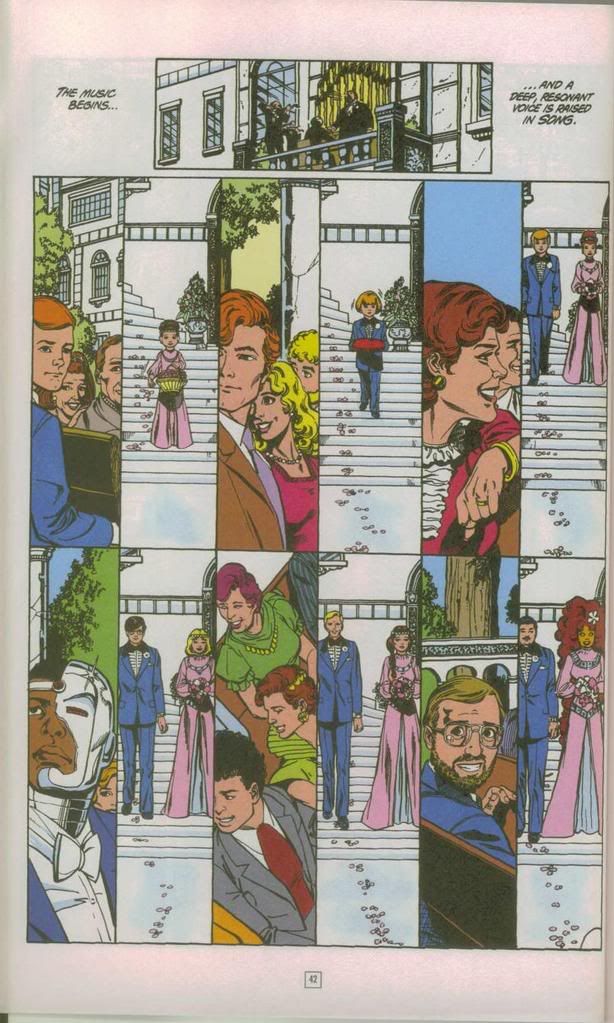
Hey Little Sister, What Have You Done: Tales of the Teen Titans #s 48-50

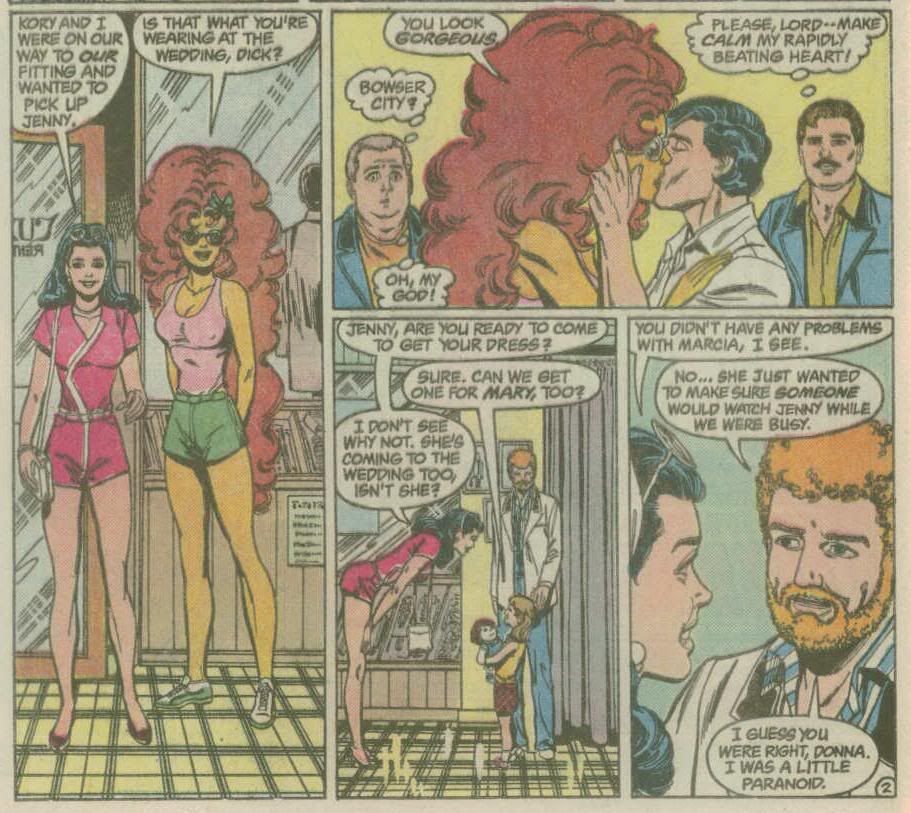
These issues are bittersweet for a few reasons. Obviously, the wedding is the apex of Donna-worship. As for Terry ... yeah, he's there too. Tales of the Teen Titans #50 also represents the conclusion of George Pérez’s first, longest, and most successful tenure with these characters. Therefore, it’s our last bit of Pérez for a while. Appropriately enough, then, Tales #48 and #49 feature guest artists Steve Rude and Carmine Infantino, respectively, doing fill-ins while Marv and George are busy with wedding logistics.

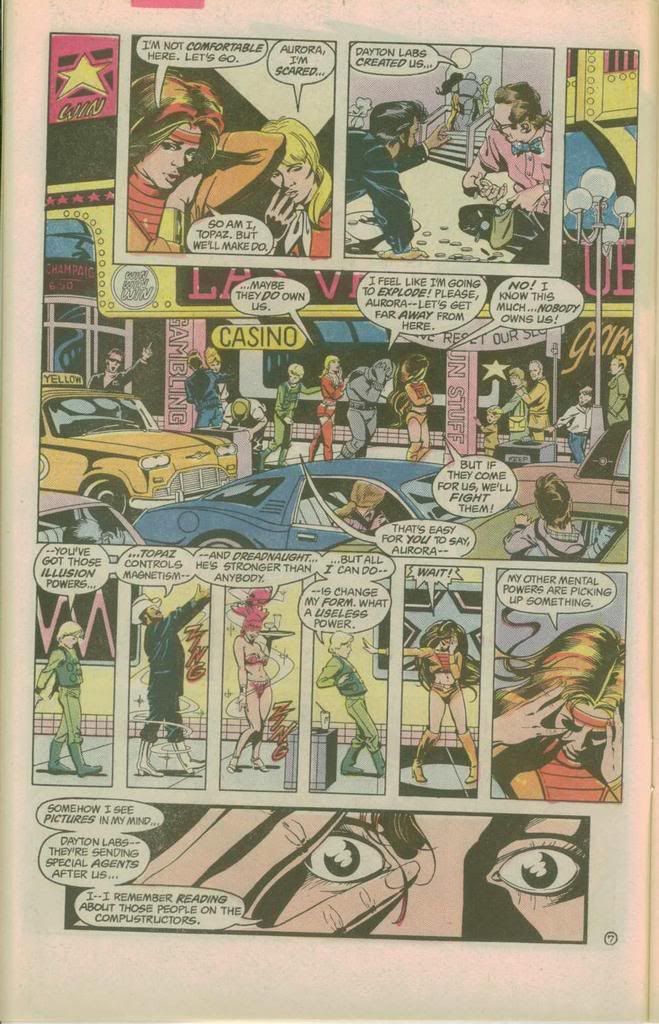
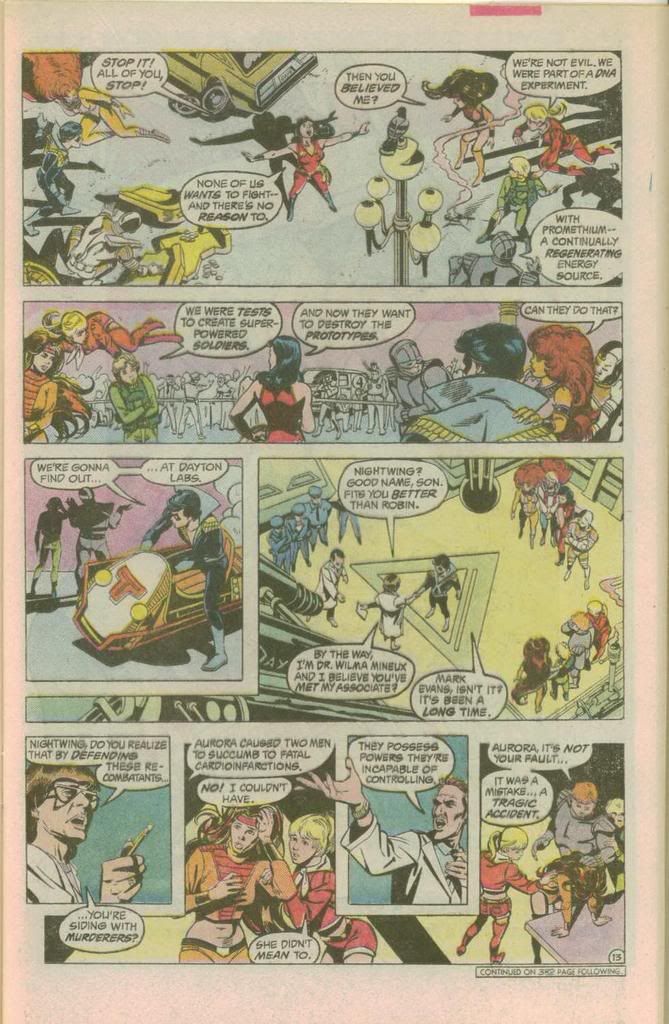
Tales of the Teen Titans #48 (November 1984) presents the "RECOMBatants," a thinly-disguised pastiche of the DNAgents, a teen superhero team from the mid ‘80s created by Mark Evanier and Will Meuginot. This was part of an unofficial Titans/DNAgents crossover that mirrored the unofficial JLA/Avengers crossovers of the early ‘70s. Accordingly, to balance things out, the Titans got to be the Squadron Supreme over in the DNAgents’ own book. How’s the story itself? Well, remember how Thunder and Lightning were misunderstood teens who didn’t ask for their powers and were forced to use them in self-defense against a world that hated and feared them? Yeah, pretty much that, plus the fact that the RECOMBatants were only a one-shot deal and therefore got to enjoy a poignant sendoff.

II suspect the main interest in this issue today is the Dude (and inker Al Gordon)’s take on the Titans, because it’s pretty far from Pérez. The lines are thicker, there are more shadows and mood, and everything is generally more fluid. Don't get me wrong -- Pérez's figures can move, and his work is very dynamic, but Rude's characters are incredibly laid-back and look a lot more weightless.

A lot of it seems to be that Rude's figures are more exaggerated than we've been used to seeing. Perez tends to let his layouts do a lot of the work, and his figures then move within their confines. Rude isn't as layout-conscious, so his figures have to make up for it. Rude is also more of a cartoonist.

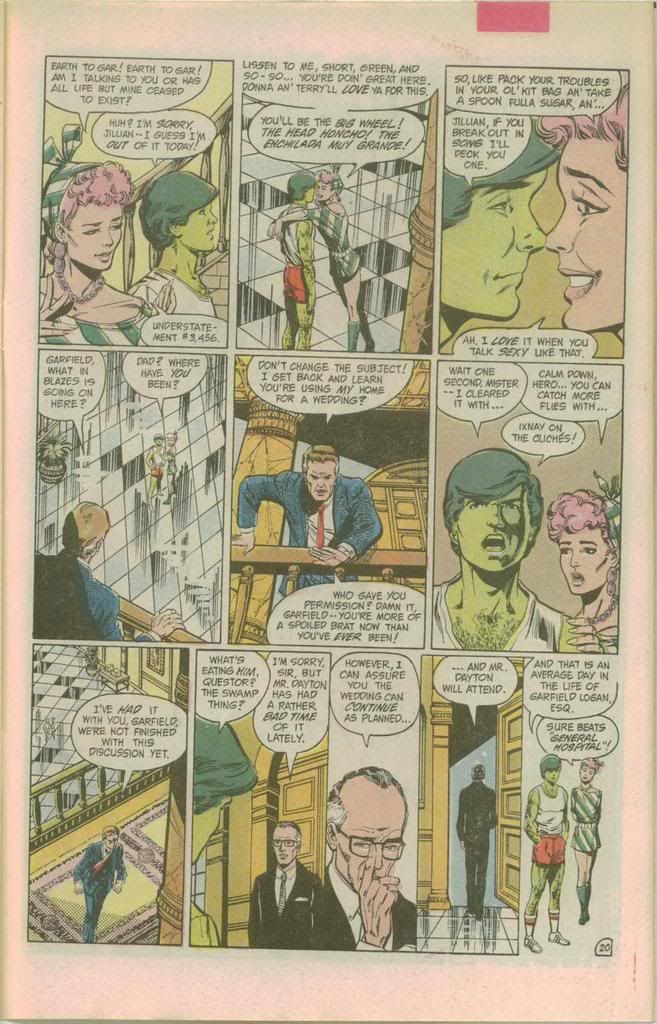
The main story is only 18 pages, leaving room for a brief set of epilogues drawn (as were the previous few issues) by Pérez and Mike DeCarlo. Gar Logan and Jillian get chewed out by Steve Dayton (who looks a lot like Reed Richards here) for letting Donna use the Dayton mansion for the wedding without his permission. Dayton also happens to know Swamp Thing, although it's not clear how.

Terry then gets a sendoff from a handful of his naughty! female students as again, Marv and George use wedding-related events to show that all of the ancillary characters are obsessed with sex. The issue ends with a short scene between Jericho and Raven, with him sensing something wrong and her warning him away.

Tales #49 (December 1984) features more shenanigans by Terry's groomsmen, the Midlife Crisis Brigade ...

... as well as the dramatic reappearance of Sharon Tracy, Donna's roommate from back in the dizzay. According to TitansTower.com, Sharon first appeared in Teen Titans #22 (July-August 1969), the Marv Wolfman-written issue that first related Donna's origin (establishing her as different from a young Wonder Woman) and introduced her red long-pantsed costume. Therefore, it's nice to see her again, hanging out with Lilith Clay (herself appearing for the first time since the Titans West days, I believe) and Diana Prince.

Didn't Gene Siskel once say his test of good characterization was whether he'd want to have lunch with the characters? Well, all the wedding subplots are fairly drama-free, so these framing sequences and epilogues are the equivalent. They're often corny, but they're still enjoyable.

The bulk of #49 concerns Wally West and Frances Kane's guerilla warfare against Doctor Light. Somehow he can turn himself into a ball of light and break into the Central City bank, but after he surrounds himself with darkness he can't stop Frances' magnetically-hurled implements of destruction. In other words, Light is just powerful enough to be a menace for about six pages. Wally spends the fight running too fast to be seen (he still has a secret identity at this point but left his costume at Titans' Tower when he retired), saving bystanders, and getting clocked by Light's invisible forcefield. Anyway, Light is eventually so bumfuzzled by Fran's attacks that he begs the cops to take him away. I used to think that Mark Waid was solely responsible for Fran's descent into psycho-hosebeast territory, but dialogue here lays the foundation for it pretty well. Frances tells Wally she enjoys using her powers, and while Wally's jokes are in the "glad you're on my side!" vein, it's hard not to think of her shrewish future here.

Turns out Wally and Fran's adventure delayed their meeting with the Flash, who's right in the middle of his murder trial at this point. Flash basically tells Wally that puberty has screwed with his powers, so that using his speed is not only harmful, it could be fatal. The issue ends with a couple of quiet scenes -- Donna and Terry relaxing on the night before the wedding, and a virtually static final page where Wally leaves a sweet RSVP on Donna's answering machine. Now, crank up the organ and cue the doves -- it's time for the Wedding of Donna Troy!

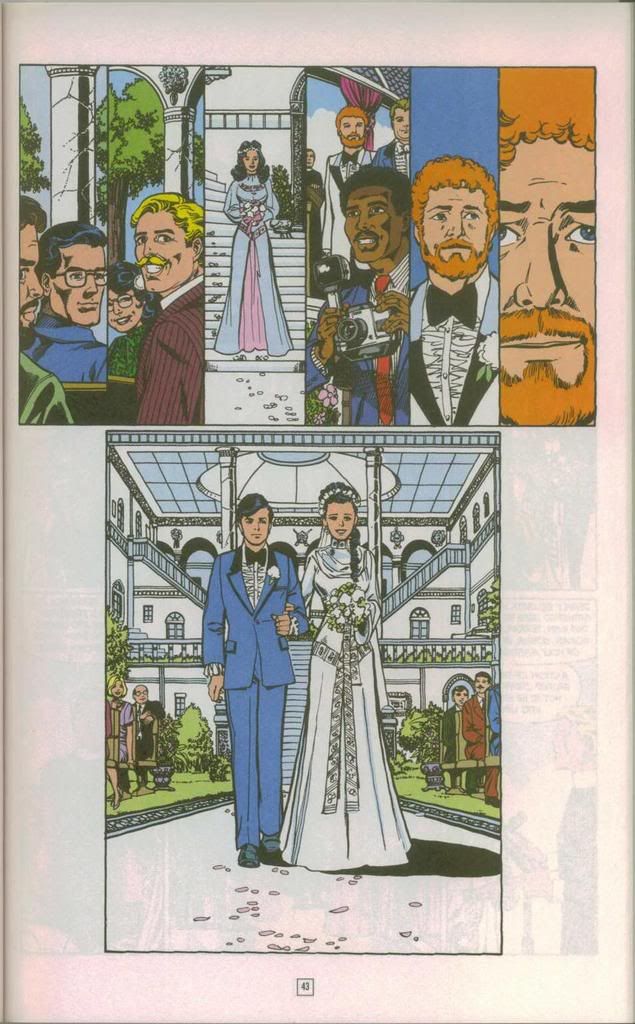
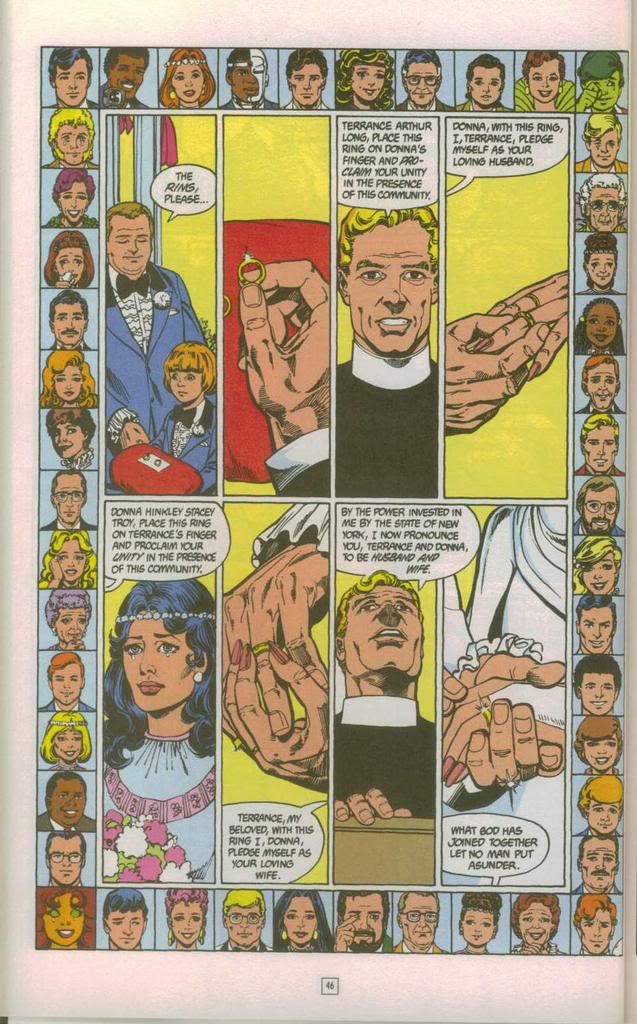
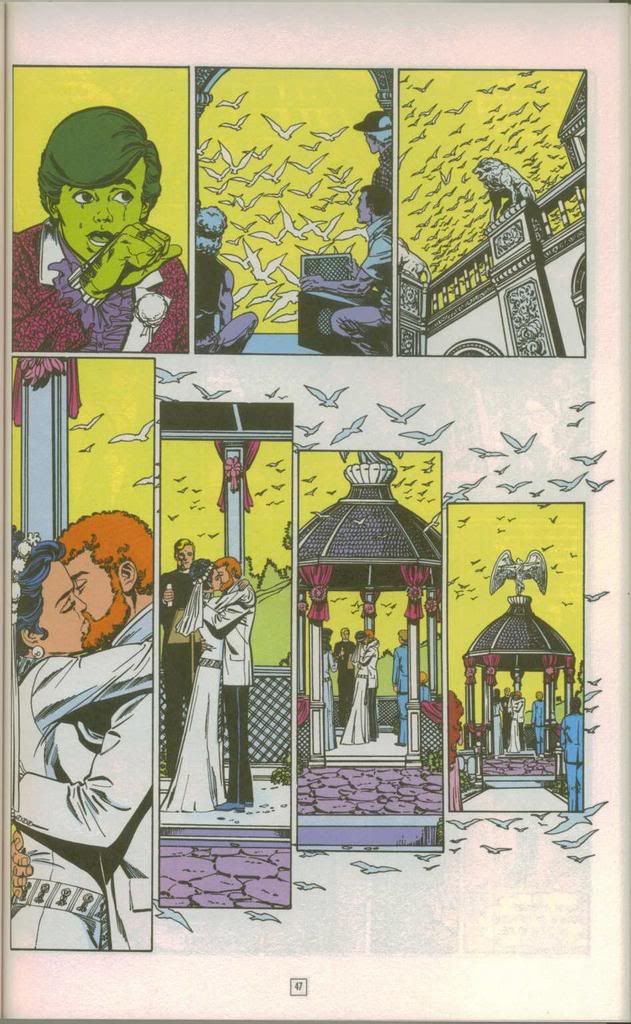
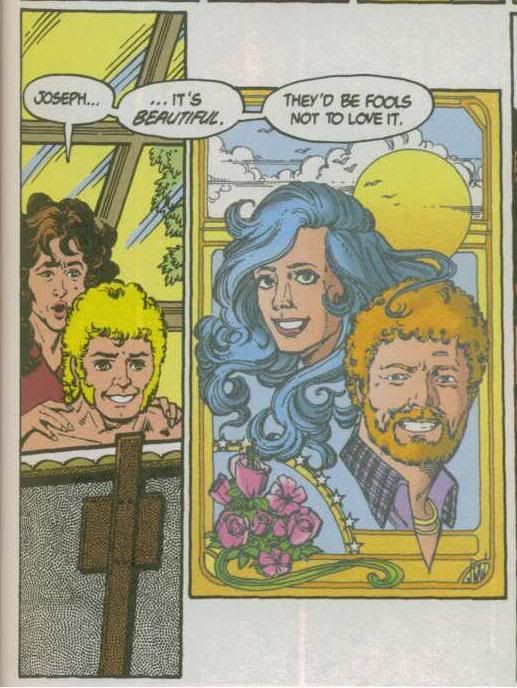
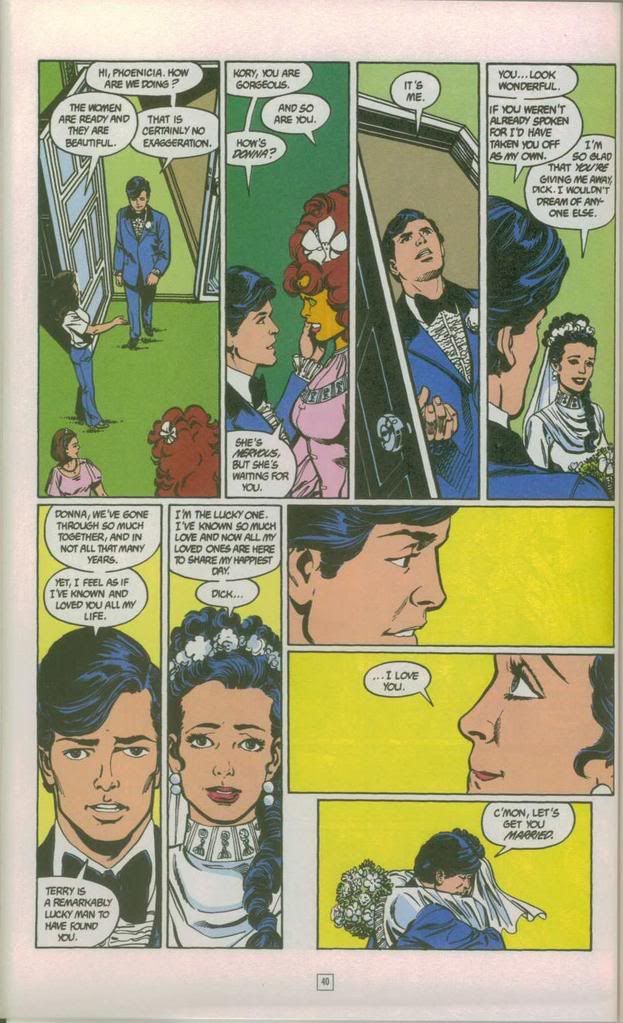
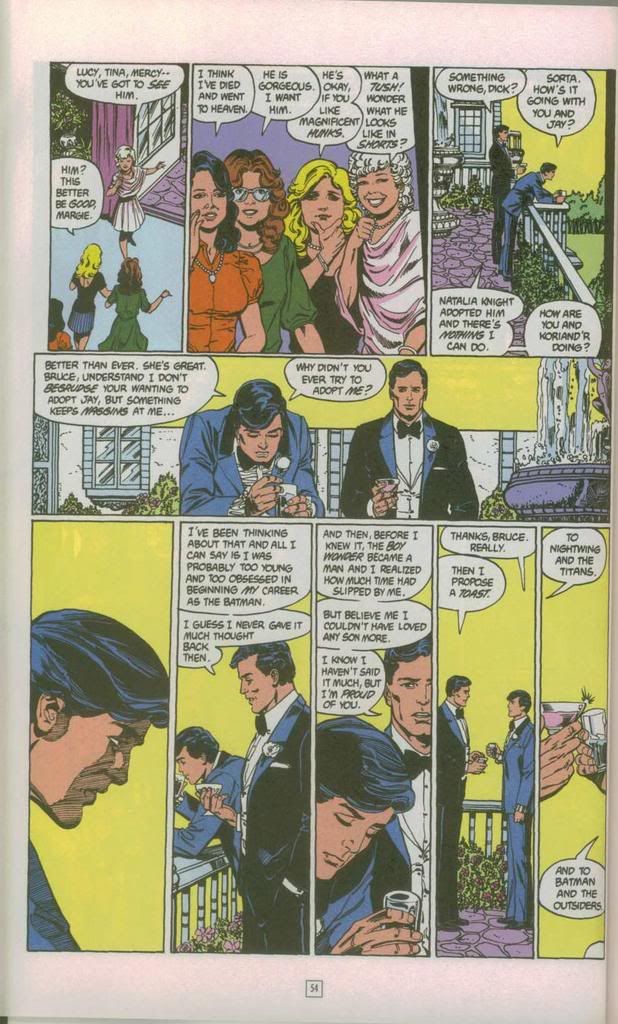
First off, Tales #50 (February 1985) is a beautiful comic. Perez says goodbye with a flourish, using his layouts to freeze time for the literally life-changing moments that deserve them. Donna's appearance at the ceremony ...


... and the happy couple's first married kiss ...


...are exquisitely framed to capture both their sweep and intimacy.

The issue builds a certain amount of tension, too, through sequences on Paradise Island meant to suggest some problem for Donna and/or Diana to solve; and through corresponding sequences at Dayton Estates suggesting someone creeping around. However, there are no supervillains interrupting this remarkably mundane occasion, just Queen Hippolyte getting special dispensation from the gods to leave Paradise Island and give Donna her blessing in person. Indeed, Donna's wedding is a fairy-tale affair after all.

The only Titan not present at the wedding is Raven, hiding in Azarath's dimension and literally afraid to show her face as she becomes more consumed by Trigon. In fact, Raven is the only costumed character in the issue, if you don't count Cyborg's armor under his tuxedo. Still, everyone else is there, clearly identified and placed in context, including most of Titans West. Some of the "civilians" don't fare as well -- Donna's family from "Who Is Donna Troy?" are all around, of course, but there's not much to help the casual reader with them. There are also a number of "insider" cameos, including Marv and George themselves and colorist Adrienne Roy. "Phoenicia," designer of the bridal party's gowns, was a friend of Perez's, and apparently a number of fans even got to see themselves drawn into the issue. I think they're ogling Bruce and Dick.


The regular cast has a lot to do, naturally. Gar shows some unexpected maturity as wedding coordinator, sublimating his continued angst over Terra's death pretty well. Vic throws a little fit when he finds out Steve Dayton's been using the Mento helmet to conceal Vic's cybernetic implants, but he and Gar make up. Joey shows his mom (in her first appearance since "The Judas Contract," so that's a little jarring) his portrait of the happy couple and, honestly, it looks like it should be on the side of a van.

Kory probably has the least to do, story-wise, but she has to share bridesmaid duties with Sharon and Diana. Dick gets to confess his platonic love for Donna, and he also caps the subplot of being "estranged" from Bruce with a warm scene that, yes, informs a similar scene in last summer's Justice League of America #0.

Those Dick/Donna and Dick/Bruce scenes are still pretty effective. Dick/Babs is the "meant-to-be" relationship now, and there was never really any hint that Dick and Donna were more than friends. Thus, it doesn't seem like much of a stretch to transfer Dick's feelings for Donna over to Babs, especially when both become unattached.

As for Dick/Bruce, talk of Natalia "Nocturna" Knight adopting Jason Todd, plus the last panel where each toasts the other and his team, places this scene squarely in the transitory mid-1980s. I never quite believed Bruce's paternal feelings towards Jason (or Tim, for that matter), mostly because pre-Crisis Jason seems to spend more time with Dick. For that matter, it made more sense to me that Bruce would feel like Dick's big brother, not his dad, so their relationship as guardian and ward were more appropriate. However, this scene defined the Bruce/Dick relationship for a whole lot of people for many years to come, and who am I to argue?

The wedding itself does have a few cringeworthy moments. Both Michael Jackson and Sting* make cameos, and depending on how you feel about the late John Denver, "Annie's Song" as the First Dance may be a dealbreaker. Also, while Dick, Joey, and Mal "Hornblower" Duncan are all shown rocking out while the regular band takes five, apparently Roy Harper no longer wishes to relive his Great Frog days.

Maybe the best thing about this issue is that it makes the wedding and reception look fun. It's the kind of shindig you wish you could put on, and if you've ever had to plan a wedding, it's the kind of party you hope you threw. The buildup to #50, and especially #49's last couple of pages, convey pretty well the crest of tension that any newlywed-to-be feels the night before. By the day of, there's nothing you can do about it: either it works or it doesn't, so just let it happen. Thankfully, Marv and George (and inker Dick Giordano, with an assist by DeCarlo again) made sure it all worked. I have to say, when I started going to my own friends' weddings a few years after this issue came out, it was always in the back of my mind. It was there too when the Best Fiancee Ever and I started thinking about our own nuptials. I didn't lobby for "Annie's Song," but I wouldn't have kicked it off the playlist.

Like I said with regard to "Who Is Donna Troy," this issue works almost despite the fact that there's not much more to Donna beyond being pretty and nice. However, the peculiar alchemy Wolfman and Perez were able to use on her has turned that around into a kind of unequivocal goodwill -- that because she's so nice, we don't want anything bad to happen to her, and we even actively wish her well. Indeed, we probably feel sorry for her that much more when she gets stuck with thankless expository 52 backups.

But that's getting too far ahead of ourselves. For now, I'm happy to let Donna and Terry enjoy their honeymoon.

Next: Rich Buckler comes aboard, Cheshire returns, and Gar gets closure with the Terminator!


*Actually, it might have been John Constantine having some fun, even if his first appearance was still a while away. He did know Steve Dayton, after all.
Full Post

Wednesday, January 31, 2007

Prison breaks

In the old days, when editor's notes rolled across the prairie like an ocean of asterisks, the superhero books would show crooks being caught and, presumably, tried and incarcerated. Later, when it was time for them to cause trouble again, they'd be shown escaping from prison because, naturally, the escape would help demonstrate how dangerous they were. An editor's note might even pop up to remind us how long they'd been in the pen.

Does anybody show that part of the process anymore? Generally speaking, do DC and Marvel track their supervillains' movements that closely, or do they just treat them as free-range bad guys who are not so much captured as temporarily thwarted? If anyone has examples, please feel free to share. I can't think of any off the top of my head, but I'm not thinking too hard....
Full Post

Sunday, January 28, 2007

New comics 1/17/07 and 1/24/07

Wow, two weeks withouth a post? Jeez, I'm sorry. A combination of factors, including the latest "successor" installment of Grumpy Old Fan, compelled me to do another double-sized weekly roundup. I'm also motivated to do some more TItans recaps. Anyway, let's get right to it.

The best book of this bunch was, no question, Criminal #4 (written by Ed Brubaker, drawn by Sean Phillips), another really great issue. Not a panel or word is wasted. For me, this story is art-house noir comics -- it reminds me of seeing a really good indie-film thrilla at the Kentucky Theater, the local art-house in my old hometown.

Runner-up is Checkmate #10 (written by Greg Rucka, pencilled by Jesus Saiz, inked by Fernando Blanco): a darn fine issue, especially considering that I couldn't remember who the Checkmate agent was supposed to be and was too lazy to look it up. If it were my first issue, I would have been just as satisfied. Considering that this is a Shadowpact crossover, that's probably what DC wants to hear. Also, Saiz and Blanco do a really fantastic job -- moody and creepy, with a nice earth-tones palette from colorist Santiago Arcas.

I was hoping it'd be Ray Palmer in 52 #37 (written by JMRW, breakdowns by Keith Giffen, pencils by Pat Olliffe, inks by Drew Geraci), and I really didn't expect my Lightray prediction to pan out, but what we got was good enough. It'll probably make more sense in the long run anyway. I don't know if I'll be able to say the same about Buddy's aliens' involvement, but there you go. 52 #38 (pencilled by Joe Bennett, inked by Jack Jadson) was a better-balanced installment, building some suspense about the return to Nanda Parbat and creating a nice bit of dread with the Four Horsemen. I would have liked a little more with Buddy and the aliens -- did they watch movies, pick their fantasy JLA, or run cheap shots into the ground on their week off?

Speaking of the Justice League, JLA Classified #32 (written by Dan Slott and Dan Jurgens, pencils by Jurgens, inks by Trevor Scott) kicks off its Tribute to 2004 with the first of two arcs originally announced for that year. This is Slott's "The 4th Parallel," featuring the Red King, an ordinary guy with the power to control probablity through manipulation of parallel universes. (Was this delayed, at least in part, by the 52 aftereffects? I dunno.) RK's scheme is somewhat hard to grasp, but Jurgens' usual stiff figures are softened well by Scott's inks. Jurgens also finished the script, I think on account of Slott's exclusive Marvel contract (right?), so I hesitate to call this one of Slott's weaker efforts, because that's not fair to him or Jurgens. Even so, not a bad start.

I don't have any particular criticism of Green Lantern #16 (written by Geoff Johns, pencilled by Ivan Reis, inked by Oclair Albert), although Hal's brief remarks about POW torture are a bit much whether they're meant to come from him or Johns. Reis and Albert make a good team, so it helps that this issue is mostly action.

Since I spent most of high school and half of college with Ricardo Villagran's inks on DC's Star Trek title, his guest art on Aquaman: Sword Of Atlantis #48 (written by Kurt Busiek) was welcome. Most of the plot concerns the old Aqua-villain Fisherman being some kind of parasite (what, another one?), with a subplot about Aquaman confronting an old failure while on a rescue mission. Villagran is less "sketchy" (for lack of a better term) than Butch Guice or Phil Winslade, but he does a good job with both the landlubbers and the undersea action. The story itself feels very prefatory, though, like it's counting on Part 2 to pull it through.

The same applies to Birds Of Prey #102 (written by Gail Simone, pencilled by Nicola Scott, inked by Doug Hazlewood). While Lois Lane and Barbara play a dangerous game of cat and mouse, in which the hunter becomes the hunted, Manhunter fights evil prison guards until ... well, she's still fighting. Wait 'til next issue.

The Spirit #2 (by Darwyn Cooke) was another good issue, although I don't have the background with P'Gell to gauge whether she's portrayed appropriately. I know that's not entirely the point of this series, but it does walk that tightrope. The issue does establish P'Gell as the Spirit's femme fatale, for whom he cares but with whom he can never settle down, and at this point in the series we're still being introduced to everyone.

Fantastic Four #542 (written by Dwayne McDuffie, pencilled by Mike McKone, inked by Andy Lanning and Cam Smith) gets the book back on track quite well. I don't mind Mike McKone, but I do think this title needs a penciller a little less antiseptic.

She-Hulk #15 (written by Dan Slott, pencilled by Rick Burchett, inked by Cliff Rathburn) was decent, but I'm not quite used to the old supporting cast being gone. Shulkie fights the Abomination with the power of her brain and some SHIELD help. We'll see.

With Omega Men #4 (written by Andersen Gabrych, drawn by Henry Flint) focusing on Vril Dox and Superman almost as much as on Tigorr and his lost love, I'm starting to think this is another backdoor prelude to DC's version of Annihilation. It's still good, but it doesn't seem so much like it's just about the Omegas.

Supergirl and the Legion of Super-Heroes #26 (written by Mark Waid, pencilled by Barry Kitson, inked by Mick Gray) offers more action, plus the slightly revised origin of the Ranzz siblings. Nice cliffhanger.

It's good that Bart does Flash-y things in Flash: The Fastest Man Alive #8 (written by Danny Bilson and Paul DeMeo, pencilled by Ron Adrian and Art Thibert, inked by Thibert). It's bad that the rest of it -- especially the just-add-water romance -- is so contrived. Maybe things will improve next issue with new writer Marc Guggenheim.

Finally, my ramble this time is about Star Trek: The Next Generation -- The Space Between #1 (written by David Tischman, drawn by Casey Maloney). This issue tells a first-season story that would have been a pretty decent first-season episode; but if you know TNG, that's not exactly a compliment. The idea of a culture with permanent records as fluid as Wikipedia offers a good opportunity for satire, and this issue hits the highlights of those opportunities. Art is sorta-kinda photo-influenced, not unlike an old DC TNG artist named (I think) Rachel Pollack. Everyone looks and sounds about like they should, but 22 pages of story obviously doesn't translate into 48 minutes of TV time, and that's the issue's biggest problem.

Pacing dooms this issue, which spends the first 3-4 pages on the mundanities of hailing the planet, establishing the mission, and beaming everyone down. It strikes me as the kind of thing that a fan would write, thinking (perhaps justifiably) that a fan would want to read it. However, that kind of initial pace can also encourage the reader, at least subliminally, to expect a more fleshed-out story -- in other words, to expect a story that would take 48 TV minutes to tell. It ends up making the more important parts feel rushed.

It also points up the differences between film and comics, which I think apply to more than just licensed adaptations. Those 3-4 introductory pages establish the away team's mission, identify their contact person, and describe (in dialogue) a weird energy surge. However, a one-page splash panel could show the away team beaming down and relate the same information through log-entry captions. The team's going to meet with the leader pretty soon; he didn't need to be introduced on the Enterprise viewscreen a couple of pages before.

Moreover, that one-page intro is something that comics can do, and film can't. It might take an actor 30 seconds to speak all the dialogue that a few captions could convey, and nobody wants to spend 30 seconds -- the length of a commercial -- on a relatively static image backed only by offscreen narration. With comics, though, the reader can digest those captions at her own pace while taking in the visual information about the planet and the beam-in from the splash panel.

Nevertheless, it seems like a lot of comics these days are so concerned with evoking the experience of film that they have forgotten, or are skittish about using, the narrative tricks that don't work for film. I know I opened this post by approving of Criminal's filmic tendencies, but the difference is its efficiency. Criminal knows how to be a good comic. The new TNG comic is inefficient (wow, sounds like the Borg, huh?) precisely because it tries too hard to capture the beats and pacing of its filmed ideal. It tries to be what it is not, and therefore fails. Infinite combinations, remember?
Full Post