Tuesday, October 24, 2006

New comics 10/18/06

Four No. 1s this week, so let's get going:

Somewhere I actually have a copy of What If #105, the issue that introduced May "Spider-Girl" Parker, but I never read the character again until Amazing Spider-Girl #1 (written by Tom DeFalco, pencilled by Ron Frenz, co-plotted by them, and inked by Sal Buscema). It's not hard to figure out what's going on, although there is the usual alt-future game of "where are they now?" In this case the future takes off from the standard Spider-Man setup, so there's not too much of a learning curve. I like Ron Frenz well enough, but here his figures and faces seem a little more angular and skinny, and it's a little distracting. Also, I halfway expected a more traditional done-in-one approach to this first issue, and while ASG #1 isn't decompressed, it still doesn't feel quite whole. Not sure if I'm coming back next month.

A lot of bloggers seem frustrated with The Authority #1 (written by Grant Morrison, drawn by Gene Ha), but I kind of liked it. It reminded me of Morrison's JLA Classified #1, which similarly spent most of its pages on something other than the Justice League. I've read the first couple of Authority paperbacks, so I'm a bit more familiar with the book, but didn't have much of an expectation going into this issue, and that might have helped. A good cliffhanger has me eager for #2, assuming I won't have lost interest in two months.

WildCats #1 (written by Grant Morrison, pencilled by Jim Lee, inked by Scott Williams) was about as busy and plugged-in as The Authority was disconnected, and honestly, it was a little disorienting. I don't mind massive infodumps generally, but this felt like I was missing a layer of references. Again, I'm moderately familiar with these characters, but not that much. I might get the paperback.

The Omega Men #1 (written by Andersen Gabrych, drawn by Henry Flint) did the most to get me looking forward to issue #2. It set up the threat, introduced the characters, put them in trouble, and left me hanging. It did take me a few pages to figure out that the flaming figure was Ryand'r and not Auron, and the choreography of the last big action sequence wasn't as clear as it could have been, but maybe I just read too quickly.

Back in the land of higher numbers, 52 #24 (written by Four Non Blondes, breakdowns by Keith Giffen, pencils by Phil Jiminez, inks by Andy Lanning) was spoiled somewhat by the revelation in Firestorm that his new JLA wouldn't get very far. Evil Skeets and his army of pirates and cyborgs was the kind of crazy I like, though. If this were my first issue of 52, I'd want to see the rest pronto. Also, Ambush Bug's room-service call was worth the $2.50.

Secret Six #4 (written by Gail Simone, pencilled by Brad Walker, inked by Jimmy Palmiotti) was a couple of weeks late getting to me, but it does get me ready for #5 coming out tomorrow. Most of it is the big fight with the Doom Patrol, which is what got me to pick up this series to begin with, but in context I'm not quite sure what purpose it served. The main plot focuses on the relationship between Scandal and her dad, and that's creepy enough -- especially the opening dinner, which (yes) I read while eating. Thanks, DC!

Like it or not, I think I'm committed to Flash: Fastest Man Alive (#5 written by Danny Bilson & Paul DeMeo, pencilled by Ron Adrian, inked by Alex Lei and Rob Lea) through the first twelve issues, or at least long enough to confirm that Bart will, indeed, be the long-term Flash. Jay Garrick's in danger, but DC won't kill him, so that's hardly suspenseful. This issue also brings back Inertia, apparently Impulse's evil twin, whose relationshp to Bart could have more ramifications for that long-term situation. That assumes Bilson & DeMeo have a plan, though. If they do, that could redeem what has been very lackluster execution so far.

Birds Of Prey #99 (written by Gail Simone, pencilled by James Raiz, inked by Robin Riggs) finishes up the Batgirl/weird Turkish assassin story from last issue (and probably before, although I only read last issue) and sets up the big changes in issue #100. With Black Canary's departure (for the JLA, I presume) capping off this issue, I get the feeling that more of a history with this book would have produced the desired emotional response. Still, I did like the interplay between the principals, and I'm eager to see #100's changes. After that, who knows?

Checkmate #7 (written by Greg Rucka, Nunzio DeFilippis & Christina Weir, pencilled by Cliff Richards, inked by Bob Wiacek & Dan Green) finishes the Suicide Squad story and, apparently, the first paperback. I think the best byproduct of this story is the firm re-establishment of Amanda Waller as her old manipulative self. The rest, including one villain's flexible approach to her late husband's memory, is just gravy. Overall, a very attractive issue, with the art being a little better defined. This creative team tends to work together a lot, and I wouldn't mind seeing it in these pages more regularly.

1602: Fantastick Four #2 (written by Peter David, pencilled by Pascal Alixe, inked by Livesay) gets the action going in earnest, bringing the Four together and setting them against Doom. The art reminds me of Keith Giffen, with its thin lines and "puffy" (for lack of a better term) figures, and that's not bad. David has a bit of fun with the 17th-century setting, as you'd expect. He turns Johnny Storm into Dorrie Evans' stalker and Doom into a Shakespeare fanboy, even going so far as to have Doom adopt a Shakespearean pun-laden speaking style.

Finally, Batman and the Mad Monk #3 (by Matt Wagner) was definitely the best of the week. As Julie Madison gets sucked into Dala and the Monk's clutches, Batman gets to be just as spooky and intimidating. Wagner does a lot with just the characters' eyes -- the Monk's are penetrating and eerie, Julie's are wide and anxious, Bruce's are thoughtful, and Batman's are blank and menacing. I can't quite see how Wagner will work the Batplane into this (it was introduced in the original story), but that's about the only negative this miniseries seems to have.
Full Post

Thursday, October 19, 2006

A to Z with the Justice League

Inspired by Scott (but not nearly as funny), here's an A-B-C for the Justice League.

A is for Aztek, Grant Morrison's fave;
B for Big Barda, Apokolips babe;
C is for Crimson Fox, sexy French twins;
D is for Doctor Fate, both her and him;
E is for stretchy Elongated Man;
F is for Fire, who's Bra-zil-i-an;
G is for Gypsy, the camouflaged teen;
H is for Hawkman -- his hist'ry's unclean;
I is for Ice (Maiden), killed in a stunt;
J is for J'Onn J'Onnz, he of the manhunt;
KooeyKooeyKooey gives our list its K;
L is for Max Lord -- who knew that he'd stray?
M is for Maxima, just like the car;
N is for Nuklon's unfortunate hair;
O is for Oracle, smarter than you;
P is for Power Girl, from Krypton-2;
Q's for The Question, conspiracy-mad;
R is for Rocket Red, husband and dad;
Superman's coming -- look up in the sky!
T is for Triumph, whose fame was denied;
U is for Ultraa, alone on Earth-Prime;
V is for Vibe, who gave up gangs and crime;
W is Wonder Woman, symbol of hope;
X is for Xotar, a time-trav'ling dope;
Y for the Yazz -- it's too bad that he's gone;
and Z's for Zatanna: won ym s'meop enod!
Full Post

Tuesday, October 17, 2006

New comics 10/11/06

I really liked 52 #23 (written by Them!, breakdowns by It!, pencilled by Drew Johnson, inked by Ray Snyder). I liked the island of mad scientists, I liked the Cult of Cain, and I especially liked the fakeout perpetrated by the cover. This is not to say I don't think Isis will make it to Week 53 alive, but at least for now everybody's happy. I had also missed Drew Johnson since he vanished from the pages of Greg Rucka's Wonder Woman a while back -- he's a good, solid artist, and he'd be a fine addition to 52's rotation.

Unlike last week, when Atom's spotlight on the digestive system put me off my salad, somehow I knew not to read Tales of the Unexpected #1 while eating. The Spectre lead (written by David Lapham, pencilled by Eric Battle, inked by Prentis Rollins) was sufficiently gory and filled with ironic punishments, but it seemed to take a while to get to the point and it wasn't as philosophical -- even indirectly -- as the recent miniseries. On the other hand, the Dr. Thirteen story (written by Brian Azzarello, drawn by Cliff Chiang) was a neat start to what looks like an enjoyable little arc. Yes, the schtick of a guy who doesn't believe in any of the fantastic things happening all around him strains credulity (appropriately enough), but this story was funny and I'd like to see more.

I think I may have mentioned my difficulties distinguishing between the two warring sides in the latest JLA Classified arc (#28 written by Howard Chaykin, pencilled by Kilian Plunkett, inked by Tom Nguyen), but I'm not that concerned about it. The zippy Chaykin dialogue really propels this story, driving home the point that the JLA needs to lie low and keep out of what can't be a good situation. Of course, the plot keeps entangling the League more and more, so that by the end of the issue, everybody's in some kind of costume, even if they're not very colorful. I have to wonder too if Superman's disguise is meant to reference Neo explicitly....

Firestorm, The Nuclear Man #30 (written by Stuart Moore, pencilled by Jamal Igle and Stephen Sadowski, inked by Keith Champagne) finds part of our happy little band attempting to infiltrate Hewitt Industries, while Jason and Gehenna check out a Hewitt lab out in the jungle. However, it all starts with a One Year Earlier prologue featuring Lorraine's announcement that she's running for Congress, and it made me wonder -- will her unabashed liberalism spark a flurry of angry letters to the editor ("Keep your politics out of my funnybook!"), or does it have so few readers that they wouldn't do anything to jeopardize its health? Anyway, that only lasts for a few pages, and the rest is some genial skullduggery on the part of Lorraine, Martin, and Mikhail, compared to some sweet-but-slightly-creepy flirting between Jason (who's 19) and Gehenna (who has the body and mind of a 17-year-old but who's chronologically only 6). I don't see this book on DC's January schedule, and I hope it's just a temporary hiatus.

Green Lantern Corps #5 (written and pencilled by Dave Gibbons, inked by Michael Bair) focuses on Guy's shore-leave misadventure, but takes an abrupt turn away from it to put Guy in the middle of another assignment, on a living-city planetoid with a newbie Lantern. The issue also catches up with some other ongoing subplots, including Soranik Natu getting some closure thanks to Mogo. That last contains an unfortunate visual transition from Mogo's globe to Soranik's ... globe. It could have been just a Watchmen-inspired pun, but it's still disturbing. Anyway, I'm interested to see how, or even whether, Gibbons will draw these threads together. I was looking forward to Guy pounding on Bolphunga once he got his ring back, and I got something else entirely.

Finally, it's a few weeks late (for me, at least), but She-Hulk #12 (written by Dan Slott, pencilled by Rick Burchett, inked by Cliff Rathburn) was pretty good. If you've read it, you know about the climactic revelation, so I'll just say that Slott and Burchett (and Rathburn too) are very complementary, much like Slott and Ty Templeton were on Spider-Man/Human Torch. Also, the revelation was explained so well that even I, the casual Marvel reader, could appreciate it.
Full Post

Tuesday, October 10, 2006

New comics 10/4/06

Yeah, yeah, I should have done these over the weekend, but 1) most of my family came to visit, and 2) TEN INCHES OF RAIN on Friday and Saturday.

I did like 52 #22 (written by You-Know-Who, breakdowns by Him Again?, pencils by Eddy Barrows, inks by Rob Stull) and its focus on Doc Magnus doing science-fu to get away from the bad guys. The Luthor/Supernova bit at the beginning was okay, I suppose, but I'm getting a little bored with the mini-mysteries. Also, whither Batwoman?

Actually, she does warrant a mention in this week's Detective Comics (#824 written by Paul Dini, pencilled by Don Kramer, inked by Wayne Faucher), featuring the return of the Penguin. Add in the Riddler, Zatanna, and Lois Lane, and it's practically a Marvel book, or maybe a Jeph Loeb one. It's a cute story overall, and I guess with the Penguin it's hard not to be cute on some level. Kramer and Faucher are fine Bat-artists -- nothing flashy, which again fits the story's attitude. I did wonder if Zatanna had dislocated her hip in a couple of panels, though.

The (All-New) Atom #4 (written by Gail Simone, inked by Trevor Scott) welcomes new penciller Eddy Barrows for a transitional story between last issue's Giganta cliffhanger and a new direction about how Ray Palmer's quantum experiments turned Ivy Town into a weirdness factory. I liked this issue well enough, but I will say that in light of its emphasis on Giganta's digestive system, reading it while eating dinner was a mistake. Still, Ryan Choi gets to do some traditionally Atom-style heroics, and the bit about Ivy Town's different neighborhoods should be good for several months' worth of stories. Art was fine -- Barrows, like Don Kramer above, isn't too flashy, and I agree with other bloggers who see a certain "DC house style" developing. Barrows is no John Byrne, but neither is he *John Byrne!*, if you know what I mean.

I picked up Nightwing #125 for Marv Wolfman's big return to the character (with Dan Jurgens pencilling and Norm Rapmund inking), and got a perfectly serviceable superhero story about ... really, a guy who flips and swings around Manhattan fighting a flying bad guy in battle armor, and then having to explain his bruises to the hott women throwing themselves at him. Typing that out makes it sound like an old-school Daredevil issue, and really, it maybe could have been. Except for some bits about Bruce Wayne and an intriguing meta notion that Dick should have died in Infinite Crisis, nothing about this seemed unique to Nightwing. More to the point, it didn't feel like Marv Wolfman telling us readers why we should see Nightwing as more than a Daredevil knockoff. I'm going to give Marv a chance, but come on -- for years the book was I Don't Want To Be Batman and now it's Generic Acrobatic Guy? There's gotta be a happy medium.

So, Marvel still publishes Fantastic Four, huh? FF #540 (written by J. Michael Straczynski, drawn by Mike McKone) apparently fills in some Civil War gaps to chronicle the no-takebacks breakup of the Richards' marriage, and also Reed's misguided attempts to set Peter Parker on the right law-abiding path. If you're reading the rest of CW, maybe it means something, but like last issue's crossover, it just leaves me a little cold. I don't feel like JMS has laid the groundwork for the breakup sufficiently in this book, so that although the senses-shattering events of CW might have blindsided the team, they still should be understandable to the readers. Also, I'm sure I'm not the first person to point this out, but this is the guy who stole a rocketship all those years ago, now lecturing his colleagues on the importance of the Rule of Law? I can see Reed's current point, and the guilt backing it up, but I think he'd find it easier to live in a world where sometimes you gotta steal the rocketship.

Beyond! (#4 written by Dwayne McDuffie, drawn by Scott Kolins) and Agents of Atlas (#3 written by Jeff Parker, pencilled by Leonard Kirk, inked by Kris Justice) both continue to be bewilderingly fun comics. I'm sure they are more enjoyable the more Marvel knowledge you have, but I like them just the same. I'm reserving more comment until I have more time to read them all in a lump.

Marvel Adventures: Spider-Man #20 (written by Peter David, pencilled by Mike Norton, inked by Norman Lee) is the big Hawkeye/Frankenstein Halloween issue, and it works out about as well as you'd expect. I don't remember any "Hawkeye is dead" jokes, which tells me that the book really is intended for the continuity-challenged. It's all a bunch of smartaleck comments and "hey, nice costume!" gags instead, and it comes together pretty well.

Finally, I picked up Criminal #1 (written by Ed Brubaker, drawn by Sean Phillips), and I really don't think I devoted enough time to it. I liked it well enough, although hard-boiled noir is not exactly my most favorite genre. I found the beginning a little hard to get into (specifically, trying to see if the narration was supposed to match the pictures) but maybe I was trying too hard. Still, I like Brubaker and Phillips, and I liked Sleeper, so we'll see. It certainly seems like it will reward multiple readings.
Full Post

Tuesday, October 03, 2006

New comics 9/28/06

Picking up a spare from last week, here's Checkmate #6 (written by Greg Rucka, Nunzio DeFilippis, and Christina Weir, pencilled by Cliff Richards, inked by Dan Green), the first part of a Suicide Squad reunion. To my eternal shame, I have read exactly two Squad stories -- the JLI crossover, and the "What About Ray Palmer?" arc -- so that probably dulled some of the emotional impact for me. Yes, I know it was the height of badassery. Filled with shame, remember? Still, even I thought this was a pretty decent comic. It juggled the book's ongoing subplots, brought readers up to speed on the Squad, and wove the two together with the aftermath of Villains United. That's pretty ambitious, but the book keeps it all straight for the most part. The same isn't true for the art and coloring, which are still a bit muddy. With all the sneaking around and fighting, the choreography gets a bit confused. It's a bit hard to work up sympathy for a group of fairly unrepentant villains, so I suppose we're supposed to be concerned about whether the Squadders will sink Waller.

Justice League of America #2 (written by Brad Meltzer, pencilled by Ed Benes, inked by Sandra Hope) was frustratingly good. I enjoyed it overall, but some parts creeped me out (Red Tornado sex?!?) or didn't make sense. The latter includes an exchange about how former Leaguer Dr. Light, who shares a name and costume with a rapist the League mindwiped, would "scare" criminals. There's an innocuous explanation, apparently, but it involves knowing these characters' shared history, which I didn't, and which I especially wouldn't expect the new readers sucked in by Meltzer's novelist cred to know. The other bit of "huh?" is the continuing fantasy-football draft the Big Three are holding in the Batcave while, apparently, the rest of the putative League is assembling itself.

Superman is, of course, intimately involved in the assemblage of a rag-tag bunch of combat-happy Joes over in Action Comics #843 (written by Kurt Busiek and Fabian Nicieza, drawn by Pete Woods). Once I got past the unfortunate use of slang on the cover, which is charming in the manner of a well-meaning mistranslation, I enjoyed the inside. Busiek's hero-worship stories are mostly effective, albeit unsubtle, but with Superman it seems appropriate. Besides, it's not just making people feel better about Superman -- as we're often reminded, Superman is supposed to uplift everyone else as well. Accordingly, hugs all around, or at least a laurel and hearty handshake from POTUS. Now, on to Geoff Johns and Richard Donner.

Hugs are in short supply in Batman #657 (written by Grant Morrison, pencilled by Andy Kubert, inked by Jesse Delperdang), which recovers nicely from a somewhat disorienting opening -- didn't we end last issue with Batman captured by Talia? -- to tell a very fun story about Damien's competition with Robin. The cynic in me doesn't expect Damien to stick around past next issue, and that's a shame, because the kid carries a lot of insight into his dad's childhood. This includes the notion, advanced countless times in the past twenty years, that Bruce became Batman the moment his parents were murdered. Granted, Damien is more a teenage Azrael than a teenage Batman at this point, but Morrison has crafted a very pulpy adventure infused with darkly funny sitcommish moments. By showing that Batman can turn his "scary face" off and on at will, Morrison gets to what I think is one of the great unexplored elements of the character's personality -- the concept of "Batman" itself as posturing, even theater. The phrase "created a monster" seems especially apt....

And that's a good segue into 52 #21 (written by GGGM, breakdowns by Keith Giffen, pencilled by Joe Bennett, inked by Jack Jadson), showcasing Lex Luthor's new team of homegrown heroes. I'm not sure I got a lot out of this issue beyond also wanting Trajectory to be the new Kid Flash, and enjoying Ralph and the Fate-Helmet's trip into Lovecraft-Ditko land. It was well-executed, but it just kind of left me cold.

Supergirl and the Legion of Super-Heroes #21 (written by Mark Waid and Tony Bedard, pencilled by Barry Kitson and Adam DeKraker, inked by Rob Stull) was fun, showing Karate Kid's strategery at romance. A subplot with Sun Boy's new team against a Super-Skru-- er, Super-Dominator looks promising too.

And speaking of fun, Batman and the Mad Monk #2 (written and drawn by Matt Wagner) was just as good as I'd hoped. Mix lurid cult activity with schoolgirl outfits and it's not just a recipe for increased Google traffic, it's a roadmap to a p.o.'ed Batman when Dala and her boss get their claws into Julie Madison in a couple of issues. Batman spends most of this issue detecting and having foreshadowing conversations with Harvey Dent, but the last page promises a beatdown. I'll definitely be there when it arrives.

Looking at the human-sacrifice pages of Mad Monk made me wonder how Howard Chaykin would have handled that story, and I'm not just saying that to transition into Hawkgirl #56 (written by Walter Simonson, drawn by Chaykin). It's Chaykin's last issue, so it wraps up the oddly-sexualized-villain plot that's been meandering through the book since this team took over. Basically Hawkgirl flies around fighting said villains and trying to save the Steve Trevor-figure from being eaten by them. I think I finally get Simonson and Chaykin's over-the-top take on this book, so I'm giving next month a chance, mainly because both of them together produced a dissonance that they wouldn't have separately. In other words, with a less flashy artist, I think Simonson's pulpish tendencies would be complementary.

Finally, Captain America #22 (written by Ed Brubaker, drawn by Mike Perkins) does a lot of good with its Civil War setup. Basically Sharon Carter has to choose between her loyalty to SHIELD and her lurve for Cap, and while that might sound rather tired, it's handled well. It's the focus of this issue, but one senses it's not the point of this little CW-related arc, especially with the Red Skull still lurking. Also, Cap and Sharon have a "serious talk" that begins with them on a rooftop and ends with clothes being put back on, which as it turns out completed this week's trifecta of superhero sex (creepy fleshy Tornado sex in JLA and Bat-Sex implied in this month's Mad Monk). Unfortunately, Cap doesn't get to then fight SHIELD troopers in faux-Iron Man armor. Maybe next issue.
Full Post

Sunday, October 01, 2006

Night of the Living Book Meme

This is an old meme, but Plok got tagged in August while he was on vacation, so he didn't tag me until last week. Also, just for the heck of it, I'm sticking to print-only books. Enjoy the nostalgia!

One book that changed your life:

Honestly, the Bible -- and if you want to hear more about that, let me know -- but on a less macro level, it's a tie. Both Michael Fleisher's Encyclopedia of Comic-Book Heroes, Volume 1: Batman and David Gerrold's The World Of Star Trek examine, in different ways, the effects of details on a serial work. (Kind of like a Bible commentary, come to think of it....) I devoured both at an early age, when my brain was eager to make sense of all sorts of things. With the combination of Gerrold's intellectualism and the Fleisher book's nitpicking, in hindsight it was inevitable I'd be on a site like this talking about these books.

One book you've read more than once:

The Right Stuff, by Tom Wolfe. Man, I love this book, from its epic sweep to its use of language and its undeniable wit. I probably read it every other year, and it never loses any of its power.

One book you would want on a desert island:

I'm probably cheating by counting The Lord of the Rings as one book, but that's how it was written, right? (The Hobbit would be pushing it, and The Silmarillion would be right out.) Please forgive the nerdiness of this choice. It's dense enough to withstand multiple readings and back-to-front analyses, so it'd keep me busy whiile I fought off polar bears and looked for that stupid hatch....

One book that made you laugh:

Joe Bob Goes to the Drive-In, by John "Joe Bob Briggs" Bloom. I feel certain that most folks reading this are familiar with Joe Bob's particular brand of redneck criticism, but it was never as potent as in this first book. Blending B-movie reviews with satire, a lurid personal life, and people who just didn't get the joke, Joe Bob showed that sometimes all you want to know is the amount of boobs, blood, and twitching dead bodies. I don't know if it's still in print, but it's worth the search just for the Terminator review. Tom says check it out.

One book that made you cry:

Seabiscuit, by Laura Hillenbrand. It's a sappy story, but at the same time Hillenbrand tells it with convincing vigor. Even the high points carry with them the creeping dread of tragedy just around the corner. Those tragic parts didn't make me misty, though -- it was the end. Knowing that the players endured so much, and achieved so much, and feeling their joys and pains, I was sorry to see them just fade away. At the same time, I was glad to have shared, however indirectly, in their amazing stories.

One book you wish you had written:

The Amazing Adventures of Kavalier & Clay, by Michael Chabon. Actually, I want to write the Silver Age account of K&C's lives. Chabon did such a great job fitting their stories to the arc of the Golden Age, I was waiting for the return of the Flash and the birth of the Fantastic Four to breathe new life into their comics careers.

One book you wish had never been written:

I'm not really a hater, so this was not an easy as you'd think. I guess it would be The Bridges Of Madison County, by Robert James Waller. Had it never been written, I would never have been tempted to read it, in a so-bad-it-must-be-good mindset. Actually, this booby prize should probably go to its wretched follow-up, Slow Waltz in Cedar Bend, which I was sure had to be so bad, etc. No, it was just bad.

One book you are currently reading:

Thunderball, by Ian Fleming. To prepare for every new Bond film, I watch all the existing ones in order; but since Casino Royale is the last Fleming book to be "officially" adapted, I decided to re-read all the Fleming novels (and short story collections) as well. Thunderball is also a kind of nexus of literary and filmed Bond, being (I think) the last book published before the movies hit.

One book you have been meaning to read:

For about ten years I've been meaning to finish Godel, Escher, Bach, by Douglas R. Hofstadter. It's a meditation on (probably grossly oversimplifying this) repetitive structures and how they relate to Bach fugues, Escher drawings, computers, and Lewis Carroll. Maybe next vacation, if The Right Stuff doesn't tempt me first.

I feel like everyone else has been tagged by this point, so if Carla, Marc, Johnny, Vincent, and Iamza are interested (and apologies if you've already done it), knock yourselves out!

Full Post

Sunday, September 24, 2006

New comics 9/21/06

The homage to a classic Detective cover convinced me to pick up Birds Of Prey #98 (written by Gail Simone, pencilled by James Raiz, inked by Robin Riggs). For "Part 3" of a story, it feels a lot like a Part 1, and that's good for us returning readers. Some ice-queen assassin gets out of jail and proves her badassery pretty quickly; meanwhile, Black Canary, Oracle, and Huntress (a trio that always seems TV-mandated to me) have to deal with two new characters -- a precocious little girl and a [SPOILER!] superpowered teenager with a Batgirl fixation.

I rather liked it, except for a couple of technical details. First, early in the first Babs/Dinah/Helena scene, an unattributed narrative caption made me a) hunt for the speaker, assuming she were in the scene; and b) wonder whether a good old-fashioned thought balloon might not have been clearer. Indeed, if anyone could rock the humble thought balloon back into fashion, I'm sure Ms. Simone would be at the top of the list. The other thing happens towards the end of the BC/Batgirl fight, when someone wearing a yellow glove punches someone else about fifty feet. Context indicates it's probably BC punching Batgirl, which doesn't make much sense by itself; but Batgirl's got the powers and the yellow gloves. Anyway, I'm coming back next month.

To me, the big reveal about the Emerald Eye in 52 #20 (written by the Four Tops, breakdowns by Keith Giffen, pencils by Chris Batista, inks by Ruy Jose) came off a bit bluntly. It's basically a sight gag, so repeating it just feels like Jay Leno milking a punchline. As for the Supernova and Steel scenes, honestly I had to keep reminding myself they were even in the issue. With no omniscient narrator -- and, in fact, no narration at all except Montoya's internal monologue, which I think has also faded away -- it's hard to connect the three disparate story threads. However, I don't think that's the point. If there were an omniscient narrator, I think it would sound something like the bratty kid my sister and I babysat one night with Back to the Future. He and I had seen the movie, but my sister hadn't, so the first 20 minutes was filled with him exclaiming "Okay, remember that tree! Remember that truck! Remember the clock!" By contrast, 52 clearly wants to be more subtle, so at the very least we are subliminally reminded of Supernova in the Batcave and Steel getting slowly back into the superhero game.

I was well into Superman #656 (written by Kurt Busiek, pencilled by Carlos Pacheco, inked by Jesus Merino) when I started to sympathize with the super-beast trying to beat the tar out of our hero. Sure, he was an unstoppable violence factory, but it wasn't his fault. Therefore, I suppose it would be an inversion of my expectations for Subjekt-17 to turn out irredeemable, after all, and not some familiar type of "there is honor in you, Kryptonian" space-gladiator. Superman's cognitive dissonance at having to take such a hard line with S-17 was also appropriate. Still, Superman speaks how many languages now; and can modulate his whistles to specific frequencies...? Oookay. Regardless, the story itself was fine, even if more of the fun parts were in flashback (giant trilobite! "Super-Boy!") Art was gorgeous, as usual.

If The Flash: The Fastest Man Alive (#4 written by Danny Bilson and Paul DeMeo, pencilled by Ken Lashley, inked by Walden Wong) is improving, it's gotten up to "adequate." Last issue's fill-in art was open and expressive, but now that we're back to Ken Lashley's overly busy pencils, the book feels cramped again. I did appreciate keeping the Rise And Fall Of "The Griffin" to pretty much this issue, even if his rise seemed a bit too quick and easy. The explanation of Bart's relationship with the Speed Force wasn't unexpected, and it feels almost like the setup that made sure Kyle Rayner was the only one who could channel Oan power. Overall, the book seems to be setting up a certain status quo for Bart to be the Flash. If that's the case, I won't stay with this title for much longer, because so far nobody's convinced me that Bart's adventures are worth my $2.99 every month. However, if the "secret of the Speed Force" ends up empowering additional speedsters, or even bringing some back, I'd be more interested in that. I'm still not sure the "don't get used to the first Flash you see" thing has played itself out yet.

Finally, yes, Nextwave (#8 written by Warren Ellis, drawn by Stuart Immonen) is love. Who wouldn't want to see Mindless Ones doing West Side Story routines? The satire, if that's how it was intended, maybe got a little thick once the Mindless Ones started shopping, dining, and watching "American Idol," but judging from the last page's captions, I think Ellis and Immonen know to keep the overt intellectualism in the background. Also, I started to feel a little sorry for Rorkannu once the Captain shoved his head in the toilet, but that's probably just me comparing him to Phil, The Prince Of Insufficient Light.
Full Post

Saturday, September 16, 2006

New Teen Titans #s 39-40 and Tales of the Teen Titans #s 41-44 and Annual #3: "The Judas Contract"

"The Judas Contract" tends to stick in my mind, and maybe in yours too, as a standalone epic. That may not be entirely accurate. It details the mechanics of Terra's betrayal, and throws in a few origins to boot. In that respect it’s a decent thriller with a nice chunk of Titans history. In the longer view, though, "TJC" and the three issues that precede it are about potential.

The plot of those first three issues is pretty simple. In The New Teen Titans #39 (February 1984), behind one of my all-time favorite covers, the Titans raid one of Brother Blood's outposts and learn he's planning to influence Congressional elections. Later, after a couple of scenes between Terra and Deathstroke that define their partnership (to say the least), Terra attends the meeting where her teammates finally reveal their secret identities to her. At that same meeting, Wally West retires from superheroics, and Dick Grayson retires from being Robin.

This doesn't stop the Titans (in The New Teen Titans #40 (March 1984)) from (once again) infiltrating Blood's headquarters and trying to stop his electioneering. However, the plan goes funny and a disguised Dick is mind-controlled by Blood into betraying his friends. In Tales of the Teen Titans #41 (April 1984), the Titans escape, mostly thanks to Terra, but are captured again, and Dick is trotted out again, only this time Blood wants him to throw the kill switch and he resists. By then, though, the president of Zandia has had it with Blood, and the Zandian army attacks Blood's headquarters. Blood once again appears to be martyred, and once again it looks like that's what his plan was all along.

We're not going to spend a lot of time on the Blood stuff, because (a) it covers much of the same ground as the introductory Blood arc, and (b) it has almost nothing to do with the underlying Terra story. I will point out that the first Blood arc saw Robin tortured by "The Confessor," which I thought was named after an old Joe Walsh song, and here Dick disguises himself as ... Joe Walsh. Somewhere there's a Glenn Frey joke struggling to get out....

Regardless, the Blood issues are something of a payoff for the Brotherhood of Evil/Zandia/Bethany Snow threads which had been given various shades of emphasis over the past year or so, and I can see how it fits into the series thus far. Even so, I get the feeling that it is more of Wolfman and Pérez winding up the subplots they'd begun over the book's first two years, clearing the decks for what's to come.

"The Judas Contract" itself has four parts. Part 1 (issue #42, May 1984) is told mostly from Tara's perspective, showing the reader how much she hates the Titans. Part 2 (#43, June 1984) is told in flashback, after Dick survives Deathstroke's attack and reconstructs how the other Titans were captured. Part 3 (#44, July 1984) gets into the origins of the Terminator, as told by his ex-wife Adeline; and also introduces Nightwing and Jericho. Part 4 (Annual #3, 1984) is the big finish, as the two "new" Titans rescue the others, Terra meets her fate, and the rest of Deathstroke's past is revealed.

[A brief note about the change in the book's title: if you don't know the history already, essentially it had to do with the launch of a second New Teen Titans book, and the change was just to avoid confusion. More later, when we get into those stories.]

In hindsight, the Terra storyline doesn’t try to fool the reader too much. Almost from the beginning, the Titans saw the holes in Tara’s backstory, but they never quite put all the pieces together. As shown by the Trident story, the group relied for its deductions pretty heavily on Robin, who was too distracted by his own personal issues to vet Tara in any meaningful way. Dick’s big detective moments in those prefatory arcs came in Annual #2, when he figured out Adrian Chase was still alive, and #38, when he tracked down Donna’s family.

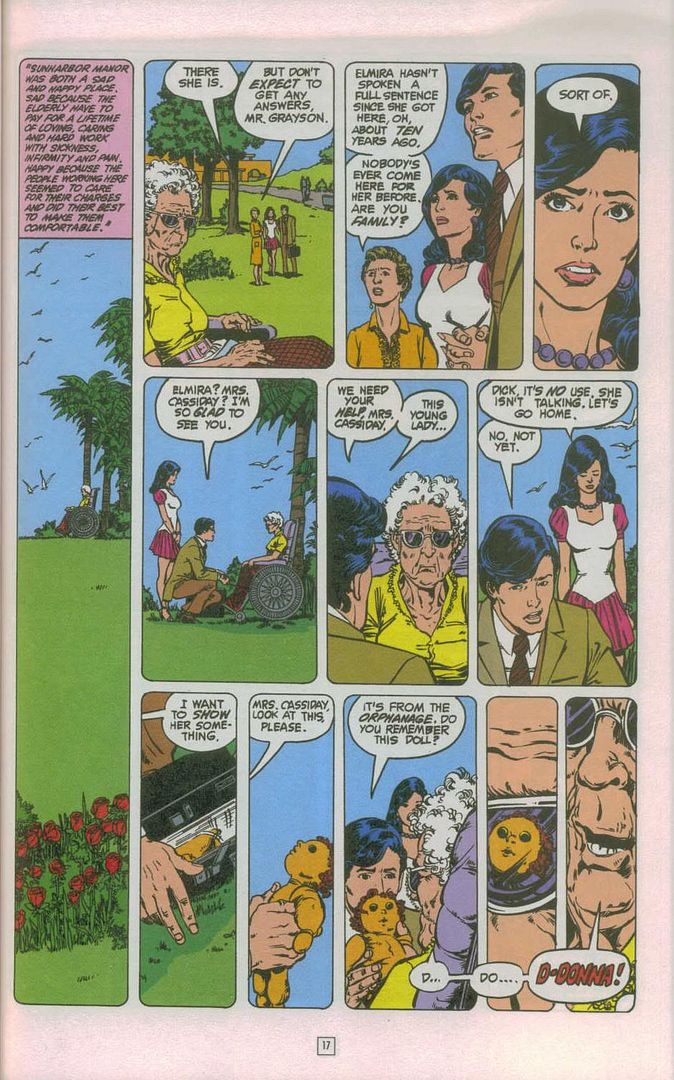
Indeed, in the longer view, "Who Is Donna Troy?" works as a decent capper to thirteen months’ worth of subplots and drama. It’s not only a chance for Dick to relax and throw himself into a personally fulfilling case, it’s also a tantalizing look at what Dick might have uncovered if he’d put as much effort into Tara’s background.

Of course, this plays into the overall theme of "potential." Dick can’t investigate Tara because he’s been pulled in various directions for too long. The development of "Nightwing" thus allows Dick to concentrate more fully on leading the Titans. However, although Dick does put together the pieces of the Titans’ capture, it’s a little troubling that Adeline Wilson has to fill in the crucial factor of Terra’s betrayal. It’s a failure of imagination, perhaps; and perhaps also one that Dick’s harder-edged mentor would not have made. As of the Titans/Outsiders crossover, Batman hadn’t unmasked to his team yet. Still, that’s hindsight too, and probably not as accurate as we’d like to think.

It does illustrate the extent to which the Titans trusted Tara, even in light of her story’s holes. Indeed, as Tara points out, Raven tried to kill Kid Flash and the Brotherhood of Evil at various points in the recent past, and by extension might well have gone after the Titans themselves if Trigon’s nature had manifested itself any further.

Thus, Raven’s potential is pretty grim. Likewise, one of Starfire’s prominent traits has been her desire to cut loose and unleash her warrior spirit. The Titans have had to restrain her natural urges out of necessity, and she must now maximize her effectiveness within those limits. Cyborg tests his potential pretty explicitly in a workout scene in #42, trying to push his metal parts past their stated limits by developing what remains of his own muscles. Changeling’s potential manifests itself in his embryonic romance with Terra. (In fact, she encourages him in #42, saying "[the] only time anyone's better 'n you is when you let 'em be.") Wonder Girl has a similarly bright future with her fiance, but this arc sees her potential more as team leader. Even Deathstroke, the villain of the piece, draws his abilities from maximizing his brainpower.

That leaves the two Titans who depart the team in this arc, Kid Flash and Terra. Both are, arguably, the most powerful Titans -- Wally because, even slowed down, he still has all the powers of a Silver Age Flash; and Terra, because Wolfman and Pérez have given her almost limitless control over not just earth and rocks, but vulcanism too. Those extreme power levels are compared and contrasted, implicitly in Wally’s case and explicitly in Terra’s.

For Wally, his speed is the underlying reason behind his leaving the team -- he’s too powerful to be used effectively. He misses the simple life of being a college student in Blue Valley and hanging out with his girl Frances Kane (who also chooses not to use her own powers), but we know that he can travel between Manhattan and the Midwest in an eyeblink, without breaking a sweat. This says two things about Wally: first, his "I wish I were home" schtick is either short-sighted or disingenuous; and second, if he’s so fast, why isn’t he more effective in a fight?

Both of these issues are handled by Marv and George’s notion that Wally is losing his speed (something that will be explored in much more depth years later, in Wally’s solo series), making his decision to leave the team more of a practical matter than an emotional one. Regardless, the bottom line is that, in dramatic terms, Wally has great potential and is unwilling to explore it (again, see Baron, Messner-Loebs, and Waid on Flash); and in real-world terms, his potential is so great that exploiting it fully would overshadow the rest of the team. Either way, Wally has to go. (I still say he could have come back as Dick’s secret weapon for the big finish, but maybe in the animated movie....)

Terra’s great sin is not really her betrayal of the team, although that plays into it. Instead, it’s her choice to let her hatred control her, and thus to let the beneficial aspects of her powers go to waste. Wolfman writes a pretty fantastic eulogy for Terra on the last page of her life, and we'll get to that shortly. It stays just on the good side of florid and really drives home the point that Terra’s hatred should be met with pity.

One-dimensional though Terra’s motivations might be, she makes a fascinating foil for the Titans because she calls them on their b.s. Up to this point, the Titans had all been wearing deeper grooves in their own particular broken records:

-- "I am sick of Earth and its strange repressions! Also, I am becoming codependent on my boyfriend’s mood swings!"
-- "Strong emotions may aggravate my Trigon side!"
-- "I use mildly offensive humor to cover up my emo!"

etc.

Terra is also a (perhaps unintentional) parody of many Titans’ subplots. She has a connection to another DC hero, even if it’s just Geo-Force of the Outsiders. She has a Bad Father figure in Deathstroke. Her past is mysterious, like Donna’s used to be. Like Starfire and Raven, she has to control her antisocial impulses. In short, she’d be perfect for the team, except she can’t stand any of them and counts the minutes until she can unload all her frustrations in one (literal) eruption. Perhaps not surprisingly, she tends to pick the most fights with the most emotional characters (Kory, Raven, Gar), and she works pretty well with the others (Dick, whenever he’s around, Donna, Vic). To the extent she has an actual bond with a teammate (other than her faux-romance with Gar, for which there was surprisingly little buildup, at least in my re-reading), it’s with Wally, the guy who wants to leave. Some more connective dialogue between them would have been nice.

The Terra/Terminator scenes are pretty disturbing at first, with a Lolita-esque, tarted-up Tara implying heavily that he's been sleeping with a girl young enough to be too young for either of his sons. However, the training scene that follows is instructive. Deathstroke has taught her to explore the limits of her abilities, but as Terra starts to get more and more aggressive, thereby revealing ever-greater power levels, he starts to get worried, and our sympathies shift subtly to his side. Although Terra is, overall, the arc's protagonist, we never get inside her head like we do with him, to say nothing of the Titans.

The training scene establishes Terra as almost literally a force of nature, able to tip a balance of power decisively. It foreshadows not only a similar scene in #42 where Terra goes medieval on Changeling, but also her eventual demise. It ends with a telling exchange: Deathstroke suggests that Terra needs to go back to the Titans, and she replies, "Damn them, Terminator. They're sanctimonious do-gooders. I just wanna kill 'em all."

He deflects this with, "Ixnay on the makeup. Cute girl super-heroes aren't caught dead in it." Taking a drag on her cigarette, her eyes hooded by garish makeup, Terra fairly snarls, "Yeah. An' damn all cute girl super-heroes too!"

Deathstroke’s plan is layered with meaning. By bringing in the Titans, he fulfills his son Grant’s contract with the HIVE. You may remember Grant as the (original) Ravager, who was mad enough at the Titans for trashing his apartment and hastening the end of his dating Carol Sladky that he underwent HIVE super-soldier treatment after Deathstroke told them to shove it. Grant died fighting the Titans, as the super-soldier stuff burned out his body, and Deathstroke, blaming himself probably as much as the Titans, took over the contract. Thus, Deathstroke can’t help but be aware he’s sending another super-powered teenager after the Titans -- so why does it feel like Deathstroke, in the end, got played by Terra?

Maybe because Deathstroke gets a big spotlight, with his origin story spread over significant chunks of Parts 3 and 4. Basically, Slade Wilson and Adeline Kane were senior officers in the Army together, she a trainer and he her star pupil. After volunteering for, yes, secret military experiments, Slade's physical abilities improved dramatically, only stabilizing after the Army refused to take him back. Although Adeline thought he had turned to big-game hunting, he had already begun his Terminator career, with his first mission being to rescue his British colleague Wintergreen from the Viet Cong.

His other life caught up with the whole family when their younger son Joseph was kidnapped by "The Jackal" (Carlos?). Deathstroke rescued him, but not before the Jackal cut Joey's throat, severing his vocal cords. Furious, Adeline tried to shoot Slade in the head, but thanks to his superhuman reflexes, he only lost one eye.

More to the point, Slade tells Adeline (just before he loses the eye) that he's chosen his new life because "I haven't been a full person since the Army kicked me out. I needed something. Being the Terminator is it." See, he's maximizing his potential! His executions (his term; he also says they never compromise the national security of the U.S. -- and isn't that a storyline ready to be written today...?) are just the proverbial lemonade!

Additionally, it should be noted that Deathstroke takes out all of the Titans except Dick and Raven, and does it by subterfuge -- Cyborg gets trapped in an electrified chair, Donna and Gar are put to sleep, and Kory is zapped by a device that looks like a present. Deathstroke attacks Dick himself, and Terra defeats Raven one-on-one. This last was apparently a favor to Terra, who'd had it in for Raven I think since around #28. Deathstroke's tactics therefore prevented readers from having visceral reactions to four separate Titan fights, which could each have featured scenes like (in Annual #3) his chopping off Cyborg's hands. Deathstroke delivers the Titans to the HIVE whole, and (except for their captivity) unharmed.

Accordingly, when Terra sees that the captive Jericho is the same curly-haired blond kid from Slade's family pictures, and starts mocking Deathstroke in front of all the HIVErs, naturally the reader might feel a bit more sympathy for the mercenary than for the duplicitous Titan. We certainly haven't gotten into Terra's head as much as Deathstroke's. I don't think Deathstroke knows about Joey's Deadman-like powers, triggered by eye contact, but he can't help but look at his son's face ... and thus, the Titans are freed, by a Terminator again influenced by his son.

Let's return to Terra's potential for a bit, because another facet of it is at the heart of "The Judas Contract." Specifically, Terra' s potential as a Titan drives the story. I said earlier that Marv and George didn't try to put too much over on the reader, with more than a few Titans questioning Terra's background. It may be overly cynical, but the story counts on the reader's hope and faith that, under the accepted rules of heroic fantasy, Terra would have a last-minute epiphany and embrace the side of goodness and truth. Wolfman even says, in his introduction to the 1988 Judas Contract paperback, "I could [make Terra a 'louse'] because comic book convention would demand that readers ignore all the evidence and assume she was a good girl." Reinforcing the readers' (presumed) assumptions were the Titans, whose collective combination of naivete, trust, and distraction allowed them to take Terra into their hearts.

When the Titans are freed, Terra naturally doesn't understand that Jericho's controlling Deathstroke -- she thinks he's turned against her, and this is the last straw. Whatever barriers controlled her powers or her id vanish as Terra falls into madness, lashing out at the Titans and Deathstroke equally, and sounding at various points like a jilted lover and a sociopath. Finally, she disappears under a shower of boulders, accompanied by this narrative:

Her name is Tara Markov and she is little more than sixteen years old. And due to the fault of no one but herself, she is insane.

No one taught her to hate, yet she hates ... without cause, without reason.

No one taught her to destroy, yet she destroys ... with glee, with relish.

Don't look for reasons which do not exist -- plainly, Tara Markov is what she is. And she has taken a great power and made it as corrupt as she.

Hers was the power over the Earth itself. She could have brought life to deserts, heat to the frozen tundra, food to starving millions.

She could have dammed raging rivers and funneled water to lands parched, dry, and dead. Her powers were limited only by the mind which controlled them.

A mind which sought not hope ... not love ... not life ...

... but death.

And she found death. But not her enemies.'

Her own.

I've had my problems with Marv Wolfman's writing, but that's some darn fine comic-book prose. Annual #3 finishes with Tara's funeral, and Joe Wilson's thoughts of "tomorrow's hopes and dreams."

* * *

"The Judas Contract" also allowed Marv and George to remake the team in their own image. In his introduction to the 1988 paperback, P
érez observes that getting rid of Kid Flash and Robin gave them the freedom to do more with these characters. Indeed, Pérez calls Jericho an "artist's character," completely dependent on the artist to convey his thoughts through body language and sign language. (Pérez forbade Wolfman from using thought balloons, although if Jericho inhabited an unconscious body he could talk in its voice.)

As important a story as this was, it suffers somewhat in the art department from a variety of inkers who obscure P
érez's meticulous lines. Pérez inked himself in issue #39 and part of #40. Regular inker Romeo Tanghal inked the rest of #40 and all of #41. Dick Giordano inks #42 and parts of #43, 44, and the Annual, with Mike DeCarlo inking the rest. Giordano and DeCarlo both have fairly distinctive styles that tend to come through regardless of who they're inking, and neither of them overwhelm Pérez's pencils, but the change is noticeable, and for me it's always been a distraction.

Still, as with most of P
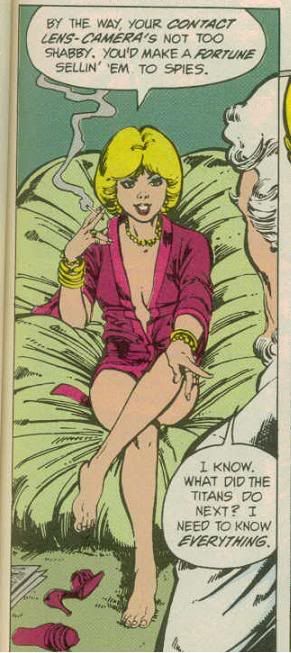
érez's "big" work, his layouts and figures carry the day. This page, from #42, reinforces the issue's theme of Tara spying on the Titans through her contact-lens cameras, and goes from Terra's eyes pleading, to a camera POV, to Raven's eyes accusing, to Deathstroke's.

The one complaint I have is with Starfire, who for some reason comes off throughout the arc as pouty (not in a good way) and whiny; for example, her panels in Dick's retirement scene, above. As I said with regard to the Trident story, in the duel of wits between Kory and Terra, I'm more on Terra's side, but the Titans are more on Starfire's. Really, though, she doesn't have much to do in this arc beyond pine after Dick and fly around blasting things. She's almost like a Powerpuff Girl gone horribly wrong ... but maybe I'm overstating my case.

I do like the original Nightwing design, but perhaps it too only looked good when pencilled by P
érez. (Okay, Scott McDaniel in "Nightwing: Year One," and maybe some others.) It's a nice blend of superhero and acrobat, which is appropriate, and it fits in with the Batman aesthetic without being associated too closely with it. I don't know if I like it better than the current version, which at times seems awfully generic, but it put in several useful years.

The Jericho costume ... yeah, I don't know. The muttonchops and curly hair make him look like Terry Long's kid brother. The color scheme isn't garish, but it's not subtle either -- aren't blue, white, and purple associated with Mardi Gras? Joey's powers are pretty cool, though, and the little "Contact!" captions that accompanied them are used to good dramatic effect. As for the name, I suppose a guy who turns immaterial so he can control other people's bodies might like "the walls come tumblin' down," but it seems to take a couple of steps to make that connection.

* * *

This was a pretty difficult essay to write, even after spotting the major themes and the big structural changes to the team, because "The Judas Contract" is a simple story with a lot going on under the surface. I didn't even have space to mention the cute ice-skating scene with Vic, Sarah Simms, and a punchline supplied by Changeling; the ominous portents surrounding Vic's grandparents, or the much scarier animal-skull helmet Brother Blood sports. Also, Gar is captured by licking drugged envelopes (he licks them, they don't lick him -- this isn't Grant Morrison), so if only Susan Ross had read Titans #43, she might be alive today. I'm sure I've forgotten other big aspects of this arc, but sheesh! this post is long enough.

"The Judas Contract" deserves to be remembered as the monumental payoff to some eighteen months' worth of serial superhero comics. It can be enjoyed on its own, but anyone who's "lived through it," so to speak, probably doesn't soon forget the experience.

Next: Payback ... against Bernadette Peters?
Full Post

Thursday, September 14, 2006

New comics 9/14/06

First let me say, regarding the mystery villain in Firestorm, The Nuclear Man (#29 written by Stuart Moore, pencilled by Jamal Igle, inked by Keith Champagne), that based on the last page of this issue, I Was Right. This gives me the distinct impression that Stuart Moore isn't so much recreating Firestorm for the 21st Century as revitalizing the best parts of the Gerry Conway/Pat Broderick/Rafael Kayanan Fury Of Firestorm from the early '80s. It's subtle, but it's there. Not a big fan of Martin Stein's hairdo, though; makes him look too grandmotherish. This issue makes me want to re-read all of the current series in preparation for the next one, and that's a good, geeky feeling to have.

Speaking of good, geeky feelings, here's Green Lantern #13 (written by Geoff Johns, pencilled by Ivan Reis, inked by Oclair Albert), a time capsule from the summer (aww, Superman Returns advertising! Don't feel bad, you did your best...) that, had it actually come out then, might be accused of stirring up bad vibes from Infinite Crisis. It still does that, but enough time has passed that it doesn't feel so blatant. Anyway, it's pretty entertaining. Reis packs a lot into his pages, and Oclair does his part to tidy everything up. Reis had a tendency in Rann-Thanagar War to fill each issue with a lot of background detail, so much so that it tended to distract from the action in the foreground. This story has a smaller scale, but there's still a lot going on in the fight scenes. The difference, I think, is both inking and coloring, so I'll give colorist Moose Baumann some credit too.

Anyway, this issue mostly resolves the Cyborg/Manhunters storyline (with a big, satisfying fight), but it also sets up subplots that will probably take months to play out. I'm not quite convinced that Hal and Arisia coupling up again is a good idea -- I wasn't convinced of that the first time -- but other than that I'm pretty happy with this book. Not counting 52, it's the only Geoff Johns book I still buy regularly, and I think it's because Johns is really interested in exploring the untapped potential of the Green Lantern Corps mythology that other writers never got around to. In particular, he seems to be going back to the Gerry Jones well of "what's the Guardians' real agenda?" Because he's picking up on old threads, abandoned during the Kyle years, it all feels more organic than it might have if he were forging a new direction of his own design. Not that he shouldn't do new things, but with this kind of series it's always appreciated (as with Firestorm) to use what's already there.

Boy, it was nice to see Dave Gibbons' pencils on a Green Lantern comic again. Green Lantern Corps #4 begins what should be a very fun all-Guy Gardner, all-Dave Gibbons (with inks by Mike Bair) story. Guy, on shore leave, is chased by Bolphunga the Unrelenting, a bounty hunter from the old GLC backup-story days (the Alan Moore story that introduced Mogo, in fact) who's just the kind of Groo-like over-the-top foe to make Guy look subtle by comparison. Interludes with other Lanterns show that Gibbons hasn't forgotten about the book's other characters, and their stories provide good character counterpoints to the main plot's action. Looking forward to the rest.

JLA Classified #27 (written by Howard Chaykin, pencilled by Killian Plunkett, inked by Tom Nguyen) presents Part 2 of "Secret History, Sacred Trust," and while it's produced about as well as Part 1 was, all the skullduggery gets a little confusing after a while. Still, Chaykin and company wrap things up in a way that drives home the main point of the plot, and his dialogue is sharp as ever, so I probably just have to pay more attention.

It hit me this week that for the past few issues, I haven't been paying much attention to the "Day ___" notations in 52 (#19 written by the Four Freshmen, breakdowns by Keith Giffen, pencils by Pat Oliffe, inks by Drew Geraci). The Pope Lobo bits reminded me, perhaps only superficially, of Pope Cerebus (although Lobo might take his office more seriously), so that was fun. I wonder, though -- can Starfire not repair her top? (Not that it's a big deal.) Also, jeez, who knew Skeets was so devious? Oliffe and Geraci were a good team in their 52 debut, although Supernova looked a little younger and Wonder Girl a little more angular than normal. I can't remember which issue is supposed to be the big tipping point where everything speeds up exponentially, but it feels close.

Aquaman: Sword of Atlantis #44 (written by Kurt Busiek, drawn by Butch Guice) makes many old-school Aquaman connections, including Mera, Ocean Master, and a big clue about Orin of Atlantis. A recent Busiek interview spoiled that last bit for me, but the notion that this is all a big arc to unify the new and old casts makes me more interested to see where this is all going.

More old and new integration happens in Captain America #21 (written by Ed Brubaker, drawn by Steve Epting), a really pretty book that focuses on Cap and the Once and Future Bucky's efforts to stop the big Nazi robot from destroying London. This issue brings Bucky/the Winter Soldier one step closer to being a recurring member of Cap's supporting cast for the first time since the Big One, and I'm not sure such a thing could have been handled any better. Certainly, in the Dead Sidekick Returns Derby, Buck's more than a few lengths ahead of Jason Todd, and it looks like he's speeding up.

Finally, thanks to last week's vacation, I was able at last to read The Amazing Adventures of Kavalier & Clay, and it was so good only my new-comics budget stopped me from buying all the Escapist swag the LCS offered. I did, however, pick up The Escapists #s 1-3 (written by Brian K. Vaughan, drawn by various people), a sort-of sequel to the book wherein an aspiring comic-book writer with parental issues of his own uses his inheritance to buy the rights to the character. It has the same breezy optimism as the first part of the novel, which kind of undercuts some of the suspense -- you can't imagine too many bad things happening to our hero, considering what he goes through in the first half of #1, The romance between two main characters is also pretty easy to foresee, and I wonder if a sort of inverted change-up, mirroring the novel's triangle, is on the way. The book does use its "real comic" pages to good effect, putting the "real peoples'" words into the Escapist's and Luna Moth's mouths, and the artists play effectively not just with the comic-within-a-comic, but also the fact that you're reading a comic that's about a comic. Also, our hero sometimes looks around 15. Overall, it may be the 2010 to AAOK&C's 2001, but there were some good parts of 2010 too. I just want to know if K&C themselves capitalized on the Silver Age boom in superheroes....
Full Post

Tuesday, September 12, 2006

New comics 8/30/06 and 9/7/06

... or, That'll Teach Me To Go On Vacation....

This past week was noteworthy for being the first time in a loooong time that I bought more Marvel than DC books. Considering I'm not participating in the Civil War hubbub, that's saying something.

Accordingly, let's begin with a couple of books that expose my ignorance of Marvel Universe minutiae, Agents of Atlas #s 1 and 2 (written by Jeff Parker, pencilled by Leonard Kirk, inked by Kris Justice), and Beyond! #3 (written by Dwayne McDuffie, drawn by Scott Kolins). For AoA, I remember Jimmy Woo pretty much only from Marvel's Godzilla book, and outside of Marvel Boy having his own Grant Morrison miniseries which, you guessed it, I never read, I hardly recognize any of these other characters. (Except for Dum Dum, but everybody knows him.) I'm intrigued by these issues, if only for the notion of Z-list characters somehow coming together into a formidable fighting force. I get the feeling that this is the attitude to which the Shadowpact aspires, but I like this book a lot more. Also, I've been a fan of Leonard Kirk's since his days on DC's Star Trek books.

I continue to enjoy Beyond! despite (again) no knowledge of Deathlok beyond the recent Dave Campbell profile. As far as the plot itself, I was a little disappointed by the big reveal at the end, and probably not as stunned as I would have been had I known who that Dobby-looking creature was.

Come to think of it, She-Hulk #11 (written by Dan Slott, pencilled by Rick Burchett, inked by Cliff Rathburn) falls into this category too. I was heartbroken by the "fate" of Awesome Andy (he came and he gave without taking), and I always like Rick Burchett, but once things started flashing back to Man-Wolf's weird alien connection, the little "??" balloons started popping up overhead. Is this how DC newbies feel all the time? Boy, I never knew you had it so bad....

And while we're on the "it was good, but I'm too stupid" theme, don't hold your breath waiting for me to extract deep profundities out of Solo #12 (by Brendan McCarthy et al.). I think I appreciated what he was trying to do, but I'll be dipped if I can tell you how he did it, or much about what it was.

Everybody loved All-Star Superman #5 (written by Grant Morrison, drawn by Frank Quitely) and I did too, so if you're not buying it, or waiting for the Absolute edition, or whatever, I don't care -- you shouldn't deny yourself any longer. Maybe the best part of the fine Summer Of Superman '06 is the rejuvenation of the regular books, at least as long as Kurt Busiek has anything to do with them. Action Comics #842 (written by Busiek and Fabien Nicieza, drawn by Pete Woods) presents Part 2 of the Manga Kha -- er, Auctioneer storyline, with Supes assembling a rag-tag bunch of misfits, plus Nightwing and Firestorm, to bring him down. I'm not as excited about the prospect of Richard Donner and Geoff Johns as the regular Action writers, because while they'll certainly bring the big events, I doubt they'll do it with as much wit and style as Busiek. To be fair, Busiek and Johns collaborated on the excellent "Up, Up And Away!," so I suppose the burden is on Johns to prove he wasn't riding Busiek's coattails.

End of digression. Mark Verheiden writes and Ethan Van Sciver draws Superman/Batman #29, Part 2 of a storyline which finds our heroes up against a shape-changing menace that tends to copy their friends. Green Lantern shows up too, which is a plus, although I got the feeling I was supposed to recognize the big pink bad guy. What is this, Beyond!? Anyway, Verheiden's story has been tighter so far than Jeph Loeb's epics, but he tends to rely on the kind of overheated exposition I thought Loeb would have taken with him.

JLA Classified #26 (written by Howard Chaykin, pencilled by Killian Plunkett, inked by Tom Nguyen) begins a new arc that finds the League embroiled in global politics, and didn't we just go through this with Gail Simone a few issues ago? I'm only kidding a little -- the plot is sufficiently different, focused more on the League's keeping a low profile, and it reads enough like Chaykin and enough like the JLA to make me, a fan of both, happy. Nguyen inked much of the Joe Kelly run on JLA, and Kelly did some political storylines, so that adds to the familiarity.

1602: Fantastick Four #1 (written by Peter David, pencilled by Pascal Alixe, inked by Livesay) will probably turn out to be pretty inconsequential, but for now it's kind of goofy fun. The Frightful Four are the villains, and a Doombot and some vulture-men show up too. A bit of initial misdirection works, but a later bit doesn't. There's a somewhat oblique reference to Ben Grimm's Blackbeard impersonation as well. Art reminded me of Keith Giffen circa 1990, and for the most part it was good, although I had trouble trying to figure out if a couple of minor characters were supposed to remind me of familiar Marvel folk. I think David's sense of humor is well-suited for this, so I'll give it a chance.

Giffen himself is on display, of course, in Hero Squared #3 (plotted by Giffen, scripted by J.M. DeMatteis, drawn by Joe Abraham), another well-made issue that begins with a classic-Marvel parody and features an embarrassing fight between Milo and Valor at the funeral of the man Valor couldn't save in #1 (or was it last issue? can't remember). Abraham reminds me more and more of a cross between Kevin Maguire and Bart Sears, and given how Giffen and DeMatteis honed their comedy schtick, I wonder if that's an accident. Looking forward to #4, which promises more hitting, although I don't mind all the dialogue.

Detective Comics #823 (written by Paul Dini, pencilled by Joe Benitez, inked by Victor Llamas) presents a good, somewhat creepy, Poison Ivy story that positions itself as a fair-play mystery but really isn't. However, the twist is right out of an old EC horror book, or maybe a "Twilight Zone," and aside from my secret-identity-alert! radar going off whenever there's a fight in the Batcave, it was handled pretty well. Benitez and Llamas do a fine job with the art, which is somewhat in the Image thin-line cheesecake style (at least as far as Ivy is concerned) and still manages to make Batman look imposing and Robin look like a kid.

The best part of The (All-New) Atom #3 (written by Gail Simone, pencilled by John Byrne, inked by Trevor Scott) was, as many others have noted, the "Sanity roll!" exclamation. Not that this hasn't been a fun book all along; and here it veers into the same kind of creepy territory as that Detective story. However, the presence of the big supervillain here makes me wonder about her timeline, given her prominence in another book's current storyline. I can't decide whether I like her better here or there, and I say that despite her being, shall we say, clothed in something less than unstable molecules.

Finally, we have 52 #s 17 and 18 (written by Jay, Barry, Wally, and Bart, breakdowns by Keith Giffen, pencilled by Chris Batista and Eddy Barrows, inked by Ruy Jose & Jack Jadson and Rob Stull). I still say reading this series is like keeping up with Time or Newsweek -- every issue is an infodump, and occasionally you get a fairly cohesive issue like #18 that focuses almost entirely on one story. Therefore, I liked #18 better, but maybe that's because it feels more like a "regular" comic. Also, #18 addresses the concerns I had about Montoya's actions at the royal wedding, which was nice.
Full Post

Sunday, September 10, 2006

Tranquility Base


It was a good vacation. We'll try to go back before too long.

It's good to be back, too.
Full Post

Friday, September 01, 2006

Coming attractions

Those of you who have been enjoying the New Teen Titans recaps -- and belated thanks to When Fangirls Attack! for linking to a couple -- may be interested to know that I've been working on the Judas Contract essay and am highly motivated to head into the post-Perez era.

Unfortunately, those are still a little ways off. The Best Wife Ever and I are bugging out for a week, so normal service will resume sometime around September 10. However, I have a new Grumpy Old Fan column ready to go for Thursday, September 7.

See you then!
Full Post

Sunday, August 27, 2006

New comics 8/23/06

We begin this week with Batman and the Mad Monk #1, the sequel to/continuation of Matt Wagner's "Dark Moon Rising" project, and the retelling of the first two-issue Batman story ever, from Detective Comics #s 31-32 (September-October 1939). That story, written by Gardner Fox and Bill Finger with art by Bob Kane and Sheldon Moldoff, had Batman fighting vampires and werewolves, introduced the Batplane and Batarang, and ended with Batman shooting silver bullets into the undead fiends. Yes, with a gun. It was the first "big" Batman adventure, and it still holds up -- but it's been copied a few times, with mixed results. This time, Wagner doesn't really get into the main plot until the end of this issue, spending several pages on supporting characters Catwoman, Gordon, and Julie Madison and her dad. When the vampires do show up, though, they're hard to forget -- their wounds aren't the traditional two-hole bites, and they're scary not just because of how they dress, but because they don't stick out anymore. (If that makes sense.) I'm a big Hugo Strange fan and I really liked Batman and the Monster Men, but Mad Monk looks to be even better.

I'm going to reserve a lot of comment on Supergirl and the Legion of Super-Heroes #21 (written by Mark Waid and Tony Bedard, drawn by Barry Kitson, Adam DeKraker, and Rob Stull) until I've had a chance to read the whole series. However, I will say that the prison-break scenes are very well done and fairly suspenseful, and the Dream Girl sequence has an unexpectedly poignant ending.

Perhaps the best way to describe Hawkgirl #55 (written by Walter Simonson, drawn by Howard Chaykin) is by comparison to the works of Ed Wood. I don't believe that the creative team intended to create a storyline that veers from impenetrable to goofy and back again, nor do I think that they wanted to end up with so much attention on Kendra's underwear. Obviously this is their attempt at Lovecraftian horror, which isn't a bad choice for the existing Hawkgirl setting. Still, it's hard to balance the creeping dread we're supposed to feel with the flamboyance of Chaykin's art, and I say that as someone who's always been a fan of Chaykin's. To be fair, I don't think Simonson's art would have improved matters much either. A moodier artist (Mike Mignola, Ryan Sook) would have been better, or Chaykin on a more sci-fi-oriented story. I think that's why I'm hanging around -- to see if these two consummate pros can pull a good result out of this arc, and to give incoming artist Joe Bennett a chance. How's that relate to Ed Wood? Well, I think at some point Simonson and Chaykin decided to just let themselves go and let the mistakes take care of themselves. They're having fun, so why aren't we?

A little of that applies as well to the end of the Amos Fortune/Royal Flush Gang crossover arc in JSA Classified #16 (written by Steve Englehart, pencilled by Tom Derenick, inked by Mark Farmer), but it's all climaxes, triumphs, and exclamation points. I'm still not sure where Gypsy got the powers or the personality with which Englehart has invested her, but apart from that it makes a goofy kind of sense. It's a harmless little story that probably could have been handled in half the time.

Art does make a big difference in The Flash: The Fastest Man Alive #3 (written by Danny Bilson and Paul DeMeo, pencilled by Karl Kerschl, inked by Serge Lapointe). Too bad they're guest artists, because they convey a much more open, fluid milieu for a super-speedster than the cramped, scratchy, almost over-rendered work of Ken Lashley. Valerie Perez's dark secret is intriguing, considering that it relates to the 1990 Flash anniversary special that was the character's only appearance (right?), but she and Bart lock lips much too quickly. Overall, the book seems like it's improved, but we'll see how long it lasts.

52 #16 (written by 2001, 2010, 2061, and 3001, breakdowns by Keith Giffen, pencils by Joe Bennett, inks by Ruy Jose) was pretty suspenseful. Isis is so nice, and such a good influence on Black Adam, that I am convinced she's totally going to die horribly in his arms, probably because of something Booster did. That sense of impending doom enhanced the suicide-bomber scenes, although the lack of outrage in the denouement was a bit far-fetched. Also, last night the History Channel produced an almost surreal piece on sexual practices of ancient Egypt -- Satuday nights on The History Channel are apparently like Friday nights on Cinemax -- which made a lot out of the gods' incestuous relationships, including those between Isis and Osiris. Wonder if the 52ers will include that in Isis' search for her brother...?

As depicted by Terry and Rachel Dodson in Wonder Woman #2 (written by Allan Heinberg), the new Department of Metahuman Affairs war room is a cavern filled with wall-sized video screens and thin monitors on chromed pedestals. (One monitor shows Diana's WW in what looks like a Phil Jimenez homage.) Its size belies Batman's modest comment about Sarge Steel "putting the agency back together." It's the kind of thing that, were it on TV or in a movie, one might imagine much of the story being set there, to get the most out of the environment. However, with comics' unlimited budget, it can be just another throwaway room, like Diana's 21st-Century Emma Peel jumpsuit (and rose-colored glasses -- nice touch!). Neither of them stand up to much logistical scrutiny. Those are pretty much my only complaints about the issue, which worked so well that when Diana actually started to spin (!) into her new/old costume, I felt a little twinge of fanboy glee. (As opposed to the other "twinges of glee" that the Dodsons' va-va-voom artwork might induce, of course.)

The ninja Man-Bats of Batman #656 (written by Grant Morrison, pencilled by Andy Kubert, inked by Jesse Delperdang) were as scary as advertised. This issue featured Batman in action as much as last time focused on Bruce Wayne, and it was the James Bond Batman of Morrison's JLA that I had been waiting to see again. In a departure from his JLA treatment, this time we hear Batman's internal monologue, mostly key words, well-chosen, and not the purple discourses on pain we'd gotten used to. Have I mentioned how much Kubert and Delperdang's Batman looks like Jim Lee's? At the same time, though, their other characters and backgrounds are much more organic -- rounder, with thicker lines, and you can almost stroke the Man-Bats' fur. (Make your dirty joke if you must.) It's a nice way to state subliminally that Batman is the intrusion into an otherwise real world, and had I the vocabulary I could connect that better with the pop-art pieces which comment silently on the fight scenes. Plus, Morrison thought to bring back Aunt Agatha, who was more meddling in the '50s than Peter Parker ever dreamed his aunt might be. Can't wait to see Bat-Mite!

Finally, here's Justice League of America #1, written by Brad Meltzer, pencilled by Ed Benes, and inked by Sandra Hope, with a little help from Dick Dillin and Dick Giordano in some flashback panels. Most of it's about Kathy Sutton and Traya, the Red Tornado's (common-law?) wife and adopted daughter, waiting for word that Daddy will be coming back to life after yet another bout with the explodies. It's a weird inversion of Identity Crisis which almost suggests that Meltzer is getting too comfortable with the emotional dynamics of grieving spouses. Oh yeah, and the Big Three are holding their fantasy draft for a new Justice League. (Why no chips or soda, though, DC? I would have paid an extra dollar to see Wonder Woman crush a can of Tab on her forehead.)

I can't remember which blogger said it, but it bears repeating: in Brave and the Bold #28, the JLA fought a giant alien starfish. In Justice League of America #1, it fought Despero. In Justice League #1, it fought terrorists at the United Nations. In JLA #1, it fought the Hyperclan. Now, it's all Bands Reunited and grieving widows? Meltzer crowds the panels with narrative captions that shift from person to person, distinguished only by color. In other words, talk, talk, talk -- Hulk want action!

There are some funny bits, including Oliver Queen left home to babysit; and the artificial-intelligence grapevine. There are also a few disturbing images, like Platinum looking too much like the Avengers' Jocasta, and Red Tornado adopting the "Aheh." laugh of Alan Moore's Invisible Man. However, I was glad to see some bits of minutiae that helped reassure me that Meltzer's heart was in the right place: the retro-style logo, the membership certificates, Felix Faust, and Deadman. I just continue to be frustrated with the notion that every storyline must now proceed in strict straight-line order, so that a #1 issue deprives us of the Big JLA Fight that an in medias res approach would have allowed. From what I remember from growing up in the Midwest, tornadoes' paths are more random than linear.
Full Post

Saturday, August 19, 2006

Terra Who? and "Who Is Donna Troy?": New Teen Titans #s 35-38 and Batman and the Outsiders #5

In The New Teen Titans #34, Marv Wolfman and George Perez revealed a side to Tara Markov that was sure to shock readers who had been following the plucky young heroine for the past several months. What's more, the Titans were completely clueless about Tara's real motives, having decided already to tell her all their secrets at the first possible opportunity. The team was already beset with internal problems, and this latest development could either mean its end, or an opportunity for a new beginning.

Naturally, Marv and George sat on Terra for a while.

Now, to be fair, Perez probably wanted to be involved in the issues that decided Terra's fate, and his plate was getting pretty full -- the just-completed Titans Annual, probably some SwordQuest tie-in comics for Atari, and a little thing called JLA/Avengers (speaking of delayed gratification). Also, the book had a few more matters to take care of before Terra's other shoe would drop.

These issues don't quite forget about the major development of issue #34, but neither do they expand upon it. Although they're not really "inventory" issues, in the larger scheme of things, you'd think the focus would be a little different.

Keith Pollard pencils New Teen Titans #35 (October 1983), a hostage drama involving Sarah Simms, her psycho ex-fiance Mark Wright, and Cyborg, Changeling, and Raven. (See, Terra's not even in the issue.) Mark used to be a military sniper, so he's pretty successful at holding off the cops, and even manages to shoot Vic in one of the unarmored areas on his shoulder.

The upshot of the story is that Mark doesn't want to lose Sarah like he lost his previous girlfriend. For a while it looks like Mark might have killed her, albeit by accident, but at the end it's revealed that no, she's just "dead to him." While I don't think this backstory would have been a woman-in-refrigerator situation, exactly, it feels like Mark's crazy was toned down at the last minute. Assuming, of course, that it's somehow less crazy for a guy to take someone hostage for fear that he wouldn't, uh, not kill her like he didn't kill his girlfriend before. Yeah, that makes the ending much easier to take.

Anyway, the three Titans save Sarah and console nutty ol' Mark, and Vic finally gets to make up for her being kidnapped in #10. Fun fact: Marv Wolfman and Keith Pollard worked together on The Amazing Spider-Man, so guess what Changeling changes into this issue? You guessed it -- Seabiscuit!

New Teen Titans #36 (November 1983) wraps up the plot threads from issue #32's introduction of Thunder & Lightning. Remember, the kids were left with STAR Labs so their powers could be studied and maybe wouldn't end up killing them. Apparently "studying," as interpreted by DC go-to scientist Dr. Jenet Klyburn, means "strap to a table and shoot with high-powered lasers." It's a new field of study, Dr. K muses.

As it happens, the lasers aren't so good at "probing" T&L, and overload their powers, or something. A brief fight ensues, stopping when both sides realize it won't get them anywhere. Raven then offers -- despite the extreme risk of unleashing her Trigon side -- to try and cure the boys in her soul-self. It envelops them, and soon becomes all tentacle-y, lashing out at the Titans. When things calm down, T&L tell the group that the tentacled thing was a manifestation of their father, and he's being held prisoner. They don't know it's by a HIVE branch, which doesn't like holding Dad too much itself.

It won't be their problem much longer, though -- the Titans and T&L start wrecking the place. The HIVErs have gotten some control over Dad, and he unwillingly attacks the teenagers. Did I mention that Dad's really a centuries-old alien who apparently looks otherwise human, except when he's an 8-foot dinosaur-thing with one eye, two big fangs, and a pair of tentacles? Only T&L's powers can stop him, and he pleads with them to kill him. They do, and are suitably horrified, but Robin tries to ease the pain by telling them they "freed" him. Apparently he dies a human, because his touching final metamorphosis happens off-panel.

I therefore get the feeling that, for the second issue in a row (and the second non-Perez issue ... hmmm) the ending was "toned down" to make it less disturbing. Still, T&L clearly had to deal with a Bad Father in the classic New Teen Titans mold, and his final fate makes their story that much more hardcore. Raven came the closest to "killing" her BF, but she only put him in limbo. The issue ends with T&L saying yeah, they'll probably use their powers for good -- but first they'll tell their mother they love her.

Subplot watch: Robin thinks everyone hates him because of his involvement with Adrian Chase, and maybe he doesn't deserve to lead the Titans. Kid Flash is still quitting, and he still hates Raven for trying to kill him. Raven, as mentioned above, is still filled with worry about letting her Trigon flag fly. (Pollard does a good job conveying the group's support of Raven, just by arranging the group around her in close, comforting poses.) As for Terra, there is nary a mention of her real agenda, for the second straight month. Wally and Raven make up this issue, however, in a fairly understated couple of scenes. Before that, though, Wally gets a silent scene with Donna, where she comforts him after he lashes out at Raven.

FYI, according to a lettercolumn, George Perez had to take these issues off after getting very busy with a number of projects, including the original JLA/Avengers. Regular inker Romeo Tanghal finished Pollard's pencils, giving the issues a fairly consistent look. Pollard and Perez had worked together on a few issues of Justice League of America, so their styles were hardly incompatible.

Perez returned in fine fashion for New Teen Titans #37 (December 1983), the first part of a crossover with Batman and the Outsiders #5 (written by Mike W. Barr and drawn by Jim Aparo). Even the jokes work, and that's saying something. It's the Fearsome Five vs. the Titans and Outsiders, so #37 promises more main characters than even the Titans/Omega Men or Titans/JLA issues, and Perez, of course, delivers.

The plot is this: Gizmo breaks his Fearsome Five teammates out of prison, although nobody's really happy about having Dr. Light along again. Light just wants to do a big robbery, but Shimmer and Mammoth remember a Dr. Jace from back in Australia who was experimenting with giving ordinary people super-powers. The F5 decide to kidnap Jace and force her to augment their own powers. (I'm not quite sure how much "augmentation" a transmuter like Shimmer or a psionic like Psimon could use, but whatever.) This ends up changing into "Dr. Jace creates an army of lava-men," probably because that was more practical.

Dr. Jace also gave Terra and her brother Brion Markov, a/k/a Geo-Force of the Outsiders, their powers, so when the F5 kidnap her, she sends out a distress call on receivers built into their costumes. After the Traditional Superhero Misunderstanding Fight, the groups team up. (In a sensible touch, parties on both sides who should know each other well enough actually say, "Hey, I know [him/her]....")

However, as you might have guessed by now, the real through-line of the story is the Batman/Robin relationship, and it's handled very well. It begins with a scene at Wayne Manor, where Dick tells Bruce he wants to end their partnership -- not their friendship, Dick is careful to point out, and Dick's not giving up his Robin identity. His experiences with Chase have clarified the differences between him and his mentor. (I'm not sure this is quite fair, because I don't believe Batman -- especially the '80s Batman -- is quite the Punisher-type that Chase's Vigilante is, but Dick might not think that either.)

Once the two teams start tracking the Five, Batman takes charge. Given how Perez draws him, it's hard not to see why. His Batman is all shadows and sharp lines, and he dominates a scene. It's different somehow from the earlier Batman appearance with the JLA in issue #4, perhaps because there Batman was part of the Justice League, and therefore one of a few higher-profile heroes. As among the Titans and Outsiders, though, he's BATMAN!, like, OMG!!!11 It helps prove Marv & George's point, too -- next to Batman, Dick is "just" Robin, and it's hard not to make Robin automatically subordinate. I'm a little surprised some of the more experienced Titans and Outsiders didn't fall into an old habit of assuming Robin would follow his lead. I think Wonder Girl and Kid Flash might even have done this despite their relationships with Dick.

Anyway, this carries through until the big fight in the Empire State Building, when Batman barks out an order that would end up misusing a couple of characters. Robin calls him on it, says he's better at leading a team than Batman is, and takes charge. For his part, Batman respects Robin's authority and lets him do his thing. The Fearsome Five are defeated, and Batman acknowledges Robin's leadership skills. "You lead the Titans well, Robin -- I guess even the teacher can learn from his pupil ... his former pupil!"

"Thanks, Batman!" Robin replies. "But you know what they say ... a pupil is only as good as his teacher ... and I had the best there is!"

Mike Barr wrote those words, in case we need to reconcile them with the more "official" story from Wolfman & Perez. Not long after this, of course, Chuck Dixon and Scott Beatty have told us that Dick got "fired" again, this time for good. But that's a while in the future....

Since the plot concerns Terra and Geo-Force, they get a few sweet moments of sibling bonding, although at the very end Terra worries that she doesn't want her brother to "go down with" the Titans when she betrays them. So, in both issues, there are reminders that Terra's a rotten egg ready to crack, just to keep readers up to speed.

The last issue of this particular batch is New Teen Titans #38 (January 1984), "Who Is Donna Troy?" Fittingly enough for us, as #35 focused only on three Titans, this spotlights only Dick and Donna. It still packs an emotional wallop, because despite Dick's narration about his relationship with Batman, at its core it's the story of a woman who finds herself. Because Dick narrates, we see his detective work, and we get a little quasi-purple prose about his own abiding (platonic) love for Donna, but we also see her reactions to each new discovery.

The issue is a paen to the idea of "Donna Troy," a beautiful young woman who started life passed around from family to family, but who was always loved. It's not hard to imagine that someone who's always received that treatment -- and who, in fact, was an Amazon princess, right? -- would start to wonder if there were anything in her past that could bring all that down. There's little of that here, in a story that doesn't put Donna on a pedestal as much as it reassures her.

There's also the tendency to see Donna as Marv Wolfman's idealized woman, through the lens of Terry Long as Marv's somewhat self-effacing stand-in. However, I think that's an unnecessarily contorted view of this story. Its pathos is balanced by the routines not only of Dick's forensics, but also a few scenes of the characters traveling.

Perez and Tanghal do a great job with this issue. Tanghal's inks seem exceptionally tight, such that it almost looks like Perez inked his own work. (He might well have inked the figures, I don't know.) The noirish opening and closing scenes are rendered mostly in shadow, suggesting a downbeat detective story that counterbalances Donna's growing elation. In fact, for his part Dick is pretty even-tempered throughout, smiling only at the end when he reflects on his work.

So, who is Donna really? Well, it starts with a battered old doll that Dick discovers in an old coal bin in the soon-to-be-demolished apartment building where Wonder Woman found Donna. (Donna last visited in issue #1.) Scraps of the doll's dress reveal writing that, according to Dick's computer, might have said "HELLO MY NAME IS DONNA."

That leads to a toymaker in Newport News, Virginia (right down the road! w00t!) who remembers the doll. (It has orange skin and curly auburn hair, and looks disturbingly Tamaranean.) He fixed up all the dolls for the kids at the orphanage, so from there Dick finds the orphanage's former owner, in a Florida nursing home. Dick and Donna visit, Ms. Cassidy remembers the doll, and tells Donna about her real mother, Dorothy Hinckley. Ms. Cassidy also remembers that the Staceys adopted Donna.

It's not too long before Donna's hugging her adoptive mother fiercely, in the front yard of Fay Evans (nee Stacey)'s Newport News home. I really like this page and how it flows into the next one, because Perez and Tanghal absolutely nail Donna's quick trip from peppy nostalgia to complete emotional collapse:


So who was in the fire that gutted the old apartment building? Fay's husband Carl Stacey died in an accident, and Fay basically got pressured by a crooked lawyer (not a redundancy) into selling Donna as a black-market baby. Robin tracks down the lawyer in prison, uses a little of the Bat-mojo on him, and gets out of him that a furnace exploded before the deal for Donna could go down. That's about the only scandal in Donna's past, at least according to this story. "WIDT?" also skirts the question of Donna's paternity, saying it's not important. Rather than this being a plot hole left open for later exploitation, though, I tend to think that Marv & George knew they had a good enough issue without it, and chose to address it thusly rather than gum up the works with it.

Again, I'm sure there are a couple of different ways to mock "Who Is Donna Troy," or to look at it as the biggest step in the idealization of a character conceived as an impossible fantasy (Wonder Woman's imaginary childhood) and given life by mistake (the first Titans editor didn't realize she didn't exist). There's a strong undercurrent of irony and metacommentary running beneath this story, and it's entirely possible that Donna herself, with all the goodwill she's generated from fans, is nothing more than the coalescence of that goodwill -- optimism given form, as it were. However, even with all of that, my experience with the story is that it does humanize Donna. Its emphasis is on a series of Oprah-worthy tearjerkers, but darn if they're not skillfully paced and masterfully depicted. When Dick returns the Donna doll, fully repaired, to her owner, I found myself getting a little misty-eyed. Call me a sucker, but I bought into this story almost unexpectedly.

What about next month, though? Could The New Teen Titans get any better?

Three words: "The Judas Contract."
Full Post