Tuesday, February 27, 2007

New comics 2/21/07

Apparently, according to Superman #659 (written by Kurt Busiek and Fabian Nicieza, pencilled by Peter Vale with a little bit by Carlos Pacheco, inked by Jesus Merino), Superman can be a God figure. Who knew? Someone should tell Bryan Singer....

The other rather well-worn element of this story was, of course, the Spiritual Elderly African-American Woman, so between those two you'd think this would be a pretty painful issue. However, somehow it actually kind of worked. Probably helped by Merino's inks, Vale's pencils are a good blend of Pacheco and Jerry Ordway. He's probably done a hundred other things I've never heard of, but I liked his work this issue. I tend to pay more attention to the Supes-as-God stories, because I imagine that some people on DC-Earth would have the same reaction our guest star does: he's an actual angel she can command. The bit about "commanding" even makes her a little less spiritual, in the sense that I'm not sure God works like that. Overall it's very reminiscent of Astro City, and a decent AC story is better than a lot of stuff out there.

Wonder Woman #4 (written by Allan Heinberg, pencilled by Terry Dodson, inked by Rachel Dodson) came out this past week, and lucky for it, it doesn't leave much hanging. The big scheduling disaster which has befallen this title wiped out Heinberg concluding this story in #5, but the conclusion looks to be just a big fight scene. The plot is very simple: the "new Wonder Woman" is basically a grim 'n' gritty version, Diana crafts a plan that leaves out a lot of her allies, and there are both stunning reversals and stunning reveals. Well, one of each, at least. I'm sure it will read great in the collection, whenever that appears.

I liked The Spirit #3 (by Darwyn Cooke) well enough, although I found myself instinctively rebelling against shifting first-person narrative captions. Because it's Darwyn Cooke, though, they're handled quite well, and it only takes a split-second to switch between them. It also helps that there's only one narrator per scene. As for the art, Cooke uses looser pencils and a more impressionistic coloring style to distinguish the flashback scenes. I have read the original origin, I think, and this one feels different but it works just fine.

52 #42 (written by JMRW, breakdowns by Keith Giffen, drawn by Darick Robertson) put the spotlight on Ralph Dibny, fighting the Thing Inside Dr. Fate's Helmet. That's not meant as a spoiler, but it's not much of a surprise if you've been paying attention. It's still cool to see Ralph back at the top of his game, and Robertson makes him look both lean and mean. There are a couple of pages with Montoya and her faceless reflection, but other than that it's all Ralph.

Aquaman: Sword Of Atlantis #49 (written by Kurt Busiek, layouts by Mike Manley, inks by Ricardo Villagran) closes out Busiek's revamp with part 2 of the Fisherman story. It's more about the Parasite than it is Aquaman, flashing back to the Fisherman parasite taking over some hapless family man who happened to be down at the docks at the wrong time. I'm not sure if the family-man aspects are more interesting than the present-day guy fighting Aquaman, and it all ends up being a rather creepy tale of shambling horror. Villagran's finishes help feed the horror-story feel.

Checkmate #11 (written by Greg Rucka, Nunzio DeFillippis, & Christina Weir, pencilled by Steve Scott, inked by Nathan Massengill) presents the first part of another trust-no-one story wherein a couple of Checkmate agents are cautioned not to think outside the box and/or take a past familial slight personally, but we know that's practically a flashing neon sign that both those things will happen. However, internal Checkmate politics and the general skill of all involved combine to create a general feeling of unease, like watching a slow-motion train wreck, in a good way. Scott and Massengill provide art that's a little more static than Jesus Saiz, but again that's a good thing. I like this book, and I like reading it month-to-month, because I think I would get either lost or bored trying to get through a paperback. I am dumb.

I am really starting to like the pencils of Nicola Scott, because as presented in Birds Of Prey #103 (written by Gail Simone, inked by Doug Hazlewood), they are very crisp and clean, and they do remind me of Chris Sprouse and Paul Pelletier. Very clean. The story is the untold tale of Barbara Gordon's rival, which unfolds not unlike Lisa Simpson's rival in the episode with Winona Ryder -- the one where Ralph "I bent my Wookiee!" Wiggum wins the diorama contest. Here the stakes are a little higher and there is no Ralph. Instead, Gypsy and Manhunter fight the house supervillains at the jail Manhunter broke into, in a subplot which reminded me of the recent Howard Chaykin/Kilian Plunkett arc in JLA Classified. It was a decent issue, with a couple of well-handled plot twists.

Omega Men #5 (written by Andersen Gabrych, drawn by Henry Flint) was more of the teenage Guardian fighting Lady Styx, with Felicity going through some changes. Everyone else stands around watching these events, and I am right there with them. It's a typical penultimate issue, which means I can't really talk about it right now.

She-Hulk #16 (written by Dan Slott, pencilled by Rick Burchett, inked by Cliff Rathburn) is a big fight against the Wendigo, guest-starring Wolverine, put through the Slott/Burchett wackiness filter. It reminded me of an issue of Peter David's Captain Marvel also (I think) involving the Wendigo and the Hulk, and between that story and this one, there's my knowledge of the Wendigo. He's the Shaggy Man of Marvel, apparently. Some flirtatious banter between Shulkie and Wolvie was jarring to me, but the fights are broken up with funny scenes involving the heroes' backup staffs.

Finally, The Brave and the Bold #1 (written by Mark Waid, pencilled by George Perez, inked by Bob Wiacek) was everything I expected, and that's saying a lot. I like the Batman/Green Lantern pairing generally, and especially if it's Hal Jordan wearing the ring. I also appear to have purchased the alternate cover with Vegas in the background, and I like it better than the promo-art cover I've been seeing a lot more of. Anyway, there's a fight in the Batcave and Roulette shows up towards the end, but in between there's a great setpiece featuring "Wayne ... Bruce Wayne" and his allegedly bumpkin sidekick Hal. Good grief, this is a fun book, and by the way it gives Perez an excuse to dazzle with his layouts and general storytelling ability. Like all of his work, this is a dense issue which invites a Where's Waldo easter-egg hunt. Perez also makes the revisions to Hal's costume work, which I mention only because I think it generally throws off Hal's proportions. I was predisposed to like this book, but the creative team has done some fine work and really exploits the premise very well.
Full Post

Thursday, February 22, 2007

Kent State

Oh, here we go again, another lamentation about the loss of the Earth-1 Clark, a guy literally too good to be true. Let’s call him the Maggin Clark, after Elliot S! Maggin, chief architect of the 1970s Superman, who most prominently described the differences between Kal-El and his alter ego.

Here’s an excerpt from Maggin’s second Superman novel, Miracle Monday (available to read on Superman Through The Ages):

Superman loved Clark Kent as much as he loved anyone or anything else. He loved his alter ego as he loved the memory of the two good people who had taken him as their son; as he loved this adopted world that had accepted him as its hero; as he loved Lois Lane. Clark Kent was a person as real and individual as any man ever created by the mind of man. Superman even gave Clark a demon: Clark videotaped television commercials that particularly amused him, and showed them to friends who were polite enough to sit through them. Superman spent appreciably more time creating the reality of Clark Kent than he spent doing anything else. Clark Kent spent more time walking the Earth than Superman spent flying above it. Superman valued his creation as he valued a human life.


The Maggin Clark follows decades of Superman tradition, going back at least as far as the ‘40s radio-show narration (“And who, disguised as Clark Kent...”). Superman encumbers himself with Clark, donning a bulky suit and clunky glasses over his skintight costume and super-powered eyes. Clark isn’t quite a Harrison Bergeron-like burden, but he does personify Superman’s voluntary acquiescence to the necessities of human life. On Earth-1, Clark was Superman’s connection to humanity, and had been since childhood. Later in Miracle Monday, Maggin indicates that if something ever happened to Clark, Superman would have to re-establish that connection almost from scratch.

The Maggin Clark fits pretty well with a Superboy career. On Earth-1, Kal-El’s powers developed fairly quickly, so he knew (and was constantly reminded) early in life about the responsibilities of using them. His foster parents taught him how to fit in, but were his only confidants (outside of the Legion of Super-Heroes, but he didn’t need to be Clark Kent with them). Thus, when they died, “Clark” was a way to remember them. No wonder Superman was so attentive to Clark.

Does it follow, then, that if we change a whole slew of those elements, we can flip the characterization so that “Superman” is the disguise? I wonder, and my hesitancy comes straight from the first Christopher Reeve movie. Superman (1978) eliminated Superboy, withheld knowledge of Krypton from Clark until adulthood, and allowed Martha Kent to survive. Clark had to hide his powers, of course, but the weird, emasculated teen of the movie’s Smallville scenes wasn’t the formal “I don’t watch television; I was reading Dickens” alter ego who showed up in Metropolis. Does this mean that, at some point during Clark’s twelve years (!!) with Jor-El’s Giant Floating Holographic Head, one of them came up with the glasses-and-slouching idea? I suppose if you’re going to learn Acting!, you could do worse than Brando, just post-Godfather (and pre-Apocalypse Now...).

So Movie Clark, as much as I really love him, now seems like even more of a construct than Maggin Clark, because Movie Clark doesn’t have all of Maggin Clark’s underpinnings. That’s not necessarily a bad thing. However, it does make the developments of the 1986 revamp more understandable.

That revamp went a little further than the movie did. Both Ma and Pa Kent are alive today (All-Star Superman notwithstanding), there was still no Superboy career, Clark’s powers developed slowly (no lifting pickup trucks for baby Kal-El), and he didn’t learn about Krypton until well into his Superman career. (I’m going by Man of Steel here; I’m pretty sure Birthright is different with regard to the Krypton revelation, and who knows what it’s all supposed to be now.) The point was, Clark got to grow up more as a human and not as Kal-El. Man of Steel doesn’t touch on this significantly, but Clark also got to grow up discovering his powers in a world that was used to super-people -- another change from Earth-1, which had no explosion of superheroics a la the Justice Society until Superman came along. The Kents might have had a bit of “we have to hide him because the JSA got forced underground,” but the flip side of that might also have been “hey! everyone loves superheroes!”

In this respect, it’s almost inevitable that Clark would end up hiding in plain sight as Superman, even going without a mask (and thereby tacitly recalling the Congressional demands that stymied the JSA). As a disguise, “Superman” thus has the potential to become such a ... flamboyant isn’t the right word, I know -- how about “distracting?” -- superhero parody that it lets Clark be himself. Naturally, as it turns out, Clark and Superman are both pretty decent guys, so the Superman performance seems like a pretty thin tightrope. To be sure, in comics we don’t get to hear the different voices.

Anyway, all of this reinforces the notion, dropped anvilliciously by Byrne in Man of Steel #6, that Revamped Clark is practically hardwired to feel human by the circumstances of his upbringing. He might think he’s the last Kryptonian, but that’s just an explanation for his powers.

Where does Lois Lane come into all of this? After Lana Lang, not to put too fine a point on it. Earth-1 Lana was more of a plot device than a girlfriend; in fact, she wasn’t Clark’s girlfriend at all, was she? Revamped Lana was saddled with the knowledge of Clark’s powers, and she got to be his first love, but the necessity of getting her out of the picture made her Missed-Opportunity Woman. Today Kurt Busiek has made her head of LexCorp, which is a lot better than some other writers (I"m looking at you, Chuck "Amuck" Austen) have treated her.

Lois' portrayals are many and varied, of course, from the nosy obsessive of the '50s to the tough career woman of the '70s and '80s. However, for our purposes the biggest Lois innovation may be her role as Superman's anchor to humanity. Whenever something happens to Lois, Superman ends up going nuts: mad enough to change history in the first Reeve movie; despondent enough in an alt-future to go into exile (Kingdom Come) or even commit suicide (JLA's "Rock Of Ages"); and restoring Lois to the mix was part of the resolutions of "For Tomorrow," DC One Million, and the "King of the World" storyline from about 10 years ago. Still, in light of Maggin Clark being the anchor on Earth-1, and Revamped Clark being his own anchor, does Lois really play as big a part as we think?

I say she does, and I think it's because Lois validates both Clark and Superman. Lois -- I'm tempted to say regardless of iteration, but I'm more comfortable saying it in the '70s and more recently -- confirms that Superman, in whatever guise, can relate to humanity successfully. The combination of skepticism and idealism that makes Lois a great reporter serves as an acid test for Superman: if he can relate to her as "normal" Clark and extraordinary Superman, all is right with his world.

This, I think, helps explain the lack of Clark in Superman Returns. Superman needs to reconnect with Lois, because she represents the degree to which he's successfully connected with humanity. However, all of his business with her concerns Superman, not Clark. Indeed, the Clark of the movies is apparently such a non-entity that his return barely registers with Lois. This is not entirely surprising -- in fact, it suggests that the Clark disguise works a little too well. Besides, Lois is clearly more concerned with the aforementioned unfinished business with Superman than she is with getting reacquainted with some random guy she used to work with.

Naturally, this is not optimal for Superman, so just like in Miracle Monday, he has to learn to reconnect with the world when the world's relationship to Clark isn't what it used to be. Moreover, "Superman" is the public expression of the powers, and one of the missions of Superman Returns was to show off the powers using the latest technology, so not much room for Clark. I agree with plok and his commenters that Clark could have helped Supes deal with his Lois issues, but it's nice to see that he can adapt otherwise.

Man, this has gone on too long, and there's probably still another post in my Lois notes and my thoughts on Clark getting pushed aside ... so if any of you are still awake at this point, that's certainly something to look forward to, huh?
Full Post

Tuesday, February 20, 2007

New comics 2/14/07

Here's the thing about Batman #663 (written by Grant Morrison; illustrations by John Van Fleet): prose Batman stories are nothing new. The difference here seems to be Morrison's willingness to go all-out pulpy and purple, and make this more of a multimedia experience than a Big Little Book. It's an uneven experience, because in some ways Morrison's prose is more vivid and efficient than a page of sequential art might be. It sure doesn't go overboard in describing every kick and punch. However, if this were supposed to be the Joker's big 2007 flourish, prose really isn't the way to go. Batman stories seem suited for prose because you can write a passable Batman story that's not much more than a standard pulpish spy/crime story. Still, those stories invariably seem overwritten because they have to compensate for the lack of a tremendous visual shorthand. This story in particular cries out for more visuals than are provided, for a couple of reasons: the pictures don't match the unsettling tone of the words, and the words just aren't evocative enough to overcome that. Does that make sense? It does to me, but I have to live with it.

This month's Dr. Thirteen story in Tales of the Unexpected #5 (written by Brian Azzarello and Cliff Chiang) really revs up the commentary, which takes the story to an even higher level, and that's saying something. It's basically a challenge from the characters on DC's lower rungs that they won't go gently into the night of big-event cannon fodder and unobjectionable Vertigo makeovers. That's great. That is absolutely perfect. Oh, also there's a Spectre story (written by David Lapham, pencilled by Eric Battle, inked by Prentis Rollins) about the culpability of eevil researchers, but nobody cares anymore. I will gladly subsidize these mediocre Spectre stories for as long as it takes to keep the Azzarello/Chiang Dr. Thirteen going.

When Star Trek Generations first came out, my mom asked me how it was, and I replied, "Everybody dies and the Enterprise blows up." JLA Classified #34 (written by Dan Slott and Dan Jurgens, pencilled by Jurgens, inked by Jerry Ordway) was a lot like that. Even with a reset button, it's an effective look at the end of the DC-Earth and the JLA's efforts to save the planet's population. Oh, and not all of the Leaguers make it off before the planet pulls a Krypton. Pretty good overall, and ultimately, will probably be better than Generations.

Green Lantern Corps #8 (written by Keith Champagne, pencilled by Patrick Gleason, inked by Prentis Rollins & Ray Snyder) was a decent conclusion to the Super-Skrull-Dominator/Black Ops Lantern arc, marred by some hazy choreography from Gleason in the fight scenes. A lot of people whose opinions I respect greatly, Ragnell chief among them, like Gleason. I don't dislike him, but when Guy is fighting a wormy, vaguely-defined alien critter that can change shape, the pages could be laid out a little more clearly.

52 #41 (written by JMRW, pencilled by Giuseppe Camuncoli, inked by Rodney Ramos) was filled with nice moments, including the long-awaited Montoya vs. Richard Dragon fight, a surprise cameo, and the rescue of our remaining space travelers. It is basically a transitory issue, Part 2 of the last quarter of the series. I think it's also the first issue to have Montoya scenes without her first-person narrative captions. Since she's the only character in the series who gets to use those, it's noticeable when they're gone.

For some reason I bought Welcome To Tranquility #3 twice, which probably speaks to my affection for the series. It also means I can't remember which books I buy week to week.

Last time I decided to drop a Justice Society book, it was because a time-traveling villain murdered a helpless family. I'm sure you've heard what happens to an unfortunate family pick-a-nick in Justice Society of America #3 (written by Geoff Johns, pencilled by Dale Eaglesham, inked by Ruy Jose)? I think I'm ready to drop this book already, but doggone it, I'm in through the end of the JLA crossover, so at least two more months. So, Nazis, a Special Guest Villain who crops up throughout DC history, and some more Kingdom Come references. The big two-page Avengers Assemble! spread is coming about 5/8 of the way through the story, when it probably should have happened halfway through last issue.

Finally -- and, sadly, that comes with an extra layer here -- we say goodbye to Nextwave #12 (written by Warren Ellis, pencilled by Stuart Immonen). I liked this book so much, I will gladly buy the oversized omnibus hardcover edition. Nothing but pure joy from beginning to (sniff!) end.
Full Post

Sunday, February 11, 2007

New comics 2/7/07 -- for real, this time

Okay, I got the date wrong in the last post, so if you think this is old content ... well, probably some of the jokes are old, but the comics are as new as last Wednesday.

First up, because I was pleasantly surprised at how much I enjoyed it, is Nightwing #129 (written by Marv Wolfman, pencilled by Jamal Igle, inked by Keith Champagne). It introduces "Bride & Groom," a pair of long-lived serial killers who prey on young, hot, single people by stripping them to their underwear and sacrificing them. That Marv -- always with his finger on the audience's pulse! (To be fair, Nightwing spends time sweating in his boxers as well.) Maybe I like it because it's pretty straightforward. The scene of Dick talking back to the TV news was also fairly appealing. Mostly, this was the first issue I really got a feeling that the book was about Dick "Nightwing" Grayson, ex-Boy Wonder, and not Generic Urban Acrobat. Having him go to a party at Wayne Manor didn't hurt, but I have to say, the new art team of Igle and Champagne are a vast improvement over Dan Jurgens' old stiff figures. The faces sometimes seem a little too fluid, but overall it's a solid package.

52 #40 (written by JMRW, breakdowns by Keith Giffen, pencils by Chris Batista, inks by Rodney Ramos & Dan Green) is just as advertised -- the bare-knuckle beatdown of Lex Luthor by John Henry Irons. While everyone does their best to make Luthor detestable, it all seems too convenient somehow, aspiring to the "Aha! I too am left-handed!" school of dramatic reveals, but never getting there. It seems intended to work on a visceral, almost pulpish level, but so much has gone into this arc that that kind of resolution isn't very satisfying after all. Also, Gar Logan making a crack literally over a villain's dead body was pretty disconcerting.

I like Fantastic Four: The End (#5 written and pencilled by Alan Davis and inked by Mark Farmer), but there doesn't seem to be much "The End" in it. Mostly it's an all-inclusive FF/Marvel Universe story set a few decades from now, with no indication that this is supposed to be the last FF adventure. Maybe it's setting readers up for a tragic ending, but that doesn't quite fit its overall jaunty tone. This issue, like the others, features the FF reunited at last, but other than that it's more of the very nicely rendered travelogue in which Alan Davis seems to delight.

Welcome To Tranquility #3 (written by Gail Simone, drawn by Neil Googe) was a good introduction to one of Tranquility's younger residents, a former teen speedster gone goth with a history with the late Mr. Articulate. We get to know a lot about her in this issue, and by the end it might seem like too much, but it's really paced well, with a nice balance between the series' "multimedia" elements and more traditional storytelling. This series is growing on me, slowly but surely.

Gail Simone also writes The All-New Atom #8 (pencils by Mike Norton, inks by Andy Owens), the second half of a time-travel-based storyline featuring a Linear Man and the old Atom's friend Professor Hyatt. It's fun as usual, with shout-outs to bits of DC kitsch, but honestly, I was a little disappointed that the Linear Man didn't turn out to be as inflexible as he had indicated. Just a minor complaint.

I liked Astro City: The Dark Age Book Two #2 (written by Kurt Busiek, drawn by Brent Anderson) well enough, but I can't point to anything specific that really stood out. It's more of a mood-setting installment than anything else, establishing the change in society and the superheroes that characterized this period of AC history. Not bad, but not as memorable as some Astro City issues.

Action Comics Annual #10 (written by Geoff Johns and Richard Donner, drawn by various artists) was basically a Secret Files without the Who's Who-style pages: a smorgasbord of variable-length stories presented in scattershot fashion. The issue's two complete stories are a pastiche of the original Mon-El introduction, and a bit on the familiar (from the movies, that is) Phantom Zone villains' secret origins. They're fine on their own, and the other storylets aren't bad, but it all feels rather haphazard.

Detective Comics #828 (written by Paul Dini, pencilled by Don Kramer, inked by Wayne Faucher) started off well, with a murder at Bruce Wayne's yacht party, but it starts to get a little hinky about halfway through. The murder turns out to be pretty simple once Batman and special guest detective the Riddler put everything together, so the end result turns more on how Batman can hide Bruce Wayne's friendship with the victim. It's not a bad story; it just doesn't seem that consequential.

Finally, I really enjoyed Shazam! The Monster Society Of Evil #1 (by Jeff Smith). If you know anything about this miniseries, you can guess why. For the uninitiated, it's an all-ages look at the quintessential kids' superhero, Captain Marvel. He's the adult protector Billy Batson never had, a creation of the wizard Shazam put under Billy's control. I have two very minor complaints about this issue: the format is durable but not quite kid-friendly, and I really, really wanted Shazam to order Billy to "SPEAK MY NAME!!!" as I believe he does in the original.
Full Post

Tuesday, February 06, 2007

New comics 1/31/07

[EDIT: Yes, it took me almost a week to realize the 2/7 date in the title was wrong.] Last week was Hawk Week, with both JSA Classified #22 (by Walt Simonson) and Hawkgirl #60 (written by Simonson, drawn by Renato Arlem) chronicling the end of Hawkman's Rann-Thanagar War involvement and his return to Earth. Oh, and Hawkgirl's there too.

Simonson provides his typically hyperkinetic art for JSA Classified, which is mostly a series of fights involving him and Blackfire, and sometimes Hawkgirl . It ends with Hawkman de-powering Blackfire in a way that seems a little extreme until you remember Identity Crisis. The Hawkgirl story involves the Curse of Hath-Set, which apparently influences the Hawks' romantic futures (I'm not a longtime reader), and a Fourth World artifact that's now part of an ancient Egyptian collection. Arlem's art isn't as expressive as Simonson's, but the story doesn't need it to be. The upshot, which is hardly surprising, finds the Hawks separating, and overall the issue feels like wrapping up the last subplot of the days when the book was called Hawkman. That's fine; Simonson is steadily getting better on this title, although the book may already be doomed.

I was actually a little disappointed with Batman and the Mad Monk #6 (by Matt Wagner), because it appeared to wrap things up a little too neatly. Also, I was really hoping that Wagner would work in the first Batplane, like in the 1939 original. Furthermore, circumstances take care of the bad guy more than Batman does. However, these are minor quibbles. "Dark Moon Rising" has been an exemplary set of superhero tales, blending old-school elements with modern sensibilities.

52 #39 (written by JMRW, breakdowns by Keith Giffen, pencilled by Andy Smith, inked by Ray Snyder) focused on Nat Irons vs. Everyman, but I was more interested in the scenes on Oolong Island and outside Atlantis. Maybe I'm just incredibly slow, but I'm now thinking that's not the real Helmet of Fate. Loved the pocket-sized Metal Man, though.

Finally, JLA Classified #33 (written by Dan Slott and Dan Jurgens, pencilled by Jurgens, inked by Trevor Scott) presents Part 2 of "The 4th Parallel," in which the Red King ingratiates himself with the Justice League. This includes a couple of moments which strain credibility, but the story excuses them by having this be a best-case scenario. However, the question then becomes whether the issue knows how much it asks of the reader, and here I'm not sure it does. The fact that it involves an alternate-reality generator also takes some of the suspense out of the story. It's still an interesting setup, but it comes off just a little stiff.
Full Post

Sunday, February 04, 2007

Hey Little Sister, What Have You Done: Tales of the Teen Titans #s 48-50

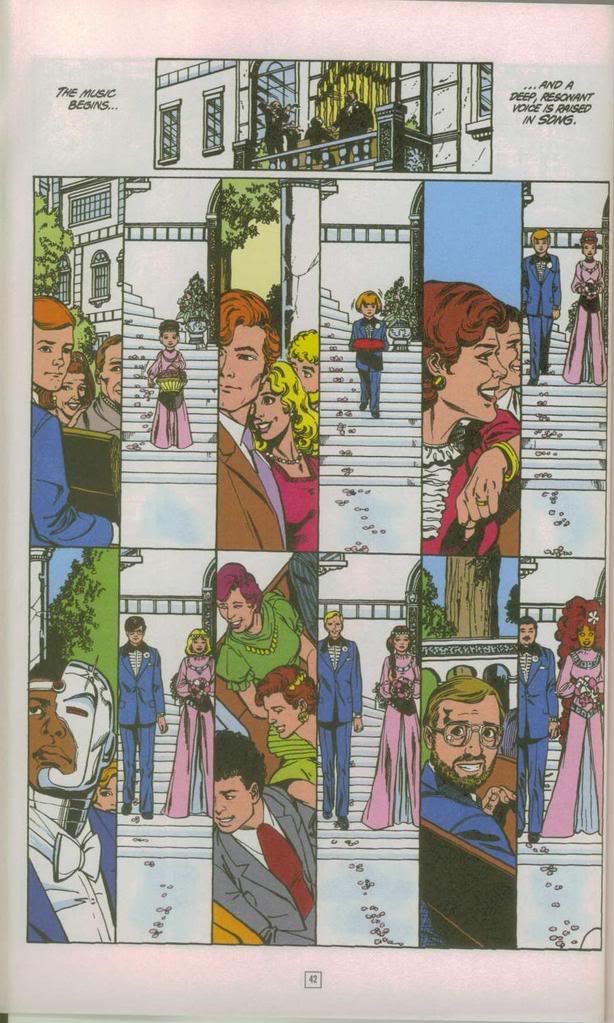
These issues are bittersweet for a few reasons. Obviously, the wedding is the apex of Donna-worship. As for Terry ... yeah, he's there too. Tales of the Teen Titans #50 also represents the conclusion of George Pérez’s first, longest, and most successful tenure with these characters. Therefore, it’s our last bit of Pérez for a while. Appropriately enough, then, Tales #48 and #49 feature guest artists Steve Rude and Carmine Infantino, respectively, doing fill-ins while Marv and George are busy with wedding logistics.

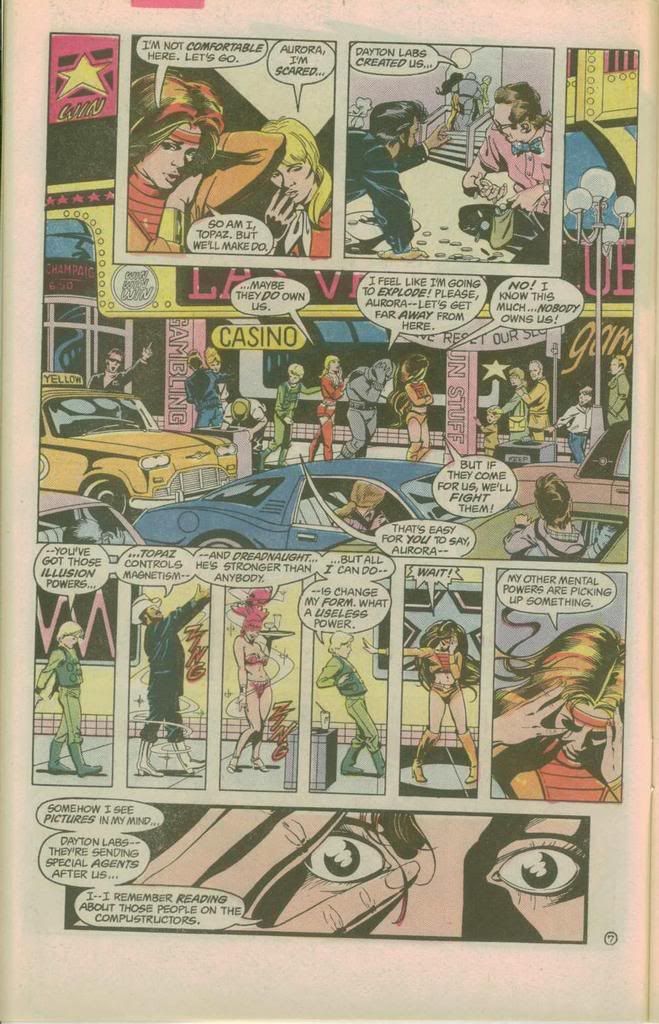
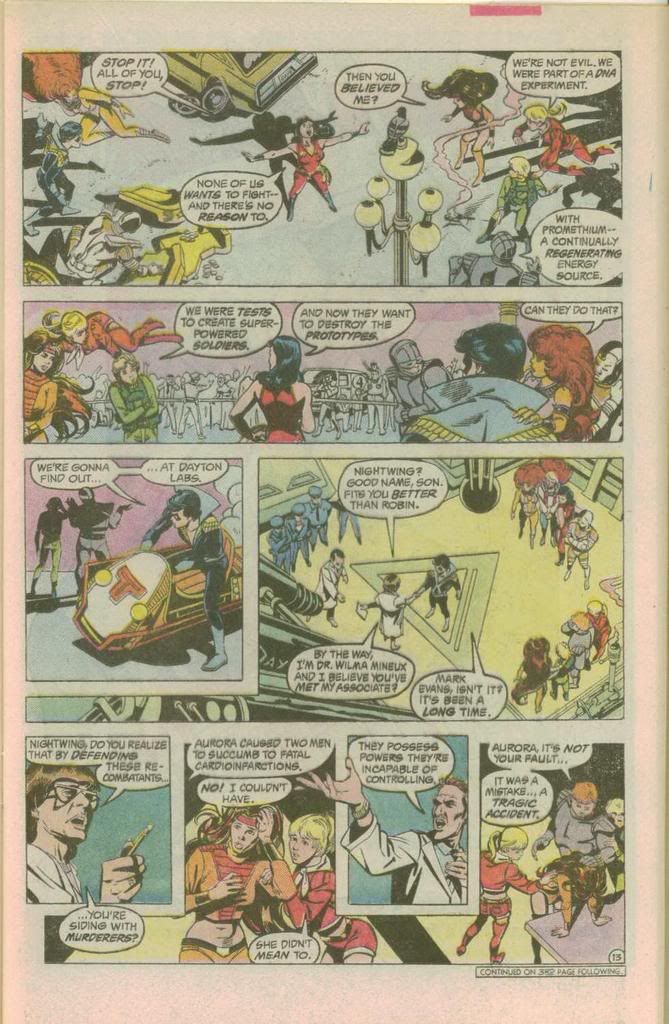
Tales of the Teen Titans #48 (November 1984) presents the "RECOMBatants," a thinly-disguised pastiche of the DNAgents, a teen superhero team from the mid ‘80s created by Mark Evanier and Will Meuginot. This was part of an unofficial Titans/DNAgents crossover that mirrored the unofficial JLA/Avengers crossovers of the early ‘70s. Accordingly, to balance things out, the Titans got to be the Squadron Supreme over in the DNAgents’ own book. How’s the story itself? Well, remember how Thunder and Lightning were misunderstood teens who didn’t ask for their powers and were forced to use them in self-defense against a world that hated and feared them? Yeah, pretty much that, plus the fact that the RECOMBatants were only a one-shot deal and therefore got to enjoy a poignant sendoff.

II suspect the main interest in this issue today is the Dude (and inker Al Gordon)’s take on the Titans, because it’s pretty far from Pérez. The lines are thicker, there are more shadows and mood, and everything is generally more fluid. Don't get me wrong -- Pérez's figures can move, and his work is very dynamic, but Rude's characters are incredibly laid-back and look a lot more weightless.

A lot of it seems to be that Rude's figures are more exaggerated than we've been used to seeing. Perez tends to let his layouts do a lot of the work, and his figures then move within their confines. Rude isn't as layout-conscious, so his figures have to make up for it. Rude is also more of a cartoonist.

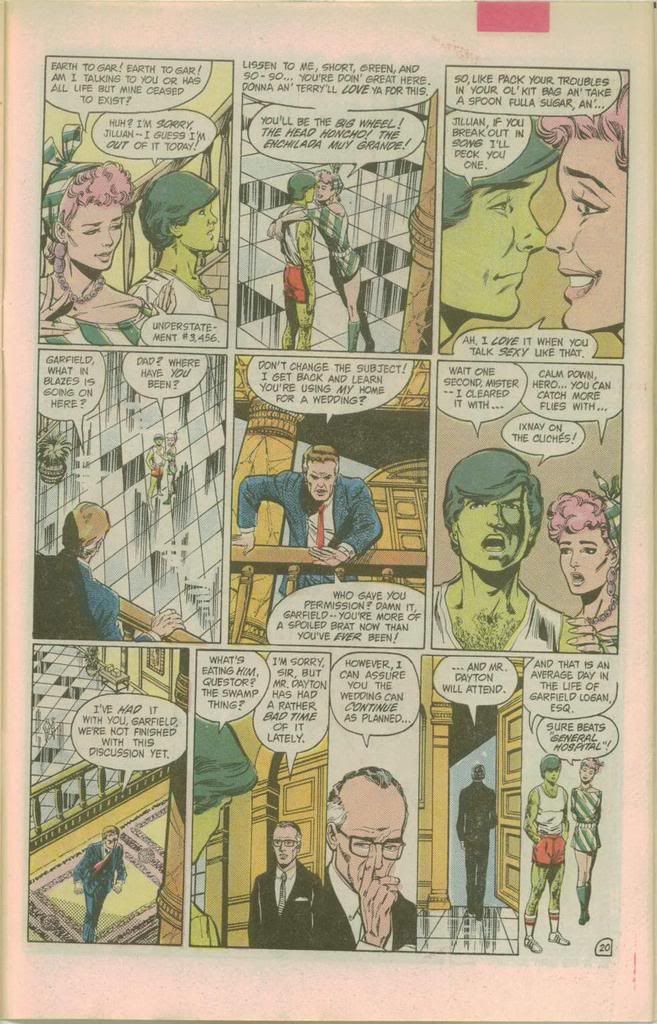
The main story is only 18 pages, leaving room for a brief set of epilogues drawn (as were the previous few issues) by Pérez and Mike DeCarlo. Gar Logan and Jillian get chewed out by Steve Dayton (who looks a lot like Reed Richards here) for letting Donna use the Dayton mansion for the wedding without his permission. Dayton also happens to know Swamp Thing, although it's not clear how.

Terry then gets a sendoff from a handful of his naughty! female students as again, Marv and George use wedding-related events to show that all of the ancillary characters are obsessed with sex. The issue ends with a short scene between Jericho and Raven, with him sensing something wrong and her warning him away.

Tales #49 (December 1984) features more shenanigans by Terry's groomsmen, the Midlife Crisis Brigade ...

... as well as the dramatic reappearance of Sharon Tracy, Donna's roommate from back in the dizzay. According to TitansTower.com, Sharon first appeared in Teen Titans #22 (July-August 1969), the Marv Wolfman-written issue that first related Donna's origin (establishing her as different from a young Wonder Woman) and introduced her red long-pantsed costume. Therefore, it's nice to see her again, hanging out with Lilith Clay (herself appearing for the first time since the Titans West days, I believe) and Diana Prince.

Didn't Gene Siskel once say his test of good characterization was whether he'd want to have lunch with the characters? Well, all the wedding subplots are fairly drama-free, so these framing sequences and epilogues are the equivalent. They're often corny, but they're still enjoyable.

The bulk of #49 concerns Wally West and Frances Kane's guerilla warfare against Doctor Light. Somehow he can turn himself into a ball of light and break into the Central City bank, but after he surrounds himself with darkness he can't stop Frances' magnetically-hurled implements of destruction. In other words, Light is just powerful enough to be a menace for about six pages. Wally spends the fight running too fast to be seen (he still has a secret identity at this point but left his costume at Titans' Tower when he retired), saving bystanders, and getting clocked by Light's invisible forcefield. Anyway, Light is eventually so bumfuzzled by Fran's attacks that he begs the cops to take him away. I used to think that Mark Waid was solely responsible for Fran's descent into psycho-hosebeast territory, but dialogue here lays the foundation for it pretty well. Frances tells Wally she enjoys using her powers, and while Wally's jokes are in the "glad you're on my side!" vein, it's hard not to think of her shrewish future here.

Turns out Wally and Fran's adventure delayed their meeting with the Flash, who's right in the middle of his murder trial at this point. Flash basically tells Wally that puberty has screwed with his powers, so that using his speed is not only harmful, it could be fatal. The issue ends with a couple of quiet scenes -- Donna and Terry relaxing on the night before the wedding, and a virtually static final page where Wally leaves a sweet RSVP on Donna's answering machine. Now, crank up the organ and cue the doves -- it's time for the Wedding of Donna Troy!

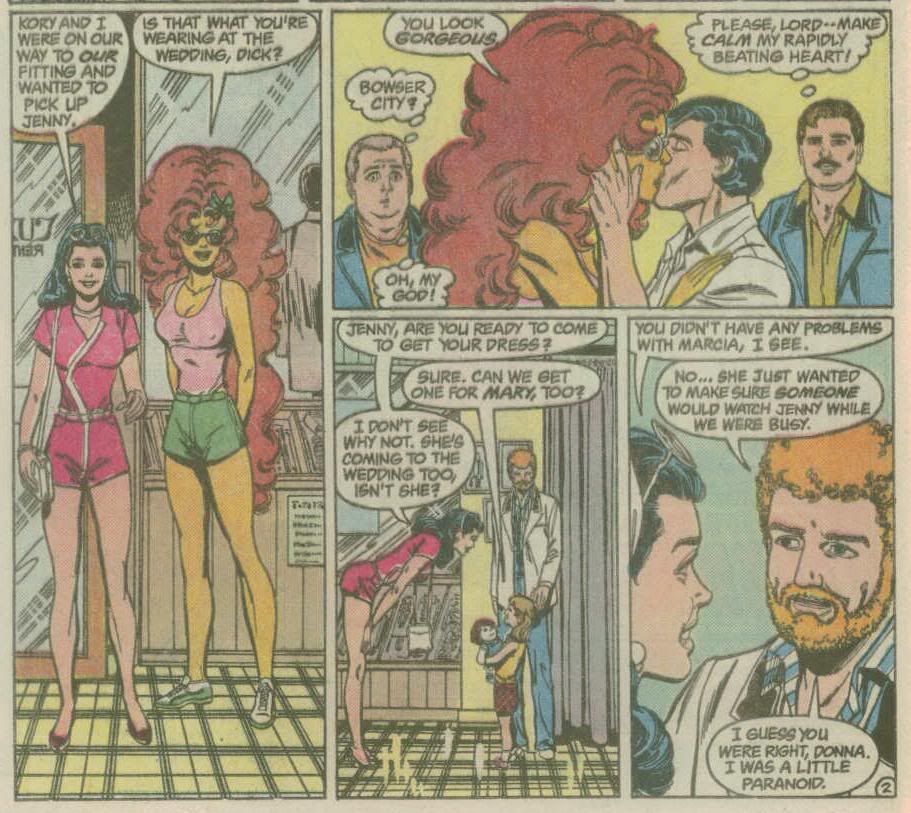
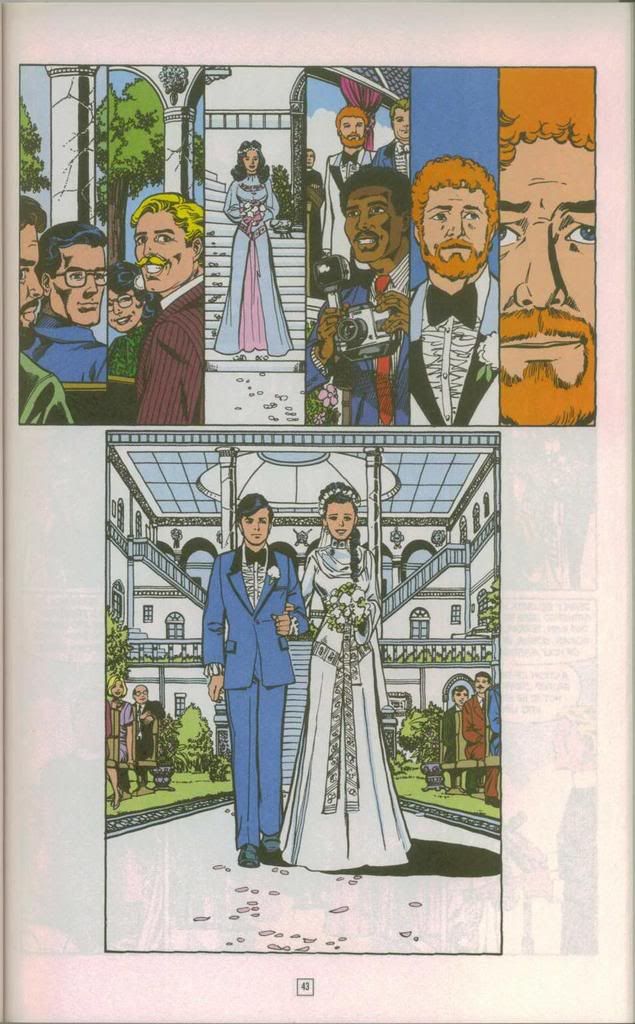
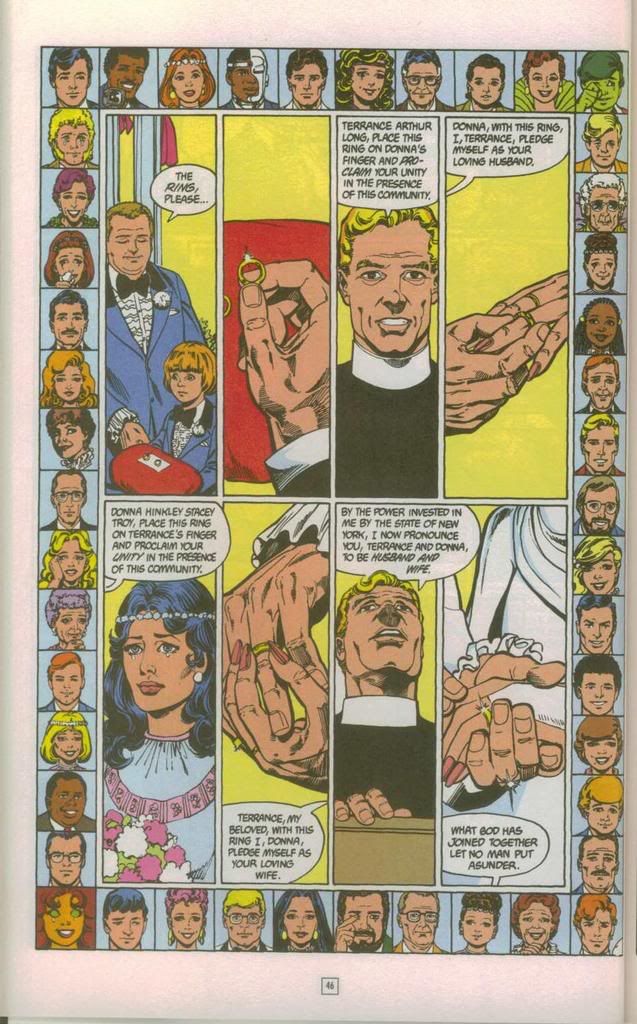
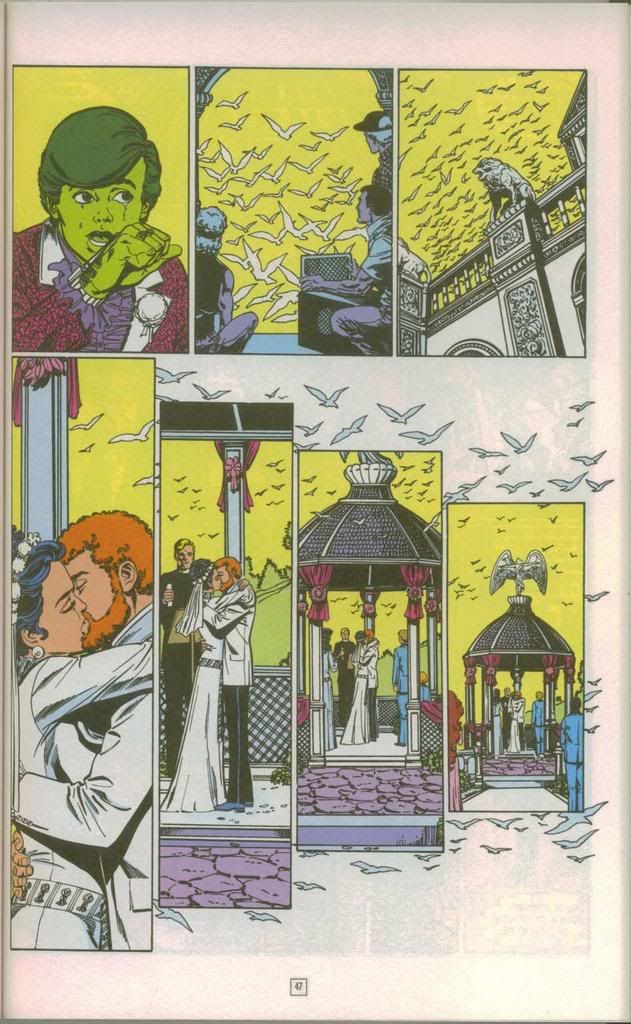
First off, Tales #50 (February 1985) is a beautiful comic. Perez says goodbye with a flourish, using his layouts to freeze time for the literally life-changing moments that deserve them. Donna's appearance at the ceremony ...


... and the happy couple's first married kiss ...


...are exquisitely framed to capture both their sweep and intimacy.

The issue builds a certain amount of tension, too, through sequences on Paradise Island meant to suggest some problem for Donna and/or Diana to solve; and through corresponding sequences at Dayton Estates suggesting someone creeping around. However, there are no supervillains interrupting this remarkably mundane occasion, just Queen Hippolyte getting special dispensation from the gods to leave Paradise Island and give Donna her blessing in person. Indeed, Donna's wedding is a fairy-tale affair after all.

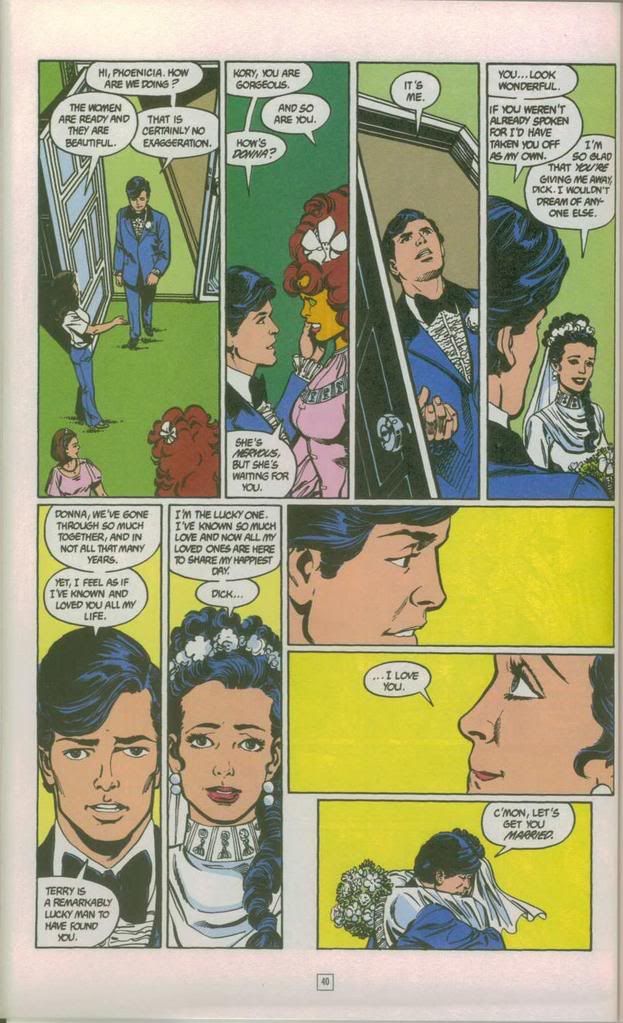
The only Titan not present at the wedding is Raven, hiding in Azarath's dimension and literally afraid to show her face as she becomes more consumed by Trigon. In fact, Raven is the only costumed character in the issue, if you don't count Cyborg's armor under his tuxedo. Still, everyone else is there, clearly identified and placed in context, including most of Titans West. Some of the "civilians" don't fare as well -- Donna's family from "Who Is Donna Troy?" are all around, of course, but there's not much to help the casual reader with them. There are also a number of "insider" cameos, including Marv and George themselves and colorist Adrienne Roy. "Phoenicia," designer of the bridal party's gowns, was a friend of Perez's, and apparently a number of fans even got to see themselves drawn into the issue. I think they're ogling Bruce and Dick.


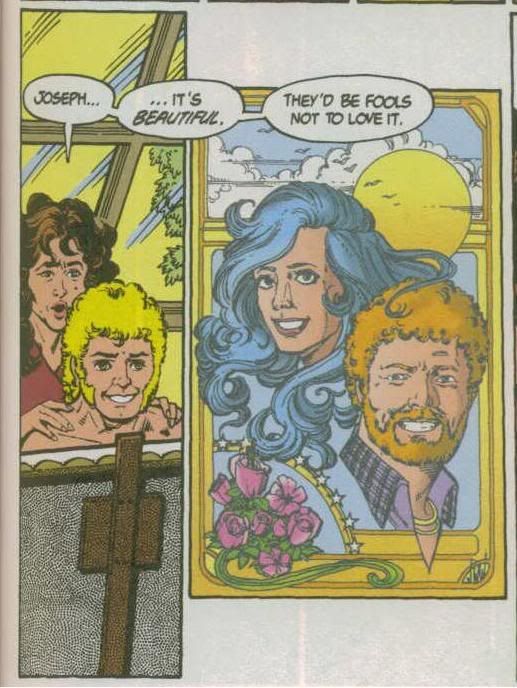
The regular cast has a lot to do, naturally. Gar shows some unexpected maturity as wedding coordinator, sublimating his continued angst over Terra's death pretty well. Vic throws a little fit when he finds out Steve Dayton's been using the Mento helmet to conceal Vic's cybernetic implants, but he and Gar make up. Joey shows his mom (in her first appearance since "The Judas Contract," so that's a little jarring) his portrait of the happy couple and, honestly, it looks like it should be on the side of a van.

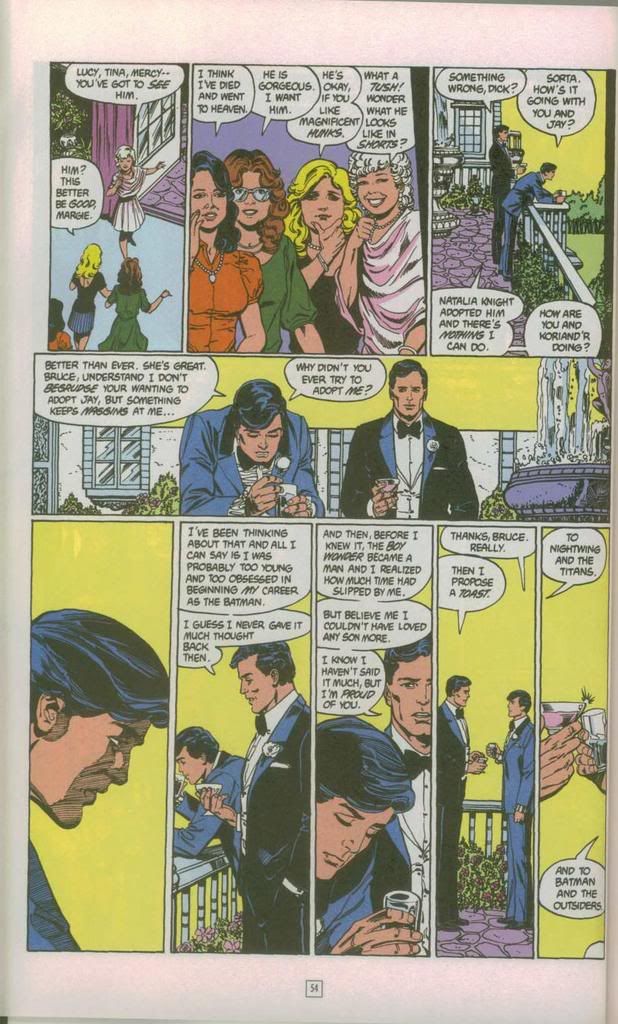
Kory probably has the least to do, story-wise, but she has to share bridesmaid duties with Sharon and Diana. Dick gets to confess his platonic love for Donna, and he also caps the subplot of being "estranged" from Bruce with a warm scene that, yes, informs a similar scene in last summer's Justice League of America #0.

Those Dick/Donna and Dick/Bruce scenes are still pretty effective. Dick/Babs is the "meant-to-be" relationship now, and there was never really any hint that Dick and Donna were more than friends. Thus, it doesn't seem like much of a stretch to transfer Dick's feelings for Donna over to Babs, especially when both become unattached.

As for Dick/Bruce, talk of Natalia "Nocturna" Knight adopting Jason Todd, plus the last panel where each toasts the other and his team, places this scene squarely in the transitory mid-1980s. I never quite believed Bruce's paternal feelings towards Jason (or Tim, for that matter), mostly because pre-Crisis Jason seems to spend more time with Dick. For that matter, it made more sense to me that Bruce would feel like Dick's big brother, not his dad, so their relationship as guardian and ward were more appropriate. However, this scene defined the Bruce/Dick relationship for a whole lot of people for many years to come, and who am I to argue?

The wedding itself does have a few cringeworthy moments. Both Michael Jackson and Sting* make cameos, and depending on how you feel about the late John Denver, "Annie's Song" as the First Dance may be a dealbreaker. Also, while Dick, Joey, and Mal "Hornblower" Duncan are all shown rocking out while the regular band takes five, apparently Roy Harper no longer wishes to relive his Great Frog days.

Maybe the best thing about this issue is that it makes the wedding and reception look fun. It's the kind of shindig you wish you could put on, and if you've ever had to plan a wedding, it's the kind of party you hope you threw. The buildup to #50, and especially #49's last couple of pages, convey pretty well the crest of tension that any newlywed-to-be feels the night before. By the day of, there's nothing you can do about it: either it works or it doesn't, so just let it happen. Thankfully, Marv and George (and inker Dick Giordano, with an assist by DeCarlo again) made sure it all worked. I have to say, when I started going to my own friends' weddings a few years after this issue came out, it was always in the back of my mind. It was there too when the Best Fiancee Ever and I started thinking about our own nuptials. I didn't lobby for "Annie's Song," but I wouldn't have kicked it off the playlist.

Like I said with regard to "Who Is Donna Troy," this issue works almost despite the fact that there's not much more to Donna beyond being pretty and nice. However, the peculiar alchemy Wolfman and Perez were able to use on her has turned that around into a kind of unequivocal goodwill -- that because she's so nice, we don't want anything bad to happen to her, and we even actively wish her well. Indeed, we probably feel sorry for her that much more when she gets stuck with thankless expository 52 backups.

But that's getting too far ahead of ourselves. For now, I'm happy to let Donna and Terry enjoy their honeymoon.

Next: Rich Buckler comes aboard, Cheshire returns, and Gar gets closure with the Terminator!


*Actually, it might have been John Constantine having some fun, even if his first appearance was still a while away. He did know Steve Dayton, after all.
Full Post

Wednesday, January 31, 2007

Prison breaks

In the old days, when editor's notes rolled across the prairie like an ocean of asterisks, the superhero books would show crooks being caught and, presumably, tried and incarcerated. Later, when it was time for them to cause trouble again, they'd be shown escaping from prison because, naturally, the escape would help demonstrate how dangerous they were. An editor's note might even pop up to remind us how long they'd been in the pen.

Does anybody show that part of the process anymore? Generally speaking, do DC and Marvel track their supervillains' movements that closely, or do they just treat them as free-range bad guys who are not so much captured as temporarily thwarted? If anyone has examples, please feel free to share. I can't think of any off the top of my head, but I'm not thinking too hard....
Full Post

Sunday, January 28, 2007

New comics 1/17/07 and 1/24/07

Wow, two weeks withouth a post? Jeez, I'm sorry. A combination of factors, including the latest "successor" installment of Grumpy Old Fan, compelled me to do another double-sized weekly roundup. I'm also motivated to do some more TItans recaps. Anyway, let's get right to it.

The best book of this bunch was, no question, Criminal #4 (written by Ed Brubaker, drawn by Sean Phillips), another really great issue. Not a panel or word is wasted. For me, this story is art-house noir comics -- it reminds me of seeing a really good indie-film thrilla at the Kentucky Theater, the local art-house in my old hometown.

Runner-up is Checkmate #10 (written by Greg Rucka, pencilled by Jesus Saiz, inked by Fernando Blanco): a darn fine issue, especially considering that I couldn't remember who the Checkmate agent was supposed to be and was too lazy to look it up. If it were my first issue, I would have been just as satisfied. Considering that this is a Shadowpact crossover, that's probably what DC wants to hear. Also, Saiz and Blanco do a really fantastic job -- moody and creepy, with a nice earth-tones palette from colorist Santiago Arcas.

I was hoping it'd be Ray Palmer in 52 #37 (written by JMRW, breakdowns by Keith Giffen, pencils by Pat Olliffe, inks by Drew Geraci), and I really didn't expect my Lightray prediction to pan out, but what we got was good enough. It'll probably make more sense in the long run anyway. I don't know if I'll be able to say the same about Buddy's aliens' involvement, but there you go. 52 #38 (pencilled by Joe Bennett, inked by Jack Jadson) was a better-balanced installment, building some suspense about the return to Nanda Parbat and creating a nice bit of dread with the Four Horsemen. I would have liked a little more with Buddy and the aliens -- did they watch movies, pick their fantasy JLA, or run cheap shots into the ground on their week off?

Speaking of the Justice League, JLA Classified #32 (written by Dan Slott and Dan Jurgens, pencils by Jurgens, inks by Trevor Scott) kicks off its Tribute to 2004 with the first of two arcs originally announced for that year. This is Slott's "The 4th Parallel," featuring the Red King, an ordinary guy with the power to control probablity through manipulation of parallel universes. (Was this delayed, at least in part, by the 52 aftereffects? I dunno.) RK's scheme is somewhat hard to grasp, but Jurgens' usual stiff figures are softened well by Scott's inks. Jurgens also finished the script, I think on account of Slott's exclusive Marvel contract (right?), so I hesitate to call this one of Slott's weaker efforts, because that's not fair to him or Jurgens. Even so, not a bad start.

I don't have any particular criticism of Green Lantern #16 (written by Geoff Johns, pencilled by Ivan Reis, inked by Oclair Albert), although Hal's brief remarks about POW torture are a bit much whether they're meant to come from him or Johns. Reis and Albert make a good team, so it helps that this issue is mostly action.

Since I spent most of high school and half of college with Ricardo Villagran's inks on DC's Star Trek title, his guest art on Aquaman: Sword Of Atlantis #48 (written by Kurt Busiek) was welcome. Most of the plot concerns the old Aqua-villain Fisherman being some kind of parasite (what, another one?), with a subplot about Aquaman confronting an old failure while on a rescue mission. Villagran is less "sketchy" (for lack of a better term) than Butch Guice or Phil Winslade, but he does a good job with both the landlubbers and the undersea action. The story itself feels very prefatory, though, like it's counting on Part 2 to pull it through.

The same applies to Birds Of Prey #102 (written by Gail Simone, pencilled by Nicola Scott, inked by Doug Hazlewood). While Lois Lane and Barbara play a dangerous game of cat and mouse, in which the hunter becomes the hunted, Manhunter fights evil prison guards until ... well, she's still fighting. Wait 'til next issue.

The Spirit #2 (by Darwyn Cooke) was another good issue, although I don't have the background with P'Gell to gauge whether she's portrayed appropriately. I know that's not entirely the point of this series, but it does walk that tightrope. The issue does establish P'Gell as the Spirit's femme fatale, for whom he cares but with whom he can never settle down, and at this point in the series we're still being introduced to everyone.

Fantastic Four #542 (written by Dwayne McDuffie, pencilled by Mike McKone, inked by Andy Lanning and Cam Smith) gets the book back on track quite well. I don't mind Mike McKone, but I do think this title needs a penciller a little less antiseptic.

She-Hulk #15 (written by Dan Slott, pencilled by Rick Burchett, inked by Cliff Rathburn) was decent, but I'm not quite used to the old supporting cast being gone. Shulkie fights the Abomination with the power of her brain and some SHIELD help. We'll see.

With Omega Men #4 (written by Andersen Gabrych, drawn by Henry Flint) focusing on Vril Dox and Superman almost as much as on Tigorr and his lost love, I'm starting to think this is another backdoor prelude to DC's version of Annihilation. It's still good, but it doesn't seem so much like it's just about the Omegas.

Supergirl and the Legion of Super-Heroes #26 (written by Mark Waid, pencilled by Barry Kitson, inked by Mick Gray) offers more action, plus the slightly revised origin of the Ranzz siblings. Nice cliffhanger.

It's good that Bart does Flash-y things in Flash: The Fastest Man Alive #8 (written by Danny Bilson and Paul DeMeo, pencilled by Ron Adrian and Art Thibert, inked by Thibert). It's bad that the rest of it -- especially the just-add-water romance -- is so contrived. Maybe things will improve next issue with new writer Marc Guggenheim.

Finally, my ramble this time is about Star Trek: The Next Generation -- The Space Between #1 (written by David Tischman, drawn by Casey Maloney). This issue tells a first-season story that would have been a pretty decent first-season episode; but if you know TNG, that's not exactly a compliment. The idea of a culture with permanent records as fluid as Wikipedia offers a good opportunity for satire, and this issue hits the highlights of those opportunities. Art is sorta-kinda photo-influenced, not unlike an old DC TNG artist named (I think) Rachel Pollack. Everyone looks and sounds about like they should, but 22 pages of story obviously doesn't translate into 48 minutes of TV time, and that's the issue's biggest problem.

Pacing dooms this issue, which spends the first 3-4 pages on the mundanities of hailing the planet, establishing the mission, and beaming everyone down. It strikes me as the kind of thing that a fan would write, thinking (perhaps justifiably) that a fan would want to read it. However, that kind of initial pace can also encourage the reader, at least subliminally, to expect a more fleshed-out story -- in other words, to expect a story that would take 48 TV minutes to tell. It ends up making the more important parts feel rushed.

It also points up the differences between film and comics, which I think apply to more than just licensed adaptations. Those 3-4 introductory pages establish the away team's mission, identify their contact person, and describe (in dialogue) a weird energy surge. However, a one-page splash panel could show the away team beaming down and relate the same information through log-entry captions. The team's going to meet with the leader pretty soon; he didn't need to be introduced on the Enterprise viewscreen a couple of pages before.

Moreover, that one-page intro is something that comics can do, and film can't. It might take an actor 30 seconds to speak all the dialogue that a few captions could convey, and nobody wants to spend 30 seconds -- the length of a commercial -- on a relatively static image backed only by offscreen narration. With comics, though, the reader can digest those captions at her own pace while taking in the visual information about the planet and the beam-in from the splash panel.

Nevertheless, it seems like a lot of comics these days are so concerned with evoking the experience of film that they have forgotten, or are skittish about using, the narrative tricks that don't work for film. I know I opened this post by approving of Criminal's filmic tendencies, but the difference is its efficiency. Criminal knows how to be a good comic. The new TNG comic is inefficient (wow, sounds like the Borg, huh?) precisely because it tries too hard to capture the beats and pacing of its filmed ideal. It tries to be what it is not, and therefore fails. Infinite combinations, remember?
Full Post

Sunday, January 14, 2007

Waterlogged: Tales of the Teen Titans #s 45-47

Remember the recap of NTT #s 10-12, when I said it was always a chore for me to get through those issues? Well, the same applies to Tales #s 45-47, the "end of the HIVE" story. Put simply, the Titans attack and destroy the HIVE's underwater headquarters. This takes three issues. The subplots, involving Gar & Vic and Wally West & Frances Kane, are more interesting than the main action, but they get lost in all the big sequences.

Starting this issue, there's also a lot less George Perez, since he's busy over in the new New Teen Titans Vol. 2 supplying full pencils and inks (at least for the first couple of issues). This, plus gearing up for Crisis on Infinite Earths, meant that he could only provide loose pencils for Tales, with inker Mike DeCarlo finishing everything. DeCarlo had been working on the book already, inking the last chapters of "The Judas Contract" with Dick Giordano, but these issues are more DeCarlo than Perez, so everybody gets the same wide-eyed face and a lot of Perez's detail work is lost. Back then, the direct-market-only NTTv.2 might not have had the circulation of the newsstand-distributed Tales, but considering both titles today, Tales definitely feels like the little brother.

Still, these three issues had ambition. The whole thing starts well enough in Tales of the Teen Titans #45 (August 1984), with a near-death Aqua-couple dropping cold just short of the inviting Titans' Tower pool. Wait, I can hear you interrupting, pool?!? isn't Titans' Tower on an island? Ah, therein lies the tale: the HIVE has been poisoning the seawater around its base, and Aqualad and Aquagirl got caught in the toxic zone. The group of Titans decides it's had enough of the HIVE, and is still nursing the emotional wounds from Terra's death, so Nightwing, Starfire, Wonder Girl, and Jericho head out with Aqualad and Aquagirl to do some damage.

However, that's at the end of an issue front-loaded with subplots. The most prominent is Gar's turn for the dark and gritty, as he works out his Terra issues through the mauling of evildoers. Cyborg tries to counsel him, but he admits he's been busy, and this really sets Gar off: "I understand you had better things to do. So did Donna and Kory and Dick and everyone else, too." As Gar stalks off, Vic muses that the Titans really were naive to trust Terra, which makes me feel better about my own armchair analysis.

Meanwhile, Vic's wacky grandparents -- ex-Vaudevillians who know how to pick locks, among other things -- show up at his apartment. More with them later.

The wackiness continues at Terry Long's bachelor party, attended by teetotaler Dick Grayson ("Somebody's got to drive the school bus home") and Terry's goofball Midlife Crisis Brigade. Yes, there is a stripper. Yes, only the Midlife Crisis Brigade cares. Dick and Terry are, of course, above such low pursuits, and they share a moment about how they have found their lobsters, and of course no stripper will distract them.

Over on Paradise Island, Donna is getting an Amazonian bachelorette party, and if you can imagine the bizarre sexual shenanigans of the Marston/Peter Wonder Woman, you'll have only the faintest idea of the deprav ... okay, it's not like that at all, drat the luck. Diana gives Donna a new set of Amazon bracelets, reflecting her dual Amazon/human heritage, and it's all very sweet ... but really, don't we all at least imagine the other?

Finally, we catch up with Raven and Jericho, the latter picking up the former as she gives her well-meaning geeky classmate the old it's-not-you-it's-my-demonic-father brushoff. In Joey's car, Raven monologues about how Joey's so trustworthy and calming, but then she abruptly teleports to Titans' Tower, because hey -- weren't some Atlanteans dying?

Lucky for Aqualad and Aquagirl (Garth and Tula, since I keep forgetting to mention their real names), Wally and Fran had returned to the Tower looking for some closure from Terra's death, when they found the ex-Titans about to die. With Dick busy trying to save their lives, though, Wally's free to vent about having to learn of Terra's death through the mainstream media. To me this is a valid issue, maybe not raised at the best time, but still underscoring Wally's subtle rejection by the group. When Dick starts making preparations to attack the HIVE base, he invites Wally to join them, but Yoko/Fran vetoes that, and Wally sheepishly agrees. Fran apparently thinks Wally's still in lurve with Raven, and Wally's tapdancing around telling the Titans (and us) how sick he's gotten.

But that's a subplot for another day, because now we're into #46 (September 1984) and the attack proper. A few pages in the middle of the book check in on Vic with his grandparents, and the aftermath of Gar's mauling another skel, but other than that it's all combat. I'm not going to go into much detail, except to give a few highlights.

First, Tula/Aquagirl gets a couple pages to herself, fighting random HIVE goons. I don't know her history, but I'd bet Topo the octopus got more face time in the Aquaman books than she did. Therefore, putting her in the spotlight here was nice -- kind of a last hurrah, considering her fate in Crisis On Infinite Earths. She gets zapped by flamethrowers, causing Raven to teleport in and throw some Trigon dark-side mojo onto the unsuspecting HIVErs.

The HIVE mistress herself is introduced this issue too. She's like the Borg Queen, I suppose, put through a Junior League filter. Perez designed her to look like Bernadette Peters as a platinum blonde, but she really reminds me of Julia Duffy's airhead heiress-turned-maid on "Newhart."

Also, Jericho takes over an unconscious HIVE flunky, so there's that. More with him later. Anyway, the Titans (minus Raven, who's stayed behind to guard the still-recovering Aquagirl) fight HIVErs until they get herded into a big empty room. All the doors slam and the chamber is ejected out into the ocean, where it's destroyed.

That's where #47 (October 1984) picks up, and if you supposed that Raven could have saved the group by gathering them into her soul-self, you probably remembered NTT #23, when she did pretty much the same thing. The group blasts its way back into the base, but Raven's tapped out from the expenditure of power and teleports away. By this time, though, Flunky #32 (the guy controlled by Joey) has awakened, and he's ready to tell the Titans about all the base's secret snares, because, y'know, Bernadette was ready to kill him too. So, for starters, he tells the Titans the HIVE is going after Atlantis itself.

And on that note, we zap back to Titans Tower (where Raven is apparently nowhere to be found ... hmm ...) to see Gar still upset over Terra. Vic shows up, wanting to talk, but Gar only wants to kill Deathstroke. However, his bloodlust is sated somewhat by the sudden appearance of his old girlfriend, Jillian No-Last-Name, from Tales of the New Teen Titans #3. (No, it's not explained how she got past security, although Vic isn't surprised to see her, so maybe that's a clue.) Gar still wants Deathstroke dead, though.

Back at HIVE base, Perez treats us to a two-page spread that kicks off a sequence of (mostly) all-woman action, with Wonder Girl, Aquagirl, and Starfire busting heads while Nightwing, Aqualad, and Jericho act more indirectly. Starfire gets knocked out, but Jericho takes control and, in her body, fights through flames and an electrified net to destroy the base's innards. Sensing that all is lost, the HIVE mistress flips the suicide switch that kills herself and her inner circle. In a somewhat anticlimactic touch, Aqualad rips the guts out of a missile launched at Atlantis, but by then the HIVErs are dead and the base is set to self-destruct. It's all very perfunctory at the end, which is weird considering all the buildup.

Speaking of which, the HIVE mistress' posthumous message to the Titans reveals that a) they were going to poison the world's oceans and blackmail its governments into obedience; and b) they wanted to make a name for themselves, and went after the Titans because they'd be easier to kill than the Justice League. In a final panel showing a certain golden satellite, Lyla tells the Monitor that the HIVE has been defeated.

And that's the end. Not a bad little arc, if you like action, and it did address some of the lingering issues from Terra's death, but it still feels unnecessary. If the HIVE's main base had been destroyed by Terra's death throes in Annual #3, that would have been one thing, and the book could have moved on. However, Donna's wedding is coming up in #50, and there's even a couple of fill-in issues before then, so maybe Wolfman and Perez decided they needed to stretch things out a little beforehand. They couldn't go right into Raven's continuing Trigon problems, because that was the subject of the parallel arc in NTTv2, and in between I guess they didn't have as much plot as they thought.

With that in mind, these subplots still felt a bit reheated. The overall structure -- one group destroys a base while a member lashes out -- is reminiscent of NTT #13, and as noted above, the means of the Titans' escape in #47 was identical to Raven's actions in #23.

Female characters are prominent in this arc. Bride-to-be Wonder Girl is contrasted (perhaps unintentionally) with the HIVE mistress, a widow who keeps musing that her late husband would have handled the Titans better. Aquagirl does her share of butt-kicking, as does Raven. The ghost of Terra continues to haunt Gar (until he's brought back to earth by Jillian), and Frances Kane likewise continues to influence Wally. Finally, Vic's grandmother gives him a dressing-down after he reminds them they (too) haven't cared enough to check in on him since his dad died. I don't think there is any grand design behind all these characters, but it's worth noting.

In the end, this arc was probably intended to be cathartic for the Titans after the Grand Guignol of "The Judas Contract." Regardless, in hindsight it's hard not to see Marv and George checking another ongoing subplot off their list before Perez leaves the book. Having the arc end with a nod to Crisis may be more revealing than they originally intended.

Next up: The Dude, Doctor Light, and Donna's wedding!
Full Post

Saturday, January 13, 2007

New comics 1/10/07

We begin this week with Agents Of Atlas #6 (written by Jeff Parker, pencilled by Leonard Kirk, inked by Justice with Terry Pallot), the little miniseries that deserves a big future. I really liked how this book played with my expectations, especially this issue. The ending is so perfectly suited to the book's quietly subversive tone that I can't say much more for fear of spoiling it. The whole miniseries strikes me as Marvel: The Lost Generation without all of M:TLG's aspirations at legitimacy, but it's a fine story by itself. Also, speaking of nostalgia, it was good to see inker Terry Pallot's name in credits again -- for me, it's been since I read Star Trek comics in the' 90s.

From the Midnighter cameo I'm a little confused as to whether Welcome To Tranquility #2 (written by Gail Simone, drawn by Neil Googe) is supposed to be part of the regular WildStorm universe. It doesn't matter all that much, I guess: the issue uses Mr. Articulate's murder as an opening into further exploration of Tranquility and its quirky inhabitants. It's not really Astro City or Top Ten-level pastiche, but there's a lot of meta elements (old-style comics pages, ads, etc.), sometimes overlaid with the regular story, and that can get a little overstimulating. Together with Googe's cartoony art, the overall effect is supposed to be something like Northern Exposure, I guess, and that's not bad. Really, that's how I feel about the series too, at this point.

I did like the Spectre lead in Tales of the Unexpected #4 (written by David Lapham, pencilled by Eric Battle, inked by Prentis Rollins) more than I have in previous months, but that's because it ties the previous issues' carnage into an overarching plot. Unfortunately, the plot depends on none of the Gotham City police ever having heard of the Spectre; and I'm sorry, but wasn't the old Spectre rampaging throughout DC-Earth, including Gotham City, during Infinite Crisis? As always, the real treat of this book is the Dr. 13 backup (written by Brian Azzarello, drawn by Cliff Chiang), this time featuring much more craziness, including a gorilla with (I swear) the transliterated accent of Arnold Schwarzenegger. Yes, there are Planet of the Apes jokes, including the one you expect, but there's also the one I didn't expect, and that was the best of all.

[FYI, I am writing while listening to the complete 2-disc Superman soundtrack, and I just took a break to enjoy Disc 1, Track 12, "The Big Rescue." ("You've got me? Who's got you?!?") Mmmm ... John Williams-licious.]

Batman Confidential #2 (written by Andy Diggle, pencilled by Whilce Portacio, inked by Richard Friend) takes its story in a very strange, almost Iron Giant-like, direction. I didn't dislike it, it was just ... not what I was expecting at all. The issue still ends in a pretty familiar place, though, although I'm not sure if that's good or bad. I have made up my mind, however, that this kind of Batman-discovers-technology story is done no favors by the moody, expressionistic art of Portacio and Friend. I'd have been happier with someone more suited to giant robots and mean-looking Bat-vehicles. Howard Porter's old style would have worked, as would Chris Weston's or even Michael Lark's.

"Grotesk" wraps up in Batman #662 (written by John Ostrander, drawn by Tom Mandrake), and nothing much happens except for a final confrontation between Grotesk and Batman aboard a vintage sailing ship in the icy waters of Gotham Harbor. Now, I like Bat-fights in moody, Frankenstein-esque locations, so this was a highlight of the issue; but the rest of the story was pretty predictable. I do get the feeling that Ostrander was going for a combination of Frankenstein and maybe Phantom of the Opera, but it ended up being very familiar.

Walt Simonson writes and draws JSA Classified #21 as a tie-in to the Rann-Thanagar aftermath he started over in Hawkgirl, and I'm not going to say no to Simonson art. The story answers some questions Hawkgirl raised, but by the end of the issue, unfortunately, things have gotten more confusing. Basically, Hawkman's trying to prove that Blackfire is still evil, but can't; he gets involved in a pretty cool mid-air fight; and the issue ends on a cliffhanger that sets up the last Hawkgirl. Oh, and Adam Strange might be alive and able to see, assuming nobody else on Rann dresses like him, which they do.

For real interstellar action, though, the best bet this week was Green Lantern Corps #8 (written by Keith Champagne, pencilled by Patrick Gleason, inked by Prentis Rollins). The three Green Lanterns take on a super-Dominator and a super-Khund, and things don't go well. Things go so badly, in fact, that I can't help but think a big chunk of this issue will have to be undone next issue. Still, I didn't mind, because the creative team did a great job of establishing these two bad guys as overwhelmingly dangerous, and building to a really suspenseful cliffhanger. Well done all around.

52 #36 (written by JMRW, breakdowns by Keith Giffen, pencilled by Jamal Igle, inked by Keith Champagne) finally wrapped up the Lady Styx storyline, touched on the Question and Osiris subplots, and connected Supernova and Skeets to Rip Hunter. The highlight was Igle and Champagne's artwork, because the two major plot threads -- in space and with the Question -- felt like they should have happened a while ago.

Finally, if the super-neo-Nazis are hunting down JSA relatives in Justice Society of America #2 (written by Geoff Johns, pencilled by Dale Eaglesham, inked by Ruy Jose), why are they just trying to kill them? Why not try to sway them to their side? After all, the JSA's attempts to identify them could be taken as part of a plan to establish a kind of genetically-superior class of people, whose powers and connections give them a special destiny, yadda yadda yadda. In other words, there's a fine line between wanting to raise the next generation of superheroes right, and wanting them to embrace what sets them above the rest of humanity. Okay, maybe the line's not so fine, but you can see where Nazis might make a good set of villains for a Justice Society beyond just the World War II angle.

Instead, the issue is filled with more allusions to DC history, from the new Commander Steel to the old Star Boy -- and really, that's not a spoiler, because with last issue's last page, you had to kind of think that's what was going on. The Wildcat-and-son scene was good, but it's balanced against devoting a couple of pages to Starman screwing around with gravity. I like the art, despite Eaglesham's tendency to clutter panels with people and things. The issue itself moved in fits and starts, jumping at one point from a quiet scene right into the middle of a fight, and that might not have been so jarring if the rest of the issue had more action. Again, I'm sure a lot of folks will eat this up, but I've been out of the JSA loop for too long, I guess.
Full Post

Thursday, January 11, 2007

National De-Lurking Week -- get in before it's gone!

Well, now we see the misplaced priorities of the 110th Congress! Apparently they're too busy with the minimum wage and the 9/11 Commission recommendations to announce it's National De-Lurking Week! I had to find out from Tom and Ragnell and Kalinara.

So anyway, whether you comment regularly or not, please feel free to leave a message, even if you're just saying you're de-lurking. Let's make this the Best De-Lurking Week Ever!

P.S. If you need a topic for discussion, I'm trying to decide between Blogger Beta and WordPress....
Full Post

Sunday, January 07, 2007

New comics 12/28/06 and 1/4/07

Here we are again, with another two-in-one set of new comics thoughts. Be warned -- it's a long one.

Quick rundown of the last books of 2006 first:

Despite its flaws, I'm sticking with Flash: Fastest Man Alive probably at least through #12, or whenever the incoming creative team's first arc ends. I look at #7 (written by Danny Bilson and Paul DeMeo, pencilled by Ron Adrian and Art Thibert, inked by Rob Lea & Alex Lei) and besides the GOB Kadabra images, it just feels awfully cardboard. The art is decent, although the bits with the obligatory hot new neighbor are pretty cartoonish in a very Tex Avery way. The story is divided between the disconnected Kadabra business (which I guess establishes Bart in Los Angeles) and picking up the existing subplot about Valerie's kidnapping. The latter is apparently an attempt by her father, the villain Mota, to ... get a new body? Bart's evil counterpart Inertia is involved, and he in turn is being helped by Deathstroke (to tie in with their Teen Titans appearances), and that's about it. Mostly the book is a collection of familiar names, costumes, and character types running around dealing with motivations that seem to have been grafted to them. I honestly can't remember how much longer Bilson & DeMeo have on this book, but I keep getting it so I won't miss the start of the new team.

I've already talked at length about Justice League of America #5 (written by Brad Meltzer, pencilled by Ed Benes, inked by Sandra Hope), so in case that leaves you thinking I totally hated it, I didn't. It's perhaps the most ambitious Red Tornado story ever, but I still don't know if that makes it a good Justice League story. Maybe the best little bit of business (besides GL and Batman's microscope fun) was Roy Harper's "Pretty bird," which naturally recalls the old Green Arrow/Hawkman feud. I like the Benes/Hope team too, although the panel of Geo-Force and his doctor makes him look about 8 feet tall, or her about 4 feet.

Ah, Nextwave (#11 written by Warren Ellis, drawn by Stuart Immonen) -- is there anything you can't do? I will miss you like I miss "Firefly," "Mystery Science Theater 3000," "Arrested Development," Hourman, and innumerable gone-but-not-forgotten pop-culture joys. #12 will be bittersweet.

Over in 1602: Fantastick Four #4 (written by Peter David, pencilled by Pascal Alixe, inked by Livesay), the Fantasticks, the Frightfuls, and von Doom fall off the edge of the world (nice touch) and end up in the land of Numenor, the Sub-Mariner. This was never a very deep series (pardon the pun), but it is clearly more concerned with wit and parody than with plot. It's good that this issue sets up the final conflict, but it's bad that there's only one issue to go.

What says Christmas more than a rejuvenated ex-teen-sidekick with a chip on his metal replacement shoulder? That's the conceit of the fine Winter Soldier: Winter Kills special (written by Ed Brubaker, drawn by Lee Weeks and Stefano Gaudiano, with Rick Hoberg) that I picked last time as my favorite one-shot of 2006. Using Bucky and Toro's last Christmas together (the last Christmas of World War II, in fact) as a counterpoint for the Winter Soldier's first real Christmas in the modern world, Brubaker and his artistic collaborators continue to argue convincingly that undoing one of the more untouchable Marvel deaths was a good idea. Indeed, WS fights, and then of course teams up with, his spiritual descendants in the Young Avengers, for more juxtaposition fun. It's pretty zippy for something so heavy, but like all good Christmas stories, it's about a lonely person finding out he's not so lonely after all.

Another highlight of 2006 was Matt Wagner's Batman, spotlighted here through Batman and the Mad Monk #5. I'm running out of different ways for the same superlatives. Even so, DC, please give Mr. Wagner a regular Batman title, just so I can keep trying.

The first word that comes to mind when picking up Hawkgirl #59 (written by Walter Simonson, drawn by Renato Arlem) is "texture." Arlem's work uses a lot of shading effects and is very detailed and sort of photo-influenced, so together with Alex Bleyaert's vibrant colors, it really pops. Arlem's linework is very reminiscent of Howard Chaykin's, but his layouts aren't as flasy, nor are his figures as stylized. Fans of Kendra's rear end and/or underwear will find at least a few panels to like, though. The issue itself isn't too bad, with Kendra trying to date again but feeling hemmed in by the continuing influence of her (literal) soulmate Hawkman, apparently killed by space vixen Blackfire in the Rann-Thanagar War. We know this because, in a nice touch, Blackfire shows up on Earth hunting Hawkgirl and wearing Hawkman's wings. Building up to this are scenes with Batman and his recommended armorer picking out a new arsenal for Hawkgirl. Simonson tries to infuse it all with a light, breezy tone (even Blackfire complains about her wacky starship computer), but it doesn't really come together. Maybe the closer to Chaykin the artist gets, the more Simonson's scripts seem to recede.

More killer aliens populate Superman/Batman #31 (written by Mark Verheiden, pencilled by Matthew Clark, inked by Andy Lanning) in what I pray is the penultimate installment of this particular arc. Clark and Lanning take over for Ethan Van Sciver this issue, and while their work doesn't have the sharp edges Van Sciver's does, it's not completely dissimilar. A couple of fairly obscure DC aliens reappear in this issue too, so there's that. The issue reminds us of one of the arc's main conceits -- that baby Kal-El might not have originally been humanoid when his rocket landed, and his goopy tentacled form scared the Kents until he could shape-shift instinctively to look like one of them. This in turn produced buried resentment, yadda yadda yadda. That wouldn't be so bad, except -- isn't that one of the elements separating the Superman origin from the Martian Manhunter origin? J'Onn shows up here too, so maybe there will be some exploration of that next time. Otherwise it's KIll All Humans, just like the past few months.

The Ventriloquist returns, sort of, in a pretty strong Detective Comics #827 (written by Paul Dini, pencilled by Don Kramer, inked by Wayne Faucher). There are a few little bits of flair that make this story endearing, like a new criminal disguise for Batman, and having the Scarface dummy dressed as Robin at one point, but the real strength of this story is its presentation as a mystery and its refusal to give up all its secrets at once.

"Grotesk" heads into the home stretch in Batman #661 (written by John Ostrander, drawn by Tom Mandrake). It's not as good as last issue, and this time Grotesk gets a little more theatrical. There's death, and fire, and explosions, and Batman's intense, so pretty typical.

Supergirl and the Legion of Super-Heroes #25 (written by Mark Waid, pencilled by Barry Kitson, inked by Mick Gray) finds the Legion having to deal with the dual problems of a slightly crazy Mon-El and the attacking Wanderers (which I think I called the Legion of Super-Villains last time...). Both are very familiar Legion concepts which are integrated surprisingly well into the new framework. The Wanderers now make a lot more sense than just a bunch of Legion wannabes and/or potential rivals. Good issue all around.

Guy Gardner: Collateral Damage #2 (by Howard Chaykin) was just a mess. I can't say much more than that. Every character but Guy seemed to exist solely to be dumber, on at least one level, than he. Maybe someday I will be motivated to revisit these two issues, but not anytime soon. Chaykin does draw some nice Green Lanterns, though.

52 #s 34 and 35 (written by You Guessed It, breakdowns by Keith Giffen, #34 pencilled by Joe Bennet and inked by Ruy Jose, #35 pencilled by Phil Jiminez and Dan Jurgens and inked by Andy Lanning and Norm Rapmund) provide our transition from '06 to '07. They were probably most notable for Luthor's interrogation of Clark Kent in #34, and the subsequent New Year's apocalypse in #35. Oh sure, the Black Adam stuff will be important in a couple of months, but the literal crashing and burning of the Everyman project was pretty gut-wrenching, especially against the backdrop of a Superman-themed New Year's Eve.

Superman #658 (written by Kurt Busiek, pencilled by Carlos Pacheco, inked by Jesus Merino) wrapped up (at least for now) the potential end-of-the-world scenario told to our hero by Arion, and let me say it's pretty bleak. Reaching the end of this issue was like waking up from a particularly bad -- but exquisitely drawn -- dream, and realizing you're late for work. Nothing against Busiek, just that the issue still finishes on a down note.

Superman Confidential #3 (written by Darwyn Cooke, drawn by Tim Sale) is a little more cheery, but it also has a "down" ending (ha ha, because I am looking at the last page). The sentient Kryptonite appears to have returned, Superman sticks it to both Luthor and Gallo and has a meaningful conversation at the Fortress of Solitude, and Lois continues to be smokin' hot. I am still waiting to see how the Kryptonite thing plays out, but otherwise I am on board with this team.

JLA Classified #31 (written by Howard Chaykin, pencilled by Kilian Plunkett, inked by Tom Nguyen) concludes a very fine story of the League's covert involvement in a super-conflict between a couple of banana republics. This issue they fight the big monster on the cover, but it's really just an excuse to get a little more flashy. If you haven't been following this story already, consider getting the paperback.

If Mike Norton and Andy Owens are the new art team on The All-New Atom (#7 written by Gail Simone), I'll be very happy. They bring a zippy, simple style to the book that suits Simone's scripts pretty well. The issue's good too -- Ryan has to deal with a time-guarding Linear Man, fights some cowboys, and has to decide whether a date with the erstwhile Giganta is a good idea.

Nightwing #128 (written by Marv Wolfman, pencilled by Dan Jurgens, inked by Norm Rapmund and Rodney Ramos) concludes the Raptor storyline by making me wonder about the overall timeframe of the book. It's supposed to be One Year Later, but the Lexcorp stuff suggests otherwise, and I think it might even be self-contradictory. Still, Dick's final fight with Raptor 2.0 did make me believe he was Batman's heir, and that's progress.

I'm still trying to find my way around the subplots, but Manhunter #27 (written by Marc Andreyko, pencilled by Javier Pina and Fernando Blanco, inked by Robin Riggs) was a good superhero-lawyer story, perhaps even better (dare I say it) than She-Hulk. I believed Kate as Wonder Woman's lawyer, and I'd almost buy this book just for that, her costume notwithstanding. Art was good throughout, thanks to the consistent look given the pencils by the inks of Robin Riggs. There is a lot of black ink in this issue, which to my untrained eye lends the pages a very serious feel, appropriate under the circumstances.

I suppose Fantastic Four: The End (#4 by Alan Davis and Mark Farmer) is gearing up for the last act. Ben and Johnny, the Inhumans, and the Silver Surfer defeat a Kree Sentry on Mars (sound effect: "BARSOOM" -- nice!), Sue finds another old FF villain under the sea, and Reed defeats the Super-Skrull only to wind up against yet another old FF villain. It all looks nice, and it probably all makes sense, but it's more like Alan Davis betting himself he could work every FF character into just six issues.

Finally, All-Star Superman #6 (written by Grant Morrison, drawn by Frank Quitely) was another great issue. It might be a little gratuitous for Morrison to reference his own work (DC One Million) in an "all-star" context, and some of the plot points might be a little overplayed, but considering that the post-1986 Superman has never had to deal with Pa Kent's death, this issue was a good encapsulation of the emotions that made the Earth-1 Superboy grow up. In fact, this issue is almost the entire concept of the series in microcosm. Morrison's macro-arc concern's Superman's last "twelve labors" before his death, and of course Pa's death is proclaimed by the cover, so mortality is at the forefront of both the issue and the series. However, we know Pa will die, we know Superman won't, and the latter is confirmed by the events of this issue -- twice over, in fact. Superman doesn't realize it, but we do, so our concern is not with the superficial conflicts presented, but rather with his (and our) reactions to them. Sometimes the meta is just overwhelming, you know?

(Whew!)
Full Post

Tuesday, January 02, 2007

The Incredible Shrinking 2006 Overview

I want to do something similar to the exhaustive 2005 year-in-review posts, but haven't had as much time to pull it all together for '06. Therefore, while I may still do a more comprehensive by-the-numbers look (and comparison with '05) later on, for now here's a little different take on the comics I bought last year.

CANCELLED TOO SOON
I was really sorry to see Solo and The Thing go. I enjoyed Solo's diversity and hope it gets at least a best-of collection. The Thing was a good read all around, and obviously a labor of love for writer Dan Slott.

Honorable Mention: Batman: Legends of the Dark Knight, Flash, Gotham Central. Each of these made way for a "newer, better" use of their characters and/or format, but I didn't think any of them had run out of potential -- especially LOTDK, which limited itself too much to a particular generic-Batman style.

The Rest: Adventures of Superman, Batman: Gotham Knights, JLA, JSA. Not really cancelled in any meaningful sense.

FAVORITE EVENT
It's a toss-up between 52 and Seven Soldiers. Both focused on DC's lesser lights (yes, I am copping-out somewhat by lumping all the miniseries together), and both featured varying degrees of Grant Morrison. Likewise, both have been hard for me to categorize -- 52 because I'll have to wait until the end before really evaluating it; and 7S because I am dumb. If I had to choose one, though, Seven Soldiers' nonstop barrage of ideas and energy puts it ahead of 52's remarkably endearing (if somewhat uneven) week-in-the-life approach. The end of Infinite Crisis and its companion specials (including Brave New World) round out this category.

LIMITED SERIES, FAMILIAR CHARACTERS
Matt Wagner blows away the competition with his two Batman miniseries, Batman and the Monster Men and Batman And The Mad Monk. They're throwback stories that don't position themselves ironically, but they don't wallow in retro trappings either. Mad Monk delivers the goods especially well, creating a very spooky mood that sets it apart from the rest of the Bat-fare. They would also have made a perfect couple of LOTDK arcs.

Honorable Mention: Astro City: The Dark Age Book Two, Fantastic Four: First Family, Secret Six, Sgt. Rock: The Prophecy, Star Wars: Tag & Bink Episode I, Star Wars: The Return Of Tag & Bink, Tales of the Unexpected (the Dr. 13 stories)

The Rest: Captain Atom: Armageddon, Crisis Aftermath: The Spectre, Fantastic Four: The End, Green Lantern Corps: Recharge, Guy Gardner: Collateral Damage, Marvel 1602: Fantastick Four, Omega Men, Spider-Man/Black Cat, Tales of the Unexpected (the Spectre stories)

LIMITED SERIES, UNFAMILIAR CHARACTERS
Except for The Escapists, this would be the "old-school Marvel miniseries" category: Agents Of Atlas, Beyond!, The Escapists, and Marvel Romance Redux. I'm tempted to go with Beyond, because it both introduced me to Gravity and made me care about him, but that's just because AoA hasn't concluded yet.

NEW SERIES, UNFAMILIAR CHARACTERS
Criminal
and Nextwave headline this category (and the latter was definitely Cancelled Too Soon, but it still has an issue to go). Criminal didn't pull me in right away, and Nextwave was cheerfully simple.

Honorable Mention: Checkmate, (Welcome To) Tranquility

The Rest: American Virgin (dropped after #4)

NEW SERIES, FAMILIAR CHARACTERS
Darwyn Cooke competes against himself with The Spirit and Superman Confidential, and both are good so far. The other series in this category is Batman Confidential, which didn't impress me with its lone 2006 issue.

RELAUNCH - NEW CREATORS
To me, the most successful relaunch this year, hands down, was Kurt Busiek and Carlos Pacheco’s Superman. Superman doesn’t do well with angst, and starting with the “Up, Up And Away!” crossover, Busiek (with co-writers Geoff Johns and Fabian Niceiza on Action Comics) brought the Man of Steel back to a happy place. I’m also enjoying Allan Heinberg and Terry & Rachel Dodson’s Wonder Woman, whenever it appears.

Honorable Mention: Batman, Detective Comics, Justice League of America, Justice Society of America

The Rest: Action Comics, Hawkgirl

RELAUNCH - NEW FACES
Among The All-New Atom, Aquaman: Sword Of Atlantis, and The Flash: The Fastest Man Alive, Atom has the most fun with its concept. Aquaman can’t decide how connected it wants to be to the rest of DC-Earth, and Flash fails utterly to make the case for Bart.

SPECIALS
A late entry overtakes the field as Winter Soldier: Winter Kills, the Captain America tie-in, tells the poignant story of Bucky Barnes’ last Christmas of his youth and first of his rejuvenation.

Honorable Mention: Astro City: Samaritan, Marvel Legacy: The 1970s Handbook, Marvel Legacy: The 1980s Handbook

The Rest: Fantastic Four: A Death In The Family, Giant-Size Hulk, Superman Returns Prequel: Krypton To Earth

TRYOUTS - LIMITED SERIES
I picked up Civil War #1 and Eternals #1, but didn’t stick around for the rest of either one.

TRYOUTS - CONTINUING SERIES
Tryouts that did hook me (sometimes after a break) included Birds Of Prey #s 98-101, Manhunter # 26, and Nightwing #s 125-27. Of these I’m happiest with BoP, which is really getting exciting with its more inclusive approach. Manhunter was also a pleasant surprise; now I have to get the paperbacks. Titles that weren’t so lucky included Amazing Spider-Girl, and One Year Later Robin and Supergirl.

REGULAR ONGOING SERIES
This is the catch-all category for books that just kept doing their regular thing in 2006. All-Star Superman, Captain America, Firestorm, and She-Hulk 2 were perennial favorites, as was Hero Squared (which graduated to regular-series status). I found myself enjoying (Supergirl and the) Legion of Super-Heroes more as well, and apart from an off issue to close out the year, Green Lantern was good too. The nod goes to All-Star Superman, for knocking it out of the park every time.

Honorable Mention: Green Lantern Corps, JLA Classified, Peter David's work on Marvel Adventures: Spider-Man, Planetary

The Rest: All-Star Batman & Robin, Fantastic Four, the "Detroit" issues of JLA Classified and JSA Classified, Star Wars: Rebellion, Superman/Batman, and What Were They Thinking?

HARDCOVERS
Finally, my big purchases were Absolute New Frontier, Batman Illustrated By Neal Adams Vol. 3, Dynamic Duo Archives Volume 2, and Fantastic Four Masterworks Volume 10. If there's a "winner" in this category it's between Darwyn Cooke and the last FF issues of Stan and Jack; and as nice as ANF's presentation was, I can't pick it over the Lee/Kirby FF.

So there you go. It looks like my favorite titles across these various categories were Solo, The Thing, the various Seven Soldiers miniseries and wrap-up, Batman And The Mad Monk, The Spirit, Superman Confidential, Superman, The All-New Atom, Beyond!, Winter Soldier: Winter Kills, Birds Of Prey, All-Star Superman, and Fantastic Four Masterworks Volume 10.

Again, this is meant to account for the books I bought, and I've tried to include everything (except trade paperbacks, about which I couldn't say much). If your favorite isn't here, I probably don't own it. More numbers, coming soon.
Full Post